Introduction: the ‘absolute existence’ of phlogiston
Though the late experiments demonstrate that phlogiston does not give weight or heaviness to metals, that phlogiston does not disengage itself from the sulphur during formation of the sulphuric acid; yet we still allow the absolute existence of a phlogiston. It is still the matter of fire, of flame, of light, and of heat which is liberated in combustion; the only difference is, that we do not agree with Stahl, that this principle disengages from the body in combustion … [we believe] that it is liberated from the vital air on the precipitation of the oxygen. Yet it is still phlogiston with its most distinguishing attributes. In short, it is still the matter of heat; whether we call it phlogiston, caloric, or in plain English, fire.Footnote 1
The author of this paragraph, James St John, was anything but a militant advocate of phlogiston theory. In fact, as Crosland puts it, he was ‘convinced of the superiority of the oxygen theory and the new nomenclature’,Footnote 2 and in this passage of 1788 he was prefacing his own English translation of the Lavoisians’ seminal Method of Chymical Nomenclature, the work that is customarily taken to have all but concluded the takeover by the new French chemistry. Writing only one year before the publication of Lavoisier's Traité élémentaire de chimie (published in English in 1790 as Elements of Chemistry), St John grants that ‘experiments demonstrate’ that combustion and calcination processes cannot be accounted for in traditional phlogistic terms. Moreover, St John's words embed Lavoisier's operative view of elementary constituents (of composites) as the endpoint of chemical analysis: since phlogiston could be obtained from neither metals nor sulphur it was not one of their constituents. Even his definition of what phlogiston actually is – ‘the matter of fire, of flame, of light, and of heat which is liberated in combustion’ – could have just as easily been captured under Lavoisier's new term ‘caloric’. Yet St John insists on the need to ‘still allow [for] the absolute existence of a phlogiston’.
Why? What did St John find amiss in the chemistry he was presenting to the English reader that required clinging to the existence of an entity whose elimination was one of its main aims and achievements? Perhaps the most surprising, hence most telling, aspect of St John's remark was this insistence on the ‘absolute existence’ of phlogiston over and above the hypothetical properties that gave this entity its theoretical import and sustained it for the better part of the eighteenth century. Found in the preface to the Method this is all the more striking, since one of the core motivations of this work was to assure that each chemical term connoted the precise composition of the substance it denoted. This, Lavoisier boasted, meant that
we have so well succeeded that by a single word, it is instantly evident what is the combustible substance entering into any composition; if that combustible substance is combined with the acidifying principle, and in what proportion; in what state the acid is, and to what basis united; if there is a perfect or exact saturation; and if it is the acid or if it is the basis which is in excess.Footnote 3
The lack of such analytical precision was one of Lavoisier's main allegations against phlogiston and phlogistic chemistry. A decade earlier, in his memoir Réflexions sur le phlogistique (1777), Lavoisier famously framed phlogiston as a ‘vague principle, lacking a rigorous definition, and which is, consequently, adaptable to all explanations … It is a veritable Proteus that changes its form at each instance’.Footnote 4
The claim that ‘it is still phlogiston’ was not peculiar to St John or to the English-speaking parts of the world of chemistry. Antoine François Fourcroy, one of the co-authors of the Method and Lavoisier's close collaborator, expressed a similar sentiment:
the matter of fire or of heat, which Mr. Lavoisier admits in pure air, whose disengagement is supposed by him to be the cause of the bright flame in combustion, can be nothing else than the phlogiston of Stahl … and that all chemists are of course agreed that it exists.Footnote 5
Like St John, Fourcroy assumes that phlogiston had already been stripped of its traditional theoretical functions and properties, but insists on its existence, which is allegedly agreed upon by all chemists. Nor was this expression only an early hesitation by Fourcroy or a reflection of his well-known slow transition into Lavoisier's camp. In 1790 and again in 1796 he still insisted that
even that numerous train of experiments which have been of late made on combustible bodies and combustion, have not fully demonstrated that there is no such principle as fixed fire in material bodies: its existence seems to be allowed, while its name is changed; and instead of the phlogistic, it is called the caloric, principle.Footnote 6
Even staunch supporters of the ‘anti-phlogistic theory’ – a term coined by the Anglo-Irish chemist Richard KirwanFootnote 7 – found it seemingly hard to depart from this beleaguered entity.
Phlogiston, of course, survived long after Lavoisier's experimentum crucis, as even Joseph Priestley referred to the calcination of metals.Footnote 8 Nor was it laid to rest with Lavoisier's ensuing publications, beginning with the 1775 ‘Easter memoir’ and culminating with the 1789 Traité.Footnote 9 ‘Phlogistians’, to use Kirwan's terminology again – those still working and reasoning within phlogistic frameworks after Lavoisier's memoir – could convincingly claim that although the nature and existence of phlogiston were in question, they were not more questionable than the nature and existence of the new theoretical entities proposed in its stead. How was phlogiston inferior to Fourcroy's ‘matter of fire or of heat’, or to St John's ‘matter of fire, of flame, of light, and of heat’? Lavoisier himself professed openly in the Traité his lack of a theoretical grasp of the nature of caloric, or that of light, as well as the relationship between the two, conceding ‘the existence of this fluid to be hypothetical’ and admitting that ‘we are not obliged to suppose [caloric] to be a real substance’.Footnote 10 In his 1792 First Principles of Chemistry, William Nicholson could therefore package old and new entities together in a sceptical remark: ‘the existence of heat, light, and phlogiston, as chemical principles of bodies, is not yet incontrovertibly established’.Footnote 11 Phlogiston survived also on its own: in the 1780 Treatise on Air and Fire, Scheele reasoned exclusively within a phlogistic framework and dedicated an entry to phlogiston.Footnote 12 Bergman's ‘Table of affinities’, published in his 1785 Treatise on Elective Affinities, comprised a column for phlogiston and a lengthy entry explored its nature and chemical functions.Footnote 13 In 1787 Kirwan published his much-anticipated Essay on Phlogiston, mentioned above, in which he presented his own phlogistic experiments and analysed Lavoisier's experiments in phlogistic terms. Phlogiston was also accorded an entry in the 1795 Dictionary of Chemistry of Nicholson, the English translator of the Lavoisians’ replies to Kirwan's Essay,Footnote 14 and as late as 1800 Fourcroy still enumerated the friends and foes of ‘the new doctrine of the French chemists’.Footnote 15 Priestley, among the foes, was to remain a lifelong vocal supporter of the phlogistic cause.Footnote 16
Our present interests, however, are not in the fact that the demise of phlogiston was a protracted process, contrary to the once common view of the Chemical Revolution. Nor are we interested in the relative strength of the phlogistian and anti-phlogistian arguments and especially not in the various theories of phlogiston still in play in the 1780s and beyond. It is well established that throughout the eighteenth century, and more so toward its end, there were as many such theories as there were theoreticians, thriving within different cultural and national traditions.Footnote 17
What we will study in the following is the insistence on the ‘absolute existence’ of phlogiston, particularly when the demise of the theories in which it featured became all but a foregone conclusion. This insistence on existence is conspicuous especially given the acknowledged fundamental disagreements about phlogiston's theoretical status, about its constitution, about its properties and even, as the words of Fourcroy and Nicholson above suggest, about the very meaning of ‘existence’ of a chemical substance.
Increasingly defensive, the late phlogistians rarely questioned the merits of the new theory and the experiments adduced in its support; nor did they attempt to undermine the competence of its promulgators. What their arguments reflect is rather a clear sense of loss. For phlogiston's dwindling supporters, and even for some Lavoisians like St John and Fourcroy, the new chemistry was evidently coming at too high a price. In exchange for what Kirwan dubbed a ‘false shew of simplicity’, the traditional chemist was forced to abandon ontological assumptions and epistemological mores that were essential to what comprised the science of chemistry.Footnote 18
Our paper is therefore an inquiry into what late eighteenth-century chemists reveal as their most cherished presuppositions, when the deep changes to their discipline force them to reflect on, reformulate and argue for what used to be self-evident. These presuppositions are ontological in the sense of determining what a chemical substance is, what are its ways of engaging with other substances and what are its relations to its properties. They are epistemological in the sense of defining the ways such a substance was expected to present itself to experience; in dictating the criteria for successful experiment, convincing argument and tenable theory. Yet these are not philosophical assumptions in the sense of being elaborated in philosophical tracts or reflecting a reasoned allegiance to a philosophical school.Footnote 19 Rather, the ontology and epistemology that the late defenders of phlogiston were trying to rescue were embedded in the practices of producing chemical knowledge and in the criteria by which this knowledge is assessed; they reveal themselves most prominently when these practices are endangered and when their proponents come under threat.Footnote 20 This is the reason why the very ‘existence’ of phlogiston was defended, while the important theoretical functions it fulfilled were surrendered in face of the theoretical and experimental prowess of ‘the new system of chemistry’.Footnote 21
‘Red vapours’ versus ‘absolute facts’
It was the existence of phlogiston, rather than any of its hypothetical qualities, which was being defended. According to Nicholson, by 1792 the claim that during calcination metals unite with ‘the vital part of the air’ ceased to be a matter of debate. All that phlogistians still insisted upon was that this process also involved ‘phlogiston [being] disengaged’.Footnote 22 Fourcroy made a similar claim from the opposite perspective. ‘All chemists are of course agreed’, he exclaimed, that the ‘phlogiston of Stahl … exists’, yet the phlogistians are wrong in everything else they maintain about this entity:
What proves that they are not in the true road to truth, is, that each phlogistian has framed a particular theory of his own, which has little or no relation to any other theory; so that there are now nearly as many theories, as many different kinds of phlogiston, as there are defenders of phlogiston.Footnote 23
Even Priestley, commonly considered the ‘last important defender of phlogiston’ or ‘the most relentless opponent of the antiphlogistic theory’, did not venture to offer a distinct concept, let alone a ‘particular theory’, of phlogiston.Footnote 24 In his explicit (and very late) attempt rekindle the phlogistic debate in 1796, he willingly conceded that the ‘phlogistic theory is not without its difficulties’.Footnote 25 But this theoretical frailty did not shake his conviction that phlogiston, as a substance, exists:
In all other cases of the calcination of metals in air, which I have called the phlogistication of the air, it is not only evident that they gain something, which adds to their weight, but that they likewise part with something.Footnote 26
‘Something’ was lost, the precise nature of which Priestley no longer ventured to define. He was willing to accept the antiphlogistians’ crucial claim that metals absorb, ‘gain something’, during their calcination. What he was unwilling to eschew, however, was that they ‘likewise part with something’. Some physical, material substance must be admitted, even if its particular import in the chemical process had changed radically. Priestley went on to explain the necessity of this assumption:
The more simple of this [sic] processes is the exposing [of] iron to the heat of a burning lens in confined air, in consequence of which the air is diminished, and the iron becomes a calx. But that there is something emitted from the iron in this process is evident from the strong smell which arises from it … and this is the substance, or the principle, to which we give the name of phlogiston.Footnote 27
The smell emanating from the metal undergoing calcination cannot and should not be ignored. It signals ‘something’ – ‘to which we give the name of phlogiston’ – before and independently of what this thing is. The undeniable sensual experience implied for Priestley an indubitable material existence. It was as important, if not more so, than the acknowledged fact that weight was gained. Priestley's reasoning was not an isolated instance. Johan Christian Wiegleb, for instance, German pharmacist and chemical educator, advanced a similar point in asking, rhetorically, ‘would it be reasonable to question the existence of [an inflammable] principle, because one cannot pick it up immediately?’Footnote 28
I think not, since experience proves that during the calcination of metals, or while other bodies burn with a flame, a particular matter, sensitive to the sense of smell, spreads through the air, and it must be the same one upon which the inflammability of these bodies depends; because the latter, having been stripped of this principle, are either entirely consumed, or cease to be flammable.Footnote 29
The surprising concurrence between the likes of St John, Wiegleb and Fourcroy indicates that there was more to Priestley's point than an old man's desperate clinging to a defunct, pre-theoretical perception of what the essence of inflammability or combustibility might be.Footnote 30 It suggests that Priestley's insistence that sensual experience is a definite sign of ‘something’ being released reflects a common underlying assumption concerning the nature of the chemical substance and its place and function within the chemical process. Kirwan, the most prominent spokesman of the late phlogistic camp,Footnote 31 reasoned along similar lines, explaining in his Essay,
If a solution of mercury in the nitrous acid be dropped into common marine acid, it forms white precipitate, which is phlogisticated, since it affords red vapours, when re-dissolved in the nitrous acid. But if the nitrous solution of mercury be dropped into dephlogisticated marine acid, it forms sublimate corrosive, which does not give red vapours when the nitrous acid is poured on it.Footnote 32
The ‘red vapours’ are a sign of phlogiston. Like the ‘strong smell’ noticed by Priestley and Wiegleb, they cannot be ignored, for they signal the presence of a material entity. This presence, so vivid and unquestionable to the traditional chemist, is absent in the new chemistry. Responding to Kirwan's analysis of the marine (muriatic) acid, Berthollet ignored the ‘red vapours’ altogether, asserting that ‘if hydrogene [Kirwan's phlogiston] exists in the muriatic acid, there is no fact which shows its existence’. Once the vapours and their particular colour had been rendered ‘no fact’, Berthollet was justified in asking, ‘is not the phlogiston therefore that [Kirwan] supposes, an useless being, which has no influence in any of the phenomena we have endeavoured to explain, relating to the properties of the oxygenated muriatic acid?’Footnote 33
Phlogiston became ‘an useless being’ precisely because ‘red vapours’ became a ‘no fact’. In the new chemistry facts were of a different order than vapours, colours and smells. The ‘explanation of what happens in calcination’, Berthollet emphasized, together with the other authors of the Method, ‘is not an hypothesis, but the result of absolute facts’, which are established in a particular and distinct fashion:
It was then proved that in the calcination of metals, either under bell-glasses, or in closely stopped vessels and with certain quantities of air, the air becomes decomposed, and the metal becomes augmented in its weight by a quantity precisely equal to that of the air absorbed.Footnote 34
In the new chemistry, ‘absolute facts’ were ‘certain quantities’, the results of precise weighing of the outcomes of processes in carefully enclosed systems.Footnote 35 The competing analyses of aqua regia (a mixture of concentrated nitric and hydrochloric acids) exhibit a similar disagreement. Advancing a causal explanation, Kirwan referred to qualities picked up by the senses, suggesting that ‘part of the nitrous acid is converted into nitrous air, which immediately unites to the undecomposed part of the nitrous acid, and forms phlogisticated nitrous acid, and hence the red colour of the liquor’.Footnote 36 Berthollet's response, in contrast, consisted of a strictly quantitative analysis. ‘The part of the muriatic acid, which combines with the oxigene’, he reasoned, ‘does not remain in the liquid, but is disengaged, and maybe received in proportion as it is formed, at the expense of part of the oxigene’.Footnote 37 Attention to vapours, colours and smell, Berthollet stresses, with less respect to Kirwan than usual, is not only spurious; it is positively misleading:
It is with great reason that Mr. Kirwan finds it surprising, that the muriatic acid of the aqua regia can remain united in the oxygenated state with a small quantity of the nitrous acid … it is enough to have taken notice of its extremely penetrating smell and its great disposition to fly off in vapours … the author therefore has a mere supposition, when he affirmed that the volatile alkali is destroyed in the preparation of aqua regia by the amoniacal muriate; which is so far from being well founded.Footnote 38
For Berthollet the cause of Kirwan's mistake was obvious: the great Irish chemist was confused by smell and vapours.
This is not to suggest that chemists before Lavoisier had any qualms about the chemical practice of weighing or the implementation of precise techniques of measurement. Nicholson emphasized that ‘the beginning and end of every exact chemical process consists in weighing’.Footnote 39 Cavendish, who in 1784 was still convinced that ‘the commonly received principle of phlogiston explains all phenomena, at least as well as Mr Lavoisier's’,Footnote 40 was particularly skilled in precise quantitative experimentation and ‘his measurements [were] made with “superhuman care”’.Footnote 41 Furthermore, the defenders of phlogiston acknowledged the great advance in weighing procedures introduced by the antiphlogistians. Lavoisier, Kirwan commended, is ‘a philosopher of great eminence, who was the first that introduced an almost mathematical precision into experimental philosophy’. Nicholson, however, in his introduction to Kirwan's Essay, suggested treating some of these claims to accuracy with caution:Footnote 42
it happens, however, most commonly, in the determination of weights, which is half the business of a chemist, that an account of the admission of elements of specific gravity, carried to too many places of figures … or sometimes from actual noting of weights to a degree of minuteness which experiment cannot justify, we find the results to exhibit an unwarrantable pretension to accuracy.Footnote 43
Nicholson's ironic attitude towards the rhetoric of precision does not reflect a rejection of ‘exact chemical … weighing’ as a crucial empirical practice. Rather, it conveys the phlogistians’ discomfort with the subjection of all chemical experimentation to weighing and with the conceptions of matter and of chemical knowledge implied by this reduction (see Figure 1).
‘The determination of weights’ was always crucial for the chemist, but it became the ultimate empirical tool only with the assumption of a homogeneous material infrastructure to all chemical phenomena. The observation that bodies gain weight in combustion was never contested. Yet this observation was a decisive argument against the existence of phlogiston – and against its theoretical and practical framework – only for those who accepted that matter is homogeneously heavy. Only with the assumption of such homogeneity does every increase in weight indicate the addition of matter and any loss of matter correspond directly to loss of weight. The assumption of homogeneity, however, was in contrast with the chemistry of someone like Priestley, whose professional pride as a chemist rested on an intimate familiarity with differences and particularities, which for him comprised the chemical realm. Substances, in the chemistry defended under the phlogistic banner, were first and foremost particular entities, and since their chemical functions were irreducible to the manifestations of a homogeneous material substratum, neither their presence nor their absence could be inferred solely from the detection of weight changes and exchanges.
Weighing before Lavoisier. Note the prominence of accurate balances (on the right, against the window) alongside traditional chemical alembics, cucurbits, furnaces, distillation retorts and so on in this figure from William Lewis's Commercium Philosophico-Technicum of 1765.

For Priestley, weight computations could not comprise chemistry's ultimate analytic tool. Weight change was an important indicator, of course, but its causes were rarely transparent and it required as much skilled interpretation as any other chemical effect. Overemphasizing weight calculations, Priestley complained, the antiphlogistians forgot the basic chemical lore. ‘Because the calx of mercury derives its additional weight from dephlogisticated air’, he explained,
the antiphlogistians have too hastily concluded that all metallic calces derive their additional weight from the same cause. But this is not by any means a just inference. For the calces of some metals are, in this and other respects, very different from one another, and even the different calces of the same metal.Footnote 44
The continuous avowal of the existence of phlogiston, even by chemists less committed to it and more impressed than Priestley by Lavoisier's arguments, expresses the refusal to ignore smells and colours and the insistence on interpreting those as a sign of ‘something’, a chemical entity. For the chemistry they practised, every substance comprised unique properties and every chemical phenomenon was an effect of causal processes involving particular substances endowed with such unique properties. Chemical knowledge was predicated upon the study of these properties through an array of empirical procedures, consisting of various phenomenological expressions, as Bergman explained in words Priestley and Scheele would have readily accepted: ‘the knowledge of the form, taste, solubility, tendency to effloresce, and other properties … of the substances, is of great use in enabling us to judge … whether any, and what decomposition has taken place’.Footnote 45
Like other phlogistians, Bergman was not opposed to chemical accuracy or careful mathematical representation, and he noted that ‘a more accurate measure of [attraction], which might be expressed in numbers, is as yet a desideratum’.Footnote 46 Yet aspiring to greater accuracy in chemical practice and theory could not justify the reduction of matter to sheer bulk, of chemical phenomena to the aggregation of mass, or of the wide variety of chemical experimental practices to weighing. Echoing Priestley's lamentations, Bergman observed how ‘smell also often indicates what is taking place’, and how ‘the taste likewise often informs an experienced tongue’.Footnote 47
Priestley's arguments concerning the interpretation of the famous experimentum crucis with the calx of mercury demonstrate how fundamental this reasoning was for the defence of phlogiston and, through it, of traditional chemistry. ‘That mercury revived either by inflammable air or in close vessels has the same properties will not be denied’, Priestley conceded, ‘and if so, it must consist of the same principles, and in the same proportion, or nearly so’. According to the traditional chemistry, as Nicholson summarized, ‘metals, like all other inflammable bodies, contain phlogiston united to a base’,Footnote 48 so Priestley (like Scheele two decades earlier) assumed that ‘phlogiston passes … thro’ the glass when the calx is revived’.Footnote 49 Yet Priestley was willing to assume, for the sake of argument, that the antiphlogistians were correct and that the ‘difference between the calx [of mercury] and the metal [mercury], is that the latter has parted with the air which it had imbibed’. Yet for this to be a ‘proof that metals are simple substances’, and that calcination does not involve the release of phlogiston, one had to conclude that this is true ‘in all other cases of calcination, as well as this’. But this was patently false, for ‘this is the case of only this particular calx of this metal’. Homogeneity of substances cannot be inferred from similarity in appearances, Priestley stressed, for ‘though with the same external appearance’,
the same metal may contain different proportions of any particular principle, as phlogiston, they must be denominated different substances, if some specimens contain this element, and others be wholly destitute of it. All, therefore, that can be inferred from the experiment with the precipitate per se is, that in this particular case, the mercury in becoming that calx imbibed air, without parting with any, or very little of its phlogiston … mercury may have the same external appearance, and all its essential properties, and yet contain different proportions of something that enters into it.Footnote 50
What the antiphlogistians considered a cornerstone of their reinterpretation of pneumatic processes – inferred directly from rigorous computations in close accord with the principle of weight conservation – was for Priestley a mere instance of a ‘particular case’. Mercury's specific constitution, in this particular chemical reaction, allowed it to absorb air while parting with almost no phlogiston; such were the ‘proportions’ of its ‘particular principle[s]’. Even ‘different proportions’ of constituents did not necessarily entail a change in a substance's essence. After all, Priestley concluded by way of question, ‘what is the evidence of a change in the nature of any thing, but a change in its properties?’Footnote 51
The insistence on particularities as the foundation for chemical knowledge was what led Priestley to reject the Lavoisians’ interpretation of another crucial experiment: the synthesis and decomposition of water. This, the phlogistians had to admit, was a strong argument against their stance, as Kirwan remarked, concerning the synthesis of water:
[phlogiston is] no longer to be regarded as a mere hypothetical substance, since it could be exhibited in an aerial form in as great a degree of purity as any other air. This opinion seems to have met the approbation of the most distinguished philosophers … nor can I see what Mr. Lavoisier could reply, before the important discovery of water made by Mr. Cavendish. This furnished him with a new and unexpected source from which he could derive the inflammable air.Footnote 52
Like Kirwan, Priestley did not deny that water was a compound that could be decomposed and recomposed, analysed and synthesized. He even seems to have accepted the Lavoisians’ account of what takes place in the experiment itself:
The proof that water is decomposed, and resolved into two kinds of air, is that when steam is made to pass over red-hot iron inflammable air is produced, and the iron acquires an addition of weight, becoming what is called finery cinder; but what they [the Lavoisians] call oxide of iron.Footnote 53
Priestley, however, could not consider this experiment as an instance of oxidation; that would equate it with other processes that according to the antiphlogistians were similar chemical instances – of the same oxidation – such as rusting. Such identification flew in the face of fundamental chemical knowledge, as Priestley understood it: ‘common rust of iron, has a very different appearance from this finery cinder, being red, and not black’. For Priestley, appearances stood for properties and properties were carried by substances (we explain below how his concept of ‘degrees of phlogistication’ fits into this close relation between substances and properties). Consequently, even Fourcroy's explanation that ‘iron is partially oxygenated’ was unacceptable to Priestley: it implied that ‘common rust’ and ‘finery cinder’Footnote 54 were essentially the same substance, differing only in that they exhibited varying degrees of oxidation. But the different properties of rust and cinder, according to Priestley, demonstrated their essentially different ‘nature’: ‘iron in this state is saturated with some very different principle, which even excludes that which would have converted it into rust’.Footnote 55 As late as 1800 Priestley was still complaining of ‘the experiments adduced in support of [oxidation] being not only ambiguous, or explicable on either hypothesis, but exceedingly few’.Footnote 56 But just as his defence of phlogiston was aimed at rescuing the irreducible particularity and specificity of the chemical account of phenomena, his arguments against the explanatory power of oxidation and its empirical support were aimed at fending off the threat of reduction that the overarching concept of oxidation presented.
‘Certain quantities’ versus ‘proportions’
Lavoisier famously succeeded in portraying ‘Dr. Priestley's work’ as but ‘a train of experiments, not much interrupted by any reasoning, an assemblage of facts’.Footnote 57 It is therefore important to stress that Priestley's underscoring of differences and particularities was not just a stubborn anti-theoretical or naive empiricist stance. His rejection of Fourcroy's analysis was based on a distinctly theoretical consideration. For Priestley, as well as for other pneumatic chemists, phlogistication and dephlogistication of pneumatic entities such as airs (for Scheele also heat and light) were processes of transmutation. Aerial entities transmuted one into another upon the loss and gain of phlogiston (as we shall explain below); they changed some of their properties but retained their common pneumatic essence. Reacting to phlogiston they changed their ‘nature’ – they became different substances. From the phlogistians’ perspective therefore, although gradual addition (or subtraction) of phlogiston to airs made sense, Fourcroy's ‘partially oxygenated’ metals did not: ‘nature’ could not be changed ‘partially’.
In the new French chemistry air and different vapours represented particular substances as much as they expressed states of matter (solid, liquid, gaseous). For Lavoisier each gas was a different chemical species whose involvement in chemical processes was as different as that of various solids and liquids. Solids could combine with solids, liquids, and airs in the same fashion as airs combined with airs. The state of the body was irrelevant in this context. This implied an elimination of the distinction between air(s) and metals that the phlogistians could not accept. Defending phlogiston against Lavoisier's assault meant, among other things, defending a concept of a chemical substance as a particular species of matter, endowed with substantial qualities irreducible to quantities of homogeneous bulk.Footnote 58 This did not preclude thinking about chemical substances in terms of relative proportions and combinations, for ‘the same substances in different combinations, and in different states, have different properties’ and ‘substances possessed of very different properties may be composed of the same elements, in different proportions, and different modes of combination’.Footnote 59 Indeed, the basic pneumatic phlogistic hypothesis, going all the way back to ‘the phlogiston of Stahl’, was that combustibility and inflammability of bodies are functions of the degree of phlogiston they contain:
the purest air is that which contains the least phlogiston: that air is impure (by which I mean that it is unfit for respiration, and for the purpose of supporting flame) in proportion that it contains more of that principle; and that there is a regular gradation from dephlogisticated air, through common air, and phlogisticated air, down to nitrous air; the last species of air containing the most, and the first-mentioned the least phlogiston possible … so that all these kinds of air differ chiefly in the quantity of phlogiston they contain.Footnote 60
The ‘kinds of air’, Priestley summarizes, ‘differ chiefly in the quantity of phlogiston’, but it will be a mistake to read him as suggesting a truly quantitative analysis of phlogistication. The ‘gradation’ of phlogiston did not stand for its different relative amounts but implied the level of an air's purity or impurity, namely its ability to support respiration and combustion; there was no real sense in which the ‘quantity of phlogiston’ could be isolated, measured or perceived independently of the different level of impurity it was linked with. Phlogistication or dephlogistication did not consist of an arithmetic addition or subtraction of quantities of phlogiston but entailed a transmutation, by which one kind of air turned into another, following regular and constant sequences such as dephlogisticated, common, phlogisticated and nitrous airs, according to Priestley's basic sequence. The different ‘proportion[s] … of that principle’ produced differences in pneumatic ‘kinds’. The various steps of this sequence implied various ‘proportions’ of phlogiston, yet these proportions represented the distinct properties of each of the distinct airs. As such, they were expressions of these steps as much as they were their causes.Footnote 61
To wit, although expressed in terms of quantities of phlogiston, it was a process – phlogistication – that Priestley described and analysed, a process he had interpreted as a transformation of aerial qualities. Priestley expressed this understanding in his account of the nitrous air test, designed to evaluate what he referred to as the ‘goodness’ of a given air.Footnote 62 After explaining how to perform the test by mixing different airs with nitrous air, then measuring the diminution in aerial bulk, Priestley added that ‘any other process by which air is diminished and made noxious answers the same purpose … In fact, it is phlogiston that is the test’.Footnote 63 This status accorded to phlogiston shows why the demand to isolate it, which became a major crux philosophiae,Footnote 64 could be rendered at times as a categorical misinterpretation of chemical knowledge, as Richard Watson claimed in 1787. Answering his own question, ‘what is phlogiston?’, Watson presented the demand to isolate it as a complete fallacy:
you do not surely expect that chemistry should be able to present you with a handful of phlogiston, separated from an inflammable body; you may just as reasonably demand a handful of magnetism, gravity, or electricity to be extracted from a magnetic, weighty, or electric body; there are powers in nature, which cannot otherwise become the objects of the sense, than by the effects they produce, and of this kind is phlogiston.Footnote 65
The difference between phlogiston and other imponderable entities, such as light and caloric, expounded by the new chemistry, was not that the latter were less hypothetical or more immediately quantifiable. In this context, Lavoisier's use of caloric may seem symmetrical to Priestley's use of phlogiston:
the same body becomes solid, or fluid, or aëriform, according to the quantity of caloric by which it is penetrated; or … according as the repulsive force exerted by the caloric is equal to, stronger or weaker than the attraction of the particles of the body it acts upon.Footnote 66
But whereas Lavoisier's quantities of caloric put ‘the same body’ into different states, Priestley's ‘gradations’ of phlogiston produced different aerial substances, which transmuted into one another. It is the transmutational sequence that other phlogistians like Scheele shared with Priestley, even though, as Fourcroy complained, they could not agree on the specific products:
if empyreal Air is composed with more phlogiston than is necessary for producing heat, radiant heat is produced; if some very little phlogiston be added, the property discovered in radiant heat is then increased and light is produced … each particle of Light is nothing more than a subtle particle of empyreal Air, which is more charged with phlogiston than an equally subtle particle of heat.Footnote 67
Whereas Priestley's sequence consisted of four kinds of air (dephlogisticated, common, phlogisticated and nitrous), Scheele's sequence included empyreal air (analogous to dephlogisticated air), light, heat and inflammable air. Later on Scheele adds that ‘with a small addition of phlogiston it produces light; and with still more, the well known inflammable air’.Footnote 68 Inflammable air, Scheele's most phlogisticated entity, was later advanced by Kirwan as phlogiston in an aerial state (or phlogiston gas).Footnote 69 However different the sequences they stipulated, pneumatic chemists like Priestley, Scheele and Kirwan all subscribed to the notion of transmutational sequences.
Bergman, Nicholson, Priestley and their phlogistian colleagues shared Lavoisier's aspiration to quantitative accuracy. But the explanatory role Lavoisier had assigned to quantification militated against their basic concept of matter. For them, the various ‘kinds of airs’, endowed with different properties, were ipso facto different substances. They could not be merely different states, distinguished only quantitatively. Put differently, from the ontological perspective of the traditional chemistry that they were struggling to preserve, substance was a chemical entity whereas a material state was merely physical. ‘Dr. Priestley’, Nicholson observed, discovered ‘a considerable number of aerial fluids.’ These airs, he explained, reflecting on Priestley's sequence, were distinguished by degree of phlogistication: ‘common or atmospheric air’, ‘fixed air’, ‘nitrous air’. They were, nevertheless, distinct substances; particulars endowed with essential properties and not states of the same substance. According to Lavoisier, ‘air is a fluid naturally existing in a state of vapour’, but Nicholson viewed ‘vapours’ as mere ‘elastic fluids or subtle invisible matters which fly from bodies subjected to chemical operation or otherwise’. ‘Accurate chemical writers’, Nicholson stressed, ‘confine this appellation [of vapour] to such exhalations only as may be condensed into the fluid state by cold’.Footnote 70 A substance's ephemeral existence in a particular state was evidently ‘in contradistinction to the aerial fluids, of which scarcely any are so convertible by any means in our power’.Footnote 71 Airs of varying degrees of phlogistication were no vapours:
Air is a generic name of such invisible and exceedingly rare fluids as posses a very high degree of elasticity, and are not condensable into the liquid state by any degree of cold hitherto produced. This last circumstance is the only distinctive criterion between air and vapour; for vapour is condensable by cold.Footnote 72
The force of affinity and affinity as a force
This distinction between airs and vapours reveals the fundamental ontological units that people like Nicholson and Bergman were defending when they were clinging to the concept of phlogiston. ‘Condensable’ vapours were mere physical states of matter; airs, pneumatic entities charged with various ‘gradations’ of phlogiston, were chemical substances. To eschew phlogiston was not merely to accept the superiority of a new hypothesis over an old one, which most of these chemists were (grudgingly) willing to admit, but to depart from a peculiar and distinct understanding of what chemical substances were and of what constituted the relations between them.
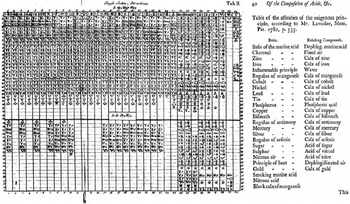
If the fundamental chemical units of the phlogistians were substances with their irreducible properties, the fundamental relations between these substances were affinities. Eighteenth-century chemists developed a growing mastery of the intricate web of these relations and their roles in various chemical processes, which they represented in the affinity table, their emblematic ‘paper tool’.Footnote 73 Phlogiston was an essential component of the affinity table from its first introduction by Geoffroy in 1718, and was still a crucial element in Bergman's 1785 version, the most extensive affinity table of his time (see Figure 2).Footnote 74 The defence of phlogiston was thus also a defence of a particular understanding of what affinities were – again, over and above phlogiston's own declining theoretical merit. As Bergman's example demonstrates, his table reflected and resulted from a particular type of chemical order, which entailed particular types of chemical transformation:
Volatile alkali is dislodged by fixed alkali and pure calcareous earth … quicksilver and silver are precipitated from nitrous and vitriolic acids on the addition of copper, which is again separated by iron. Silver, quicksilver and lead … are separated from nitrous acid both by the vitriolic and marine. Do not these … shew, that there prevails a constant order among the several substances?Footnote 75
Affinities in the traditional and the new chemistry. On the left: ‘Single Elective Attractions’ from Bergman's 1785 Dissertation (phlogiston in column 36); on the right: Lavoisier's ‘table of oxygenous principle’ from Kirwan's 1789 Essay. Comparing the two tables demonstrates the visual dimension of the reduction from the ‘richness’ of phlogistic traditional chemistry to the ‘bareness’ of the French system.

The affinity table was perhaps the most conspicuous tool of traditional chemistry to be retained by the Lavoisians. Their conception of chemical affinities and the respective manner of their application, however, failed to impress Kirwan:
To explain the precipitation of metals dissolved in acids by other metals, Mr. Lavoisier thinks it sufficient that the oxigenous principle should have a greater affinity to the precipitant than to the precipitated metal … But the phenomena of precipitation are much more complicated.Footnote 76
This may seem a harsh assessment of Lavoisier's work on affinities. Lavoisier was aware that ‘the table of affinities of the oxigenous principle with the different substance’ is far from perfect; ‘Mr. Kirwan’ he averred, ‘does not judge me with more severity than I do myself.’Footnote 77 Yet Kirwan's complaint, as always, did not concern the antiphlogistians’ competence but the chemical principles – ontological and epistemological – underlying their reasoning and practice. Even more so, Kirwan was defending the principles the antiphlogistians rejected.
Lavoisier conceded that affinities were complex and difficult to pin down, admitting that ‘the force of affinity, which unites two principles’, for example, ‘is not the same in … two degrees of saturation’.Footnote 78 Yet it is a ‘force’ that he is searching for; it is not a quality of any particular substance, but a unifying principle of nature, subject to mathematical laws which are simple and precise even if hard to discover: ‘affinity is a variable force, which decreases according to certain laws, not yet determined’.Footnote 79
This idea of homogeneous force captures exactly what Kirwan and the late defenders of phlogiston could not accept in the new chemistry's perception and use of affinities. The term ‘force’ did have a natural place in the old system of affinities as well. ‘In this dissertation’, Bergman announced at the beginning of his work on affinities, ‘I shall endeavour to determine the order of attractions according to their respective force’.Footnote 80 Moreover, in the homage to Newton with which he commenced his work, Bergman made it clear that he understood well the concept of force as a universal presence governed by simple mathematical laws.Footnote 81 For Lavoisier, the two uses of ‘force’ – the chemical and the physical – had to coincide, at least in principle; attractions and elective affinities were to be understood along the lines of Newtonian gravity: ‘two forces, both of which are variable; the first, according to a certain law dependant of temperature; and the second, according to the distance’.Footnote 82 Bergman, however, would never confuse this universal simplicity of gravity governed by mathematical law with the complexity of the attraction of affinity. For Lavoisier, ‘force’ was a physical, unifying principle, common to all matter. For Bergman, attractions were particular properties of substances; force was but a second-order property, the measure of their difference.
What the insistence on phlogiston represented, then, was resistance neither to the replacement of one hypothesis with another, nor to the introduction of ‘mathematical precision into experimental philosophy’, as Kirwan framed Lavoisier's contributions. Kirwan and Bergman were defending the autonomy of chemistry from physics.Footnote 83 What they refused to accept was the idea that the unifying principle of nature consisted, in essence, of a simple material infrastructure governed by simple mathematical laws. What they tried to maintain in their concept of affinity was regularity of cause and effect, rooted in the qualities of individual substances, which were, at the same time, wholly embedded in continuous chemical processes: ‘By chemical operations or processes, we mean the application of the proper means to affect the decomposition or composition. Every one of them is grounded on the various degrees of affinities of heterogeneous substances amongst each other.’Footnote 84 Affinities, a chemist like Friedrich Gren would still assert in 1800,Footnote 85 could not be perceived outside ‘chemical operations or processes’. Their ‘various degrees’, moreover, did not follow independent mathematical laws but the relations ‘amongst heterogeneous substances’. Such substances, Bergman explained, were ‘heterogeneous’ by virtue of possessing different qualities:
When homogeneous bodies tend to union, an increase of mass only takes place, the nature of the body remaining still the same; and this effect is denominated the attraction of aggregation. But heterogeneous substances, when mixed together, and left to themselves to form combinations, are influenced by difference of quality rather than quantity. This we call attraction of composition.Footnote 86
Lavoisier's interpretation of the reasons for the complexity of affinities is revealing. Justifying his own ‘table of affinities’, in reaction to Kirwan's critique, he argued,
A principal defect, common to all the tables of affinities which have hitherto been made consists in their presenting only the results of simple affinities, whereas there exists only in nature … cases of double affinity, often triple, and others perhaps still more complicated.Footnote 87
And in order ‘to form accurate ideas respecting these phenomena’, Lavoisier added,
it is necessary to consider all the bodies in nature as plunged in an elastic fluid of great rarity and lightness … [known as] the principle of heat … [which] would separate them [their parts] if they were not retained by their mutual attraction, that is to say, the attraction which is commonly called the affinity of aggregation.Footnote 88
There was no place for the sharp distinction between ‘heterogeneous’ and ‘homogeneous’ substances in Lavoisier's system. Since all matter was homogeneous and consequently homogeneously heavy, all unions had ultimately to abide by the rules of ‘aggregation’. Both Bergman and Lavoisier, then, had recourse to the concept of aggregated matter. Yet even the difference in their particular phrasings is instructive. Bergman paired ‘aggregation’ with ‘attraction’, distinguishing it from ‘attraction of composition’, as the other type of possible combination: the chemical. This distinction was altogether ignored by Lavoisier, who intentionally blurred the division between the chemical and the physical, referring to the ‘affinity of aggregation’ as the only existing type of combination. For him, only one kind of chemical ‘affinity’ existed – that of ‘aggregation’ – which was physical in the sense that it was universal to ‘all the bodies in nature’ and abided by the (Newtonian) laws of ‘mutual attraction’. This was how the chemical complexity of affinities and their particularities, as entailed by their relational character, were replaced by ‘accurate ideas’. This accuracy hardly served to settle Kirwan's worries. He complained that the ‘simplicity’ of the ‘antiphlogistic hypothesis … though seducing in some cases, becomes insufficiency in many others. I pass over many other embarrassing objections’ (see below).Footnote 89
Bergman's table is at once a tour de force of chemical knowledge and an admission of its limits. It is an attempt at the highest level of formalization attainable, given the limited regularity of chemical processes and their irreducible complexity. In fact, this complexity is the single most distinctive characteristic of affinities. Justifying ‘the necessity for a new Table of Attractions’, Bergman wryly admitted,
I am very far from venturing to assert, that that which I offer is perfect, since I know with certainty, that the slight sketch now proposed will require above 30,000 exact experiments before it can be brought to any degree of perfection. But when I reflected on the shortness of life, and the instability of health, I resolved to publish my observations, however defective, lest they should perish with my papers.Footnote 90
Uniformity versus simplicity
From the point of view of the late defenders of phlogiston, therefore, phlogiston and oxygen were not symmetrical. To say that all inflammables contain phlogiston was to suggest a unifying hypothesis. To say that they all have affinity to oxygen was only to repeat that they are inflammable. Moreover, the Lavoisians used the term ‘affinity’ in a way traditional chemists could not accept. Affinity as understood by the latter was not a universal, physical force but an expression of the interrelation between various substances. Affinity tables described patterns of such relations as displayed by the elective chemical behaviours of recognizable substances.
Yet it is not because affinities were lost on the new chemistry that the adherents of ‘the old system’ complained.Footnote 91 Quite the contrary: Kirwan, still in his phlogistic mode,Footnote 92 had to admit that some accounts by chemical affinities are much more suited to ‘the antiphlogistic hypothesis’. For example, ‘why iron precipitates copper from the vitriolic acid, may be explained in the antiphlogistic hypothesis, since iron is said to have a greater affinity to the oxigenous principle than copper has, and also to take up more of it’.Footnote 93 Yet there is a fundamental tenet to Lavoisier's analysis by affinities that Kirwan could not permit. In one of his responses to Kirwan's Essay, Lavoisier claimed to have
proved that whenever one metal was precipitated by another, and re-appeared under the metallic form … the precipitating metal had taken the oxigene from the precipitated metal, and that by comparing the respective quantities of the two metals employed, a conclusion must be made of the quantities of oxigene necessary for the dissolution of each metal in the acids.Footnote 94
Unlike Priestley's ‘quantities of phlogiston’, Lavoisier's ‘quantities of oxigene’ are gauged strictly by weighing; characteristically, Lavoisier applies here a quantitative analysis to a distinctly chemical pattern: the recovery of substances by precipitation. Kirwan found this type of analysis – the attempt to infer the chemical (substances, nature of reactions, etc.) directly from the physical (ultimately represented by quantities) – severely lacking, ignoring many of the crucial phenomena to be accounted for:
But why copper, which is insoluble in the dilute vitriolic acid should become soluble in a dilute solution of vitriol of iron exposed to the air, or in a boiling heat, seems to me difficult to conceive in the new hypothesis, for the iron should not only retain the oxigenous principle, with which it is far from being saturated, but also take up that which comes from the atmosphere … [this is one] of the many difficulties in which the antiphlogistic hypothesis is involved. They are sufficient to shew that its simplicity, though seducing in some cases, becomes insufficiency in many others.Footnote 95
The difference in the understanding of the explanatory role and ontological status of affinity highlights the dissatisfaction with the new chemistry's account of combustion and calcination processes which clinging to phlogiston expressed, a dissatisfaction emerging from a fundamental conviction of what comprises a natural law and its use in chemical explanations. This difference is best perceived by a closer look at the use of the term ‘force’ in the context of affinities.
Lavoisier's Newtonian allusion in this context was not haphazard. Bergman was using attractions to mean both chemical affinities and physical forces, but was always careful to distinguish between the chemical ‘attractions of composition’ and the physical ‘attractions of aggregation’ which were expressions of Newtonian universal gravitation. Lavoisier, as we have seen above, used both notions interchangeably, blurring the difference, crucial to traditional chemists, between distinctly chemical properties and the universal physical force:
as the attraction of these particles for each other is diminished in the inverse ratio of their distance, it is evident that there must be a certain point of distance of particles when the affinity they possess with each other becomes less than that they have for oxygen, and at which oxygenation must necessarily take place if oxygen be present.Footnote 96
Interpreting affinity as an underlying force, identical in all the substances exhibiting it, Lavoisier could utilize it to replace phlogiston as the general principle of inflammability: where inflammable bodies were the ones containing phlogiston, they were now those possessed of a high affinity to oxygen. ‘Several conditions are requisite to enable a body to become oxygenated’, Lavoisier explained, ‘and primarily, that the particles of the body … shall have less reciprocal attraction with each other than they have for the Oxygen’.Footnote 97 This, from the perspective of traditional chemistry, was a hopelessly simplistic and reductive account. Even one type of combustion, like calcination, was a complex process, differing from one substance to another, as Kirwan tirelessly described:
to calcine a metal is to deprive it of its metallic splendour, or reduce it to a brittle, less coherent and pulverent form: malleable metals thereby lose their malleability, and mercury its liquidity. To reduce a metal is to restore to it the metallic lustre, and the degree of coherence and malleability peculiar to it … The differences substances by whose means in different degrees of heat, different metallic substances may be calcined, are respirable air, water, acids, alkalis, mercury, with the assistance of respirable air, and various other metallic substances in different circumstances.Footnote 98
It is precisely this emphasis on ‘differences’, the emphasis on the intrinsic complexity of nature, that the antiphlogistians challenged. ‘We may justly admire the simplicity of the means employed by nature to multiply qualities and forms’, declared Lavoisier,
whether by combining three or four acidifiable bases in different proportions, or by altering the dose of oxygen employed for oxydating or acidifying them. We shall find the means no less simple and diversified, and as abundantly productive of forms and qualities, in the order of bodies we are now about to treat of.Footnote 99
Nature, according to the new chemistry, was in essence simple, and its diversity was hence produced by equally simple means; chemistry should follow suit. ‘The method we have adopted’, declared Lavoisier, ‘following nature in the simplicity of her operations, gives natural and easy nomenclature applicable to every possible neutral salt’.Footnote 100
The traditional chemists never denied this feature of the new theory. Kirwan, for instance, readily admitted that it was ‘recommendable by its simplicity’. Yet it was a ‘false shew of simplicity’.Footnote 101 ‘The more we succeed in simplifying the principles of bodies, the more difficult it is to determine truly what passes in chemical operations’, was the way Nicholson formulated a similar concern.Footnote 102 The conclusion from the irreducible complexity of chemical processes, however, was not a call for phenomenological scepticism (or for self-imposed modesty of an art versus a science). Kirwan's complaint was not that the antiphlogistians tried to explain too much but that they explained too little. The ‘simplicity’ of their ‘doctrine’ was ‘insufficiency’ not because it offered more order than nature allowed, but because, as he pointed out in the preface to his Essay, ‘the ancient doctrine [is] the more uniform of the two’.Footnote 103 It is more uniform, Bergman explained, because it pays full attention to the richness of causal relations that bring about natural phenomena:
It is beyond doubt, that the most minute circumstances have their efficient causes; and these causes, for the most part, are so interwoven with the more powerful ones, and so moderate their efficacy, that, without the former, the whole effect cannot be appreciated. In natural philosophy, no observations are trivial, no truths insignificant.Footnote 104
The chemical subject matter is essentially complex, hence chemical knowledge cannot be reductive. Chemistry requires immediate recognition of the different substances in their different states and stages. Not a ‘false shew of simplicity’ but a close acquaintance with substances that allows the discernment of uniformities and regularities within the complexity. This was the kind of interpretation of principles and properties that the defence of phlogiston strived to preserve. Priestley, the last major chemist to engage actively in this defence, was perhaps the most eloquent in characterizing the type of uniformity that traditional chemistry offered, and how it was phlogiston that embodied the unique balance between uniformity and diversity, between ‘differences’ and ‘known laws’, which formed the foundation of chemical knowledge:
Some philosophers dislike the term phlogiston; but, for my part, I can see no objections to giving that, or any other name, to a real something, the presence or absence of which makes so remarkable a difference in bodies … and which may be transferred from one substance to another, according to certain known laws, that is, in certain definite circumstances. It is certainly hard to conceive how any thing that answers to this description can be only a mere quality, or mode of bodies, and not a substance itself, though incapable of being exhibited alone. At least, there can be no harm in giving this name to any thing, or any circumstance, that is capable of producing these effects. If it should hereafter appear not to be a substance, we may change our phraseology, if we think proper … When I use the term phlogiston, as a principle in the constitution of bodies, I cannot mislead myself or others, because I use one and the same term to denote only one and the same unknown cause of certain well-known effects.Footnote 105
Just as the emanating ‘smell’ signalled the indubitable presence of ‘something’ – a substantial chemical agent of sorts, for which ‘the term phlogiston’ was as fitting as any other – so the very same ‘thing’, Priestley claimed, cannot be ‘a mere quality, or mode of bodies’. Its presence and nature are inferred from relations between qualities or chemical ‘circumstance[s]’, which derive from experiments and experiences. It must be a ‘substance’, and as such an integral part of the material realm, the ultimate subject of chemical knowledge.
Conclusion
When Kirwan and Priestley, Bergman and St John, Nicholson, Cavendish, and even Fourcroy attempted to save phlogiston in the 1780s and 1790s, and into the 1800s, it was not a particular hypothesis concerning combustion, calcination or respiration that they were defending. They were all well aware that the term ‘phlogiston’ had already gone through too many changes to designate any one substance or principle and they did not fail to appreciate the achievements of the new chemistry. Their defence of phlogiston was, rather, a defence of a chemistry they felt was about to vanish. This chemistry compiled a close and broad acquaintance with the world of matter in all its complexity. Its practitioners came to view this complexity as essential to matter: matter comprised particular substances, each carrying unique properties, related to each other in a variety of ways. This complexity embedded uniformities and regularities, but could not be reduced to the universal bulk and force which the new chemistry imported from physics. Proper chemical inquiry had to pay full attention to the various causal interactions and their manifestations; it could not be reduced to the measurement and comparison of weight.
Affinity to oxygen was a useful and convincing generalization characterizing all combustible and inflammable bodies. Like any chemical property, however, it required a chemical cause, which in turn had to be embodied by a substance, ‘the absolute existence’ of which we must allow, whether, as St John observed, ‘we call it phlogiston, caloric, or in plain English, fire’.