1. INTRODUCTION
One of the key design education issues in engineering design is the enhancement of creative abilities. The typical paradigm underlying design education is the experiential learning approach (Tynjala, Reference Tynjala1998). The curriculum of experiential learning activities usually takes the form of complex projects consisting of generally structured, guided experiential activities (Tynjala, Reference Tynjala1998). Project-based learning has also been adopted as the key teaching–learning strategy in most design schools, but questions about the effectiveness of this approach remain unanswered. It assumes that students will have their curiosity aroused with an increased motivation to learn, and that when in a novel design situation, students will transfer the meaningful insights they learned in school into other design tasks (Pietersen, Reference Pietersen2002). However, in these later activities, students are often faced with unstructured, ambiguous design problems, for which they may not have acquired strategies to assist them in developing new solutions. With a critique-based evaluation of student projects, the set of design knowledge and strategies acquired may not be apparent even to the successful student.
Our broad research agenda is to develop a theory of design education based on the cognitive processes involved in successful design, and to identify instructional methods that may help novice designers gain knowledge and experience in creative design. Which cognitive strategies enhance innovation in design? How can strategies used by successful designers be communicated through explicit instruction? Although the importance of design strategies is well recognized (Finke et al., Reference Finke, Ward and Smith1992), little is known about how designers apply them, and how they affect the quality or creativity of the resulting design. Pedagogy for enhancing design creativity is essential because most engineering problems demand innovative approaches in the design of products, equipment, and systems. This demand can come from the market, new technologies, new legislation, or additional criteria such as sustainability concerns. The result of engineering design activity is often expected to be original, adding value to the base of existing designs by solving technical problems in new ways.
This paper presents an empirical approach to the study of cognitive processes in design, and the utility of explicit instruction on strategy use in design. We begin by reviewing previous research on cognitive processes in engineering design, leading to our research questions and experimental approach described in the following sections. Then, we present an empirical study examining the use of heuristics in conceptual design, and finally, the implications of this work for design pedagogy.
2. MOTIVATION AND PREVIOUS WORK
The long-term objective of this research is the development of cognitive strategies for design generation that will increase the variety, creativity, and quality of designs. There are many instances where designers are required to be “creative” by going beyond existing solutions to devise original designs. This may be driven by the need for innovation and a competitive edge in product design, or by problem characteristics where existing designs do not meet requirements and constraints. Our goal is to enhance the effectiveness of designs by identifying the cognitive strategies used by experts and developing corresponding pedagogical approaches to benefit novice designers.
2.1. Designers' cognitive processes
Several decades of research in cognitive science have defined expertise as the skilled execution of highly practiced sequences of procedures (Ericsson et al., Reference Ericsson, Charness, Feltovich and Hoffman2006). For example, a violinist may use a variety of exercises to learn the vibrato technique, requiring extensive repetition, over many pieces of music and performances, until it can be executed automatically. By contrast, expert musical composition requires very different cognitive processes, including conscious reflection and introduction of variation that leads to unique, creative music. Because each composition is intentionally novel, there is no highly practiced skill that allows seamless composition in the same way as mastering the vibrato technique. Design expertise appears more similar to composition: a skill like sketching may be automatic, but the process of creating a new design is unlike executing a well-learned procedure. It is the intentional, deliberately considered introduction of variation, sometimes resulting in a creative solution.
Design researchers and cognitive scientists have developed a variety of process models to account for creativity in design. These models are often based on observations of design processes in verbal protocols of experts solving design problems. French (Reference French1985) proposed a model that includes analysis of the problem, conceptual design, embodiment of schemes, and detailing. Cross (Reference Cross2000) also described a four-stage model of exploration, generation, evaluation, and communication. Benami and Jin (Reference Benami and Jin2002) introduced a cognitive model to capture interactions between cognitive processes, design entities, and design operations. Finally, Jin and Chusilp (Reference Jin and Chusilp2005) identified repeated mental iterations of idea generation, followed by evaluation, as important features of cognitive processes during design. In these cognitive process models, the focus is on clarifying more general stages of thinking involved in the design process rather than identifying specific information involved in these steps.
Another approach to the cognitive processes in design focuses on the role of past knowledge. Wertheimer (Reference Wertheimer1959) described “reproductive thinking” as problem solving defined by our previous experiences. Past experiences lead down familiar paths, and in some cases the process may go awry as in “functional fixation,” which may actually block the generation of new ideas (Duncker, Reference Duncker1945). Through studies with design students and professional designers, Jansson and Smith (Reference Jansson and Smith1991) found that designers are sometimes trapped by the characteristics of a possible solution that has been developed, or by existing precedents. On the positive side, analogies to past experiences in design can also be sources for design solutions (Dahl & Moreau, Reference Dahl and Moreau2002). The case-based design approach (Schank, Reference Schank1982; Kolodner, Reference Kolodner1993) reminds designers of their previous experience and uses them as building blocks to modify to solve problems new situations (Maher & Gomez de Silva Garza, Reference Maher and Gomez de Silva Garza1997; see also Klein, Reference Klein1998; Ball et al., Reference Ball, Ormerod and Morley2004; Scott et al., Reference Scott, Lonergan and Mumford2005). Such tools can assist designers in making use of previously created designs in new problems (see Cross & Cross, Reference Cross and Cross1998).
One specific cognitive process identified is “problem framing,” where Schon (Reference Schon1988) suggested, “In order to formulate a design problem to be solved, the designer must frame a problematic design situation: set its boundaries, select particular things and relations for attention, and impose on the situation a coherence that guides subsequent moves.” Csikszentmihalyi and Getzels (Reference Csikszentmihalyi and Getzels1971) demonstrated that art students who spent time initially defining the design problem produced more successful designs, and were later judged more successful as professional artists. This “problem finding” process (see also Chronicle et al., Reference Chronicle, MacGregor and Ormerod2004) relates to the coevolution of problem and solution. Dorst and Cross (Reference Dorst and Cross2001) confirmed through a series of protocol studies that creative design involves a period of exploration in which the problem and solution spaces are evolving, remaining unstable until (temporarily) fixed by an emergent bridge that identifies a problem–solution pairing. Goel and Pirolli's (1992) protocol studies demonstrated that problem framing occurs not only at the beginning of the design task but also periodically throughout the process.
It is estimated that 70% of a product's cost is defined during conceptual design (Pahl & Beitz, Reference Pahl and Beitz1996). Perhaps, as a result, much research has investigated the cognitive processes that occur in the idea generation phase of design creation (Chan, Reference Chan1990; Christiaans & Dorst, Reference Christiaans and Dorst1992; Hybs & Gero, Reference Hybs and Gero1992; Adams & Atman, Reference Adams and Atman1999; Dorst & Cross, Reference Dorst and Cross2001; Kruger & Cross, Reference Kruger, Cross, Gero and Maher2001). The purpose of the concept generation phase is to conceive as many creative solutions as possible that fit the requirements defined by the design problem. There have been some descriptions of the varieties of ways that ideas are generated. Finke et al. (Reference Finke, Ward and Smith1992) divided these creative processes into generative (analogical transfer, association, retrieval, and synthesis) and exploratory (contextual shifting, functional inference, and hypothesis testing). Shah et al. (Reference Shah, Vargas-Hernandez, Summers and Kulkarni2001) proposed a model of design thought process involving brainstorming to describe generation and interpretation of ideas. Linsey et al. (Reference Linsey, Laux, Clauss, Wood and Markman2007, Reference Linsey, Wood and Markman2008) suggested a method for identifying analogies as part of the ideation process, and showed that memory representations influence the ability to use analogy to solve a design problem. Christensen and Schunn (Reference Christensen, Schunn, Wood and Markman2008) suggested studying the cues designers are using within creative cognitive processes to understand what leads to creative outcomes. They propose that, as a cue promotes one type of generative process, it may constrain another exploratory one. Alternatively, a cue might aid the cognitive process within the design domain, while hindering the information processing between domains. Therefore, a more detailed understanding of cognitive processes and their functions is needed.
2.2. Designers' strategies
Our approach arises from the intuition that designers appear to generate questions and choose directions from within an internal dialogue, choosing to follow known strategies with or without conscious reflection. However, little is known about these cognitive strategies, and whether their use leads to innovative design. Observational studies of designers at various levels have demonstrated the use of strategies (e.g., Adams & Atman, Reference Adams and Atman1999). For example, Park et al. (Reference Park, Yilmaz and Kim2008) found that expert designers who used generation, transformation, and external representation when performing a sketching task produced more creative alternatives than designers who used perception, maintenance, and internal representation as defined by their visual reasoning model. Other studies have identified some design strategies employed by expert designers in the product design process (e.g., Cross, Reference Cross2004; Kruger & Cross, Reference Kruger and Cross2006). Kruger and Cross (Reference Kruger, Cross, Gero and Maher2001) found that designers using a problem-driven design strategy tended to produce the best results in terms of the balance of overall solution quality and creativity compared to a solution-driven strategy. However, many questions remain surrounding the use of strategies. For example, which are the most effective? Does strategy use change depending on level of expertise? How can such strategies be effectively taught in engineering design courses?
Anderson (Reference Anderson1982) differentiated creative problem solving from routine problem solving by emphasizing the involvement of learning, or acquisition of new procedures, rather than using existing procedures. What kinds of strategies lead to designs that are original, differing from past designs? How do these strategies influence the efficiency of the process and the quality of the solutions? In our approach, we view the solution of a design problem as a search through a “problem space” of possible designs that satisfy multiple constraints (Goel & Pirolli, Reference Goel and Pirolli1992). In most design problems, this space of possible designs is never fully defined, and may include new features not previously applied to the problem, and not already identified as relevant. Following Newell and Simon (Reference Newell and Simon1972), we define each design problem as constructing a “design space” consisting of all possible designs, along with operators, or strategies, that assist the designer in exploring parts of the design space that are novel. The key to creative solutions is characterized as the strategies that assist the designer in exploring new parts of this potential design space.
2.3. Design heuristics
We define design heuristics as cognitive strategies applied to a design problem that take the designer to a different part of this space of potential design solutions. Design heuristics are transformational strategies that take a concept, such as a form, and introduce systematic variation. Each heuristic requires specific features within the design problem in order to be applicable, and produces a changed concept altered in a specific fashion. As a result, which heuristic may be useful depends upon the immediate problem context, so that there is no determinate heuristic that will lead to a definitive solution. A single heuristic can produce alternative versions depending on how it is applied, so that the same heuristic can be applied repeatedly to produce variant designs. However, it is possible to specify the nature of each heuristic and the nature of the transformation it provides within a design.
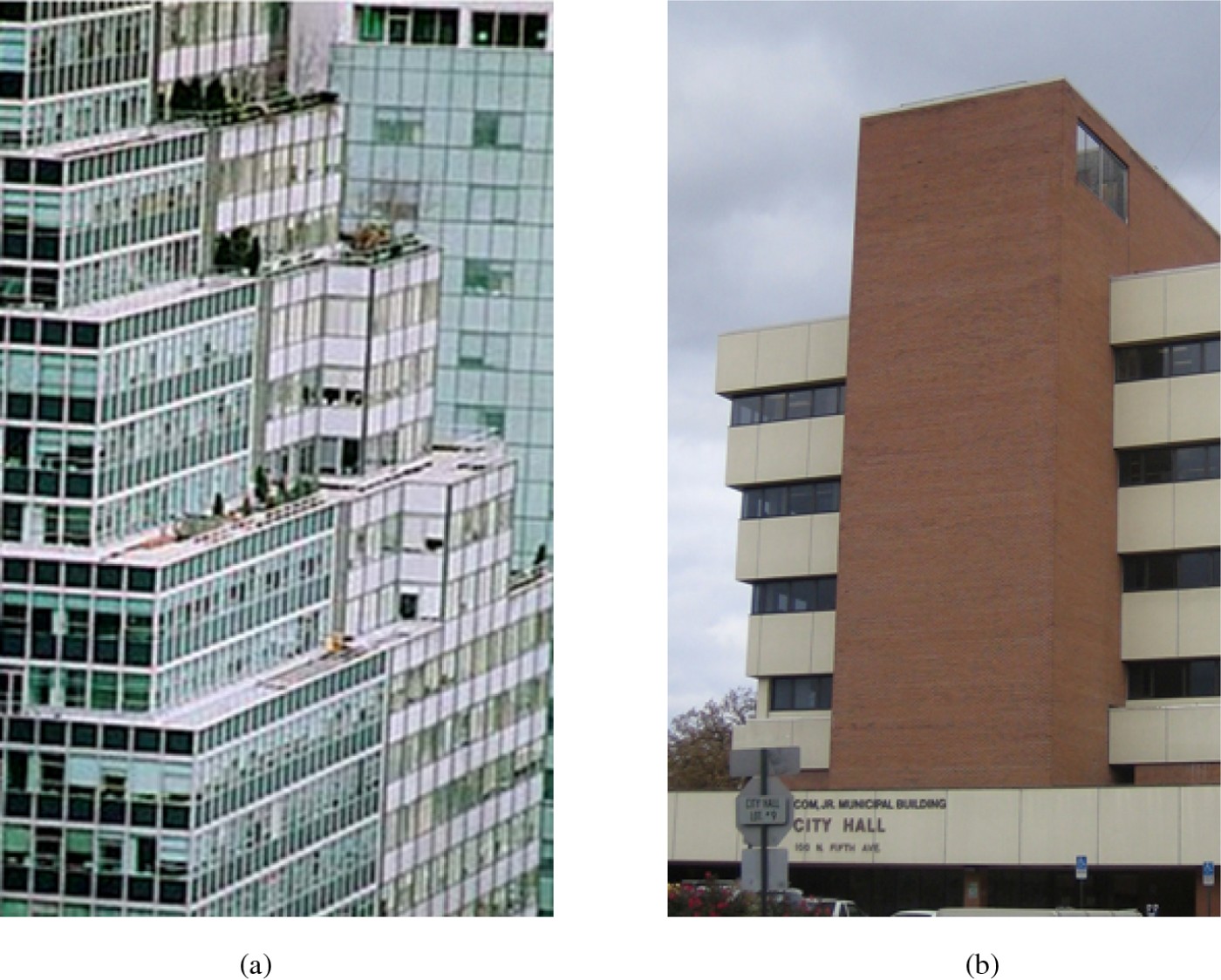
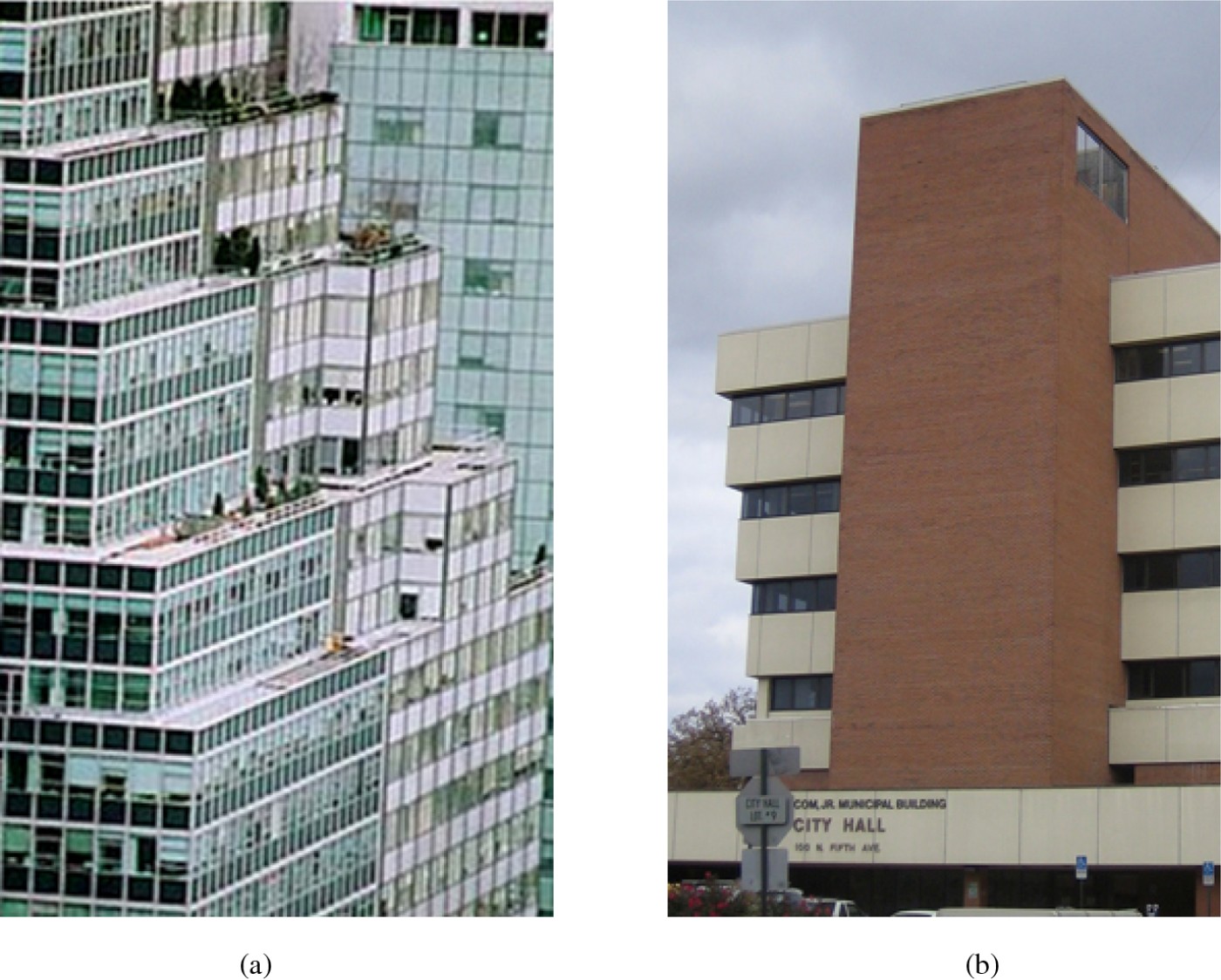
For example, consider the problem of creating a novel design for a building. How would a designer approach this problem and generate a new concept to consider? One heuristic recalled by a designer in our pilot study involved a transformation of shape by “flipping” the object across an axis, either top to bottom or left to right. The “flipping” heuristic creates a new form that introduces variation because its flipped form differs from the canonical form. A “flipped” building produces a transformed concept that may give rise to an innovative design concept, and then applied to the design of a building concept (see Fig. 1b). This “flipping” heuristic is one cognitive strategy an expert identified and a means for creating novel forms by introducing variation in familiar forms. It is possible to apply this heuristic in many design problems, and to do so multiple times.
A comparison of the “stacked” building construction: (a) a traditional form, which is commercial building from Jeff Klamer Design, and (b) a “flipped” form, which is the Ann Arbor, Michigan, City Hall Building. [A color version of this figure can be viewed online at journals.cambridge.org/aie]
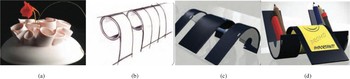
The use of this design heuristic is also illustrated in the “desktop accessory” below (Fig. 2). In a protocol from an expert industrial designer, she described seeing a photograph of a flower vase made of circles with overlapping edges (Fig. 2b). By expanding on this form, she created a drawing of circular shapes with one long end hanging from each circle, leading to the J-shaped object in Figure 2c. Then, to add interest to the form, she “flipped” the center to go in opposition to the aligned shapes (Fig. 2d). The resulting accessory is striking in the novelty of its design. The novelty appears to arise from the use of the “flipping” design heuristic, varying a form by flipping its form (or portions thereof) across an axis.
An expert designer's account of applying the “flip” design heuristic to an existing form: (a) a vase, (b) an exaggerated form, (c) a prototype, and (d) a “flipped” final form. [A color version of this figure can be viewed online at journals.cambridge.org/aie]

In the protocol, the flipping heuristic added variation that led to an interesting outcome. However, design heuristics are not guaranteed to produce either high quality or innovative designs. Heuristics instead serve as a way to “jump” to a new subspace of possible design solutions, or even to expand the original space of possible designs. Design heuristics move the designer into other ways of looking at the same elements and provide the opportunity for a novel design to occur.
Design heuristics are not algorithms that will systematically take the designer through all possible designs. A problem space for buildings might be constructed by varying all known attributes (number of tiers, size, colors, heights, materials, etc.), and suggest combining them in all possible ways. However, creating a novel design may require adding or transforming an element that was not previously considered part of the problem space, for example, the progression of the tiers in Figure 1b. This innovation cannot be discovered through simple combinations of existing alternatives as would follow from traditional search of the problem space. In this example the innovation in design comes from creating a new area of problem space based on the transformation proposed by the heuristic.
Our view is that design heuristics propose alternatives for designs not yet envisioned and set up a new space to search with new features to consider. We break from the standard view of heuristics constraining search (Kaplan & Simon, Reference Kaplan and Simon1990) to a view of heuristics that create potential problem spaces, and facilitate navigation through possible spaces for designs. Thus, heuristics are more general than the operators typically modeled in the problem-solving literature because operators involve moves within an existing problem space. The cognitive process occurs through the use of heuristics as “idea prompts,” avoiding fixation on combinations of current design features by proposing alternative transformations to existing ideas (e.g., von Oech, Reference Von Oech2003). Candidate heuristics are found in the Synectics, TRIZ, and SCAMPER frameworks, including specific transformations such as substituting, rearranging, iterating, and eliminating (Gordon, Reference Gordon1961; Altshuller, Reference Altshuller1984; Eberle, Reference Eberle1995; Abarca et al., Reference Abarca, Bedard, Carlson, Carlson, Hertzberg, Louie, Milford, Reitsma, Schwartz and Sullivan2000). Other sources for design heuristics include mechanical drafting processes like inversion and scaling; genetic algorithm-based processes involving mutation, mixing, and transcription; and processes analogous to those in reinforcement learning models using trial and error learning. The set of potential design heuristics includes a wide variety of methods and processes, and may be applied based on form, function, and context for the intended design.
How is a heuristic applied to a candidate concept? Each heuristic will vary according to the specified features required for their application, and in their potential adaptiveness for particular problems. Their application is context-dependent in that there will be more than one way to apply a specific heuristic to a candidate form (e.g., flipping upside down or from side to side). An even more challenging question is how the application of design heuristics is organized. There appears to be no general prioritized ordering of heuristics; instead, designers may recall and use heuristics based on specific cues or factors within the problem, such as needs of the user, or a specific functional requirement such as securing closure. For each problem, some heuristics are better than others, and some are not appropriate for a given design problem. A heuristic may contradict other heuristics (e.g., when there is a conflict between decreasing complexity and increasing flexibility), and relevant heuristics may be missed at times.
However, the power of design heuristics is that they will result in a more varied set of potential design solutions. Each heuristic can potentially form a possible design different from the ones considered so far. For the designer, following these cognitive strategies can prevent lingering in recombinations of already considered elements. The design heuristics instead allow the designer to jump to a new part of a very broad problem space of potential solutions that may never have been considered. Although design heuristics do not guarantee the best solution, they help to reduce search time, and may guide the designer toward discovering more creative solutions.
To test these ideas, the present study begins with a set of heuristics culled from protocols of an expert industrial designer working on a professional engineering project on accessible bathrooms (Yilmaz & Seifert, Reference Yilmaz and Seifert2009). By examining the expert's progression of designs over time, we identified a set of candidate design heuristics: merging, changing configuration, substituting, rescaling, repeating, and nesting. Our approach to create an initial set of heuristics was to learn from an expert designer by following his intentional steps through a design process, and identifying specific design heuristics he used in design creation. It is this type of expertise, which is an effortful, conscious process of attempting a variety of heuristics to help to develop new ideas, that is the target for our design heuristics approach. The question of interest in this paper is whether design pedagogy can teach novice designers to use these same design heuristics, and whether doing so results in designs that are considered more creative.
3. EXPERIMENTAL APPROACH AND RESEARCH QUESTIONS
Our hypothesis is that design heuristics offer a means of generating possible designs by guiding designers to consider specific types of variations on concepts. At the outset, the question we posed was, “What is the role of heuristics in design problem solving?” To further explore the effects of design heuristics, we conducted a study that manipulated how participants learned about a series of heuristics and that measured how they used those heuristics when generating a series of product concepts.
In this context of novice designers, we seek to answer the following research questions:
1. Does the use of heuristics in general lead to more creative designs?
2. Which design heuristics are most effective in creating novel designs?
3. Can the use of design heuristics be taught with simple instructions?
These questions were addressed in a large-scale study of novice designers that manipulated the training about heuristics, along with their order of presentation. This study focuses on the impact of instruction about design heuristics on the creativity and practicality of the resulting design concepts. In addition, the experiment allows us to examine the effects of each heuristic in the ideation process. Throughout the experiment, participants used the modality of sketching along with writing text descriptions to both develop and document their ideas during the design task.
3.1. Participants
To test the utility of instruction on design heuristics, we selected a population of novice designers. One hundred twenty first-year students were drawn from the introductory psychology subject pool at a Midwestern university, and they earned course credit from their participation. These students ranged in age from 18 to 21, and 73 (61%) of them were female. They were assigned at random to one of the four instructional conditions.
The choice of participants for the study is appropriate for a number of reasons. Our hypothesis is that expert designers acquire these design heuristics over their lengthy education and experience as designers. As an initial test of whether these heuristics play a role in design success, we need a comparison where subjects have no knowledge of the heuristics prior to the instruction we provide. By choosing subjects with no training in design or engineering, we avoid the question of the heterogeneity of pedagogies individuals may have been exposed to in the past, and potential prior knowledge of design heuristics. In addition, because participants had no formal technical training in sketching or drafting, the designs would reflect a similar baseline in drawing independent of the influence of the conceptual improvement in design from any heuristic use. The first-year university participants also allowed us to gather a sample of novice designers with a wide range of demographic and educational backgrounds and interests, potentially supporting the effectiveness of our pedagogical approach in a broader variety of educational programs.
3.2. Materials
The experiment uses the task of redesigning a familiar object: a pair of salt and pepper shakers. These objects are very familiar in Western cultures, with many prototypical designs available as commercial products and exposure as everyday objects. The decision to use a redesign task assures adequate domain knowledge by the participants, and avoids the difficulty with vagueness sometimes seen in novel design problems.
3.2.1. The design task
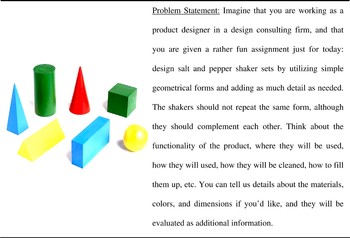
In all groups, a short written description of the design task was provided, along with a picture of simple geometric shapes to use in the generation of design concepts. Simple block shapes were included to encourage thinking in three dimensions, but also helped to constrain designs to a manageable set of possible forms. The geometrical shapes and the redesign task are displayed in Figure 3. The task instructions were to complete a design and to label the drawing to indicate specific elements that might help to explain their design.
The problem statement for the design problem used in the empirical study. [A color version of this figure can be viewed online at journals.cambridge.org/aie]

3.2.2. Design heuristics training materials
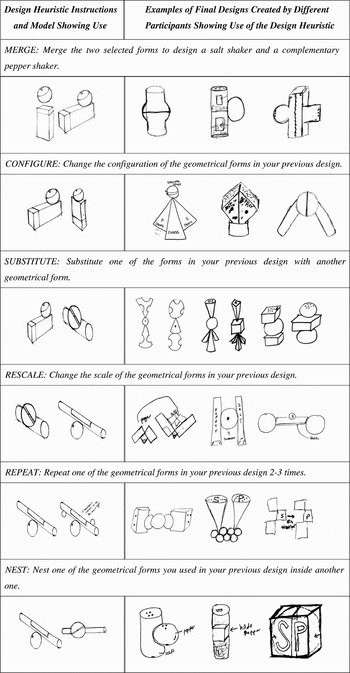
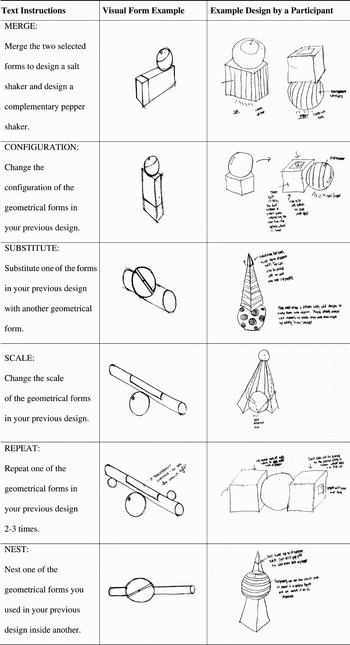
Six heuristics were included in the experiment: merging, rescaling, substituting, changing configuration, repeating, and nesting. These heuristics presented in Figure 4 were selected as simple, independent changes in design, and were identified by a visual content analysis performed on an expert designer's sketching process (Yilmaz & Seifert, 2009). They were the most frequently used strategies throughout this expert designer's concept generation process. A large variety of heuristics have been proposed in engineering design; for example, the TRIZ approach (Altshuller, Reference Altshuller1984) identified over 40 engineering heuristics by examining successful patents. More general heuristics have been proposed in the SCAMPER approach (Eberle, Reference Eberle1995), and in Synectics (Gordon, Reference Gordon1961). For this study, we identified a small set of 6 heuristics that are easy to apply and can be used to generate alternative forms quickly. Working from design scrolls contributed by an experienced industrial design expert (Yilmaz & Seifert, Reference Yilmaz and Seifert2009), a set of over 20 heuristics was initially identified. These heuristics were observed in the design sketches created over time as the designer generated a wide variety of alternative concepts for accessible bathroom facilities. Within this extensive set, 6 heuristics were identified that appeared most frequently in the concepts, and these 6 were selected for use in the present study. This set (see Fig. 4) appeared to be easy for our nonexpert participants to understand.
The six heuristics selected for the study, each proposing a way to change a form to increase the novelty and variety in the design. The left panel shows the drawing included in the instructions for each heuristic. This provides a model for the application of the heuristic, depicting a form before and a form after applying it. In the right panel, designs created by individual subjects using that heuristic are displayed for comparison. Each of the three separate final designs shown display that heuristic and are generated by a different novice subject in the study.

The chosen heuristics are not unique to this work, but bear important similarities to the engineering design heuristics proposed in Triz and Synectics. For example, the “flip” heuristic used in this study is also proposed as the “another dimension” engineering redesign strategy in the Triz publications (Altshuller, Reference Altshuller1984) and as a “transfer” strategy in the Synectics approach (Gordon, Reference Gordon1961). For purposes of the current study, we selected the six most frequent heuristics to use in the present study with novices.
The training materials provided for each heuristic consisted of a brief written explanation of the heuristic and a visual example of how it can be applied to simple forms. The example sketches included an initial concept and the result after the application of the given heuristic. Participants were told that these examples could be used to understand how the heuristic works, but they should not be repeated in their own designs. The instructional materials included both the short written representations of the heuristics and the visual information to clarify how the heuristics could be used.
3.3. Experimental design
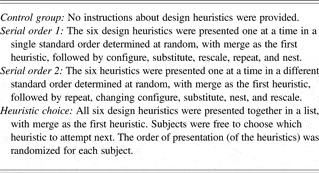
The effects of the heuristics on the creativity and practicality of the observed designs were evaluated through four experimental conditions. The design task provided simple geometrical shapes as starting points that allow a wide variety of alternative designs. The participants were free to choose single or multiple shapes to incorporate in their designs. Across all conditions where heuristics were used, the first heuristic presented was the “merge” heuristic. Thus, the three conditions with heuristic instruction (two serial orders and the heuristic choice conditions) all began with “merge” as the first heuristic presented. The rationale was that at least two shapes would be present in the first candidate design, making the application of the other heuristics more apparent. The experimental design employed included the four different experimental groups shown in Table 1.
Overview of the experiment design

Participants were assigned to experimental conditions at random, with 30 participants per group. The sessions were conducted in a classroom in small groups of 2 to 12 participants. All participants within a testing session were in the same experimental condition.
3.4. Procedure
Participants in all four conditions were given an introduction page summarizing the design task and presenting the task guidelines (see Fig. 3). Because prior research (Harrington, Reference Harrington1975) has shown that creativity test scores are influenced by explicit instructions to “be creative,” participants were told, “This task involves drawing creatively. We want you to create concepts that are highly creative, imaginative. That is, please create concepts that are both original (novel, uncommon) and also appropriate (artistically effective).” Participants were given letter-size response papers to depict their designs, and were also asked to write labels and notes to clarify their designs. Then, they were told to turn the page and begin again, creating a new design concept following the same task instructions. Eight task sheets were provided so that participants could continue to create new designs, turning the page after each one, up to a total of eight different designs depending on how long each design took to complete. Subjects were given 40 min to complete the task.
The three heuristics conditions varied in the additional instructions that were given about the heuristics. For the heuristic choice condition, subjects received instructional sheets describing each of the six heuristics included in the study all at once, at the beginning of the session. They were asked to choose the heuristics they wished to use to help them generate designs. In the two serial order conditions, the experimenter directed subjects' progress throughout the experiment. Within each group, the heuristics instruction sheets were presented one at a time, in a standard order determined at random (see Table 1). Following each heuristic instructional sheet, a blank response sheet was provided. Subjects were given 6 min to create a design using that particular heuristic, and then the experimenter asked them to turn the page to the next heuristic, and so on until all six heuristics had been presented. All subjects in the serial order conditions completed six designs within the 40 min allowed. In the control condition, subjects were not given any heuristics, and were asked to generate as many alternatives as they can within the given timeframe for the same design task.
At the end of the design task, all participants were asked two questions to evaluate their response to the task. The two questions were rated using 7-point Likert scales: “How did you find the task?”, where 1 = easy and 7 = difficult, and “Please self-evaluate your success in the task,” where 1 = I did great and 7 = I did not do too well.
4. RESULTS
In total, 667 separate designs were generated by the 120 subjects, averaging more than 5 per subject. The majority of the participants (98%) in the three heuristics conditions generated 5 or more concepts, with an average of 5.6 (standard deviation = 1.7, range = 3–8). Only 2 of these 90 participants generated more than 6 concepts; however, 9 of the 30 participants in the control condition generated more than 6 concepts. This difference may have arisen because subjects in the control condition saw no heuristic instructional materials and thus had more time during the session for generating designs.
4.1. Task perceptions
Two final questions asked participants about their perceptions of the task. When asked, “How did you find this task?” (7 = difficult), most indicated they found it challenging, with an average rating of 4.8 across conditions. There were no differences by experimental condition for these ratings [F (3, 119) = 0.889, p > 0.05]. The mean ratings in the serial order conditions [serial order 1: mean (M) = 4.5, serial order 2: M = 4.7] were somewhat lower than the heuristic choice (M = 4.9) and the control (M = 5.1). When asked to self-evaluate their success in the task (7 = I did not do too well), the average ratings were again similar across conditions [F (3, 119) = 0.191, p > 0.05], with mean ratings of 4.8 and 4.7 for serial order 1 and serial order 2, respectively, and 4.9 in both the heuristic choice and control conditions. For our novice participants, the design task was challenging, and resulted in low expectations of success across conditions.
4.2. Complete set of designs
Three upper level undergraduate students with no formal design training rated all 667 designs. We selected these judges for convenience and because previous research (Sternberg & Lubart, Reference Sternberg and Lubart1995; Amabile, Reference Amabile1996) has shown that peers provide reliable and valid judgments of creativity. The three judges were blind to condition and to the experimental hypothesis. The judges were instructed to use their own subjective definition of creativity, and to note the concept depicted rather than the quality of the sketches. Written labels provided by the participants were also taken into consideration. Each of the designs was rated for its creativity on a 7-point scale, from 1 = not at all creative to 7 = extremely creative. Each judge independently viewed each subject's complete test booklet, assessing each drawing within the context of the preceding drawings by that subject. Given the set size, each judge's rating activity took place over several sessions within a 3-day interval. The average score over all judges' rating was 3.35 (standard deviation = 1.1), indicating that the majority of the designs were scored as low in creativity.
The reliability of the judges' scores (computed using the Cronbach α: serial order 1 = 0.744, serial order 2 = 0.742, heuristic choice = 0.717, control = 0.855) suggests some inconsistency among the judgments, but overall an acceptable level of agreement. The judges were exposed to the progression of ideas in each subject's booklet, potentially affecting their assessments of later designs. As a result, the ratings for each design were not independent of the subjects' other drawings.
Because we are most interested in creative designs, and in whether heuristics can improve creativity, we chose to analyze a selected subset of designs. We set the criterion of a creative rating by at least one of the three judges and analyzed this subset of drawings to determine which of the four instructional conditions resulted in the most successful designs.
4.3. Selected creative drawings
Every design that received a rating of 5 or above on the 7-point creativity scale from at least one of the three judges was included in this analysis. The selected set included 266 of the 667 original designs, representing approximately 40% of the total. The designs in this selected set were generated by 93 of the 120 subjects (77.5%), and each of these subjects contributed between 1 and 6 designs. Differences by experimental condition in the frequency of selection are readily apparent in a generalized linear mixed model with the logit link function and subjects as a random factor. The fewest designs were selected from the heuristic choice group (24.9%), significantly fewer than the serial order 1 group (51%; z = 4.74, p < 0.0001), the serial order 2 group (49%; z = 4.57, p < 0.0001), and the control group (35%; z = 1.98, p = 0.04). The two serial order groups did not differ (z = 0.27, p > 0.05), although both differed from the control group (serial order 1: z = 2.66, p = 0.0077; serial order 2: z = 2.41, p = 0.015).
Subjects in the two serial order conditions produced significantly more designs than those in the control or heuristic choice conditions. This pattern may result from the experimenter-directed procedures in these two conditions, where subjects were instructed when to read about each heuristic and given 6 min to complete a design using that heuristic. By contrast, subjects in the control and heuristics choice conditions were given initial instructions, but then left to work their way through the multiple design tasks on their own for the 40-min period. As a result, the serial order participants may have been kept on task and attending well to the instructions. In addition, the smaller number of designs selected from the heuristic choice condition may reflect that these subjects had to spend time in the selection of a heuristic for each design. They may have chosen at random, or considered many possibilities with uncertainty about which to select. As a result, the heuristic choice group may have had less time and fewer cognitive resources to devote to the design task compared to the serial order groups, who were told which heuristic to apply for each design. Another plausible methodological explanation for the advantage of the serial order groups is that, by following the instructions, they may have used more of the heuristics (to be considered in Section 4.5). Because the judges saw each subject's work as a whole, these procedural differences may have impacted the judges' perceptions of designs in their booklet context. For example, those in the serial order conditions were likely to include more varied designs because the procedure required them to use a different heuristic in each design.
In sum, the experimental conditions produced differences in the frequencies of designs identified as creative, with the serial order conditions, where the heuristics were individually introduced and then used in a design, producing more successful designs. However, it is not clear how the experimenter-directed procedures in these conditions may have influenced this benefit. In addition, conducting the ratings within the context of the individual subject's task booklet may have influenced judges' views of individual designs. Because our focus is on examining whether heuristics lead to better solutions, and on how heuristics were used in the creative designs, we decided to pursue an analysis of this selected subset of the creative designs. With this smaller set of designs, we hoped to improve the rating process by asking judges to compare all of the selected designs within a single rating session, potentially increasing consistency across the set. In addition, each of the selected designs was removed from the subjects' booklets, and shuffled into a different order, rerandomized for each judge. This allowed each concept to be considered independently of the sequence of its generation by the subject, allowing the determination of creativity independently for each design. We also hoped the new ratings would show improved interrater reliability among the three judges, increasing the confidence in the dependent measure of creativity central to our study.
4.4. Average creativity ratings of selected designs
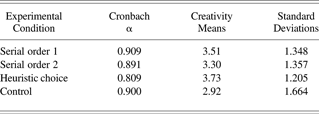
Beginning with these 266 selected designs, the same three judges rated the creativity of each of the designs separately, remaining blind to condition and hypothesis. A modified rating task was employed where judges placed each drawing into one of seven piles, each representing a point on the 7-point creativity scale. This “sorting” procedure allowed the judges to compare drawings within their categories, and shortened the time required to complete the ratings to less than 1 h. The result of this rating procedure was a high degree of interrater reliability scores (using the Cronbach α, as shown in Table 2).
Interrater reliability statistics (Cronbach αs) and average creativity ratings for designs in the selected set
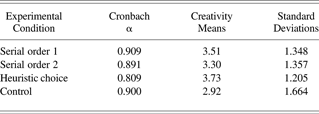
The average creativity ratings (averaged over the three judges) show differences for design in the four instructional conditions. Designs generated under the heuristic choice instructions were rated highest in creativity, followed by serial orders 1 and 2. A one-way analysis of variance using a random effects model with designs nested within subjects found that both serial order 1 and the heuristic choice conditions differed significantly from the control condition (p < 0.05); however, no other pairwise comparisons reached significance (neither by the more liberal uncorrected Type I error rate nor the Bonferroni corrections). An a priori contrast was conducted comparing all three heuristic instructional groups (serial order 1, serial order 2, and heuristic choice) against the control group. This pattern was significant (z = 2.105, p = 0.04). Further, a contrast testing the prediction that the heuristic choice was rated highest, followed by both serial order conditions, followed by the control condition, was also significant (z = 2.209, p = 0.0339). This suggests the choice of heuristics produced somewhat higher creativity ratings than the serial order heuristics instructions, with the control condition designs rating lowest.
These results point out some interesting differences between the heuristic conditions. In the selected set, many more of the designs came from the two serial order conditions (77 and 89, respectively) than from the heuristic choice condition (43), with 57 from the control. Yet, the heuristic choice designs were rated higher than the serial order conditions when the designs were rated in isolation (not tied to subject booklets) and with better interrater reliability. This may appear contradictory in that the serial order conditions produced more designs with at least one creative judgment; however, more of the highest rated designs came from the heuristics choice condition. It may be possible to reconcile these findings by noting that the experimenter-driven procedure in the serial order conditions was more likely to produce more creative designs using heuristics. However, although producing fewer creative designs overall, the heuristic choice condition may produce the highest quality designs.
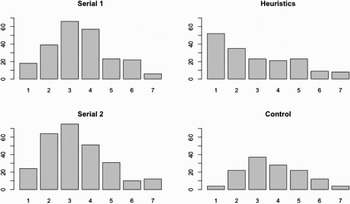
To consider this possibility, we examined the judges' ratings for the selected designs, comparing the frequency of each rating scale value (n = 7, where 7 = most creative designs) by instructional condition. Thus, for serial order 1 and serial order 2, there are a respective 231 (for 77 designs) and 267 (for 89 designs) separate ratings counted from the three judges (see Fig. 5).
The frequencies of ratings for each of the selected designs by condition, including each from all three judges, falling at each point on the 7-point rating scale, with 7 indicating the most creative designs.

Although the serial order conditions both contributed more designs rated above 5 on the 7-point scale, they also received more ratings of 1, the not creative end of the scale. Compare this to the heuristic choice condition, with 129 separate ratings for the 43 designs selected: the choice condition designs received the same or more ratings 4 and above, and fewer low ratings of 1. This may suggest that there were more designs in the serial order conditions that received mixed ratings from the three judges; that is, at least one judge scored a design highly, but these same designs received low scores from other judges. In contrast, the heuristic choice designs received fewer low ratings, suggesting greater consensus around the higher rated designs in this condition. The control condition (with 171 ratings for 57 designs) shows a clear pattern of more scores falling lower on the scale.
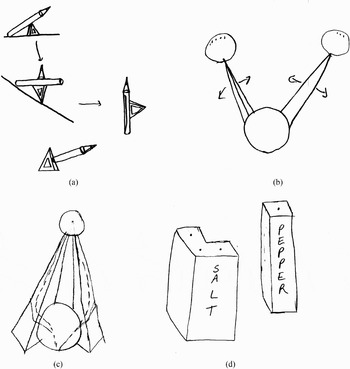
The higher creativity ratings observed for the heuristics conditions suggest these instructions resulted in more successful designs compared to the control condition. A sample of highly rated concepts for each condition can be seen in Figure 6.
A design drawing from each condition receiving the highest creativity rating of 7: (a) serial order 1, (b) serial order 2, (c) heuristic choice, and (d) the control group.

When compared with the control group, the highly creative concepts in the heuristics conditions are visually more detailed, have indications (directional arrows) of how they will be used and how contents will come out of the container, have variations in the arrangement of the design elements, and are rarely labeled. These differences suggest the heuristics allowed the participants consider the design form differently, resulting in greater novelty in the resulting design forms. The designs from the heuristics instructions do not appear to resemble any existing shakers or alternative product containers (e.g., soda bottles), as seen in the control condition example (Fig. 6d). Heuristics appear to noticeably change participants' designs, resulting in more visual forms. This type of concept generation behavior has been observed in expert designers (Cross, Reference Cross2004).
4.5. Average practicality ratings of selected designs
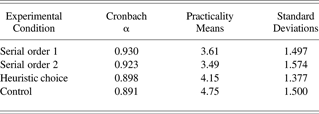
Each of the selected designs was coded by the same three judges, following the sorting procedure described above, for the practicality of the concepts (using their own understanding of this term) on a 7-point scale, with 1 meaning not at all practical and 7 indicating extremely practical. The designs were again rated in isolation from the subjects' booklets in a different random order for each judge, and they took less than an hour. Table 3 shows a high level of agreement between the three judges in their perception of variations in the practicality of drawings.
Interrater reliability statistics (Cronbach αs) and practicality ratings for the designs in the selected set
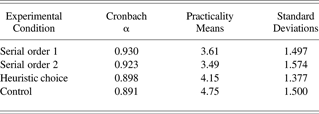
Table 3 also shows the means and standard deviations of the practicality ratings. There were noticeable differences in the mean scores of the four instructional conditions: concepts generated in the control condition were rated more practical than the ones in the heuristics conditions. The pairwise comparisons suggested that the serial order 1, serial order 2, and heuristic choice conditions each differed from the control condition, and each of the serial order conditions differed from the heuristic choice condition (all p < 0.05). These pairwise differences hold up even with the stringent highest posterior density Bonferroni simultaneous intervals. This analysis suggests choosing heuristics led to more practical solutions than applying heuristics in either given order. Further, a contrast showed all three heuristics instructional groups (serial order 1, serial order 2, and heuristic choice) scored lower in practicality than the control group (z = 3.56, p = 0.0004).
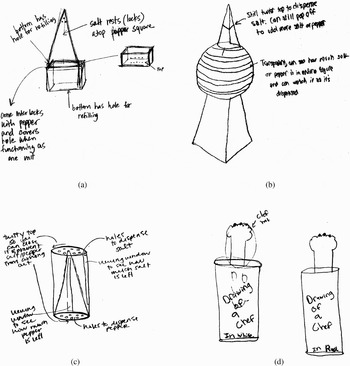
Figure 7 shows a sample of designs rated as “highly practical” in each of the four conditions. The drawings considered more practical than others in all conditions demonstrated higher clarity of how parts come together, and had more written details about the materials and mechanisms. The product designs in the control condition tended to depict functionality, such as explaining how the containers will be filled, cleaned, and stored. This result implies that design heuristics may lead to more abstract or varied form considerations, and therefore more creative solutions; however, this may occur at the expense of practical concern with function, as evidenced in the control condition's higher practicality scores.
A design drawing from each condition receiving the highest practicality rating of 7: (a) serial order 1, (b) serial order 2, (c) heuristic choice, and (d) the control group.

4.6. Heuristics use
A final analysis involved coding each of the designs for the presence of one or more of the six heuristics (merging, changing configuration, substituting, nesting, repeating, or rescaling), as shown in Figure 8.
Coding instructions provided to the three independent judges for scoring for the presence of specific design heuristics in the final designs drawn by participants. For each heuristic, the judges were shown the instructional text and an example form that were provided to subjects and an example of a participant's design fitting the heuristic.

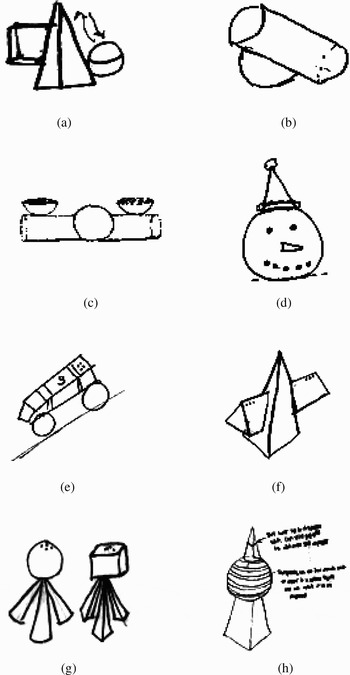
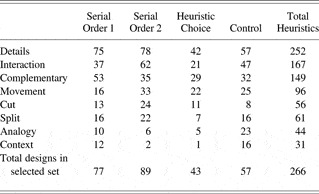
Each design was also coded for other potentially relevant elements, including the presence of movement (the expression of motion), cut (missing parts not represented anywhere else), split (cutting the form, and then representing it somewhere else), analogy (real-world, nonimaginative designs), context, interaction (multiple forms interacting), complementary, and providing additional details (shown in Fig. 9). The same three judges, no longer blind to hypothesis (the design heuristics) but still blind to condition, performed the coding for the six heuristics and these categories for each selected design in isolation. The judges were given written descriptions and pictures of heuristics and other elements as shown in Figures 8 and 9, and were told that each concept could have multiple elements.
Other categories coded as design metrics by judges for all selected designs: (a) movement: expressing motion; (b) cut: cutting forms; (c) split: splitting forms; (d) analogy: using analogy; (e) context: concrete context; (f) interaction: interacting forms, (g) complementary: paired forms, and (h) detailed: detailed information.

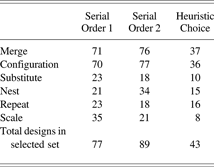
Table 4 shows the number of times each heuristic was observed (by all three judges) by instructional condition. In terms of the number of heuristics observed, the two serial order conditions were coded as showing many more uses of heuristics than the heuristic choice or control conditions, perhaps not surprising given the experimenter-driven task procedure discussed above, where each heuristic was presented serially with time provided to use it. In the heuristic choice condition, subjects were able to choose whether and which heuristics to use, and as in the two serial order conditions, the designs incorporated “merging” and “changing configuration” much more often than the others. All three heuristics conditions show the greatest use of “merging,” which was the first heuristic introduced in all of these booklets. However, they also show almost as many uses of “changing configuration.” Because these conditions also had higher average creativity scores, it appears their advantage may be carried by the use of this heuristic more than any other. Substituting one form with another and repeating one form multiple times were used least often in the heuristics conditions. Serial orders 1 and 2 appeared to make more use of nesting and scaling.
Observed frequency of heuristic use in the selected set designs including scores from all three raters for all four conditions
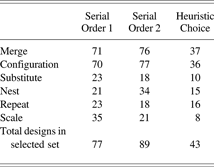
It is surprising that in the control group, where there was no instruction on heuristics, heuristic use averaged more than one for each design, with “substituting” and merging used most often. The evidence of heuristic use in the control condition may suggest that the heuristics selected were already known or easy to use in the design task, even for these novice designers. Most prominently, substituting one shape for another appears to play a role in the designs created in the control condition.
A comparison of heuristic-based designs created by participants can be seen on the coding sheet given to raters (see Fig. 8). These example designs illustrate differences from the simple examples provided in the task instructions, and in the instructions for each heuristic. These designs, in contrast to the control condition, show intentional variation of the form using the heuristics. The heuristic use led to more complex and detailed visual forms depicted in the subjects' designs. In the control condition, many of the designs maintained form, but introduced a new aspect such as a new function, a descriptive detail, or a thematic element.
Table 5 shows the results of the judges' coding for eight other elements potentially related to the success of creative designs. Examining the frequency counts for each category, there are many differences among the conditions. Depicting details, the interaction between shakers, and using complementary salt and pepper shaker shapes were the most frequently used categories, along with movement and splitting, across all four experimental conditions. The two categories that most distinguish the control condition from the three heuristics conditions are the use of context and analogy. For example, one control drawing labeled the form with a university logo to make it distinctive based on content rather than form, and this was a frequent strategy in the control group. Similarly, 40% of those in the control condition used analogy to other known objects, such as animals, to bring distinct ideas in without creating distinctions in form. Previous studies have provided evidence for the role of analogy as an important cognitive process during design (Benami & Jin, Reference Benami and Jin2002). For our novice participants, left without heuristic instruction in the control condition, analogy made use of their knowledge and memory of existing product sources for their designs.
Observed frequency of use of categories in the selected set of designs across three raters for all four conditions

In sum, the control condition designs include many with simple forms, and created variety by adding a new function, detail, or theme. In the three heuristic conditions, the designs show more intentional variation and greater complexity of form, presumably assisted by using the design heuristics available from the instruction. This analysis of design content supports the conclusion that heuristics instruction can assist even novice designers in creating more varied visual forms, leading to designs rated as more successful and creative.
In order to explore the effects of progression of sketches each participant completed, we compared whether more of the selected concepts occurred in the first three drawings compared to the fourth through eighth drawings. This comparison of drawings was not different than expected by chance in any of the experimental conditions (p > 0.05). Some participants' initial sketches were selected as creative, but others' final concepts were the ones rated as creative. The progression of sketches that each participant completed likely had some effect on their designs compared to sessions where a single design may be requested. It might be assumed that individuals start with a basic, less creative design and then successively increase their innovativeness of their design as they spend more time thinking about the design problem. However, the nature of changes in design with progression is not discernable from these data.
5. DISCUSSION
This empirical study suggests the potential effectiveness of instruction on design heuristics. Even for novice designers, a few minutes of text and illustration on six specific heuristics led to designs reliably judged as more creative. Through use of heuristics, the designs appeared more engaged with visual form, more varied, and more successful than those in the control condition. Our results suggest that the ideation phase of design can be assisted by explicit instruction on design heuristics.
5.1. Evaluation of findings
In the context of this empirical study of design creation with novice designers, we sought to answer the following research questions:
Question 1: Does the use of heuristics in general lead to more creative designs?
Design heuristics, when applied to the design problem in the study, increased the creative success of designs. The concepts generated by participants through the use of heuristics appeared more diverse and unusual, concentrated more on visual form, and were judged as more creative. Variation was also introduced by subjects in the control condition, primarily through reference to themes and labels, analogy to other objects, and functional qualities. However, these diverse designs were not judged to be as creative as those produced through the heuristic instruction conditions. Heuristic use led novice designers to consider candidate designs outside of ones they could generate alone, leading them to more diverse and creative ideas. This result has important implications for the way we should teach designers how to think about design creation, and for the kinds of cognitive strategies they may learn through instruction in design.
Question 2: Which design heuristics are most effective in creating novel designs?
Six candidate design heuristics were compared in the process of generating creative designs. Two of these heuristics, “merging” and “changing configuration,” were used in over 85% of designs created by the three heuristics instruction groups, and less than 45 of the control designs. The use of these two heuristics alone appears to have been a major factor in the success of these designs. Both heuristics focus attention on the individual forms and their composition. This may encourage the consideration of alternative combined forms that are more complex, and therefore more distinctive. In the heuristic choice condition alone, where people were free to select any heuristic, these two heuristics appeared in over 85% of the designs. By their ubiquity, they appear to play an important role in the success of the heuristic-based designs. The other four heuristics were selected for use in between 20% and 40% of the designs, and in the serial order conditions where subjects were asked to use each heuristic, these four were observed in 20–45% of the designs. These heuristics (nesting, rescaling, repeating, and substituting) may be more appropriate in only some candidate designs; even so, each appears in more designs than expected given the instructional manipulations. Of course, many more heuristics can be identified, as Triz (Altshuller, Reference Altshuller1984), SCAMPER (Eberle, Reference Eberle1995), and Synectics (Gordon, Reference Gordon1961) show. However, these results demonstrate empirically that design heuristics like these can be used to create designs, and that heuristic use contributes to greater creativity.
Question 3: How can the use of design heuristics be taught with simple instructions?
Designers, who are called upon to be creative on demand, frequently make use of heuristics as ways of triggering new ideas not yet considered. Many times, the designer may be unaware of their use of strategies, or of how and where they learned a particular heuristic. The goal of this research project is to determine whether these heuristics can be of help to designers by providing them as cognitive direction for solving a design problem. Our results show that heuristics are effective in design creation, and result in designs with greater creativity.
One implication of this research is that heuristic use can be supported with simple written instructions along with visual examples. Another implication is that heuristics are applied frequently once they are learned even when not under instructions to do so; for example, the three instructional groups on average used more than two heuristics within each design. Our results also indicate that more than eighty percent of the participants in the control condition used one or more heuristics without any instruction. This implies that generating concepts using heuristics may be a natural approach to design, and that providing specific instructions on design heuristics will take further advantage of their utility.
Our paradigm also suggests that creativity can increase through heuristic instruction even in novice designers. The student sample used in this study provides a test bed for examining the effects of heuristics on novices, a population that may exhibit more malleability in training compared to seasoned experts. Further, the design task involved no technical or background knowledge, and this may be helpful in learning to generalize the use of the heuristics appropriately. However, the set of heuristics in the study were ones frequently evident in the professional designs of a highly expert industrial designer (Yilmaz & Seifert Reference Yilmaz and Seifert2009). These factors will be important to consider when extending the design pedagogy for heuristics to engineering design settings.
5.2. Limitations
The results of this empirical study must be considered in context. Ultimately, our research agenda is to create a set of design heuristics and instructional materials that will serve as a viable pedagogy for capturing and passing on the strategies used by successful professional designers. Part of this agenda includes identifying successful design heuristics within the actual production of expert designs. Another major focus lies in placing the resulting pedagogy within design curricula in schools of art and design and in colleges of engineering. These important pieces are omitted from the present study.
More specifically, the results here were observed in a study of novice designers without regard to potential design ability, interest, or motivation. They were certainly less technically sophisticated than industrial design or engineering design students, and presumably had little exposure to this type of design task. Of course, individuals vary in their ability and comfort with sketching, and as a result they may have a more difficult time expressing their creative ideas visually. However, because the participants were assigned to experimental condition at random, these individual differences would occur in all of the conditions and not bias the results toward more creativity in any particular one. In addition, the variation in comfort level with sketching might be smaller because of the homogeneity of the sample (students enrolled in a psychology course). Finally, to further mitigate differences in drawing skill, we instructed the judges to focus on the creativity and practicality of the concepts, and not the skill level shown in the sketches.
The study session took place as a one-time lesson within 1 h, limiting any conclusions about the usefulness of the instruction on future design creation. The task also employed pen and paper, limited the time spent considering any one design, and employed a single design problem. In addition, we do not know whether the selected designs came from the more talented novices, so the advantage of heuristics training may be limited to those able to make use of it. Other issues include design problem characterization, designer profiling, control of variables, and outcome measures, all potentially important to the design activity. In sum, these conditions are not similar to those in design tasks for products and will likely either over- or underestimate any effects of the instructions.
Another limitation is the assessment of the success of proposed designs. In almost every prior study, human judges are required to determine whether “creativity” is displayed in the design. This study also required extensive use of human judges, and it demonstrated some of the bounds on human performance of this task. When judging the complete set of designs, our judges were not as consistent as desired in their ratings; by limiting the number of designs, and providing a sorting component to the ratings that allowed the comparison of designs, we were able to achieve good reliability in these judgments. However, the judges were also novices, and though the use of peers as judges has been supported in previous research (Amabile, Reference Amabile1982), more knowledge about design would certainly change how creativity in design is assessed. Although our empirical study provided reliable findings, it also revealed less than we would like about what makes creative designs good as viewed by any judge.
Laboratory studies can helpful in testing specific hypotheses, leaving questions of potential robustness to later studies. The results presented here are for a redesign problem, with only a small set of design heuristics and a single design task. Our ongoing work includes multiple types of design problems, heuristics, and participants with differing expertise levels and domains. We are extending this research in these directions to empirically explore and identify heuristics usage behavior in students' engineering design problem solving, and to develop a model for representing these activities in terms of how these behaviors contribute to analysis, synthesis, and evaluation skills; how differences in these behaviors are related to design expertise; and how these behaviors may influence performance as a function of process efficiency and the overall quality of the outcome. Although these results demonstrate that design heuristics are easy to grasp and use, and that their use leads to more creative design, further evidence of their viability in engineering design and in design pedagogy will require additional work.
6. IMPLICATIONS FOR DESIGN PEDAGOGY
Design education tends toward a pragmatic view regarding the definition of creativity. Ideally, the outcome of design education is that students produce original work that is fresh and adds value to the existing domain. Previous studies suggest techniques that require self-reflection, as required for use of a design strategy, can be successful in engineering education (Adams et al., Reference Adams, Turns and Atman2003). A meta-analytic review of the effectiveness of creativity training (Scott et al., Reference Scott, Lonergan and Mumford2005) found that more successful programs were likely to focus on the “development of cognitive skills and the heuristics involved in skill application,” along with the use of realistic exercises appropriate to the domain at hand. These training programs produced gains in performance that generalized across criteria, settings, and target populations.
6.1. Design heuristics in engineering education
Many engineering undergraduates are provided with general instructions about concept generation, and the importance of creativity in this stage of the design process. However, it is less common to teach specific cognitive strategies that may lead to generating more creative ideas. Engineering students need design heuristics to take them out of the fixated thought process (Jansson & Smith, Reference Jansson and Smith1991), as much as they need the technical skills to further develop functional ideas. Using heuristics in engineering design adds to one's ability to generate multiple creative ideas, and also motivates the students by demonstrating multiple ways to move into new areas to consider as solutions. Rather than getting stuck in one idea, the engineer can choose a heuristic, apply it to the current problem, and see where the resulting transformation leads. It may prove superior to brainstorming because it provides a support for the recommended cognitive process: to take a starting point, and vary it in systematic ways shown by other designers to be productive paths. This process of considering many alternatives before “jumping in” to a solution strategy has been identified as key in human problem solving (Wertheimer, Reference Wertheimer1959); however, supporting new designers who need to generate alternatives has been challenging. The present study shows that in a simple design problem, proposing specific design strategies led students to different and creative solutions.
Our findings suggest that simple demonstration of design heuristics may, at times, be sufficient to stimulate divergent thinking, perhaps because these heuristics are readily grasped and contextual application is not required. Simple exposure to relevant heuristics, or strategies, for divergent thinking has proven effective in many studies (e.g., Warren & Davis, Reference Warren and Davis1969; Clapham, Reference Clapham1997). The success of both the serial order conditions, where the students were told which heuristic to apply, and the heuristic choice condition, where students had to decide for themselves, suggests there may be a scaffolding process possible. During design training, exposure to a variety of heuristics and experience in applying them on many different problems may lead to an expertise on which design heuristic to apply in the optimal circumstance. For many engineering students, simply having an arsenal of design heuristics to try might lead to success in getting some movement in the design space. One variable in the study may actually be a motivational factor: it is possible that demonstrating the effectiveness of heuristics for creative tasks may motivate, through feelings of efficacy, creative efforts just as the outcomes of creative efforts lead to an appreciation of creative work (Davis & Scott, Reference Davis and Scott1971; Basadur et al., Reference Basadur, Graen, Wakabayashi and Parnes1992).
How can design heuristics be taught? Within an educational environment, it is often difficult to develop an awareness of design thinking through conventional classroom activity. As the instructions are not systematized, students have difficulty in formulating conceptual structures and strategies, and reapplying them to the new design problems. Normally, when faced with a design problem, an appropriate heuristic is not obvious; one is applied only if it can be accessed from memory or instruction. Then, it is possible to demonstrate design heuristics through engaging in constructive processes, providing a medium for learning when and how to apply designs. Improvement in the use of heuristics might be indicated by a growing level of complexity in the external representations of the concepts proposed, indicating an understanding of the design heuristics and their application as idea-triggering strategies. Increasing sophistication of integrating and implementing these heuristics in design creation may demonstrate the gradual acquisition of knowledge about the interaction of design strategies and design knowledge. Design heuristics differ from other approaches used in idea generation. Although most existing approaches are mainly related to discussion, such as brainstorming, “brainwriting,” and checksheets, heuristics employ idea triggers that assist in creating concepts using simple prompts.
6.2. Example instructional lesson using design heuristics
The pedagogy we propose involves a conceptual model for design education emphasizing the importance of using a variety of design heuristics when approaching a new problem. As an example, the following instructional assignment can be completed within a 1-h session to provide experience with design heuristics.
6.2.1. Design problem
Current outlets are difficult for elderly people and people who have back problems to bend over to plug in their electrical devices, and the cords are disorganized and look cluttered. Design a device that will solve the problems defined.
1. Ask the students to write down one or two key features of the product with simple words rather than long sentences, and ask them to keep those in mind at all times during the design session. Start with providing randomly selected, simple, three-dimensional forms that would allow students to step back from the existing visual form of a current electric outlet.
2. Ask the students to create a new design each time they are given a heuristic, turning a page to allow a clean surface to begin. Previous concepts can be carried over, but the new space for design may help to start fresh with each heuristic. Ask them not to replicate the existing, familiar products. Remind them that the goal of the exercise is to be as creative as possible. They should sketch each design idea, and provide written labels and explanations to clarify.
3. Introduce “merging” as a heuristic by showing the examples of merged concepts that do not carry visual cues of the problem given. For example, show one or two example products that have merged design elements, or use the instruction examples from the study. Ask the students to select two forms from the set provided, and merge them to generate a device that would function as an outlet. Give only 5 min for applying this heuristic.
4. Next, ask the students to turn the page and give them the next heuristic to use to create a new design. Choose the order of the heuristics at random, as the study showed that the order does not alter the results. Give the students 5 min to complete a design. Repeat this process, continuing through all six heuristics, providing 5 min to consider and apply each heuristic separately.
5. Finally, ask the students to self-reflect on the concepts they generated using the heuristics. Ask them to describe the most varied forms, and the features they found most innovative. Allow 10 min for this reflection. Previous studies suggest techniques that require self-reflection can be successful in engineering education (Adams et al., Reference Adams, Turns and Atman2003; Scott et al., Reference Scott, Lonergan and Mumford2005).
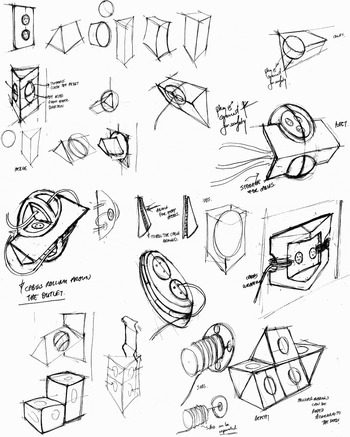
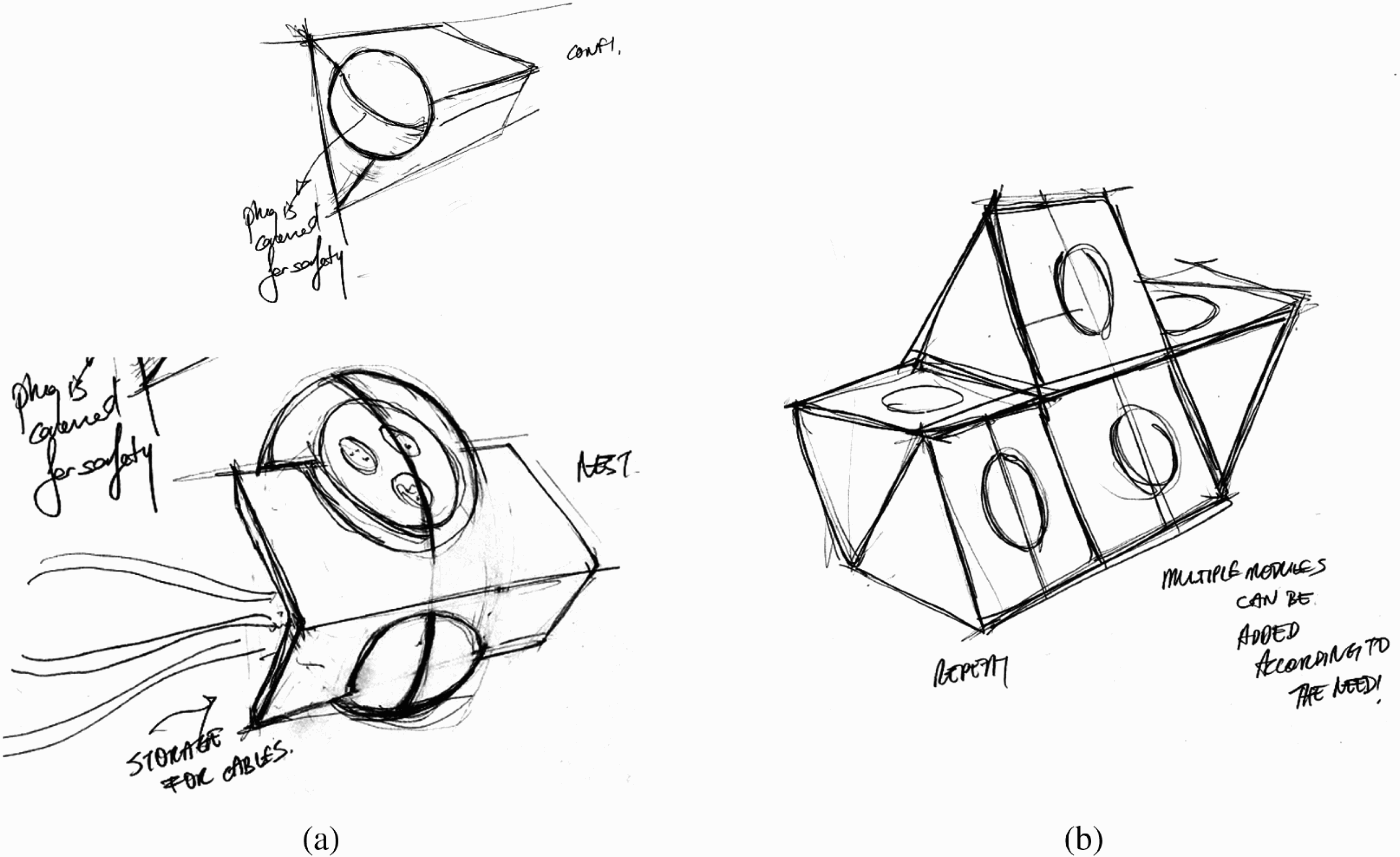
Figures 10 and 11 show an example of this exercise (steps 1 through 5) completed by a design student. From this student's exercise, two goals for the pedagogy can be readily observed. First, a large number of designs were created in a single 1-h session, providing experience with the flow of design ideas. Second, the variety of designs created shows the success of applying heuristics. Beginning with simple forms and existing models, the designs created move to forms with rounded versus flat panel shapes, consideration of multiple solutions for allowing the point of insertion to project outward into space (aiding accessibility), and single versus multiple plug solutions. When initially considering the design space for outlets, many of these designs may not have been apparent to the student. However, after applying the heuristics in succession, the student was able to examine alternative solution types, exploring areas of possible designs made evident by the intentional variation provided by design heuristic use. The result of this short exercise is an expanded perspective on the possible design space for this simple problem. Repeated exercises with other problems would allow practice with the design heuristics and a growing sense of which heuristics are helpful in particular types of design problems.
An example set of drawings showing the application of design heuristics by a design student.

The transformation of the previous form into a new concept by the application of the nesting heuristic. (a) The triangular form is covered inside the spherical form. The figure shows the application of the repeating and changing configuration heuristics. (b) Triangular modules are repeated multiple times, and the way they are arranged is varied.

As an alternative to providing the heuristics one at a time, the same exercise can be conducted by providing all six heuristics at once, and asking the students to decide on the order of use. The study found the designs judged most creative resulted from examples where students chose which heuristic to apply. However, the serial order presentation of heuristics produced a greater number of creative designs by walking the students through the process of taking a heuristic, applying it to a design, and then beginning again with a new heuristic. Structuring the lesson by keeping the students on track with the repeated attempts to apply heuristics for a short time period (5 min) and then moving on to try another may be very helpful with novice designers. Both the self-selection of heuristics and the instructor-presented order of heuristics should be successful using this timed task procedure.
This approach transcends the educational logic of conventional venues of the design education in classrooms and the studios. It suggests that design learning can be enhanced through visual and verbal instructions of a variety of heuristics, and can supplement formal education and foster personal development in design learning. It can motivate students by assisting them in jumping from one solution space to another while reducing fixation. As for the potential of future applications of this methodology, we believe that the resulting relationships between cognitive models of design, design domain knowledge, and the incorporation of computational technology have theoretical and practical implications for design education in the broad spectrum of design domains.
7. CONCLUSIONS
Students learn to generalize and abstract rules from their practice of design as they develop an understanding of why their cognitive processes result in more or less successful paths to design. Our approach, demonstrated in the empirical study presented here, is to make explicit the types of design heuristics used by expert designers in ideation; then, to prepare a design pedagogy that presents these heuristics to students as part of their own generation practice. Over time, these design heuristics may become internalized and applicable in design problems where the need to be creative is a driving concern.
This research reports the beginning of a larger empirical program of research on design heuristics, including examining heuristics in expert design, testing training programs for novice designers, and understanding our judgments of successful, creative designs. The purpose of the larger study is to empirically explore and identify heuristic use in engineering students' designs and to develop a model for representing these activities in terms of how these behaviors contribute to analysis, synthesis, and evaluation skills; how differences in these behaviors are related to expertise; and how these behaviors may influence performance as a function of process efficiency and the verall quality of the final solution.
ACKNOWLEDGMENTS
Our thanks to Panos Papalambros and Jan-Henrik Andersen for their contributions to the development of this research program. Research assistants at the University of Michigan provided many helpful ideas and hours of data collection and coding development, and we thank them for their contributions to this research: Zachary Marshall, Karen Wrenbeck, Caitlin Gdowski, and Kathleen Darbor. This research is supported by National Science Foundation, Engineering Design and Innovation Grant 0927474.
Seda Yilmaz is a PhD candidate in the Design Science Program at the University of Michigan. She received her BID from Middle East Technical University (Ankara, Turkey) and her MFA in industrial design from the University of Michigan. Her research combines her background in product design with methods in cognitive psychology in order to understand the connections among the design process, the design outcome, design heuristics, and the information processed by the designers while generating concepts.
Colleen Seifert is a Professor of psychology at the University of Michigan in Ann Arbor. She received her PhD in psychology from Yale University in 1988. Her research interests lie in the cognitive science of higher level thought processes, including medical and legal decision making, planning, problem solving, creativity, and learning and instruction.
Richard Gonzalez is a Professor of psychology, marketing, and statistics at the University of Michigan. He received his PhD in psychology from Stanford University. His research areas include consumer decision making, social psychology, creativity, and statistics.