Introduction
Sudden sensorineural hearing loss (SNHL) is an acute decline in hearing ability that affects 8–15 of 100 000 individuals annually.Reference Byl 1 The most widely used clinical definition is a loss of sensorineural hearing of 30 dB or more in at least three audiometric frequencies developing over a 72-hour period.Reference Yang, Ko, Peng and Hwang 2
Various theories have been proposed to explain sudden SNHL, including vascular disease, viral infection, genetic factors, ototoxic medications and autoimmune disease.Reference Tsai, Liang, Wu, Ding, Chiang and Wu 3 Sudden SNHL has many potential causes and current treatment modalities must address all possible aetiologies.
The proper function of the inner ear requires consistent oxygenation and nourishment by the arterial system. However, the labyrinthine artery, an end artery with no collateral paths, is the only arterial blood supply to the inner ear. Thus, cochlear function is very sensitive to an impaired blood supply.Reference Ciorba, Hatzopoulos, Bianchini, Iannini, Rosignoli and Skarzynski 4 , Reference Mom, Avan and Bonfils 5 The blood supply to the cochlear system is vulnerable to circulatory disorders, such as emboli, thrombosis, vasospasm, hypercoagulopathy and high viscosity. Many recent studies have demonstrated the key role played by the endothelium in maintaining consistent blood flow.Reference Ciccone, Cortese, Pinto, Di, Fornarelli and Gesualdo 6 , Reference Capaccio, Ottaviani, Cuccarini, Bottero, Schindler and Cesana 7
Oxidative stress, which is defined as an excess of pro-oxidant species that is not counterbalanced by adequate endogenous and exogenous antioxidant defences, has been proposed as a potential source of endothelial dysfunction and a risk factor for microvascular injury.Reference Crimi, Ignarro and Napoli 8 In a recent study, the serum concentration of reactive oxygen species and the global oxidative stress index, which reflect the oxidative and antioxidant capacity, respectively, were significantly higher in patients with sudden SNHL than in controls.Reference Capaccio, Pignataro, Gaini, Sigismund, Novembrino and De 9 Here, we evaluated the role of oxidative stress in the aetiology of sudden SNHL using thiol/disulphide homeostasis as an indicator of oxidative homeostasis.
Materials and methods
Subjects
This prospective study was conducted from August 2014 to July 2015 in the Department of Otolaryngology, Head and Neck Surgery at the Istanbul Gaziosmanpasa Taksim Education and Training Hospital, Turkey. The study protocol was approved by the ethics committee (under approval number 49). Signed informed consent was obtained from all patients.
The study comprised 62 participants, including 32 patients with sudden SNHL (13 males and 19 females; mean age of 48.3 ± 13.3 years) (study group) and 30 healthy subjects with no cochleovestibular disorders (12 males and 18 females; mean age of 41.6 ± 12.3 years) (control group). Sudden SNHL was defined as a hearing loss of 30 dB or more over at least three contiguous frequencies that developed within 72 hours, with no fluctuation in hearing loss, and hospital admission within 3 days of sudden SNHL onset. The cause of sudden SNHL in these patients was unknown, and those whose hearing loss was caused by retrocochlear lesions were excluded by magnetic resonance imaging.
Exclusion criteria were: additional middle- or external-ear pathology, or middle-ear surgical history; hearing loss caused by rupture of the round window membrane; smoking; malignancy or autoimmune diseases; concomitant marked vestibular symptoms; head trauma history; diabetes mellitus; renal insufficiency; anticoagulant or anti-aggregant therapy; and history of cardiovascular disease. Infectious diseases were also excluded based on patient history and the results of haematological tests such as C-reactive protein level, erythrocyte sedimentation rate and complete blood count.
Acoustic evaluation
Hearing was evaluated at every clinical visit. Evaluation included air and bone pure tone audiometry, speech reception threshold assessment, and speech discrimination tests. Hearing tests were conducted on the day of admission (pre-treatment audiometry) and three months after the start of treatment (post-treatment audiometry). Pure tone average was evaluated in terms of the mean threshold of 0.5, 1, 2, 3 and 4 kHz.
Blood sample collection
Blood samples were obtained from the sudden SNHL patients and controls on the morning before treatment following a 12-hour fast. Blood was collected from the patients and controls in plain tubes. Serum was separated after centrifugation at 1500 g for 10 minutes, and stored at −80 °C until analysis. The complete blood count and differential were determined from the peripheral venous blood samples obtained at admission.
Parameter measurements
Using the procedure developed by Erel and Neselioglu, the serum native thiol, total thiol and disulphide levels were measured, and the disulphide/native thiol and disulphide/total thiol ratios were determined.Reference Erel and Neselioglu 10 Briefly, reducible disulphide bonds were first reduced to form free functional thiol groups. Any unused reductant sodium borohydride was consumed and removed with formaldehyde, and all thiol groups, including reduced and native groups, were detected after reaction with 5,5′-dithiobis-(2-nitrobenzoic) acid. Half of the difference between the total thiol and native thiol gave the dynamic disulphide amount. After determining the amounts of native thiol and disulphide, the thiol/disulphide ratio was calculated.
Statistical analysis
The mean, standard deviation, median, minimum, maximum, frequency and ratio values were used as descriptive statistics. The distributions of variables were assessed using the Kolmogorov–Smirnov test. The Mann–Whitney U test was used to analyse quantitative data. The Wilcoxon signed rank test was used to analyse repeated measures, and SPSS® statistical software (version 22.0) was employed to conduct the analyses.
Results
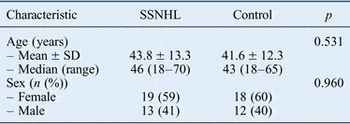
The demographic characteristics of the patients and controls are summarised in Table I. There were no significant differences between patients and controls in terms of sex (p = 0.960) or mean age (p = 0.531).
Demographic characteristics

SSNHL = sudden sensorineural hearing loss; SD = standard deviation
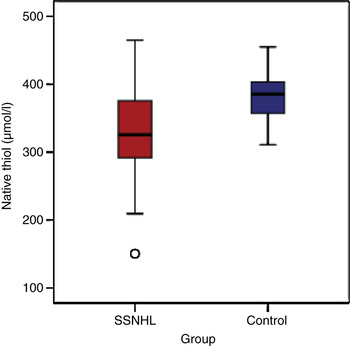
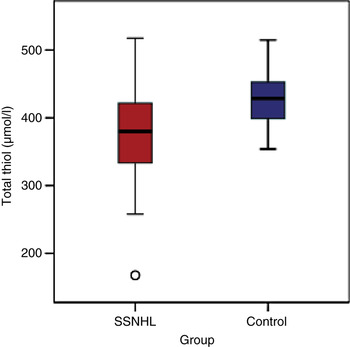
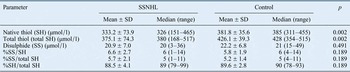
The sudden SNHL patients had lower native thiol levels compared to controls (333.2 ± 73.9 vs 381.8 ± 35.6 μmol/l, p = 0.002) and lower total thiol levels (375.1 ± 74.3 vs 426.1 ± 39.3 μmol/l, p = 0.002). The study group had lower mean disulphide levels than the control group (20.9 ± 7 vs 22.2 ± 6.8 μmol/l, p = 0.491), a higher disulphide/native thiol ratio (6.6 ± 2.7 vs 5.8 ± 1.9 per cent, p = 0.189) and a higher mean disulphide/total thiol ratio (5.7 ± 2.1 vs 5.2 ± 1.4 per cent, p = 0.189), although these differences were not significant (all p > 0.05) (Table II, Figures 1 and 2). Compared with the controls, 25 and 24 (out of 32) patients had lower serum native and total thiol levels, respectively.
Native thiol levels showed a statistically significant difference between the sudden sensorineural hearing loss (SSNHL) group and the control group.

Total thiol levels showed a statistically significant difference between the sudden sensorineural hearing loss (SSNHL) group and the control group.

Serum native and total thiol levels*

* Analysis revealed statistically significant differences between sudden sensorineural hearing loss group and control group. SSNHL = sudden sensorineural hearing loss; SD = standard deviation
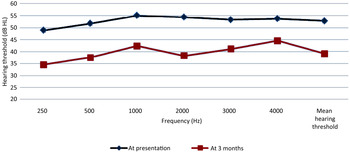
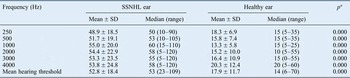
The baseline audiological data of the patients are summarised in Table III. The unilateral SNHL was of the pantonal type in 14 cases, descendent type in 10 cases and ascendant type in 8 cases; no U-shaped type was observed. Figure 3 compares the hearing improvement three months after treatment in the study group. Severity of hearing loss, grade of recovery and frequencies of the different types of sudden SNHL (pantonal, ascendant, descendent and U-shaped) were not correlated with oxidative parameters.
Comparison of mean hearing thresholds at presentation and three months after treatment in the study group.

Patients’ audiological (baseline) data for involved and uninvolved ears at presentation

Data represent hearing thresholds (dB HL), unless indicated otherwise. *Wilcoxon test. SSNHL = sudden sensorineural hearing loss; SD = standard deviation
Discussion
In this study, we found significant differences in thiol/disulphide homeostasis between the sudden SNHL and control groups. This is the first study to show thiol/disulphide homeostasis as a novel marker of oxidative stress in individuals with sudden SNHL compared to healthy controls.
Thiols are important antioxidants that contain a sulfhydryl (–SH) group, which can prevent oxidative stress in a cell.Reference Erel and Neselioglu 10 In the blood circulation, the high amounts of circulating albumin bind thiol sulfhydryl groups via albumin cysteine residues. Cysteine residues in the active sites of proteins, such as thioredoxin, glutaredoxin and peroxiredoxin, detoxify reactive oxygen species and reactive nitrogen species, and form reversible disulphide bonds.Reference Winterbourn 11 , Reference Thomas, Poland and Honzatko 12 The plasma and tissue levels of thiol groups may not be maintained during these interactions,Reference McCord 13 although it is possible that newly formed disulphide groups could be converted back into thiol groups, resulting in sustained thiol/disulphide homeostasis.Reference Erel and Neselioglu 10
Dynamic thiol/disulphide homeostasis has a vital role in antioxidant protection, signal transduction, detoxification and apoptosis, and in the regulation of enzymatic activity, transcription factors and cellular signalling mechanisms.Reference Biswas, Chida and Rahman 14 , Reference Circu and Aw 15 Reduced thiol levels have been observed in various diseases, such as diabetes mellitus, kidney disease, disorders related to alcoholic cirrhosis, chronic renal failure, cardiovascular disorders, stroke and other neurological disorders, and cancer. A determination of dynamic thiol/disulphide homeostasis can provide important details about numerous normal or abnormal biochemical processes.Reference Kundi, Ates, Kiziltunc, Cetin, Cicekcioglu and Neselioglu 16 – Reference Eren, Dirik, Neselioglu and Erel 18 Although thiol/disulphide homeostasis could be determined individually previously, the levels of both compounds can now be measured individually and additively using the procedure developed by Erel and Neselioglu, and may be assessed both separately and in total.Reference Erel and Neselioglu 10
The inner ear is very sensitive to hypoxia, and its blood supply depends entirely on the labyrinthine artery, which is an end artery. Blood flow in the labyrinthine artery is regulated by adrenergic receptors located on the smooth muscle cells underlying the endothelium, particularly at the modiolus, although distal blood flow is regulated poorly and depends on the presence of healthy, functioning endothelium, normal plasma viscosity and normal platelet function.Reference Rudack, Langer, Stoll, Rust and Walter 19
Exposure to reactive oxygen species triggers a complex series of events leading to endothelial damage as a result of the excessive production of the free oxygen radical nitric oxide.Reference Oreskovic, Shejbal, Bicanic and Kekic 20 , Reference Cai and Harrison 21 This occurs through the direct toxic effect of nitric oxide or via peroxynitrite produced by the reaction of nitric oxide with superoxide radicals. Peroxynitrite is a potent oxidising agent that is more cytotoxic than nitric oxide and activates numerous pro-inflammatory processes, including the expression of intracellular adhesion molecule-1, P-selectin, interleukin-8, and lipid inflammatory mediators, such as platelet-activating factor and nuclear factor-ĸB.Reference Capaccio, Pignataro, Gaini, Sigismund, Novembrino and De 9 , Reference Crimi, Sica, Williams-Ignarro, Zhang, Slutsky and Ignarro 22 , Reference Urbich, Dernbach, Aicher, Zeiher and Dimmeler 23
There is increasing support for a central role of endothelial dysfunction in the pathophysiology of sudden SNHL. Imbalances in the oxidant/antioxidant system may contribute significantly to reactive oxygen species generation and endothelial dysfunction. Capaccio et al. demonstrated that oxidative stress indicators increased after sudden SNHL developed, and suggested that in addition to the traditional risk factors for ischaemia, oxidative stress is a risk factor for endothelial injury in terminal microvascular systems.Reference Capaccio, Pignataro, Gaini, Sigismund, Novembrino and De 9 The relationship between oxidative stress and coronary artery disease has recently drawn clinical interest, and both increased oxidative stress and inadequate defence can lead to the early onset of coronary artery disease.Reference Vassalle, Pratali, Boni, Mercuri and Ndreu 24 – Reference Napoli, de Nigris and Palinski 26
Increased reactive oxygen species formation is believed to play a role in the potentiation of hearing deterioration, especially age-related, noise-induced and drug-induced hearing loss.Reference Fechter 27 – Reference Li and Steyger 29 Our results seem to support this mechanism in sudden hearing loss.
In the light of these findings, we hypothesised that impaired thiol/disulphide homeostasis is present in some sudden SNHL patients and that oxidative stress contributes to disease pathophysiology. We found that the native and total thiol levels were significantly lower in patients with sudden SNHL compared with the controls. In addition, the mean disulphide levels were lower and disulphide/native thiol and disulphide/total thiol ratios were higher in the study group than in the control group, although the increases were not significant (p > 0.05). Decreased thiol concentrations are consistent with oxidative imbalance in sudden SNHL patients. Despite the obvious decline in thiol levels, disulphide levels were not increased. This may be because our sample size was relatively small. Compared to controls, typical changes in oxidative markers were evident in a significant number of patients, indicating that, in these patients, oxidative stress played a role in the pathophysiology of disease. However, such changes were not detected in all patients, suggesting more than one aetiology.
-
• Blood supply to the cochlear system is vulnerable to circulatory disorders, such as embolism, thrombosis, vasospasm, hypercoagulopathy and high viscosity
-
• Oxidative stress represents an excess of pro-oxidant species not counterbalanced by adequate endogenous and exogenous antioxidant defences
-
• Oxidative status imbalance may cause endothelial dysfunction and may be a risk factor for microvascular injury
-
• Serum thiol levels (oxidative stress indicator) were significantly reduced in sudden sensorineural hearing loss (SNHL) patients
-
• The changes in oxidative markers may be associated with oxidative stress and may have caused sudden SNHL
One important limitation of this study is the small number of patients enrolled. Relatively few patients met the strict criteria for inclusion in the study. Second, our findings were not compared with other oxidative stress markers, such as lipid hydroperoxide, total antioxidant status, total oxidant status, oxidative stress index, and paraoxonase or arylesterase.
Conclusion
The native thiol and total thiol levels were significantly lower in patients with sudden SNHL compared with controls. The mean disulphide levels were lower and disulphide/native thiol and disulphide/total thiol ratios were higher in the study group, although these differences were not significant (p > 0.05). These findings may be associated with an imbalance between antioxidants and reactive oxygen species, which may be a cause of endothelial dysfunction in the pathophysiology of sudden SNHL. This is the first paper to investigate thiol/disulphide homeostasis in patients with sudden SNHL compared with healthy controls.
Future investigation of a larger patient population might follow to determine whether altered thiol/disulphide homeostasis is a predictor of sudden SNHL.