

1. Introduction
Over the course of the last few decades, much effort has gone into incorporating the sustainability objective into the evaluation of policies, plans, programmes and public projects (Anandarup, Reference Anandarup1997; Chichilnisky, Reference Chichilnisky1997; Fischer, Reference Fischer2003). The move to achieve this goal has led to certain developments and some debate over different discounting approaches. The terms environmental cost–benefit analysis or extended cost–benefit analysis (ECBA) have been coined to refer to the application of this method to evaluate projects involving environmental externalities, converting them into cash terms in order to aggregate tangible and intangible effects. Similarly, the terms environmental or ecological discount rate (EDR) are sometimes used to refer to the discount rate to be applied when performing cost–benefit analysis (CBA) on projects with environmental impact. This concept has evolved in response to a high level of consensus that the conventional social discount rate (SDR) sharply deflates long-term benefits and costs (Ehrlich, Reference Ehrlich2008). This calls for an alternative approach for this new level of analysis, in which the time horizon has increased from a few decades to several centuries. For an overview of the various approaches to discounting, see, for example, Portney and Weyant (Reference Portney and Weyant1999), Pearce et al. (Reference Pearce, Groom, Hepburn and Koundouri2003), Guo et al. (Reference Guo, Hepburn, Tol and Antoff2006) and Almansa and Calatrava (Reference Almansa and Calatrava2007).
The main approaches to environmental discounting fall into the following four groups: (a) the use of discount rates below the standard SDR to address environmental concerns (Rabl, Reference Rabl1996; European Commission, 1998); (b) the use of declining discount rates, using a hyperbolic rather than an exponential discount factor, offering an option especially in projects with time horizons stretching over centuries (Loewenstein and Prelec, Reference Loewenstein and Prelec1992; Sterner, Reference Sterner1994; Henderson and Bateman, Reference Henderson and Bateman1995; Frederick et al., Reference Frederick, Loewenstein and O'Donoghue2002); (c) the use of constant discount rates adjusted to the time horizon of the impact generated by the project (Weitzman, Reference Weitzman2001; H.M. Treasury, Reference Treasury2003); (d) the design of different mechanisms to include future generations in the analysis (Fearnside, Reference Fearnside2002; Padilla, Reference Padilla2002; Sumaila and Walters, Reference Sumaila and Walters2005); and (e) the ‘modified discounting’Footnote 1 in view of intergenerational fairness (Kula, Reference Kula1981, Reference Kula1998).
Each of these discounting approaches has its own set of arguments and practical implications, and it is likely that all of them have their uses in certain contexts. The key point is that those performing the evaluation should be aware of the theoretical apriorisms and ethical implications (relating to the weight given to future environmental impacts) that are involved.
The main focus of this paper is a relatively new approach to discounting known as ‘dual discounting’ or ‘dual-rate discounting’ (Tol, Reference Tol1994; Yang, Reference Yang2003; Kula and Evans, Reference Kula and Evans2011), which is the simultaneous application, that is, in the same CBA, of different SDR to environmental impacts (intangible or non-market effects) and market impacts (tangible costs and benefits). The main aim of this paper is to offer an overview of the dual discounting proposal to explore its potential as a practical option.
Setting out with this aim, section 2 examines the existing literature, and the underlying rationale for this proposal, by reassessing and updating the apriorisms underpinning the conventional social time preference rate (STPR). It also aims to distinguish it from other apparently similar proposals. Section 3 describes two environmental profitability criteria relating to the dual discounting proposal. Section 4 presents the results of a Delphi survey of international experts in discounting, with particular emphasis on those relating to their degree of support for dual-rate discounting.
Sections 5 and 6 describe a case study: ‘Economic evaluation of a plant for the desalination of irrigation return water in southwest Spain’, in which CBA techniques are used in different sensitivity analysis scenarios with changing project time horizons and discounting approaches. The aim is to draw methodological conclusions from this practical application. Finally, section 7 summarises the main conclusions deriving from the preceding sections.
2. The dual-rate discounting approach
2.1. Research background for the dual-rate discounting approach
The relatively few references in the scientific literature to the dual-rate discounting approach fall into the following groups, classified by the nature of the methodological proposal:
(a) The first group includes Tol (Reference Tol1994), Rabl (Reference Rabl1996), Hasselmann et al. (Reference Hasselmann, Hasselmann, Giering, Ocana and Storch1997), Hasselmann (Reference Hasselmann1999) and Philibert (Reference Philibert1999), which are actually versions of the Krutilla–Fisher (K–F) approach, which does not apply a different discount rate to environmental goods, but does use time-varying evaluation of the environmental costs and benefits (N t) (see equation (2)).
(b) The second group contains the studies by Almansa and Calatrava (Reference Almansa and Calatrava2007) and Kula and Evans (Reference Kula and Evans2011), which recommend the use of a dual-rate discounting approach, in the same methodological framework as used in the present study. This evaluates the environmental good or cost in current cash terms (N 0), applying a lower discount rate (EDR) than the conventional SDR (see equation (1)). These studies find justification for the use of a different discount rate for environmental goods, thereby questioning the hypotheses of Ramsey's formula. Other works that fit into this group are the theoretical model of Gollier (Reference Gollier2010) and prior to that Guesnerie (Reference Guesnerie2004), who justify reducing the discount rate for the evaluation of environmental goods. This is known as ‘ecological discounting’, as distinct from ‘economic discounting’. With another model, Kögel (Reference Kögel2009) explores the relationship between dual-rate discounting and substitutability.
(c) Thirdly, there is a proposal by Yang (Reference Yang2003), similar to the approach (b) above (see footnote 2).
2.2. The dual discounting proposal
The central idea of this proposal for intergenerational discounting is to defend the rationality of applying simultaneously in the same CBA exercise discount rates for intangible effects (e.g., environmental) that are different from those we use for tangible ones. It could be represented as followsFootnote 2:

where NPV is the net present value, F t represents the annual net financial cost or benefit (in general, the shadow price of the tangible effects), and N 0 the annual environmental cost or benefit at the current time for the current generation (or, more generally, the shadow price of the intangible effects). The discount rate is the appropriate STPR value to account for the financial effects (first term), and a lower EDR, for the environmental effects (second term).
2.3. In what way does this proposal differ from that of Krutilla–Fisher (Reference Krutilla and Fisher1975) and Yang (Reference Yang2003)?
Maintaining the standard discount rate but increasing the value of the good over time, in line with the approach proposed by Krutilla and Fischer (Reference Krutilla and Fisher1975), is a method further developed in studies such as Tol (Reference Tol1994), Rabl (Reference Rabl1996), Hassselmann et al. (1997), Hasselmann (Reference Hasselmann1999) and Philibert (Reference Philibert1999). A comparison of equations (1) and (2) clearly shows that, despite the similarities, our proposal differs significantly from the K–F method. While K–F uses N t (the value of the environmental good that increases with time as a result of decreasing supply) in the numerator and the same STPR for the environmental and financial term, our approach explicitly considers two different discount rates by applying an EDR to the environmental term, which clearly entails a different underlying principle.

2.4. Arguments to support the dual discounting proposal
The theoretical arguments for the use of dual-rate discounting follow from the following reasoningFootnote 3:
2.4.1. Since environmental goods are not market goods, individuals have different mindsets and act differently when dealing with ‘merchandise’ than when dealing with ‘environmental goods’
Working from the starting point that the STPR (STPR = ce + p)Footnote 4 is the most coherent SDR for market effects, it is only logical to suppose that the interest rate of pure time preference (p)Footnote 5 will be lower in the case of environmental goods, either in response to the ethical ‘imposition’ of intergenerational equity, or simply based on the empirical evidence provided by certain studies in this direction.
In fact, governments often carry out environmental enhancement projects that would not pass the decision-making criteria of the conventional CBA. Such projects, in which the benefits will be enjoyed by future generations, imply a very low discount rate (and therefore, very low interest rate of pure time preference), as in the UK, where a lower-than-usual discount rate is applied in the case of forestry projects, as a ‘grant for future generations’.
Regarding the empirical evidence, Kopp and Portney (Reference Kopp, Portney, Portney and Weyant1999) see no reason to assume that individuals will be willing to exchange environmental goods by the same logic as they exchange money. This idea is implicit in Lumley's (Reference Lumley1997) review of an empirical assessment of individual discount rates in relation to soil conservation adoption, where no clear relationship emerges between one and the other. Gintis (Reference Gintis2000) reaches the same conclusion. In a study already mentioned above, Luckert and Admowicz (Reference Luckert and Admowicz1993) deduce different behaviours when dealing with the discounting of forests and securities holdings. Similarly, Taylor et al. (Reference Taylor, Adamowicz and Luckert2003) obtained different implicit discount rates for different types of forest benefits, namely timber and recreation.
2.4.2. It appears logical to suppose that the hypothesis of the marginal decline in utility consumption will not hold for environmental goods
If the environmental benefits or costs extend over a long period, the term ce of the STPR formula may decrease for this type of goods, since the hypothesis of the marginal utility consumption decline is not fulfilled. For example, if in 200 years people are worse off in terms of ‘environmental welfare’, deprivation of an environmental good (a natural space for recreational purposes, for example) will be no less damaging to them than it would be to those alive today, as is usually claimed. Many authors have upheld the idea that per capita consumption decreases instead of increasing with the passage of time, based on the idea that future growth and diminishing natural capital stock go hand in hand. It is one of the central themes of the criticism of conventional discounting by some authors, who others deem to be creating pessimistic scenarios (see Azar and Sterner, Reference Azar and Sterner1996 and Dasgupta et al., Reference Dasgupta, Mäler, Barrett, Portney and Weyant1999, respectively). A recent contribution to the literature in favour of this approach to discounting is that of Kula and Evans (Reference Kula and Evans2011), who justify it with the same logic, in their words: ‘(…) a common discount rate for both natural capital and manmade capital cannot be assumed as natural capital is finite and limited whereas man made capital is not limited (…) In reality what is happening is that the marginal productivity of ecosystems is diminishing’ (Kula and Evans, Reference Kula and Evans2011: 181).
2.4.3. Environmental capital and man-made capital (or money) are not substitutes in the context of the major environmental impacts affecting humanity, insofar as they imply some degree of irreversibility
The point is that a CBA approach to the decision-making process is only compatible, at best, with a philosophy of weak sustainability (Neumayer, Reference Neumayer1999). This implies accepting the limitation of ECBA as a ‘mono-criterion’ decision approach.Footnote 6 An interesting study in this respect is Kögel's (Reference Kögel2009) development of the relationship between dual-rate discounting and substitutability, based on a theoretical model. His conclusions, drawn from applications of CBA to climate change, are that: (1) whether or not the dual-rate discounting approach succeeds in justifying substantial emission reductions depends on whether environment and goods consumption are substitutes; and (2) a low intra-temporal elasticity of substitution between environment and goods consumption within a period contributes to a low EDR in comparison to the consumption discount rate, while a low inter-temporal elasticity of substitution between composite consumption of different periods contributes to declining discount rates over time. These conclusions are relevant insomuch as one of the most problematic aspects of sustainability in CBA is that environment and man-made capital (or money) are not substitutes in the context of the key irreversible environmental impacts threatening humanity. In other words, the dual rate discounting approach enables a change in methodology that, while not completely overcoming this problem, would reduce it to some extent, thus contributing to an improvement in the application of ECBA.
2.5. What specific value(s) would the EDR take on?
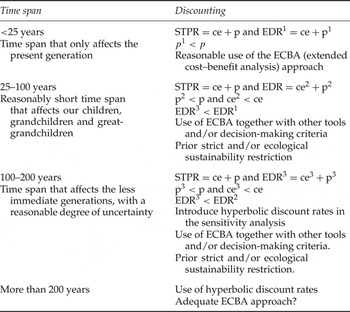
This paper addresses this thorny question starting from the very general guidelines summarized in table 1. These enable us to define a series of suggestions, from the perspective of recent approaches to (non-dual rate) environmental discounting (sections a and b) and subsequently to review some theoretical proposals and practical applications for the case of dual discounting (section c).
A general proposal of different STPR and EDR depending on the time span of the project

(a) The same EDR should not be used for all types of projects, or all types of resources, and the choice of discount rate will depend on the time span considered
Regarding the time span, in the context of a proposal for a (non-dual) downward-adjusted discount rate, Weitzman (Reference Weitzman, Portney and Weyant1999, Reference Weitzman2001) recommends different discount rates for different time spans.Footnote 7 Along the same lines is the proposal contained in the UK Government's Green Book (H.M. Treasury, Reference Treasury2003) in its official guidelines to Ministries for the appraisal of investments and policies.Footnote 8
An example of the relationship between the discount rate and the nature of the project can be observed by comparing the values published in two significant reports that form part of the discounting literature: the Stern Review (Stern, Reference Stern2006), which deals specifically with climate change; and the above-mentioned Green Book of the UK Treasury. Using the same value of e = 1, the Stern Review considers a specific value of p = 0.1%, well below the general value of p = 1.5% of the Green Book (see footnote 4).
In fact, the Stern review contains a very interesting discussion about the appropriate value for p, since this is a much more subjective value than the term used in Ramsey's formula. This relates to the interesting debate about whether the discount rate, and the p term in particular, should be descriptively determined (derived from the real discount rate of society, based either on individual or government preferences) or prescriptively determined (normatively agreed upon in accordance with society's objectives for the sustainability of the ecosystem). Without wishing to carry this debate any further in this paper, it is interesting to recall the arguments underpinning the line of reasoning behind the idea that the sum of individual preferences is not equal to the collective preference (Klaassen and Opschoor, Reference Klaassen and Opschoor1991; Bürgenmeier, Reference Bürgenmeier1994).Footnote 9
The differences in c can be explained, as mentioned in the Stern Review, by the fact that the Treasury's Green Book (H.M. Treasury, Reference Treasury2003) focuses on projects or programmes that have only a marginal effect relative to the overall growth path; whereas the application of CBA in projects relating to climate change is a very different case.
(b) A hyperbolic discount factor can be included in sensitivity analysis for projects with very long time spans (several centuries)
There is increasing academic support for calculating time-varying discount rates using a decreasing hyperbolic function (Loewenstein and Prelec, Reference Loewenstein and Prelec1992; Sterner, Reference Sterner1994; Henderson and Bateman, Reference Henderson and Bateman1995; Chichilnisky, Reference Chichilnisky1996; Frederick et al., Reference Frederick, Loewenstein and O'Donoghue2002; Hansen, Reference Hansen2006).Footnote 10
(c) Specific EDR values proposed in the literature
Guesnerie (Reference Guesnerie2004) discusses the optimum discount rate for very long term environmental restoration and improvement projects. His model considers environment as finite, while the private good grows exponentially. The welfare of future generations depends on a parameter describing the elasticity of substitution between the private good and the environmental good, which gives an ecological discount rate. He concludes by recommending a value close to zero, assuming sufficient concern for intergenerational equity.
For illustrative purposes, Almansa and Calatrava (Reference Almansa and Calatrava2007) apply different combinations of SDR and EDR (SDR of 3 and 5 per cent and EDR of 1 and 3 per cent) in the ECBA of an environmental restoration project with a 100-year time horizon.
Recently, Gollier (Reference Gollier2010) answered the question ‘Which rates should we use to discount costs and benefits of different natures?’ by developing a theoretical model that extends the Ramsey rule by taking into account the degree of substitutability between the two goods and the degree of uncertainty surrounding the economic and environmental growths. The conclusion is that ‘the rate at which environmental impacts should be discounted is in general different from the one at which monetary benefits should be discounted’. This study provides arguments to support an ecological discount rate lower than the economic discount rate. In particular, under certainty and Cobb–Douglas preferences, the difference between the economic and the ecological discount rates equals the difference between the economic and the ecological growth rates. In that study, data concerning the link between biodiversity and economic development enable the estimation of discount rates of 1.5 per cent for changes in biodiversity and 3.2 per cent for changes in consumption.
The dual discount rates derived by Gollier (Reference Gollier2010) are similar to those used by Kula and Evans (Reference Kula and Evans2011) in the economic evaluation of a forestation project in County Tyrone (Northern Ireland). The results show that using a SDR of 3.5 per cent gives a negative net present value (NPV); however if timber benefits are discounted at the Treasury rate of 3.5 per cent (H.M. Treasury, Reference Treasury2003) and the environmental benefits, that is, carbon sequestration, are discounted at 1.5 per cent, the NPV yields positive.
In conclusion, there is not, and probably never could be, a single answer to the question of what specific EDR to use in dual discounting. However, the rates derived from the theoretical models and the available practical applications converge towards considerably lower EDR than the STPR applicable to tangible goods (which in Europe is between 3.5 and 5.5 per cent).Footnote 11 They also coincide with the values reached by Weitzman (Reference Weitzman2001) and proposed by H.M. Treasury (Reference Treasury2003) for horizons spanning centuries. Indeed, dual discounting acquires particular relevance, that is, it becomes particularly applicable, in the long-term time horizon of environmental impacts. Thus, ‘environmental discounting’ and ‘intergenerational discounting’ are virtually synonymous.
3. Environmental profitability indicators
As a complement to the dual discounting proposal, two concepts of environmental profitability indicators have been tested (Almansa, Reference Almansa2006):
(a) Intergenerational transfer amount (ITA)
The ITA is a criterion for the estimation of environmental profitability in absolute terms. It is defined as the difference between the NPV obtained using the general STPR for public investments, the NPV (STPR%), and the NPV in which an intergenerational equity adjustment has been carried out on the discount rate applied to the environmental effects, effects, the NPV (STPR%, EDR%). This indicator represents what the current generation passes on to future generations by incorporating a certain degree of intergenerational equity in the analysis. It may therefore be interpreted as an approximation of the degree of sustainability chosen by the current generation. Although expressed in monetary units, it is less important in absolute terms than as a means to compare different investment proposals. Logically, this value will be higher than or equal to zero, and when comparing alternative environmental restoration projects, a higher ITA value will indicate a more environmentally profitable project.Footnote 12
(b) Critical environmental rate (CER)
The CER is defined as the discount rate that, when applied to the environmental effects after discounting the market effects from the usual STPR, gives an NPV equal to zero. The CER is obtained from equation (1), where STPR is a preselected value, F t is the annual financial flow and N 0 the environmental flow in year 0.
It is, therefore, a criterion for assessing the environmental profitability of a project in relative terms. It must be interpreted in comparison to the social environmental discount rate; that is, the environmental discount rate that adequately represents the level of intergenerational equity a society is willing to assume. Another way of viewing this criterion is to considerer it as an indicator of ‘environmental profitability generated by the financial cost’.Footnote 13
4. Expert opinion on environmental discounting
The key methodology in this part of the study is a two-round Delphi survey of a panel of experts, which allows a feedback process. Since the survey as a whole has broader aims than those presented in this paper, this section offers an overall description of the objectives and methodology, and a simplified summary of the results in relation to the particular objective of this paper, which in this section is to examine the degree of support for the dual-rate discounting approach.
The Delphi method is a group forecasting technique that draws on the opinions of experts. It is aimed at developing a framework for individual specialists from different disciplines to contribute their own opinions about the problem under discussion. It is therefore, as noted by Landeta (Reference Landeta2006), a way of using collective human intelligence. The method consists of consulting a panel of experts on a given topic by asking them, individually and anonymously. Using a series of questionnaires, it creates channels of communication, allowing participants to give their opinions and later receive feedback on the views of the rest of the panel on the same issues and, finally, allows them the opportunity to review their original responses (Dalkey and Helmer, Reference Dalkey and Helmer1963).
According to Linstone and Turoff (Reference Linstone and Turoff1975), the Delphi method is particularly recommended for use in areas where ethics or morals override economic and technological issues. There is no question of the high level of uncertainty surrounding long-term environmental issues or of the need to determine an appropriate SDR for their evaluation. At the same time, they also carry direct or indirect ethical implications, which, in the case at hand, relate specifically to intergenerational ethics. This provides the main justification for the use of this methodology in this study, particularly in view of the limited number of experts in environmental discounting.
4.1. Technical details of the Delphi process
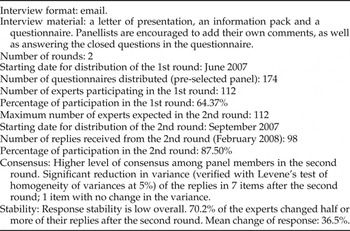
The survey was conducted by email and the main criterion for the selection of the Delphi panel was that the panellists should have had research on the specific topic of environmental discounting and the overall theme of the evaluation of public projects with environmental impact published in international scientific journals. The search drew on the Web of Knowledge platform provided by the Spanish Ministry of Science and Technology, which includes, among others, reference bases such as the Web of Science, Current Contents Connect, ISI Proceedings, Derwent Innovations Index and Medline. This enabled the construction of an initial panel of 174 experts. Table 2 shows the technical details of the survey. The last two rows summarize the validation of the feedback process (Linstone and Turoff, Reference Linstone and Turoff1975). The main observation is that the second round yields two desirable outcomes: a higher degree of consensus and a lower level of stability, both of which provide justification for the use of the Delphi method.
Technical details of the Delphi process

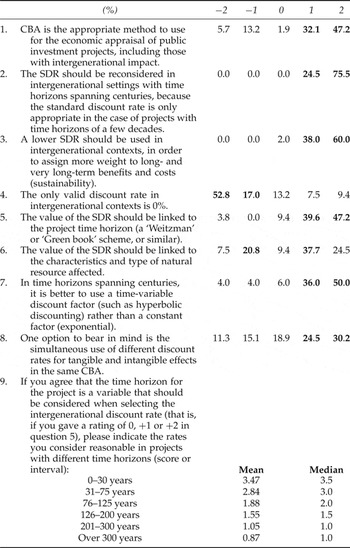
The questionnaire consisted of 9 questions with space for additional comments. In questions 1–8, panel members were asked to indicate their level of agreement with eight statements (see table 3), using a standard Likert-type scale (from −2 to 2), where −2 indicates ‘complete disagreement’; 2 indicates ‘complete agreement’; and 0 indicates indifference. Question 9 (only for those who agreed with statement 5) was designed to elicit opinions regarding the most appropriate discount rate for a series of time horizons: 0–30, 31–75, 76–125, 126–200, 201–300 and more than 300 years. Together with the questionnaire, participants received an information pack explaining the different discounting strategies. The questionnaire for the second round gave the overall statistics for the first round (the percentage frequencies in questions 1–8; and the mean and standard deviation in question 9), allowing participants to consider the initial replies of each panel member, thus providing the feedback process that makes the Delphi method so attractive.
Descriptive statistics for questions 1–9 (2nd round)

4.2. Results of Delphi survey
Table 3 gives the basic statistics for each question. Significantly, the results reveal the panel's unanimous full support for the modification of the discounting approach in the intergenerational context (question 2), almost unanimous support for the reduction of discount rates (question 3), and ample support for DDR approaches (questions 5 and 7). Although dual rate discounting (question 8) receives a somewhat lower level of support, it still meets with the approval of more than half the panel members (54.7 per cent, scores +1 and +2). This, and the fact that only slightly more than a quarter expressed their disapproval (26.4 per cent, scores −2 and −1), suggests a reasonable initial level of acceptance, taking into account that this is a more novel approach and therefore less well known. In fact, the greatest difference in responses between the two rounds was in question 8. The feedback process that is a characteristic of the Delphi method in this case led to a reduction in the percentage of don't know/no answer (DK/NA) from one round to the next (Rowe et al., Reference Rowe, Wright and McColl2005) and to an increase in the percentage of full agreement (score +2). The discount rates proposed by the panel members for the different time horizons (question 9), are similar although somewhat lower than the UK Government proposal (H.M. Treasury, Reference Treasury2003). The modes reveal that the experts prefer three intervals: up to 75 years; 75–200 years and over 200 years, instead of the six originally proposed.
5. Economic appraisal of a desalination plant to treat farm drainage water flowing
5.1. Description of the study area and its environmental problems
The Mar Menor is a hypersaline coastal lagoon located in Murcia, SE Spain. Its surface area of 135 km2 makes it the largest lagoon of its kind in the western Mediterranean (Pérez-Ruzafa et al., Reference Pérez-Ruzafa, Marcos and Pérez-Ruzafa2011). It has five islands and a 24-km long sandbar that separates it almost completely from the open sea, several natural canals being its only direct links to the Mediterranean Sea. The area is one of enormous ecological and natural value that comes under multiple national and international nature protection orders (RAMSAR wetlands since 1994, SPA, among others).
The natural drainage basin of the Mar Menor, known as the Campo de Cartagena, has gradually developed into an area of irrigated farmland, much of it intensively cultivated, using water pumped from the underground water table or diverted from the Tajo-Segura transfer. The run-off from the nutrient-rich fertilizers used on this land flows directly into the Mar Menor, causing severe alterations in its hydrological functioning and ecological integrity (Perni et al., Reference Perni, Martínez-Carrasco and Martínez-Paz2011), and leading to the eutrophication of the lagoon. Compliance with the Water Framework Directive requires intervention to stem the flow of contamination from nutrient-laden agricultural run-off into the lagoon (Grindlay et al., Reference Grindlay, Zamorano, Rodriguez, Molero and Urrea2011).
The main source of this agricultural run-off into the Mar Menor is the Albujón watercourse (Carreño et al., Reference Carreño, Esteve, Martínez, Palazón and Pardo2008). This 42-km long wadi collects drainage from an area of over 44,000 ha, accounting for no less than one third of the total nutrient load flowing into the lagoon. Removal of this source of run-off is clearly one of the main undertakings needed to halt the eutrophication process of the Mar Menor. A brief outline of the plan is given below.
5.2. The desalination plant for treatment of agricultural drainage water
One of the proposals for dealing with drainage via the Albujón is the construction of a desalination plant to collect and treat the drainage water to remove the dissolved salts that are responsible for polluting the lagoon.
The technical/project details published by the Confederación Hidrográfica del Segura (Segura Water Board) (CHS, 2008), the agency designated to manage the project, indicate a maximum water treatment capacity of 9 Hm3/year. This is more than enough for a normal year, given that the Albujón Watercourse has a normal flow rate of 6 Hm3/year, and treats a large proportion of the excess overland flow of storm rainfall, which can double the river's normal flow rate (Garcia-Pintado et al., Reference García-Pintado, Martínez-Mena, Barbera, Albaladejo and Castillo2007). As well as removing salts, the plant produces a flow of marketable freshwater for irrigation purposes in an area heavily burdened in economic and ecological terms by a freshwater shortage. Since the rate of freshwater production from this process is set at 75 per cent of the total in-flow, the 6.75 Hm3/year generated would be enough to fully serve the needs of over 800 ha of the region's irrigated horticultural lands (Martínez-Paz et al., Reference Martínez-Paz, Martínez-Fernández and Esteve2007).
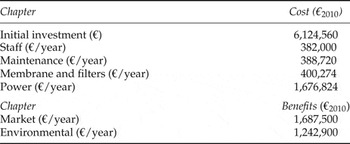
The same technical project plan also includes the plant construction cost estimates shown in table 4.Footnote 14 The initial investment includes the cost of initial environmental impact mitigation measures. The maintenance chapter includes, in addition to the standard costs, the cost of the environmental mitigation measures and environmental monitoring program and an annual amount to fund the restoration plan at the end of the period of operation (Markandya and Murty, Reference Markandya and Murty2004).
Benefits, construction and operating costs

Source: Authors' own calculations based on Martínez-Paz et al. (Reference Martínez-Paz, Martínez-Fernández and Esteve2007).
The benefits of the desalination plant are also shown in table 4 under two headings:
• Market benefits. Total income from the sale of the freshwater generated is estimated at 1,687,500 €/year, based on an initial price of water of 0.25 €/m3, the most common one from alternative sources in the area (Rigby et al., Reference Rigby, Alcon and Burton2010).
• Environmental benefits. One of the main objectives of the plant is to prevent the ecological degradation of the Mar Menor by halting the flow of a large volume of salt-laden run-off into its waters. This service to the environment is a non-market service and, as such, has no direct price, but can be evaluated by indirect methods drawn from environmental economics (Stemplewski et al., Reference Stemplewski, Krull, Wermter, Nafo, Palm and Lange2008). The case at hand uses the avoided cost method, valuing the impact (benefit) in terms of the cost of the cheapest available alternative treatment (Zanou et al., Reference Zanou, Kontogianni and Skourtos2003). This means calculating the cost of the most efficient alternative measure to prevent the flow of these drainage waters into the Mar Menor, namely, the construction of an artificial wetland at the mouth of the watercourse to act as a green filter on the drainage waters (Trepel, Reference Trepel2010). A previous complete study can be found in Martínez-Paz et al. (Reference Martínez-Paz, Martínez-Fernández and Esteve2007) which, after a detailed analysis of the project, obtains a total cost of 138,100 €/Hm3 for the treatment of drainage water and run-off with an artificial wetland at the mouth of the Albujón Watercourse into the Mar Menor. The resulting environmental benefit of the desalination plant is estimated in monetary terms as 1,242,900 €/year, given a treatment capacity of 9 Hm3/year.
6. Results and discussion
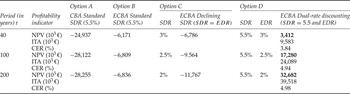
Table 5 presents the average values of both the classic profitability indicators (NPV and IRR), and the environmental profitability indicators (ITA and CER), the latter for the dual-rate discounting approach. This is done across all three of the considered time horizons (40, 100 and 200 years) and the four CBA approaches (options A–D) detailed below.
• From the standard cost–benefit perspective, not including non-market intangibles, which, in this case, are environmental benefits (standard CBA) (Option A).
• From the environmental cost–benefit perspective (environmental CBA), including both market flows (tangibles) and non-market flows (intangibles). In this case, three different discount rates are used:
– Option B: a standard social discount rate (standard SDR) of 5.5 per cent. For the period 2007–2013, the European Commission (2008) suggests two benchmark SDRs: 5.5 per cent and 3.5 per cent. The reason for the choice of the higher rate for comparison of the scenarios is that the results are more graphic and nearer to the traditional rate of 5 per cent suggested in the guidelines of the European Commission (2003).Footnote 15
– Option C: a declining social discount rate by time horizon (declining SDR), according to the values proposed by H.M. Treasury (Reference Treasury2003).
– Option D: the dual discount rate, with a standard SDR of 5.5 per cent for tangibles (market flows) and a declining rate (also according to the values proposed by H.M. Treasury, Reference Treasury2003) for intangibles (non-market flows).
Summary statistics for the traditional and environmental profitability indicators (EDR according to H.M. Treasury, Reference Treasury2003)

Notes: CBA, standard CBA without including environmental externalities; ECBA, environmental cost–benefit analysis; CBA (including environmental externalities); SDR, social discount rate; EDR, environmental discount rate; NPV, net present value; ITA, intergenerational transfer amount; CER, critical environmental rate.
The conclusions drawn from the resulting data, displayed in table 4, are that:
(a) Option A, which is CBA without including environmental benefits, finds the project clearly unprofitable for all time horizons, since the costs outweigh the benefits.
(b) The inclusion of environmental benefits in monetary terms (option B) clearly improves the results, although in this particular practical case, not to a degree sufficient to achieve a positive NPV.
(c) The most striking observation is that, in this particular case, the option in which the discount rate is reduced in relation to the time horizon (option C) also fails to improve the result of the profitability of the project in question. It is important to stress that this will not be the case in all projects, but the fact that it is for the case study that concerns us is significant for the findings of this paper. As argued by Kula (Reference Kula2008), overcoming the difficulty of including sustainability in CBA may require more than simply reducing the discount rate. As observed in this case, the lower the discount rate the more the future matters, so reducing the SDR results in a worse NPV.
(d) The above problem can be solved by applying the logic that different types of effects require different discount rates. Thus, option D, which applies dual discounting, is the only one that gives a positive NPV and therefore declares the project profitable.
The reality is that the regional authorities carried out the project, showing that they considered it socio-environmentally profitable. In this case, the only way to an NPV reflecting socio-environmental profitability is by applying a dual discount rate. In other words, it is not a question of identifying the best discounting option by seeing which gives the highest NPV, but rather of the methodological adjustments used to switch from a classic CBA to an ECBA, increasing our capacity to achieve the level of profitability implicit in society.
Meanwhile, the values of the environmental profitability indicators proposed for the dual-rate discounting approach (option D) show that:
• The project that concerns us proves environmentally profitable when we apply a CER (critical environmental rate) of 4.9 per cent (in time horizons spanning centuries, where the dual approach is most applicable). As explained earlier, this is a relative value that must be compared with the level assumed by society either descriptively (by deducing the profitability of publicly financed environmental projects, in the style of the social opportunity cost); or, in certain cases, normatively, through institutional support for a particular CER for application in public works. This, obviously, would not be a single unique value, since it would depend on, among other variables, the nature of the environmental impact. It may be worth considering the possibility of setting the same institutional standard as recommended in H.M. Treasury (Reference Treasury2003), for example. That is, SDR of 2.5 per cent for 100 years and 2 per cent for 200 years would provide a reference in the case that concerns us. This would make the projectenvironmentally profitable under the methodological logic considered here.
• The ITA, meanwhile, shows that the implementation of this project would mean a legacy to future generations worth €24.089 thousand (over 100 years) and 39.518 thousand € (over 200 years). The fact that the value increases as the time horizon grows is consistent with the fact that the longer the time scenario, the more generations are affected.
7. Conclusions
Dual discounting is a novel approach to environmental discounting, which, according to the findings of this study, is a potentially useful option in ECBA for the reasons listed below.
(a) Re-assessment of Ramsey's formula in the context of ECBA provides sufficient theoretical justification for the dual discounting approach.
(b) Over half the international panel of experts consulted on the subject of environmental discounting are in favour of this approach. This, and the fact that only slightly more than a quarter expressed their disapproval, suggests a reasonable initial level of acceptance, which encourages further research into the potential application of this as yet little-known methodological alternative.
(c) The literature describes practical cases exemplifying its practical implications, in the sense that the resulting NPV is a better reflection of a project's socio-environmental profitability, showing it to be an appropriate methodological option.
(d) The practical case described in this paper, in addition to the above, shows that using a lower SDR as a sustainability adjustment is not always the best methodological option. Sometimes, as in the case study presented in this paper, a dual discounting approach is the only way to approximate a socio-environmental profitability valuation of an investment with environmental impact.
(e) The dual discounting approach allows the incorporation of specific environmental profitability criteria (still under study) to enable the degree of intergenerational equity implicit in the analysis to be expressed in cash or percentage terms.
Nevertheless, further discussion and practical application of the dual-discounting proposal will be required in order to evaluate and improve the method and narrow down the settings in which it makes most sense. It is not the intention of this paper to propose this as the option to replace all others. It is rather to recommend it as an additional option in sensitivity analysis in relation to projects with intergenerational implications, which tend to be all those with a major environmental impact.