1. INTRODUCTION
The dielectronic recombination (DR) process plays an important role when determining the level populations and ionization balance of both high- and low-temperature non-local thermodynamic equilibrium (NLTE) plasmas over a wide range of electron densities. Therefore, an accurate description of this process is a key requirement for correct spectral analysis. At finite electron densities, the radiative cascade can be interrupted by further electron collisions that redistribute the population reducing the effective DR rate. These situations required a re-appraisal of the strategy for computing DR. The principle resonance-forming process in electron-atom and electron-ion interactions includes the non-radiative (dielectronic) capture of the projectile electron with simultaneous excitation of a bound electron in the ion core and the subsequent relaxation of the intermediate highly excited state by radiative decay or electron emission. Investigations of electron-impact excitation and ionization (Müller, Reference Müller2009) revealed unexpected strength of resonances contributing to cross-sections that are relevant in many plasma environments. Recently, Robicheaux et al. (Reference Robicheaux, Loch, Pindzola and Balance2010) and Pindzola et al. (Reference Pindzola, Loch and Robicheaux2011) discussed for the first time, the impact of negative-energy resonance states on DR rate coefficients in astrophysical and fusion (tokamak) plasma environments, respectively. The applications referred to Mg3+ and C3+. Since the below-threshold resonance contributions are usually omitted from DR calculations, the experimental verification of their effect on recombination is important. The corresponding contribution to the DR rates of these negative-energy resonance states has been calculated as function of the resonance energy. E r, relative to the ionization threshold. The reason for including these states into DR calculation is that, depending on plasma density and temperature, there are different paths for an atomic ion to temporarily capture the free electron into a high Rydberg state. It means that due to collision processes, the electron energy is not constant varying with a thermal distribution. In such circumstances, different doubly excited states mix through configuration interaction (CI). One of the aims of this work is to identify another species in other plasma environment that could be used for the experimental validation of the role of negative-resonance states in DR calculations. We have focused our work attention on the short-pulse laser produced plasmas. In the “long” nanosecond pulse regime, laser-plasma interaction physics has been studied extensively to explore the efficiency of collisional absorption by inverse bremsstrahlung, parametric instability growth rate, filamentation, X-ray conversion efficiency, and hydrodynamic instabilities (Campbell, Reference Campbell1992). In the short-pulse regime of laser interaction with solid targets, a key issue is the understanding of the initial processes leading to the hot dense plasmas (Gauthier, Reference Gauthier and Rose1995). Recent progress in laser technology has revolutionized the production of high intensity coherent light. In the visible or near infrared regions, terawatt laser pulses, which comprise only a few cycles of oscillation of the electromagnetic field can be used for the production of attosecond vacuum-ultraviolet and X-ray-ultraviolet pulses by high-order harmonic generation in gases.
A general feature of a laser plasma X-ray spectrum is the presence of the so-called satellite lines on the longer wavelengths side of each resonance line (Kato et al., Reference Kato, Yamamoto and Rosmej2004). These lines, for which the ion levels involved in the transition are the same as for the corresponding resonance lines, are emitted as a consequence of the DR process. The presence of a further bound electron in an excited state causes the emission to occur at a slightly longer wavelength.
Dedicated experiments have been performed to support the fundamental studies in the field of atomic physics and hydrodynamics (Phillion et al., Reference Phillion, Campbell, Estabrook, Phillips and Ze1982; Gizzi et al., Reference Gizzi, Giulietti, Willi and Riley2000; Chambers et al., Reference Chambers, Pinto, Hawreliak, Al'miev, Gouveia, Sondhauss, Wolfrum, Wark, Glenzer, Lee, Young, Renner, Marjoribanks and Topping2002; Renner et al., Reference Renner, Limpouch, Krousky, Uschmann and Foster2003; Magunov et al., Reference Magunov, Batani, Faenov, Lucchini, Desai, Padoan, Pikuz, Skobelev, Canova and Chiodini2006; Stehle et al., Reference Stehle, Gonzalez, Kozlova, Rus, Mocek, Acef, Colombier, Lanz, Champion, Jakubczak, Polan and Stupka2010; Shukla & Khare, Reference Shukla and Khare2010; Louzon et al., Reference Louzon, Henis, Levy, Hurviz, Ehrlich, Franckel, Maman, Raicher, Malka, Mandelbaum and Zigler2011; Zastra et al., Reference Zastrau, Burian, Chalupsky, Doppner, Dzelzainis, Faustlin, Fortmann, Galtier, Glenzer, Gregory, Juha, Lee, Lee, Lewis, Medvedev, Nagler, Nelson, Riley, Rosmej, Toleikis, Tschentscher, Uschmann, Vinko, Wark, Whitcher and Förster2012). In these experiments, the plasma created using picosecond or nanosecond laser pulses focused on the surface of a solid target or using exploding foils was characterized using standard diagnostic techniques and modeled with hydrodynamic- and NLTE-atomic physics codes. At the same time, special attention has been paid to the investigation of new processes and methods interlinking nuclear and laser-plasma physics (Renner et al., Reference Renner, Juha, Krasa, Krousky, Pfeifer, Velyhan, Granja, Jakubek, Linhart, Slavicek, Vykydal, Pospisil, Kravarik, Ullschmied, Andreev, Kampfer, Uschmann and Foster2008; Reference Renner, Liska and Rosmej2009; Stancalie et al., Reference Stancalie, Pais, Totolici and Mihailescu2007). In laser plasmas, the general approach to the interpretation of spectra is to model the laser-plasma emission at selected transition wavelengths under both steady-state and time-dependent conditions and then to compare the calculated ratios with the experimental data.
Al has been used as a benchmark material to spectroscopically study ultrafast plasmas. The conversion efficiency into narrow spectral lines and the duration of Al thermal lines have been studied for a variety of experimental scenarios. For example, the X-ray signals from the H- and He-like ionization stages of Al ions have been observed at the AMBIORIX Z-pinch facility during the use of an Al vapor jet onto a very thin coaxial wire (Rosch et. al., Reference Rosch, Friart, Darrigol, Chatrieux, Zehnter, Romary and Chevallier2000). Additional theoretical analysis of the spectral intensity distribution in well-resolved Ly (alpha) satellites from the X-ray diagnostics of Z-pinch hot points formed during the fast electrical discharges through exploding Al wires, have been carried out by Politov et al. (Reference Politov, Potapov and Antonova2000), and more recently, the spatial distribution of the gain coefficients of Li-like Al ion transition line has been determined by micro-dot array irradiation method (Yamaguchi et al., Reference Yamaguchi, Fujikawa, Kazunobu and Hara2002). Experiments aimed at the generation and characterization of solid density plasmas at the free-electron laser FLASH in Hamburg have also been reported (Zastra et al., Reference Zastrau, Burian, Chalupsky, Doppner, Dzelzainis, Faustlin, Fortmann, Galtier, Glenzer, Gregory, Juha, Lee, Lee, Lewis, Medvedev, Nagler, Nelson, Riley, Rosmej, Toleikis, Tschentscher, Uschmann, Vinko, Wark, Whitcher and Förster2012). In these experiments the absorption and temporal evolution of the Al samples under X-ray-ultraviolet laser irradiation were investigated in order to understand the origin of saturable absorption, radiative decay, bremsstrahlung, and atomic and ionic line emission. In this work, we discuss the negative-energy resonance states and their role in the short-pulse laser plasma environment. We refer herein to DR process of Li-like into Be-like Al ions, as an example.
Depending on the experimental parameters (intensity, pulse duration, plasma size, etc.) the interaction physics can be dominated by processes that occur in the underdense plasma n e < n c or near the critical density (n e is the plasma electron density. n c is the critical density where the electron plasma frequency ωpe equals the laser frequency, i.e., for non-relativistic situations n c(cm−3)~1021/λ2(μm)). The underlying physics is complex and highly nonlinear, i.e., many processes compete in the coupling and mix of these processes is dependent on the plasma conditions. The plasma conditions, in turn, are determined by the coupling processes and the transport of energy from the absorption region (Baldis et al., Reference Baldis, Campbell and Kruer1991). In Section 2, we present, for completeness, two examples of short-pulse laser produced plasmas on Al target where DR of Li-like into Be-like Al ions is the important process. In this section we give details on the method of calculation of the negative-energy resonance states for the working ion. We apply the perturbative method to calculate DR rate coefficients associated with the 2s–2p excitation in Al10+. In Section 3, we give our concluding remarks and the future plan of research.
2. THEORY AND DETAILS OF CALCULATION
The mix of interaction physics depends on a range of parameters now experimentally accessible. These include laser intensity, wavelength, spatial and temporal coherence, pulse duration and shape, and the nature of the plasma. It is not the aim of this work to give the experimental details of dedicated experiments for fundamental studies in atomic physics. In this article, we carry out low-order relativistic perturbation-theory calculations for DR rate coefficients associated with the 2s–2p excitation in Al10+. Resonance structures arise from the 38 levels of the Al9+ 1s22p8l configurations that straddle the Al9+ 1s22s2 → Al10+ 1s22s ionization threshold. This paper's main concern is with ensuring the completeness of negative-energy resonance effects in dielectronic data for plasma modeling and not with all the consequential modeling of populations and ion distributions in plasma.
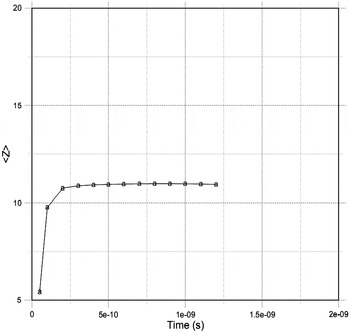
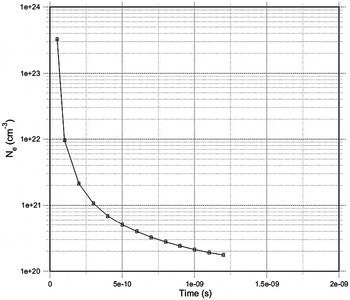
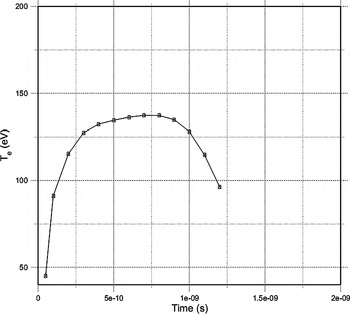
The various applications of laser plasmas, each has their own requirements for the coupling. The inertial confinement fusion, for example, requires that inverse bremsstrahlung be the dominant absorption process. This preferred absorption mechanism is simply described as collisional heating. In inverse bremsstrahlung, the coherent energy of the oscillating electrons in the laser field is thermalized by elastic scattering with the plasma ion. In an electromagnetic wave, electrons acquire a coherent energy oscillation. This coherent energy is converted into random thermal energy at the rate at which electrons are scattered by ions. By conservation of energy, this heating represents a damping of the laser energy. Inverse bremsstrahlung leads to bulk heating of the plasma and can be very efficient. Assuming the plasma created on Al target by a single 1 ns, temporally squared shaped pulse of 0.53 µm, with intensity on target of 1.6 × 10¹⁴ W/cm2, we used the FLYCHK code (Chung et al., Reference Chung, Chen, Morgan, Ralchenko and Lee2005) in “runfile mode” at NIST (http://nlte.nist.gov/FLY) to execute time-dependent collisional-radiative calculation. The Al layer was considered tamped on both sides with a thin layer of plastic. The driver is an undiluted radiation field emitted from the rear side of a thin, 1000 Å Au foil. The intensity on the target is considered of 1.6 × 10¹⁴ W/cm2 over an area that is 1500 µm square. The solution of time dependent coupled state equations including radiative transfer gives not only the temporal evolution of the population but also the temporal evolution of the mean ionic charge state into this plasma. Figure 1 presents this result as output from the code. Once the population distributions on the excited states have been determined, the code calculates the temporal evolution of the plasma parameters. Figure 2 and Figure 3 presents, respectively, the calculated time-dependence of the electron density and temperature into the plasma. The effect of excitation-autoionization and dielectronic channels on ionization balance is taken into account. Autoionizing doubly-excited states are included as Δn = 1 DR channels, which are critical in ionization balance for low Z atoms. The absorption efficiency is a function of the damping rate of the laser energy times the plasma density scale length. The dependence of the plasma absorption efficiency, the most basic signature of the coupling physics, as function of Iλ2 for lasers with no coherence control, is an important indicator of the absorption mechanism. For Iλ2 values on the order of 1014 W μm2/cm2 the inverse bremsstrahlung becomes the dominant absorption mechanism with small component of collective processes. In region dominated by inverse bremsstrahlung, the bulk electrons are heated to several keV. Inverse bremsstrahlung is efficient when the absorption length, the group velocity of the light divided by the damping rate is less than the plasma dimension. The radiation transport equation is written in terms of specific intensity. The specific intensity of radiation I(r, n, ν, t) at position r in direction n, with frequency ν is defined as the amount of energy δɛ that is carried by radiation of frequency interval (ν, dν), across the surface element dS into a solid angle dΩ in a time interval dt:
 $${\rm \delta} {\rm \varepsilon} = I\lpar r\comma \; n\comma \; {\rm \nu} \comma \; t\rpar n \quad dSd\Omega d{\rm \nu} dt.$$
The atomic data, continuum lowering and radiation trapping effects (or opacity effects) are included in the FLYCHK code. The emissivity and opacity are determined for all transitions, both bound-bound and bound-free by recourse to the populations in the file generated by FLYCHK. The emissivity for a bound-bound transition between the upper level “u” and the lower level “l” is given by:
 $${\rm \varepsilon} _{\rm \nu} = N_{\rm \nu} A_{ul} h{\rm \nu} _{ul} /4 {\rm \pi} {\rm \varphi} \lpar {\rm \nu} \rpar \quad \hbox{\lpar ergs/cm}^3/\hbox{Hz}/\Omega\rpar \comma \;$$
where the population density of the upper level u is N u and ν ul is the frequency of the transition. The opacity of the same transition is given by:
 $${\rm \kappa} _{\rm \nu} = N_l \lpar 1 - N_u g_l /N_l g_u \rpar {\rm \pi} e^2 /mcf_{ul} {\rm \varphi} \lpar {\rm \nu} \rpar \quad \lpar {\rm cm}^{-1}\rpar .$$
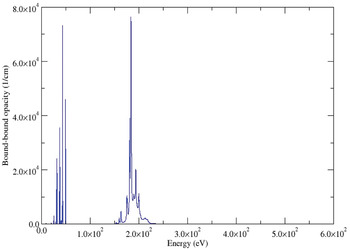
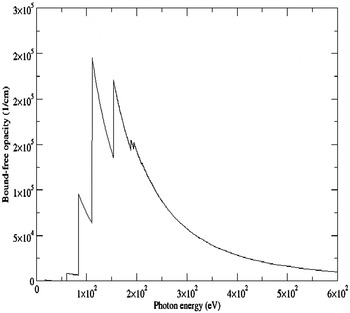
A ul and f lu are the spontaneous emission rate and oscillator strength of the radiative transition, respectively. The line profile function ϕ(ν) that determines the frequency dependence of the emissivity and opacity is considered with a Voigt function. We performed this computation work and results are given in Figures 4 and 5, respectively. Figure 4 presents the simulated bound-bound emissivity as function of photon energy. Figure 5 presents the bound-free opacity as function of photon energy, as output from the code. These figures correspond to t = 5 × 10⁻¹¹ s, T e = 45 eV, N e = 2.7 × 1019 cm−3 parameters in the FLYCHK code. The post-processor FLYSPEC synthesizes the emission and absorption spectra using the population distributions from the FLYCHK output file.
The time evolution of the mean ion charge in laser-produced aluminum plasma. The plasma is formed at the interaction of a single 1ns, temporally squared shaped laser pulse of 0.53 µm, with intensity on target of 1.6 × 10¹⁴ W/cm2.

The time evolution of the electron density (in cm−3 units) into the plasma.

The time evolution of the electron temperature (in eV units) as output from the code.

(Color online) Bound-bound opacity (in cm−1) as function of photon energy (in eV units), corresponding to t = 5 × 10⁻¹¹ s, T e = 45 eV, N e = 2.7 × 1019 cm−3.

Bound-free opacity (in cm−1) as function of photon energy (in eV), as output from the code. Results correspond to the following parameters: t = 5 × 10⁻¹¹ s, T e = 45 eV, N e = 2.7 × 1019 cm−3.

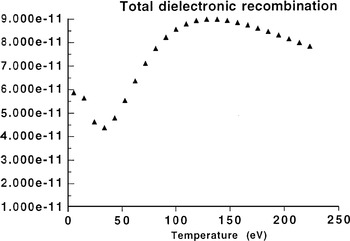
The second example presented herein is the laser produced plasma with Li-like Al ions, i.e., the recombining laser-produced plasma. Amplification of the X-ray-ultraviolet radiation on Li-like Al ion 3d–5f (λ = 10.57 nm), 3d–4f (λ = 15.46 nm), and 4f–5g (λ = 33.47 nm) transitions has been experimentally demonstrated 20 years ago (Carillon et al., Reference Carillon, Edwards, Grande, Henshaw, Jaegle, Jamelot, Key, Kiehn, Klisnick, Lewis, O'neill, Pert, Ramsden, Regan, Rose, Smith and Willi1990). The plasma has been generated by irradiating cylindrically an Al fiber of 7 µm diameter by a laser pulse of following characteristics: intensity 1013 W/cm2, wavelength 0.53 µm. Gaussian temporal shape of 120 ps duration (full width at half maximum) with maximum at 70 ps. Some discrepancies have been observed between the measured and calculated values of the gain coefficient. The complete simulation (time- and space-dependent density and temperature being taken into account), has then been carried out with, and without, DR (Stancalie et al., Reference Stancalie, Sureau, Klisnick, Moller, Gouennou, Berete and Rose1995). Following this precursory work, DR doesn't modify significantly the temporal profiles and appears only as a lowering of amplitude of about 8% for each transition. Depending on the plasma density and temperature, there are different paths for Al10+ ion to temporarily capture an electron into a high Rydberg state. Owing to the electron temperature during the recombination phase (≤200 eV), the most probably ways involve the autoionizing levels 1s22pnl 1,3L'J' and 1s23pnl 1,3L'J' (with initial ion 1s22s) and 1s23dnl 1,3L'J' (with initial ion 1s22p). For each way characterized by a core transition, i-j, the population density of the initial level decays according to the relation dn i/dt = −n in eK d (i − j) where n e is the free-electron density and K d(i-j) the total rate coefficient (sum over all possible intermediate and final states) of the considered way. During the time interval dt the total DR of the considered species is then: 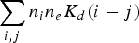 $\sum\limits_{i\comma j} {n_i } n_e K_d \lpar i - j\rpar $. If the populations are expressed in terms of the Saha-Boltzmann factors (Summers et al., Reference Summers, Dickson, O'mullane, Badnell, Whiteford, Brooks, Lang, Loch and Griffin2006), then they show strong overpopulation of the high n-shells at low density due to DR. As the electron density is increased, the DR influence becomes less due to ionization of the high n-shell populations with all the Saha-Boltzmann factors tending to 1. Complete detailed calculation of a K d coefficient requires a lot of intermediate data, and is therefore not easily manageable in a simulation calculating, for each time step, the populations of many levels in a number of plasma cells. For positive resonance energies, the values of K d (cm3s−1) as a function of electron temperature (kT in eV) has shown a first maximum (near 10 eV) due to the core transitions 2s–2p while the other two recombination ways (core transitions 2s–3p and 2p–3d) are dominant above 50 eV and maximum at 150 eV. We reproduce in Figure 6 the total DR rate of Li-like into Be-like Al ions in this recombining plasma regime (Stancalie et al., Reference Stancalie, Sureau, Klisnick, Moller, Gouennou, Berete and Rose1995). The only positive-energy resonance states have been included into the calculation.
The total DR rate coefficients (cm3s−1) in X-ray laser produced plasma with Li-like Al ions (Stancalie et al., Reference Stancalie, Sureau, Klisnick, Moller, Gouennou, Berete and Rose1995).

The electron scattering with Li-like Al has been subject of our previous works (Stancalie Reference Stancalie2000; Stancalie & Pais, Reference Stancalie and Pais2006). The detailed analysis of the radiative damping effect on DR for this particular ionic species has also been reported (Stancalie, Reference Stancalie2005). In order to investigate the negative-energy resonance states contribution to DR of Li-like and Be-like Al ions, in the present work we use the low-order relativistic perturbation theory to calculate the DR in Al10+ above and below the first ionization threshold. The Oxford code, the GRASP multiconfiguration Dirac-Fock (MCDF) code (Dyall et al., Reference Dyall, Grant, Johnson, Parpia and Plummer1989), was used to obtain the wave functions and energies of the Li-like Al target. The first autoionizing state in Al9+ corresponds to n = 9 (Stancalie, Reference Stancalie2005). We are interested in evaluating atomic data as level energies, radiative transition probabilities, line-strengths, and Auger rates, for transitions between the n = 8 levels. To this end, configurations such that 1s22s2, 1s22p2, 1s22s8s, 1s22s8d, 1s22s8f, 1s22s8g, 1s22p8s, 1s22p8p, 1s22p8f, and 1s22p8g have been included in the average level (EAL) calculation, while 1s2, 2s2 and 2p2 shells were kept full. These jj-coupled configuration state functions result in a set of 74 levels that are limited to the following symmetry-parity combinations J π = 0±, 1±, 2±, 3±, 4±, 5+. We have used the extended average level MCDF-EAL option where in the Hamiltonian matrix we minimize a weighted trace (proportional to 2 J +1). Additional relativistic corrections arising from the Breit interaction and quantum electrodynamics are also included. For determining the radiative and autoionizing rates the Dirac atomic R-matrix Code was used (Norrington & Grant, Reference Norrington and Grant1987, and references herein). To stabilize the order of the levels (odd or even), an initial analysis on each parity has been done. For the even parity group, the reference set contains (1s22s2, 1s22p2, 1s22s8s, 1s22s8d, 1s22s8g, 1s22p8p, and 1s22p8f), and for the odd parity group the reference set contains {1s22s8p, 1s22p8s, 1s22p8d}. Once the order has been stabilized, we refer to Δn = 0, n = 8 transitions. There is no level energy data in the Atomic Structure Database of the National Institute for Standards and Technology (http://www.nist.gov). To check the accuracy of the resonance positions we used the Opacity Table (1995).
The relativistic approach based on the Dirac equation has the advantage that all the relativistic effects are included not only for the Eigen energies but, most importantly, in the radial wave functions. In the present calculation, we included Breit interaction in the bound-bound part of the continuum Hamiltonian. The effect is to modify the thresholds and move the resonance structures.
The Dirac Hamiltonian for the (N + 1)-electron system, in atomic units, is written as:
 $$H^{N + {1}} = \sum\limits_{i = {1}}^{N + {1}} { - ic\, {\rm \alpha} } \cdot \nabla _i + \lpar {\rm \beta} - {1}\rpar c^{2} - \displaystyle{Z \over {r_i }} + \sum\limits_{\,j = i + {1}}^{N + {1}} \displaystyle{{1} \over {\left\vert {r_j - r_i } \right\vert }}\comma \;$$
where i and j index the individual electrons, Z is the charge of an infinitely heavy point nucleus, the electron mass has been subtracted, and α and β are the usual Dirac matrices constructed from Pauli spin and unit matrices. The first three one-electron terms in the Hamiltonian are a momentum term, mass term, and the electron-nucleus Coulomb attraction. The final two-electron term is the Coulomb electron-electron repulsion.
In the isolated-resonance and independent process approximation, the DR cross section for a given N electron initial level i through an intermediate (N + 1) electron intermediate level j is given by (Pindzola et al., Reference Pindzola, Loch and Robicheaux2011, and references herein):
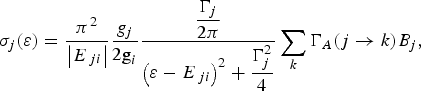 $${\rm \sigma} _j \lpar {\rm \varepsilon} \rpar = \displaystyle{{{\rm \pi} ^{2} } \over {\left\vert {E_{\,ji} } \right\vert }}\displaystyle{{g_j } \over {{2{\rm g}}_i }}\displaystyle{{\displaystyle{{\Gamma _j } \over {{2{\rm \pi} }}}} \over {\left({{\rm \varepsilon} - E_{\,ji} } \right)^{2} + \displaystyle{{\Gamma _j^{2} } \over {4}}}}\sum\limits_k {\Gamma _A } \lpar j \to k\rpar B_j\comma \;$$
where E j is the energy and g j is the statistical weight of the (N + 1) electron doubly excited level, E i is the energy and g i is the statistical weight of the N electron initial target level, and E ij = E j − E i. The branching ratio for radiative stabilization is given by:
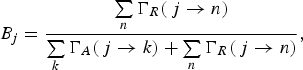 $$B_j = \displaystyle{{\sum\limits_n \Gamma _R \lpar \,j \to n\rpar } \over {\sum\limits_k \Gamma _A \lpar \,j \to k\rpar + \sum\limits_n \Gamma _R \lpar \,j \to n\rpar }}\comma \;$$
where the radiative ΓR and autoionizing ΓA rates are evaluated using relativistic calculations. When a single state is embedded in a continuum or Rydberg series, the short range S matrix has the property (Robicheaux et al., Reference Robicheaux, Gorczyca and Pindzola1995):
 $${{1} - \left\vert {S_{{11}} \lpar E\rpar } \right\vert ^{2} = \displaystyle{{\Gamma _R \Gamma _A } \over {\lpar E - E_r \rpar ^{2} + \left[{\left({\Gamma _R + \Gamma _A } \right)/{2}} \right]^{2} }}}\comma \;$$
where E r is the energy of the compact state (which can be positive or negative). ΓA is related to the CI coupling between the state and the channel. This form does not depend on whether E r is positive or negative. If the resonance is at positive energy, the rate coefficient for DR from a thermal distribution is calculated as:
 $$K_d = \left({\displaystyle{{{2{\rm \pi} }} \over T}} \right)^{{3}/{2}} \displaystyle{{{2{\rm J}}_r + {1}} \over {{2}\lpar {2{\rm J}}_c + {1}\rpar }}\displaystyle{{\Gamma _R \Gamma _A } \over {\Gamma _R + \Gamma _A }}e^{ - E_r /T}$$
where T is the temperature (T≫ΓR + ΓA), J r is the angular momentum of the resonance, and J c is the angular momentum of the core. If the resonance is at negative energy, the probability to be in an n manifold with total angular momentum J r and core electrons with angular momentum J c is (Robicheaux et al., Reference Robicheaux, Loch, Pindzola and Balance2010):
 $$P\lpar n\comma \; J_r \rpar = \left({\displaystyle{{{2{\rm \pi} }} \over T}} \right)^{{3}/{2}} \displaystyle{{{2{\rm J}}_r + {1}} \over {{2}\lpar {2{\rm J}}_c + {1}\rpar }}{\exp}\lpar \!- E_n /T\rpar {\rm \zeta} \lpar E_n \rpar \comma \;$$
with E n = −Z 2/(2(n 2) is the energy of the n manifold and ζ (E n) is the Saha-Boltzmann deviation factor (Summers et al., Reference Summers, Dickson, O'mullane, Badnell, Whiteford, Brooks, Lang, Loch and Griffin2006) depending on plasma temperature and density.
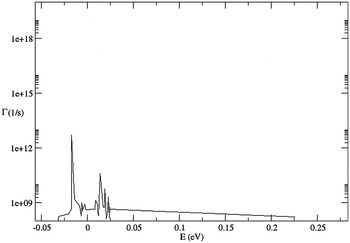
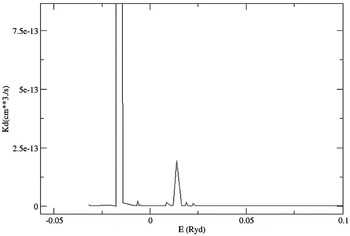
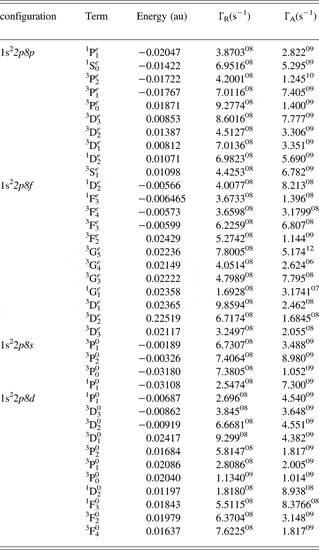
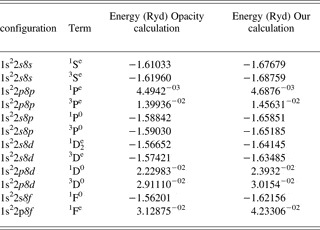
Relativistic calculation has been done to output energy levels for 1s22s8l and 1s22p8l levels in Al9+. For the even-parity resonance levels the radiative rates were determined for the decay to the multiconfiguration levels involving the odd-parity configurations: 1s22s8p and 1s22s8f, while the autoionization rates were determined for the decay of the even-parity resonance levels to the single-configuration levels involving the even-parity configurations: 1s22sɛs, 1s22sɛd, and 1s22sɛg, ɛ ≤ 8. For the odd-parity resonance levels, radiative rates were determined for the decay to the multiconfiguration levels involving the even-parity configurations 1s22p2, 1s22s8s, and 1s22s8d, while the autoionization rates were determined for the decay of the odd-parity resonance levels to the single-configuration levels involving the odd-parity configurations: 1s22s8p, 1s22p8d, and 1s22s8f levels. Results are shown in Table 1. To check the accuracy of the resonance positions we compared our calculated energies with those reported by the Opacity team, and a very good agreement has been observed. In Table 2, we present these data. The resonance-level energies are calculated relative to the ionization threshold 2Se.Figure 7 presents the temperature-independent contribution of the Al9+ states to DR rate coefficient as a function of energy, relative to the ionization threshold. Resonances attributed to 1s22p8l configurations straddle the threshold, with a strong resonance feature found at −0.02 eV. We recall here that for positive resonance energies (Fig. 6), the values of K d (cm3s−1) as a function of electron temperature (kT in eV) has shown a first maximum (near 10 eV) due to the core transitions 2s–2p while the other two recombination ways (core transitions 2s–3p and 2p–3d) are dominant above 50 eV and maximum at 150 eV. The effect of including the negative-energy resonance-level into the rate coefficient calculation is shown in Figure 8. In this figure the electron temperature has been considered 1 eV.
The temperature-independent contribution of the Al9+ states to DR rate coefficient, Γ ≡ (2Jr + 1)/[2(2Jc + 1)][ΓA ΓR/(ΓA + ΓR)], as function of energy, E, relative to the ionization threshold. The energies were obtained from DARC code shifting the core energies to the NIST values.

The DR rate coefficient (in cm3s−1) for Al10+: a relativistic perturbation theory calculation at 1eV.

Al9+ resonance-level energies, in atomic units (au), the radiative transition rates, ΓR, and the autoionization transition rates, ΓA. a −b read s a × 10b

Comparison between the resonance –level energies (this work), in Rydberg units (Ryd.), and those reported by the Opacity team calculation. a −b reads a × 10b

3. CONCLUSIONS
In order to investigate the dominant states in DR of Li-like- into Be-like-Al ions in short-pulse laser produced plasma, we have used the low-order relativistic perturbation theory in electron collision with Al10+. Additionally, two experimental scenarios of short-pulse laser produced plasma on Al targets relevant for our theoretical investigation have been revisited. The resonance positions in Al10+ have been calculated above and below the first ionization threshold. Resonances attributed to 1s22p8l configurations straddle the threshold, with a strong resonance feature found at −0.02 eV. The consequence on the relative populations of excited levels during the recombining phase of laser-produced plasma will provide a guide for future experiments devoted to the contribution made by below threshold resonances to recombination in plasmas. From our results we conclude that it is necessary to take into account the negative-energy resonance levels contribution to DR rate coefficient. However, we must also conclude that the DR should be taken into account not only through the core excitation 2s–2p, as we have done in this work, but also through the 2s–3p and 2p–3d core excitations which occur with higher electron energies, i.e., at higher temperature (>150 eV). Regions of higher temperature are also with higher densities so that we can expect a favorable effect, arising earlier and at shorter distance. We are now extending the present study to verify this expected effect.
ACKNOWLEDGMENT
This work was supported by CNCSIS-UEFISCSU project number RNP 1/2012