Introduction
The demand for organic meat products is growing in all of Europe in response to an increasing concern for safety, human health and environmental issuesReference Napolitano, Girolami, Braghieri, Nelson and Artamova1. Past studiesReference Loureiro and Umberger2, Reference Tranter, Bennett, Costa, Cowan, Holt, Jones, Miele, Sottomayor and Vestergaard3 have shown that consumers assign to organic products a high level of food quality and safety, as well as other benefits. For instance, organic beef is associated with lower ‘food miles’ than conventional beef. Consumers tend to associate organic beef production with good health, animal welfare and concern for the environmentReference Grunert, Brendhal and Brunsø4. Studies carried out in different European countries have found that consumers’ motivations in the purchase of organic food is mainly related to concerns for health, environment and animal welfareReference Harper and Makatouni5–Reference Padel and Foster11.
According to the quality guidance approachReference Steenkamp and Van Trijp12, consumers need information on the quality characteristics of the product in order to evaluate food quality. They receive this information through cues, which are pieces of information used to form quality expectationsReference Steenkamp13. Physically related aspects (color, visible fat, etc.) are named intrinsic cues, whereas product-related aspects that are not physically part of it are extrinsic cues (breed origin, animal welfare, etc.).
Researchers have separated those attributes which are important in explaining demand for organic food products in two quality attributes groups: credence and experienceReference Tranter, Bennett, Costa, Cowan, Holt, Jones, Miele, Sottomayor and Vestergaard3, Reference Gracia and Magistris14. The latter are attributes that consumers can only determine during or after consumption, but not at the time of purchase, such as the tenderness of a steak. Credence attributes, instead, cannot be discerned by consumers even after consuming the product, such as animal welfare or (lower) environmental impact. According to the multi-attribute approachReference Bernuès, Olaizola and Corcoran15 consumers combine experience and credence cues into a composite perception of overall quality. Thus, consumers who prefer organic to conventional food are likely to perceive and highly value credence attributes of organic products and consequently are expected to be willing to pay a higher price for these characteristics.
In our study we considered four credence attributes related to beef choices: (1) the organic mode of production, contrasted to conventional and genetically modified (GM)-fed beef; (2) production methods respectful of animal welfare as opposed to conventional methods; (3) country of origin, which is also a proxy for food mileage; and (4) breed origin, as a proxy for biodiversity conservation.
Of course, these variables are not exhaustive of the broad range of environmental and ethical attributes that determine food (and beef) choice by consumers. They have been selected among those mentioned by Padel and GössingerReference Padel and Gössinger16 because they could be easily related to beef choice by consumers.
The organic attribute—per se—is related to both quality and safety concerns, and embeds many environmental and ethical-related attributes. In this study, we contrasted beef produced organically with both conventional and GM-fed beef. Conventional animal farming has been seriously challenged by recurrent crises (such as mad cow disease, foot and mouth disease, scrapie, etc.) which resulted in increased concern by consumers for food safety.
Previous studies have shown that diffidence toward beef from GM-fed cattle is particularly high in EuropeReference Tonsor, Schroeder, Fox and Biere17, Reference Lusk, Roosen and Fox18. In 2007, the EC issued a revised EC Regulation for organic food and farming no. 834/2007, which came into force on January 1, 2009. The Regulation contains many novelties—generally welcomed by the organic sector—but also introduces a very controversial reference to mandatory labeling of GM food. The exclusion of GM ingredients or feed in organic production is bound to be below the same threshold applied to conventional farming, i.e. not more than 0.9%. At the same time, the reference to the GM labeling scheme is thought to ‘provide for numerous loopholes which allow for the presence of GM materials beyond 0.9 percent in organic products’Reference Schmidt19, since unwanted components such as those introduced accidentally, are believed not to trigger mandatory GM labeling. Therefore, the risk of contamination of organic food by GM materials is a serious threat, and the coexistence of organic and GM crops is a concern for both organic farmers and consumers.
Animal welfare is widely recognized as one of the most important credence characteristics for consumers. In their study on preferences for pork product and process attributes, Caracciolo et al.Reference Caracciolo, Cembalo, Cicia and Del Giudice20 found that generally European consumers take account of animal welfare attribute more than other intrinsic product characteristics. Nevertheless, this concern seems to vary across European countries: northern European consumers have higher propensity toward sustainable pig farms, while consumers from southern Europe show greater attention to meat fat quality. Moreover, Cicia and ColantuoniReference Cicia and Colantuoni21 in their meta-analysis for willingness-to-pay (WTP) on meat traceability, indicate Animal Welfare with Food Safety and Country of Origin as the most requested attributes. In our study, for simplicity, we measured animal welfare using a cue that any consumer could easily understand: were the cattle allowed to range freely (in pastures or paddock) or were they confined and chained? In Italy, most beef cattle are not free-range, and are intensively raised in confined stables.
Country of origin is a quality attribute related to the concept of traceability, an aspect of increasing importance in consumer's choice and behind the motivation to purchaseReference Hocquette, Richardson, Prache, Medale, Duffy and Scollan22. In a previous study, beef origin was identified as the most important attribute, followed by information about animal welfare and price, in purchase decisionsReference Schnettler, Vidal, Silva, Vallejos and Sepúlveda23. A more recent studyReference Villalobos, Padilla, Ponce and Rojas24 shows that beef of national origin, which is produced with protocols respectful of animal welfare and production processes ensuring product quality, is perceived as a highly attractive product by the majority of the consumers. We note that the WTP for country of origin may largely differ between countriesReference Cicia and Colantuoni21 and even within each single country, depending on cultural differences and on other macroeconomic variables (i.e., inflation and per-capita income). In terms of observable characteristics of beef steak, our study includes color, visible fat and price, which previous studies identified as the most significant intrinsic quality characteristics for beefReference Loureiro and Umberger2, Reference Acebron and Dopico25.
Against this background, this paper reports some preliminary results of a case study on consumer's preference for organic beef production by means of non-soy-based feed. An unlabeled choice experiment was conducted to investigate consumer preferences and WTP for organic, conventional and GM-fed beef with respect to the intrinsic and extrinsic cues mentioned before. From these choice data we investigate the role of the organic label as an identifier of environmentally related beef quality in three Italian locations. As preference measurements are quantitatively expressed in terms of trade-off between one attribute versus another, we focus on a trade-off that would be meaningful to most, which is that with money, so that we obtain estimates of marginal WTP.
Data and Methodology
This section reports on the choice experiment used for data collection and on the statistical analysis of the data collected in order to retrieve structural estimates of utility functions. Choice experiments are used in applied economics to derive structural estimation of consumer preferences for products currently not available in the market, such as in our case GM beef. In Italy, in 2008, this production method was only hypothetical because livestock could not be fed GM-labeled feed (i.e., feed containing more than 0.9% of GM materials). Choice in the experiment takes the form of selecting the favorite alternative out of a set of three. The interpretation of observed choices is based on the Lancasterian theory of valueReference Lancaster26, which purports the total value of a product as the sum of the values of its valuable characteristics. By observing people's choices in a number of experimentally designed choice contexts, statistical models of choice are estimated and interpreted using random utility theoryReference McFadden and Zarembka27.
Data collection and sample
Experiments were conducted in three different Italian locations in northern (Udine), central (Ancona) and southern Italy (Potenza), during February–March 2008. Apart from their geographical location, we chose these cities because the ‘average’ Italian is more likely to live in a town with a population between 50,000 and 200,000 (such as those we have surveyed) than in large cities such as Rome, Milan or Naples with a population over a million. Italy has only three cities with a population larger than 1 million, but has a population of 60 million. Even if one considers the larger city conurbations, fewer than 20 million people live around large urban centers. Medium-sized towns were chosen because the majority of Italians live in urban centers with these characteristics.
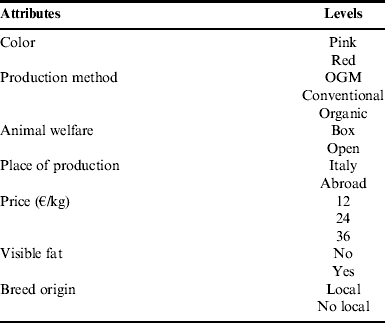
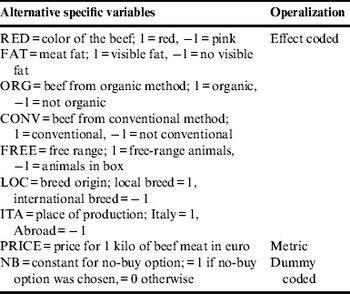
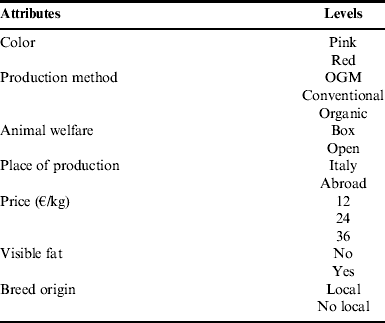
The preference structure behind the attributes of beef was unknown a priori. However, the set of intrinsic and extrinsic cues embodied in the attributes selected to describe the beef steaks were either determined by the objective of the study or by the importance that they have in determining beef choice. Seven attributes were selected to describe steaks: color, visible fat, production method, animal welfare, place of production, breed origin and price. All selected attributes and their levels are reported in Table 1. The three price levels were determined on the basis of the average selling price for beef in the three surveyed towns: the basic price (12 euros/kg) was the average price for conventional beef, while the second level (24 euros/kg) was the average price for organic beef. The third level (36 euros/kg) was a price at which most people were expected to refuse to purchase 1 kg of steak. Color and visible fat instead were used as they are often used as indicators of quality and taste, depending on people's taste and state of health, some like more and some less visible fat in their steaks. All the other credence attributes were dictated by the objective of our research.
Choice experiment attributes and levels.
Since optimal experimental design for preference-based models of choice depends on the underlying preference structure in the population, the overall sample was subdivided in three sequential stages so as to gradually build up an adaptive design. Each stage in the sequence allowed for more information to be included in the previously established prior stage and was hence embedded in the experimental design of the subsequent stages. This gave the experimental design the ability to become gradually more targeted to the specific preference structure that the survey was uncovering as more information was gathered from the field. This is a form of adaptive design at the population, rather than the individual, level.
More specifically, the survey instrument and the allocation of attribute levels to alternatives were designed using a sequential Bayesian approachReference Scarpa, Campbell and Hutchinson28, tested in a pilot study and then refined after each stage of data collection and optimized for Bayesian WTP-efficiencyReference Scarpa and Rose29, Reference Vermeulen, Goos, Scarpa and Vandebroek30. All designs involved 36 choice tasks orthogonally blocked in three blocks of 12 each and were obtained using the Ngene software31. Each design was a fraction of the full factorial that was optimized on the basis of the a priori information available that far, and the assumption of a specific statistical model of reference [the multinomial logit (MNL) model] as well as the specific statistic of interest from this model (the minimization of the sum of the marginal WTPs, seeReference Scarpa and Rose29, Reference Vermeulen, Goos, Scarpa and Vandebroek30). A sample of 145 subjects (50 each in Udine and Potenza, 45 in Ancona) completed the sequence of choices, for a total of 1740 choices. The panel formulation was accounted for in the analysis using a mixed logit (MXL) model whereby the sequence of choice by each respondent shared the same preference structure and hence were correlated.
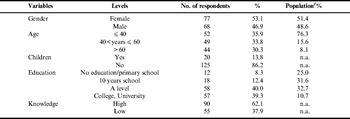
Respondents were recruited among generic food buyers. A quota sampling method was followed, with stratification criteria including age, consumption frequency of beef and organic products, in order to have enough variability between the subgroups. These were almost equally distributed among three age groups: ⩽40; 40 < age ⩽ 60; >60. To be recruited subjects had to consume beef at least 1–2 times a month as well as occasionally (not regularly) consume organic products. Sample composition is reported in Table 2. As expected, given that the sample was not chosen to be representative; females are slightly overrepresented, while younger people are underrepresented. Besides, as often is the case with survey data, less educated people are underrepresented.
Summary statistics on characteristics of respondents.

1 Source of population data: ISTAT data warehouse (http://www.istat.it).
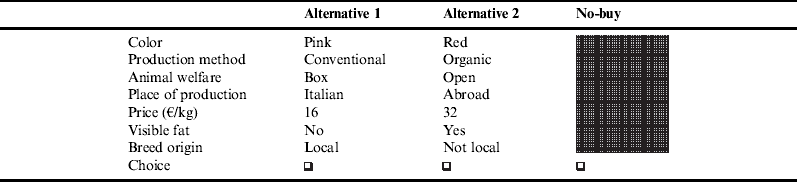
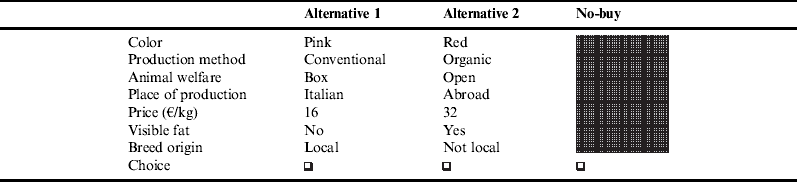
During the choice experiment, respondents were asked to choose between two types of beef steaks or neither of the two (no-purchase option). All experimental sessions were conducted in the sensory laboratory of the local university, although this was not a sensory-based experiment. Subjects who agreed to participate were asked to reach the university building at an arranged date and time. Upon arriving at the venue, respondents received a participation fee and filled in a questionnaire collecting their socio-demographic characteristics and their self-reported knowledge of organic products. Each respondent was then asked to identify their favorite alternative in each of 12 choice tasks, each including a no-buy optionReference Hensher and Bradley32. This option was included in order to make the choice more realistic compared to a normal purchase situationReference Haaijer, Kamakura and Wedel33. In order to reduce hypothetical biases a cheap-talk script was usedReference Carlsson, Frykblom and Lagerkvist34. Table 3 shows an example of choice task used in the survey.
Example of choice experiment task.
Econometric methods
We explain the probability of selecting the favorite alternative from each choice set presented to the respondents using discrete choice models. So the indicator for choice is our dependent variable. Discrete choice models based on random utility theory allow researchers to derive WTP estimates for attributes describing product profiles and evaluated by respondents in a series of experimentally designed choice tasks. The behavioral foundations of this method are based on Lancastrian consumer theoryReference Lancaster26. According to Lancastrian consumer theory, utilities for goods can be decomposed into separable utilities for their characteristics or attributes, whereas random utility theoryReference McFadden and Zarembka27 suggests that individuals acting rationally should try to maximize their utility and hence would select the alternative that yields the highest utility. However, only the deterministic portion of such utility V ij is observable by the researcher, who treats the remaining unobservable part e ij as random, where i denotes the respondent and j denotes the alternative.
So, the total utility of the beef steak described in alternative j to individual i from the researcher's perspective is represented as the sum of two utility components:
 $$U_{ij} = V_{ij} + e_{ij} $$
The systematic component V ij, can be further approximated by a linear function of steak attributes in the vector X ij and the population utility weights for each attribute collected in the vector β:
 $$V_i _j = {\rm \beta'}X_{ij}. $$
The probability that the individual prefers a given beef steak j to any other options available can be expressed as the probability that the utility associated with that steak is higher than the utility of all other k options.
In our case the indirect utilities structure for the three alternatives was:
 $$\eqalign{V_1 = &\, {\rm \beta} _1 {\rm RED} + {\rm \beta} _2 {\rm FAT} + {\rm \beta} _3 {\rm ORG} + {\rm \beta} _4 {\rm CONV} \cr & + {\rm \beta} _5 {\rm FREE} + {\rm \beta} _6 {\rm LOC} + {\rm \beta} _7 {\rm ITA} + {\rm \beta} _8 {\rm PRICE} \cr V_2 =&\, {\rm \beta} _1 {\rm RED} + {\rm \beta} _2 {\rm FAT} + {\rm \beta} _3 {\rm ORG} + {\rm \beta} _4 {\rm CONV} \cr & + {\rm \beta} _5 {\rm FREE} + {\rm \beta} _6 {\rm LOC} + {\rm \beta} _7 {\rm ITA} + {\rm \beta} _8 {\rm PRICE} \cr V_3 =& \, {\rm \beta} _0 {\rm NoBuy}} $$
Price was the only variable that was coded numerically instead of categorically, the underlying assumption being that the marginal utility of money is constant over the range of expenditure, which we consider an acceptable approximation since the range of monetary variation is small.
Thus, the probability that individual i will choose steak in alternative j out of k alternatives in the choice task is:
 $$\Pr (\,j) = {\rm Prob}(U_{ij} \gt U_{ik} ){\rm \forall} j{\rm \ne} k$$
The assumption of independently and identically distributed (i.i.d.) Gumbel-distributed error term leads to a logit modelReference Lancaster26 known as Multinomial Logit model (MNL), in this case the probability that the individual i will choose the alternative j is a logit probability:
 $$P(Y = j) = \displaystyle{{{\rm e}^{\beta 'x_{ij}}} \over {\sum\nolimits_{\,j = 1}^J {{\rm e}^{\beta 'x_{ij}}}}} $$
The unknown population parameters β are typically estimated by maximizing the sample likelihood over the parameter space. An MNL model imposes the condition that e ij is i.i.d., while β does not vary across individuals (preference homogeneity) and all members of the population are preference ‘clones’. However, these conditions are too restrictive in most applications. The random parameter MXL model for panel observations introduced by Boyd and MellmanReference Boyd and Mellman35 and popularized by TrainReference Train36 obviates the limitations of preference homogeneity (all respondents as preference clones) and allows for the more realistic hypothesis of taste variation across respondents. In an MXL model, the utility of individual i from alternative j is specified as
 $$U_{ij} {\rm = \beta '}_i \,X_{ij} + e_{ij} $$
where X ij are observed variables that relate to each alternative and decision maker, βi is a vector of coefficients for these variables for individual i representing that person's tastes and e ij is a random term.
So, the utility function is defined as
 $$U_{ij} = ({\rm \beta} + \Omega '{\rm \eta} _i )'X_{ij} + e_{ij}, $$
where β is the mean vector and the idiosyncratic departures are Ω′ηi where the first term is a Cholesky matrix that introduces correlation across random effects, and suitable distributional assumptions are made for the random departure ηi.
Conditional on βi, the likelihood that individual i chooses alternative j is still a logit probability. However, since βi is random and not known, the (unconditional) choice probability is the integral of this logit formula over the density of βi. This is approximated by simulation at the stage of estimation. The ultimate purpose of estimating a model of choice is generally to obtain unbiased estimates of the mean taste parameter vector β, and the pattern of variance–covariance of the idiosyncratic components Ω. Generally, in both MNL and MXL specifications, marginal WTP for each attribute of choice is calculated as the ratio of coefficients:
 $${\rm WTP} = - \displaystyle{{{\rm \beta} ({\rm attribute}\,{\rm level})} \over {{\rm \beta} ({\rm price})}}$$
This way of proceeding employs models specified on the ‘preference space’, where often the price coefficient is held constant. This assumption makes the estimation easier but requires undesirable restrictions on the model, such as a constant marginal utility of money.
Instead of modeling taste heterogeneity in preference space—that is by specifying the distribution of coefficients in the utility function and then using them to derive the distribution of marginal WTP—Train and WeeksReference Train, Weeks, Scarpa and Alberini37 proposed a way of specifying utility in the monetary space (WTP-space). This allows the researcher to directly assume the distributions of marginal WTP, which is very advantageous, while requiring a simple reparameterization. Recent studies have found that models in preference space tend to provide a less reasonable distribution of WTP than the models in WTP-spaceReference Train, Weeks, Scarpa and Alberini37, Reference Sonnier, Ainslie and Otter38 even though at times they fit the data better. However, Scarpa and Rose,Reference Scarpa and Rose29 in their application of WTP space models on environmental issues, found that models in WTP-space also fit the data better than the model in preference space. Similar results were obtained by Balcombe et al.Reference Balcombe, Chalak and Fraser39.
One advantage of using panel models with repeated choices from each respondent is that one can obtain an estimate of WTP for each individual respondent by conditioning on the sequence of choices contexts for each. Such posterior, conditional estimates provide more accurate information for each respondent and facilitate validation.
Results
The data were analyzed by means of standard MNL model, random-parameter MXL models, both of which used preference space specifications, and then using random-parameter WTP space models (WTP-space). Both the random-parameter models were estimated under two specifications of the behavioral profile of preference heterogeneity for each modal attribute of the variables: a normal distribution and a constrained triangular distribution. Following Hensher et al.Reference Hensher, Rose and Greene40 and Greene et al.Reference Greene, Hensher, Rose, Scarpa and Alberini41, the constrained triangular distribution with mean parameter equal to its spread was chosen in order to achieve behaviorally plausible WTP distributions and bound large and implausible value estimates. We compare these results to those obtained assuming a normal distribution of taste heterogeneity. The no-buy option was specified as normally distributed in both cases.
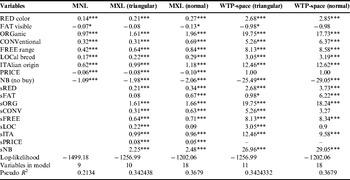
Table 4 shows coefficient estimates for MNL, MXL and WTP-space models and Table 5 reports the coding of all variables. The last two models allowed for estimating individual-specific WTP for the selected beef steak attributes. All variables, apart from price and status quo, are effect coded. With effect coding the constant is equal to the grand mean of all of the observations. The coefficients of each of the effect variables are equal to the difference between the mean of the group coded 1 and the grand mean. Effect coding in a choice experiment allows the estimation of the effects of all levels without any correlation with the constant. However, when the variables are effect coded, the estimated unconditional and conditional WTPs have to be multiplied by 2 to obtain the actual marginal WTP valuesReference Bech and Gyrd-Hansen42.
Estimated coefficients for the different models.

*** **, *Significance at 1%, 5% and 10% level.
Variable and coding.

* GM-fed beef = (ORG = −1, CONV = −1).
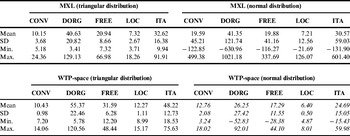
With few noticeable exceptions, standard deviations are significantly different from zero for the majority of variables in all models, showing heterogeneity in consumer preferences (Table 5). Generally speaking, the WTP estimates increase when going from MNL (with no taste heterogeneity) to WTP-space models. In both preference- and WTP-space, the specification with normally distributed taste fits the data better (Log-L −1202.06) than the one specified assuming a constrained triangular distribution for the parameters (Log-L −1256.99). Since the models in WTP-space provide a more reasonable distribution of individual WTPs than the models in preference space, we will concentrate on the results from the former.
In Table 6, we report the mean conditional WTP estimates for the attributes of interest in this study, namely the ethical and environmental attributes. The variable DORG consists of the mean difference in individual-specific WTP estimates between organic and conventional production, and approximates the ‘premium price’ per kg of beef derived from consumer choice statements. Hypothetical choices are known to lead to over-estimates and these amounts should probably be discounted by one-sixth to account for hypothetical biasReference Lusk and Schroeder43.
Mean conditional WTPs for ethical and environmental attributes.

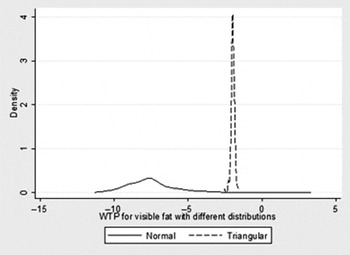
The mean value estimate for visible fat is not different from zero for most of the models. However, the estimated standard deviation is significant, indicating that there is much variation across consumer preferences. Respondents are split into two distinguishable groups: people who do not like visible fat in beef steak (the majority) and a vast group of people who either do not like fat or are indifferent to it.
The tendency is clearly visible in Figure 1 where the distribution of individual-specific WTP for the fat attribute at individual level is reported (from the WTP-space model), for both normal distribution and constrained triangular. Using the latter distribution—which constrains the parameters in the 0–2β range—the heterogeneity in consumer tastes is reduced to a minimum, but this is an artificial result not representing the true spanning of preferences between the ‘visible fat in steak’ lovers and those who want lean meat. This shows a shortcoming of using bounded or constrained distributions. Therefore we will stick to the unconstrained, normally distributed WTP-space estimates as most reliable.
Kernel density plot for conditional WTP of FAT (triangular and normal distributions).

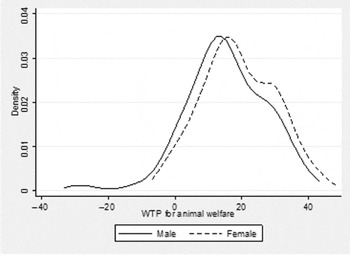
Socio-demographic characteristics in most cases do not seem to influence choices nor implied marginal values. The only noticeable exception is gender: women have a higher WTP for higher animal welfare than men, and the difference is statistically significant (Fig. 2).
Kernel density plots of conditional WTP for animal welfare in different gender groups.

Organic production and domestic origin were the most relevant attributes for respondents. Consumers reject GM-fed beef, which is perceived as a ‘bad’ good or non-good, in contrast to other types of beef. We estimated a difference in WTP of 12.76 euros/kg between conventional and GM-fed beef. Thus, compared with a medium price of 12 euros/kg (average price in the three survey locations in euros/kg in February 2008, for a conventional fresh beef steak, first cut44), consumers are willing to be paid 0.76 euro/kg for purchasing GM-fed beef, confirming the fact that GM-food is something European (and, especially, Italian) consumers are not willing to accept without compensation.
Organic is perceived as a much safer production method to avoid GM contamination risks than conventional. Besides, organic entails other environmental- and health-related meaningsReference Gambelli, Naspetti and Vairo8. Looking at the normally distributed, WTP-space estimates in Table 6 (those in italics), consumers are WTP a price premium (DORG = ORG − CONV) of 26.25 euros/kg. Even considering the correction for hypothetical bias (one-sixth of the marginal WTP), the resulting absolute WTP (12 + 21.86 = 33.88 euros/kg) is well above current average organic market price (24 euros/kg). An explanation for such a high result is twofold. First, since our sample included highly educated and older-than-average Italians, a portion of this premium could be ascribed to an (unmeasured) income effect. Second, one must consider that the European (and Italian) market for organic beef is very volatile: periods of undersupply follow periods of oversupply, due to the fact that high WTP attracts new farmers but then—due to the time needed for conversion—time is required to react to market price increases. It happens that prices tend to increase further attracting farmers into the market until the market dropsReference Napolitano, Girolami, Braghieri, Nelson and Artamova1, 45. In 2008, there was a period of undersupply in the Italian organic beef marketReference Naspetti, Zanoli and Ricke46. So, the results may indicate that the market did not fully exploit the potential premiums. Indeed, such a fact may be explained by a long-term strategic approach to marketing of organic beef: increasing organic prices in the short term would allow market equilibrium (since some consumers will simply stop demanding the product), but will eventually hamper the future prospect of the sector, when supply would eventually increase. So, for retailers, it is probably better to accept a higher amount of unsatisfied demand than to accept sharp rises of organic beef price.
Other ethical and environmental variables are also valued positively: estimates ranges from 24.69 euros/kg for lower food miles (i.e., national origin: ITA) to 6.40 euros/kg for biodiversity preservation (i.e., LOCal breeds), passing through 17.29 euros/kg for animal welfare (FREE). Globally, ethical and environmental issues (credence cues) appear more relevant in explaining the overall WTP for organic beef than ordinary product characteristics (search cues: RED, FAT).
Concluding Remarks
Albeit our study was limited in geographic scope and sample representativeness, we conclude that ethical/environmental issues (credence cues) appear to play a relevant role in explaining WTP variation for organic beef, perhaps more so than ordinary product characteristics (search cues). For example, our results confirm that animal welfare is a relevant extrinsic cue in organic meat purchase, coupled with local/nation origin and local breedsReference Carlsson, Frykblom and Lagerkvist47–Reference Napolitano, Girolami and Braghieri52. These preliminary results suggest a potential increase in the role of ethical concerns in consumers of organic beef in Southern European countries (such as Italy), where health-related credence attributes used to be the main drivers for organic consumptionReference Gambelli, Naspetti and Vairo8, Reference Padel and Foster11.
Further research should address some of the limitations of our study, in order to confirm or disconfirm our findings.
Acknowledgements
This research was supported by the ‘EQUIZOOBIO’ research project (Efficiency, Quality and Innovation in Organic Livestock Production) funded by Interregional Governmental funds in Italy.