

Introduction
Nathan Witkin, in his article The Cost of Closed Doors…,Footnote 1 attempts to reframe the question of whether child dependency proceedings should be open or closed to the public and press by positing a balancing test between “dependent families seeking privacy…and the macro-level benefits of a more transparent system.”Footnote 2 Witkin’s hypothesis is that opening dependency proceedings educates the public that child welfare spending must be increased, that transparency leads to “greater per capita” spending in open versus closed dependency systems, and finally, that more child welfare spending will result in fewer per capita child welfare fatalities in open court states.Footnote 3 This article will examine both sides of Witkin’s proposed balancing test to demonstrate that his approach fails to prove his hypotheses. First, it will discuss how Witkin’s almost total reliance on twenty-five to thirty-year-old psychological studies rather than on contemporary mental health research substantially understates the potential dangers to child abuse victims, especially LGBTQ+ and polyvictimized children, from opening child dependency proceedings. Second, it will present evidence that the welfare budgets did not constantly increase in some closed court states that were later opened to the public, but rather fluctuated through sporadic ups and downs which over time resulted in almost no net longitudinal budgetary increases. Second, those originally closed courts that were later opened had their child fatality rates actually increase which is the opposite of Witkin’s predictions.
Child abuse and neglect continues to be a crisis in the United States. For instance, in 2022 there were “558,899 victims of child abuse and neglect nationally.”Footnote 4 In order to protect those child victims hundreds of federal and state laws provide specialized state court systems, termed “dependency courts,” to litigate allegations of abuse and/or neglect.Footnote 5 Those courts also determine what types of interventions are needed to protect children and what reasonable services the government can provide in an attempt to cure the conditions that led to the abuse and to provide for safe family reunification if the children were temporarily placed outside the custody of their parents.Footnote 6 To meet its burden of proof during those hearings, the government must introduce evidence, not only of the alleged child abuse and/or neglect, but it is also required to demonstrate that the children are in ongoing danger and that formal court intervention is necessary to protect them.Footnote 7 Much of the evidence produced in court is very personal about family members, often embarrassing, and frequently protected by confidentiality laws.Footnote 8 The witnesses can include abused children, parents, relatives, significant others, social workers, medical personnel, and psychologists and psychiatrists.Footnote 9 Relevant evidence frequently includes information about the parents’ and children’s medical and mental health history, criminal history, school record performance data, and drug and alcohol information.Footnote 10 It is therefore not surprising that one of the central issues in dependency proceedings is whether those court hearings will be open or closed to the public and press.Footnote 11
Although the United States Supreme Court has determined that the media and public have a presumptive constitutional right to attend adult criminal trials, it has never extended that constitutional right to attending juvenile dependency proceedings.Footnote 12 Therefore, states have been free to experiment with different models of dependency proceedings ranging from a ban on admitting the press and public to court systems that presumptively admit them into most aspects of dependency proceedings unless likely harm to the abused children is demonstrated.Footnote 13 The state court models of dependency hearings range from states with proceedings that are: (1) very strictly closed; (2) presumptively closed; or (3) open or presumptively open.Footnote 14 According to Witkin, only a minority of states have open or presumptively open dependency court systems.Footnote 15
Since there is no established constitutional right for the press and public to attend dependency proceedings, each state must balance competing interests to determine whether its hearings will be open or closed and whether, even if presumptively open, some aspects of those proceedings will be absolutely closed to the public and press. The factors most often identified by opponents and proponents of admitting the press and public are best summarized by the California case, San Bernardino County Dep’t of Pub. Soc. Servs. v. Superior Court. Footnote 16 The San Bernardino court noted the open court proponents’ reasons to admit the press and public. It noted that opening the courts might promote: (1) fairness; (2) improve “juvenile court practice”; (3) discourage perjury; (4) encourage witnesses to come forward; (5) check judicial abuse; and (6) educate the public about the dependency system.Footnote 17 The San Bernardino case also summarized open dependency court opponents’ concerns: (1) juvenile proceedings, unlike adult criminal cases, have historically been private; (2) juvenile proceedings are meant to be informal and non-adversarial unlike adult trials; (3) opening the courts will cause community stigma around child abuse victims and make reintegration into society more difficult; (4) the lack of confidentiality will cause the abused child to be retraumatized psychologically; and finally (5) non-confidential proceedings will make it more difficult for the court to discuss and provide the needed family reunification services that are necessary to determine whether and when an abused/neglected child should be returned home or placed for adoption.Footnote 18
Witkin’s article fits within this historical context of states and dependency court judges attempting to balance the benefits of opening juvenile dependency proceedings with the potential serious dangers to abused children and their families should confidentiality be abrogated. As the following discussion will demonstrate, Witkin fails to present sufficient evidence that shows that opening juvenile dependency courts will provide enough social benefits to warrant risking further injury to abused children and their families. Most troubling is that Witkin’s article: (1) relies almost exclusively on twenty-five to thirty-year-old psychological studies rather than on relevant contemporary research; (2) fails to discuss the many limitations and warnings by the authors of those decades old psychological studies; and (3) fails to discuss the critically important contemporary social issues of how abrogating confidentiality will lead to bullying and community ostracism of LGBTQ+ child abuse victims, polyvictimized minors, and their families. In sum, he fails to demonstrate that abandoning the historically private and non-adversary child protective functions of the dependency courts will result in a net social benefit that is worth risking abused children’s mental health and potential family stability attained through court-ordered reunification services.
I. Witkin’s Discussion of Decades Old Data is Inconsistent with Contemporary Pscyholgical Studies on the Dangers to Abused Children in Open Child Dependency Courts
Witkin appears to dismiss “closed court advocates[’]” fears of “psychological harm to victims of child abuse” from the effects of open courts with four short paragraphs that cite to three studies published between 1990 and 1997.Footnote 19 Witkin’s use and discussion of those older psychological studies makes reliance on his article by public policy decision makers difficult because it: (1) omits critically important data from those studies; and (2) does not discuss other researchers’ analyses of those studies that demonstrate their serious methodological flaws and limitations.Footnote 20 As the following discussion will demonstrate, Witkin’s statement that the studies he relied on concluded that child victims who testify in “dependency hearings” suffer less distress than those who testify in open adult criminal trials appears to overlook the fact that the studies he cited involved dependency hearings that were “closed,” meaning not open to the press and public.Footnote 21 It comes as no surprise that children who testify in dependency hearings closed to the public would suffer less trauma than those children who were forced to testify in open adult criminal trials. Although not discussed by Witkin, his cited studies actually found that children suffered less trauma in closed judicial proceedings, even in closed adult criminal proceedings than in hearings open to the press and public.Footnote 22 Witkin’s cited studies provide no evidence that child victims are safe from emotional harm from open dependency hearings.Footnote 23 Even more important is that Witkin’s reliance on other researchers’ 1990s psychological studies is problematic because they were published well before contemporary psychological literature discovered the dangers of public disclosure of polyvictimized and LGBTQ+ child abuse victims’ identities and stories, as will be discussed, infra. Footnote 24
A. Witkin’s Reliance on the Whitcomb Study is Misplaced for Several Critical Reasons
Witkin discussed a 1994 study by Whitcomb to support his position that testifying in dependency court is less traumatic for abused children than testifying in adult criminal court: “[t]his distinction between children testifying in dependency hearings versus adult criminal hearings is supported by meta-analysis.”Footnote 25
First, the Whitcomb authors never stated that their study involved abused children appearing in open dependency proceedings. In fact, none of the three studies examined in the Whitcomb meta-analysis involved children testifying in dependency proceedings open to the public and press. Indeed, those three child witness studies found that child witnesses were less traumatized in only two types of hearings that they studied: (1) child dependency proceedings that were potentially closed to the public (the Runyan North Carolina study)Footnote 26; and, (2) adult criminal proceedings that were closed to the public (the Goodman Denver study).Footnote 27 Because the North Carolina authors never specified whether their study involved any children testifying in open dependency proceedings, Witkin’s reliance on that study is misplaced.Footnote 28
The third child witness study discussed in Whitcomb’s meta-analysis, the OJJDP study, also provides no support for Witkin’s position that child abuse victims are not at risk of trauma from testifying in open dependency proceedings because the OJJDP study only analyzed child victims who testified in adult criminal proceedings, not dependency hearings.Footnote 29
The Whitcomb study presents no evidence to rebut open court opponents’ fear that child victims are at risk of additional harm in open dependency proceedings. In fact, none of the three studies discussed in the Whitcomb meta-analysis even investigated potential harm to abused children when confidentiality is stripped from dependency hearings.
B. Witkin’s Article Overlooks Highly Relevant Counter Arguments to the Runyan Study Cited in the Forty-Three-Year-Old American Psychological Association Amicus Curiae Brief
Witkin lists a 1990 amicus curiae brief by the American Psychological Association (“APA”) that “noted that children do not experience ‘significant, lasting distress’ from testifying in dependency hearings, unlike testifying as victims in adult criminal cases…”Footnote 30 Witkin’s reliance on that APA amicus brief is strange because: (1) the underlying psychological child abuse study (the “Runyan study”) relied on by the APA is thirty-six years old;Footnote 31 (2) the author of the Runyan Study never stated that any of his research involved abused children testifying in open dependency proceedings;Footnote 32 and (3) the Runyan study took place in North Carolina dependency courts, which may have been open or closed depending on judges’ case-by-case determinations, but does not indicate whether the underlying proceedings were open or closed.Footnote 33
Witkin presented no evidence to demonstrate that the 1990 amicus brief, nor its reliance on the Runyan study, is even relevant to his claim that abused children are not at serious risk in open dependency proceedings since all the evidence supports the conclusion that those hearings were closed, not open. Since neither the APA amicus brief nor the Runyan study it relied on stated that they even examined dependency proceedings that were open to the public, those studies provide Witkin with no support for his claims about the safety of open hearings.
The Runyan study also lacks statistical validity since it only involved the examination of twelve children who appeared in dependency proceedings.Footnote 34 Contemporary psychological researchers have warned against heavy reliance on pre-2000 psychological studies, in part, because the small sample sizes may not provide statistically reliable conclusions.Footnote 35 Small sample sizes can lead to distorted effects and difficulties of replicating the study to test its validity unless they are meticulously designed and sufficiently controlled which did not occur in the Runyan study.Footnote 36 Therefore, the Runyan study does not provide any reliable evidence that child victims are not at risk in open dependency proceedings.
Finally Runyan cautioned that his study has several significant limitations and that it “should not be interpreted as definitive” for several reasons.Footnote 37 First, the study excluded one of the largest age groups of child victims who appear in dependency courts, “children less than 6 years of age…”Footnote 38 Second, Runyan indicated that the greater stress experienced by children in open adult courts versus the juvenile court experiences may be explained by the “[p]rotracted involvement with the criminal justice system”…[and] may increase feelings of powerlessness and subject the child to stigmatization….”Footnote 39 It is critical to note that Runyan found that children in the criminal adult system who had their cases quickly resolved had psychological test scores that “equaled those of children not involved with the criminal justice system at all.”Footnote 40 Thus, the twelve children involved in the dependency court may have had less anxiety than the children involved in criminal court because dependency court proceedings are usually less protracted than adult criminal proceedings because state statutes usually provide for expedited dependency proceedings by establishing short timelines for judicial determinations and by centering juvenile welfare in hearing procedures.Footnote 41 Therefore, Runyan’s findings posit that the relationship between protracted criminal proceedings and more trauma to child victims may have had no causal link to whether the hearings were open or closed to the press and public since it may be that delay in either adult criminal or in dependency proceedings is what leads to worse psychological outcomes for abused children.
Witkin’s heavy reliance on the 1990s Whitcomb and Runyan studies to devalue contemporary critics’ resistance to opening dependency court proceedings to the press and public is thus problematic. Contemporary data presents a contrary picture on potential harm to child victims in open dependency courts than the information relied on by the APAin its 1990s amicus brief.
For example, after reviewing post-2000 child victim research and studies the American Academy of Pediatrics (“AAP”) issued a policy statement in 2016 that was recently reaffirmed in 2023 that whenever possible, there should be an “exclusion of the press and nonessential people” and the “shielding of witness identity” in proceedings involving child victims in court proceedings.Footnote 42 The AAP policy statement also states that “confidentiality be maintained with respect to child witnesses before, during, and after any courtroom appearance. Publicity and loss of privacy may prolong the child’s sense of shame and stigma stemming from the abuse beyond the immediate courtroom appearance. Furthermore, public disclosure of events precipitating a school-aged child’s appearance in court has the potential to lead to exclusionary behavior and bullying by other children.”Footnote 43 The next section will discuss how contemporary psychological literature differs from Witkin’s discussion of the 1990s studies and adds to our knowledge of potential psychological harm to child abuse victims in proceedings open to the press and public.
C. Witkin’s Article Overlooks the Counter Evidence in the Hamblen Study that Testifying in Open Court Proceedings is More Traumatic than Testifying in Hearings Closed to the Public and Press
Witkin’s fourth source regarding the level of harm to children testifying in open dependency proceedings is a 1997 meta-analysis by Hamblen & Levine (the “Hamblen study”)Footnote 44 which he states demonstrates the “distinction between children testifying in dependency hearings versus adult criminal hearings is supported by meta-analyses.”Footnote 45 He uses the Hamblen study to support his earlier claim that children do not suffer “significant, lasting distress” from testifying in open dependency proceedings.Footnote 46
However, again, the Hamblen study assumes that juvenile dependency court proceedings are closed to the press and public.Footnote 47 The Hamblen study clearly states the basis for its comparison of child sexual abuse victims who must testify in dependency proceedings versus in adult criminal trials:
“In [juvenile court] proceedings … the courtroom is closed to the public … [and] if a child does have to testify, it is often in the judge’s chambers.”Footnote 48
“Criminal court proceedings are completely different … . Child
victim-witnesses are usually required to testify in open court … .”Footnote 49
Witkin’s analysis does not account for Hamblen’s conception that dependency courts are closed, and that presumption of closure is at the heart of Hamblen’s discussion of the safety to abused children inside closed dependency courts.Footnote 50 Hamblen contemplates a dependency court system that is closed to strangers who may distress child victim witnesses or media who may publish embarrassing data versus a harshly adversarial criminal courtroom environment with strangers in the audience and a lack of confidentiality.
Witkin asserts that child abuse victims who testify suffer no long term effects;Footnote 51 however, the Hamblen study, after reviewing eight earlier studies, significantly pares back the research data on longitudinal mental health harm from children testifying.Footnote 52 Hamblen states that “more recent research indicates that, for at least a subgroup of child victim-witnesses, there are no long-term negative consequences to providing testimony.”Footnote 53 Hamblen suggests a number of variables that may explain why some child abuse witnesses heal faster and suffer shorter anxiety and stress than others. First, psychological improvement “may…be attributable to the resolution of the case rather than from any effects of testifying.”Footnote 54 Second, the older child witness studies lacked controls over which of the children were sexually abused versus others who may have suffered a different kind of abuse or who were witnesses based, not on their own abuse, but who were witnesses of crimes against others.Footnote 55 Third, even though the psychological testing instruments, such as the Child Behavior Checklist (“CBCL”), were used in some of the studies to determine distress levels, some children who testified and whose CBCL scores decreased over time “continued to demonstrate clinically significant behavioral disturbances.”Footnote 56 And, fourth, Hamblen determined that the evidence clearly indicates that testifying before strangers triggers more emotional trauma for child abuse victims than testifying outside the presence of strangers.Footnote 57 Hamblen discussed the child victim studies which determined that children’s trauma of testifying in open adult criminal cases could be substantially reduced by allowing them to testify either in the court’s chamber or by way of closed circuit television rather than facing those strangers in court: “Children who testified via closed circuit television were viewed as less stressed than children who testified in open court.”Footnote 58
Ironically, as in Witkin’s citation to the Whitcomb study, his citation to the Hamblen study significantly weakens his argument that child dependency proceedings should be open to the public and the press. What we learn from 1990s empirical data on child victims’ reactions to testifying is that child victims are traumatized less and for less time only when testifying in closed hearings, whether they be child dependency or adult criminal court cases.
D. Witkin Erroneously States that Open Court Opponents’ Fears of Psychological Harm to Abuse Victims in Open Courts “Relates Exclusively to Child Testimony” Footnote 59
Witkin claims that “evidence for children suffering psychological harm from courtroom experiences relates exclusively to child testimony.”Footnote 60 Witkin’s claim is inconsistent with psychological literature. Abused children can suffer psychological harm by having embarrassing information, such as drug addiction and alcoholism, about themselves and/or their family members publicly disclosed even when the child does not testify.Footnote 61 Witkin’s article does not discuss any of those 2000 to 2023 psychological studies on child victimization that discuss how both the fear of and actual disclosure of confidential and embarrassing information in dependency proceedings can exacerbate abused children’s psychopathology.Footnote 62
Witkin categorically states that open court opponents have not presented any evidence that child victims have been harmed from dependency hearings where the child did not testify,Footnote 63 in other words, harm caused by the disclosure of information in those open proceedings. In strong contrast, medical and mental health experts and professional associations have cautioned that disclosure of otherwise confidential embarrassing information disclosed in open courts can seriously harm child victims. For instance, as early as 1993, the American Academy of Pediatrics warned that: “[m]edia publication of information about child abuse victims and their families may be detrimental to the victims. This is particularly true in cases of sexual abuse, but it may be just as serious in some cases of physical abuse or neglect.”Footnote 64
Other studies have found that once child victims’ information on their abuse was made public, their school peers “bullied” them and made “homophobic” taunts.Footnote 65 For example, in one case a child’s mother stated that after her child’s information became public: “[in] her school…the kids ostracized so…badgered her…They chased her home in a threatening fashion. She had to take home studies and drop out of public school… .”Footnote 66 In another case, a child victim was represented by a law school legal clinic in dependency proceedings:
the client attempted suicide following disclosure by the client’s therapist that the client had been diagnosed with HIV. The client had been diagnosed a year earlier, but seemed to adjust to her medical status. She maintained control and discretion over who was told about her status. This information was somehow disseminated to the client’s teacher, and then apparently to the client’s classmates. The client’s suicidal ideation did not appear to develop until she lost control and power over disclosure of her medical status.Footnote 67
Since many child abuse victims may not manifest psychological symptoms caused by the disclosure of facts about their abuse to the public for many months or even years after their court proceedings are finalized, it is almost impossible to compile the empirical evidence of their harm that Witkin seems to require in order to close proceedings to the press and public.Footnote 68 Cost-effective research such as surveys of dependency court personnel and participants regarding perceived trauma by child victims in court is insufficient since lay individuals are not equipped to accurately assess the internalized symptoms suffered by victims and because often, the time lag, termed the “sleeper effect,” between the triggering traumatic event and physical manifestations of that trauma occur well after the court proceedings end.Footnote 69
Witkin also asserts that open court opponents’ concerns about the effects on abused children of disclosing confidential and/or embarrassing data in front of the public and press are illusory because that information “is attainable outside the hearings…so closing these hearings is arguably an imprecise policy to achieve these ends.”Footnote 70 The following discussion will demonstrate not only that Witkin is incorrect and that much of the confidential information disclosed in dependency proceedingsFootnote 71 is not available to the press and public outside the courtroom,Footnote 72 but also that such disclosure can have a significant and lasting psychological effect on abused children.
1. The Scope of Confidential and Embarrassing Data Disclosed in Open Dependency Hearings
Witkin’s claim that the information disclosed to the press and public in dependency proceedings “is obtainable outside those proceedings”Footnote 73 by the public contradicts the studies he lists in his “References” section that contain detailed and extensive discussions of the types of evidence regarding children’s and family members’ mental health, general medical records, and drug and alcohol addiction histories that are discussed in dependency proceedings that are not available to the press and public because of state and federal confidentiality laws.Footnote 74 However, the discussion below will demonstrate that much of the confidential information discussed in dependency courts is not available to the press and public through other public sources.
For instance, Witkin refers to a study of the Los Angeles child dependency courts which were improperly opened to the press by the Presiding Judge’s Blanket Order.Footnote 75 That study reported that during twenty hearings open to the press and attended by the author, many pieces of evidence protected by the Social Security Act, FERPA, and HIPAA were disclosed to the media.Footnote 76 Another researcher addressed the irony that open dependency court states that have strict records confidentiality statutes prohibiting release of child welfare data to the press and public do not have similar statutes that require the courtroom be closed when that same confidential information contained in those records is introduced, discussed or testified to in dependency proceedings.Footnote 77 I have been unable to find a single statute in any open dependency court state that requires the dependency courtroom to be closed when confidential information protected under that state’s records laws is being introduced or discussed in the open dependency court proceedings. The historic legal adage that the law does not permit what is directly prohibited to be done indirectly simply does not apply to presenting otherwise confidentially protected information in open dependency court proceedings in most state courts in the United States.Footnote 78
2. Witkin Does Not Deny That The Media Publishes Identifying Information About Child Victims Gleaned in Open Dependency Courts and That The Press has A Constitutional Right to Publish That Data Obtained in Court Proceedings
Witkin does not attempt to rebut the empirical evidence presented on the frequency at which the media publishes identifying information about child abuse victims once they obtain that information. He also admits that once the press legally obtains information in open dependency courts that they have a constitutional right to publish that data.Footnote 79 Nonetheless, he discounts open court critics’ fears of harming child abuse victims by publishing their identities and embarrassing facts about their lives because “closing these hearings is arguably an imprecise policy….”Footnote 80 He does not dispute the potential harm to abuse victims and does not present any ideas on how to protect child victims in open courts. Thus, in his proposed balancing test between victims’ privacy and hypothetical “macro-level benefits” of opening the courts, he substantially discounts potential danger to child victims from media publicity.Footnote 81 The following discussion details the media’s publication of identifying child victim information and the danger from such publications exacerbating child victims’ mental health.
One media study, Protecting Victims’ Identities In Press Coverage of Child Victimization, found that in fifty-one percent of news articles about child abuse and/or neglect, the media provided “at least one type of identifying information about the child”; in twenty-one percent of news reports of neglected children, the media published identifying information about the child victim; and in thirty-seven percent of articles, the media provided at least one piece of identifying information about sexually abused children.Footnote 82 Another study chronicled dozens of specific media stories in which the press provided identifying information about child abuse victims.Footnote 83 Finally, a third study surveyed news media ethics codes not only in the United States, but also in several foreign countries, and failed to find a single media ethics code that prohibited the publication of identifying information about all three classes of child victims, those who had been sexually, physically, and/or emotionally abused.Footnote 84 Annually, the child victim data demonstrates that approximately seventy-eight percent of abused children are neglected, sixteen percent are physically abused, 10.1% are sexually abused, and 6.4% are psychologically maltreated.Footnote 85 Therefore, most media ethics codes do not even caution reporters and editors about the risks of publishing identifying and embarrassing information about close to ninety percent of abused children.Footnote 86
Public policy decision-makers, especially those who are deciding whether or not to open currently closed dependency proceedings and who are using Witkin’s balancing test, must include in that balance all of the dangers and the limitations on the media’s publication of identifying information regarding abused children rather than merely focusing on the other side of Witkin’s scale, the supposed “macro level benefits”Footnote 87 of opening the courts.
3. Witkin Overlooks the Dozens of Post-1990’s Child Abuse Victim Studies Which Succeeded Those in His “REFERENCES” Section and Which Demonstrate the Serious Risks to Child Victims from Opening Dependency Courts
Unlike Witkin’s 1990s psychological research citations, contemporary child victim data introduces significantly different, more nuanced and granular research on the differences among child abuse victims who might be harmed by the effects of open courts, including studies on Polyvictims, LGBTQ+ children and the potential for bullying to exacerbate child victims’ mental health once their identities and private facts are disclosed in open courts.
a. Polyvictims: A Newly Identified Category of Child Abuse Victims That Can Have Their Psychopathology Exacerbated By Open Dependency Proceedings
All the psychological studies relied on by Witkin in his claim that abused children, at most, suffer some temporary trauma from open dependency proceedings were conducted before the momentous research findings in 2005 by Finkelhor et. al., that for the first time identified a new subset of severely traumatized children: those who suffer from polyvictimization, which involves different types of abuse over an extended period of time.Footnote 88 This section provides the data overlooked by Witkin that demonstrates the serious inadequacies of relying on only pre-2000 psychological literature in the debate over whether to open closed dependency courts to the press and public.
“Polyvictimized youth have “double the risk of depression, triple the risk of PTSD…and five to eight times increased risk of comorbid disorders compared with adolescents who had trauma histories who were not polyvictimized.”Footnote 89 Self-esteem is often low among polyvictimized children, and their fear of being shamed by having their personal and embarrassing history disclosed in open court proceedings can exacerbate their psychopathology, lengthen the treatment regime, and reduce their resilience and reintegration into the community.Footnote 90 Polyvictimized children can also be emotionally harmed by having the confidential histories of their mothers, fathers and siblings disclosed to the community in open courts. It is important for polyvictims that their family members’ disclosed histories do not negatively affect social and community resources that are necessary for the child victim’s support while healing.Footnote 91 Polyvictimized youth who feel shamed and who lose otherwise available community support are more likely to commit delinquent acts and become involved in delinquency or criminal courts.Footnote 92 None of the 1990s psychological studies that Witkin cited discuss the dangers of open courts to polyvictimized children.
b. LGBTQ+ Child Victims and the Dangers of Admitting the Press and Public In Child Dependency Proceedings
None of the 1990s psychological studies cited by Witkin discuss the dangers of open dependency courts to LGBTQ+ child victims. However, dozens of contemporary victimology studies on LGBTQ+ children raise significant concerns for LGBTQ+ child victims whose cases are heard in open courtrooms, especially for those who have not yet publicly disclosed their sexual orientation or gender identity to the public.Footnote 93
Several of those studies discuss the psychological damage to LGBTQ+ children from having their gender identity and/or sexual orientation non-consensually disclosed to the public.Footnote 94 I have been unable to find a single statute or rule of court in an open dependency court state that prohibits the discussion in court of child victims’ sexual orientation and/or gender identity in the presence of the press and public. That is very problematic since many of the issues in child dependency proceedings at the initial detention hearing, adjudication hearings, disposition hearings, and in review hearings involve discussions, sometimes through expert testimony, regarding the best placements and treatment regimens for child victims based on their sexual identify or gender identification.Footnote 95 Since a higher percentage of LGBTQ+ youth live in foster care or residential placements than the general child population, having a discussion about them in open courts may further marginalize and retraumatize them.Footnote 96
There are also LGBTQ+ sub-groups, based on their race, ethnicity, religion and disabilities that may be differently affected by disclosures and/or discussions of their sexual orientation and/or gender identity in open court. LGBTQ+ child victims fear that their status may lead to a loss of family and religious support and lead to bullying or community ostracism.Footnote 97
Although the rate of bullying of LGBTQ+ children has always been higher than other children, currently the risks have increased because the laws surrounding LGBTQ+ children are in great flux and in some states have led to deep political divides in communities.Footnote 98 A recent study by the Williams Institute at UCLA discussed dozens of anti-transgender and LGBTQ+ youth legislative bills among the states that are currently being considered for passage or which have already been enacted into state law.Footnote 99 That report found that in 2023 “nearly 500 pieces of legislation restricting the rights of LGBTQ+ people were introduced in state legislatures this year.”Footnote 100 Another 2023 study chronicled the hundreds of education-related legislative bills that have sought to limit discussions in schools about issues related to LGBTQ+ children.Footnote 101 In addition, a new study of the possible illegality of the anti-LGBTQ+ legislation noted that “many laws targeting LGBTQ+ youth exemplify irrational animus towards and impose a stigma upon LGBTQ+ individuals…[and] [m]uch of the rhetoric accompanying these bills portrays LGBTQ+ identity as pathological and depraved.”Footnote 102 A new study found that in “states with restrictive laws, the number of hate crimes on K-12 campuses has more than quadrupled since the onset of a divisive culture war centered on the rights of LGBTQ+ youth.”Footnote 103 Those recent studies demonstrate that there is currently less community support for LGBTQ+ child victims and if the anti-LGBTQ+ movement continues to spread there may be many fewer foster home placements, educational opportunities, and “safe-spaces” where they can attempt to heal from their tortured lives.Footnote 104 In addition, since much of the anti-LGBTQ+ legislation is taking place in states with currently “closed” dependency courts, that new community animus must be considered by those closed court states that are considering opening their courts since that change may place many LGBTQ+ child abuse victims in those states at greater risk of being re-traumatized by open dependency proceedings.Footnote 105
The critical importance of community attitudes cannot be overstated regarding their effects on LGBTQ+ children and their chances to heal from abuse. A recent study found that forty-five percent of LGBTQ+ youth contemplated suicide within the last year; however those children that “felt high social support from their family reported attempting suicide at less than half the rate of those who felt low or moderate social support,” and that “LGBTQ+ youth who found their school to be LGBTQ+ affirming, reported lower rates of attempting suicide.”Footnote 106 LGBTQ+ children’s beliefs and needs are in collision with the anti-LGBTQ+ movement in many communities. Forcing these children to face the press and public in open dependency courts is not only problematic, but also cruel.
II. Witkin’s Descriptions of State Open Court Pilot Projects Overlooks Critical Information about the Reliability and Limitations of Those Studies
Three states have conducted pilot projects to determine whether opening their closed dependency courts is the best public policy. After considering the pilot project results, two states: Minnesota and Arizona, opened their courts.Footnote 107 In contrast, Connecticut chose not to presumptively open its court system because it determined that it might not be safe for child abuse victims.Footnote 108 `Witkin relies on the results of those three pilot projects in determining that opening the courts does not cause serious harm to child victims and that it does not increase system costs.Footnote 109 However, Witkin did not discuss the pilot projects’ authors’ own criticisms or other critics’ reservations about the methodological flaws and biases inherent in those studies.
A. The Minnesota Open Court Pilot Project (1999-2001)
The National Center for State Courts’ researcher, Dr. Fred Cheesman, wrote the Minnesota Open Court Pilot Project study relied upon by Witkin.Footnote 110 Dr. Cheesman testified under oath in a California child dependency court about the methodological and budgetary inadequacies of that report.Footnote 111 He testified that the Minnesota advisory committee forbid the researchers from speaking with any of the abused children or their family members regarding any psychological harm that those child victims may have experienced in the open dependency court proceedings even though as a researcher he would have desired that data.Footnote 112 In addition, Dr. Cheesman testified that no child psychologists, psychiatrists, or therapists in the Minnesota child welfare system were questioned or consulted about any psychological harm that might have been suffered by the abused children in the open court proceedings.Footnote 113 The validity of the study was further compromised by having the Advisory Committee select “a list of people for [Cheesman] to interview about possible harm” to child victims rather than permitting Dr. Cheesman as the expert researcher to use his best judgment on whom to interview.Footnote 114 Finally, Dr. Cheesman testified that he only asked those surveyed whether they saw any “extraordinary harm” to child victims in the open courts, but he did not define the term “extraordinary harm” to those surveyed.Footnote 115 Even on the witness stand Dr. Cheesman had a hard time defining what the term “extraordinary harm” meant to him when designing the survey instrument: “I guess a case where you’re able to demonstrate embarrassment or psychological trauma,” but no such definition was supplied in the survey.Footnote 116 Finally, Dr. Cheesman testified that because of the limited budget provided for the Minnesota Pilot study, he was not able to design a methodologically-sound survey to test for harm to children in the open court system.Footnote 117 Dr. Cheesman summarized the methodological reliability of the Pilot Project thus: “I’m not claiming that this is the most fool-proof study.”Footnote 118 Thus, the Minnesota study did not provide any reliable evidence regarding whether or not abused children did or did not suffer emotional distress by opening those hearings to the press and public.
Witkin also relies on the Minnesota Pilot Project to assert that open courts did not “require greater attention by the court to motions to open or close proceedings … .”Footnote 119 However, some of the judges during the Minnesota Pilot Project rejected many blanket closure motions by Public Defenders, and some judges did not close the hearings because they did not want to interfere with the Pilot Project results.Footnote 120 Dr. Cheesman testified that some judges had a “reluctance … to close the hearings because they didn’t want to interfere with the experiment. We heard that in the interviews.”Footnote 121 Based on Dr. Cheesman’s statements, the Minnesota Pilot Project results were tainted because of many judges’ pre-conceived decisions not to close hearings during the experiment.
The Minnesota Pilot Project reported that: (1) “[seven] percent of the media respondents reported that their media organization published the image/photo of a child involved in a child protection proceeding”; (2) “[seven] percent reported that that their media organization had published the name of a child involved and thirty-five percent reported publishing names of parents involved in proceeding”; and (3) “[eleven] percent indicated that their media organization had published the address of a child or parent involved in a child protection proceeding.”Footnote 122 The report also included three troubling conclusions from its review of the quality and effect of the media’s coverage of open dependency proceedings. First, those professionals that had a “client-oriented” perspective on child advocacy — “[guardians ad litem], public defenders, and social workers” — had a much lower opinion on the issue of whether the press coverage was “responsible” than those who had a “‘case processing’ orientation (court administrators, county attorneys, and judges).”Footnote 123 Second, “a review of newspaper articles found that media reporting of child protection subjects tends to be dominated by sensational cases, as was the case before open hearings/records.”Footnote 124 And finally, the study found “a handful of instances where open hearings/records caused problems for parties to the case.”Footnote 125
Because of the methodological problems in the Minnesota Open Pilot Project, the National Council of Juvenile and Family Court Judges (NCJFCJ) has cautioned about the dangers of relying on those Pilot Project results.Footnote 126
B. The Arizona Pilot Project
Witkin cites the results of the Arizona Pilot Project (the “Arizona study”) for some of his rebuttal to the objections to opening dependency proceedings.Footnote 127 However, like the Minnesota study, the Arizona study is seriously methodologically flawed. The author of the Arizona Pilot Project Report, Greg Broberg, testified as an expert witness in the same hearing in which Dr. Cheesman testified.Footnote 128 Broberg testified that much of his methodology for the Arizona Pilot Project was based on the Minnesota Pilot Project.Footnote 129 The Arizona study suffered many of the same methodological weaknesses. First, no mental health experts were consulted in the determination of whether any child abuse victims were harmed by the open courts.Footnote 130 Second, Broberg shed light on the survey’s bias by admitting that he, the one who helped write and implement the study, is a Court Appointed Special Advocate (CASA) member who is involved in cases in the Arizona dependency courts, and that instead of consulting independent psychological experts on any “adverse effects” suffered by children, he relied “upon the department’s caseworker in order to [determine harm].”Footnote 131 Finally, Broberg cast doubt on the reliability of the Arizona study by stating that “[m]any … things can be pause for concern with regards to this project” because of the limited funding for the “unfunded mandate. Legislatively we had no appropriation … .”Footnote 132
C. The Connecticut Open Court Pilot Project
Witkin relies on the Connecticut Open Court Pilot Project to support his argument that opening the dependency courts does not increase administrative budgets by having to process motions to close those courts because such motions are not filed in the majority of cases.Footnote 133 However, the evidence uncovered in the Connecticut Open Court Pilot Project actually demonstrates that motions to close the hearings can have significant administrative costs. Out of 194 Connecticut hearings studied, forty-six had motions to deny or partially limit public access filed, or a public exclusion motion rate of just under twenty-four percent.Footnote 134 Although not a majority, hearing closure motions in around twenty-four percent of dependency cases is a considerable administrative burden. Zealous and competent children’s and parents’ attorneys realize that often psychological experts will be needed to demonstrate the potential harm to children from opening the hearings, and the cost of that expert testimony and court time adds significantly to the judiciary’s administrative budget per dependency hearing.Footnote 135 For instance, in California which had 37,755 dependency court case filings in 2020, hearing closure motions in twenty-five percent of those cases (9,439) would require extensive new court funding.Footnote 136
Witkin’s article does not discuss one of the most important aspects of the Connecticut Pilot Project that strongly rebuts his statements regarding the lack of evidence of psychological harm to children in open courts. First, based on the evidence presented in the Advisory Report, the Connecticut Legislature refused to pass a presumptively open child dependency court proceeding law because “significant concerns remained for many Board members that opening child protection proceedings could potentially harm children.”Footnote 137 Unlike Minnesota and Arizona, Connecticut was able to track potential harm to child abuse victims because it designed its research methodology to gather information on harm to victims.Footnote 138 Connecticut was the first open court pilot program to survey the mental health professionals in their child dependency system regarding harm to child victims from opening the courts. The survey found that “[p]sychologists were unanimously opposed to public access… .”Footnote 139 Those comments by mental health professionals, which included specific examples of media exposure of child victims, were an important component in the decision not to open Connecticut’s dependency proceedings to the press and public.Footnote 140 Therefore, the Connecticut Pilot Project presents strong evidence against Witkin’s claims that child victims are not at risk in open courts and that opening dependency proceedings does not involve additional budgetary challenges.
III. Witkin Presented No Empirical Evidence that Opening an Existing Closed State Dependency Court System has Resulted in Fewer Child Fatalities or in Consistent Greater Child Welfare Funding
Witkin presents no state-specific evidence that opening a currently closed dependency court system has ever led to a reduction in that state’s child fatality rate or in a sustained increase in its child welfare budget. I term Witkin’s theory as the three-chain hypothesis: open courts = more child welfare spending = fewer child fatalities.Footnote 141 A problem with Witkin’s methodology is that it involves a great deal of speculation without empirical evidence to support his hypotheses. For instance, central to his comparison of closed court and open court states is his claim that there is a correlation between state per capita spending on child welfare and per capita spending on public education.Footnote 142 He posits that those two state expenditures help determine the “pro-child priorities of each state.”Footnote 143 Unfortunately, Witkin does not even examine the meaning of his term “pro-child priorities of each state.”Footnote 144 Further, Witkin provides no citations to research that supports his postulated correlation between state education funding and child welfare funding as an accurate reflection of a state’s attitudes toward “pro-child priorities” or whether different correlations of state funding are more accurate predictors.Footnote 145 For instance, consider the following two hypothetical state budgets:
State A must decide how it spends its budget on child welfare issues. It identifies four main areas of concern: (1) education; (2) juvenile courts; (3) health care; and (4) reduction of juvenile crime. State A determines that it only has enough money to increase funding in two of those four areas. State A chooses to increase funding for education and children’s health care rather than on juvenile courts and reduction of crime as the best public policy decision.
State B decides that among the four categories of funding for children’s welfare that it will increase funding for education and juvenile courts rather than for health care and reduction in juvenile crime.
Now assume that State A has a closed child dependency court system, and that State B has an open system. It appears that under Witkin’s analysis and hypothesis: (1) since State A did not increase juvenile court funding, it has a lower “pro-child” score than State B; and (2) since State B has an open court system, Witkin posits that the reason for choosing to increase funding for child welfare was because of its open court system. His paper presents no empirical evidence to support either proposition. He merely states “[t]he above results [of court funding] indicate that public access to dependency hearings is associated with greater public support for and increased caution within the child welfare system.”Footnote 146 Witkin does not present any evidence for his hypothesis that opening the courts is the causal effect of educating the public about the dependency system.Footnote 147 He furthers speculates that increased dependency court budgets “could be the result of reporting by local journalists and/or motivated members of the community.”Footnote 148 But again, Witkin presents no data to support his theory that media coverage has directly resulted in much larger juvenile dependency court budgets in any or in most open court systems. Witkin’s comparison of the education and child welfare budgets in open court versus closed court states tells us almost nothing about why state legislatures passed those budgets, nothing about their annual decisions regarding the state’s allocation of child welfare funding to different state child-centered services, and provides no evidence that those child welfare funding decisions were caused by journalists’ news coverage in open dependency court systems.
A. A Comparison of Child Welfare Budgets and Child Fatalities During Georgia’s Closed Court and Open Court Eras
A second methodological flaw in Witkin’s research is that he presented no evidence to demonstrate whether states that originally had a closed dependency court system, but which later opened their courts, saw his predicted increased child welfare budgets and decreased per capita child fatalities. What currently closed state public policy decision-makers want to know is whether child welfare budgets will increase, and whether child fatalities will decrease if they just open their dependency proceedings. Witkin provides no data on states that changed from closed to open dependency courts.
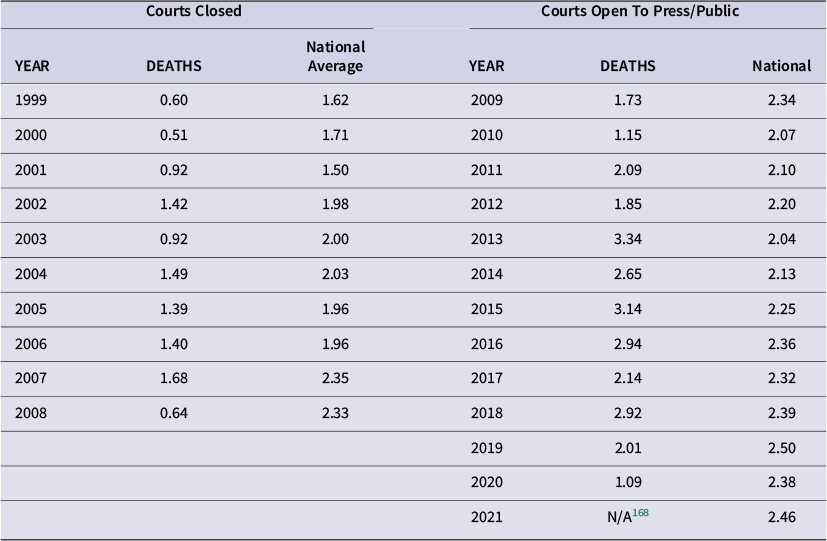
To test Witkin’s hypotheses further, the following analysis isolates and disentangles his three variables by providing state-specific examination of his theories. The following data compares the child welfare spending levels and the child fatality rates in Georgia and in Arizona before and after they opened their previously closed dependency courts to the press and public in 2009. Under Witkin’s three-chain hypothesis, the data should show that during the “closed court era” that those states’ child welfare funding was lower and that their per capita child fatality rates were higher than after Georgia and Arizona opened their court systems. Tables 1-4, infra., demonstrate that the Georgia and Arizona evidence is inconsistent with Witkin’s predictions. Those states’ child welfare budgets during both the closed court and open court eras fluctuated between increased and decreased child welfare budgets.Footnote 149 This data also belies Witkin’s claim that child welfare budgets in closed court states are “largely stagnant” since funding increased significantly during the closed court era.Footnote 150 The Arizona and Georgia data on child fatalities is also inconsistent with Witkin’s prediction. His theory is that opening the courts leads to fewer per capita child fatalities and contends that open court states had a “fifteen percent decrease in child fatalities associated with open dependency courts.”Footnote 151 The following analysis of Arizona’s and Georgia’s child fatality rates demonstrate the opposite results since they actually increased after admitting the press and public into previously closed dependency proceedings.Footnote 152
The following Georgia and Arizona studies will use the same resources and data sets used by Witkin in his study regarding state child welfare budgets and child fatality statistics so that comparisons between the two studies will be easier and more consistent.Footnote 153 Table 1 includes the Georgia annual child fatality rates during the “closed court era” from 1999 through 2008 compared with the annual child fatality rates during the “open court era” from 2009 to 2021. Under Witkin’s theory the child fatality statistics during the closed courts era should be higher than the child fatality data during the open courts era in which the press and public could put pressure on the system to better protect abused children. However, the results in Table 1 are just the opposite: the child fatality data was lower in the closed court era and substantially higher in the open court era. To reduce any state variables such as a recession or health pandemic issues that might affect the comparisons between closed court and open court child fatality statistics, I have also included a comparison annually between the Georgia child fatality rates and the national state mean child fatality rates as a control and comparison.
Footnote 154 Georgia Child Abuse Fatalities Footnote 155 1999 to 2021

The increase in Georgia per capita child fatalities after the courts were opened is dramatic:

Witkin’s theory would entail Georgia’s child deaths decreasing over time following the change from closed to open courts. In the two years prior to opening the Georgia dependency courts (2007-2008), the Georgia child death rates in relation to the national average were .06 higher in 2007 and .34 higher in 2008. However, during the subsequent Georgia open dependency court era (2009-2021), both the child abuse death rate and the difference between the Georgia child death rate and the national state average increased. Table 1 demonstrates that the average rate of child deaths in Georgia when the dependency proceedings were closed (1999-2008) was 2.63 deaths per 100,000 children. However, during the open court era (2009-2021) that state average of child deaths increased significantly to 3.37 deaths per 100,000 children. Further, in the last nine years of reported data (2013-2021), the Georgia child death rate in relation to the national death rate has averaged the worst in its history. Georgia’s rate of 3.67 exceeds the national average child fatality rate of 2.31 by a difference of 1.36.
During the closed court era the number of years that Georgia exceeded 1.0 more deaths than the national average was only three out of ten, or thirty percent from 1999-2008. During the open court era, the average child death rate exceeded 1.0 more deaths than the national average in eight out of thirteen years, or in sixty-two percent the period from 2009-2021. Again, during the closed court era, Georgia was significantly closer to the national average of child abuse death rates much more frequently than after the courts were opened.
The data in Table 1 belies Witkin’s claim that there is a correlation or causation between per capita child fatalities and the type of state dependency courts, open versus closed.Footnote 156 The Georgia and Arizona studies are important because unlike the Witkin study, they analyze the differences in child welfare budgets and child fatality rates before and after a state opens its child dependency proceedings rather than comparing those rates in currently open versus currently closed state court systems. His data presents no evidence that opening a currently closed court system will likely result in an increased child welfare budget or in a reduced per capita child fatality rate. The Georgia and Arizona analyses demonstrate that the results in those states that were closed and then opened to the public did not result in larger budgets or reduced child fatalities.
It is also important to note that the Georgia data also fails to provide any evidence that per capita child fatalities are causally related to those courts being closed to the public and press. Put simply, there is no evidence presented by any researchers, including Witkin, that demonstrates a causal connection or correlation between the nature of dependency proceedings (open versus closed) and per capita child fatality rates.
B. The Georgia Study Results Are Also Inconsistent With Witkin’s Hypothesis That Opening Dependency Courts Will Result in Larger State Child Welfare Budgets
The second part of the Georgia study compares the Georgia total child welfare budgets between the “closed court era” of 2002 through 2008 with the child welfare budgets in the “open court era” of 2008-2018. One of Witkin’s major hypothesis is that opening child dependency courts will shed light on the need to increase child welfare budgets and that the press and public pressure will result in significant increases in state child welfare funding.Footnote 157 He concludes that the results of his study “are consistent with open courts leading to a better-informed public regarding child abuse and, thereby, a greater likelihood that voters support spending on child protection agencies. This effect could be the result of reporting by local journalists and/or motivated members of the community.”Footnote 158 Witkin did not produce any direct evidence that increases in open court state welfare budgets were directly attributable to the fact that those courts were open to the press. To test his hypothesis that open court state budgets increase while closed court state child welfare budgets remain “stagnant,”Footnote 159 Table 2 compares the Georgia child welfare budgets during the “closed court era” (2004 to 2008) with the budgets in the “open court era” (2008-2018)
Footnote 161 Georgia Child Welfare Budgets 2004 to 2018 Footnote 162

:
Table 2 demonstrates that the history of Georgia’s child welfare budget during the four years prior to the opening of Georgia’s closed dependency courts through the first eight years of those courts once they were opened is inconsistent with Witkin’s hypothesis. He posits that budgets in closed court states remain “stagnant” while budgets in open courts should see increases in child welfare budgets due to the light shed on the inadequate court system once it was opened.Footnote 160 In Georgia, however, in 2006, just three years before the closed courts were opened, the Georgia child welfare budget grew at the highest percentage of any of the twelve years in Table 2. Since the court was closed in 2006 when the budget was increased by 80.5%, something other than Witkin’s “opening the courts” theory precipitated that large increase.Footnote 166
The Georgia data does not demonstrate a correlation or causation between closing or opening child dependency proceedings and child welfare funding. There is no evidence to demonstrate that the large increase in Georgia’s child welfare budget of 55.5% (85.5% increase minus 25.0% decrease) during the closed court era had anything to do with the courts being closed. In addition, there is no evidence that during the six years of open court era budget cuts of twenty percent (2009-2012) that the reductions had anything to do Georgia opening its courts to the press and public. Finally, there is no evidence that when Georgia finally raised its child welfare budget in 2016 that the “open” nature of its courts had anything to do with that budget increase.
What is clear is that the history of Georgia’s child welfare budgets does not fit Witkin’s model because: (1) during the closed court era there were significant child welfare budget increases; and (2) during the open court era there were several child welfare budget cuts. Witkin’s model and theories simply do not explain Georgia’s experience of opening its previously closed courts.
C. A Comparison of Child Welfare Budgets and Child Fatalities During Arizona’s Closed Court and Open Court Eras
To further test Witkin’s hypotheses that opening dependency courts leads to a reduction in per capita child abuse fatalities,Footnote 169 Table 3 compares those Arizona statistics from 1999 to 2008 when dependency courts were closed with 2009 to 2021 after the Arizona courts were opened to the public:
Footnote 167 Arizona Child Abuse Fatalities 1999 to 2021

The Arizona comparison of child fatalities before and after the courts were opened is exactly the opposite of Witkin’s prediction of what should have happened because the per capita child fatality rates actually increased when the courts were opened:

After the Arizona courts were opened the average child fatality rate between the closed court era and the open court era more than doubled from a rate of 1.10 to a rate of 2.25. Further, during the closed court era the Arizona child fatality rate never exceeded the national average rate. However, during the open court era the Arizona child fatality rate exceeded the national rate in five out of twelve years, or forty-one percent of the time.
Again, under Witkin’s theory opening the Arizona courts should have seen a significant reduction in the child fatality rate.Footnote 171 However, as was found in the Georgia study, the per capita child fatality rate actually went up dramatically after Arizona opened its courts to the press and public. But, again, as in the Georgia study, there is insufficient evidence to support any correlation between dependency courts being closed and a reduction in per capita child fatality rates.
D. The Arizona Study Results Are Inconsistent With Witkin’s Hypothesis That Opening Dependency Courts Will Result in Larger State Child Welfare Budgets
The Georgia study found that opening the dependency courts did not result in an increase in the child welfare budgets. As Table 4 demonstrates, Witkin’s prediction that opening the Arizona courts would result in significant increases in the state’s child welfare budget also did not occur.
Footnote 173 Arizona Child Welfare Budgets 2004 to 2018

Like the Georgia study, the Arizona study also defies Witkin’s predictions that opening dependency courts leads to significantly increased and/or sustained increases in child welfare budgets. During the “open court era” of 2004 to 2008 the budget increases totaled 53.7%. However, during the “open court era” the budget changes decreased in three of four reporting periods, and the total budget increase during 2008 to 2018 was only thirty percent. Witkin’s prediction of sustained increases in child welfare funding in open court statesFootnote 172 is simply inconsistent with the pattern in both Georgia and Arizona. Rather, those states had sporadic reductions and increases in child welfare funding once the courts were opened.
Although Witkin has presented a great deal of general statistical information on education budgets, child welfare budgets and child fatality statistics, one central failure of his study is that he did not present a scintilla of evidence to demonstrate that states which changed from closed child dependency courts to open courts had a sustained net increase in child welfare funding and a decrease in per capita child fatality rates from their previous “closed court era” statistics.
Conclusion
Witkin did not present any evidence from a state that was traditionally closed and that transitioned to proceedings open to the public that child fatality rates decreased. Table 1 and Table 3, supra, demonstrate that in both Arizona and Georgia that their child fatality rates rose after they opened their historically closed child dependency courts. Further, the evidence in Table 2 and Table 4 are inconsistent with Witkin’s statement that budgets in closed court states are “largely stagnant.”Footnote 174 In Arizona and in Georgia, the child welfare budgets in both the closed court and open court eras were both dynamic and included many increases and decreases in child welfare spending. Unlike Witkin’s prediction, child welfare funding did not result in continued or significant increases in child welfare spending once those states opened their child dependency courts to the press and public.Footnote 175
Witkin proposes a new balancing test for states that are considering whether to open their currently closed dependency court proceedings: “the individual interests of dependent families seeking privacy and our society’s distaste for publicity about private family matters should be fairly weighed against the macro level benefits of a more transparent system.”Footnote 176 Witkin’s article did not demonstrate that opening a currently closed dependency court will probably result in any “macro level” benefits. Further, he did not “fairly” weigh the loss of privacy and potential harm to child victims since he failed to seriously discuss contemporary child victim psychological research regarding the potential serious harm to children, especially LGBTQ+ and polyvictimized child victims, in child dependency proceedings open to the press and public. If anything, contemporary psychological literature cautions that we should close more hearings currently open to the press and public to better protect child victims from being revictimized by the very legal system that is designed to protect them.