Peripheral pulmonary artery stenosis occurs in the context of diffuse arteriopathies (for example, Williams syndrome) and cardiac developmental defects (for example, tetralogy of Fallot). Peripheral obstruction leads to proximal pulmonary arterial hypertension. Although right ventricular function is initially preserved, this can result in severe right ventricular hypertension. Unmitigated, this right ventricular hypertension results in arrhythmia, ventricular failure, and death.Reference Bird, Billman and Lacro 1 , Reference Geggel, Gauvreau and Lock 2 Risks associated with the haemodynamic burden imposed by peripheral pulmonary stenosis can be compounded by additional left-sided obstructive lesions, as seen in some cases of Williams syndrome, or by residual shunts or pulmonary regurgitation, as in the case of repaired tetralogy of Fallot. Peripheral pulmonary stenosis is managed surgicallyReference Monge, Mainwaring, Sheikh, Punn, Reddy and Hanley 3 when lesions are located proximally, but more peripheral disease usually calls for endovascular management, with transcatheter balloon angioplasty or stent placement.Reference Maglione, Bergersen, Lock and McElhinney 4 , Reference Law, Shamszad and Nugent 5
Stents have been reported to be effective in lesions refractory to balloon angioplasty, and have greatly enhanced the therapeutic armamentarium of the paediatric interventionalist;Reference Maglione, Bergersen, Lock and McElhinney 4 – Reference Fogelman, Nykanen, Smallhorn, McCrindle, Freedom and Benson 6 however, rates of in-stent stenosis in patients with arteriopathy and tetralogy of Fallot are high, affecting ~1/3 of these patients,Reference Hallbergson, Lock and Marshall 7 identifying this as a larger problem than that suggested by previous reports.Reference Fogelman, Nykanen, Smallhorn, McCrindle, Freedom and Benson 6 , Reference McMahon, El-Said, Grifka, Fraley, Nihill and Mullins 8 , Reference Mehran, Dangas and Abizaid 9 We explored the potential to mitigate in-stent stenosis by adding medical adjunct therapy to anatomical management in patients with multiple diffuse pulmonary arterial obstructions at high risk for right ventricular failure. In light of reports showing that both localReference Simsek, Magro and Boersma 10 (drug-eluting stents) and systemicReference Hausleiter, Kastrati and Mehilli 11 – Reference Waksman, Ajani and Pichard 13 administration of the antiproliferative medication rapamycin (sirolimus) reduce in-stent stenosis among adult patients with atherosclerotic coronary artery obstruction, we chose this agent. The choice of rapamycin was further supported by the understanding of its dosing and safety profile in the paediatric population, among paediatric transplant patients.Reference Schubert, Venkataramanan and Holt 14 – Reference Ettenger and Grimm 16 In this study, we describe the treatment strategy we have developed, preliminary safety data, and initial clinical results from the pilot series of patients following rapamycin administration.
Methods
Study population
We first administered rapamycin (Rapamune®; Pfizer Inc., New York, New York, United States of America) to a 3-year-old patient with a severe phenotype of Williams syndrome in 2011. The drug was made available in this off-label manner in accordance with Boston Children’s Hospital Innovative Therapy pathway guidelines. Selected patients had severe peripheral pulmonary stenosis and in-stent stenosis (⩾25% stenosis and a diameter narrower or equal to the distal vessel as previously describedReference Hallbergson, Lock and Marshall 7 ) and either right ventricular hypertension (⩾1/2 systemic or ⩾70 mmHg) pulmonary blood flow maldistribution (⩽25% of flow to either lung or regional decrease in individual lobar segments by lung perfusion scan) or segmental pulmonary hypertension (distal pulmonary artery pressure >20 mmHg as determined by catheterisation). A few patients were offered treatment at the primary stenting procedure if determined to be at high risk of developing in-stent stenosis as previously described.Reference Hallbergson, Lock and Marshall 7 Of the 10 patients offered treatment with the drug during the 2.5-year pilot period, 10 patients – parents or guardians when applicable – elected to receive the drug. Patients were not offered the drug if they had significant renal, hepatic, immune, or haematologic organ dysfunction, had undergone surgery or transcatheter interventions in the past 6 weeks, had any history of malignancy, were ⩽6 months of age, or pregnant.
Rapamycin therapy protocol
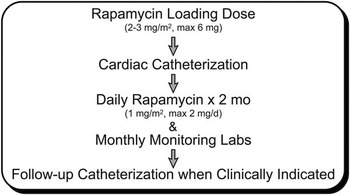
Details of the proposed treatment protocol have evolved since we started the therapy in 2011 (Fig 1). Our initial patient was treated with long-term therapy over the course of a year during which she underwent three catheterisations – her typical catheterisation frequency. Over the course of the 1st year, we learnt that immediate post-catheterisation, and likely even pre-catheterisation, therapy appeared to be crucial. We gradually shortened our duration of treatment for subsequent patients to 1–3 months after catheterisation. Target serum rapamycin level has remained 6–10 ng/ml (for reference, the typical post-transplant level is 8–15 ng/ml). More recently, patients have received a loading dose of 2–3 mg/m2 (maximum 6 mg) on the day before catheterisation (in cases when initiation of treatment had been determined based on in-stent stenosis seen on previous catheterisations) or immediately after catheterisation. The loading dose is followed by once per day dosing of 1 mg/m2 (maximum 2 mg) for 2 months. In patients who turn out to metabolise the drug unusually fast as evidenced by persistently low drug levels, the dose is split into twice a day, which is more common in younger patients. Similarly, the dosing can be divided to twice a day in case of side-effects to reduce the serum peak levels. The starting doses were decreased in patients with documented or suspected mild hepatic dysfunction – patients with more than mild dysfunction were not offered the drug. Until the target serum level was reached, the serum rapamycin level was checked typically 1–2 times as an outpatient in the first 2 weeks of therapy. Once the target level was reached, the rapamycin level and blood work to monitor for potential side-effects were followed monthly. Baseline and monthly laboratory analyses included complete blood count, serum chemistry, renal and hepatic function tests, and cholesterol level tests.
Rapamycin treatment protocol. The diagram outlines our proposed treatment protocol.

Evaluation of drug efficacy and safety
The drug was prescribed as part of clinical care individualised for each patient, and the regimen was modified throughout the 2.5 years, resulting in significant variation in administration schedules and follow-up evaluation; however, using the available clinical data, we retrospectively evaluated drug efficacy by assessing the degree of angiographic in-stent stenosis expressed as percent of stent diameter as previously described,Reference Hallbergson, Lock and Marshall 7 and when applicable we also assessed changes in right ventricular pressure and lung perfusion.
The change in in-stent stenosis and right ventricular pressure following rapamycin administration was qualitatively assessed by non-blinded angiographic review and review of serial catheterisation reports. Given the wide variability in rapamycin administration regimens, a quantitative analysis of its effects was deferred. In-stent stenosis was reported as unchanged, mildly improved, or improved as compared with baseline at index catheterisation – that is, catheterisation at the time of rapamycin initiation. In-stent stenosis grading was as follows: unchanged=no change, mildly improved=in-stent stenosis improved by <10%, improved=in-stent stenosis improved by ⩾10%. It was also considered mild improvement if the patient had multiple stents and the majority of stents had mild improvement or no change even if one stent was graded as improved. Haemodynamics were evaluated by change in baseline right ventricular pressure, which was considered improved if either the absolute systolic pressure or the right ventricular-to-systemic pressure ratio decreased by at least 10%.
The safety aspect was evaluated by assigning Adverse Event Severity Levels 1–5 as described by Bergersen et alReference Bergersen, Giroud and Jacobs 17 to any change in patient status following the index (drug initiation) catheterisation, laboratory values, or events during the period of time while the patients were taking the drug.
Results
Demographics
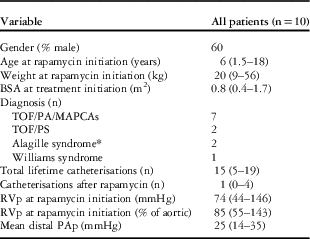
Patient age ranged from 18 months to 18 years (Table 1). Out of 10 patients, three of them had genetically confirmed arteriopathy; nine out of 10 patients had tetralogy of Fallot with collaterals or severely hypoplastic branch pulmonary arteries, with two patients having both arteriopathy and tetralogy of Fallot. Median number of previous catheterisations was 15 (5–19), supporting severe peripheral pulmonary stenosis with need for frequent pulmonary artery dilations. Of the nine patients with available lung perfusion scan at the time of rapamycin initiation, six had asymmetric pulmonary blood flow, with <25% flow to one side or loss of lobar segments; six out of 10 patients had severe right ventricular hypertension as indicated by systolic pressure ⩾70 mmHg and ⩾2/3 of systemic pressure at baseline in the catheterisation laboratory, two had moderate right ventricular hypertension, and one had an unrestrictive ventricular septal defect. Of the 10 patients, five had distal mean pulmonary artery pressure ⩾25 mmHg, indicating segmental pulmonary hypertension. Analysed stents were 4- to 10-mm pre-mounted Genesis stents (Johnson & Johnson, New Brunswick, New Jersey, United States of America), except in one patient who had primarily 3- to 5-mm coronary stents placed in severely hypoplastic branch pulmonary arteries. The majority of stents had been previously dilated to high pressure. All the patients had angiographic evidence of recurrent in-stent stenosis.
Demographics.

BSA=body surface area; PAp=pulmonary artery pressure; RVp=right ventricular pressure; TOF/PA/MAPCAs=tetralogy of Fallot with pulmonary atresia and major aortopulmonary collaterals; TOF/PS=tetralogy of Fallot with pulmonary stenosis
Values expressed as median (range)
* Both patients with Alagille syndrome also had tetralogy of Fallot
In-stent stenosis following rapamycin treatment
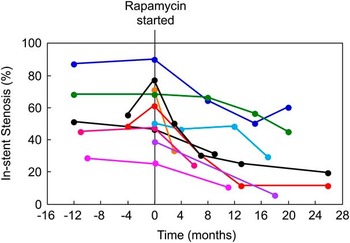
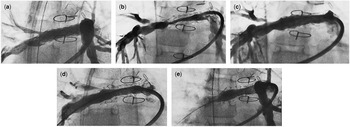
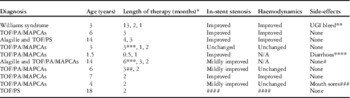
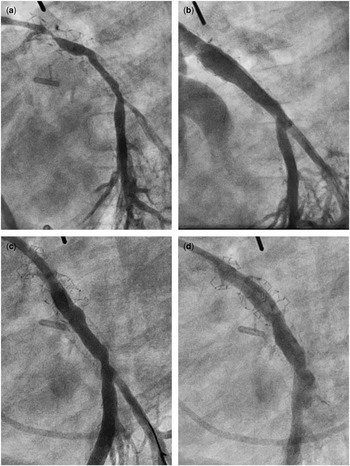
Angiographic evaluation of stented vessels before and after initiation of rapamycin showed heterogeneity in response to drug therapy. The impact of rapamycin on in-stent stenosis reduction was complicated by variability in the timing of drug initiation and duration of administration as well as stent re-dilations. Taking these vulnerabilities into account, the degree of in-stent stenosis decreased in most patients following rapamycin administration (Fig 2). Improved in-stent stenosis and improved haemodynamics were frequently noted in the same individuals (Table 2). Some patients with long-standing, recurrent in-stent stenosis observed during multiple previous catheterisations had remarkable reduction of in-stent stenosis, which corresponded with the initiation of rapamycin (Fig 3). In several patients with reduced in-stent stenosis, there was associated improvement in lung perfusion to previously hypoperfused segments of lung; one patient with right ventricular dysfunction experienced normalisation of function associated with improved in-stent stenosis, and this patient also experienced improved symptomatology – namely, decreased fatigue and shortness of breath and improved exercise capacity.
In-stent stenosis following rapamycin administration. Each coloured line represents a stent (10 stents from eight patients); two treated patients are not included due to either difficulty with exact quantification of in-stent stenosis due to placement of new stents or lack of follow-up catheterisation. The change in percent in-stent stenosis was primarily due to decreased thickness of the in-stent stenosis and not an increase in the external stent diameter following angioplasty, which is also supported by angiographic and lung perfusion findings.

Right pulmonary artery stent in a patient with Williams syndrome before ( a – c ) and after ( d and e ) chronic rapamycin treatment. ( a ) Immediately after balloon dilation. ( b ) Baseline severe in-stent stenosis 3 months later. ( c ) After balloon dilation at the time of rapamycin initiation. ( d ) Baseline in-stent stenosis at 7 months and ( e ) 13 months on rapamycin.

Patients treated with oral rapamycin for pulmonary artery in-stent stenosis.

TOF/PA/MAPCAs=tetralogy of Fallot with pulmonary atresia and major aortopulmonary collaterals; TOF/PS=tetralogy of Fallot with pulmonary stenosis; UGI=upper gastrointestinal tract
N/A (not applicable): unrestrictive ventricular septal defect or no appropriate comparison available
Qualitative assessment of in-stent stenosis and haemodynamics described in ‘Methods’ section
* If more than one number, indicates separate post-catheterisation treatment periods (the last treatment period may not yet have a follow-up catheterisation). Follow-up catheterisations performed as clinically indicated. In most instances, treatment has been short term (1–3 months) followed by catheterisation several months after stopping therapy (with a range from 0 to 13 months). Median time between catheterisations is currently ~5 months
** Unclear whether rapamycin contributed to gastrointestinal bleeding related to local trauma from a chronically indwelling nasogastric feeding tube. Severity level 2
*** Delay of rapamycin initiation to ~4 weeks after catheterisation
**** Required withholding drug. Symptoms improved following administration regimen modification after subsequent catheterisation. Severity level 2
# Died of catheterisation complications unrelated to rapamycin
## Delay of rapamycin initiation to 1 week after catheterisation
### Did not require drug administration alteration. Did not result in alteration of patient’s food and drink intake. Severity level 1
#### No follow-up catheterisation available
Safety of rapamycin in children with peripheral pulmonary stensosis
Goal serum rapamycin levels were accomplished in all patients with maintenance within the goal range throughout the treatment period. The goal serum level was typically reached within 1 week of therapy initiation. Of the 10 treated patients, seven tolerated rapamycin treatment well with no reported clinical symptoms or side-effects as detected by regular discussion with families and monthly blood tests while on therapy (Table 2). On monthly laboratory testing, a few patients had very mild and expected decrease in white blood cell counts and several showed expected reversible mild elevation in lipids. Among all, two patients experienced clinically relevant symptoms that may have been related to the medication and required temporary drug withholding (severity level 2); one patient developed mouth sores while on medication that did not require drug discontinuation and did not alter the patient’s ability to eat and drink (severity level 1); and one patient died while on medication, which was not deemed to be associated with rapamycin.
The initial patient remained on chronic therapy for the 1st year of treatment as previously discussed. She developed gastrointestinal bleeding a few days after a catheterisation when she had been receiving rapamycin for ~8 months. Her serum levels that had remained stable in the goal range and her complete blood count were normal at discharge 1 day after catheterisation. Owing to family preference, she had a long-term nasogastric feeding tube in place since infancy, despite recommendations to convert it to a percutaneous tube. The bleeding required hospital re-admission and blood transfusion. Rapamycin was empirically withheld, given its potential for interfering with wound healing. A gastroenterological consult determined the likely source of the bleeding to be local irritation by the tube and/or hypotensive hypoperfusion experienced during the recent catheterisation. The tube was removed and replaced by a percutaneous tube. During the next 6 months of rapamycin administration, the patient had no further bleeding. This patient was the only one among the 10 treated patients with peripheral pulmonary stenosis who required hospital admission due to potential drug side-effects.
An 18-month-old girl who was failing to thrive developed chronic diarrhoea, and given her nutritional vulnerability, drug therapy was held. Despite treatment for only 10 days before discontinuing therapy, the in-stent stenosis was less severe at follow-up catheterisation (Fig 4). She was therefore re-started on therapy following a subsequent catheterisation using a twice-a-day dosing to reduce the serum peak levels. This regimen was better tolerated and she was able to remain on therapy for 1 month. The patient who died while on therapy was a teenager with multiple co-morbidities, chronic cardiopulmonary disease, cyanosis related to severe pulmonary arteriopathy, and unrepaired tetralogy of Fallot. She experienced respiratory failure related to pulmonary oedema following her 19th transcatheter pulmonary artery angioplasty procedure. Care was eventually redirected according to the patient’s and her family’s wishes. Although she had been treated with rapamycin and remained on it during and after the catheterisation, it was not felt to contribute to the patient’s death.
Left lower pulmonary artery in a patient with tetralogy of Fallot with pulmonary atresia and major aortopulmonary collateral arteries before ( a and b ) and after ( c and d ) 10 days of rapamycin treatment. ( a ) Baseline severe in-stent stenosis before rapamycin treatment. ( b ) Improvement in stent lumen after balloon dilation. Rapamycin was initiated immediately after these interventions. ( c ) Baseline in-stent stenosis 2 months later showed mild improvement following 10 days of rapamycin treatment. ( d ) Results of balloon dilation.

Discussion
We are reporting for the first time systemic administration of rapamycin in 10 children with primary arteriopathy and/or tetralogy of Fallot. These initial results suggest that treatment in this patient population is safe and that it can reduce in-stent stenosis and improve haemodynamics in some patients. Each patient had severe peripheral pulmonary stenosis with significant haemodynamic burden from recurrent in-stent stenosis, which contributed to either their risk of right ventricular failure from complications of significant right ventricular hypertension, pulmonary vascular obstructive disease, or pulmonary blood flow maldistribution.
Out of nine patients with available follow-up catheterisation, eight of them showed measurable improvement in in-stent stenosis. In three patients with 1–4 weeks of delay in drug initiation following catheterisation, there was less improvement in in-stent stenosis, supporting the importance of pre-emptive or immediate drug initiation. In one patient with Williams syndrome and right ventricular dysfunction, the function normalised in the setting of improvement in in-stent stenosis and reduction in right ventricular pressure from persistently suprasystemic to 60% systemic within 7 months of therapy initiation. Some patients with Williams syndrome are known to have spontaneous reduction in peripheral pulmonary stenosis severity as they grow; however, the rapid time course observed here would be atypical and this patient’s haemodynamics appeared to mainly have improved as a result of gradient improvement across the pulmonary artery stents secondary to reduced in-stent stenosis; one patient treated for only 1 month after catheterisation showed minimal improvement, whereas one patient treated for only 10 days showed mild improvement at follow-up, providing some conflicting information regarding the potential benefit of treatment for 1 month or less.
Safety of rapamycin in the paediatric population is better studied in larger cohorts and has been reported elsewhere;Reference Schubert, Venkataramanan and Holt 14 – Reference Ettenger and Grimm 16 however, our patient cohort represents children with severe cardiovascular disease and should be carefully reviewed. None of the patients experienced clinical or laboratory-based evidence of drug-related side-effects that corresponded to severity level 3 or higher – that is, side-effects were at most mild – using published severity levels for complications in CHD associated with cardiac catheterisation.Reference Bergersen, Giroud and Jacobs 17 We elected to discontinue rapamycin in a 9-kg child with failure to thrive who developed significant diarrhoea, although her serum rapamycin levels were in a low range. Despite early discontinuation, she appears to have benefited and tolerated medication better when the dosing regimen was adjusted. It remains unclear whether rapamycin contributed to an upper gastrointestinal bleed that likely developed due to local irritation from an indwelling feeding tube.
To determine whether the benefits we observed were likely associated with rapamycin administration, we propose a rapamycin treatment protocol (Fig 1) that will be applied in a prospective clinical trial. This protocol is based on experience from systemic treatment for prevention of coronary artery in-stent stenosis in adults,Reference Hausleiter, Kastrati and Mehilli 11 general principles from long-term treatment of heart transplant recipients at our institution, and lessons learnt throughout the first 2 years of experience with treating children with pulmonary artery in-stent stenosis. At this time, we favour short-term treatment starting immediately before or after stent interventions. We administer a loading dose on the day before for planned initiations or as soon as possible after catheterisation in the case of unplanned initiations. This is followed by daily dosing that is titrated to goal serum rapamycin levels. Once in the target range, levels are checked monthly together with laboratory tests performed to monitor for side-effects. Optimal length of treatment in our experience to date appears to be for 2–3 months after catheterisation. Chronic therapy appears to work well, but we favour short-term treatment as our working hypothesis continues to be that most intimal cell proliferation takes place in response to interventions in the time period immediately after the catheterisation, thus not necessitating or warranting chronic drug exposure.
Following this initial clinical experience and establishment of our protocol for rapamycin for pulmonary artery in-stent stenosis, we have also offered rapamycin to patients with pulmonary vein stenosis. Historically, success of pulmonary vein stent angioplasty has been limited by subsequent significant in-stent stenosis. This patient population typically includes younger patients, frequently with history of prematurity and multiple co-morbidities. At our institution, we have treated 11 patients with pulmonary vein stenosis, mostly patients with primary pulmonary vein stenosis but also some with pulmonary vein stenosis secondary to repair of total anomalous pulmonary venous return. Several of these patients were also previously or simultaneously treated with the tyrosine kinase inhibitor imatinib (Gleevec, Novartis Pharmaceuticals Corporation, Basel, Switzerland). They had 5- to 8-mm pre-mounted Genesis stents placed in one or more pulmonary veins. Some were treated due to previous angiographic evidence of in-stent stenosis, whereas others were initiated on rapamycin at the time of primary stenting. Treatment of this group started more recently than for patients with pulmonary artery in-stent stenosis; therefore, follow-up is limited, but some patients have shown improvement in pulmonary vein in-stent stenosis or have not developed significant in-stent stenosis in stented pulmonary veins following rapamycin initiated at the time of placement. Results and conclusions about the utility and safety of rapamycin in this patient group may be the topic of future reports from our institution.
Conclusions from our initial clinical experience with rapamycin to reduce pulmonary artery in-stent stenosis are limited by a small sample size, non-standardised protocols, and lack of blinding and comparison groups in the analysis process; therefore, clinical guidelines or formal recommendations cannot be formulated. Any prescription of rapamycin according to our protocol should be made with these significant limitations in mind.
In conclusion, this initial clinical experience in a small cohort of children with peripheral pulmonary artery stenosis suggests that oral rapamycin may provide an important novel medical approach to reduce pulmonary artery in-stent stenosis and that it can be used safely in conjunction with percutaneous interventions. It is likely that rapamycin for in-stent stenosis will continue to be well tolerated in patients with peripheral pulmonary stenosis based on the benign safety profile of long-term treatment in transplanted patients, limited drug exposure by our short-term treatment strategy, and the low target serum rapamycin levels for patients. We have recently begun enrolment to a prospective trial at Boston Children’s Hospital to more precisely answer the questions regarding the clinical safety and efficacy of rapamycin in the treatment of in-stent stenosis following pulmonary artery stenting.
Acknowledgement
None.
Financial Support
This work was supported by the Keane Family Foundation, Boston Children’s Hospital, Boston, Massachusetts, United States of America.
Conflicts of Interest
None.
Ethical Standards
The authors assert that all procedures contributing to this work comply with the ethical standards of the relevant national guidelines on human experimentation in the United States of America and with the Helsinki Declaration of 1975, as revised in 2008, and has been approved by the institutional committees (Boston Children’s Hospital Innovative Therapy Pathway guidelines as approved by the Office of Clinical Investigation and Institutional Review Board).