Introduction
Cassava (Manihot esculenta Crantz) is an excellent source of starch and is considered an ideal crop for food security in tropical and subtropical parts of the world. Its tubers are consumed fresh or processed into flour, animal feed and its starch extracted for industrial use. The leaves, containing valuable protein, vitamins and minerals (Montagnac et al., Reference Montagnac, Davis and Tanumihardjo2009), are not consumed extensively, but have potential for greater utilization. Cassava thrives between 30°N and 30°S latitude and elevation of 0–2000 m with mean temperature above 20°C (Cock, Reference Cock and Cock2011). The crop is valued for its ability to tolerate low soil fertility and drought stress, being prevalent in areas with 1000 mm/year rainfall but withstanding as low as 750 mm/year. High rainfall can only be tolerated with good soil drainage (Leihner, Reference Leihner, Hillocks, Thresh and Bellotti2002). The tubers are harvested between 7 and 24 months after planting (MAP) depending on variety, use, agronomic and environmental conditions; shorter crop cycles are preferred, and much of the breeding effort has been focused on faster tuber growth.
The crop is propagated vegetatively using hardwood stem cuttings (stakes) whereas seed cultivation is limited to plant breeding and genetic studies. Growth readily takes place at axillary buds and one to four shoots may develop per stake. The quality of the stakes determines the growth and yield performance of the cassava plants (Okeke, Reference Okeke1994; El-Sharkawy, Reference El-Sharkawy2004; Cock Reference Cock and Cock2011; López, Reference López, Ceballos and Ospina2012). Traditionally, the stems cut at harvest are used for the next crop cycle, and with stakes of 15–30 cm length, the multiplication rate is low, normally 9–15 stakes per plant. In addition, the viable storage period for many modern varieties is less than a month as deterioration is rapid (Sungthongwises et al., Reference Sungthongwises, Arunee, Anucha and Anan2016; Mdenye, Reference Mdenye2016), and diseases may be transferred through vegetative propagation. Consequently, planting material is often limited and restricts the area or time of cultivation, especially of newly introduced varieties. In response to these limitations, methods for rapid propagation of cassava have been developed, such as use of short stakes with few nodes (Otoo, Reference Otoo1994; Bridgemohan and Bridgemohan, Reference Bridgemohan and Bridgemohan2014), micropropagation by tissue culture or leaf-buds (Neves et al., Reference Neves, Diniz and De Oliveira2018) and the multiple shoot removal technique (MSRT). The main purpose of producing planting material by rapid propagation is to establish nurseries to supply stakes (planting material) to farmers for conventional planting (López, Reference López, Ceballos and Ospina2012; Shiji et al., Reference Shiji, James, Sunitha and Muthuraj2014). However, although yield of plants grown directly by the rapid propagation methods have not often been compared in the field with those grown conventionally, a few studies suggest equivalence (Vichukit and Toro, Reference Vichukit and Toro1975; Okeke et al., Reference Okeke, Okoli, Utoh and Cock1983; Msogoya and Viljoen Reference Msogoya and Viljoen2006; Neves et al., Reference Neves, Diniz and De Oliveira2018). The MSRT, also known as shoot induction, was refined at the Centro Internacional de Agricultura Tropical (CIAT) Colombia (Wholey, Reference Wholey1974; Cock Reference Cock and Cock1983) and involves the use of small two-node hardwood cassava cuttings which are put to root in a humid environment. Each axillary bud at a node has an opportunity to sprout and grow into softwood shoots. The shoots are excised leaving behind a stump with axillary buds and then put to root to yield a new plant. New shoots usually develop from the stump of the shoot until the hardwood cutting is exhausted. The technique is said to be able to generate eight shoots per cutting in 4 months (Cock et al., Reference Cock, Wholey and Lozano1976), but, similar to traditional planting stakes, shoot number depends on stem quality (Wholey, Reference Wholey1974). After it was first developed at CIAT, Colombia, the MSRT was introduced to several other countries including Cuba (Nadals, Reference Nadals and Cock1983), Mexico (Gonzalez Lauck, Reference Gonzalez Lauck and Cock1983), Nigeria (Okeke et al., Reference Okeke, Okoli, Utoh and Cock1983) and the Philippines (n.d), but not Jamaica. In recent years, CIAT has provided Jamaica with several improved sweet cassava varieties showing high yield and pest resistance (Agriculture Services Unit, 2015; FAO et al., 2016). These varieties are used locally mainly for fresh consumption, flour production and as starch for beer production. Since cassava has been identified by the Jamaican government to be an important crop in its thrust to increase food security, it is anticipated that rapid propagation of selected varieties will be needed for expansion of crop production. The aim of this study was to determine how physiological characteristics of the planting material affected shoot production in the MSRT and make recommendations to growers for suitable planting material to use. The objectives were to identify which age of parent plant and section of stem harvested provided cuttings producing most shoots in the MSRT, whether fertilization of parent plants affected productivity, and differences in shoot production among locally available varieties.
Materials and method
Experimental outline
Each trial was conducted in two stages. Firstly, cassava was grown in fields to provide planting material (stem cuttings) for use in the MSRT study. Since earlier experiments had indicated that growing conditions as well as variety of parent plants affect the success of the MSRT (Murray et al., Reference Murray, Cohen and Myers-Morgan2018), the varieties to be tested were grown together under the same agronomic and environmental conditions. There were two plots each of six varieties (treated with fertilizer v. no fertilizer). Stems were harvested at 6, 7 and 9 MAP. The second stage of the study involved propagation with the MSRT under greenhouse conditions of two-node cuttings prepared from the harvested stems to study the effects of variety, nodal age, parent plant age and fertilization on the ability of the cuttings to produce multiple shoots. An ordinary greenhouse was used rather than the specially designed humid environment normally used in the MSRT, based on results from preliminary experiments. There were duplicate trials, starting 2 months apart from each other.
Location
The experiment was conducted at the Department of Life Sciences of the University of the West Indies, Mona Campus (lat. 18°0′21.647″N and long. 76°44′49.571″W). Firstly, parent plants were grown in the experimental field on sandy clay loam (Typic Haplustalf) at a location with a history of vegetable cultivation involving fertilization. No assessments were conducted at this stage except for resupplying of cuttings which did not sprout. Stems were then selected from these plants for testing with the MSRT in the greenhouse on site which represented the second stage of the experiment.
Parent plants field establishment
The parent plants were grown in the field in a 6 × 2 factorial randomized plot design of six cassava varieties and two levels of fertilizer as main effects. The six varieties were CM 516, CM 849, CM 2772-3, CM 2766-5, CM 6119-5 and MCol 1505, all known as sweet varieties and selected from the improved Colombian varieties being tested by the Jamaican Ministry of Agriculture at two of their field research stations. Fertilizer levels were unfertilized or fertilized with nitrogen, phosphorus and potassium applied at standard rates. Twelve plots of 4 × 4 m2 with four ridges (1 m apart), separated by 1 m wide spacing for demarcation of plots, were established in 2016 and allowed to grow for stem harvests in 2017. Trial 1 was established on 9 June towards the end of the first rainy season (May–June) and trial 2 on 30 July of the same year, during the summer dry season (July–August). Since the trials overlapped, they were established next to each other; the site for trial 1 was in an area with a history of more intense cultivation than for trial 2. To ensure sufficient planting material was available for each variety in each trial, stems were obtained from different research stations of the Ministry of Agriculture: for trial 1 from the Bodles Research Station from plants aged 24 months for CM 2772-3 and CM 6119-5 and 12 months for the other varieties; for trial 2 from the Montpelier Research Station from 14-month-old plants for all varieties. Planting pieces were cut from the stems to lengths of 8–12 cm with 4–8 nodes, the shorter lengths being used for more lignified portions. Stem pieces were treated with an insecticide and fungicide mix containing mancozeb and copper, by dipping for 10 min, allowed to dry overnight and planted the next day. They were planted at an inclined angle of approximately 60° on the top of ridges at 1 m spacing along the ridge, exposing about one-third of the stem piece; extras were planted for supplying. The few non-sprouting pieces were replaced at 1 MAP. After establishment, each plot, of a particular variety and fertilizer treatment, contained 16 plants. These plants were allowed to grow until 9 months old.
Field management practices and fertilizer treatment
Plots were irrigated until 3 MAP and rainfed thereafter. However, plants were exposed to a 2-month dry period in January and February 2017 due to low rainfall. This period equated to plants being aged about 7–8 months old for trial 1 and 6–7 months old for trial 2. Consequently, irrigation was resumed until the end of the trials. Plots were weeded monthly until 4 MAP. Half of the plots were fertilized with a total in kg/ha of 154 nitrogen (N), 78 phosphorous (P) and 216 potassium (K), applied as 65 kg/ha urea and 182 kg/ha 11-22-22 blend at 1 MAP, and 74 kg/ha urea, 136 kg/ha muriate of potash and 600 kg/ha 11-22-22 blend at 4 MAP. The fertilization of one plot of each variety and non-fertilization of the other represented the fertilization treatment of parent plants. These nutrient rates were based on recommendations by Howeler (Reference Howeler, Hillocks, Thresh and Bellotti2002, Reference Howeler and Cock2011) and Wilson and Ovid (Reference Wilson and Ovid1994). Fertilizer was applied to the soil in a circular band 5 cm from the stem of the plant at 3–5 cm depths. Plots were hilled at 1 MAP after fertilizer application.
Selection of stems and nodal ages for use in the MSRT in the greenhouse
At 6 MAP in each trial, a single mature stem was harvested from two plants selected at random from the middle rows in each plot. Main stems were cut about 30 cm from the base, with approximately uniform thickness and length. Stems were selected similarly when parent plants were 7 and 9 months old in each trial.
At each harvesting plant age, the apical portion with little lignification was removed from each of the stems and the rest of the stem was sectioned into three to provide three nodal ages, apical, middle and basal. Two two-node cuttings were selected from the central part of each section for each stem, giving four cuttings in total per plot. Therefore, at each parent plant age, there were four cuttings per treatment combination of nodal age × variety × fertilization level.
Planting of two-node cuttings in the greenhouse
The two-node cuttings obtained at each harvest date (i.e. parent plant age) were treated in the same way by dipping in the insecticide and fungicide mix described above. They were planted horizontally just under the soil surface in plastic nursery bags in 550 g of 1 : 1 soil (from the field) and sand mix autoclaved at 121°C and 100 kPa for 15 min. A total of 144 cuttings for each parent plant age (four per treatment combination of three nodal ages, six varieties and two fertilization levels) were arranged in a completely randomized design. The sets of cuttings from 6, 7 and 9 month-old parents were grown in different sections of the same greenhouse; maintained and assessed for 3 months. Cuttings from 9-months old parents for trial 2 were discarded after 1 month due to excessive mite infestation.
Chemical soil analyses
At the end of the trials, the soil of the experimental plots were sampled and analysed for nitrogen (N), phosphorus (P), potassium (K), magnesium (Mg) and calcium (Ca) by the Agricultural Land Management Division of the Jamaican Ministry of Agriculture. Composite soil samples (across varieties) were taken from 0 to 30 cm depth for each trial separately for fertilized and unfertilized plots. Total N was analysed using Kjeldahl acid digestion, available phosphate by the Truog method, available K after extraction with acetic acid, and exchangeable Ca and Mg after extraction with ammonium acetate.
Data collection and analyses
Length and diameter of the internode between the two nodes on the cuttings was measured before planting of cuttings; assuming a cylindrical shape, these values were combined to give an estimate of the volume of the cuttings. Fresh mass of cuttings per variety, parent plant age and fertilization were also taken. Cutting density was not specifically measured, but a proxy parameter was estimated by dividing cutting fresh mass by internode volume. Since fresh rather than dry mass was used, the proxy density results were examined across varieties and fertilizer levels within sampling sessions (parent plant age), when stem water content was at least approximately similar. Assessment was made of sprouting success at 1 month after planting by noting percentage of cuttings producing at least one viable shoot. The total number of shoots produced per cutting was recorded at 3 months. Comparisons between trials were made by paired t-tests or the Wilcoxon test and within trials by analysis of variance (ANOVA) (with Tukey's HSD test) for parametric, and Kruskal–Wallis for non-parametric, data sets using the SPSS V 21 package with the critical alpha probability at 5%. Treatment means are presented with standard errors (s.e.).
Results
Soil nutrient analysis of parent plants
Soil nutrient analyses at the end of the crop cycle had no differences between unfertilized and fertilized plots for trial 1. However, notable differences in trial 2 were that fertilized plots had two-fold potassium and four-fold phosphate compared to unfertilized plots (Table 1). Generally, total N (%) in the soil was relatively low, but other nutrients were at medium or high levels according to Roy et al. (Reference Roy, Finck, Blair and Tandon2006) and Howeler (Reference Howeler and Hershey2017) even without fertilization, which is adequate for cassava growth. In both trials, exchangeable Mg and Ca were medium and high, respectively.
Soil chemical properties at a soil depth of 0–30 cm at the end of fertilized and unfertilized cassava crops grown in two replicate trials in Jamaica (trial 1, June 2016–March 2017 and trial 2, July 2016–April 2017)

Each measurement represents a composite sample from six varieties; soil type Typic Haplustalf, pH 6.8–7.2.
Size of two-node cuttings
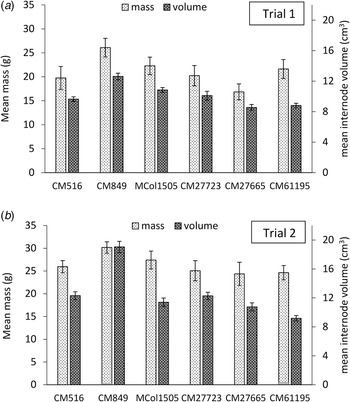
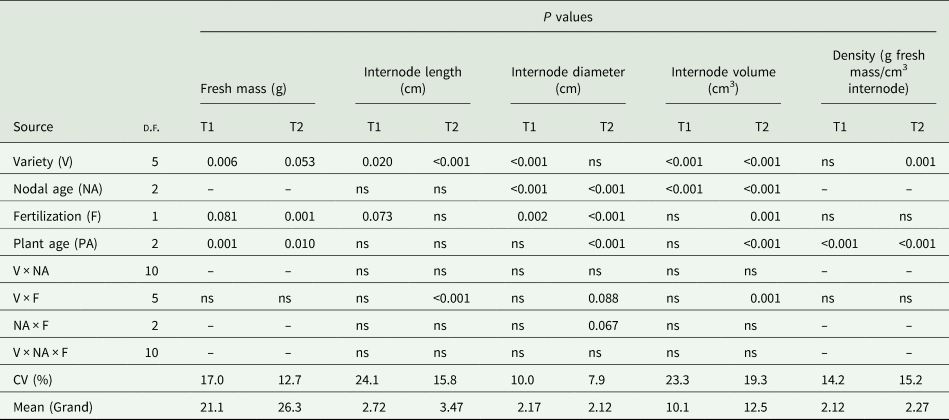
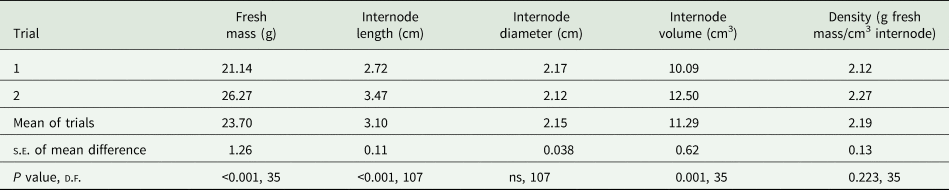
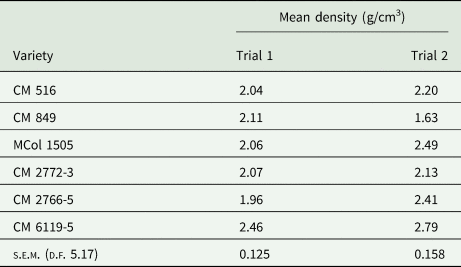
The two-node cuttings had significantly larger internode volume and fresh mass in trial 2 than in trial 1 but had similar internode diameter and density. The difference in volume was because cuttings had longer internode lengths (Tables 2 and 3). There was a significant effect of variety on fresh mass and internode volume of two-node cuttings (Table 2, Fig. 1). In both trials, CM 849 had significantly largest internode volume among the six varieties, and although it also had greatest fresh mass this was only significantly greater than that of CM 2766-5. The differences between these two varieties were 64 and 36% for internode volume and fresh mass, respectively. The internode density for CM 849 was similar to other varieties in trial 1 but was lower than most other varieties in trial 2 (Tables 2 and 4). Another notable result was for CM 6119-5 which consistently had the highest density (significantly so in trial 2), yet one of the smallest internode volumes (Table 4, Fig. 1).
Mean fresh mass and internode volume of two-node cassava stem cuttings from six varieties used for shoot production, combined for stem nodal ages (apical, middle and basal), parent plant ages (6, 7 and 9 months old) and parent fertilization (fertilized and unfertilized), in replicate trials in Jamaica, trial 1 (a) and Trial 2 (b); bars represent ± s.e.m.

ANOVA table for physical characteristics of cassava two-node stem cuttings used for shoot production, taken from parent plants grown in the field of six varieties (variety) aged 6, 7 or 9 months (plant age), fertilized or unfertilized (fertilization) and from three stem sections (nodal age) in replicate trials in Jamaica, trial 1 (T1) and trial 2 (T2)

d.f., degrees of freedom; CV, coefficient of variation; ns, not significant (P > 0.100).
Mean fresh mass, internode volume and density of two-node cassava cuttings used for shoot production in replicate trials in Jamaica, trials 1 and 2

d.f. and P of t-test comparing trials using paired treatments: six varieties, three parental plant ages, fertilized and unfertilized parent plants; and also three stem sections (nodal ages) for length and diameter.
s.e., standard error, d.f., degrees of freedom.
Mean density of hardwood cuttings (fresh mass per internode volume) of two-node cassava cuttings used for shoot production in replicate trials in Jamaica, trials 1 and 2, of six cassava varieties

Means of fertilized and unfertilized parent plants of ages 6, 7 and 9 months; standard error of mean (s.e.m.) and degrees of freedom (d.f.) from ANOVA.
Mean internode volumes for apical, middle and basal nodal ages were 7.1, 11.1 and 12.0 cm3 (S.E. of difference 0.17) for trial 1, and 9.4, 13.0 and 15.2 cm3 (S.E. of difference 0.29) for trial 2, respectively. For both trials, these differences were significant (Table 2) and more so from ages 1 to 2 (by around 50%) than from ages 2 to 3 (by around 13%). In trial 1, internode volume did not significantly change with age of parent plants, but in trial 2, cuttings from parents at 7 MAP were 33% smaller than at 6 and 9 MAP (which were similar), a difference that was consistent across varieties and nodal ages (Table 2). Differences in fresh mass due to fertilization of parent plants were not quite significant in trial 1 (mean fresh mass unfertilized 22.2 ± 1.44 g, fertilized 20.0 ± 1.03 g), but in trial 2, cuttings from fertilized parents (28.7 ± 0.90 g) were heavier than unfertilized (23.9 ± 1.03 g), applying to all varieties. Density of cuttings was not affected by fertilization in either trial.
Sprouting success by parent stem maturity, variety and nodal age
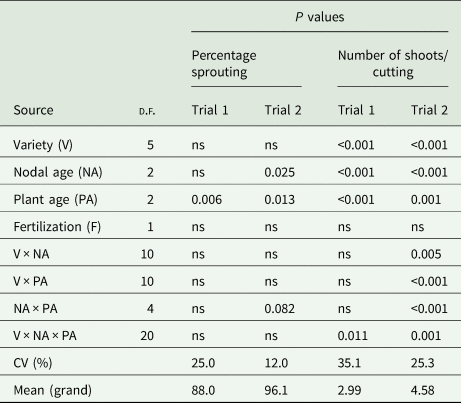
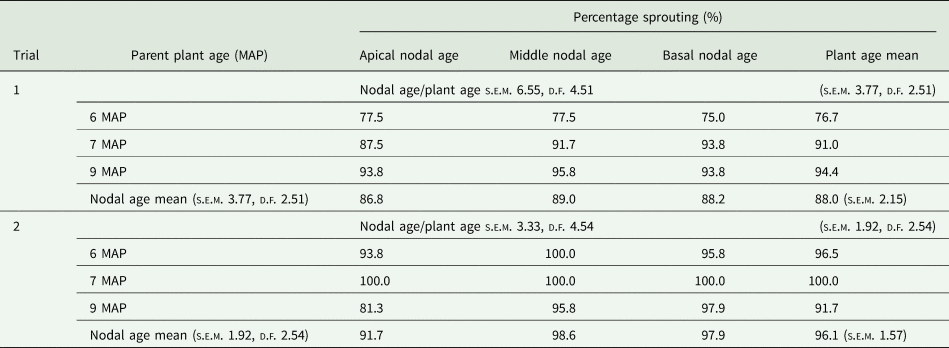
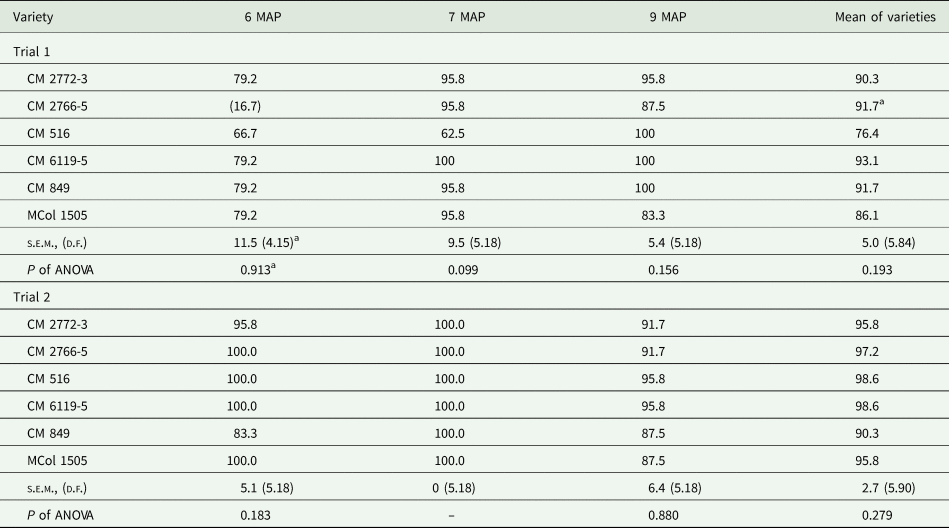
Results of percentage sprouting of two-node cuttings based on different parent plant age, nodal age and variety are presented in Tables 5 (ANOVA table), 6 and 7. Sprouting of cuttings was high, with most treatments between 90 and 100%; differences between the trials were small, although significant (P 0.001 by paired t-test, d.f. 107, CV 21.3%). Mean sprouting in trial 1 was 88.0% and in trial 2 was 96.1% (s.e.d. 2.9%). In trial 1, the percentage of cuttings that sprouted at 6 MAP was significantly lower compared to the older plant ages (Table 6). Increase in plant ages showed increased percentage sprouting regardless of nodal age. However, in trial 2 percentage sprouting was maximum at 7 MAP for all nodal ages followed by 6 and 9 MAP.
ANOVA table for percentage sprouting and number of shoots per cutting for two-node cassava cuttings taken from parent plants of six varieties (variety) aged 6, 7 or 9 months (plant age), fertilized or unfertilized (fertilization) and from three stem sections (nodal age) in replicate trials in Jamaica, trials 1 and 2

d.f., degrees of freedom; CV, coefficient of variation; ns, not significant (P > 0.100).
Percentage sprouting of two-node cassava cuttings from parent stems of three nodal ages (apical, middle and basal) and three plant ages (6, 7 and 9 MAP) in replicate trials in Jamaica, trials 1 and 2

Standard error of mean (s.e.m.), degrees of freedom (d.f.) from ANOVA.
Percentage sprouting of two-node cassava cuttings from parent plants of six varieties at three plant ages (6, 7 and 9 MAP) in replicate trials in Jamaica, trials 1 and 2

Standard error of mean (s.e.m.), degrees of freedom (d.f.) from ANOVA.
a Omits CM 2766-5 at 6 MAP.
Number of shoots produced per two-node cutting for variety, parent plant fertilization and age, and nodal age
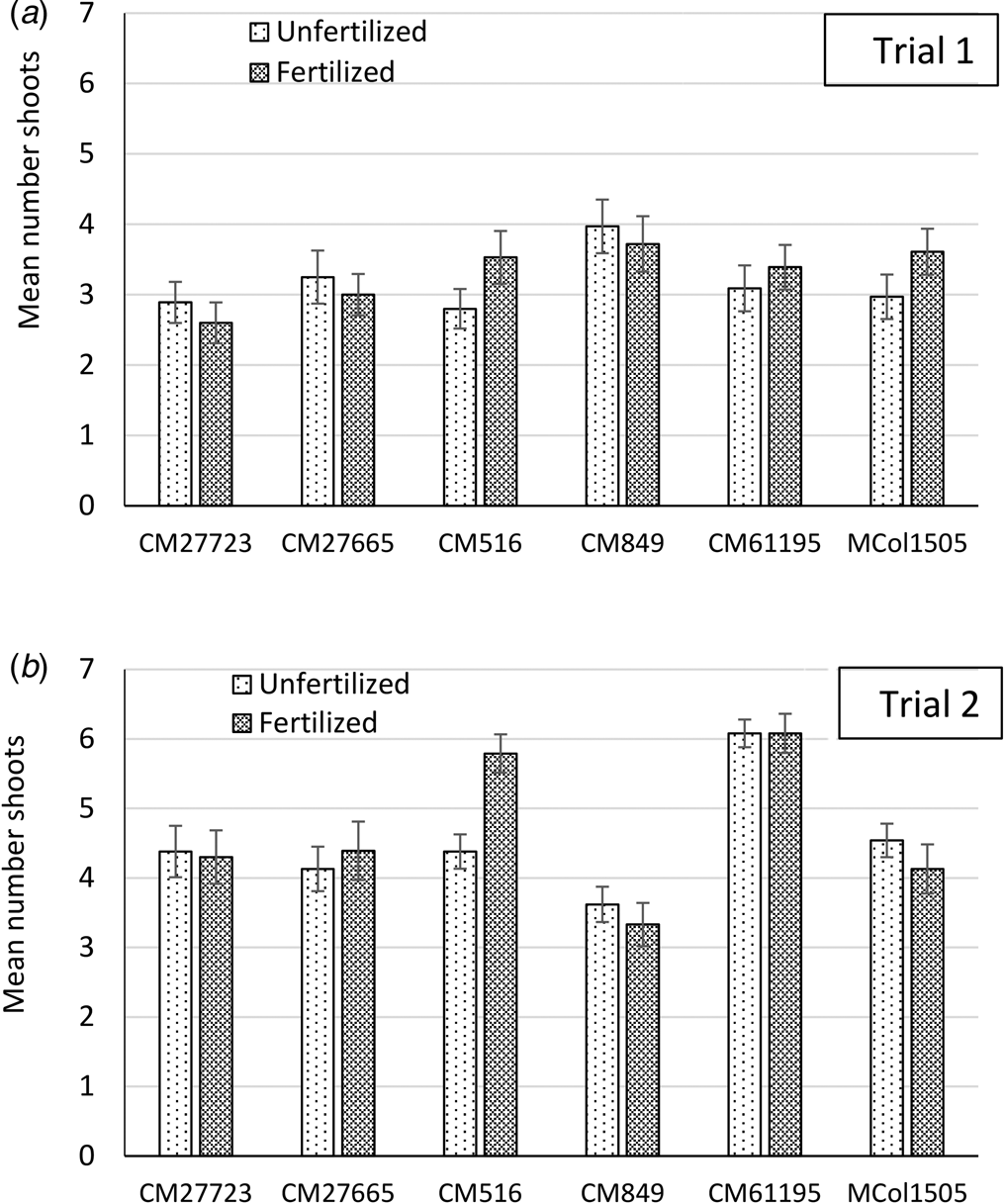
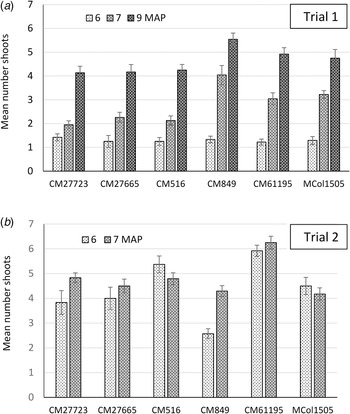
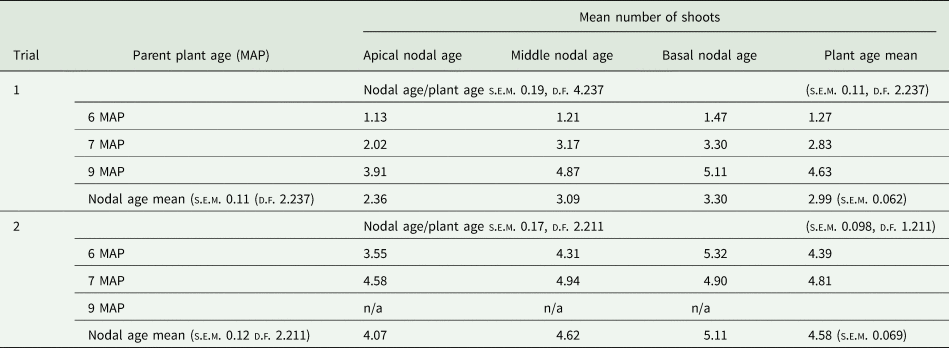
The mean number of shoots produced for six varieties ranged from 2 to 4 in trial 1 and 3 to 6 in trial 2 (Fig. 2) regardless of whether the plots were fertilized or not fertilized. In trial 1, CM 849 produced the highest number of shoots compared to the other varieties from both fertilized and unfertilized plots, but in trial 2, CM 6119-5 had the highest shoot production. For both trials, CM 6119-5 and MCol 1505 were among the higher producers and CM 2772-3 and 2766-5 were among the lower producers. Shoot production was less consistent for CM 849 and CM 516 (Figs 2 and 3). Varietal differences were also affected by nodal and parent age (Table 5, Fig. 3). The mean number of shoots produced by all varieties increased as the parent plants’ age increased from 6 to 9 months in trial 1. However, in trial 2, cuttings for 9 MAP had to be abandoned due to pest infestation and differences from 6 to 7 months were only significant for the variety CM 849 (Fig. 3), which produced fewest shoots in this trial. Generally, the older the nodal age of the cuttings, the more shoots were produced, but the differences depended on the age of parent plants (Table 8). For 6 MAP in both trials, cuttings from apical and middle nodal ages gave significantly fewer shoots than basal nodes. For 7 MAP in trial 1, mean numbers from middle and basal cuttings were not significantly different and only apical cuttings produced fewer shoots; in trial 2, the trend was similar but not significant. This pattern of more shoots being produced from middle and basal cuttings was also shown for 9 MAP in trial 1, but differences in shoot production among nodal ages were smaller than at 7 MAP. Although not significant, cuttings from fertilized parent plants produced more shoots (mean 3.0 ± 0.09 for trial 1, 4.6 ± 0.10 for trial 2) than those unfertilized (2.9 ± 0.08 for trial 1, 4.5 ± 0.10 for trial 2).
Mean number of shoots produced from two-node cassava cuttings of six varieties from parent plants either fertilized or unfertilized, combined for three nodal ages (apical, middle and basal) and three parent plant ages (6, 7 and 9 months old), in replicate trials in Jamaica, trial 1 (a) and trial 2 (b); bars represent ± s.e.m.

Mean number of shoots produced from two-node cassava cuttings of six varieties from parent plant ages 6, 7 and 9 MAP, combined for three nodal ages (apical, middle and basal) and two parent plant fertilization levels (fertilized and unfertilized) in replicate trials in Jamaica, trial 1 (a) and trial 2 (b); bars represent ± s.e.m.

Mean number of shoots produced by two-node cassava cuttings from stems of three nodal ages (apical, middle and basal) of parent plants of three ages (6, 7 and 9 MAP) in replicate trials in Jamaica, trials 1 and 2

Standard error of mean (s.e.m.), degrees of freedom (d.f.) from ANOVA.
Distribution of numbers of shoots and effect of fertilization of parent plant on multiple shoot production
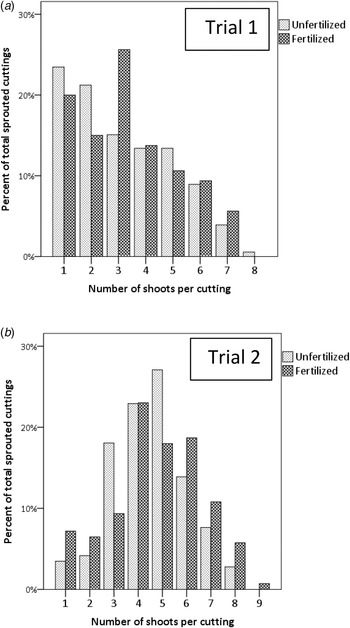
The effect of fertilization of parent plants on the ability of cuttings to produce multiple shoots was further investigated using the distribution of number of shoots per sprouted cutting (Fig. 4). The distribution differed between trials: that for trial 1 was skewed with modal numbers of 1 to 3, whereas that for trial 2 was approximately normal with modes of 4 and 5 shoots. The only consistent trend for the effect of parent plant fertilization was observed for trial 2, where the proportion of cuttings producing 6 or more shoots was greater by 48% with fertilization than without.
Number of shoots from two-node cassava cuttings as percentage of total of sprouted cuttings from parent plants that were unfertilized or fertilized in replicate trials in Jamaica, trial 1 (a) and trial 2 (b); percentages were collated over six varieties, three nodal ages (apical, middle and basal) and three parent plants ages (6, 7 and 9 months old), with 119 total cuttings in trial 1 and 106 in trial 2 for each of the fertilized and unfertilized sets.

Discussion
To reduce phenological and other physiological differences in the stems from which hardwood cuttings would be taken for shoot production, the parent plants of the six varieties were grown together under the same agro-ecological conditions in the two trials. However, the planting material used to establish the two field trials, came from locations in different agro-ecological zones and from plants at different ages. Despite being grown under similar environmental conditions and only about 2 months apart, there were significant differences between trials in stem fresh mass for all varieties and internode size for four of the varieties: CM 516, 2772-3 and 2766-5 and especially CM 849. These differences suggest that the growing conditions of the source plants (‘grandparents’ in this study) and quality of planting material carried over into the growth of the progeny, which were the ‘parent’ plants for the MSRT. This is supported by reports of the importance of the quality of planting material for good crop growth in many cassava studies. For example, Okeke (Reference Okeke1994) showed that the size of planting stake positively correlated with thickness of stems and tuber yield of daughter plants, and similar effects were reported for stake length (Cardoso et al., Reference Cardoso, Régis, Argenta, Forsthoffer, Suhre, Teichmann and Strider2004) and stake nutritional content (López Molina and El-Sharkawy, Reference López Molina and El-Sharkawy1995). Our research also indicated a distinct interaction of growing conditions with genotype. The fact that internode volume did not differ significantly for MCol 1505 and CM 6119-5 across trials unlike the other four varieties which had differences (Fig. 1), suggests that the genotypic effect was particularly strong for these varieties irrespective of source of planting material. As reviewed by Alves (Reference Alves, Hillocks, Thresh and Bellotti2002), a strong genotype–environment interaction for cassava has frequently been reported, e.g. Tumuhimbise et al. (Reference Tumuhimbise, Melis, Shanahan and Kawuki2014) and Chipeta et al. (Reference Chipeta, Melis, Shanahan, Sibiya and Benesi2017). On the other hand, El-Sharkawy (Reference El-Sharkawy2004) observed that certain genotypic characteristics evident at plant establishment can be linked to those during growth. Despite the carry-over effect of grandparental plant status, the effects of treatment factors on internodal size of parents were distinguishable and indicated distinct differences among varieties. Calculating density was useful in highlighting that size as determined by internode volume was not always correlated with mass (Fig. 1). Density varied independently of size, apparently influenced by both genotype and environment. For example, in both trials, cuttings from stems of the variety CM 6119-5 were among the smallest in volume but had greatest density (Table 4). Also, although CM 849 cuttings were consistently largest and heaviest, their density was much lower in trial 2, 32% less than the other varieties, indicating an environmental impact.
Internode volume was not influenced by plant age in trial 1, but the reduction at 7 MAP compared to 6 MAP in trial 2 was possibly due to the dry period occurring when plants were 6–7 months old. With the resumption of irrigation, volume increased and at 9 MAP was similar to that at 6 MAP. Plants of trial 1 were 2 months older than those of trial 2, so the dry period affected plants at a later stage of development, 8–9 MAP, having no discernible effect on internode volume at 9 MAP. From weekly measurements of diameter at cassava stem base, Odubanjo et al. (Reference Odubanjo, Olufayo and Oguntunde2011) reported greatest increase from planting to 6 MAP, with only a small further increase from 6 to 9 MAP, representing about 11% of total growth and no significant change in some weeks. In research at CIAT, the percentage dry mass of stems varied with variety and generally increased with plant age up to 6–8 MAP, the rate and timing depending on variety; after this period, dry mass was determined more by weather conditions than plant age (Leihner, Reference Leihner and Cock1983). El-Sharkawy and Cadavid (Reference El-Sharkawy and Cadavid2002) found that the reduction in shoot dry mass was partially or largely recouped when irrigation resumed at 8 MAP after a period of water deficit from 4 to 8 MAP and that later-season water stress, from 6 to 12 MAP, produced only small reductions in shoot mass.
Internode volume increased with the maturity of the stem section (or tissue age), designated as nodal age in this research, as found in earlier tests with the MSRT (Murray et al., Reference Murray, Cohen and Myers-Morgan2018). The variation between the trials in the relative differences among nodal ages could also be explained by the 6–7 MAP dry period in trial 2. Similarly, Wholey (Reference Wholey1974) noted that diameter and mass of cuttings increased with nodal age. Okeke (Reference Okeke1994) reported that dry mass (and carbohydrate content) of stakes of similar length increased consecutively from upper to middle to basal sections of stems of 12-month-old cassava, giving a difference from top to base of 42%, averaged over two varieties.
The fact that fertilizing plants had no apparent effect in trial 1 can be explained by the relatively good soil fertility at the site due to prior cultivation and favourable soil properties. Soil levels of P, K, Ca and Mg were high enough at the end of the trials even in unfertilized plots to fall within the range suggested to be adequate for cassava production (Howeler, Reference Howeler and Hershey2017). However, the greater mass from fertilized plants in trial 2 was likely due to the higher concentrations of K, and possibly P. Cadavid (Reference Cadavid, Ceballos and Ospina2012) noted that the need for high levels of K is well established for cassava and that responses to P fertilization are common.
When measured as the development of at least one viable shoot, sprouting success was generally good for the hardwood cuttings of most treatment combinations (Tables 6 and 7). The fact that varietal differences were not consistent between trials indicated a role for other factors such as quality of parental planting material and growing conditions. The impact of the planting material for field establishment on stem size of the parent plants used in the MSRT appeared to carry over into sprouting ability of the stem cuttings, as demonstrated by the difference, albeit small, in sprouting between trials, which corresponded with the difference in size of cuttings. Since the difference in sprouting was only significant at 6 MAP, it could be inferred that the plants of trial 1 were at an earlier stage of physiological maturity than those of trial 2 resulting in lower sprouting potential at 6 MAP. The trials were conducted almost 2 months apart resulting in small differences in the temperature and rainfall experienced by the two crops, which also could have had some impact on growth. Certainly, the timing of the dry period with respect to life cycle appeared to have impacted the crops differentially, but as this occurred at 8–9 MAP for trial 1, it would not have contributed to the lower sprouting from cuttings at 6 MAP. At 7 MAP, after another month of growth, the stems of trial 1 plants appeared to have reached their potential for sprouting (Table 2). For traditional field planting, the lower sprouting observed from smaller stakes (Cardoso et al., Reference Cardoso, Régis, Argenta, Forsthoffer, Suhre, Teichmann and Strider2004; Remison et al., Reference Remison, Omorodion and Eifedyi2015) was suggested to be related to total dry matter; the potential for faster drying out of smaller stakes also can be a reason (López, Reference López, Ceballos and Ospina2012).
Although nodal age affected two-node cutting size, it did not affect sprouting percentage except at 9 MAP in trial 2, when there was slightly lower sprouting from cuttings of the younger, apical nodal age. This effect is explained by the altered growth pattern due to the resumption of irrigation following the dry period in trial 2. Under such conditions, cassava plants direct resources into leaf production (El-Sharkawy and Cadavid, Reference El-Sharkawy and Cadavid2002; Alves, Reference Alves, Hillocks, Thresh and Bellotti2002; Howeler, Reference Howeler and Cock2011), which would have resulted in fewer nutrients stored in the newly developing part of the stem, the part that provided the apical cuttings at 9 MAP. Leihner (Reference Leihner and Cock1983) reported lower percentages of dry matter in stems during the rainy season than dry season. The high levels of soil K in trial 2 could have played a role in sprouting success. López Molina and El-Sharkawy (Reference López Molina and El-Sharkawy1995) highlighted the crucial role of K even in the early stage of cassava development. They tested the sprouting of planting stakes made from stems of parent plants fertilized with N, P and K in different combinations. Sprouting was 97–98% as long as K was applied, but dropped by 17% when parents were grown without fertilizer or only N and P.
Good sprouting is important for field planting, but the ability of a cutting to produce several shoots is critical for the success of the MSRT. The number of shoots varied with all the factors tested and often depended on their interactions. The increase in shoot numbers with parent plant age (Fig. 3) and nodal age (Table 8) seemed to be associated more with the size or density of the cuttings than was sprouting. Importantly, the effect of parent plant age depended on growing conditions; the dry period at 6–7 MAP in trial 2 is likely to account for the insignificant difference between shooting of cuttings from younger parents at 6 MAP with those at 7 MAP in this trial. The more productive nodal ages were middle and basal sections, particularly for the younger parent plant age, 6 months. However, the apical sections gave almost as good shoot production for cuttings from older, 9-month-old plants. These results reflect the recommendation of Wholey (Reference Wholey1974) for use of both middle and basal sections to maximize on planting material. Studies with traditional planting stakes have reported that highly lignified stakes, those from basal sections of stems of older plants (over 18 months), sprout poorly and may produce non-vigorous shoots (CIAT, 1983).
Previous research has indicated that amounts of stored carbohydrate and mineral nutrients in the cassava cuttings correlate with cutting size and are directly related to ability to sprout and produce viable shoots (Wholey, Reference Wholey1974; Leihner, Reference Leihner and Cock1983; López, Reference López, Ceballos and Ospina2012). That shoots depend on the parent cutting for nutrients for up to 40 days after planting (López, Reference López, Ceballos and Ospina2012) is well established and was supported by results of our earlier experiments (Murray et al., Reference Murray, Cohen and Myers-Morgan2018). In this research, the absolute size of cuttings was not always an indicator of ability to induce multiple shoots, as seen in the varietal differences, and density seemed a better predictor. Although CM 6119-5 had one of the smaller-sized stems (Fig. 1), its cuttings were most dense and produced among the most shoots in trial 1 and the most in trial 2 (Figs 2 and 3). In both trials, CM 849 had largest stems and heaviest cuttings, but although it produced among the most shoots in trial 1, it produced fewest shoots in trial 2 which corresponded with a drop in the density of its cuttings. These observations, along with those regarding effects of nodal age, suggest that physiological factors such as efficiency of storage and mobilization of nutrients have important roles in the potential for multiple shoot production by cassava cuttings and further investigations into these factors should include the role of cutting density. It has been suggested that variability in cutting density at the variety level, irrespective of volume and environment, may be explained by differences in hygroscopic water content in cuttings (Blankenhorn and Bhuiyan, Reference Blankenhorn and Bhuiyan2016). Clearly, there was a strong genotypic effect as shown by CM 6119-5 as well as a significant interaction with environment, highlighted by the response of CM 849 between the two trials. On average, 5.0 shoots were produced over 3 months under normal greenhouse conditions by cuttings from parent plants aged 9 months, the largest mean number being 6.2 per cutting for CM 6119-5. More shoots, 7, 8 and even 9 per cutting, were produced but infrequently (Fig. 4). According to Cock et al. (Reference Cock, Wholey and Lozano1976), it is possible to obtain an average of 8 shoots per cutting when propagation is conducted in a humid chamber over 4 months.
Cuttings from parent plants fertilized in the field would be expected to have an advantage by having accumulated higher levels of mineral nutrients and dry matter (López Molina and El-Sharkawy, Reference López Molina and El-Sharkawy1995; Howeler, Reference Howeler and Cock2011), but due to the good soil fertility of most plots, whether fertilized or not, this could not be effectively investigated in this research. However, the greater amounts of P and K in fertilized plots of trial 2 did contribute to increased shoot production especially for cuttings from one variety, CM 516. Also in this trial, 48% more cuttings produced at least 6 shoots when taken from fertilized than unfertilized parents (Fig. 4(b)).
The difference between trials in quality of planting material of parent plants seemed to have affected shoot production in the MSRT as well as size of stems of parent plants. Fewer shoots were produced in trial 1 than in trial 2, and the proportional increase in numbers with plant age and nodal age was greater in trial 1 than in trial 2 (Fig. 3, Table 8). The number of shoots at 6 MAP in trial 2 (4.4 per cutting) was close to that at 9 MAP in trial 1 (4.6 per cutting). Apart from the importance of healthy grandparental plants, it is clearly critical for cuttings to be taken from parent plants grown under good agronomic and environmental conditions for the MSRT technique to be successful. As each shoot extracts nutrients from the two-node cutting to sustain its growth and the reserves in cuttings are gradually depleted, cuttings from plants which grow vigorously and store maximum amounts of nutrients, both mineral and carbohydrate, have the potential to produce most shoots.
Conclusion
For the MSRT, parent plants should be cultivated from planting material of good quality and grown under standard conditions with good soil fertility. Under these conditions, apical, middle and basal sections of stems from plants at 6–9 months old are equally suitable for shoot production. If the quality of the parent planting material is uncertain, stems from older plants or older parts of stems are recommended: all stem sections from 9-month-old plants but only middle and basal stem sections of 7-month-old plants. Propagation in an ordinary greenhouse allows the production of 3–6 shoots per two-node cutting over 3 months from varieties CM 516, CM 849, CM 2772-3, CM 2766-5, CM 6119-5 and MCol 1505, sourced in Jamaica.
Acknowledgements
The authors thank Mr. Dewayne Johnson for his assistance with field plot maintenance. We thank Director of Research & Development, Dr Lisa Myers-Morgan, and staff of the Jamaican government Ministry of Industry, Commerce and Agriculture research stations at Bodles and Montpelier for the provision of planting material. Among the staff, Mr. Michael Williams and Mr. Aldaine Gordon are acknowledged for their guidance on selection of varieties and plants.
Financial support
This research received a grant from Graduate Studies and Research of The University of the West Indies, Mona that funded the field trials.
Conflict of interest
The authors declare there are no conflicts of interest.