Implications
Heat shock proteins (HSPs) have been suggested as biomarkers for predicting meat quality. This study showed that heat shock protein 70 (HSP70) is expressed and distributed differentially in normal and pale, soft and exudative (PSE)-like breast muscles of broilers subjected to transportation at high ambient temperature. This finding suggests that as a molecular chaperone protein, HSP70 may be employed to maintain biochemical changes and contribute to meat quality development under stress conditions. Further studies should focus on the mechanism of how HSP70 influences meat quality development.
Introduction
Broilers have been intensively selected for rapid growth and breast muscle mass conformation to meet the increasing demand for poultry meat (Barbut, Reference Barbut2012). However, breeding and feeding success have been accompanied by a serious meat quality defect known as PSE-like meat. Rapid pH decline combined with high pre-rigor temperature during early postmortem is the direct cause of PSE-like meat (Warriss and Brown, Reference Warriss and Brown1987; Kim et al., Reference Kim, Warner and Rosenvold2014). Recent studies have found that pre-slaughter stressors, such as struggling, environmental heat stress and transportation conditions, induce the formation of PSE-like meat (Adzitey and Nurul, Reference Adzitey and Nurul2011).
Heat shock proteins play important roles as essential molecular chaperones during protein assembly and disassembly, protein folding and unfolding, translocation, and interaction with damaged proteins under various environmental and physiological stresses (Larkins et al., Reference Larkins, Murphy and Lamb2012). One of the most prominent and abundantly expressed HSPs is 70 kDa (HSP70), which belongs to the highly conserved family of HSP (Mayer and Bukau, Reference Mayer and Bukau2005). Heat shock protein expression is regulated at both transcriptional and translational levels. Heat shock transcription factor 1 (HSF1) acts as the master regulator that integrates the stress response by binding to the heat shock element (HSE) and activates HSP genes (Åkerfelt et al., Reference Al-Aqil and Zulkifli2010).
Proteomic studies have reported the differential expression of HSP70 in muscles with variable meat quality traits (Di Luca et al., Reference Di Luca, Mullen, Elia, Davey and Hamill2011) and protein characteristics (Bjarnadóttir et al., Reference Bjarnadóttir, Hollung, Færgestad and Veiseth-Kent2010). Meanwhile, several studies have preliminarily correlated meat quality with HSP70 under stress situations (Yu et al., Reference Yu, Tang, Bao, Zhang, Hao and Yue2009; Xing et al., Reference Xing, Xu, Zhou, Wang and Jiang2015).
Nevertheless, the variation in meat quality caused by intra-animal variability in response to stress remains unclear. In this study, breast muscle samples were collected and categorized as PSE-like or normal after pre-slaughter stress. Subsequently, the expression and distribution of HSP70 were evaluated, and the relationship between HSP70 and meat quality traits was investigated to provide novel insights into how pre-slaughter stress affects meat quality.
Material and methods
All experimental procedures were approved by the Institutional Animal Care and Use Committee of Nanjing Agricultural University.
Chickens and experimental design
For the trial, we used a total of 126 male broiler chickens (Arbor Acres), 42-day-old, and all the birds were fed the same starter and grower diets from the 1st day to market age. At time of transport, the average BW of the broilers was 2.75 kg. Feed and water were removed from the birds 8 h before transport and no feed or water was supplied during transport. The broilers were randomly categorized into three treatment groups: (1) control group without transport (C), (2) 30 min transport (T) and (3) 30 min transport followed by 10 min water shower spray and 20 min lairage (T/W). Each group consisted of seven birds with six replicates. On the day of transport, seven broilers from each replicate were held in one crate (760×480×380 mm) and six replicates in two transported groups were randomly distributed in the truck. The total load was around 2500 birds per truck. During the transport period, the ambient temperature was 32°C to 35°C and the temperature inside the truck was 40°C to 42°C. While the control group was kept in crates (the farm temperature was 31°C to 33°C as recorded at the end of the fattening period and the relative humidity was 60% to 65%). Transportation was performed on a national road in Sheng Village near Taian, Shandong. The route was set in the form of laps, with a length of ~15 km/lap. The road was flat. The average speed was 45 km/h. The water shower spray system consisted of 130 sprayers; each diameter of the sprayer was 40 mm. The temperature of the water was 23°C to 25°C and the rate was 75 to 80 m3/h. Lairage was kept under a quiet and cool environment (28°C to 30°C). All birds in both the transported and the control groups were slaughtered according to a commercial slaughter process provided by the local slaughterhouse; essentially consisting of electrical stunning, bleeding, scalding and evisceration (Liuhe Group, Shandong, P.R. China).
Sampling procedure
Within 20 min following each treatment, the birds were stunned electrically (40 V: alternating current, 400 Hz for 5 s each bird) and slaughtered immediately. Blood (10 ml) was collected in heparinized anti-coagulant tubes, shaken gently and chilled on ice. Then the blood was centrifuged at 4°C for 10 min at 2000×g, and the plasma was stored at −20°C until required for analysis. About 10 g of wing side of left pectoralis major (PM) muscle was taken at 0.5 h postmortem and placed into 5 ml antifreeze tubes, frozen in liquid nitrogen, stored at −80°C for the subsequent biochemical measurements (HSP70 level and location). Right PM muscles were collected and stored at 4°C and taken to the laboratory for assessment of meat quality at 24 h postmortem.
Meat quality determination
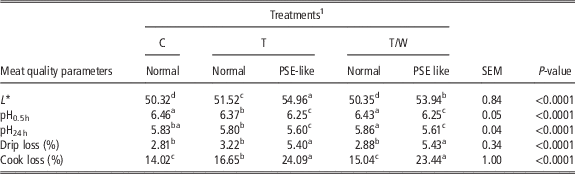
Meat quality characteristics were evaluated by measuring lightness (L*), pH0.5 h, pH24 h, drip loss and cook loss as described previously (Xing et al., Reference Xing, Xu, Zhou, Wang and Jiang2015). The critical values for normal (46<L*<53, 5.7<pH24 h<6.1) and PSE-like (L*>53, pH24 h<5.7) meat were based on L*24 h and pH24 h (Zhang and Barbut, Reference Zhang and Barbut2005). Only normal meat was found in control group. Blood and muscle samples for each of normal and PSE-like characteristics in their respective treatment group were obtained from six randomly selected birds to evaluate the subsequent biochemical parameters. Means and SEM of meat quality indicators of the samples used in the present study are shown in Table 1.
Meat quality indicators of pectoralis major muscle of broilers used in the present study

PSE like=pale, soft and exudative; L*=lightness; pH0.5 h=pH at 0.5 h postmortem; pH24 h=pH at 24 h postmortem.
The results are presented by mean values and SEM.
a,b,c,dMeans in the same row with different superscripts differ significantly (P<0.05).
1 C=broilers kept in crates without transport; T=broilers suffered from 30 min transport; T/W=broilers suffered from 30 min transport followed by 10 min water shower spray and 20 min lairage; n=6/group.
Plasma parameter measurements
The activities of creatine kinase (CK) and lactate dehydrogenase (LDH) were measured with commercial kits (Nanjing Jiancheng Bioengineering Institute, Nanjing, China), in accordance with the manufacturer’s instructions.
Western blot for heat shock protein 70 in pectoralis major muscle
The determination of HSP70 was quantified according to the procedure of Xing et al. (Reference Xing, Xu, Zhou, Wang and Jiang2015). A frozen muscle sample (0.5 g) was homogenized in 5 ml buffer (10 mM Tris-HCl (pH 7.4), 0.1 mM NaCl, 0.1 mM phenylmethylsulfonyl fluoride, 5 μM soybean (soluble powder; Sigma, St. Louis, MO, USA) as trypsin inhibitor) using a polytron homogenizer (IKA T25 digital ultra-turrox Made in IKA, German). Tissue homogenates were then centrifuged at 17 500×g at 4°C for 20 min and the supernatants were collected into fresh tubes. Protein concentration was determined by BCA protein assay kit (Sigma). For electrophoresis, each homogenate was mixed with an equal amount of 2×loading buffer and heated for 3 min in a dry heater (100°C). Equal amounts of total protein (40 μg) were resolved by electrophoresis (Bio-Rad, Richmond, CA, USA) on 10% SDS-PAGE before being transferred electrophoretically to a polyvinylidene fluoride (PVDF) membrane. The transfer was done with a transfer buffer containing 25 mM Tris, 192 mM glycine, 15% (v/v) methanol, 0.01% (w/v) SDS using 90 V for 90 min at 4°C. After transfer, the membranes were incubated in a blocking buffer consisting of 5% non-fat dry milk powder in Tris-buffered saline with Tween-20 (TBST; 0.1% (v/v) Tween-20, 50 mM Tris-HCl (pH7.6) and 150 mM NaCl) for 1 h. Primary antibody (Anti-Hsp70[3A3] antibody; Abcam, Cambridge, UK; or monoclonal anti-GAPDH antibody; Bioworld, Nanjing, China) was diluted in TBST. The PVDF membranes were incubated overnight at 4°C with primary antibody. The blots were washed and incubated for 1.5 h with a secondary antibody (Sigma, Dorset, UK). After 30 min washing, membranes were visualized using ECL Western blotting reagents (Amersham Biosciences, Piscataway, NJ, USA) and scanned with ImageQuant LAS4000 (GE, Fairfield, CT, USA). The density of the bands was quantified by using Imager Scanner II and Image Quantity One software. GAPDH was used as the house-keeping protein for normalization. The sample of birds from control group was used as the calibrator sample. All samples were run in triplicate, and the relative band density is reported after normalizing to GAPDH.
Analysis of heat shock transcription factor 1 and heat shock protein 70 gene expression by real-time (RT) PCR
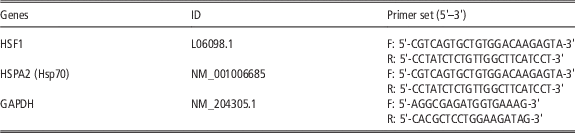
Ribonucleic acid extraction was performed using Trizol reagent (Takara Biotechnology Co., Ltd, Dalian, China) according to the manufacturer’s protocol. Total RNA was quantified by measuring the absorbance at 260 nm with a NanoDrop ND-100 spectrophotometer (NanoDrop Technologies, Rockland, DE, USA), and the purity was assessed by determining the ratio of the absorbance at 260 and 280 nm. The integrity of the RNA preparation was verified by visualization of the 18S and 28S ribosomal bands stained with ethidium bromide after electrophoresis on 1.2% agarose gels (E-gel; Invitrogen Inc., Carlsbad, CA, USA). Reverse transcription to complementary DNA (cDNA) was performed using a commercially available cDNA synthesis kit (PrimeScript™ RT Master Mix; Takara). The cDNA samples were stored at −20°C. Real-time PCR was performed using Applied Biosystems 7500 Fast Real-Time PCR System (Applied Biosystems, Foster City, CA, USA) under the following protocol: 95°C for 30 s, 40 cycles of 95°C for 10 s and 60°C for 30 s. SYBR green fluorescence was detected at the end of each cycle to monitor the amount of PCR product. A standard curve was constructed using a 10-fold dilution series, and its slope was used to calculate the efficiency of quantitative PCR primers. Pairs of oligonucleotide primers used are shown in Table 2. The relative amount of target gene mRNA was calculated according to Xie et al. (Reference Xie, Tang, Lu, Zhang, Xi, Liu, Odle and Luo2014). The expression level of a target gene mRNA was normalized to the mRNA level of GAPDH. The ΔΔCT was calibrated against an average from the control group. All samples were run in triplicate, and the linear amount of the target gene expression to the calibrator was calculated by 2−ΔΔCT. Therefore, the relative expression levels of HSF1 and HSP70 were reported as the fold difference between treated and control groups.
Primers for semi-quantitative real time (RT)-PCR analyses

HSF1=heat shock transcription factor 1; HSPA2=heat shock 70kDa protein 2; GAPDH=glyceraldehyde-3-phosphate dehydrogenase.
Confocal microscopy: immunofluorescence of cross-sections
Cross-sections (7 μm) of breast muscles were placed on 3-aminopropyl-triethoxysilane-coated slides. Before fixation in 4% paraformaldehyde for 30 min at room temperature, the slides were dried by oven at a temperature setting of 50°C for 15 min. After rinsing three times (5 min/time) in 0.01 M phosphate buffer solution (PBS) (135 mM NaCl, 2.7 mM KCl, 1.5 mM KH2PO4 and 8 mM K2HPO4, pH 7.2), normal goat serum (1 : 10) diluted in PBS was added for 1 h at 37°C. The sections were incubated with the primary antibody of HSP70 (1 : 100) diluted in 0.01 M PBS overnight at 4°C. Buffer (0.01 M PBS) without primary antibody was used as negative control. Later, sections were incubated at 37°C for 1 h with an appropriate secondary antibody (Alexa Fluor 488; Molecular Probes, Eugene, OR, USA). The muscle sections were washed in 0.01 M PBS for 3×5 min between each step. The fluorochrome-stained sections were mounted with cover slips. Finally, the sections were examined under a confocal laser scanning microscope (LSM700, Carl Zeiss, German). Fluorescence intensity was assessed using NIH Image J software (version 1.42). The results are reported as the fold difference between treated and control groups.
Statistical analysis
Data were analyzed by one-way ANOVA using the program SAS 9.12 (SAS Institute Inc., Cary, NC, USA, 2003) and differences among individuals were compared using Duncan’s multiple-range tests. Data on PSE-like meat incidence were not normally distributed and were tested using the non-parametric Kruskal–Wallis test (χ 2 approximation). The significant level was at P<0.05, and the results are presented as mean±SEM. Principal component analysis (PCA) was performed using SIMCA-P, version 11.5 (Umetrics, Sweden).
Results
Meat quality
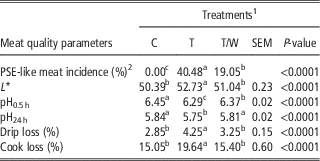
The basic indicators of meat quality are presented in Table 3. Short-distance transport resulted in the formation of PSE-like broiler breast meat, and the incidence rate was 40.48%. Transportation followed by water shower spray with resting significantly decreased the incidence rate to 19.05% (P<0.05). Transport significantly increased the L* value, drip loss and cooking loss of PM muscle compared with the control group (P<0.05). In addition, pH0.5 h and pH24 h values were significantly lower in the T group than in the C group (P<0.05). A significant difference in pH0.5 h value was observed between the T/W group and the control group (P<0.05).
Effects of transport and water shower spray with lairage on meat quality of pectoralis major muscle of broilers

PSE like=pale, soft and exudative like; L*=lightness; pH0.5 h=pH at 0.5 h postmortem; pH24 h=pH at 24 h postmortem.
The results are presented by mean values and SEM.
a,b,cMeans in the same row with different superscripts differ significantly (P<0.05).
1 C=broilers kept in crates without transport; T=broilers suffered from 30 min transport; T/W=broilers suffered from 30 min transport followed by 10 min water shower spray and 20 min lairage; n=42/group.
2 Kruskal–Wallis test (χ 2 approximation).
Activities of stress-associated enzymes
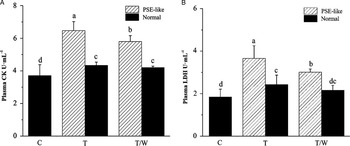
As shown in Figure 1, the activities of plasma CK and LDH were significantly higher in normal and PSE-like samples after transportation than those in the control group (P<0.05). Moreover, significant differences were observed between normal and PSE-like muscle samples either in the T or T/W group (P<0.05). As a subsequent recovery procedure, water shower spray with resting after transportation appeared to significantly alleviate the stress response of PSE-like muscles (P<0.05). However, no significant changes in the activities of CK or LDH were found in normal muscle samples in the T/W group compared with the T group (P>0.05).
Activities of plasma creatine kinase (A) and lactate dehydrogenase (B) of normal and pale, soft and exudative (PSE)-like broilers for each treatment. C=broilers kept in crates without transport; T=broilers suffered from 30 min transport; T/W=broilers suffered from 30 min transport followed by 10 min water shower spray and 20 min lairage. a,b,c,dAll measurements were expressed as mean±SEM (n=6) with different superscript letters differ significantly (P<0.05).

Heat shock protein 70 and heat shock transcriptional factor 1 mRNA expressions in pectoralis major muscles
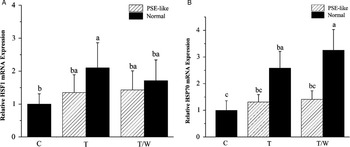
The mRNA expression levels of HSF1 and HSP70 in the PM muscles are presented in Figure 2A and B, respectively. The expression of the HSF1 gene was higher in normal muscles in the T group (P<0.05) but not in normal muscles in the T/W group. Moreover, no significant differences in HSF1 gene expression were observed between normal and PSE-like muscles in each group. Heat shock protein 70 mRNA expression tended to exhibit a similar pattern as that of HSF1. The expression of HSP70 mRNA was significantly higher in normal muscles of both T and T/W treatments compared with that in the control group (P<0.05). A significant difference was observed between normal and PSE-like samples in the T/W group (P<0.05). Meanwhile, no significant differences in HSP70 were found in PSE-like muscle samples in the T or T/W groups compared with the control group (P>0.05).
Relative mRNA expressions of heat shock transcriptional factor 1 (HSF1) (A) and heat shock protein 70 (HSP70) in normal and pale, soft and exudative (PSE)-like pectoralis major muscle samples from each treatment (B). C=broilers kept in crates without transport; T=broilers suffered from 30 min transport; T/W=broilers suffered from 30 min transport followed by 10 min water shower spray and 20 min lairage. a,b,cAll measurements were expressed as mean±SEM (n=6) with different superscript letters differ significantly (P<0.05).

Heat shock protein 70 protein expression in pectoralis major muscle
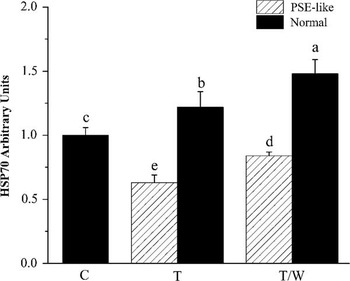
The results of HSP70 protein expression in the different treatment groups are presented in Figure 3. Compared with that in the control group, the expression of HSP70 was significantly higher in normal muscles after transportation. However, it was lower in PSE-like muscles in both T and T/W treatments (P<0.05). Furthermore, a difference was observed in the level of HSP70 between normal and PSE-like muscles in both T and T/W treatments (P<0.05).
Representative protein expression of heat shock protein 70 (HSP70) in normal and pale, soft and exudative (PSE)-like pectoralis major muscle samples from each treatment. C=broilers kept in crates without transport; T=broilers suffered from 30 min transport; T/W=broilers suffered from 30 min transport followed by 10 min water shower spray and 20 min lairage. The relative band density of HSP70 after normalizing to GAPDH was shown. a,b,c,d,eAll measurements were expressed as mean±SEM (n=6) with different superscript letters differ significantly (P<0.05).

Location and fluorescence intensity of heat shock protein 70
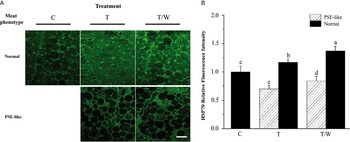
As shown in Figure 4A, the majority of HSP70 was readily diffusible within the cytoplasm of muscle fibers in the control group and only a small part was observed on the surface of cell membranes. After transport stress, the fluorescence-staining pattern of HSP70 was evidently enhanced in the normal muscles of the T and T/W groups, showed a generally even stain spreading in the cytoplasmic space, and were tightly bound to the surface membranes. Heat shock protein 70 was basically absent from the cytoplasm and was only found in the extracellular matrix and on surface membranes in PSE-like muscles in the T and T/W treatment groups. Heat shock protein 70 fluorescence intensity was significantly higher in normal muscles of the T and T/W groups than in those of the control group (P<0.05). However, this trend was contrary to that of the PSE-like muscle samples (Figure 4B). These results are in accordance with the result of Western blot. The distribution or migration changes in HSP70 in the normal and PSE-like muscle samples suggest possible functional changes in its molecular chaperone activities.
Representative fluorescence staining (A) and relative fluorescence intensity (B) of heat shock protein 70 (HSP70) in cross-section of normal and pale, soft and exudative (PSE)-like pectoralis major muscle samples from each treatment. C=broilers kept in crates without transport; T=broilers suffered from 30 min transport; T/W=broilers suffered from 30 min transport followed by 10 min water shower spray and 20 min lairage. Magnifications: 200×. Scale bar=50 μm. a,b,c,d,eAll measurements were expressed as mean±SEM (n=6) with different superscript letters differ significantly (P<0.05).

Principal component analysis
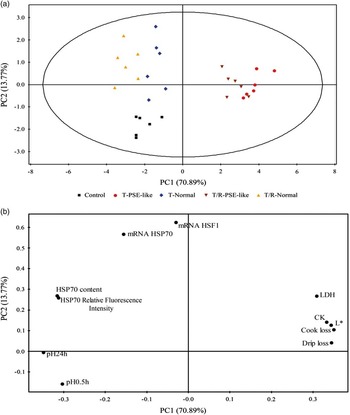
The relationship between measured meat quality indicators and biochemical parameters was evaluated through PCA. A score plot from the PCA of the first two principal components (R 2=84.66%) is shown in Figure 5a. The normal muscle samples are located on the left side of the plot, and the PSE-like muscle samples are predominately on the right part. This result shows that the normal muscle samples could be well discriminated from the PSE-like muscle samples based on the determined parameters. Moreover, the HSP70 protein expression exhibited a high correlation with meat quality parameters and stress indicators (Figure 5b).
Score plot (a) and loading plot (b) of the first two principal components (PCs) of a principal component analysis of meat quality indicators and biochemical parameters. The percentage variance explained by the two PCs was 84.66%. C=broilers kept in crates without transport; T=broilers suffered from 30 min transport; T/W = broilers suffered from 30 min transport followed by 10 min water shower spray and 20 min lairage; HSP70=heat shock protein 70; HSF1=heat shock transcriptional factor 1; mRNA=messenger RNA; LDH=lactate dehydrogenase; CK=creatine kinase; T-PSE-like = pale, soft and exudative-like meat in T group; T-Normal = normal meat in T group; T/R-PSE-like = pale, soft and exudative-like meat in T/W group; T/R-Normal = normal meat in T/W group.

Discussion
Transportation of broilers from farms to abattoirs involves many potential stressors, including fasting, ambient temperature and road conditions, which may cause severe physiological stress and metabolic reactions. In the present study, the occurrence of PSE-like meat in the T group was significantly higher than that in the other two groups. This finding is in accordance with those of previous studies, which reported that the high incidence of PSE-like chicken breast meat is related with heat stress or transport stress (Song et al., Reference Song and King2015; Jiang et al., Reference Jiang, Wang, Xing, Han and Xu2016). Numerous studies have indicated that the direct cause of PSE-like syndrome in poultry is muscle hyper-metabolism during early postmortem (Barbut, Reference Barbut2012). Severe pre-slaughter stress is a potential factor that leads to intense anaerobic glycolysis. Accelerated glycolysis produces excessive lactic acid and thus leads to rapid early postmortem pH decline. According to Huff-Lonergan and Lonergan (Reference Huff-Lonergan and Lonergan2005), pH decline may influence the activation of the calpain system and the degradation of intermediate filament and cytoskeletal proteins. Altogether, the biochemical changes caused by stress during postmortem may cause a variation in meat quality. Water shower spray with resting after transport can slow down the pH decline in the early postmortem period and counteract the negative effects caused by transport stress under high ambient temperatures, thereby improving meat quality. This finding is similar to the finding of Guarnieri et al. (Reference Guarnieri, Soares, Olivo, Schneider and Macedo2004).
As revealed by the present results, exposing broilers to short-distance transportation under high-temperature conditions caused a significant increase in the plasma activity of CK and LDH in both normal and PSE-like muscle samples. These elevations indicate muscle cell membrane disruption and permeability, which led to subsequent skeletal muscle damage and fatigue (Sandercock et al., Reference Sandercock, Hunter, Nute, Mitchell and Hocking2001). Scheffler and Gerrard (Reference Scheffler and Gerrard2007) indicated that damage on muscle membranes is an important factor that leads to a reduction in meat quality, as shown in Table 1. Moreover, plasma CK and LDH activities were significantly higher in the PSE-like muscle group than in the normal muscle group. This result may reflect the severe muscle damage induced by antemortem stress and subsequent changes in muscle metabolism, which ultimately lead to meat quality variation.
Substantial evidence shows that HSPs play important physiological roles in normal conditions and situations involving both systematic and cellular stress. Among these HSPs, HSP70 family proteins are the most temperature sensitive and highly conserved (Mayer and Bukau, Reference Mayer and Bukau2005). Generally, HSP70 transcription in response to stress is mainly regulated through the binding of HSF1 to HSE in the upstream promoter region of the HSP70 gene (Åkerfelt et al., Reference Al-Aqil and Zulkifli2010). The present study found that the transcriptional levels of HSF1 and HSP70 as well as the protein expression increased in the normal muscles of the T and T/W groups. Gabriel et al. (Reference Gabriel, Ferro, Stefani, Ferro, Gomes and Macari1996) found that acute heat stress induces an increase in HSP70 mRNA in broiler liver, which is similar to that of mammals. Delezie et al. (Reference De Maio2007) indicated that HSP70 mRNA increases in the liver of broilers when transported at high stocking densities. In addition, a previous study found that the HSP70 protein expression increases in the brain sample of conventional open-side housed broilers compared with that of windowless, environmentally controlled, chamber-bred broilers after being subjected to 4 h of transportation (Al-Aqil et al., Reference Åkerfelt, Morimoto and Sistonen2009). These results indicate that the variation in the HSP70 expression is associated with the stress condition. Moreover, our results are in accordance with those of Milne and Noble (Reference Milne and Noble2002), who demonstrated that increased HSP70 expression in skeletal muscles occurs in all muscle fiber types in response to exercise or heat stress. The synthesis of HSP70 under stress conditions plays a protective role in maintaining the metabolic homeostasis and structural integrity of muscle cells against damage. Therefore, over expression of HSP70 could be associated with improved tolerance to severe pre-slaughter stress.
Meanwhile, no significant increases in HSF1 or HSP70 mRNA expression were observed in the PSE-like muscle group after stress. Similarly, Hao and Gu (Reference Hao and Gu2014) proposed that no significant increase in HSP70 mRNA expression occurs in the PM muscle of broilers subjected to 2 h of heat stress treatment. The protein expression of HSP70 in the PSE-like muscle group was lower than that in the control and normal muscle groups in the present study. Periale et al. (Reference Periale, Peskov, Iacobaeus, Francke and Pavlopoulos2015) indicated that feed restriction of broilers exerts a significant effect on brain HSP70 levels. In another study, selective breeding for phenotypic traits in the domestication process resulted in physiological alterations of three chicken breeds, in which HSP70 showed different expressions in response to acute stress (Soleimani et al., Reference Soleimani, Zulkifli, Omar and Raha2011). Yu et al. (Reference Yu, Tang, Bao, Zhang, Hao and Yue2009) found that the protein expression of HSP70 in the longissimus muscle of pigs decreases after different times of transportation. Based on our results, we assume that the expression of HSP70 is related to stress levels.
The relative change in HSP70 in response to stress is fiber-type specific. Neufer et al. (Reference Neufer, Ordway, Hand, Shelton, Richardson, Benjamin and Williams1996) suggested that the induction of HSP70 occurs more slowly in type IIB muscle fibers than in types I and IIA muscle fibers. This condition might contribute to the relatively slow response of HSP70 induction in the present study, given that chicken PM muscle is composed almost entirely of type IIB, fast-twitch, glycolytic muscle fibers. Moreover, we propose that the changes in HSP70 in the PSE-like muscle samples might be caused by disruptions in the membrane function and permeability, which resulted in the release of HSP70 into the plasma as described by Khazzaka et al. (Reference Khazzaka, Figwer, Poirel, Serrar and Franck2006).
Sugimoto et al. (Reference Sugimoto, Furuoka and Sugimoto2003) found that misfolding of energy-related proteins caused by HSP70 deficiency might lead to protein aggregation and muscle fiber degeneration in cattle diaphragmatic muscles. Di Luca et al. (Reference Di Luca, Mullen, Elia, Davey and Hamill2011) indicated that HSP70 shows different expressions in divergent water holding capacity phenotypes of pork muscle. Based on our results, we assume that the decrease in HSP70 expression in PSE-like chicken PM muscles may be disadvantageous for the recovery of the normal function of the cell membrane and the protection of disrupted muscle cell homeostasis under stress conditions.
Previous studies have shown that the majority of HSP70 is readily diffusible within the cytoplasm in non-stressed muscle fibers; meanwhile, after various stress interventions, HSP70 primarily binds to and stabilizes the structure and function of cell membranes (Larkins et al., Reference Larkins, Murphy and Lamb2012). This was clearly indicated in the normal muscle groups in our study. The increased fluorescence intensity indicated the similar response of HSP70 when confronted with stress as found in the skeletal muscles of other species (Vega et al., Reference Vega, Rodríguez-Silva, Frey, Gehrmann, Diaz, Steinem, Multhoff, Arispe and De Maio2008). Furthermore, we found the distribution or migration of HSP70 from the cytoplasm to the extracellular matrix in the PSE-like muscle groups, as indicated in Figure 3. Previous study has shown that HSPs are located outside the cell, particularly after various pathological conditions such as inflammatory response syndrome, muscle contractile dysfunction and severe diseases (Mathur et al., Reference Mathur, Walley, Wang, Indrambarya and Boyd2011). Vega et al. (Reference Vega, Rodríguez-Silva, Frey, Gehrmann, Diaz, Steinem, Multhoff, Arispe and De Maio2008) revealed that HSP70 translocates into membranes after stress and is released within membranous structures from intact HepG2 cells that activate the immune system to generate a systemic response to avoid the propagation of initial stress. Once HSP70 goes beyond its intracellular location as it has been detected outside cells during the stress response, its chaperone roles may change and could activate signaling pathways or participate in cellular communication (De Maio, Reference Delezie, Swennen, Buyse and Decuypere2011). The different cellular distributions or migrations of HSP70 in chicken PM muscles may be related to its functional changes.
Conclusion
This study showed that HSP70 exhibits different expressions and distributions in normal and PSE-like muscles of broilers after being subjected to stress. Principal component analysis indicated a correlation between HSP70 protein expression and meat quality indicators. In conclusion, as a protective protein in stress situations, HSP70 may be employed to maintain biochemical changes and contribute to the quality of postmortem muscles. The role of HSP70 in chicken meat quality development and its function mechanism requires further investigation.
Acknowledgments
This research was funded by China Agricultural Research System (Beijing, China, CARS-42) and National Natural Science Foundation of China (31101507).