Introduction
Type 2 diabetes mellitus has become a major health problem worldwide. Direct and indirect costs of type 2 diabetes are estimated to continue rising,Reference Hex, Bartlett, Wright, Taylor and Varley1,Reference Png, Yoong, Phan and Wee2 leading to concerns about public health burden in the future. Lifestyle factors such as a healthy diet, regular physical activity, and avoiding smoking are important to prevent or delay the onset of type 2 diabetes.3 Lower birth weight (or birth size) is also increasingly being recognized as an early predictor of type 2 diabetes. In most studies, birth weight was inversely related to the risk of diabetes.Reference Anazawa, Atsumi and Matsuoka4–Reference Katanoda, Noda and Goto7 However, its public health importance relative to current lifestyle factors for the risk of diabetes is not fully understood. The identification of dominant factors that contribute to the risk of diabetes is important to achieve primary prevention of type 2 diabetes.
Physical activity is one of the most important and modifiable factors in the primary prevention of type 2 diabetes. The World Health Organization’s global recommendation on physical activity for health states that people aged 18–64 years should do at least 150 min of moderate-intensity aerobic physical activity or at least 75 min of vigorous-intensity aerobic physical activity throughout the week, or an equivalent combination of moderate- and vigorous-intensity activity (MVPA).8 A recent meta-analysis of prospective studies has shown that higher levels of physical activity were associated with a substantially lower incidence of type 2 diabetes in the general population,Reference Smith, Crippa, Woodcock and Brage9 even after adjustment for body mass index (BMI).Reference Jeon, Lokken, Hu and van Dam10
Up to now, however, whether the association between lower birth weight and the risk of diabetes is modified by physical activity remains unknown.Reference Laaksonen, Lakka and Lynch11,Reference Eriksson, Ylihärsilä, Forsén, Osmond and Barker12 Laaksonen et al.Reference Laaksonen, Lakka and Lynch11 compared birth size (ponderal index) and fasting blood glucose or insulin levels according to the duration of vigorous physical activity using a questionnaire in middle-aged men. They reported that the association between small birth size and fasting serum insulin levels was absent in men engaging in at least 25 min/week of vigorous physical activity.Reference Laaksonen, Lakka and Lynch11 Eriksson et al. also compared the odds ratio of type 2 diabetes and impaired glucose tolerance with birth weight or size and frequency or intensity of regular exercise in subjects aged 65–75 years.Reference Eriksson, Ylihärsilä, Forsén, Osmond and Barker12 They found that regular exercise had protective effects regarding the development of type 2 diabetes and impaired glucose tolerance in the small birth size or low birth weight group. These results suggest that physical activity may play a key role in glycemic control in individuals born with lower weight. These two studies, however, reported on middle-aged men and an elderly cohort in Europeans. Studies in other populations are needed to establish the association between birth weight, physical activity, and the risk of type 2 diabetes.
In 2011, the diagnostic criteria for type 2 diabetes were revised to include glycated hemoglobin (HbA1c) which reflects average glucose concentrations over the previous 2–3 months. HbA1c in blood is a direct biomarker for the presence and severity of hyperglycemia and is now considered to be a better index of overall glycemic exposure.Reference Lyons and Basu13 The association between MVPA and HbA1c is well defined in populations with type 2 diabetes as well as in general populations.Reference Bakrania, Yates and Edwardson14 Its clinical value in the prevention of type 2 diabetes is recognized not only in diabetics but also in healthy subjects. Therefore, the aim of the present study was to examine the association between birth weight and glycemic status and whether this association is modified by physical activity in nondiabetic Japanese women.
Methods
Study participants
We used data for Japanese women who underwent annual health checkups from July 2013 to March 2017 at the Okayama Southern Institute of Health. The institution has a hospital and an exercise facility in the same area. Visitors must undertake health checkups which include physical activity measurements and blood sample examination before they use the exercise facility. Blood sampling was assessed before starting the physical activity measurements. We included individuals who met the following criteria: (1) female sex aged between 20 and 65 years, (2) underwent HbA1c examination, and (3) obtained birth weight data and written informed consent. A total of 122 individuals met the above criteria. Those who were born with a birth weight of more than 1.5 kg were to be included for analyses, and no individuals had a birth weight of less than 1.5 kg. Participants who had been diagnosed with diabetes mellitus (n = 5) were excluded. Additional participants were excluded if accelerometer data were not available (n = 12) or not conforming with the study criteria (n = 2). Finally, 103 women were included for subsequent analyses. Questionnaires were used to evaluate medical history, family history of diabetes, state of menstruation, and birth information.
This research project was approved by the Ethics Committee of the National Institute of Health and Nutrition in Japan (receipt number: 20130517-01). The study procedures were explained in writing to all participants, and written informed consent was obtained from each participant.
Anthropometric measurements
Body height and weight were measured without shoes but with clothing to the nearest 0.1 cm and 0.1 kg, respectively. BMI was calculated from measured height and weight (kg/m2). Abdominal circumference (AC) was measured at the umbilical level using an inelastic measuring tape at the end of normal expiration.
Birth weight
Participants were asked to provide their birth weights through the Maternal and Child Health Handbook records, issued by each municipal office. Those participants who had lost the Handbook were asked to report their birth weights based on the participant’s or his/her mother’s recall.
Physical activity measurements
Daily MVPA was objectively measured using a triaxial accelerometer (Actimarker EW4800; Panasonic Electric Works, Osaka, Japan; weight 36 g including batteries) for more than seven consecutive days. The validity of the device is described elsewhere.Reference Hikihara, Tanaka, Ohkawara, Ishikawa-Takata and Tabata15–Reference Murakami, Kawakami and Nakae17 Participants wore the accelerometer around the waist and were requested to wear the device at all times, except under special circumstances such as dressing, bathing, swimming, or sleeping.
Metabolic equivalent (MET) intensity levels of physical activity were calculated as described previously.Reference Yamada, Yokoyama and Noriyasu16,Reference Murakami, Iemitsu and Sanada18 Briefly, acceleration in the anteroposterior (X), mediolateral (Y), and vertical (Z) axes was calculated using a sensor with a sample rate of 20 Hz over a range from 0 to 2 × g. The apparatus stored the standard deviation (SD) of the vector norm of the integrated acceleration in three dimensions each minute. The MET intensity levels of physical activity were calculated by simple linear regression of the integrated acceleration. Subjects with data obtained from wearing the accelerometer >10 h on at least 3 daysReference Trost, McIver and Pate19 were included in the analysis. Periods with >60 min of consecutive one counts (no signal) were classified as “non-wear time”. We included all days with wear time >10 h in the analyses. The mean time spent in MVPA (≥3.0 METs) was analyzed.
Regular exercise habits were also assessed by a questionnaire for the purpose of supportive information. Regular exercise habits were defined as engaging in exercise more than 2 days a week for at least 30 min a day and for 3 months or more.
Statistical analyses
Measured and calculated values are presented as means ± SDs. Student’s t-tests were used to investigate potential differences between women with recorded birth weight data and women with recalled birth weight data. The t-tests were also used to compare MVPA between women with and without regular exercise habits. Pearson’s correlation analysis was used to test the relationships between study variables. Multiple linear regression analyses were performed to assess the associations between birth weight and HbA1c. We first entered the birth weight (Model 1) and then added MVPA and accelerometer wear time (Model 2) as independent variables to examine how the association is altered by physical activity. An interaction term (birth weight × MVPA) was entered into Model 2 to test a potential interaction between birth weight and physical activity. However, it was removed because of a nonsignificant contribution to HbA1c. All models were adjusted for age, state of menstruation (regular, irregular, or menopause), family history of diabetes (yes or no), and AC (or BMI). Statistical analyses were performed using IBM SPSS Statistics Version 22.0 for Windows (IBM Japan Ltd., Tokyo, Japan). Statistical significance was set at a P-value < 0.05.
Results
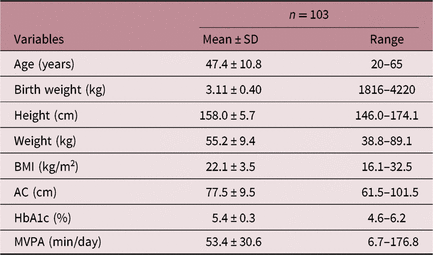
Table 1 shows the characteristics of the study participants and time spent in MVPA. All participants were born as singletons. Three women were born with low birth weights (<2.5 kg) and one with large birth weight (≥4.0 kg). Women with recorded birth data (n = 52) were younger (43.7 ± 11.7 years) than women with recalled birth weight data (51.2 ± 8.5 years) (P < 0.001); however, there were no significant differences between other study parameters. HbA1c was 5.4 ± 0.3%, and 13 women were categorized as having prediabetes (HbA1c ≥ 5.7%).20 Accelerometer data showed that the mean time spent in MVPA was almost 53 ± 31 min/day. The numbers of days and duration of wearing the accelerometers used for analyses were considerably greater than the minimum criteria specified (at least 3 days and 10 h/day), with an average of 9.5 days and 16.0 h/day, respectively. The number of days not used for analyses (i.e., wear time < 10 h) was 1.3 days on average. Thirty-eight (37%) participants had regular exercise habits, and they spent more time in MVPA (63.0 ± 31.5 min/day) compared with those who had no regular exercise habits (47.7 ± 29.0 min/day, P < 0.05).
Characteristics of the participants

BMI, body mass index; AC, abdominal circumference; HbA1c, glycated hemoglobin; MVPA, moderate to vigorous physical activity.
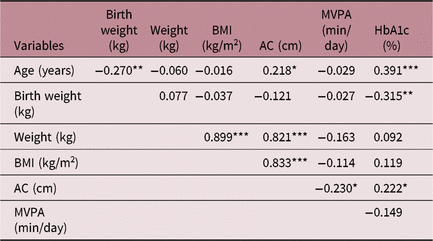
Table 2 shows the correlation matrix among factors associated with HbA1c. Age (P < 0.001) and AC (P < 0.05) were positively and weakly correlated with HbA1c. Birth weight was also inversely and weakly correlated with HbA1c (P < 0.01). MVPA was not significantly associated with HbA1c. Moreover, MVPA was negatively associated with AC (P < 0.05), although this association was weak.
Correlation coefficients among factors associated with HbA1c

BMI, body mass index; AC, abdominal circumference; HbA1c, glycated hemoglobin; MVPA, moderate to vigorous physical activity.
*P < 0.05; **P < 0.01; ***P < 0.001.
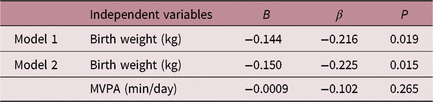
Table 3 presents the results of the multiple linear regression analyses used to examine the associations of birth weight and MVPA with HbA1c. As shown in Model 1, birth weight was negatively associated with HbA1c (β = −0.22, 95% confidence interval (CI): −0.26, −0.02), even after adjusting for age, state of menstruation, family history of diabetes, and AC. When MVPA was introduced as an independent variable in the model, the association between birth weight and HbA1c remained essentially unchanged (β = −0.23, 95% CI: −0.27, −0.03) (Model 2). We also examined whether having regular exercise habits instead of MVPA may contribute to HbA1c, but no significant association was found (data not shown). In addition, the results were still unchanged when BMI was entered into the model instead of AC (data not shown).
Multiple linear regression analyses with HbA1c as the dependent variable

Model 1: Adjusted for age, state of menstruation, AC, and family history of diabetes.
Model 2: As Model 1 plus MVPA and accelerometer wear time.
B, unstandardized regression coefficient; β, standardized regression coefficient; AC, abdominal circumference; HbA1c, glycated hemoglobin; MVPA, moderate to vigorous physical activity.
Discussion
This study was performed to examine the association between birth weight and glycemic status and to test whether this association is modified by physical activity in nondiabetic Japanese women. The main finding was that lower birth weight was significantly associated with higher levels of HbA1c. This result is in line with previous studies in Japanese individuals which showed that birth weight is inversely associated with the risk of diabetes.Reference Whincup, Kaye and Owen5–Reference Katanoda, Noda and Goto7 These cross-sectional studies conducted in Japanese populations included subjects with diabetes, whereas we studied only nondiabetic subjects. Thus, the findings of our study provide further evidence that low birth weight may be linked to glycemic status, even before the onset of diabetes in adulthood. We demonstrated that each 1-kg decrease in birth weight was associated with an almost 0.14% increase in HbA1c (Table 3, Model 1). This difference appears to have clinical importance because each 0.1% increment in HbA1c level has been associated with an almost 10% higher risk of diabetes in nondiabetic adults.Reference Selvin, Steffes and Zhu21
Although the detailed mechanisms by which lower birth weight predicts HbA1c levels are not completely understood, it may be related to the “thrifty phenotype hypothesis” proposed by Hales and Barker.Reference Hales and Barker22 According to their hypothesis, poor development of pancreatic β-cell mass and function may play a key role in the association between poor early nutrition (low birth weight) and later type 2 diabetes.Reference Hales and Barker22 These anatomical and physiological changes involved in glucose tolerance have permanent effects after birth and may lead to hyperglycemia under the condition of a mismatch between intrauterine constraint and a nutritionally rich postnatal environment. The findings of our study support their hypothesis.
More importantly, the present study showed that the association between lower birth weight and HbA1c was unchanged by MVPA. This finding is in contrast with the studies by Laaksonen et al.Reference Laaksonen, Lakka and Lynch11 and Eriksson et al.Reference Eriksson, Ylihärsilä, Forsén, Osmond and Barker12. They found that the association between low birth weight (or small size at birth) and the risk of diabetes was absent in the groups engaged in regular strenuous physical activity.Reference Laaksonen, Lakka and Lynch11,Reference Eriksson, Ylihärsilä, Forsén, Osmond and Barker12 The difference in patient characteristics may be a potential reason for the discrepancy between our findings and those of their studies. Participants in our study were relatively younger and healthier compared to those in their studies: Laaksonen et al. studied middle-aged men (50.6 ± 6.4 years) with 22% having metabolic syndromeReference Laaksonen, Lakka and Lynch11, and Eriksson et al. studied an elderly cohort (65–75 years) with 20% having type 2 diabetes.Reference Eriksson, Ylihärsilä, Forsén, Osmond and Barker12 In contrast, our participants were nondiabetic women (47.4 ± 10.8 years). Otherwise, the lifelong influence of lower birth weight on glucose tolerance might differ between men and women. When we compare the present study in women with the previous study in middle-aged men,Reference Laaksonen, Lakka and Lynch11 our results suggest that glucose concentrations in women could be more dependent on their birth weight. Additionally, the difference in race may be another potential factor in the discrepancy. Because type 2 diabetes occurs in Japanese, who are less obese than populations in Western countries,Reference Chan, Malik and Jia23 the association of birth weight with HbA1c may be stronger in Japanese individuals whose birth weights are typically much lower than those of Westerners.Reference Mikolajczyk, Zhang and Betran24 This might make it difficult to modify the association of birth weight with HbA1c by physical activity in Japanese individuals.
On the other hand, our result is similar to that of a previous study showing that the association between lower birth weight and higher insulin resistance is not modified by physical activity as assessed by an accelerometer (ActiGraph) in healthy children and adolescents.Reference Ridgway, Brage and Anderssen25 However, the study by Ortega et al. showed an interaction in the association between birth weight and insulin resistance with levels of objectively measured physical activity (ActiGraph) in adolescents.Reference Ortega, Ruiz and Hurtig-Wennlöf26 More observational studies in various populations are needed to identify the reason for discrepancies among these studies.
It should be noted that MVPA was not significantly associated with HbA1c in this study. Bakrania et al. reported that MVPA was an important determinant of HbA1c in a national sample of England.Reference Bakrania, Yates and Edwardson14 They also suggested that the association between MVPA and HbA1c was stronger in those with higher BMI levels (≥30 kg/m2).Reference Bakrania, Yates and Edwardson14 In our study, the mean ± SD value for BMI was 22.1 ± 3.5 (kg/m2), and the percentage of women with a BMI above 30 kg/m2 was only 4% (n = 4). As such, lower BMI levels in Japanese womenReference Takimoto, Yoshiike, Kaneda and Yoshita27 might explain why MVPA was not associated with HbA1c in our study. However, MVPA was inversely correlated with AC, and AC was positively correlated with HbA1c in this study (Table 2), suggesting that physical activity could contribute to a reduction in glycemic levels by indirectly affecting abdominal adiposity.
The present study has several limitations. First, we relied on recalled data for information on birth weight. There was a high agreement between recorded and recalled birth weight, and recalled birth weight data have been shown to be suitable for use in epidemiological studies, at least in high-income countries.Reference Shenkin, Zhang and Der28 However, our sample was quite small; therefore, the potential bias related to the recalled birth weight might have affected on our results. Second, data on gestational age were not available, and consequently, data could not be adjusted for preterm or small for gestational age births. These points should be resolved in further studies. Third, because the prevalence of type 2 diabetes is much lower in Japanese women than in Japanese men, the findings of the present study must be adopted carefully for women. However, the prevalence of type 2 diabetes is increasing continuously in both Japanese men and women. Fourth, this was a retrospective study based on a relatively small sample size with few women with low or large birth weight. Long-term follow-up studies with larger sample sizes are required to elucidate the influence of birth weight and physical activity patterns on the risk of diabetes in later age. While this remains to be investigated, our study provides valuable information concerning Japanese women.
In summary, the present study showed that lower birth weight was associated with higher HbA1c levels in nondiabetic Japanese women. This association was unchanged by the time spent in MVPA in adulthood. These results suggest that lower birth weight may be associated with higher HbA1c levels before the onset of type 2 diabetes, irrespective of adulthood physical activity. Early-life development should be taken into account when considering the risk of diabetes in Japanese women, even if they are physically active.
Acknowledgments
The authors would like to thank the participants for their cooperation in the study. We also wish to thank the staff of the Okayama Southern Institute of Health, especially Yumiko Kunihashi, Akie Morishita, and Reiko Gotou for their help with the survey. We would like to express the deepest appreciation to the late Dr. Takeyuki Numata for his great contribution to the study. We would like to thank Editage (www.editage.jp) for English language editing. The authors are entirely responsible for the scientific content of the paper.
Financial Support
This work was supported by the Japan Society for the Promotion of Science KAKENHI Program (https://kaken.nii.ac.jp/en/grant/KAKENHI-PROJECT-13J07359/) (T.A., grant number JP13J07359).
Conflicts of Interest
None.
Ethical Standards
The authors assert that all procedures contributing to this work comply with the Helsinki Declaration of 1975, as revised in 2008, and have been approved by the institutional committee of the National Institute of Health and Nutrition in Japan (receipt number: 20130517-01). The study procedures were explained in writing to all participants, and written informed consent was obtained from each participant.