INTRODUCTION
Children's early speech productions are often inconsistent, with coda consonants sometimes appearing and sometimes omitted (e.g. Demuth, Culbertson & Alter, Reference Demuth, Culbertson and Alter2006). The question arises as to whether this early variability is random, or perhaps phonologically conditioned. Cross-linguistic findings suggest that the early use of coda consonants may interact with segment type, stress, position within the word, or other language-specific aspects of prosodic and/or metrical structure (e.g. Catalan: Prieto & Bosch-Baliarda, Reference Prieto and Bosch-Baliarda2006; Dutch: Fikkert, Reference Fikkert1994; Spanish: Lleó, Reference Lleó2003; Lleó & Arias, Reference Lleó, Arias, Grijzenhout and Kabak2009). English has a word-minimality requirement that all open-class lexical items must contain at least two moras of structure (Hayes, Reference Hayes1995; McCarthy & Prince, Reference McCarthy and Prince1986). If young children are sensitive to these English-specific phonological constraints, this might help explain some of the reported variability in coda production. It would also provide further support for proposals that coda consonants may be ‘prosodically licenced’ in early speech (e.g. Demuth, Reference Demuth, Farris-Trimble and Barlow2014; Lleó, Reference Lleó2003). We explore these issues below in the acquisition of Australian English, using the International Phonetic Alphabet (IPA) transcriptions of Australian English vowels (cf. Harrington, Cox & Evans, Reference Harrington, Cox and Evans1997).
The prosodic structure of monosyllabic English words
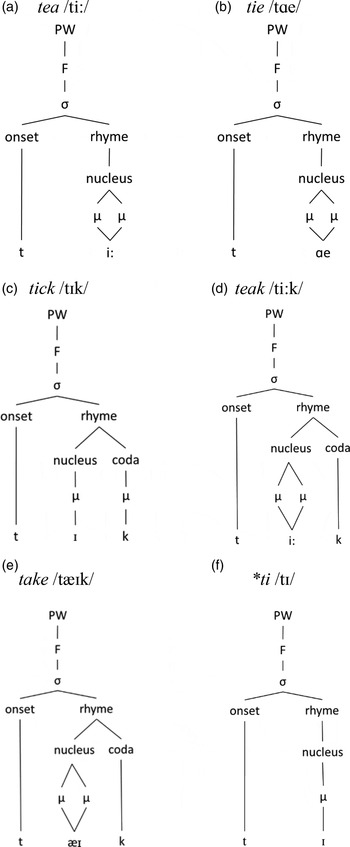
A well-formed, open-class phonological word in English must contain at least two moras (or a foot) of prosodic structure (e.g. Broselow, Reference Broselow and Goldsmith1995; Cohn, Reference Cohn2003; Hayes, Reference Hayes1995). This restriction is often referred to as a word-minimality constraint (McCarthy & Prince, Reference McCarthy and Prince1986), and in languages like English ensures that all monosyllabic lexical items will receive stress. Thus, monosyllabic English words in the Australian English dialect examined here can either be composed of a long vowel (e.g. tea /tiː/ – Figure 1a), a diphthong in an open syllable (e.g. tie /tɑe/ – Figure 1b), a short vowel with a coda consonant (e.g. tick /tɪk/ – Figure 1c), or a long vowel/diphthong with a coda (teak /tiːk/ – Figure 1d; take /tæɪk/– Figure 1e). An open-class lexical item in English cannot be composed of one mora of structure (e.g. *ti /tɪ/ – Figure 1f), as this would violate the word-minimality constraint and would be prosodically ill-formed.
Prosodic structure of monosyllabic English lexical items.

Note that the word-minimality constraint is language-specific. Thus, children must learn that a light syllable consisting of one mora of structure can constitute an open-class word in both Japanese (e.g. me /me/ ‘eye’) (Ota, Reference Ota1999) and French (e.g. feu /fø/ ‘fire’) (Demuth & Johnson, Reference Demuth and Johnson2003), but not English (Demuth et al., Reference Demuth, Culbertson and Alter2006) or Sesotho, where the monosyllabic verb *ja ‘eat!’ in the imperative is ill-formed, resulting in the addition of another syllable: eja! or jaa! (cf. Doke & Mofokeng, Reference Doke and Mofokeng1957). The main focus for this study is therefore to examine when the English word-minimality constraint is learned, and if this constraint might account for some of the variable use of coda consonants in children's early speech.
Previous studies of American English have provided some evidence for the role of the minimal word in acquisition. For example, in a case study of one child, Salidis and Johnson (Reference Salidis and Johnson1997) observed a period of development during which multisyllabic targets conformed to minimal words, with few sub-minimal forms. This occurred during a period when the child could also control vowel length, indicating an interaction between vowel and coda. Other studies have also observed interactions between vowel length and the occurrence of coda consonants (English: Kehoe & Stoel-Gammon, Reference Kehoe and Stoel-Gammon2001; Song & Demuth, Reference Song and Demuth2008; German: Kehoe, Reference Kehoe2002). Of relevance to the current study is the recent finding that vowels and coda consonants covary as a unit for Australian English-speaking children learning the vowel length distinction (Yuen, Cox & Demuth, Reference Yuen, Cox and Demuth2014).
Omission of coda consonants
Coda consonants are often omitted in children's early speech (e.g. Demuth & Fee, Reference Demuth and Fee1995; Fikkert, Reference Fikkert1994; Kehoe & Lleó, Reference Kehoe and Lleó2003). Using perceptual/transcription methods, Demuth et al. (Reference Demuth, Culbertson and Alter2006) examined the contexts of coda production in the spontaneous speech of four children aged one to two years. Although there was little evidence that children lengthened vowels when coda consonants were omitted, it was noted that children did retain coda consonants more often in monosyllabic words with short vowels, in contrast to those with long vowels. That is, children's early use of coda consonants seemed to be sensitive to the minimal word constraint. This is consistent with the findings of Kehoe and Stoel-Gammon (Reference Kehoe and Stoel-Gammon2001), who investigated rhyme acquisition in the speech productions of fourteen English-speaking children between the ages of 1;3 and 2;0. They found that children produced coda consonants more often following short vowels than long vowels. Similar observations have been made for German- (Kehoe & Lleó, Reference Kehoe and Lleó2003) and Catalan-speaking children (Prieto & Bosch-Baliarda, Reference Prieto and Bosch-Baliarda2006).
Song and Demuth (Reference Song and Demuth2008) conducted an acoustic investigation of vowel duration and coda omission in American English-speaking children's early monosyllabic CVC and CVVC target words ending in stops, fricatives, and affricates. The authors compared vowel durations in matched productions of words with and without a coda (e.g. American English cup [kʌp], [kʌ]), controlling for phrase-final lengthening. Vowel durations increased when the coda consonant was omitted in the context of both short and long vowels. This suggested that the vowel was made longer to compensate for the missing coda, not to preserve bimoraic/minimal word structure. However, these data involved spontaneous speech productions from very young children (below the age of 1;6), when coda consonants are only beginning to emerge. The current study thus used a controlled experimental design to further explore this issue with slightly older children learning another dialect, Australian English, which distinguishes vowels also in terms of vowel length.
Use of acoustic cues in the identification of coda
In addition to a transcriptional method, the current study conducted acoustic analysis as a means to affirm the perceptual observations. Child speech can be quite variable and children may be making categorical distinctions (covert contrasts) that adult transcribers may not hear. This may lead coders to underestimate the child's phonological knowledge (cf. Bottell & Clark, Reference Bottell and Clark1986; Macken & Barton, Reference Macken and Barton1980; Scobbie, Reference Scobbie, Gruber, Higgins, Olson and Wysocki1998). For this reason, recent research has pointed to the importance of using acoustic measures in the analysis of children's early speech in addition to perceptually evaluating children's phonological representations (e.g. Munson, Edwards & Beckman, Reference Munson, Edwards and Beckman2005; Theodore, Demuth & Shattuck-Hufnagel, Reference Theodore, Demuth and Shattuck-Hufnagel2012). Analysis that draws on Stevens' (Reference Stevens2002) cue-based model allows us to examine acoustic cues to feature contrasts that manifest in terms of multiple acoustic landmarks (e.g. vowel duration, voice bar, closure duration, coda release bursts, onset of frication, etc.).
Recent research provides good evidence for the range of acoustic cues that two- to three-year-old American English-speaking children employ to realize stop and fricative coda consonants (e.g. Shattuck-Hufnagel, Demuth, Hanson & Stevens Reference Shattuck-Hufnagel, Demuth, Hanson, Stevens, Clements and Ridouane2011; Song, Demuth, Evans & Shattuck-Hufnagel, Reference Song, Demuth, Evans and Shattuck-Hufnagel2013; Song, Demuth & Shattuck-Hufnagel, Reference Song, Demuth and Shattuck-Hufnagel2012). These included voice bar (low-frequency periodicity found after a sudden drop in amplitude following the vowel), vowel epenthesis (the insertion of a schwa following the stop coda consonant), noisy end of vowels, and a period of noise at coda release. In the current study, we used these acoustic measures along with vowel duration to complement perceptual coding, thereby providing a more rigorous evaluation of possible word-minimality effects.
Aim and hypotheses
The aim of the current study was to examine (both perceptually and acoustically) the possible effects of short and long vowels on two-year-old children's early production of coda consonants in monosyllabic words, using a controlled set of stimuli in an elicited imitation task. According to the word-minimality constraint, we hypothesized that more coda consonants would be produced following short vowels (CVC) than long vowels (CVVC). We also anticipated that, if a coda consonant was omitted, only short vowels would be lengthened in order to meet the requirement of a minimal word (CVː). If children produced more coda consonants following short vowels, and lengthened only short vowels when the coda was missing (CVC ~ CVː vs. CVVC ~ CVV), this would provide some converging evidence that they had an awareness of the word-minimality constraint. We call this the ‘word-minimality’ account. On the other hand, the ‘coda-compensation’ account would predict that compensatory vowel lengthening in the absence of a coda might occur across the board, irrespective of vowel length (CVC ~ CVː vs. CVVC ~ CVVː). To evaluate vowel lengthening as a function of the missing coda, we therefore included in our stimuli an open syllable word control (CVV). This would allow us to eliminate the possibility of vowel duration variations arising from the difference in closed vs. open syllable words.
Method
Participants
The participants were fifteen monolingual Australian English-speaking children (10 girls, 5 boys) from Sydney, Australia between the ages of 1;11 and 2;6 (Mage = 2;3). All children were reported to have typical speech, language, and hearing development. An additional seven children were excluded from the analysis because six were too shy to talk, and one did not produce 12 out of the 15 experimental items (over 80%). The short form of the MacArthur Communicative Development Inventory (CDI) (a 100-word checklist) was used to approximate the children's vocabulary size (Fenson, Pethick, Renda, Cox, Dale & Reznick, Reference Fenson, Pethick, Renda, Cox, Dale and Reznick2000). The CDI percentile scores ranged from 74 to 99, with a mean of 92·2 and a standard deviation of 9·5.
Stimuli
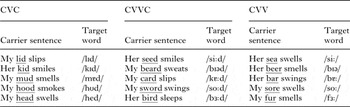
Australian English is a non-rhotic dialect that contains seven short vowels (/ɪ, e, æ, ɐ, ɔ, ʊ, ə/), six long vowels (/iː, eː, ɐː, oː, ʉː, ɜː/), and six diphthongs (/oɪ, æɪ, ɑe, əʉ, æɔ, ɪə/) (Cox & Palethorpe, Reference Cox and Palethorpe2007). These were used to construct short–long vowel pairs of stimuli. The stimulus items consisted of fifteen nouns embedded sentence medially in three-word three-syllable utterances (see Table 1). To test the possibility that vowel length may interact with coda production, five items contained a short vowel and coda consonant (CVC), five contained a long vowel and coda consonant (CVVC), and five consisted of a set of control CVV words with a long vowel and no coda, used to test for the possible effect of compensatory vowel lengthening. To control for the possible effects of voicing, all codas were voiced /d/. This ensured that vowel durations could be measured and compared across vowel types.
Stimulus sentences and target words (underlined) used in the experiment

All words were familiar, picturable nouns suitable for Australian English-speaking children. Word frequencies were obtained through ChildFreq by means of the CHILDES database (Bååth, Reference Bååth2010), calculated by counting child productions of the word per one million words. For the purpose of this paper, the age bracket for calculating word frequency was set from 0 to 2;9. The sum of the frequencies for each of the three word types were CVC (5447), CVVC (6423), and CVV (1344). The stimulus sentences were also carefully constructed to control for the position of the word within the utterance and sentence length, both of which have been shown to influence child productions of coda consonants (Song, Sundara & Demuth, Reference Song, Sundara and Demuth2009; Theodore et al., Reference Theodore, Demuth and Shattuck-Hufnagel2012).
As mentioned above, all codas contained the voiced alveolar stop /d/, thereby controlling for any extrinsic vowel duration effects due to coda voicing. All vowels were carefully selected to sample vowel height, fronting, and roundness and to be consistent across the CVV and CVVC conditions (e.g. CVV sea /siː/, CVVC seed /siːd/). Short vowels selected for the CVC condition were those whose spectral characteristics differed minimally from the long vowels in the same set (e.g. CVC /ɪ/ lid, CVVC /iː/ seed, and CVV /iː/ sea). Note that since Australian English is a non-rhotic dialect lacking postvocalic [ɹ], words like spa and spar are homophones (Cox & Palethorpe, Reference Cox and Palethorpe2007). Thus, none of the CVV or CVVC target words containing orthographic ‘r’ had the phonetic realization of ‘r’. The words following the target item all began with an s-cluster onset, facilitating acoustic identification of the stop at the end of the target word, if one was present. Placing the target word in utterance medial position also avoided any potential confounds of phrase-final lengthening (cf. Lehiste, Reference Lehiste1973).
The stimulus sentences were recorded by a female native speaker of Australian English in child-directed speech. Recording was conducted in a sound-attenuated room at a sampling rate of 44·1 kHz using a Behringer C-2 microphone and ProTools LE software. Vowel durations for the model speaker were as follows: CVC words M = 200 ms, SD = 11·4 ms, CVVC words M = 282 ms, SD = 71·5 ms, and CVV words M = 346 ms, SD = 75·1 ms. The sound files were excised and each paired with a cartoon picture as part of a PowerPoint slideshow (see ‘Appendix’). This provided a visual stimulus for the child to look at as they repeated the utterances they heard.
Procedure
The child and parent were invited into a sound-attenuated room where the child was engaged in a computer game. On the child-sized table where the experimenter and child sat there was a computer monitor, a Behringer C-2 microphone placed in front of the child, and Sony SRS-55 speakers through which the stimuli were presented. When the child was settled, the experimenter began the task with two warm-up sentences to acquaint the child with the game. Once the child was familiarized with the task, the experimenter moved on to the actual test items. For each trial, an audio prompt and visual stimulus would appear and the child was instructed to repeat what the computer said. For example, the audio prompt would say Her bird sleeps, and the child was instructed to repeat the whole sentence. Sticker incentives and praise were used to encourage the child. At completion of the task, the parent was asked to complete a demographic/language survey and the short form of the MacArthur CDI vocabulary checklist (Fenson et al., Reference Fenson, Pethick, Renda, Cox, Dale and Reznick2000). A short hearing screening using a tympanogram was also carried out to ensure the child had no middle ear pathology. The audio files were segmented for analysis using Praat software (Boersma & Weenink, Reference Boersma and Weenink2001).
The data
The total number of analyzed items was 191: CVC (n = 58), CVVC (n = 70), CVV (n = 63), after 34 missing items and 4 outliers greater than 2 standard deviations from the mean vowel duration were excluded.
Perceptual coding
All tokens were aurally examined for presence/absence of coda consonants (including CVV words). If a word was perceived as having a coda consonant, it was coded as ‘coda present’. If a word was perceived as not having a coda consonant, it was coded as ‘coda absent’. Ten percent of the items were re-coded by a second trained listener, with 92·85% inter-coder reliability.
Acoustic coding
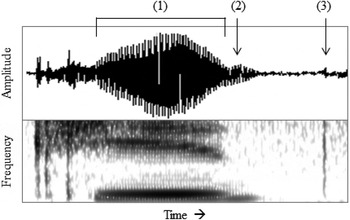
The data were also analyzed acoustically for possible non-perceptible cues to the coda consonant, as well as for measuring vowel duration to explore possible compensatory vowel lengthening in the case of missing codas. Both the spectrogram and the waveform were used to identify the following acoustic events: (1) Vowel duration: from the onset to the offset of the high intensity formant 2 (F2) and high amplitude regularity in the waveform; (2) voice bar: from the point of transition from the vowel into a voice bar, characterized by less energy in the mid- to high-frequency range (especially in F2) on the spectrogram than is seen in the preceding vowel, a simpler waveform than in the vowel, and an abrupt loss of waveform amplitude compared to the preceding vowel; (3) coda bursts: measured from the left edge of the burst signaling the release of the stop consonant, characterized by an abrupt spike on the waveform with a corresponding strong energy transient on the spectrogram; (4) presence/absence of irregular pitch periods near the end of the vowel due to a change in phonation; and (5) The onset of /s/ frication in the following word, indicated by aperiodicity in the waveform and frication on the spectrogram. Labels (1) through (3) are illustrated in Figure 2.
Waveform and spectrogram for the word kid /kɪd/, produced by a female participant (aged 2;0 years), illustrating (1) vowel duration, (2) voice bar, and (3) coda burst.

Two trained coders first coded the data from one child, compared and discussed the acoustic landmarks coded, and agreed on the coding procedure to be used in the remainder of the data. The first coder then proceeded to code the remaining data. Ten percent of these newly coded items were re-coded by the second trained coder, with 91·7% inter-coder reliability for the presence or absence of the acoustic cues listed above. One item was removed from the analysis because there was disagreement about whether the quality of the sound file was sufficient for acoustic analysis. Inter-coder reliability was carried out for the vowel durations as well. The Kolmogorov–Smirnov test of normality indicated that vowel durations were normally distributed in each of the three experimental conditions (CVC: D(58) = ·096, p = ·2; CVVC: D(70) = ·064, p = ·2; CVV: D(63) = ·063, p = ·2). A paired t-test on vowel durations confirmed there was no significant difference between the two coders (t(19) = ·406, p = ·689). The acoustic events were then automatically extracted in Praat for statistical analysis.
Results
The production of coda consonants
Perceptual–acoustic analysis
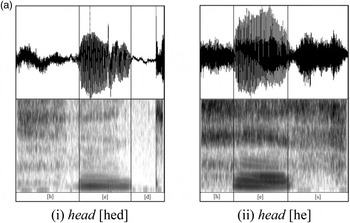
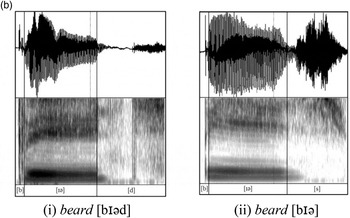
Perceptually, 30 of the 58 tokens were perceived as having a coda consonant in the CVC condition, and 21 of 70 in the CVVC condition. We then also examined all tokens acoustically, to see if there was acoustic evidence for a coda. Our acoustic analysis for evidence of a coda consonant included voice bar, irregular pitch periods at the end of the vowel, and/or the presence of a coda burst. A coda consonant was considered ‘produced’ if at least one of the acoustic cues was present. Figure 3(a) shows example waveforms and spectrograms of a short vowel with and without a coda, and Figure 3(b) shows the same for a long vowel (diphthong).
The target word head with (i) and without (ii) a coda consonant.

The target word beard with (i) and without (ii) a coda consonant.

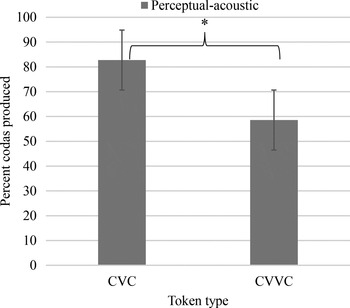
Taking both the perceptual and acoustic analyses into account resulted in 48 of the 58 CVC target words containing a coda consonant, and 41 of the 70 target items in the CVVC condition containing a coda consonant. Thus, 83% of the CVC target words had a coda consonant compared to 59% of the CVVC target words. This result is illustrated in Figure 4. These numbers were then included in all subsequent analysis. (Note that all the perceived codas exhibited one or more acoustic cues to a coda consonant.)
Percentage of codas produced as a function of token type.

A binary logistic regression analysis was then conducted to investigate the effect of word type on the occurrence of a coda consonant (the dependent variable). The predictors included word type (CVC, CVVC, CVV), and participant. The Hosmer–Lemeshow goodness-of-fit test indicated that the data were suitable to be used in the statistical model (p = ·664). There was a robust effect of word type (χ 2(2) = 26·25, p = < ·001). In fact, the odds of a child exhibiting an acoustic cue to a coda consonant when preceded by a short vowel (CVC) was 1·9 times greater than when preceded by long vowel (CVVC) and 16·4 times greater than when preceded by the long vowel in an open syllable (CVV). Participant was not statistically significant (χ 2(14) = 14·2227, p = ·433).
The fact that the two-year-olds produced more coda consonants when the vowel is short rather than long is consistent with the word-minimality hypothesis. However, to further evaluate this hypothesis, we needed to eliminate the possibility that there might be compensatory vowel lengthening when the coda was not produced (cf. Song & Demuth, Reference Song and Demuth2008).
Vowel length distinctions
Drawing on results from previous studies of child language (Kehoe & Stoel-Gammon, Reference Kehoe and Stoel-Gammon2001; Salidis & Johnson, Reference Salidis and Johnson1997), it was predicted that the children in this study would be able to distinguish the durations of the short vowels in the CVC words from the long vowels in the CVVC words. Based on the findings for five-year-old children in Lehman (Reference Lehman1993), we did not expect the long vowels to differ between a closed CVVC [+voice] syllable and an open CVV syllable. That is, we expected that the children in this study would distinguish short from long vowels in both closed and open syllables.
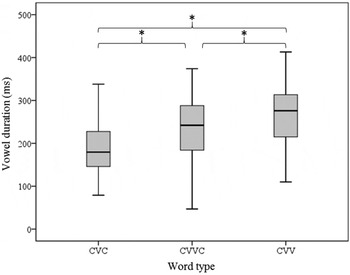
This analysis included words containing all codas (both perceptually or acoustically present), resulting in 48 items in the CVC condition and 41 items in the CVVC condition. There are also the 48 control items in the CVV condition without a coda (either perceptually or acoustically). A linear mixed effects model, using lme4 R package (Bates, Maechler & Bolker, Reference Bates, Maechler and Bolker2012), was conducted to test whether the children distinguished short from long vowels in the three word types (CVC, CVVC, CVV). Word type had a significant effect on vowel duration: vowels in the CVC condition were significantly shorter than the vowels in both the CVVC (β = –43·37, t = –3·421, p = ·0008) and the CVV conditions (β = –92·60, t = –7·544, p = ·0001). As expected, the short vowels were shorter than the long vowels. In addition, children's vowels in the CVVC condition were significantly shorter than the vowels in the CVV condition (β = 49·22, t = –3·855, p = ·001). Thus, unlike Lehman (Reference Lehman1993), the children in our study did show a difference in vowel duration between the closed- (CVVC) and open-syllable (CVV) words, with longer vowels in the open-syllable CVV condition. These results are illustrated in Figure 5.
Vowel durations as a function of target word type.

Compensatory vowel lengthening
Recall that Song and Demuth (Reference Song and Demuth2008) found that children between the ages of 1;1 and 2;6 produced longer vowels when the coda was omitted than in the same word when the coda was produced, and this was true for both short and long vowels in children's spontaneous speech. They suggested that these children had a ‘coda representation’, even if no other coda cues were present, and that vowel lengthening was compensating for the missing segment. In the current study, acoustic analysis was used to determine if two-year-olds might also be using compensatory lengthening to signal the presence of a coda, or if they systematically compensated for the missing coda in the CVC words only. If vowel lengthening was found for both the CVC and CVVC words when no coda was realized, this would provide some evidence that these children were exhibiting compensatory lengthening for missing coda consonants. If, on the other hand, vowel lengthening was found more systematically in CVC words, this might provide further support for the proposal that these children were trying to ensure that monosyllabic words had at least two moras of structure, thereby observing the English word-minimality constraint.
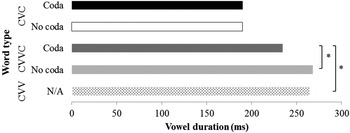
Comparisons of vowel durations for each word type, produced with and without a coda, were carried out. For the CVC words, a linear mixed effects model was used to compare vowel durations as a function of coda presence (n = 48) vs. absence (n = 10). Presence/absence of a coda was set as the fixed factor and participant as the random factor. The results showed that vowel duration was not significantly affected by whether a coda consonant was produced or not (β = –0·069, t = 0·003, p = ·9975). These results suggest that when the children omit a coda consonant following a short vowel, they do not lengthen the vowel to compensate for the missing coda.
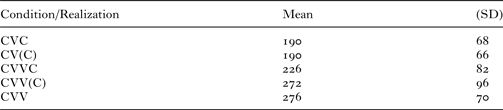
A similar comparison was made for the CVVC words between items with a coda (n = 41) and without a coda (n = 29). The CVV words were included as a control (n = 48). A linear mixed effects model was run with word type as a 3-level fixed factor (CVVC, CVV(C), CVV) and participant as the random factor. The results showed that vowels in the CVVC words were significantly shorter than vowels in both the CVV(C) (β = 46·12, t = 2·828,p = ·0055) and the CVV words (β = 50·05, t = 3·677,p = ·0004). The vowel duration in CVV words was not significantly different from the vowel duration in the CVV(C) words (β = 3·931, t = 0·259,p = ·7960). When the children omitted a coda consonant in the CVVC words, they approximated the duration of the target CVV words. The means and standard deviations for all acoustic measures are presented in Table 2, and are graphically illustrated in Figure 6.
Vowel durations as a function of condition and coda realisation (*=p < .05).

Means and standard deviations (ms) of short/long vowel durations across conditions with coda absent in CV(C) and CVV(C)

Taken together, the vowel duration results did not provide evidence that compensatory lengthening was used to ensure word-minimality, because children lengthened long vowels rather than short vowels in the absence of a coda consonant. Nor is there any evidence for the compensatory lengthening account, because children only compensated for the missing coda following long vowels.
DISCUSSION
This study explored the possibility that children might produce more coda consonants following a short vowel rather than a long vowel in early speech, thereby exhibiting sensitivity to the English word-minimality constraint. If so, this would provide some evidence that they may be aware that a well-formed prosodic word in English must have two moras of structure. Consistent with this hypothesis, the results showed that children were more likely to produce a coda consonant in the context of a preceding short vowel. This suggests that these two-year-olds have begun to learn much about the prosodic phonology of English that was not necessarily evident at an earlier age (cf. Song & Demuth, Reference Song and Demuth2008).
Vowel durations of words with omitted codas were also examined in order to determine if compensatory vowel lengthening was present, and if so, if it supported a word-minimality account or a coda-compensation account (Song &Demuth, Reference Song and Demuth2008). However, the acoustic analysis revealed that there was no vowel lengthening for CV(C) forms, but there was vowel lengthening for the CVV(C) forms.
One possibility for why only the long vowels were lengthened in the absence of a coda consonant is the constraint imposed by the phonemic vowel systems of Australian English, which has a phonemic vowel length contrast for a small number of vowels (Cox & Palethorpe, Reference Cox and Palethorpe2007). In order to maintain a phonemic vowel length distinction, children might have refrained from lengthening the short vowels in their CV(C) words since this can create a new lexical item (cf., cut /kɐt/ vs. car /kɐː/). Although only one of these vowels was included in this experiment, this could have biased how children weighted the vowel duration cue for other items, since other studies have shown a sensitivity to these vowel length distinctions in children aged 2;7 (cf. Yuen et al., Reference Yuen, Cox and Demuth2014). Note that this would not be expected in American English. The Song and Demuth (Reference Song and Demuth2008) data were collected with American English-speaking children, albeit younger children and using spontaneous speech data from the Providence Corpus (Demuth et al., Reference Demuth, Culbertson and Alter2006). Replicating the present more controlled experiment with American English-speaking children could help to address this issue.
The difference in report of compensatory vowel lengthening between Australian English and in Song and Demuth's (Reference Song and Demuth2008) study of American English might also be related to the difference in the nature of the data. The data in Song and Demuth (Reference Song and Demuth2008) included spontaneous production of stop, fricative, and affricate codas (both voiceless and voiced), compared in the same child (3 children) at different time points in development – i.e. when codas were omitted before age 1;6 to the same words produced later in development. In contrast, the current study only examined the word-final coda /d/ in the same prosodic contexts for fifteen children. It would therefore be interesting to evaluate the word-minimality account by extending the current study to other segment types, including the voiceless counterparts, in the coda position.
Children eventually acquire longer, more complex words. Examining the acquisition of words with great complexity could shed light on whether the more systematic early use of coda consonants following a short vowel is due to the learning of word minimality constraint, or due to learning important aspects of metrical structure, including the constraint that only heavy (bimoraic) syllables in English can be stressed. Thus, if children show a tendency to include a word-final coda consonant more often in a CVCVC target word (e.g. dugong) compared to a CVCVVC word (e.g. racoon), this would provide some evidence that they are sensitive to the further constraint in English against stressed syllables ending in a short vowel. Such a finding could indicate emerging knowledge of metrical structure as the driving mechanism behind these coda effects, raising questions about when and how such constraints might be learned in bilinguals and early L2 learners of English, as well as in children with specific language impairment (SLI).
The findings presented here also have implications for understanding the speech of children with hearing loss. Markides (Reference Markides1970) found that the most common speech production error made by children with hearing loss was coda consonant omission. Similarly, Geffner (Reference Geffner1980) reported that 91% of the speech errors made by children with hearing loss involved coda consonant omission. Many studies have conducted acoustic analyses of onset consonant productions in children with hearing impairment (e.g. voice onset time: Lane & Perkell, Reference Lane and Perkell2005; Monsen, Reference Monsen1976), yet little research has looked at the acoustic cues to these children's coda consonant productions or the phonological contexts in which coda consonant omissions are most likely to occur. Exploring the acoustic cues to coda consonant use might also reveal that some children with hearing loss do in fact have coda representations that cannot be perceived by the trained listener. Such findings could have important implications for understanding some of the variable use of coda consonants in this population, with important implications for intervention.
CONCLUSION
This study set out to better understand why coda consonants are variably produced in English-speaking children's early speech, and if this might be phonologically/prosodically conditioned. Consistent with the Prosodic Licensing Hypothesis (Demuth, Reference Demuth, Farris-Trimble and Barlow2014; Lleó, Reference Lleó2003) the findings provide strong evidence that Australian English-speaking two-year-olds are more likely to produce coda consonants in monosyllabic words with a short vowel (CVC) compared to a long vowel (CVVC). This suggests that two-year-olds may be aware of the English word-minimality constraint on monosyllabic words, and raises questions about how and when such constraints are learned cross-linguistically, as well as in populations with language delay, including those with hearing loss, SLI, or bilinguals.
APPENDIX