Introduction
Peak bone mass is a major determinant of osteoporosis risk in later life.Reference Hernandez, Beaupre and Carter1 Bone mass tends to track throughout childhood, and we have previously demonstrated that growth in early life, both in utero and during infancy, predicts adult bone mineral content (BMC)Reference Cooper, Cawley and Bhalla2, Reference Dennison, Aihie-Sayer and Syddall3 as well as the risk of hip fracture.Reference Cooper, Eriksson and Forsen4 It is likely that these findings reflect, in part, the influence of environmental factors acting during intrauterine life. We initially explored potential maternal influences on intrauterine bone mineral accrual in a study of 145 mother–offspring pairs; in this study, lower maternal birthweight, maternal smoking, lower fat stores and vigorous exercise in late pregnancy were all associated with decreased whole body BMC in the offspring at birth.Reference Godfrey, Walker-Bone and Robinson5 Data from other cohorts consistently reveal the influence of maternal smoking,Reference Jones, Riley and Dwyer6, Reference Jones, Riley and Dwyer7 but those of exercise and body build remain unconfirmed. These previous studies did not address bone geometry in addition to density and overall size; this is an important issue as an effect on bone shape is also likely to be associated with altered fracture risk in later life.Reference Szulc, Munoz, Duboeuf, Marchand and Delmas8 Finally, gender-specific relationships have not been examined. In this study, therefore, we evaluated the maternal predictors of neonatal bone size, geometry and density in a large prospective cohort – the Southampton Women’s Survey (SWS). The large sample also provided the opportunity to explore gender-specific associations of maternal factors with neonatal bone mineral, before and during pregnancy.
Methods
The SWS is a unique, prospective cohort study of around 12,500 women aged 20–34 years recruited from the general population.Reference Inskip, Godfrey and Robinson9 Assessments of lifestyle, diet (by validated food frequency questionnaireReference Robinson, Godfrey, Osmond, Cox and Barker10) and anthropometry were performed at study entry and then in early (11 weeks) and late (34 weeks) gestation in those women who became pregnant. Maternal height was measured with a stadiometer, weight with calibrated digital scales and skinfolds (biceps, triceps, subscapular and suprailiac regions) with Harpenden callipers. The research nurses carrying out the measurements underwent regular assessment and re-training to optimize consistency. The mothers were asked to characterize their current walking speed into one of five groups (very slow, stroll at an easy pace, normal speed, fairly brisk or fast). The women’s own birthweight was recorded (by recall, checked by asking her own parents), and grip strength in both hands was measured at 19 weeks gestation, using a Model J00105 JAMAR hydraulic hand dynamometer (Lafayette Instruments Europe, Loughborough, UK).
Mothers registered with specific general practitioners were invited to participate in the bone component of the SWS. These practices were selected to avoid the mothers participating in more than one substudy, and were representative of the population of Southampton as a whole. At birth, the baby had been weighed on calibrated digital scales (Seca, UK), and crown-heel length measured using a neonatometer (CMS Ltd, UK). The mother was asked to agree to her baby undergoing assessment of bone mass and body composition within 2 weeks of birth, using a Lunar DPX-L instrument with specific paediatric software (paediatric small scan mode, v 4.7c, GE Corporation, Madison, WI, USA). The instrument underwent daily quality assessment, and was calibrated against a water phantom weekly. The mothers could attend either as inpatients, or return from home within the 2-week time period. At the visit to the scan room, the baby was pacified and fed if necessary, undressed completely and then swaddled in a standard towel. It was placed on a waterproof sheet in a standard position on the scanner for measurement of whole body bone area (BA), bone mineral content (BMC) and body composition, using specific software protocols. The baby was kept in position using rice bags placed over the bottom end of the towel. The short-term and long-term coefficients of variation (CV) for adult whole body bone mineral density (BMD) for the dual energy-X-ray absorptiometry (DXA) instrument were 0.8% and 1.4%, respectively. It was not possible to repeatedly scan neonates to establish precision values in the study group; however, the ability of DXA to measure bone mass in small subjects has been demonstrated by Abrams et al.,Reference Abrams, Schanler, Sheng, Evans, Leblanc and Garza11 using miniature piglets, where correlation between DXA-derived BMC and ashed calcium content was 0.90 (P < 0.001). The radiation exposure to the baby was estimated as a maximum of 8.9 microsieverts for whole body measurement, which is equivalent to around 3 days exposure to normal background radiation. All scan results were checked independently by two trained operators and agreement reached as to their acceptability. Thirty-two scans showing unacceptable movement artefact were excluded.
Statistical analysis
All variables were checked for normality. Non-normally distributed variables were transformed logarithmically, or by square root for total and percentage fat, and then standardized to s.d. scores. Correlation and linear regression methods were used to explore the determinants of neonatal body composition, using Stata V9 (Statacorp, TX, USA). Predictors at each of the three time points (pre-, early and late pregnancy) were explored in univariate analyses and overall multivariate models were then derived. Maximum grip strength regardless of side and handedness was used. Whole body BA, BMC and areal BMD (aBMD) were used as the primary skeletal outcomes. To explore the influence of maternal factors on bone mineral independently of linear growth, we used BMC adjusted for birth length; BA was adjusted for birth length to give a measure of bone width. Additionally, we used BMC adjusted for BA, birth length and birth weight to give an estimate of volumetric BMD. Proportionate BMC was calculated as total BMC divided by the sum of total BMC, fat and lean mass. A sample size of 350 gave 95% power to detect a significant correlation (P < 0.05) between maternal BMI, triceps skinfold thickness and neonatal whole body BMC.
The study had full approval from the Southampton and Southwest Hampshire Local Research Ethics Committee and all participants gave written informed consent.
Results
Characterization of the cohort
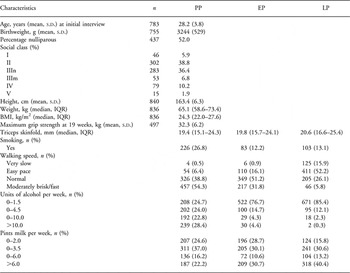
There were 841 mother–baby pairs, among which 443 (53%) of the offspring were boys. In all, 16 of these (6 boys) were scanned at day 15–17 of postnatal life; but, as inclusion of these babies did not alter the results, they were retained in the analysis. The characteristics of the mothers and babies are shown in Tables 1 and 2, respectively. The mean age (s.d.) of the mothers at the initial interview was 28.2 (3.8) years, and at delivery, it was 30.5 (3.7) years; 52% were in their first pregnancy and 26.9% were smokers at the initial interview. Approximately, half of women who smoked before conception had given up by late pregnancy, such that 13.1% were still smoking at this time point. The proportion consuming >10 U of alcohol each week decreased from 28.4% before pregnancy to 0.25% in late pregnancy. A total of 97.3% of the mothers were white Caucasian ethnicity.
Maternal diet, lifestyle and anthropometric measures among 841 women aged 20–34 years

PP, pre-pregnancy; EP, early pregnancy; LP, late pregnancy; IQR, interquartile range; BMI, body mass index.
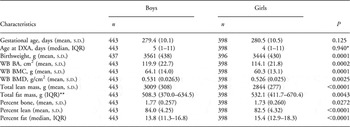
Neonatal anthropometric and DXA measures among 443 male and 398 female offspring

DXA, dual-X-ray absorptiometry; IQR, interquartile range; BMD, bone mineral density; BA, bone area; WB, whole body; BMC, bone mineral content.
Birthweight adjusted for gestational age; DXA indices adjusted for gestational age and age at DXA assessment.
*Wilcoxon rank-sum test; **geometric median and IQR.
There were strong, statistically significant (P < 0.001), associations between gestational age at birth and neonatal body build. Thus, birthweight increased by 20.9 g/day (95% confidence interval (CI): 17.9–23.9), and whole body BA, BMC and aBMD increased by 1.2 cm2 (95% CI: 1.1–1.4); 0.73 g (95% CI: 0.64–0.82) and 0.0006 g/cm2 (95% CI: 0.0005–0.0008) for each day of gestation, respectively. After adjustment for gestational age, the boys were slightly heavier at birth (P = 0.0001) and had greater whole body BA, BMC and aBMD (Table 2). Consistent with the known pattern of weight loss in the first week of postnatal life (with subsequent gain), there was a quadratic relationship between age at DXA and indices of bone mineral (BA, BMC and aBMD). Given these associations, subsequent analyses were performed after adjustment for gestational age, gender and age at DXA scan.
Predictors of neonatal bone mineral
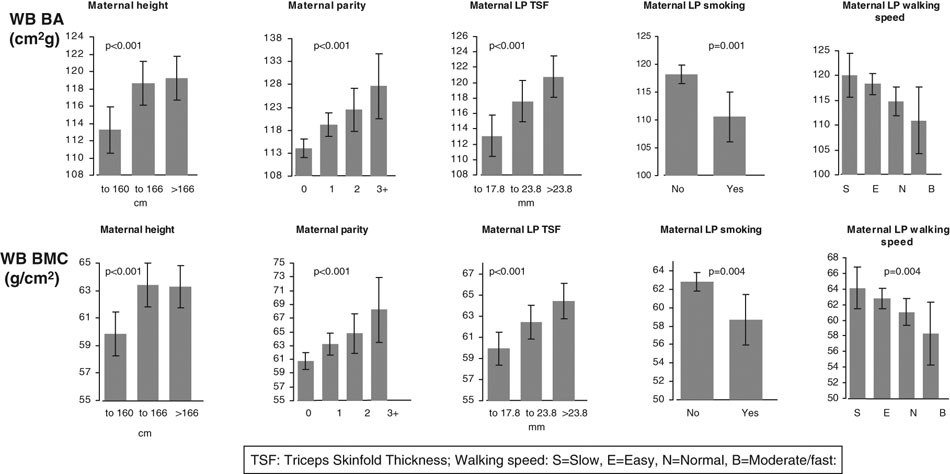
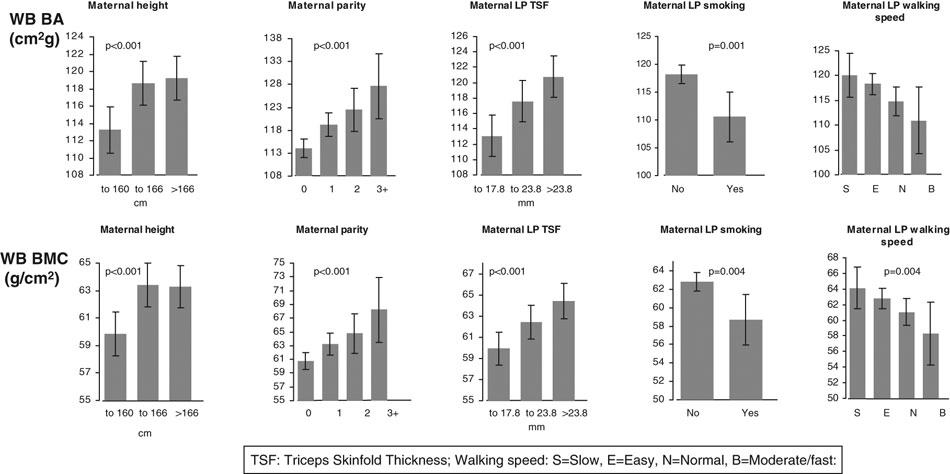
There were strong associations between maternal factors and each of neonatal BA and BMC; in contrast, neonatal aBMD and BMC adjusted for BA, height and weight showed no significant relationships with any maternal measure. Figure 1 summarizes the unadjusted associations of maternal measures with neonatal BA and BMC. The predictors of neonatal whole body BMC included maternal height, parity, fat stores (measured by triceps skinfold thickness), walking speed and smoking (all P < 0.05). Alcohol and milk intake at any time before or during pregnancy did not predict bone mineral in the neonate. Thus, babies of mothers who were taller, of higher parity, had greater fat stores, did not smoke and walked more slowly in late pregnancy had greater whole body BA and BMC at birth. Maternal educational level, social class and season of birth did not predict offspring bone size or density at birth, and including these factors as covariates in regression analyses did not alter the associations observed.
Maternal determinants of neonatal bone area (BA) and bone mineral content (BMC).
Where factors were measured before, as well as during pregnancy (smoking, walking speed and triceps skinfold thickness), the magnitude and statistical significance of the associations with neonatal bone mineral strengthened from before pregnancy to late gestation. However, there was significant collinearity between these measures. Thus, for example, 72.3% of the variance in late pregnancy triceps skinfold thickness was explained by that measure in early pregnancy, and 51.6% by that before conception (both P < 0.001). Additionally, the change in triceps skinfold thickness, smoking or walking speed across the three time points was not associated with neonatal BA or BMC.
In a consecutive subset of women (n = 467), maximum grip strength was available. After adjustment for maternal height, this variable was positively associated with BA and BMC, such that BA increased by 0.5 cm2 (95% CI: 0.1–0.8 cm2; P = 0.008) and BMC increased by 0.2 g (95% CI: 0.01–0.40 g; P = 0.036) per 1 kg increase in grip strength. There was no association between maximum grip strength and maternal walking speed at any time point, with the relationship being least weak for pre-pregnancy walking speed (R 2 = 0.2%; P = 0.16). A total of 755 of the mothers reported their own birthweight. BA increased by 7 cm2 (95% CI: 4–10 cm2; P < 0.001) and BMC by 4 g (95% CI: 2–6 g; P < 0.001) for each 1 kg increase in maternal birth weight.
Independent predictors of neonatal bone mineral by gender
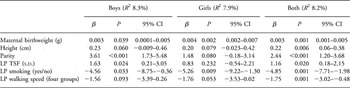
The independent maternal predictors of neonatal whole body BMC included maternal birthweight, height, parity, triceps skinfold thickness, smoking and walking speed (Table 3). Relationships between maternal variables and bone mineral were generally of similar magnitude in both genders, although the associations between maternal triceps skinfold thickness, height, parity, walking speed and neonatal bone mass did not attain statistical significance in the girls alone. Interaction terms between gender and these maternal factors as determinants of whole body BMC were not statistically significant.
Independent maternal determinants of neonatal whole body BMC (g) by gender

BMC, bone mineral content; CI, confidence interval; β, regression coefficient; LP, late pregnancy; TSF, triceps skinfold thickness; DXA, dual-X-ray absorptiometry.
Walking speed in four groups (slow, easy, normal, moderately brisk/fast).
BMC adjusted for gestational age, age at DXA by gender.
Bone geometry
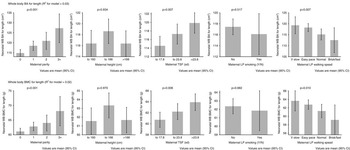
Maternal parity and triceps skinfold thickness were positively associated and maternal walking speed in late pregnancy was negatively associated with neonatal BMC adjusted for birth length. Similar associations were found for BA for birth length. Thus, increasing maternal parity and triceps skinfold thickness in late pregnancy and decreasing maternal walking speed in late pregnancy were associated with increasing bone width. Figure 2 summarizes these associations. These factors remained statistically significant when combined in a multivariate model. Finally, we explored the influence of maternal factors on the proportionate contribution of bone to overall body composition. Measured in late pregnancy, maternal triceps skinfold thickness (positive) and walking speed (negative) remained predictors of whole body percentage BMC (P = 0.015 and P = 0.058, respectively).
Maternal predictors of neonatal bone area (BA) and bone mineral content (BMC) adjusted for birth length.

Discussion
We have confirmed, in a large prospective population based on UK cohort, our previous findings that maternal birth weight, body build and lifestyle during pregnancy are associated with neonatal whole body BMC in the offspring. Thus, mothers who were of taller stature, had greater fat stores, were of higher parity, did not smoke and walked less briskly, and were of higher birth weight themselves, had children with greater whole body BMC at birth. The relationships for maternal parity, fat stores and walking speed resisted adjustment for birth length, suggesting an effect on skeletal shape independently of total body size. The associations were similar for both male and female offspring.
We studied a large, well-established cohort, with detailed characterization of mothers before and during pregnancy; we also used DXA, a well-validated technique for measuring bone mineral in the neonates. However, there are several limitations to our study. First, assessment of maternal fat stores was hampered by our use of an indirect measurement – skinfold thickness. However, skinfold thickness has been shown to correlate very well with fat mass and is a well-established tool in epidemiological studies.Reference Ravaglia, Forti and Maioli12 Second, we used a subjective questionnaire assessment of physical activity, and thus did not have an objective measure of this exposure. Third, although DXA is the gold standard measurement of bone mineral in neonates, it is hampered by their tendency to move and also by their low absolute BMC. However, we used specific paediatric software, and movement artefact was modest and uniform across the cohort; those few babies with excessive movement were excluded from the analysis. DXA has been validated in small animals against the ashed calcium content.Reference Abrams, Schanler and Sheng13 The study cohort was a subset of the SWS, but mothers whose babies underwent DXA scanning and mothers whose babies did not were broadly similar. The former were on average slightly older and smoked slightly less. The average age of the DXA mothers at time of birth of their baby was comparable to the national average of 29.3 years. Finally, the use of DXA does not allow measurement of true volumetric bone density, thus making it difficult to be certain about differential determinants of skeletal size and volumetric density.
The influence of maternal height is likely to be largely genetic, although taller mothers, particularly with a larger pelvic diameter, might have greater capacity to nourish the foetus and thereby directly influence foetal growth. The mechanism underlying the observation of greater offspring BMC with greater maternal parity has yet to be elucidated, but could involve alterations in the uterine vasculature. Maternal smoking may impair calcium transport by trophoblast cells,Reference Lin, Fitzpatrick and Iannotti14 or directly influence uterine blood flow. Although it has a genetic component, triceps skinfold thickness is partly a reflection of past and current nutritional status. Maternal fat stores might influence intrauterine bone mineral accrual through several mechanisms including effects on nutrient availability or endocrine factors such as leptin and oestrogen. Triceps skinfold thickness measured in late pregnancy showed a stronger association with offspring BMC than that measured before pregnancy, consistent with the observation that late gestation is a critical time for skeletal growth. The collinearity of late pregnancy triceps skinfold thickness with the pre-conceptional value, however, indicates that optimization of nutrition before, as well as during, pregnancy may be important. As in our previous study,Reference Godfrey, Walker-Bone and Robinson5 a measure of maternal physical activity (walking speed in late pregnancy) was negatively associated with neonatal BMC, raising the possibility of competition between the maternal and foetal skeleton for finite mineral resource. This was independent of the relationship between skinfold thickness and bone mass, suggesting that it was not mediated by more active women having lower fat stores. There was no association between maternal walking speed at any time point and grip strength at 19 weeks, although the relationship was less weak before pregnancy than in late pregnancy. Thus, it may be that maternal grip strength is here acting as a marker of maternal health and nutrition rather than just as a proxy for lower limb muscle strength, and that this wider association is driving the relationship with neonatal bone.
We identified maternal factors that were associated with overall skeletal size (BA and BMC), but also with BA and BMC adjusted for birth length. There were no statistically significant relationships with estimated volumetric density. These findings suggest that there is an effect of early environment on birth size, but that these factors may also influence bone geometry. BA for birth length gives a measure of bone widthReference Molgaard, Thomsen and Michaelsen15 (although without information on bone depth); thus, an increase in a maternal factor that is positively associated with BA for length will result in wider bones for a given height. The lack of association with BMC adjusted for BA, birth length and weight is consistent with the important outcome for these influences being geometric shape rather than volumetric mineralization. Thus, our study suggests that maternal factors in pregnancy are associated with bone geometry and that the first born babies of mothers who are poorly nourished and walk more quickly in late pregnancy may be born with narrower bones for their height. Having small bones relative to overall body size has been found to be a predictor of fracture risk in childrenReference Clark, Ness, Bishop and Tobias16 and bone size is an important determinant of bone strength in adults.Reference Szulc17 Studies have shown that differences in femoral neck width and length may contribute to the risk of hip fracture.Reference Szulc, Munoz, Duboeuf, Marchand and Delmas8, Reference Szulc17 We have previously shown that poor early growth is associated with reduced femoral neck width in old age.Reference Javaid, Lekamwasam and Clark18 Therefore, the results from our current analysis provide further understanding of the maternal factors which might underlie these observations.
The long-term effect of the associations shown in our study may depend on whether they reflect a short-term restraining or boosting effect on last trimester growth, or in some way permanently modify the growth trajectory. Birthweight is largely a result of the prevailing environment,Reference Little19 but the relative influence of early v. late gestational influences on long-term growth trajectories is unclear. Studies in adult cohorts in which birth records are available suggest that birth weight itself is predictive of bone mass in older age.Reference Dennison, Aihie-Sayer and Syddall3 Although weight at 1 year predicts bone mass more strongly than does weight at birth, the earlier measure retains a significant contribution when weight at 1 year is taken into account.Reference Dennison, Syddall, Sayer, Gilbody and Cooper20 Poor childhood growth has been associated with increased fracture risk in older age,Reference Cooper, Eriksson and Forsen4, Reference Javaid, Eriksson and Valimaki21 and rapid catch-up growth in infancy may predict obesity and cardiovascular disease in adulthood.Reference Barker, Eriksson, Forsen and Osmond22 It is possible, therefore, that environmental factors could act differentially in early and late gestation, such that influences in early pregnancy could modify the postnatal growth trajectory, and factors in late pregnancy could superimpose a temporarily modified growth pattern upon this. The evidence that birth size and subsequent catch up or down influence the risk of adult diseases suggests that the degree of deviation of this last trimester growth from the early trajectory is important, and much work will be needed to unravel these complex interactions.
Our results have implications for public health advice for women before and during pregnancy. The associations with triceps skinfold thickness were largely accounted for by the initial pre-pregnancy measure, and thus ensuring adequate pre-conception nutrition may help bone geometry of the offspring. Taking all this into consideration, it might be sensible to target advice at mothers who smoke and are poorly nourished (particularly those who are pregnant for the first time) to help improve the intrauterine environment and thus offspring bone development. We feel the associations with walking speed are interesting, but given the subjective nature of this measurement, are not compelling enough to form the basis of public health advice. It is important to view these as population-based public health measures, where small changes in a large number of people may lead to a reduction in overall population morbidity, and not at the level of an individual.
In conclusion, we have confirmed, in a large cohort, previous findings that maternal lifestyle and body build are associated with intrauterine bone mineral accrual. The associations with maternal parity, fat stores and walking speed remained robust after adjustment of BA for birth length, suggesting a specific effect on bone geometry. The long-term implications of these findings remains to be elucidated, but may have implications for public health advice; follow-up of children in the SWS is currently underway at 4 years with DXA and at 6 and 8 years with DXA and peripheral quantitative computed tomography which may shed further light on these observations.
Acknowledgements
We thank the mothers who gave us their time, and a team of dedicated research nurses and ancillary staff for their assistance. This study was supported by grants from the Medical Research Council, Arthritis Research Campaign, National Osteoporosis Society, Wellbeing, Cohen Trust, NE (now North) Thames NHS R&D Directorate, and International Osteoporosis Foundation. Participants were drawn from a cohort study funded by the Medical Research Council. We thank Mrs G. Strange and Mrs L. Reeves for helping prepare the manuscript.
Statement of Interest
All authors report no conflict of interest.