Introduction
The Textbook Incident, which is often regarded as the first large-scale diplomatic conflict between China and Japan over the history of the Fifteen-year War, occurred in the summer of 1982.Footnote 1 Since then, it is observable that the problems related to the history of the war have developed into a special, yet serious, element of Sino-Japanese relations.Footnote 2 While post-1982 developments have been well covered in academic writing, studies on the equally important pre-1982 period are scarce.
Before 1982, according to a small group of political scientists who were pioneers in researching the Sino-Japanese History Problem, the issue of wartime history was not as salient as it is now. If it was troubling bilateral relations at all, it was usually seen by scholars as the fault of the Chinese Communist Party regime. For example, it is argued by Johnson and Ijiri that the Chinese Communist Party government raised the issue of the history of the war frequently to emotionally manipulate Japanese people, thus intruding into Japanese domestic politics. Japan, on the other hand, responded with a ‘low posture’, giving apologies and concessions, always in a humiliating way.Footnote 3 In short, these scholars believe that the history of the Fifteen-year War was manipulated in Sino-Japanese relations, mostly by the Chinese side.
Nevertheless, several younger scholars, who apply a series of European war remembrance theories and methodologies to explain the origins of the Sino-Japanese History Problem, take a quite different view. They argue that the Chinese Communist Party regime ‘suppressed’ the recollection of Japanese wartime atrocities since friendship with Japan was important. For instance, Reilly argues that ‘the Communist Party applied a similarly lenient approach [to the Kuomintang's] as to Japanese wartime atrocities’.Footnote 4 He Yinan further identifies the period of Sino-Japanese friendship as an illusion created by the Chinese Communist Party regime after it normalized its relationship with Japan in 1972. During this period, she implies, young people did not learn of Japanese atrocities in state-controlled textbooks, and ordinary people could not see Japan's revisionist treatment of the history of the war in the state-controlled media.Footnote 5 Kosuge also points out that the lenient stance of the Chinese Communist Party regime did not reflect Chinese public opinion. The regime suppressed domestic anti-Japanese sentiment while implementing a generous policy towards Japanese war criminals.Footnote 6
Which of these two contradictory arguments about the Chinese Communist Party regime's treatment of the history of the Fifteen-year War is right? I contend that both of the arguments are partially right, but problematic at the same time. The argument of the earlier political scientists is insightful. However, by examining just a few influential diplomatic conflicts over this issue, they saw only that the history of the Fifteen-year War was a bargaining chip used by the Chinese Communist Party regime vis-à-vis the Japanese government. Ignoring other aspects, like the people's feelings, the remembrance of the war, and domestic affairs in the People's Republic of China (hereafter China), they paid little regard to the wider context in which the Chinese Communist Party government acted.
For scholars of the younger generation, the history of the Fifteen-year War was more than a bargaining chip—they also associated the history of the war with the concept of ‘collective remembrance’ and paid greater attention to the contextual aspects ignored by the earlier political scientists. The approach of these scholars—which is also adopted in this article—would have been ideal for discussing the Chinese Communist Party regime's treatment of the history of the war. However, they gave much greater weight to the era after the 1982 Textbook Incident, when the Sino-Japanese History Problem became increasingly disturbing. In other words, they dealt with the period before 1982 as merely a ‘preface’ to later events. Inevitably, their examination of the pre-1982 period is not sufficient and appears debatable.
One of the insufficiencies is that Sino-Japanese relations during this period were simplified in their studies as ‘pursuing’ (1949–1972) and ‘maintaining’ (1972–1982) friendship with Japan. Based on this generalization, one could easily assume that the Chinese Communist Party regime, who were eager for friendship with Japan, imposed a ‘benevolent amnesia’ over the Fifteen-year War in pre-1982 mainland China.Footnote 7 However, the reality of China's relations with Japan was far more complex than this and so was its treatment of the history of the Fifteen-year War, which will be discussed in detail later.
Exploring how the Fifteen-year War was dealt with in pre-1982 mainland China is an essential step towards understanding the currently explosive Sino-Japanese History Problem. Moreover, the treatment of the history of the Fifteen-year War is also closely related to other issues in post-war relations between China and Japan. However, based on the existing literature, it is hard to find a thorough and accurate panorama of the pre-1982 situation. Thus, the aim of this article is to take a small step towards filling this gap in the literature, by exploring how the history of the Fifteen-year War was dealt with in China's diplomatic conduct towards Japan before 1982. This article will carve out a way for further discussions of the Chinese Communist Party's treatment of the history of the war both in the domestic field and in other Chinese diplomatic relations.
This article will first contextualize the treatment of the history of the Fifteen-year War in pre-1982 China, reinterpret a well-known slogan, and introduce the quasi-diplomatic event in Nanjing in 1965 as a dramatic yet informative case study. The article then moves to discuss the Chinese Communist Party's Japanese militarist-bashing activities at a time when Sino-Japanese inter-governmental relations were not friendly. It continues by taking a look at the treatment of the war by the Chinese Communist Party leaders, the Chinese people, and Japanese visitors during friendly encounters between China and Japan. Nanjing will be used as a case study at times to demonstrate the local dimension.
After an examination at the level of national and local state actors as well as at the level of Chinese general public, this article can first of all assert that the Fifteen-year War was certainly not benevolently forgotten in mainland China before 1982. Although supporting the view of earlier political scientists that the history of the war was used as leverage by the Chinese Communist Party regime in its diplomatic relations with Japan, this article has substantially enriched this viewpoint. It argues that although Sino-Japanese relations went through ups and downs, the history of the Fifteen-year War was always an ‘indispensable element’ in China's diplomacy with Japan before 1982. In addition to Sino-Japanese bilateral relations, the regime's utilization of the history of the war was also affected by China's ever-changing domestic and international context. Furthermore, besides exploiting the history of the war on its own initiative, the Chinese Communist Party regime was driven by the Chinese people as well as their Japanese counterparts to engage with the legacy of the war. Thanks to its slogan: ‘We should distinguish a handful of evil Japanese militarists from the majority of kind Japanese people’, the Chinese Communist Party regime were able to utilize the history of the war flexibly and without being jeopardized by it.
Context, the slogan, and a case study
The main theme of the Maoist era, especially during the Cultural Revolution, was ‘permanent revolution’, and the main task was construction and class struggle. Meanwhile, the external enemies were the United States as well as its ‘running dogs’: the Kuomintang government in Taiwan and, eventually, the Soviet Union. For a long time the right-wing Japanese government was considered by the Chinese Communist Party regime to be a ‘running dog’ of the United States; thus, as will be mentioned in this article, when attacking ‘American imperialists’, the regime often mentioned Japanese wartime atrocities alongside their criticisms of the post-war Japanese conservative administrations. After Mao's death, China experienced a short period of turmoil. In July 1977, Deng Xiaoping returned to power and declared that in the following year ‘reform and opening up’ would be the Party's new line. With the changing domestic atmosphere in China as well as on the international front, the treatment of the history of the Fifteen-year War by the Chinese Communist Party regime was also evolving.Footnote 8
Before the Sino-Japanese normalization in 1972, the two countries’ inter-governmental relationship was a negative one overall and the Chinese Communist Party regime frequently criticized Japanese militarists. Furthermore, due to the East Asian Cold War, the Chinese Communist Party regime and various Japanese administrations were hostile towards one other. Nevertheless, friendship was to be found, with ‘kind Japanese people’ and ‘friendly groups’. But as the Chinese Communist Party regime constantly pointed out the dangers of and evidence for a Japanese resurgence of militarism, this friendship occupied only fragmented moments of time against the wider backdrop of a fraught inter-governmental relationship. Even so, many historical sources show that the topic of the history of the Fifteen-year War was brought up on several occasions, even during the friendly periods.
Between 1972 and 1982, China's relations with Japan progressed to being good overall, and this period is usually referred to as the period of the ‘Sino-Japanese friendship illusion’. During this time there continued to be moments when warnings about a resurgence of Japanese militarism were voiced.
The key to understanding how remembering the Fifteen-year War and the Chinese Communist Party regime's conduct towards Japan played out in mainland China between 1949 and 1982 in general, is the message: ‘We should distinguish the majority of kind Japanese people from a handful of evil Japanese militarists’. This is in fact a famous slogan promoted by the top Chinese Communist Party leaders and used on various occasions by the party cadres to deal with the Chinese people's ill feeling towards Japan and to relieve ‘kind Japanese people’ of their misgivings.Footnote 9 This slogan has been mentioned by many scholars; nevertheless, no-one seems to have discussed it in an integrated and exhaustive way.
The slogan has two equally important layers. The implication of the first layer is that those who were defined as Japanese militarists should shoulder the blame. Whether the Chinese Communist Party leaders were genuinely concerned about Japanese militarist revision, or whether they needed a convenient pretext to criticize the Japanese government and its allies’ actions, which infuriated them, this layer could justify their Japanese ‘militarist-bashing’. Nevertheless, during friendly moments and periods when Sino-Japanese inter-governmental relations were good, how did the Chinese Communist Party regime manage the aftermath of the Fifteen-year War and maintain friendship with the Japanese at the same time?
This contradiction was solved by the Party's ‘secret’ weapon—the second layer of the slogan, that ‘kind Japanese people’ should not be blamed for the misdeeds perpetrated by a small group of ‘evil Japanese militarists’. Early political scientists often overlooked this layer and as a result their arguments about the Chinese Communist Party regime's actions are one-sided. Most scholars of the new generation only saw this layer, and thus overlooked the large number of Japanese militarist-bashing activities conducted by the regime.
With its two layers, this slogan conferred great diplomatic flexibility on the Chinese Communist Party regime. Thanks to it, the history of the war could both facilitate the Chinese Communist Party regime's Japanese militarist-bashing activities and, at the same time, did not prevent it from pursing friendship with its Japanese friends.
I particularly want to point out here that this slogan was not merely created for the pragmatic aim of winning over the Japanese and harnessing the animosity of the Chinese people.Footnote 10 The Chinese view (including those of the Chinese Communist Party leaders) of the Japanese was largely shaped by the Fifteen-year War and even the earlier period dating back to the first Sino-Japanese War (1894–1895).Footnote 11 The Chinese always (consciously or unconsciously) associated the Japanese with being brutal invaders. On the other hand, the Chinese Communist Party's idea of ‘the majority of kind Japanese people’ was also shaped during the same period.
Based on the ideology derived from the international communist movement, the Chinese Communist Party formed an abstract idea of ‘Japanese people’: they assumed that many ordinary Japanese were poor people like workers and farmers, who were exploited by the Japanese imperialists. So, from the beginning of the full-scale war between China and Japan, the Chinese Communist Party leaders urged the Chinese not to forget the distinction between Japanese invaders and Japanese people. They also kept appealing to Japanese people on the home front and Japanese soldiers fighting overseas to unite together against the invasion launched by the Japanese imperialists. They also managed to convince themselves that a united front of Japanese people was forming, which they believed would be a very important force to help China win the war of resistance.Footnote 12
Furthermore, many Japanese leftists and pacifists came to China in the name of the ‘Japanese people’ and fought shoulder-to-shoulder with the Chinese resistance, which provided many Party members with an experience of support from ‘real’ Japanese people.Footnote 13 The combination of the idea and experience of the distinction between brutal Japanese invaders and kind Japanese people during the war underpinned the Chinese Communist Party's basic principle of dealing with Japan in the post-war era. In the diplomatic field this principle was the policy that one should ‘distinguish [the] conservative Japanese government from revolutionary Japanese people’; in the war remembrance field, it was that one should ‘distinguish evil militarists from the kind Japanese people’. The post-war political connotations of the term ‘Japanese people’ referred to those Japanese individuals and groups who were friendly to China (not Taiwan) and were truly remorseful for the Fifteen-year war. Post-war development in Japan also supported the Chinese Communist Party's idea of a new ‘Japanese people’.
This is based on the following ideas. First, Japan had discovered its similarities with and become closer to China. It was no longer a colonial country as it had lost all its overseas territories after the war. Furthermore, similarly to China, Japan also obtained its ‘political capital’ by demanding repayment of a debt from the United States, as it was suffering under the occupation of the latter. The Chinese Communist Party leaders believed that the ordinary Japanese had suffered as much as Chinese people had. They thought exposing the crimes committed by the militarists would have resonance with the Japanese.Footnote 14
Secondly, the pacific movement in Japan showed the Japanese people's power and determination to resist militarism, which in turn confirmed the Chinese Communist Party's image of a revolutionary Japanese people. Thirdly, most of the Japanese who visited China were pro-China or friendly people, who kept apologizing to the Chinese Communist Party leaders. These visitors claimed to represent the Japanese people, which made the Chinese Communist Party leaders believe that the majority of Japanese people felt guilty for the war. Being offered a sincere apology from the people of a nation, makes it seem likely that the Chinese Communist Party would have accepted it graciously, even without the pre-existing slogan. Fourthly, Mao had the somewhat unusual belief that he should be grateful for the Japanese invasion. This is not because the invasion had weakened the Kuomintang while strengthening the Chinese Communist Party—as is wrongly believed by many Chinese internet activists nowadays—but because the Japanese invasion had ‘educated’ the Chinese people by stimulating their nationalist tendencies.Footnote 15 Therefore, it was not simply out of generosity that the Chinese Communist Party leaders made comments like: ‘You have already apologised, you cannot apologise everyday, right?’Footnote 16
In short, the slogan was rooted in the Party's ideology of internationalism and was underpinned by the friendly support and revolutionary actions of the ‘Japanese people’ during and after the war. It was drummed into the Chinese people so that their resentment would not harm China's relationship with the ‘majority of kind Japanese people’. It was also introduced to the Japanese, so that they would not hesitate to embrace China, even though the war between the two nations still lingered in the minds of their people.
Nanjing in 1965
In 1965, on the eve of the Cultural Revolution, Nanjing was allocated the mission of receiving Japanese delegations, consisting of Japanese youths from many different interest groups across the political spectrum.Footnote 17 They came to China for a quasi-diplomatic event—the Sino-Japanese Youth Friendship Get-together.
This event is well worth special examination, as it was probably the most extreme example of how the Fifteen-year War was dealt with by the Chinese Communist Party diplomatically before 1982. This friendly event happened at a time when Sino-Japanese inter-governmental relations were poor, and in a place where anti-Japanese sentiment was still running high. It was also complicated by elements from the domestic and international spheres at the time, such as the hostility between the Chinese and American governments, and the Chinese government's plan to commemorate the twentieth anniversary of the end of the Fifteen-year War. This kind of tangled, and even contradictory, context provided the opportunity for the slogan to prove a truly useful tool for the Chinese Communist Party regime. According to a local record, one of the aims of this get-together was to improve Sino-Japanese friendship and support the Japanese anti-America youth movement.Footnote 18 This aim was achieved mainly through the local Chinese Communist Party regime's manipulation of the history of the war with the assistance of the slogan.
Starting on 21 August 1965, these Japanese youths toured Beijing and 15 other big cities in China. Because of a passport problem caused by the Japanese government, some members of the delegation only arrived in November and the get-together was repeated for these members. Both of the occasions were vast events. There were around 600 Japanese delegates and some 10,000 Chinese youths welcomed them in Beijing alone.Footnote 19
The get-togethers in Nanjing also went well according to official propaganda. Ninety-six Japanese delegates arrived in the city on 7 September and left on 11 September. Another delegation consisting of 75 Japanese youths visited Nanjing from 14 December to 18 December. The press was full of stories of Sino-Japanese friendship during these periods. Souvenirs such as stamps were produced to commemorate this event, which provided reminders to both the Chinese and Japanese of this friendship event for several generations. This event was the first among many Sino-Japanese youth get-togethers in the post-war era, and have featured in scholarly works as well as some memoirs as being representative of Sino-Japanese friendship.Footnote 20 However, a closer look at the inside stories and the wider background of this particular event reveals how complicated the situation actually was.
From the very beginning, this quasi-diplomatic mission was strongly questioned by Nanjing citizens. In response, cadres of the Nanjing branch of the Chinese Communist Youth League made a painstaking effort to mobilize the citizens of Nanjing. Their mobilization was very thorough, especially in terms of teaching the citizens to be friendly to the delegates. The cadres tried to indoctrinate Nanjing citizens with messages such as: ‘We need to distinguish between the kind Japanese people and evil Japanese militarists. Japanese militarists committed many crimes in China, conducted “three-all” policies, and owed the Chinese people countless bloody debts, but the Japanese people should not be held responsible for this. They are the victims of Japanese militarism as well.’Footnote 21
The cadres also emphasized that, ‘In the past, we called Japanese military invaders “dongyang guizi (east ocean devil)”, “Riben guizi (Japanese devil)” or “xiao Riben (little Japanese)”; [but] please don't use these words to swear at our guests this time. We invited them to influence them and win them over, not for venting anger at them.’Footnote 22 Still, the cadres realized that there were citizens, especially those who were the victims of Japanese atrocities, who could not accept the idea of receiving Japanese guests in their city. Examples of the citizens’ complaints that were recorded include:
My mother's arm was broken by the Japanese devil, when the Japanese come, can I air my grievances to them?
Our house was burned by the Japanese devil, how can you have a get-together with them? You should learn properly this time and settle this bloody debt with them!
Why do we not receive other kind people, but receive the people who killed us?
If I see a Japanese, first of all I will go to slap him in the face.
Japanese did a lot bad things in China, and the Chinese all know Japanese swear words. It will be really awkward, if we swear baka yaro [a stereotype of a Japanese swearword among Chinese, meaning idiot] towards these Japanese.
How can we forget the old hatred? We should not forget the past . . . the hatred of the nation.Footnote 23
Nevertheless, thanks to the hard work of local cadres, many Nanjing citizens did change their attitudes towards Japanese people, at least according to the few officially (well-)documented episodes. Their hatred was still there, but only towards past and present Japanese militarists. For instance, a Japanese delegate named Fujimori, an artist, was painting alongside the Yangzi river, when an old boatman came to him and pointed out some scars on his head. He gesticulated emotionally towards the delegate and told him how he was chased and slashed by about four Japanese solders around 20 years before. The delegate was shocked by this unexpected visitor and his tale. The accompanying translator immediately told the boatman that this Japanese man was a guest for the get-together. In this very tense situation, the boatman unexpectedly smiled. He answered, ‘I know, the government had already educated us about this’ and he warmly shook the delegate's hand—the hand of perceived ‘kind Japanese people’.Footnote 24
Interestingly, the cadres were not shy to show the delegates the Chinese people's experience of the brutal war. In fact, they actively engaged themselves in doing so. A revolutionary opera, ‘The Legend of the Red Lantern’, was performed for the delegation on the evening of 16 December. It is a classic Fifteen-year War-themed contemporary Peking opera. The father and grandmother of the heroine—a 17-year-old girl called Li Tiemei—are killed by the Japanese occupiers for their underground anti-Japanese activities. To get her revenge and to save her fellow countrymen, Tiemei completes the job her father did not manage to finish by sending the secret telegraph code to the anti-Japanese guerrillas. Many scenes show how the Japanese occupiers bullied and oppressed the Chinese. For example, in one scene an injured rickshaw puller complains, ‘I pulled a Japanese devil, he did not pay me any money and beat me.’ The hatred of the Chinese people towards the invaders is also manifested in the opera. For instance, after members of Tiemei's family are killed, she sings, ‘The bottomless fire of my anger will burn down the dark earth and sombre sky.’Footnote 25 The cadres carefully observed the reactions of the delegates. According to their observations, some delegates were interested in the opera, while others (especially those who were considered right-wingers) were uncomfortable with it.Footnote 26
Moreover, the Japanese delegates were also aware of the atrocities committed by their wartime government and communicated frankly with Nanjing citizens about it. Shortly after arriving at Nanjing railway station, many delegates said something like, ‘The Japanese military slaughtered 300,000 innocent people in Nanjing, thus we came to Nanjing with grief and remorse. When we saw the friendship and enthusiasm conveyed by the Nanjing people, we felt really uneasy’.Footnote 27 Many delegates were keen to know more about the Nanjing Massacre. Forums with the victims were hurriedly organized for the first delegation. During the second get-together, according to the instructions from the centre and demands from the delegates, a formal exhibition and carefully worded presentation on the Nanjing Massacre (mainly to avoid offensive words like ‘Japanese devils’) was arranged. Still, the script of the presentation shows that many details of the massacre were collected and revealed to the delegation. Three aspects of the atrocity were introduced: inhumane massacre, brutal acts of rape and robbery as well as destruction.Footnote 28 Most of the delegates were very shocked and apologetic.
Some delegates even requested to talk to the victims of the Nanjing Massacre. Jiang Genfu, who was often invited to give his testimony in public, and two other victims met with a journalist from Shimbun Akahata (the Japanese Communist Party's mouthpiece). After listening attentively to their testimonies, the journalist reportedly said, ‘Thanks for helping me understand the crimes committed by Japanese militarists . . . I will reveal these crimes to the Japanese people.’ He also promised that he would publish their testimonies in Akahata.Footnote 29 Throughout the get-togethers, especially when the topic of the war was touched upon, the cadres kept reassuring the Japanese delegates by emphasizing the distinction they made between the Japanese people and Japanese militarists. Still, after being exposed to so many horrors committed by imperial Japan, some of the delegates commented, ‘You suggest that the military and the people should be distinguished [between]; for me it is not that simple. As Japanese people, we should be responsible.’Footnote 30
The Nanjing cadres were proud to have fulfilled this quasi-diplomatic mission successfully.Footnote 31 In their view, the true contributor to this success was not the friendly activities undertaken and portrayed by the official media, but exposing the crimes committed by Japanese militarists.Footnote 32 This was because the latter was ‘closely related to the current anti-American movement, and directly targeted the American and Japanese plot to revive Japanese militarism, as well as revealing to the Japanese youths the spurious nature of elements of their education’.Footnote 33 The cadres adopted a strategy that scheduled these atrocity-exposing activities in the middle of the get-together, having exposed the delegates to the ardour of the Nanjing citizens before and again after these activities took place. The contrast made most of the delegates, including left-wingers, right-wingers, and neutralists, feel guilty about the crimes that had committed by imperial Japan. Some of them also started to back up the Chinese by criticizing the militarists in their own country. For instance, they highlighted the problems of Japan's education system, such as the fact that Tojo Hideki's picture was re-entered into the primary school textbook and the Japanese invasion was taught as a ‘national liberation activity’. Furthermore, after returning to Japan, ‘many of the Japanese youths’ started to ‘advocate Chinese-style revolution and launched activities against the Japanese government’.Footnote 34
Furthermore, in the background, from August 1965, a nationwide campaign to commemorate the twentieth anniversary of winning the ‘Anti-Japanese War’ was launched. In Nanjing, a mass ceremony was held on 3 September (the Chinese V-J Day) and many articles were published in Nanjing's local newspapers as well.Footnote 35 Some of these were written by the Chinese Communist Party leaders, like Vice-president Lin Biao.Footnote 36 Apart from introducing the basic historical facts of the war, most of the speeches in the ceremony and the newspaper articles were rather routine.Footnote 37 However, there were other commemorative activities going on, which provided the people with more direct opportunities to remember the merciless war. Between August and September, many memoirs of famous battles and stories from the war appeared in Nanjing's local newspapers or were published separately as books.Footnote 38 He Bingyan, who was the commander of the army that had participated in the battle of Yanmen Pass, wrote in his memoir:
When we were marching towards Yanmen Pass, we could see the brutal scenes caused by the Japanese bandits everywhere: many villages and towns were burned into rubble, many fellow countrymen were slaughtered. Just in Ningwu Town, countless people were killed; vegetable cellars of almost every family transformed into pits for burying living people; all the wells were filled up by the bodies of men and children who were stabbed by the bayonets, as well as the women who were raped and killed . . . bloody debt must be returned by blood! . . . I would never forget the monstrous crimes carried out by the [Japanese] devils.Footnote 39
In addition, other forms of commemoration were utilized for this anniversary. For instance, special radio programmes were broadcast and commemorative stamps were issued.Footnote 40 Exhibitions of photography, paintings, and historical materials were held in national showrooms like the National Art Gallery. Many items on display revealed the atrocities committed by the Japanese army, which, according to a report, ‘stimulated Chinese people's hatred towards imperialists’.Footnote 41 In Nanjing, the Jiangsu Provincial Art Gallery also held an exhibition, and pictures of the Nanjing Massacre could be seen there.Footnote 42 A group of Nanjing veterans organized an exhibition of their own army's history as well. Visitors to this exhibition said that these diplays brought back memories of the War of Resistance.Footnote 43 In addition, classic Fifteen-year War themed films, such as ‘Little Soldier Zhangga’ and ‘Five Warriors in Langya Mountain’, were shown from 15 August to 25 September in Nanjing. Concerts of classic war songs, which were popular during the Fifteen-year War, were also organized.Footnote 44
The Chinese side did not try to stop this massive war remembrance campaign for the sake of the large-scale Sino-Japanese friendship mission. During the first youth get-together, commemoration activities for the twentieth anniversary were taking place. For example, an article describing how around 3,000 youths in Nanjing gave a magnificent welcome to Japanese friends was printed on the front page of Xinhua Ribao (Xinhua Daily) on 9 September. However, advertisements for Fifteen-year War themed films and concerts were also printed in the same issue.Footnote 45 Also, according to the press, during the get-together period, despite reports of a deep Sino-Japanese friendship, the Nanjing citizens still swarmed to the cinema to watch ‘Long Live the Victory of People's War’, a documentary film made for the twentieth anniversary; the audiences still reacted strongly to the scenes showed the Japanese invading army trampling Chinese territory and slaughtering Chinese people.Footnote 46
Although the situation in Nanjing in 1965 was exceptional, it nevertheless exemplified the ways in which remembering the Fifteen-year War was positioned in the complicated picture of China's relations with Japan. The case study of Nanjing in 1965 suggests that remembering the war was consented to implicitly and explicitly by the Chinese Communist Party regime. It also exploited the history of the Fifteen-year War substantially and its practice of utilizing the history of the war was informed not only by Sino-Japanese bilateral relations, but also the domestic and wider international context of China at the time. Moreover, memories of the Fifteen-year War were still vivid for both Chinese and some Japanese people. Although sometimes people's remembrance of the war could be a troublesome for China's diplomacy towards Japan, the Chinese Communist Party regime did not try to suppress it. However, the slogan was a marvellous assistance to them. This—and the points made above in the case study of Nanjing in 1965—will be further explored through a discussion of the Chinese Communist Party's war remembrance activities throughout the pre-1982 period in the next two sections.
Bashing Japanese militarists when the inter-governmental relationship was poor
In the Chinese Communist Party's discourse, ‘Japanese militarists’ consisted of two groups. The first group comprised those people who had invaded China or supported the invasion and were labelled as (old-style) Japanese militarists, Japanese imperialists, Japanese invaders, and so forth. The second group consisted of those who were charged with reviving militarism in post-war Japan. Blaming past and present Japanese militarists was not just an empty slogan. Many large-scale campaigns, which directly or indirectly made Chinese people remember the cruelty of the war, were initiated by the Chinese Communist Party. These campaigns exposed the many atrocities committed by past Japanese militarists and provided evidence (which was kept updated) of how wartime ideology and practices were being revived. Apart from Japan's military build-up, the evidence frequently shown was surprisingly similar to what we often hear of happening today, such as textbook revision, the Yasukuni Shrine, right-wing films, and so forth.
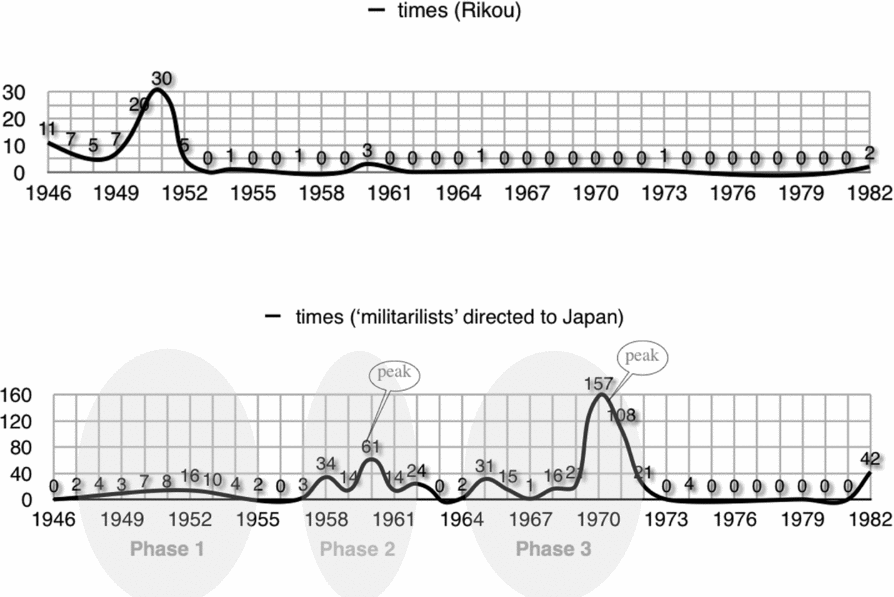
Helping to demonstrate this section, Figure 1 is based on an analysis of the headlines of the Chinese Communist Party's mouthpiece Renmin Ribao (People's Daily) from 1946 to 1982. ‘Rikou’ (Japanese bandits) is a very negative word to call the Japanese. Before 1952 it was used substantially in the article titles of Renmin Ribao, but its use in headlines stopped almost completely after 1953 (the first graph in Figure 1). On the other hand, the use of ‘junguo zhuyi’ (militarist) in the article titles of Renmin Ribao has completely different results (the second graph in Figure 1).Footnote 47
The graph above shows the number of times ‘Rikou’ appeared in Renmin Ribao article headings; the graph below shows the number of times ‘junguo zhuyi’ appeared in Renmin Ribao article headlines.
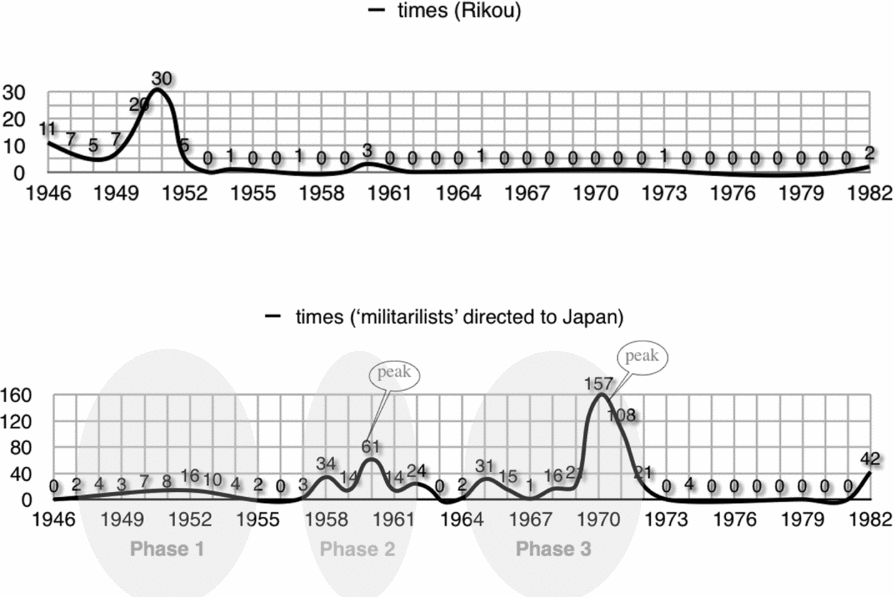
At a glance, these two charts are at odds with each other. In fact, both of them reflect the Sino-Japanese inter-governmental relations very well. The decline in the use of abusive language like ‘Rikou’ to refer to the Japanese after 1952 implies that Japan's status as a disgraceful foe was officially redefined to that of a foreign nation. Nevertheless, this does not mean official accusations of Japan as a past or potential invader disappeared entirely.
According to the second graph in Figure 1, there were three phases of continuous yet fluctuating growth and decline in terms of the Chinese Communist Party's Japanese militarist-bashing: from approximately 1947 to 1955, from 1957 to 1962, and from 1964 to 1972. This graph reflects the ups and downs of Sino-Japanese inter-governmental relations between 1945 and 1982, and shows the peaks and troughs of the Chinese Communist Party's Japanese militarist-bashing (that is, the years when no article titles used ‘junguo zhuyi’). In what follows, I will discuss in chronological order how the two graphs show that the Chinese Communist Party's war remembrance activities centred around Japanese militarist-bashing against the background of the Sino-Japanese inter-governmental relationship.
From undisguised accusations to undisguised courting: 1945 to 1956
Immediately after the end of the Fifteen-year War, the main issue related to the war for the Chinese Communist Party was that of Japanese war crimes. Its propaganda sector reported on the International Military Tribunal for the Far East and published articles that revealed the extent of Japanese atrocities. In addition to its aim of attacking Japanese militarists, it was intended that this propaganda would ultimately help strengthen the Chinese Communist Party's position in the Civil War. To achieve the latter, the regime's accused the Kuomintang regime of colluding with the United States and Japan of bullying China during and after the war,Footnote 48 and criticized the Kuomintang's domestic governing of China. The Chinese Communist Party alleged that the Kuomintang was corrupt in taking over Japanese properties, its behaviour towards the Chinese people was as brutal as that of the Japanese military, and even that it had employed Japanese solders to kill Chinese people in the civil war.Footnote 49 Thus, many articles deprecating the Japanese military also attacked ‘Jiangzei’ (Chiang Kai-Shek the thief), the ‘Meidi’ (American imperialists) and ‘Maimo’ (MacArthur the demon). It also praised the friendship offered by the Soviet Union and its assistance during the war.Footnote 50 Finally, this propaganda aimed at building a ‘just’ image of the Chinese Communist Party by reporting the abnormal lenience of the International Military Tribunal and the Kuomintang's military tribunals, while promising that Japanese war criminals would be punished in the areas occupied by the Chinese Communist Party.Footnote 51
From October 1949, when the Chinese Communist Party established China, until October 1952, its narratives relating to the Fifteen-year War and its extra propaganda aims were similar to those of the previous period.Footnote 52 As before, accusations and revelations of atrocities committed by the Japanese imperial army were open and undisguised. According to the first graph in Figure 1, abusive language was frequently used to refer to this group of Japanese. The primary reason for this, I would argue, is that the Chinese Communist Party government still saw Japan—governed by right-wing politicians—as an enemy.
Formerly, the Chinese Communist Party did not trust Japan. How to defend China against a potential attack from Japan and its allies was considered by Mao to be one of the fundamental purposes of the Sino-Soviet Treaty in 1950, which was considered to be the most important treaty for the new-born China.Footnote 53 Later, the Yoshida Shigeru government (22 May 1946–22 May 1947 and 15 October 1948–10 December 1954) signed the San Francisco Treaty and the Japan-United States Security Treaty, which confirmed the nation's image as the ‘running dog’ of the United States among the Chinese Communist Party leaders. Yoshida and Chiang Kai-Shek also concluded the Japan-Taiwan Treaty and institutionalized Japan's pro-Taiwan stance, which further enraged the Chinese Communist Party.Footnote 54 Moreover, when the Korean War erupted, there was widespread fear that this would spark a Third World War; Chinese Communist Party officials also believed there was evidence that Japan had helped American solders in the battlefield. By this point, Japan, rather than being a potential danger became a real enemy (although as the accomplice in the war this time). The combination of all this suspicion, indignation, and hostility made the Chinese Communist Party regime refuse to be friendly with the Japanese government, although the Party was still embracing ‘kind Japanese people’.Footnote 55
During this first phase of the Chinese Communist Party's Japanese militarist-bashing, they launched three mass campaigns to ensure that the Chinese people recalled Japanese atrocities. The first two campaigns were related to Japanese war criminals. The aim of one of the campaigns was to ‘protest against the release of Japanese war criminals by America’, which began in around March 1950 and ended around December of that year.Footnote 56 Another campaign was launched to ‘expose Japanese Biological Warfare atrocities’.Footnote 57 This campaign was triggered by the Khabarovsk trial, conducted by the Soviet Union from 25 to 30 December 1949, which revealed the extent of Japanese biological warfare atrocities, and was followed closely by the Chinese media. After March 1950, the first wave of the campaigns gradually ceased, until the discovery of an alleged attempt by the United States to use biological weapons in the Korean War in February 1952. Newspaper articles criticizing the Americans and providing tips for surviving in a biological war were published extensively thereafter, gradually ending in 1953. Naturally, the memory of Japanese biological warfare was revived in this latter wave.Footnote 58
The third campaign can be summarized as ‘remembering the bitter anti-Japanese war and protesting against the American plan to rearm Japan’, which was started in around February 1951. Memories of all kinds of Japanese atrocities suffered by the masses were consistently written about in the media.Footnote 59 According to a labour union record in Nanjing, this campaign was started in the previous year as part of mobilizing for the Korean War. Establishing patriotism and hatred towards the United States was its main aim. However, this did not go down well with Nanjing's workers and new guidelines were introduced in February 1951. The new core task was to protest against the American plan to rearm Japan and to conclude peace with Japan on its own.
Why was Japan the centre of this campaign? According to the Chinese, the United States was experiencing setbacks in the battlefield but was not willing to be defeated. As a result they made some disgraceful moves to stay afloat. John Foster Dulles was sent to Japan to conclude a peace agreement, which included rearming Japan. This outraged Chinese workers as: ‘300,000 Nanjing people were killed by the Japanese invasion army during the Anti-Japanese War. The people and workers will never forget this huge debt of blood.’Footnote 60 Thus, the Japan-centred campaign was the response to try to destroy America's plan—but it was also in line with the sentiment of the workers.
To fulfil the task, mobilization of the masses was planned by organizing mourning ceremonies, petitions, and so forth. The result of this renewed campaign was notable, as the sentiments of Chinese people were harnessed successfully. However, in late April, the central government started to warn that in some places the results of the campaign had miscarried, as local people only expressed their hatred towards the Japanese but did not transfer their anti-Japanese sentiment to the Americans and to the task of reconstructing the motherland. This indicated that the campaign, originally designed to attack the United States, was becoming increasingly anti-Japanese because painful memories of Japanese atrocities were still deeply entrenched among the Chinese people.Footnote 61 Gradually, the media reports of this campaign devoted more space to talking about how the local people could successfully transfer their anti-Japanese sentiment to the Americans.Footnote 62
There was no contact between the Chinese Communist Party and Japanese governments until three members of the Japanese Diet came to Beijing and signed the first bilateral trade agreement on 15 May 1952.Footnote 63 Following this initial visit, 13 Japanese delegates came to Beijing to participate in the Peace Conference of the Asian and Pacific Region in October 1952.Footnote 64 Although the sentiments of the Chinese people could still be observed, after the conference the undisguised condemnation of the atrocities committed by the Japanese imperial army gradually disappeared in official media.Footnote 65 Articles about biological warfare were still written, but only in the context of its use by the Americans. Furthermore, abusive language was rarely used to refer to the Japanese in the Chinese Communist Party's official discourse after that. In brief, the Chinese Communist Party regime gradually changed its hostile stance towards the Japanese government after some semi-official communication took place between the two regimes.
Still, criticism of Japanese militarism or the resurgence of militarism continued after the end of the Korean War, despite the increased communication between the two governments. This was mainly because the Chinese side still considered the Yoshida administration to be a right-wing government that represented the wishes of Japanese militarists and was unwilling to build a proper state-to-state relationship with it.Footnote 66
Nevertheless, as the Soviet Union started advocating peaceful relations with the Japanese government and a change of leadership was going on in Japan, China cautiously changed its attitude. In late September 1954, Khrushchev visited China and tried to persuade the Chinese to follow the Soviet Union's lead by changing its policy towards Japan as well.Footnote 67 Scholars noticed the fundamental change in China's Japanese policy from the statements issued at the Sino-Soviet summit meeting: previously the Chinese Communist Party regime only pursued friendship with ‘kind Japanese people’, now they did not mind making friendly overtures to the Yoshida government. Hatoyama Ichiro took over the Japanese premiership on 7 December 1954, and the Chinese Communist Party publicly welcomed his government's statement about normalizing Sino-Japanese relations.Footnote 68
At last, the two countries stepped into the first chapter of good inter-governmental relations in the post-war era. In contrast to its tough stance on Japanese war criminals, the Chinese Communist Party actively engaged in repatriating Japanese prisoners-of-war (and nationals), as well as conducting lenient military tribunals. Also, quasi-diplomatic communication between the two countries increased greatly. This is reflected in first graph of Figure 1; once the first phase of the Chinese Communist Party's militarist-bashing was over, there is no instance of ‘junguo zhuyi’ appearing in Renmin Ribao during the tenures of Hatoyama and Ishibashi Tanzan (10 December 1954–25 February 1957).
The Chinese Communist Party's grudge against the Kishi-Sato brothers
These good times did not last long, however, as the next Japanese prime minister, Kishi Nobusuke (25 February 1957–19 July 1960) soon upset the Chinese Communist Party, with his series of pro-American and pro-Taiwan actions. His unprecedented visit to Taiwan in June 1957—the first by a Japanese prime minister since the end of the war—and his support for Chiang Kai-shek's speech about reclaiming the mainland, annoyed the Chinese Communist Party.Footnote 69 Around this time, the discourse surrounding Japanese militarism and Japanese imperial atrocities reappeared, albeit on a small scale. Still, the Chinese Communist Party regime did not give up hope of normalizing their relationship with the Kishi government. Its Japan affairs team devoted itself to preparing for the negotiations of the fourth bilateral trade agreement, which was considered an important step towards normalization.Footnote 70
Against this background, Liu Lianren, a forced labourer who was taken to Japan by the Japanese imperial army during the war, was found in Hokkaido, Japan, on 8 February 1958. Many reports about the story and the refusal of the Kishi government to acknowledge the culpability of the Japanese imperial government were printed in the Chinese media.Footnote 71 However, it seems that these reports restrained their criticisms of a militarist resurgence and did not directly target the Kishi cabinet (although, technically, Kishi himself was a ‘resurgent’ member of the former militarist government). It seems that the Chinese Communist Party regime did not want to fall out with the Kishi cabinet by including its members on the list of ‘Japanese militarists’ at this point. It was only when the Kishi cabinet refused to acknowledge the fourth bilateral trade agreement on 9 April that the Chinese Communist Party regime started to directly criticize the Japanese government for the resurgence of Japanese militarism. After the Nagasaki Flag incident of 2 May 1958,Footnote 72 criticism of both imperial militarists and resurgent militarism increased quickly and reached a peak in 1960.Footnote 73
The justification given for the 1960 wave of Japanese militarist-bashing was that it supported the Japanese people's movement against the Japan-US Security Treaty, which was reported in China from 1958. The nationwide campaign started in Beijing on 9 May 1960. By 15 May, assemblies and demonstrations were launched in 33 cities and some counties, with around 12 million people reportedly participating in these activities. Japanese atrocities were recalled repeatedly both by party leaders and participants. For example, Liao Chengzhi said in a Beijing meeting on 9 May, ‘Chinese and other Asian people's memory of atrocities committed by Japanese militarists is still vivid.’Footnote 74 The citizens were very emotional during the 700,000-participant assembly in Wuhan—a city that was ruled by the Japanese occupiers for a long time. For example, a woman whose husband was shot by the Japanese army expressed her outrage to the media about the resurgent Japanese militarism.Footnote 75
In Nanjing, there were two assemblies organized on 13 May (400,000 participants) and on 22 May (1 million participants). According to the records of the Nanjing municipal government, the assemblies were carefully planned. The intention was to mobilize 105,000 people across Nanjing to participate in the first meeting. The participants were required to be energetic and spirited to represent the mood of demonstration. All of the physical and mental equipment, such as banners, slogans, and songs were prepared by the government. To avoid any accidents, caused by over-emotional masses, for example, the Public Security Bureau put careful security measures in place as well.Footnote 76 Although it was rainy on 13 May, 400,000 citizens showed up at the meeting and demonstration, nearly four times more than the authorities anticipated.Footnote 77 From party heads to the farmer's representative, those who gave speeches all mentioned how Nanjing had suffered since December 1937 at the hands of wartime Japan.Footnote 78 The meeting triggered many testimonies from the victims of the Nanjing Massacre and from the veterans who had participated in the war.Footnote 79
This series of movements carried on in Chinese cities until Kishi approved the renewed security treaty with the United States and resigned in July 1960. Nevertheless, after Ikeda Hayato formed a new cabinet (19 July 1960–9 November 1960), criticism of past and present Japanese militarists did not stop. Not until the Liao-Takasaki Memorandum Trade Agreement was signed in November 1962 was the relationship between the two governments normalized, for the first time since relations broke down publicly in light of the Nagasaki Flag incident. Jailed Japanese war criminals were released ahead of schedule.Footnote 80 Accusations aimed at Ikeda regarding the revival of militarism also ceased at this time.Footnote 81 This is reflected in the second graph of Figure 1. Compared to the first phase of Japanese militarist-bashing, the second phase was more moderate, not only in terms of the Party's discourse. Chinese people were thoroughly and widely mobilized to condemn the crimes of the Japanese militarists at every possible occasion during the campaigns in the first phase, but, although they were still being encouraged to speak out about their hatred in the second phase, this was confined to the big assemblies, carefully controlled by the authorities.
Although Ikeda, as a low-key and pragmatic politician, found himself balancing his position between mainland China and the United States/Taiwan, he still belonged in the latter's camp. Issues that would be damaging towards Sino-Japanese inter-governmental relations were buried during his tenure of office and exploded soon after his successor Sato Esaku took office (9 November 1964–7 July 1972).Footnote 82 China carried out its nuclear trial successfully on 16 October 1964, which made Japan worry about its safety. This in turn encouraged Japan to enhance its own military capabilities and strengthen its military alliance with the United States. Other emerging problems also threatened the mutual relationship, like the Japan-Korean Treaty and the Senkaku/Diaoyu Island issue. More importantly, Sato, with the ultimate political aim of regaining Okinawa, carried out a pro-American and pro-Taiwan policy much more openly and the Chinese Communist Party regime struggled to tolerate this. He made comments that were considered to be supportive of ‘two Chinas’ as early as November 1965. Unsurprisingly, criticisms of the resurgence of militarism under the Sato administration appeared in Renmin Ribao headlines for the first time in a relatively long period. As all of the elements mentioned above—among other factors—took effect, tensions between the two governments ran high and, as a result, the Chinese Communist Party's Japanese militarist-bashing carried on throughout Sato's tenure and reached its peak in 1970. However, compared to the previous two phases, the third phase concentrated on revealing evidence of the current Japanese militarist resurgence, rather than exposing or castigating the atrocities of the past. Although evidence of Japanese military resurgence was revealed throughout the post-war period, the revelations during this phase was more thorough, dense, and systematic.Footnote 83
In terms of newspaper coverage, how the Sato administration used cultural and educational tools to whitewash Japan's history of invading other nations was often analysed item-by-item in articles or special columns.Footnote 84 For example, one article started by criticizing the annual memorial ceremony for the war dead held by Japan on 15 August that year.Footnote 85 Sato was reproved for applauding those who were killed in the war as this was taken as a sign that he wanted to ‘learn lessons from senior militarists and fight hard to expand abroad’. After criticizing the enhancement of Japan's military production and military training, the article continued to express its outrage that the Sato administration had authorized cinemas to show the film ‘Turbulent Showa History: Warlord’. The article stated, ‘This film reversed the verdict for the Japanese invasion by the means of turning history upside-down . . . it also brazenly called back the spirit of the major war criminal Tojo Hideki, [who was] a Japanese militarist leader of countless crimes and the hands of whom were full of the blood of Chinese and other Asian people.’ It was also revealed that Japan's notorious Mitsubishi A6M Zero fighter aircraft as well as the uniforms and the swords used by Tojo and Yamamoto Isoroku were exhibited alongside the film.
In the end, the article warned that there was a lot of ‘poisonous weed’ produced to propagandize militarism and it listed many examples. One of them was that, encouraged by a right-wing Japanese government, a wartime primary school textbook in Japan, which encouraged expansionist tendencies and people to sacrifice their lives for the emperor and the militarists, was reprinted. This textbook also attempted to deny the crimes carried out by the imperial Japanese military by describing the Manchuria Incident as a military operation between the Japanese and Chinese armies. The article also revealed that the Tokyo National Museum was preparing an exhibition exalting Japan's military successes, and many paintings, photo albums, and memoirs that commemorated past militarists were produced, such as Okamura Yasuji's memoir, which was published in newspapers and as a book. The article concluded that all of these facts indicated that Japanese militarism had come to life again. New Japanese militarists were reviving the old dream of a ‘Great East Asia Co-Prosperity Sphere’, and targeting the people in China, North Korea, Indochina, and other Asian countries.
Individual pieces of evidence were revealed separately as well, and can be catalogued as follows. Artistic works, especially Japanese war films like ‘Gateway to Glory’ and ‘Men and War’, were attacked. Even a book that condemned the Japanese militarist resurgence shown in Japanese war films was published.Footnote 86 Commemorative activities on memorial days, like Shusen Kinenbi (the anniversary of the end of the war) and Kenkoku Kinenbi (National Foundation Day), were also targets for attack.Footnote 87 Revisionism in Japan's education was watched closely by the Chinese Communist Party regime as well.Footnote 88 Glorifying militarists especially triggered the Party's anger.Footnote 89 From the early days of the People's Republic of China the Japanese emperor was seen as the spiritual mainstay of militarism. Thus, any encouragement for Japanese people to worship him was criticized by the Party as a sign of the continuity of Japanese militarism. For example, even a mourning ceremony for the writer Mishima Yukio—who started a coup out of his belief in bushido (loyalty towards the emperor and extreme patriotism) and who committed hara-kiri after the coup failed—was denounced.Footnote 90 The Chinese media also warned that the Sato government and the United States were following the old road of Japanese militarists—a road to destruction.Footnote 91 Apart from attacking resurgent militarism, atrocities perpetrated by the Japanese invasion army in other Asian countries were introduced.Footnote 92 Interestingly, the Japanese left-wing's exposure of the evidence provided a great avenue for China's Japanese militarist-bashing. Evidence of resurgent Japanese militarism exposed by these Japanese and their protests against militarism were reported in detail.Footnote 93
Just as happened ten years before, in 1970 the Japanese people's struggles over the renewal of the Japan-United States Security Treaty and the resurgence of militarism were substantially reported by the Chinese domestic media as well as journals targeting foreign readers.Footnote 94 The actions and speeches of the Japanese Socialist Party, pro-China groups, and individuals on 7 July, 15 August, and other Fifteen-year War related memorial days were widely reported.Footnote 95 However, as regards activity on the Chinese side, in contrast to ten years previously, a propaganda campaign—as opposed to a physical mass campaign which empowered bottom-up collective condemnation of Japanese militarism—was launched by the Chinese Communist Party regime.Footnote 96 In other words, the mass-driven character of the three phases of Japanese militarist-bashing was diminishing, one after another. Furthermore, apart from having revealed a large amount of evidence, this year also commemorated the twenty-fifth anniversary of the end of the war on 7 July and 3 September. ‘Against resurgent Japanese militarists’ was clearly included in this year's slogans for the memorial days.Footnote 97
Criticisms of the Japanese militarists lessened swiftly around the time that Sato was replaced by Tanaka Kakuei as Japanese prime minister on 7 July 1972. As reflected in Figure 1, the third phase of Japanese militarist-bashing came to an end around this time. After that, war memorial days like 7 July and 15 August, which were previously commemorated at least once every five years, did not receive any attention in Renmin Ribao. Nevertheless, the Chinese Communist Party regime still commemorated 3 September in 1975. The real change came after 1978, when the Treaty of Sino-Japanese Friendship was signed. Indeed, as some scholars have argued, the four commemorative dates were either ignored or became occasions for praising Sino-Japanese friendship. In brief, roughly speaking, there was a positive correlation between the extent to which the Chinese Communist Party's war remembrance centred around Japanese militarist-bashing, and the state of Sino-Japanese inter-governmental relations.
Remembering the war during friendly encounters
In the course of Sino-Japanese friendship before the 1972 normalization, many empirical sources show that the topic of the history of the Fifteen-year War was also frequently mentioned. Even in the so-called ‘Sino-Japanese illusion’ period between 1972 and 1982, remembering the war was still a part of China's public life. This section talks first about three occasions on which the war was recalled before 1972, and then explores the situation after 1972.
When Chinese Communist Party leaders spoke to Japanese delegates face to face, they sometimes brought up the topic of the Fifteen-year War, which were the first occasions on which the war was recalled during friendly moments. Often, they merely made a brief reference to the war to remind the delegates of it, for the following possible reasons. First, Chinese Communist Party officials wanted to dispel the misgivings of Japanese people, who felt guilty for the war, by letting it be known that although they had an unfortunate past, the two countries could still build a friendship. Secondly, the Chinese Communist Party wanted to unite those Japanese people who were pro the People's Republic of China against the conservative Japanese government, which they accused of representing the Japanese militarists. An example of this is when the Nanjing cadres shared with the Japanese youth delegation the details of the Nanjing Massacre and showed them ‘The Red Lantern’. Thirdly, the Chinese Communist Party could remind less ‘friendly’ Japanese of how big a debt Japan owed to China, which was usually very effective.Footnote 98
On those occasions when the Japanese side did not show repentance for the war atrocities, the Chinese Communist Party leaders would make a fuss about it, although usually not publicly. An episode which occurred during the negotiations for Sino-Japanese normalization exemplifies this well. In his first meeting with Zhou Enlai on 25 September and at the welcoming banquet that evening, Prime Minister Tanaka described the atrocities inflicted on the Chinese people as imperial Japan ‘gave Chinese people troubles’. The problematic phrase ‘gave troubles’ caused a strong reaction among Chinese officials. Both Zhou Enlai and Mao Zedong took a very tough position against this phrase, which suggests that the Chinese Communist Party leaders actually did have a bottom line that they stuck to and they tried their best to make the Japanese side compromise. The result of this dispute was a much more sincere sentence in the China-Japan Joint Statement: ‘the Japanese side is keenly aware of Japan's responsibility for causing enormous damages in the past to the Chinese people through war and deeply reproaches itself’.Footnote 99
However, sometimes it was the Japanese who initiated discussions, as many of them were aware of the horrors committed by their wartime troops. Frequently seen during meetings between the visiting Japanese and Chinese leaders were scenes of apology. In particular, those Japanese who had participated in the war experienced a kind of urge to apologize when they revisited China as friendly envoys.Footnote 100 Chinese leaders would reiterate the distinction they made between Japanese people and Japanese militarists to reassure them. Similarly, those Japanese who were taken care of by the Chinese Communist Party regime (particularly those who were repatriated from mainland China), were inclined to publicly compare the terror imposed by the Japanese invaders with the humanitarianism shown by the Chinese Communist Party regime.
What is more, the atrocities carried out by the militarists during the war were often used by the Japanese leftists in their struggles against the conservative Japanese government. As a consequence, some of the atrocities that took place in the name of the Japanese empire—which were unknown to the Chinese—were investigated, causing a huge sensation in China. The most well-known example was the Hanaoka Massacre, which was initially investigated by and reported in Huqiao Minbao (a newspaper run by Chinese nationals living in Japan) on 11 January 1950. The report, which also accused the Yoshida administration and the occupation authority of covering up this incident, was covered by the Chinese media in late 1950, which ran emotional stories by former forced labourers. For example, Ma Zixin, who was working for a high school in Nanjing, wrote to Xinhua Ribao in response to the report about his own experience as a forced labourer in Fukushima prefecture and Hokkaido.Footnote 101 However, this episode was soon submerged in the flood of accusations of Japanese atrocities in the early 1950s, and it was not until 1953 that it was unearthed again.
On 7 July 1953, the remains of the victims of the Hanaoka Massacre were returned to China by pro-People's Republic of China groups in Japan, such as the Japan-China Friendship Association, and a grand ceremony was held in Tanggu port. This mission was covered widely in the Chinese media as was the massacre itself.Footnote 102 The Japanese side continued to compile lists of names of Chinese forced labourers, collect their remains, and return them to China. The handing-over ceremony for the ninth set of remains received renewed attention in 1964.Footnote 103 The Hanaoka Massacre gradually faded from the memories of the Chinese people but was revived by Japanese leftists during the protests against the renewal of the Japan-United States Security Treaty in 1970. The Chinese media gave in-depth coverage to how friendly Japanese groups had investigated the crimes of Japanese militarists in Hanaoka.Footnote 104 Above all, before the normalization of the Sino-Japanese relationship, talking about the war and dealing with the legacies of the war were inevitable when the Chinese and Japanese met.
Lastly, if any friendship event went too far and upset the Chinese people, they would react strongly. Their animosity was not suppressed—in fact, they were able to air it publicly, and this was faced squarely by the Chinese Communist Party leaders. According to the memoirs of some of the cadres who were in charge of Japanese affairs, such as Wu Xuewen and Sun Pinghua, the resistance of the Chinese people to friendship with Japan was fairly strong. For example, Wu recalled that in Shenyang, when some citizens saw Japanese delegates, they would stare at them angrily. Even the cadres, including Wu himself, would feel resentful when they heard Japanese delegates casually using words like ‘Shina’ (an old Japanese word for China) and ‘Manchu’.Footnote 105
A vivid example to illustrate this resulted from the trouble caused by the Japanese flag. A Japanese products exhibition was held in Beijing in 1956. Zhou Enlai recalled that ‘a very big Japanese flag was hung in the exhibition hall in Beijing Hotel . . . which gave me a strong impression. This was the very first time Chinese people saw the Japanese flag after the foundation of PRC.’Footnote 106 This triggered painful memories of the misery inflicted by the Japanese invasion. Many Beijing citizens made violent objections to the office in charge of the exhibition. Posters depicting Japanese flags were torn down as well. According to the records of a Japanese member of staff, similar scenes occurred in Guangzhou and Wuhan in 1958, where Japanese merchandise exhibitions were also held. Many citizens posted their queries and complaints regarding the Japanese flag in the message box at the event or sent them to a news agency. A factory cadre who was obliged to visit the exhibition lost control of his emotions when he saw the flag and started describing through his tears how his brother was killed by the Japanese imperial army.Footnote 107
The Chinese Communist Party leaders were, of course, aware of the sentiments of the Chinese people and the potential dangers surrounding them. Zhou Enlai once again instructed the cadres to ‘distinguish [between] Japanese militarists and Japanese people’, and the cadres, in turn, made great efforts to educate the masses. Also, the People's Liberation Army was deployed to guard the exhibition halls in case any physical threat was posed by the Chinese people. When Prime Minister Tanaka visited China in 1972, paper flowers instead of Japanese flags were used to greet his delegation, the purpose of which was to avoid triggering people's resentment.Footnote 108 Nonetheless, the Chinese Communist Party never attempted to forcefully suppress the Chinese people's sentiments and consistently showed understanding. It confined its efforts to redirecting the Chinese people's anger to a small group of Japanese militarists and to convincing the people to accept its diplomatic missions with Japan.
After the two nations normalized their relationship in September 1972, the Sino-Japanese friendship in both the official and non-official spheres became mainstream. Remarks made by Chinese leaders in public about Japan were mostly about how to learn lessons from Japan's economic reconstruction.Footnote 109 Still, the Chinese Communist Party leaders did not see Japan, as a completely trustworthy friend but instead, pragmatically, as a partner in the camp of capitalist countries.Footnote 110 Thus, occasionally, warnings of Japanese militarist resurgence can be observed. For example, a Japanese right-wing organization Seirankai, founded in 1973 by a group of pro-Taiwan Diet members, held several national meetings in places like Tokyo (on 26 January 1974) and Nagoya (on 10 March 1974). Apart from reporting these meetings, the Chinese media also criticized its members for being resurgent militarists. Similarly, in the same year the House of Representatives passed the Bill of Yasukuni Shrine, which also alerted Chinese officials to the danger of a Japanese military resurgence.Footnote 111 Nevertheless, these reports would normally suggest that these were the actions of a small group of right-wing Japanese, acting against the will of the Japanese people, left-wing parties, and even the Liberal Democratic Party regime.
The discussion above shows that before 1972, based on their ‘innocent Japanese people theory’, the Chinese Communist Party leaders made great efforts to persuade themselves, their cadres, as well as the Japanese and Chinese people that, although the war should not be forgotten, developing the Sino-Japanese friendship could—and should—be carried out. The war was also consistently remembered by the Chinese Communist Party leaders, the Chinese people, and the Japanese people during friendly encounters between China and Japan, although in a much softer manner (in comparison to the vigorous manner in which Japanese militarist-bashing activities were carried out when the Sino-Japanese inter-governmental relationship was poor).
Conclusion
The history of the Fifteen-year War was an ‘indispensable element’ in the relationship between China and Japan before 1982. When inter-governmental relations between China and Japan were bad, remembering the Fifteen-year War was vigorously pursued. However, the war was also consistently referred to when Sino-Japanese relations were friendly, as a way of reaching out to the Japanese left. What is more, the history of the Fifteen-year War was not a forbidden topic when good Sino-Japanese inter-governmental relations were enjoyed during the periods of the Hatoyama cabinet, the second half of the Ikeda cabinet, and after Sino-Japanese normalization. The slogan, ‘We should distinguish the majority of kind Japanese people from a handful of evil Japanese militarists’ allowed the Chinese Communist Party regime great diplomatic flexibility to both attack the Japanese conservative government (when remembering the war was an asset), and pursue friendship with Japan (when remembering the war was not a barrier).
Nevertheless, the Chinese Communist Party regime did not always take the initiative. As shown in this article, the regime was sometimes forced to take action against the legacies of the Fifteen-year War, such as harnessing the Chinese people's anti-Japanese sentiment and reassuring those Japanese visitors who felt guilty about their country's wartime aggression. Just as happens today, remembering the Fifteen-year War was also a double-edged sword for the Chinese Communist Party regime, but despite this, it was not deliberately avoided nor suppressed by the regime. In short, before 1982, war remembrance activities were not as prevalent as they are currently, but nevertheless, the war was well remembered in mainland China (and at certain times, it was even central to the public life). Although the Chinese Communist Party regime significantly manipulated remembrance of the Fifteen-year War, as a whole it was a joint enterprise between the Chinese government, the Chinese people, and visiting Japanese.
Finally, the perspective adopted in this article is that of both central as well as local Chinese government and is largely based on Chinese official sources: direct accounts from Chinese people and the Japanese side of the events described in this article are not fully included. Thus, there is more work to be done to provide a full picture of the situation before 1982.
Furthermore, apart from being an important element in the Chinese Communist Party regime's diplomatic practice vis-a-vis Japan, the history of the Fifteen-year War was also utilized in other fields. For example, as mentioned in this article, when criticizing ‘American imperialists’, Japanese wartime atrocities were often raised by the regime. Similarly, the history of the Fifteen-year War was entangled with various domestic affairs in mainland China during the period as well. For instance, commemorative activities held on Fifteen-year War memorial days were closely related to domestic issues, such as national identity construction and public education. Although treatment of the history of the Fifteen-year War in these fields is only lightly touched upon in this article, it definitely deserves further exploration.