Introduction
Dementia is a clinical syndrome characterized by cognitive deficits, caused by numerous underlying etiologies including Alzheimer's disease. Dementia prevalence is estimated between 5%–7% in most world regions, with a standardized prevalence of 5.65% for South Asia (Prince et al., Reference Prince2013).
However, some reports suggest a low dementia prevalence in India, 0.3%–1.36% (Chandra et al., Reference Chandra, Ganguli, Pandav, Johnston, Belle and DeKosky1998), much lower than other low-income regions such as China and Latin America (Chandra et al., Reference Chandra, Ganguli, Pandav, Johnston, Belle and DeKosky1998; Llibre Rodriquez et al., Reference Llibre Rodriguez2008; Prince et al., Reference Prince2013).
Data on dementia occurrence in low-income countries are sparse, and there are no reports from Bangladesh. A recent meta-analysis of dementia prevalence included only seven studies from South Asia, limited to India and Sri Lanka (Prince et al., Reference Prince2013). Forecasts predict 304% increase in dementia prevalence in South Asia from 2010–2050 (Prince et al., Reference Prince2013), with population growth and increased aging suggested as contributing causes. The estimated total costs for dementia care in South Central Asia raised from US$10.5 billion to US$15.6 billion from 2005 to 2009 (Wimo et al., Reference Wimo, Winblad and Jönsson2010). In low-income countries there is high family burden related to caregiving for persons with dementia (Prince, Reference Prince2004). These reports highlight the growing importance of dementia in low-income countries.
Although numerous studies have investigated factors associated with dementia in high-income countries, little is known about whether such factors are also relevant in low-income countries. Available results are conflicting; increased age (Chandra et al., Reference Chandra, Ganguli, Pandav, Johnston, Belle and DeKosky1998; de Silva et al., Reference de Silva, Gunatilake and Smith2003; Mathuranath et al., Reference Mathuranath2010), low education (Mathuranath et al., Reference Mathuranath2010), and illiteracy (de Silva et al., Reference de Silva, Gunatilake and Smith2003) are reported to be associated with higher dementia prevalence in India and Sri Lanka, but being female was associated with dementia in some (Mathuranath et al., Reference Mathuranath2010) but not all (Chandra et al., Reference Chandra, Ganguli, Pandav, Johnston, Belle and DeKosky1998) studies in South Asia. Diabetes, depression, hyperhomocysteinemia, hyperlipidemia, and body mass index were reported to increase dementia risk in India, whereas cognitively stimulating activities, socialization, and living in joint families decreased the risk (Tripathi et al., Reference Tripathi2012).
There is little information concerning nutritional factors and dementia in low-income settings. A meta-analysis of studies from low-income countries, including China, India, and Latin America reported higher dementia prevalence in persons with high meat consumption, and a lower prevalence associated with high fish consumption (Albanese et al., Reference Albanese2009). Nutritional factors such as saturated fatty acids (Tripathi et al., Reference Tripathi2012) were found to increase dementia occurrence, whereas an increased intake of polyunsaturated fats, fruits, and salads was related to a lower dementia occurrence in India (Tripathi et al., Reference Tripathi2012).
An important question is whether risk factors reported in high-income counties are the same as in low-income settings, because exposure to, for example, nutritional and socioeconomic factors might differ between regions. A review of dementia risk factors in Asia highlighted the importance of studying inter-ethnic differences and focusing on novel risk factors that might be more prominent in low-income countries, such as nutritional factors. This is particularly important as such factors are potentially reversible or treatable. Further, country-specific dementia prevalence rates are needed for planning of healthcare and welfare, particularly in low-income countries where prevalence rates are estimated to increase dramatically over the next 20–40 years (Prince et al., Reference Prince2013).
The main objective of our study is to report the prevalence of dementia in persons aged 60+ in rural Bangladesh, according to sociodemographic factors, and to examine a broad range of factors that are potentially associated with dementia occurrence, including clinical, social, and nutritional factors.
Method
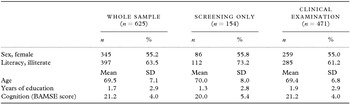
Data were collected in the Poverty and Health in Ageing (PHA) Project, a cross-sectional study of health and functioning in older people in rural Bangladesh during 2003–2004; detailed information has been reported previously (Kabir et al., Reference Kabir, Ferdous, Cederholm, Jhanam, Streatfied and Wahlin2006). A total of 850 community-dwelling persons aged 60 years and above were randomly selected from two areas of Matlab, a rural area located 55 km from Dhaka: 625 (73.5%) participated in the screening phase, 63 died before start of data collection, 38 declined, 93 were unreachable, 11 migrated, 18 were registered twice, and two were younger than 60. Participants were interviewed in their homes by trained interviewers using a structured questionnaire. Three quarters (n = 471, 75.4%) also underwent a thorough examination at a nearby health clinic, including a clinical examination by physicians and cognitive testing by psychologists. Baseline characteristics of the study population stratified by screening and clinical sample are seen in Table 1.
Baseline characteristics, stratified by screening, and clinical sample

BAMSE = Bangla version of the Mini-Mental State Examination.
Information on age, sex, education (years of schooling), and literacy was collected from the Demographic Surveillance System. Literacy was defined as being able to read and write in Bangla. Age was double-checked with questions concerning biological and historical events, as many people in rural Bangladesh do not know their exact age, and there are often no birth certificates. Using this method to determine age in low-income countries is well established (Allain et al., Reference Allain1997). Age was categorized into five-year intervals (60–64, 65–69, 70–74, 75–79, 80–84, 85–92). General cognitive ability was measured with the Bangla version of the Mini-Mental State Examination (BAMSE; Kabir and Herlitz, Reference Kabir and Herlitz2000), which is a validated tool assessing a range of cognitive functioning in older individuals irrespective of literacy levels. Dementia diagnosis was made with DSM-IV criteria using a stepwise procedure. First, diagnosis was made by a physician in Bangladesh with information from the survey questionnaire and medical examination, focusing on any change in behavior, mood, memory, daily function, co-morbidity, current physical, and mental status at examination, and BAMSE results. All diagnoses were reviewed by another physician, blinded to the first diagnosis. In the case of disagreement, a final decision was made by a senior physician not involved in the first two evaluations.
Somatic disorders were diagnosed by the physician during the clinical visit, after taking a detailed medical history, questionnaire on presence and history of symptoms, and clinical investigation including blood analyses. We investigated: arthritis (lower back or joint pain, arthralgia, joint swelling, or reported previous diagnosis by a physician); stroke (neurological examination and previous history); chronic obstructive pulmonary disease (physical examination, history of smoking, coughing, respiratory distress); heart failure (peripheral edemas, shortness of breath engorgement of neck vein, shifted apex beat, thrill and/or abnormal heart sound); thyroid hypofunction (presence of swelling in the neck, fatigue, changes in voice etc., and laboratory values of thyroid stimulating hormone); hypotension (sitting systolic BP < 90 and diastolic BP < 60); hypertension (systolic BP ≥ 140 and diastolic BP ≥ 90); and depression based on the Self-Report Questionnaire 20 (SRQ20; Harding et al., Reference Harding1980) and in line with DSM-IV criteria.
Living arrangement and social factors were assessed by self-report. Marital status included being married, widowed, or unmarried or divorced. Social network was defined as having relatives living either in the same household or bari (a group of households sharing a common courtyard, normally comprising members of the same family). Financial factors included receiving financial support from at least one relative and having own source of income in the last month. Participation in social activities, groups, or meetings was dichotomized into never/less than monthly versus daily/weekly/once a month. Social relations were investigated by asking participants how frequently they meet family members, and dichotomized into poor (no contact/less than monthly) versus good contact (daily/weekly/monthly).
Laboratory values were assessed using blood collected during the medical visit. Hemoglobin was determined using the Colorimetric method; normal ranges = 14–18 g% for men, 12–16 g% for women (Drabkin and Austin, Reference Drabkin and Austin1935). Albumin was measured using the BCG Alb plus method; normal range = 34–50 g/L (Tietz, Reference Tietz1995). Total calcium was measured with indirect potentiometry by ion-selective electrode; normal range = 2.12–2.62 mmol/L (Tietz, Reference Tietz1995). Thyroid stimulating hormone was assessed with Microponticle Enzyme Immunoassay; normal range = 0.47–5.01 micro IU/mL (Morely, Reference Morley1981). Total cholesterol was measured with the CHOD-PAP method; normal range = 3.6–6.3 mmol/L (Siedel et al., Reference Siedel, Hägele, Ziegenhorn and Wahlefeld1983). High density lipoprotien was assessed with the Enzymetic Colorimetric method; normal ranges = 0.78–1.81 mmol/L for men, 0.78–2.2 mmol/L for women (Lopes-Virella et al., Reference Lopes-Virella, Stone, Ellis and Colwell1997). Low density lipoprotein calculated by the Friedewald equation (Friedewald et al., Reference Friedewald, Levy and Fredrickson1972); normal range = 1.68–4.53 mmol/L. Triglyceride was assessed with the GPO-PAP method; normal ranges = 0.45–1.81 mmol/L for men, 0.4–1.53 mmol/L for women (Trinder, Reference Trinder1969). Homocysteine was measured with Fluoroscence Polarization Immunoassay; normal range = 5–15 micromol/L (Malinow, Reference Malinow1995). Vitamin B12 was determined with chemiluminescence-based ELISA; normal range = 174–878 pg/mL (Herbert and Zalusky, Reference Herbert and Zalusky1962). Folate was assessed with ion capture assay by IMX analyzer; normal range = 6.57–42.36 nmol/L (Kones, Reference Kones1991). Random blood glucose was measured using ACCU-CHEK glucometer (Roche Diagnostics, Indianapolis, IN); high levels ≥ 6 mmol/l (Somannavar et al., Reference Somannavar, Ganesan, Deepa, Datta and Mohan2008).
We used a modified version (Kabir et al., Reference Kabir, Ferdous, Cederholm, Jhanam, Streatfied and Wahlin2006) of the Mini Nutritional Assessment (MNA) to assess nutritional factors. This is a tool designed for assessing nutritional status of older persons, including anthropological, dietary, and subjective health measures. It is mostly used for older persons living in high-income countries, and some items are not relevant to rural, low-income populations. For example, nursing homes for elderly people do not exist in Bangladesh, and thus this MNA item was removed. Table 3 shows the sub-items included in the current study; cognition (BAMSE score) was also included. The total score is 28; 0–14 indicates a diagnosis of malnutrition, 15–21.5 indicates a risk of malnutrition, and ≥22 indicates no nutritional problems.
Ethical approval was received from Karolinska Institutet, Sweden and the International Centre for Diarrhoeal Disease Research, Bangladesh. Informed consent was obtained from all participants.
Statistical analyses
The prevalence of questionable and definite dementia was calculated by age and sex. Logistic regression analyses examined the association between prevalent dementia (questionable/definite dementia vs. no dementia) and socio-demographic factors, somatic status, social and financial factors, nutritional status, and blood values. Crude and adjusted odds ratios (OR) and 95% confidence intervals (CI) were used to assess whether participants with a certain characteristic were more likely to have a dementia diagnosis than persons without.
Results
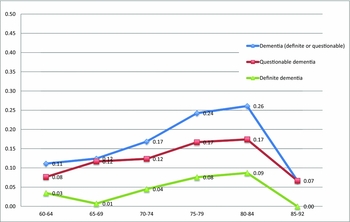
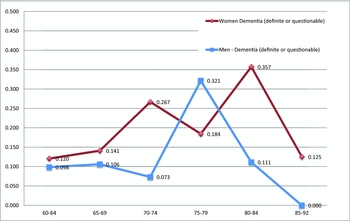
The overall prevalence of dementia was 0.151; questionable dementia was 0.115, and definite dementia was 0.036. The overall dementia prevalence for men was 0.123 and for women 0.174. There was a slight increase in dementia with increasing age until age of 84 years, and a sharp decline in the oldest-old (age 85–92; Figure 1). The lower dementia prevalence in men was mostly evident in the older age categories, (80+ years; Figure 2).
Prevalence of definite and questionable dementia by age

Prevalence of dementia according to age and sex

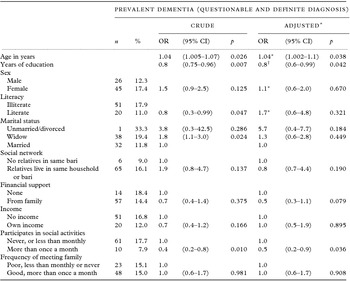
Although women had slightly higher prevalence of dementia, the difference was not statistically significant between sexes (Table 2). Increased age and lower education were associated with increased odds of dementia after adjustment for covariates, even literacy. Although being literate was associated with lower crude odds of having dementia, the association lost significance after adjustment for education.
Association between sociodemographic variables and social factors with dementia prevalence

*Adjusted for age, sex and education.
†Adjusted for age, sex and literacy.
Being widowed was associated with a 1.8 greater odds of dementia compared to being married, but this association lost significance after adjustment for socio-demographics. Persons who participated at least monthly in social activities had 0.4 lower odds of dementia compared to people who never or rarely participated, even after adjustment.
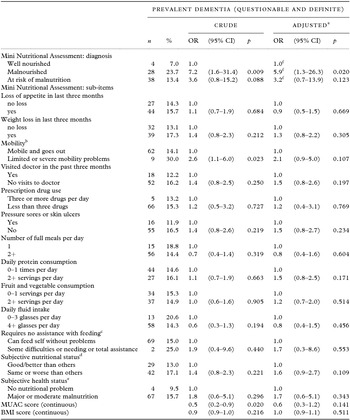
Table 3 shows the association between nutritional factors and dementia. People with a high MUAC score had lower odds of dementia, and limited or severe mobility problems were associated with dementia, but both these factors lost significance after covariate adjustment. Almost a quarter of malnourished persons had dementia, compared to only 7% of well-nourished people, corresponding to a seven times higher odds of dementia, even after adjustment. As MNA diagnosis includes cognition, we adjusted for BAMSE score, and the results remained significant.
Association between nutritional factors dementia prevalence: crude and adjusted logistic regression

aAdjusted for age, sex, and education.
bCompletely mobile, compared to being bed or chair bound or being able to get out of bed or chair but does not go out.
cRequires no assistance with feeding versus having some difficulties or needing total assistance.
dNo nutritional problem versus major or moderate malnutrition.
eCompared to people of same age. Good or better than others, compared to same or worse.
fAdjusted also for cognition (BAMSE score).
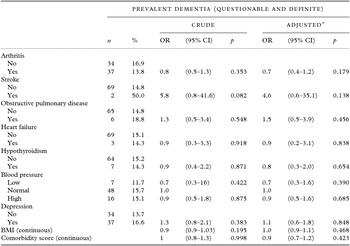
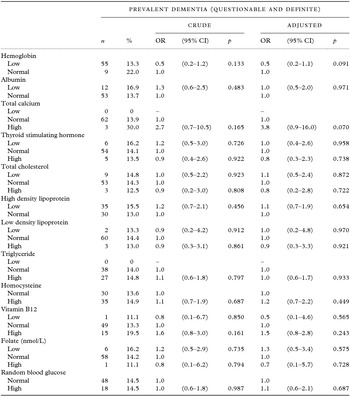
There were no associations between somatic disorders or laboratory values and dementia prevalence (Tables 4 and 5) However, stroke had a tendency to be associated with dementia but because of low numbers (n = 2 dementia cases with stroke) the ORs were not statistically significant (crude OR = 5.8 (0.8–41.6), p = 0.082; adjusted OR = 4.6 (0.6–35.1), p = 0.138).
Association between somatic disorders and dementia prevalence: crude and adjusted logistic regression analyses

*Adjusted for age, sex, and education.
Association between laboratory values and dementia prevalence: crude and adjusted logistic regression analyses

*Adjusted for age, sex, and education.
Discussion
We found an overall prevalence of questionable and definite dementia of 11.5% and 3.6% respectively in persons aged 60+ years living in rural Bangladesh. Dementia prevalence increased with increasing age and was associated with lower education, being malnourished, and infrequent participation in social activities.
The definite dementia prevalence rate of 3.6% is similar to reports in comparable populations, including semi-urban Sri Lanka (de Silva et al., Reference de Silva, Gunatilake and Smith2003), and south India (Mathuranth et al., Reference Mathuranath2010), but slightly lower than the reported standardized prevalence of 5.65% for South Asian countries (Prince et al., Reference Prince2013), and lower than worldwide rates (5%–7% in most world regions; Prince et al., Reference Prince2013). Our overall prevalence estimations might be biased by the age distribution of our sample; only 12% were 75+ years, since life expectancy in Bangladesh at that time was 64 years.
Selective survival may explain our results; persons in this rural, low-income setting may die earlier, particularly of disorders that might increase dementia risk. Therefore, those who live up to 60+ years may be selectively healthy and less likely to develop dementia. Further, the prevalence rates dropped dramatically in the oldest age group of 85+ years, where there were only 15 dementia cases, possibly due to low numbers of men at this age. Therefore, the prevalence estimates may be underpowered, and the estimates for the oldest-old should be viewed with caution.
There was no association between sex and dementia, in line with results from rural India (Chandra et al., Reference Chandra, Ganguli, Pandav, Johnston, Belle and DeKosky1998), although most studies in both high-income and low-income countries report higher dementia prevalence among women. Our sample had a lower proportion of women than studies in high-income settings. Women with dementia might have a shorter survival than men in this setting, which would reduce prevalence rates among women, and dilute potential sex differences. The overall life expectancy of women, compared to men, in Bangladesh is indeed lower than in high-income countries (Dhillon et al., Reference Dhillon2011).
Malnourished persons had a seven times higher odds of dementia than those who were well nourished. Weight loss is common in the early phases of dementia, both preceding diagnosis and during disease progression (Atti et al., Reference Atti, Palmer, Volpato, Winblad, De Ronchi and Fratiglioni2008). Some specific dietary factors have previously been shown to be associated with dementia in other low-income settings (Albanese et al., Reference Albanese2009; Tripathi et al., 2013), but presently there is insufficient evidence to confirm the role of malnutrition and nutritional factors on dementia. More research on this topic is warranted, especially since nutritional deficiency is an issue of particular importance in low-income countries, where the prevalence of nutritional deficiencies among home-dwelling elderly is greater than in high-income settings (FAO, 1999). It is also important to consider reversible dementias when interpreting the association between malnutrition and dementia diagnosis. Reversible dementia is a type of dementia that might be treatable and possibly cured, due to, for example, dietary deficiency or vitamin B12 deficiency. However, vitamin B12 deficiency and low BMI have also been shown to increase the risk of developing non-reversible dementia disorders such as Alzheimer's disease (Atti et al., Reference Atti, Palmer, Volpato, Winblad, De Ronchi and Fratiglioni2008; O’Leary et al., Reference O’Leary, Allman-Farinelli and Samman2012). Therefore, it is imperative that future studies investigate further our finding that malnutrition is associated with dementia in low-income settings. Longitudinal studies designed to assess any changes in dementia diagnosis over time would help clarify the role of malnutrition in dementia, and examine whether malnutrition is an independent risk factor, and to what extent dementia is reversible after dietary intervention.
Persons who participated frequently in social activities had lower odds of dementia than people who never or rarely participated in social activities. This supports previous findings from Northern India that cognitively stimulating activities and socialization protect against dementia (Tripathi et al., Reference Tripathi2012). Social engagement may decline as a result of the dementia disorder itself, due to loss of cognitive functioning and mobility, or conversely, low engagement in social activities may be an independent risk factor for future cognitive decline (Ghisletta et al., Reference Ghisletta, Bickel and Lövdén2006). As our study is cross-sectional it is not possible to investigate the casual direction of our findings. Interestingly, we found no association between dementia and social support or family contact. However, there are cultural factors to consider before drawing firm conclusions. Most older people in Bangladesh live in close proximity to family members; in our sample, more than three quarters lived in the same household or bari with family members. Social contact usually occurs daily, and few older people are isolated or live alone like in some high-income countries. Therefore, in our sample, there may be too few people living without close family contact to examine the association of such factors on dementia occurrence.
Somatic disorders and clinical blood measures were not associated with dementia prevalence, in contrast to findings from Northern India showing higher dementia risk associated with diabetes, depression, hyperhomocysteinemia, hyperlipidemia, and BMI (Tripathi et al., Reference Tripathi2012).
Although numerous somatic disorders have been reported to be associated with a higher dementia prevalence in other settings, for several risk factors results have been inconsistent and longitudinal studies are needed. The prevalence of somatic disorders was low in our sample, which may be due to short survival in persons with acute and chronic disease in this setting. If the underlying distribution of risk factors in our population is different from other populations, this may lead to differences in reported associations between such factors and dementia prevalence. Until now, most research into somatic factors has been conducted mainly in high-income counties. Our findings that none of the somatic diagnoses or blood indicators were related to dementia prevalence is of interest. However, due to demographic development that could change the patterns of selective survival, such associations may appear in future rural Bangladeshi cohorts.
Some study limitations deserve mention. First, as the study was cross-sectional we cannot determine the causal direction of the associations between dementia and age, education, social activities, and malnourishment. It is plausible that dementia might in turn cause both malnourishment and decline in social participation, although some studies have reported that reduced social activities may be a risk factor for future dementia development, but evidence is limited. Second, we examined the dementia syndrome rather than specific aetiologies such as Alzheimer's disease. Yet, this is the first study to report dementia prevalence data in Bangladesh, and our findings provide an overall picture of the potential burden of dementing disorders in general in this region. Due to the issues of collecting data in rural, low-income settings, somatic disorders may be underestimated because the diagnoses relied on symptomatic evaluation and self-report. Hospital records are not available and access to medical care is limited in rural Bangladesh. Still, we tried to provide a comprehensive somatic assessment by physicians, and took blood tests to support the evaluations.
The strengths of our study include that it was population-based, and included a detailed clinical examination and a thorough two-step dementia diagnostic procedure. Our results provide new insights into an aging population of rural Bangladesh, and highlights interesting avenues for future research, particularly, longitudinal studies on the incidence of dementia and specific subtypes in low-income countries to establish potential causal relationships. Further, as the life-expectancy of low-income settings is set to increase dramatically in coming years, it is important to conduct further studies on the oldest-old ages in these settings, particularly those aged 80+ years.
In conclusion, dementia prevalence in rural Bangladesh is slightly lower than most other countries, but in line with other countries in South Asia. Dementia increases with age and lower education. Our finding that malnourishment was associated with higher dementia prevalence needs to be investigated further, to establish what role nutritional factors may have on dementia occurrence in low-income settings.
Conflict of interest
None.
Description of authors’ roles
Katie Palmer designed the study, performed the statistical analysis, and wrote the paper. Zarina N. Kabir was involved with the study design, data collection, and assisted with writing the article. Tanvir Ahmed was involved in the data collection and study design, and reviewing of the article. Jena D. Hamadani was involved in the data collection and study design, and reviewing of the article. Christel Cornelius was involved in the data collection and study design, and reviewing of the article. Miia Kivipelto was involved in the data collection and study design, and reviewing of the article. Åke Wahlin was involved with the study design, data collection, statistical analysis, and assisted with writing the article.
Acknowledgments
The PHA study was supported by grants from the Department for International Development, UK to the ICDDR,B: Centre for Population and Health Research, and from the Swedish Medical Research Council and the Swedish International Development Agency to ICDDR,B and the Karolinska Institutet. Åke Wahlin was funded by a grant from the Swedish Council for Research in the Humanities and Social Sciences (Grant 2011–1621). Miia Kivipelto was funded by Academy of Finland (Grant 120676).