“Disasters are no longer minor or chance occurrences, but each year they are more widespread, more devastating, [and] more demanding of the harmonious assistance of [multiple] agencies…The problem of harmonizing forces prior to disaster is worthy of our best efforts.” 1 As illustrated by this quotation from 1930, community-wide preparedness for natural and manmade health incidents has long been recognized as a national public health priority.Reference Sargent 2 Partly as a result of the 9/11 terrorist and anthrax attacks, attention turned to ensuring that diverse components of the health care system—in conjunction with and aided by community-based responders—can carry out critical roles and responsibilities when preparing for and responding to catastrophic events. In 2002, the US Congress authorized the US Department of Health and Human Services to establish the National Bioterrorism Hospital Preparedness Program, now known as the Hospital Preparedness Program (HPP), to improve national health security. 3 Numerous health care coalitions (HCCs) predated the formation of the HPP, and others were formed or evolved as a consequence of grant requirements for coordination, enhanced communication, and disaster planning, among other functions. While HPP funding has focused on the specific medical and public health roles that these coalitions play, it is important to note that they in turn rely on multiple nonmedical, community-based functions (eg, fuel resupply, logistics, and public transportation) that are not specifically supported by this funding mechanism. Indelible images from recent disasters, such as lines of motorists waiting for fuel to commute to storm-hit areas after Superstorm Sandy, have highlighted the need for whole-community, end-to-end planning for health emergencies. After reviewing the current state of HCC organization and function in the United States, we introduce a pair of conceptual frameworks that may help HCC leaders identify targets for optimization in pre-emergency planning, response, and recovery. In practice (eg, due to funding constraints), HCCs may not be able to apply all of the points covered here, but that should not diminish their importance for stimulating thinking (and furthermore, HCCs may discover new ones in the process of implementing them). The purpose of this paper is to provide a theoretical basis for directing progress toward strategies and/or practices that enhance HCC function. To that end, we list a brief research agenda, which poses questions for HCCs to consider.
Characteristics of US Health Care Coalitions
The majority of the continental United States falls within the boundaries of an HCC, but there are small regions of Iowa and Alaska that currently lack coverage (HPP, Office of Emergency Management, Office of the Assistant Secretary for Preparedness and Response, unpublished presentation). Federal guidance gives HCCs leeway in delineating their geographic boundaries, although the HPP does suggest that HCCs consider local geopolitical boundaries, natural barriers, and specific aspects relevant to their member organizations. 4 As an example, rural HCCs may take into account the significant distance that exists between some health care facilities, which can be up to 150 miles in some instances.Reference McCulley 5 In general, many HCCs follow county lines and there are multiple coalitions in each state. However, 6 states (Delaware, Mississippi, Hawaii, Montana, North Dakota, and Rhode Island) have established statewide coalitions. Other states, such as Arizona, Louisiana, and Wisconsin, have statewide coalitions in addition to multiple county-level ones. At the other end of the size spectrum, in New England, some coalitions operate at the township level (HPP, Office of Emergency Management, Office of the Assistant Secretary for Preparedness and Response, unpublished presentation). Allowing HCCs to assign themselves in their respective states results in boundaries that make sense for local communities; in Texas, HCC boundaries correspond to those of trauma service areas, which were already well established at the time the HCCs were created. 6 Alternatively, the lack of a standard method to define coalition boundaries limits the ability to compare functionality and activities across them. This issue is complicated by the substantial differences in the size of populations covered by individual HCCs. In California, for example, HCC population size ranges from roughly 1200 in Alpine County to more than 9.8 million in Los Angeles County (HPP, Office of Emergency Management, Office of the Assistant Secretary for Preparedness and Response, unpublished presentation).
Given the large differences in geographic distribution and population, it is not surprising that HCC organization exhibits considerable variability. HCC governance and leadership structures often align with local conditions that may be unique to each state and region. Accordingly, they may be governed by state or local public health departments, nonprofits, hospital associations, or leading regional health facilities or systems (HPP, Office of Emergency Management, Office of the Assistant Secretary for Preparedness and Response, unpublished presentation). Three categories used to describe structure types are (1) quasi-governmental, (2) private sector, and (3) stand-alone models. In the quasi-governmental model, the HCC is led by government organizations (eg, local or state health departments), whereas in the private sector model, the HCC is administered by existing private-sector organizations (eg, hospitals). Typically, funding and staffing for quasi-governmental and private sector HCCs are generated and managed by the host government agency and organization, respectively. Stand-alone models establish their own independent legal entity and function as a business or foundation with the leader and their executive board directing coalition activities (HPP, Office of Emergency Management, Office of the Assistant Secretary for Preparedness and Response, unpublished presentation). Leadership of HCCs may include staff from state or local government, senior management from nonprofits or associations, regional emergency managers, safety officers, or emergency department clinicians (HPP, Office of Emergency Management, Office of the Assistant Secretary for Preparedness and Response, unpublished presentation).
The people heading these diverse organizations share a common goal of promoting community and regional partnerships between clinical and nonclinical entities to enhance community resilience.Reference Walsh, Craddock and Gulley 7 In fact, over 90% of coalitions engage in exercises that bridge clinical and nonclinical partners.Reference Rambhia, Waldhorn and Selck 8 Exercises are, however, only one feature of the full cycle of preparedness and response activities. In an emergency, HCCs may be responsible for carrying out feats of prodigious logistical complexity (eg, coordination of patient transport, matériel movement, and care provision all in an environment that prioritizes safety and accurate tracking of people and things). We believe that HCCs may gain insight into how to optimize their emergency operations by considering other, non-health-related organizations that exhibit multiple layers of complexity and yet exist to achieve clearly defined, high-profile goals. In the next section, we describe 2 alternative (but complementary) frameworks that may help leaders better understand how to optimize specific HCC functions. One is based on supply chain management, and the other is grounded in the principles of high-reliability organizations (HROs). Our goal is to provide HCC leaders and health preparedness policy makers with a better understanding of coalition features that can be instrumental in accomplishing their unique and crucial objectives.
Conceptual Frameworks for Optimizing HCC Operations
In 2012 the HPP focus changed from supporting hospitals and facility-based equipment purchases to a more inclusive vision of community-based partnerships among multiple health care service providers (public and private sector partners) collectively working to build capabilities. The Office of the Assistant Secretary for Preparedness and Response (ASPR) identified the following 8 health care preparedness capabilities to guide HCC efforts: health care system preparedness, health care system recovery, emergency operations coordination, fatality management, information sharing, medical surge, responder safety and health, and volunteer management. 4 The capabilities represent a high-level conceptual map of emergency preparedness domains, not necessarily a “how to” guide for attaining competency or excellence in a particular task; for example, stating that an HCC needs to provide “medical surge” is not the same as providing leadership with detailed guidance on how to achieve that goal. What may help to optimize the function of HCCs, therefore, are functional frameworks to ensure that effective infrastructure, systems, and processes are in place when and where they are needed for both effective quotidian health care delivery and emergency response.
Among the many potential ways to characterize key features of effective HCCs, we believe there is particular value in developing analogies to modern industrial supply chainsReference Hupert, Muckstadt and Xiong 9 and HROs,Reference Sutcliffe 10 two relatively well-studied industrial systems. Akin to HCCs, supply chains and HROs are complex systems (for example, exhibiting self-organization and resilience) with minimal tolerance for failure. Therefore, principles that make these 2 systems successful may translate to health care settings. Of course, there are obvious ways in which voluntary, lightly funded HCCs may be quite unlike these exemplars of system integration and goal-oriented activity. Comparing a voluntary HCC to, for example, a multinational company focused on customer demand fulfillment will not be fair if the point is to highlight the HCC’s infrastructure or governance structure. On the other hand, we assert that certain elements that underlie such developed enterprises are of great importance for improving HCCs. Both supply chains and HROs rely heavily on collaboration and involve complex processes to meet the demands of an end consumer. In the case of supply chains, collaboration occurs between firms in order to design, engineer, market, manufacture, and distribute products or services. Similarly, HROs involve teams that are organized around goal-oriented transactive responsibility systems, ones that encourage mutual monitoring and the sharing of responsibilities,Reference Xiao, Plasters and Seagull 11 to promote cooperation among members.
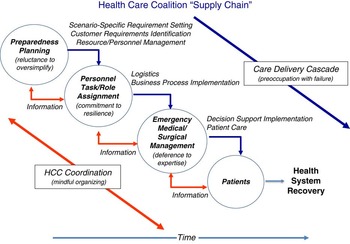
The analogy to supply chains gains traction once we better characterize what is “supplied” by HCCs. HCCs may be seen as entities that provide medical and other health care services (“products”) to patients in covered communities (“customers”), as well as to other hospitals or health care institutions that comprise the coalition (also “customers”) using facilities, personnel, supplies, logistics, and expertise (“resources”). This “care delivery cascade” needs to be capable of operating under both normal and extreme conditions. If the analogy holds, then HCCs can be decomposed into their component functions to determine if they actually retain the underlying system components necessary for sustaining their required performance. This infrastructure, which we may call a preparedness system architecture,Reference Altan and Kemper 12 has parallels with the following well-described 5 key features and capabilities of modern supply chainsReference Muckstadt, Murray, Rappold and Collins 13 :
-
1. A rich understanding of customer requirements. In a health care setting this includes detailed, condition-specific knowledge of resource requirements for providing acceptable levels of care for anticipated casualties of various types from a variety of high-consequence scenarios.
-
2. Well-developed resource management systems. These should be characterized by accurate supply and demand assessment, short turnaround times, and reliable transportation logistics.
-
3. Tightly coupled information systems. These should provide HCC leadership with real-time views of demand (eg, casualty load), supply (eg, capacity and inventories), and operational readiness in and across organizations comprising the HCC.
-
4. Tightly coupled business processes. These should enable the flexible and timely flow of patients, providers, and resources between HCC partners.
-
5. Tightly coupled decision support systems. These promote effective use of existing supply chain systems and permit rapid, adaptive response to unexpected or overwhelming events.
Individual health care organizations would likely utilize some or all of these 5 components of supply chain systems on a daily basis; the challenge for HCCs is to apply them to the larger demands they face across institutions in order to promote a fully functioning coalition-based preparedness system. One advantage of adopting this framework is that it divides this larger preparedness and response task into readily addressable elements. For example, coalition leaders and members may develop mutually agreed-upon scenarios that define the care and resource needs of potential patients and facilities involved in a disaster (ie, their “customers”). Further, leaders may attempt to test whether their information management, business process, and decision support systems can function properly during an emergency and whether they provide the right information to the right person in the right time frame for a successful response. As Young and Peterson have argued, emergency management logistics must become emergency supply chain management because the latter embraces many more participants who share in a greater quantity of information about resources in need of deployment.Reference Young and Peterson 14 By applying an external operationally oriented perspective, like that of supply chain management, to the ASPR capabilities, HCC leaders can better align existing systems to accomplish their coalition’s goals.
Successful HCCs are likely to have the aforementioned systems in place to carry out their unique mission, but simply implementing these systems may not be sufficient for optimal functioning; effective, community-responsive leadership is also key. Leaders are essential for the success of any system, especially when people are called upon to operate in challenging conditions, including public health emergencies and disasters. A paradigm that may be particularly useful for gaining insight into this aspect of HCC leadership is HRO theory. HROs are a subset of complex socio-technical systems, such as aircraft carriers, that operate nearly error-free for sustained time periods.Reference Roberts 15 HRO theory explains that reliability and safety are achievable through human processes and relationships,Reference Sutcliffe 10 especially effective teamwork.Reference Baker, Day and Salas 16 There is a fair amount of literature on its application to health care organizations, which has come to include studies of organizations that do not have command and control over their technical core. 17 By exposing attributes and organizational processes that contribute to error-free performance in dynamic contexts, HRO theory can provide a template by which to understand how safe and dependable performance can be achieved under problematic health care conditions.Reference Sutcliffe 10 Several principles that underlie the success of HROs and that could be adopted by leadership in HCCs are mindful organizing, preoccupation with failure, reluctance to oversimplify, commitment to resilience, and deference to expertise.Reference Sutcliffe 10 In the following section, we explicate how each of these principles may be applied to HCC operations.
Mindful Organizing
HROs embrace the concept of mindful organizing, which depends on the continuous interaction of individuals as they develop, refine, and update a shared perception of the situation they face and their capabilities to act on that common understanding.Reference Sutcliffe 10 In a care setting, this translates into having a rich awareness of both customer and staff requirements in a dynamic, ongoing manner. In this way, mindfulness can be seen as the leadership analog to the first supply chain principle listed above, specifically, that of knowing the needs of your customer (eg, each HCC member’s organization).
Preoccupation With Failure
Preoccupation with failure can promote well-developed resource management systems because it entails imagining potential system breakdowns and raising awareness of small issues that can lead to larger ones, which would likely result in patient harm. Prasanna and Nagy clearly portray this through an example in which ample numbers of rolling stretchers designed for patient transport become useless when they have stuck wheels.Reference Prasanna and Nagy 18 The distinction here between stretchers and functional stretchers can be generalized to any important medical resource in a disaster. To elaborate, supplies can be considered “available” only if they are where they are needed, in the quantity that is needed, under conditions (eg, environmental, operator-dependent) that render them functional. This HRO notion has corollaries in the supply chain concept described above, because an emergency is the worst time for HCCs to uncover and rectify details of weak resource sharing and management systems.
Reluctance to Oversimplify
There is also a clear supply chain analogue for the HRO notion of reluctance to oversimplify. This is mirrored directly in the cross-cutting requirement that systems be tightly coupled. Information, resource management, business process, and decision support systems that are tightly coupled have 3 critical elements. They provide key actors with real-time or near real-time information (ie, hourly instead of daily bed capacity information for situations that are changing approximately every 60 minutes) in a format that is understandable and actionable (ie, resource requests that conform to standard distributor-managed shipping specifications). This occurs in a context of collaborative decision-making in which both or multiple parties have a preexisting familiarity with what likely next steps are going to be based on meetings, exercises, playbooks, etc. Reluctance to oversimplify in the context of health preparedness means unpacking key concepts like “medical surge” into its component functional parts and then going a step further to ensure that the processes that support those functions are fit for the tasks demanded of them.
Commitment to Resilience
The HRO notion of commitment to resilience has increasing relevance to preparedness efforts, because HCCs are an example of organizations that must demonstrate resilience in the face of both daily perturbations and rare large-scale disruptions. To help clarify how organizations may accomplish this task, Vugrin et al have developed a resilience analysis framework, specifying (1) absorptive capacity, (2) adaptive behavior to accomplish core missions, and (3) restorative capability to reestablish normal functioning after disruptive events.Reference Vugrin, Warren and Ehlen 19 Adopting this tripartite perspective may help HCC leaders manage both internal failures as well as external pressures. As Ruchlin et al note, minimizing future errors rather than avoiding them is the main goal in health care because it is impossible to anticipate everything that can go wrong.Reference Ruchlin, Dubbs and Callahan 20
Deference to Expertise
Finally, deference to expertise in the context of HCCs has many implications, chief among them that one of the first steps to building an optimally functioning coalition is to find the experts in charge of diverse operations at each member facility. These individuals, who may have “day jobs” in non-patient-care positions, such as purchasing and matériel management, can provide insight into how processes may operate under duress and should have a seat at the management table in both normal and emergency situations. In such a management system, hierarchical rank becomes subordinate to expertise.Reference Sutcliffe 10
To illustrate several of the components of the frameworks just described (Figure 1), we note below how they may be applied to the 2013 Boston Marathon bombings response. This case demonstrates a number of features from all of the frameworks mentioned above, from the ASPR capability of information sharing to the supply chain element of tightly coupled information systems and the HRO principle of reluctance to oversimplify. Due to the difficulty of gleaning objective data from acute unscheduled events, it is not always feasible to measure the real-life implementation of these elements in the suggested frameworks. In particular, it is difficult to obtain information on overwhelming events (eg, the response to the 2012 Tohoku, Japan earthquake) because of the lack of recorded detail. For this reason, using the reports of high-profile or well-managed incidents like the Boston Marathon bombing response as scenarios for exercises and planning may help HCCs identify and address potential vulnerabilities before they become operationally relevant.
Theoretical Representation of Health Care Coalition Supply Chain Framework With Associated High-Reliability Organization (HRO) Principles. (Adapted, with permission, from reference 13)

Case Example: 2013 Boston Marathon Bombing Response
The 2013 Boston Marathon bombing response demonstrated almost instantaneous, effective HCC functioning across multiple member organizations. Although there were 3 on-site fatalities, none of the 264 casualties transported to surrounding medical facilities died. 21 The involved facilities had practiced for such an eventReference Biddinger 22 in 2 coalition-wide, full-day exercises in the year before the bombing. These exercises appear to have laid the groundwork for the widely lauded speed and appropriateness with which casualties were transported and triaged at area hospitals. However, the actual event highlighted remaining process-oriented limitations in response capability. For example, certain emergency department (ED) information systems were possibly an area of weakness that could be targeted in future optimization efforts for HCCs. The challenges and opportunities associated with this shortcoming are described by Landman et alReference Landman, Teich and Pruitt 23 and are a good example of the HRO principle of reluctance to oversimplify, because the issues identified were highly detailed and practical but vital to rapid patient movement and care. In particular, the process of registering and tracking multiple trauma patients with a unique medical record number and a temporary (unidentified) patient name on an ED tracking board turned out to be suboptimal in the setting of a mass trauma. In this case, the charge and triage nurses who would normally be updating the data on the board were involved in directing patient care, organizing care teams, and building capacity within the ED. Consequently, all patient locations on the tracking board remained in the check-in column, and most patients remained unidentified. Because most of the marathon patients were initially registered as unidentified, it was challenging to distinguish and identify patients with the labels in the system appearing similar.
Overall, the Boston Marathon bombing response illustrates how complex achieving the ASPR health care preparedness capability of information sharing turns out to be in practice. The value of maintaining tightly coupled information systems decreases as the information in the system becomes less accurate. In this case, a technical detail of the registration process, namely, a requirement for human input in a setting in which all staff were otherwise occupied with patient care, made the information in the system less useful than it may have been had this potential roadblock been identified before the event occurred. It was a relatively minor but significant aspect of the overall response, which was widely praised as being remarkably rapid, effective, and successful. In the future, however, HCCs may be able to use the supply chain framework and HRO theory principles in a way that enables them to spot potential vulnerabilities and pinpoint opportunities for optimizing systems before a mass casualty incident or other emergency occurs.
Implementation
HCC leaders are now armed with 3 approaches to optimizing HCCs: targeting building diverse capabilities posed by ASPR, establishing organization-wide operational integration, and fostering practices that help ensure high reliability. As a result, HCC leaders now have multiple means of conceptualizing how to attain community-wide emergency preparedness and response that begins with “customer requirements,” that takes into consideration operational assets and limitations, and that aims to produce predictable, high-quality outcomes even in environments that necessitate constant adaptation. One certainty of emergency situations is uncertainty. Thus, any systematic approach to understanding the components of existing operational systems—including their strengths and weaknesses—that helps to reduce the negative impact of the unforeseeable on outcomes is likely to provide benefit.
Limitations
Of the 3 approaches that we have presented for optimizing the operation of HCCs, only one (the ASPR capabilities) has been the subject of widespread exercise and testing. The supply chain and HRO frameworks are the type of conceptual models that could inform both leadership thinking and the structure of coalition-wide drills and analyses (eg, determining the lag time of new information through a response system). Unfortunately, there is no track record yet to determine how fruitful they are for helping HCC leadership to identify and optimize components of their coalition activities. More generally, there is no uniform set of practices that specifically target in a systemic way the various components of what we have labeled the “preparedness system architecture.” Further, there are few, if any, tools to assess the integration of capabilities of individual entities into coalition-wide treatment capacity.Reference Dichter, Kanter and Dries 24 This task is made difficult by the variability in HCC size, geographic boundaries, and governance structures, but it is nevertheless essential for understanding both the coalitions themselves and the regional and state health care systems in which they operate. This is one reason some commentators have found health care delivery to be a context in which HRO concepts do not apply as well.Reference Chassin and Loeb 25
Finally, it is critical to remember that all HCC activity occurs within the setting of specific communities with their own response capabilities and requirements. As has been widely seen in US disasters over the last decade (including but not limited to Hurricanes Katrina, Rita, and Sandy; wildfires; tornadoes; floods; and winter storms), health facilities have an extremely limited ability to “go it alone.” Integrating community-based capabilities into HCC planning is therefore an invaluable and increasingly prioritized component of health security.
A Research Agenda for Health Care Coalition Optimization
We described 3 frameworks for conceptualizing HCC operations, 2 of which (supply chain and HRO) may assist HCC leaders and health preparedness policy makers develop new perspectives on the activities of HCCs that complement the well-known capabilities promoted by ASPR over the last decade. These frameworks also provide a direction for the next generation of research on the structure and function of HCCs, including the following questions:
-
1. How is HCC preparedness planning conducted now, especially with regard to the integration of community-based capabilities into response frameworks?
-
2. Is there a relationship between the structure of an HCC (its size, organizational structure, etc) and its functional capabilities, such as its ability to build and sustain tightly coupled information, business, and decision support systems?
-
3. What is the leadership structure of HCCs generally, and what efforts, if any, are being used to integrate leadership training into their activities?
-
4. How do transactional elements (resource sharing, decision-making, etc) among member organizations affect (positively or negatively) the ability of HCCs to emulate HROs?
-
5. Are there valid and replicable ways of measuring success in implementing supply chain management and high-reliability principles?
-
6. What other frameworks are HCCs incorporating into their operations, and is there a systematic way to develop an ontology (as used in information science to describe types, properties, and relationships between entities) of HCCs?
These questions should be seen as a starting point for a robust, practically oriented research agenda that will help HCCs continue to develop their preparedness efforts.
Conclusion
HCCs are currently seen as an integral component of the nation’s health care response system and have been promoted by ASPR as an evolution of preparedness activities to better safeguard the nation’s communities. These coalitions now exhibit a wide range of organizational types, coverage, and size. In an effort to address how their diverse activities can be optimized in a systematic way, we suggest 2 frameworks that have been adopted separately by similar entities to enhance their operations. These may be valuable for HCC leaders to consider as they design strategies to improve the patient care they provide on a daily basis and during emergencies.
Disclaimer
The findings and conclusions in this report are those of the authors and do not necessarily represent the views of the Department of Health and Human Services or its components.