Introduction
Attention deficit hyperactivity disorder (ADHD) is a multifaceted neurodevelopmental disorder not only associated with deficits in attention, but also with problems in executive functioning and action control processes (Oosterlaan & Sergeant, Reference Oosterlaan and Sergeant1998; Randall et al. Reference Randall, Brocki and Kerns2009; Arnsten & Rubia, Reference Arnsten and Rubia2012; Ahmadi et al. Reference Ahmadi, Mohammadi, Araghi and Zarafshan2014; van Rooij et al. Reference van Rooij, Hartman, Mennes, Oosterlaan, Franke, Rommelse, Heslenfeld, Faraone, Buitelaar and Hoekstra2015; Stroux et al. Reference Stroux, Shushakova, Geburek-Höfer, Ohrmann, Rist and Pedersen2016). In fact, executive or cognitive control dysfunctions are so prominent in ADHD that it has been suggested to include them in the ADHD diagnostic category (Roberts et al. Reference Roberts, Milich and Fillmore2012). Likewise, behavioural and imaging studies exploring the Attention Network Theory hypothesized executive control impairment in ADHD (Berger & Posner, Reference Berger and Posner2000; King et al. Reference King, Colla, Brass, Heuser and von Cramon2007). More specifically, there is evidence that children with ADHD may have weaker interference control (Cornoldi et al. Reference Cornoldi, Marzocchi, Belotti, Caroli, Meo and Braga2002; Crone et al. Reference Crone, Jennings and van der Molen2003; Forster et al. Reference Forster, Robertson, Jennings, Asherson and Lavie2014) which should leave them more susceptible to any kind of interference. In other words, they should be largely unable to shield their task goals from any kind of interference and therefore not display a shielding/conflict ‘threshold’ which supports goal-directed behaviour in healthy individuals as long as the conflict load is not too high (Stock et al. Reference Stock, Friedrich and Beste2016). Given that interference control is pivotal to executive control (Posner & DiGirolamo, Reference Posner, DiGirolamo and Parasuraman1998), it is important to examine the determinants of cognitive (interference) control deficits in ADHD.
It is well-known that cognitive control processes are quite error-prone as they can often not be completely shielded from the effects of either consciously or subliminally processed distractors (Eimer & Schlaghecken, Reference Eimer and Schlaghecken2003; Ulrich et al. Reference Ulrich, Schröter, Leuthold and Birngruber2015). The fact that interfering stimulus input may induce errors even when not consciously perceived is evidenced by studies on the positive and negative compatibility effects (i.e. PCE and NCE) (McBride et al. Reference McBride, Boy, Husain and Sumner2012). Put briefly, these terms refer to the observation that short stimulus-onset asynchronies (SOAs) between a prime and target presentation (up to 100 ms) yield faster responses in case of compatible primes due to an initial activation of the primed response (PCE). In contrast, longer SOAs (between 150 and 200 ms) yield faster responses in case of incompatible primes due to a subsequent inhibition of the initially primed response tendency (NCE) (‘activation-followed-by-inhibition account’). Of note, it has been shown that subliminally and consciously induced conflicts interact and conjointly modulate volitionally controlled behaviour. Boy et al. (Reference Boy, Husain and Sumner2010) demonstrated this by combining a spatial flanker task with preceding masked subliminal primes. They showed that response conflicts induced by primes and flankers do not simply add up in their modulation of controlled behaviour (Boy et al. Reference Boy, Husain and Sumner2010). Instead, these two types of conflict potentiate their effects by aggravating incompatibility/incongruency effects in healthy young adult subjects once the respective other kind of conflict is present (see also Stock et al. Reference Stock, Friedrich and Beste2016). It is currently an open question whether there are similar interactive effects of subliminally and consciously induced conflicts on action control in ADHD.
We hypothesize that there are no such interactive effects in children with ADHD. The main reason for this assumption is a previously reported lack of inference control capacities (Cornoldi et al. Reference Cornoldi, Marzocchi, Belotti, Caroli, Meo and Braga2002; Crone et al. Reference Crone, Jennings and van der Molen2003; Forster et al. Reference Forster, Robertson, Jennings, Asherson and Lavie2014) which suggests that ADHD patients should be more susceptible to interference and thus be less able to shield their task goals. As a result, responses should become slower and/or more error-prone. Also, consciously perceived distractors are well-known to impair conflict monitoring functions in ADHD (Albrecht et al. Reference Albrecht, Brandeis, Uebel, Heinrich, Mueller, Hasselhorn, Steinhausen, Rothenberger and Banaschewski2008; McLoughlin et al. Reference McLoughlin, Albrecht, Banaschewski, Rothenberger, Brandeis, Asherson and Kuntsi2009; Senderecka et al. Reference Senderecka, Grabowska, Szewczyk, Gerc and Chmylak2012), but findings on the effects of subliminal stimuli on information processing in ADHD are still very inconsistent. While some results suggest that negative priming effects are evident in ADHD (Christiansen & Oades, Reference Christiansen and Oades2010), others have found no evidence of priming effects in ADHD (Pritchard et al. Reference Pritchard, Neumann and Rucklidge2007), or shown that priming effects depend on the ADHD subtype (Pritchard et al. Reference Pritchard, Neumann and Rucklidge2008). Based on all of these findings, we conclude that ADHD patients are unlikely to display the shielding threshold usually observed in healthy individuals (Boy et al. Reference Boy, Husain and Sumner2010; Stock et al. Reference Stock, Friedrich and Beste2016). If we found the threshold effect to be absent, it would indicate a fundamental difference in the architecture of cognitive control in ADHD patients as reflected by deficient shielding of task goals and the associated response selection processes, especially in the face of low conflict load.
Concerning the methodology, we decided to analyse two kinds of behavioural data (i.e. accuracy rates and response times) as a recent study has shown that only a combination of both measures allows to detect all condition and group differences (Stock et al. Reference Stock, Friedrich and Beste2016). We further decided to focus on the PCE even though the NCE has also previously been investigated in ADHD (Pritchard et al. Reference Pritchard, Neumann and Rucklidge2007, Reference Pritchard, Neumann and Rucklidge2008; Christiansen & Oades, Reference Christiansen and Oades2010). Our main reason for doing so was that the associated activation of prime-compatible response tendencies is subject to less temporal variability than the subsequent NCE (Kiesel et al. Reference Kiesel, Berner and Kunde2008; Schlaghecken et al. Reference Schlaghecken, Birak and Maylor2012). We deem this advantageous in a sample that is already characterized by strong inter- and intra-individual variability of cognitive processes (e.g. Saville et al. Reference Saville, Feige, Kluckert, Bender, Biscaldi, Berger, Fleischhaker, Henighausen and Klein2015). For the same reason (i.e. sample homogeneity), we also chose to strongly limit the age range of our sample and only recruit individuals aged 11–12 years. Controlling for age is important when investigating executive functioning and related processes as those heavily depend on prefrontal development and some of the associated cognitive faculties develop and change until the early twenties (Anderson et al. Reference Anderson, Anderson, Northam, Jacobs and Mikiewicz2002; Gogtay et al. Reference Gogtay, Giedd, Lusk, Hayashi, Greenstein, Vaituzis, Nugent, Herman, Clasen, Toga, Rapoport and Thompson2004; Spencer-Smith & Anderson, Reference Spencer-Smith and Anderson2009; Giedd et al. Reference Giedd, Raznahan, Lenroot, Stuss and Knight2013). Our study focuses on interference control/conflict monitoring, which is closely related to inhibition (Checa et al. Reference Checa, Castellanos, Abundis-Gutiérrez and Rosario Rueda2014; Chmielewski et al. Reference Chmielewski, Mückschel, Dippel and Beste2016). Inhibition has been found to typically stabilize by the early school years/between the ages of 8 and 13 years (Lehto et al. Reference Lehto, Juujärvi, Kooistra and Pulkkinen2003) so that it can be argued that the data obtained from 11- to 12-year-old ADHD patients should be very similar to the data one would expect to obtain in older adolescents and adults (but not necessarily in younger individuals).
We further chose to examine our study question in a system neurophysiological approach using EEG recordings to quantify event-related potentials (ERPs). With this approach, it is possible to dissociate several involved cognitive sub-processes ranging from attentional stimulus processing to response selection and to determine which cognitive sub-processes are most affected by the two kinds of conflict. When it comes to response conflicts, perceptual gating and attentional selection processes (as reflected by the P1 and N1 ERPs, Herrmann & Knight, Reference Herrmann and Knight2001) may show little to no effects, because they are not closely related to effects of cognitive conflict and interference monitoring. Instead, we expect impairments during conflict monitoring and response selection as these processing stages are pivotal to shielding the correct response from erroneous response tendencies evoked by any kind of distractor (Larson et al. Reference Larson, Clayson and Clawson2014, Reference Larson, Clayson, Keith, Hunt, Hedges, Nielsen and Call2016; Groom & Cragg, Reference Groom and Cragg2015). While conflict detection and monitoring (i.e. ‘the process of monitoring performance for simultaneously competing response options’ as induces by conscious and subliminal input, compare Larson et al. Reference Larson, Clayson and Clawson2014) are reflected by the central N2 ERP of the current/respective trial (Larson et al. Reference Larson, Clayson and Clawson2014), decision processes between stimulus evaluation and motor responding are reflected by the P3 ERP (e.g. Verleger et al. Reference Verleger, Jaśkowski and Wascher2005; Twomey et al. Reference Twomey, Murphy, Kelly and O'Connell2015). Several studies suggest that conflict between response alternatives is reflected by an enlarged N2 ERP (e.g. van Veen & Carter, Reference van Veen and Carter2002; Folstein & Van Petten, Reference Folstein and Van Petten2008; Larson et al. Reference Larson, Clayson and Clawson2014). This should result in larger N2 amplitudes in case of conflict (i.e. incongruent flankers and/or incompatible primes). Given that ADHD patients have been reported to show reduced conflict monitoring as reflected by the N2 (McLoughlin et al. Reference McLoughlin, Albrecht, Banaschewski, Rothenberger, Brandeis, Asherson and Kuntsi2009), we expect smaller N2 amplitudes and a potentially smaller effect of conflict on N2 amplitudes. For the P3, it has been suggested that its amplitude depends on the attentional resources left over by the primary task (Schubö et al. Reference Schubö, Meinecke and Schröger2001; Polich, Reference Polich2007). As larger amplitudes are thought to reflect free capacities needed for task-goal shielding and the selection of the correct response, we expect ADHD patients to either show smaller P3 amplitudes or to lack variation that is normally induced by task difficulty differences. Following the same logic, we would expect larger P3 amplitudes in the absence of conflict (i.e. in case on congruent flankers and/or compatible primes) as it should leave the subjects with greater residual free capacities. We however refrained from analysing lateralized readiness potentials (LRPs) as a previous study using the same experimental paradigm in healthy young adults showed that the N2 and P3 ERPs better reflect behavioral differences across experimental conditions and groups than the LRP (Stock et al. Reference Stock, Friedrich and Beste2016).
Materials and method
Participants
All subjects and their parents or legal guardians provided informed written consent according to the Declaration of Helsinki and the study was approved by the local ethics committee of the Medical Faculty of the TU Dresden.
Twenty-six children with ADHD according to ICD-10 criteria (age range 11–12 years) were recruited from our outpatient clinic. Four of them were excluded during data analyses due to low performance (accuracy below chance level) and/or poor EEG data quality so that 22 patients (11.38 ± 1.6 years, two females) remained in the sample. Fourteen of them were taking medication (methylphenidate, methylphetamine, atomoxetine); but all of them were instructed to stop take medication at least 48 h prior to the start of the experiment, as done in previous studies (Bluschke et al. Reference Bluschke, Broschwitz, Kohl, Roessner and Beste2016a –Reference Bluschke, Roessner and Beste c ). Standard clinical procedures (including parent and child interview, teacher report, symptom questionnaires, IQ testing, exclusion of potential underlying somatic disorders via EEG, EKG, audiometry and vision testing) were used to confirm the ADHD diagnosis. Patients were included in the study when they satisfied the diagnostic criteria of the German ADHD rating scale by the ‘Fragebogen zur Beurteilung der Behandlung’ (FBB). This diagnostic checklist rated (>1.5 = severe problems) the children with regards to inattention (1.7 ± 0.77), hyperactivity (0.79 ± 0.66) and impulsivity (1.26 ± 0.66), thus confirming that recruited children had attention-related problems. General intelligence was estimated using the ‘Hamburg-Wechsler-Intelligenztest für Kinder’ (HAWIK) (IQADHD = 102.76 ± 11.7).
Twenty-six age-matched healthy children participated as controls. One of them had to be excluded due to poor EEG data quality. Hence, 25 controls (11.45 ± 1.5 years, seven females) were entered into analyses. Given that the two groups differed in the number of included females, the supplementary data contains additional analyses of the behavioural data after excluding all females from the sample.
Task
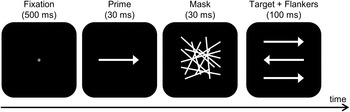
The task used in this study was based on an experimental paradigm by Boy et al. (Reference Boy, Husain and Sumner2010) and designed to evoke a PCE. The combination of a target stimulus with a subconscious prime as well as with consciously perceived flankers allows the investigation of both subliminally and consciously triggered response conflicts and their effects on response selection. All participants were seated in front of a 17-inch CRT computer monitor in a dimly lit, sound-attenuated room. The participants were instructed to respond by pressing the two Ctrl buttons on a regular keyboard placed in front of them. All participants performed a supervised task exercise immediately before the start of the experiment. A white fixation cross in the centre of the black background was presented at the start of each trial for 100 ms (see Fig. 1). Following the white fixation cross, a prime (a central white arrow pointing either left or right) was presented for 30 ms. Immediately after the prime, a central mask (an array of randomly distributed white lines) was presented for 30 ms to produce a SOA of 60 ms between prime and target onset. Following the central mask, the target (a central white arrow pointing either left or right) and two flankers (white arrows located above and below the target) were presented for 100 ms. Participants were asked to respond by pressing the left Ctrl key with their left index finger to indicate the pointing direction of the central target arrow in case the target pointed right. When the target pointed right, participants were asked to respond by pressing the right Ctrl key with the right index finger. Each trial was finished either with the first given response or 2000 ms after the onset of the target (in case no responses were given). The response stimulus interval between the participant's first response and the onset of the following trial randomly varied between 1000 and 1200 ms.
Each trial began with a 500-ms presentation of a fixation cross, followed by a 30-ms presentation of a prime (pointing either left or right). Directly thereafter, a mask was presented for another 30 ms before the target (middle arrow) and two flankers were presented for 100 ms. Afterwards, the screen went black until the participants indicated the target direction by pressing either the left or right Ctrl key on a keyboard or 2000 ms had elapsed.

In case the prime and target arrows pointed into the same direction, the trial was rated as compatible (and rated as incompatible in case of opposing pointing directions). Additionally, each trial was classified as congruent or incongruent, depending on whether the target and flankers pointed into the same or opposing directions. Altogether, 384 trials were presented, divided into four blocks. All possible combinations of prime compatibility, flanker congruency and target pointing direction occurred with equal frequency. The participants needed approximately 15 min to complete the task.
As done in a previous study using the same experimental paradigm in healthy young adults (Stock et al. Reference Stock, Friedrich and Beste2016), each of the participants was asked whether they had consciously perceived the prime stimulus (i.e. whether they had consciously perceived any visual stimulus preceding the mask), which was denied by all of them. This matches the reports by Boy et al. (Reference Boy, Husain and Sumner2010) who reported no conscious perception of the prime at a SOA of 70 ms (i.e. even 10 ms longer than in our study).
As a recent study using the same paradigm could show that accuracy not only reflects condition and group differences, but it also reveals effects which would have been overlooked when analysing response times (RTs ) alone (Stock et al. Reference Stock, Friedrich and Beste2016), we chose to record and analyse both RTs and accuracy. One could also try to argue that accuracy/error rates reflect more severe impairments as they reflect the failure of conflict monitoring while delays in hit RTs merely reflect prolonged processing prior to responding. Another possibility would be to assume differences mainly in accuracy rates as ADHD is characterized by often impulsive responses which might potentially prevent differences in hit RTs from showing in the observed data. Yet, these speculations need to be treated with caution as there is not much literature to back up these claims.
EEG recording and analysis
A high-density EEG recording was acquired using a QuickAmp amplifier (Brain Products Inc., USA) and 60 Ag–AgCl electrodes at standard scalp positions (sampling rate of 500 Hz). The reference electrode was located at Fpz and all electrode impedances were kept below 5 kΩ. After recording, the data were down-sampled to 256 Hz and a band-pass filter ranging from 0.5 to 20 Hz with a slope of 48 dB/Oct each was applied. Afterwards, manual raw data inspection was performed to remove technical and irregular movement artifacts. Next, periodically recurring artifacts such as eye blinks, saccades, and pulse artifacts were removed using an independent component analysis (Infomax algorithm). Then, another manual raw data inspection was applied to remove any residual artifacts before the EEG data were segmented. Each segment started 500 ms before the onset of the prime (set to time point zero) and ended 1500 thereafter, resulting in an overall segment length of 2000 ms. An automated artifact rejection excluded all segments which met one or more of the following exclusion criteria: amplitudes below −100 µV or above 100 µV, value differences of more than 200 µV in a 200-ms interval, value differences of less than 0.5 µV in a 100-ms interval. In order to eliminate the reference potential, a current source density (CSD) transformation was applied (Perrin et al. Reference Perrin, Pernier, Bertrand and Echallier1989). The CSD also works as a spatial filter (Nunez & Pilgreen, Reference Nunez and Pilgreen1991), which helps to identify the electrodes that best reflect activity related to different cognitive processes. Next, a baseline correction was set to the time window from −500 to −200 ms before the prime onset to obtain a pre-stimulus baseline. Finally, we averaged the segments for each combination of prime compatibility and flanker congruency on the single subject level. Based on this procedure, the P1, N1, N2, and P3 ERPs were quantified. Electrodes were chosen on the basis of a visual inspection of the scalp topography, which was validated and confirmed by a procedure described in Mückschel et al. (Reference Mückschel, Stock and Beste2014). Of note, this validation procedure revealed the same electrodes as our choice of electrodes based on visual inspection of the scalp topography plots. Based thereon, mean amplitudes for the P1 and N1 ERPs were quantified at electrodes P7 and P8 while mean amplitudes for the N2 ERP were quantified at electrodes FCz. P3 amplitudes were quantified at electrodes PO1 and PO2. Table 1 shows the respective time windows used for the quantification of the amplitude values.
Time windows used for event-related potential (ERP) peak quantification. In the column heading, each ERP and the electrodes at which it was quantified are given

All times are given in ms and relative to the onset of the prime stimulus (set to time point zero). The ERP curves within each time window were averaged to obtain the peak ERP values.
Statistics
Only trials with a correct response between 100–1000 ms after the target onset were included in the behavioural and neurophysiological analyses. Mixed-effects analyses of variance (i.e. ANOVAs encompassing within-subjects factors as well as between-subjects factors) were used to analyse behavioural and neurophysiological data. The models included the between-subject factor ‘group’ (ADHD patients v. healthy controls) as well as the within-subjects factors ‘prime compatibility’ (compatible v. incompatible pointing directions of prime and target arrows) and flanker congruency (congruent v. incongruent pointing directions of the flankers and target). Additionally, the within-subject factor ‘electrode’ was used whenever applicable. All reported values underwent Greenhouse–Geisser correction and post-hoc tests were Bonferroni-corrected, whenever necessary. For all descriptive statistics, the standard error of the mean (s.e.m.) is given as a measure of variability.
Ethical standards
The authors assert that all procedures contributing to this work comply with the ethical standards of the relevant national and institutional committees on human experimentation and with the Helsinki Declaration of 1975, as revised in 2008.
Results
Behavioural data
The analysis of the percentage of hits revealed a main effect for prime compatibility (F 1,45 = 45.946, p < 0.001, η 2 = 0.505) with a higher accuracy in compatible (93.45 ± 0.96%) than in incompatible trials (90.26 ± 1.10%). There was also a significant main effect of flanker congruency (F 1,45 = 48.496, p < 0.001, η 2 = 0.519) with fewer hits in incongruent trials (90.13 ± 1.10%) than in congruent trials (93.58 ± 0.97%). Moreover, there was a significant main effect of group (F 1,45 = 12.793, p = 0.001, η 2 = 0.221) indicating that the ADHD group responded less accurately (88.26 ± 1.47%) than the healthy control group (95.46 ± 1.38%).
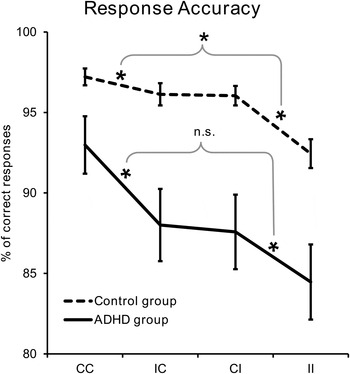
An interaction of flanker congruency × group was also found (F 1,45 = 4.26, p = 0.045, η 2 = 0.087). Furthermore, an interaction of prime compatibility × flanker congruency × group was obtained (F 1,45 = 6.103, p = 0.017, η 2 = 0.119) (see Fig. 2 for illustration). Post-hoc analyses demonstrated that both groups displayed the aforementioned main effects of prime compatibility (all F ⩾ 15.404, p ⩽ 0.001) and flanker congruency (all F ⩾ 21.885, p > 0.001). Yet, the ADHD patients showed no interaction of these two factors (F 1,24 = 1.298, p = 0.267, η 2 = 0.058) while the control group did (F 1,24 = 9.078, p = 0.006, η 2 = 0.274). Post-hoc t tests demonstrated that there was only a prime effect in incongruent flankers (t = −4.455, p < 0.001), but not in congruent ones (t = −1.693, p = 0.103). More noticeable than this, however, were the accuracy impairments induced by the two kinds of conflict (see Fig. 2). Healthy controls only showed relatively small reductions in accuracy when comparing trials with just one kind of mismatch to trials where both prime and flankers matched the target. The introduction of incompatible primes or incongruent flankers reduced accuracy rates by 1.08 ± 0.64% and 1.17 ± 0.48%, respectively. The addition of the respective other kind of conflict, however, caused a stronger decrease in accuracy rates. Trials with incongruent flankers and incompatible primes yielded 3.69 ± 0.66% less hits compared to trials with only a prime-induced conflict and 3.60 ± 0.81% less hits when compared to trials with only a flanker-induced conflict. Importantly, it did not matter which source (i.e. subliminal or conscious) induced the conflict (all t ⩾ −0.137, p ⩾ 0.893). However, the number of conflicts played an important role as the accuracy impairment caused by just one conflict was significantly smaller than that caused by the ‘addition’ of a second conflict (all t ⩾ −2.302, p ⩽ .030). Hence, healthy controls seem to display a threshold effect which was absent in the ADHD group. Like controls, patients did not differentiate between the source of conflict (i.e. subliminal or conscious; all t ⩽ −0.355, p ⩾ 0.726), but they also did not show any comparable threshold effect (all t ⩽ 1.031, p ⩾ 0.314). Instead, ADHD patients only showed additive effects of the number of conflicts on their performance.
Illustration of the response accuracy results (percentage of correct responses). The condition combinations are abbreviated as follows: CC, compatible primes and congruent flankers; IC, incompatible primes and congruent flankers; CI, compatible primes and incongruent flankers; II, incompatible primes and incongruent flankers. The kind of conflict (i.e. subliminal or conscious) did not play a relevant role as CI and IC did not differ in both groups. CC and IC/CI as well as IC/CI and II differed significantly for both groups (to avoid visual cluttering, we however only illustrated two of the four differences in each group).Yet, the accuracy effects induced by one v. two conflicts differed between groups: In the ADHD group, there were only additive main effects as inducing one kind of conflict (i.e. CC minus IC/CI) induced the same decrease in accuracy as inducing a second conflict (i.e. IC/CI minus II). By contrast, the control group showed a threshold effect as inducing the first conflict (i.e. CC minus IC/CI) induced a smaller decrease in accuracy as inducing a second conflict (i.e. IC/CI minus II). Significant differences (p ⩽ 0.05) are denoted with an asterisk.

The repeated-measures ANOVA for RTs in correct trials revealed a main effect of prime compatibility (F 1,45 = 67.29, p < 0.001, η 2 = 0.599). Participants responded faster when prime and target were compatible (498.03 ± 11.27 ms) than when they were incompatible (519.54 ± 10.99 ms). Additionally, a main effect of flanker congruency was found (F 1,45 = 139.8, p < 0.001, η 2 = 0.756). Participants responded faster when target and flankers pointed in the same direction (497.54 ± 11.12 ms) then when they pointed in incongruent directions (520.03 ± 11.07 ms). All other main effects and interactions were non-significant (all F ⩽ 2.715, p ⩾ 0.106).
In summary, the behavioral data shows that ADHD patients only show additive distractor effects while healthy controls also show an interaction of the two kinds of conflict.
Neurophysiological data
We analysed the neurophysiological data to identify the mechanisms underlying the group differences observed at the behavioral level. To keep results section concise, only main and interaction effects involving the group factor are reported below. All other results are given in the Supplementary material.
P1 and N1
We found no main effects or interactions involving the group factor for the P1 and N1 components evoked by the prime or the target (all F ⩽ 3.426, p ⩾ 0.071).
N2
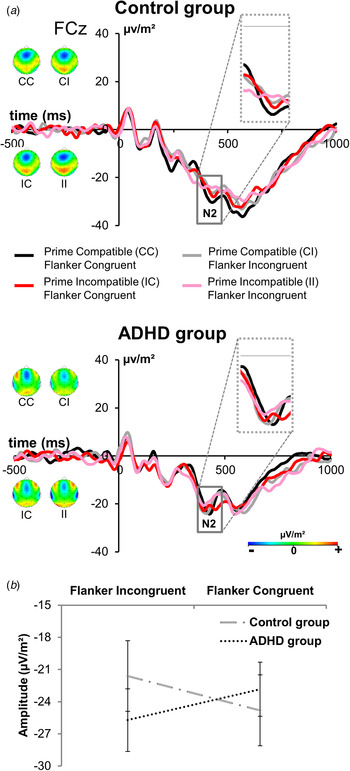
For the N2 amplitude at electrode FCz (see Fig. 3), there was an interaction of flanker congruency × group (F 1,45 = 4.087, p = 0.049, η 2 = 0.083). Post-hoc independent-samples t test revealed that the groups differed with respect to the effect of flanker congruency on N2 amplitudes (t 45 = −2.022, p = 0.049). While the ADHD group had larger N2 amplitudes in incongruent trials (−25.71 ± 3.25 µV/m2) than in congruent trials (−22.84 ± 3.10 µV/m2), the control group had larger amplitudes in congruent trials (−24.81 ± 2.91 µV/m2) than in incongruent trials (−21.61 ± 3.04 µV/m2). All other N2 main effects and interactions were non-significant (all F ⩽ 1.157, p ⩾ 0.288).
(a) The top and middle graphs separately depict the N2 peak at electrode FCz and the associated topography maps for each group (Control v. ADHD group). Time point zero denotes the onset of the prime stimulus. We found an interaction of group and flanker with larger N2 amplitudes for incompatible flankers in the ADHD group v. larger N2 amplitudes for compatible flankers in the control group. Conditions with incongruent flankers are depicted in lighter colours than conditions with congruent flankers. Also, conditions with compatible primes are denoted in black/grey while conditions with incompatible primes are denoted in red (CC, compatible primes and congruent flankers; IC, incompatible primes and congruent flankers; CI, compatible primes and incongruent flankers; II, incompatible primes and incongruent flankers). (b) Line graph depicting the aforementioned interaction of group and flanker congruency in the two groups (ADHD and control) across trials with congruent v. incongruent flankers. The graph shows that the groups had higher amplitude difference in Flanker congruent trials compared to flanker incongruent trials for the N2 peak. The time point zero denotes the onset of the priming stimulus and amplitudes are given in μV/m2 (see Method section).

P3
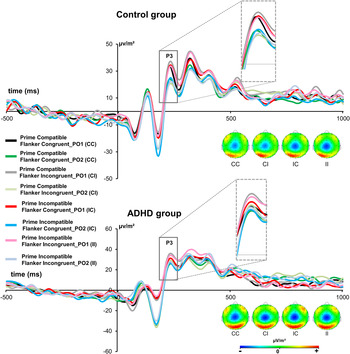
For the parietal P3 amplitude at electrodes PO1/PO2 (see Fig. 4 for illustration), there were significant interactions of flanker congruency × group (F 1,45 = 6.632, p = 0.013; η 2 = 0.128) and electrodes × flanker × group (F 1,45 = 8.95, p = 0.004, η 2 = 0.166]. Post-hoc tests revealed that the ADHD group only had a main effect of flanker congruency (F 1,21 = 5.623, p = 0.027, η 2 = 0.211) with larger P3 amplitudes in incongruent trials (31.87 ± 6.72 µV/m2) than in congruent trials (27.24 ± 5.7 µV/m2). By contrast, controls showed a significant interaction of electrodes x flanker congruency (F 1,24 = 6.806, p = 0.015, η 2 = 0.221). Further post-hoc paired-samples t tests of this interaction revealed that there was a flanker effect at electrode PO1 (t = −2.804, p = 0.010; incongruent = 13.98 ± 6.38 µV/m2; congruent = 20.45 ± 5.52 µV/m2), but not at electrode PO2 (t = 0.578, p = 0.568).
The top and bottom graphs separately depict the P3 peak at electrodes PO1 and PO2 and the associated topography maps for each group (Control v. ADHD group). Time point zero denotes the onset of the prime stimulus (CC, compatible primes and congruent flankers; IC, incompatible primes and congruent flankers; CI, compatible primes and incongruent flankers; II, incompatible primes and incongruent flankers). The ADHD group showed no modulation of the P3 amplitude by the prime, while the control group had larger amplitudes for compatible than for incompatible primes at electrode PO2. Furthermore, the ADHD group had larger P3 amplitudes in incongruent trials than in congruent trials while controls showed the opposite pattern (i.e. congruent > incongruent) at electrode PO1.

In addition to that interaction, there were also interactions of prime compatibility × electrodes (F 1,45 = 8.323, p = 0.006, η 2 = 0.156) and electrodes × prime compatibility × group (F 1,45 = 4.917, p = 0.032, η 2 = 0.099). Post-hoc tests revealed that there were no effects of prime compatibility or electrode on P3 amplitudes in ADHD patients (all F ⩽ 2.152, p ⩾ 0.157). By contrast, the control group showed a significant main effect of prime compatibility (F 1,24 = 7.983, p = 0.009, η 2 = 0.250) as well as an interaction of electrodes × prime compatibility (F 1,24 = 8.483, p = 0.008, η 2 = 0.261). Further post-hoc paired-samples t tests showed that there was a prime effect in electrode PO2 (t 24 = −3.183, p = 0.004; compatible = 13.59 ± 6.34 µV/m2; incompatible = 3.64 ± 7.89 µV/m2), but not in electrode PO1 (t = 0.998, p = 0.328).
Together, the group differences found in the behavioral data are not reflected in the attentional P1 and N1 components. Instead, we found reversed flanker modulations for ADHD patients and controls in the amplitude of the central N2 ERPs. While ADHD patients displayed larger N2 amplitudes in case of incongruent flankers, controls displayed larger amplitudes in trials with congruent flankers. We also found group differences in the P3 ERP. While ADHD patients only showed larger P3 amplitudes in incongruent flankers than in congruent ones, the P3 amplitude of controls was modulated by both prime compatibility and flanker congruency. Most importantly, both kinds of conflict reduced P3 amplitudes in controls, but not in ADHD patients.
Discussion
In the current study, we examined the interactive effects of subliminally and consciously processed information on action control processes in ADHD. While the groups did not differ with respect to response speed and the induced behavioural impairment did not differ between the two kinds of conflict for both groups, ADHD patients were generally less accurate than controls. Both groups showed lower accuracy in case of incongruent flankers and incompatible primes, but unlike controls, the patients lacked an interaction of these two factors. Instead and as hypothesized, there were only additive effects. This means that the magnitude of performance impairments simply adds up as each additional conflict decreases response accuracy by about the same magnitude. The finding that the overall ‘conflict load’ does not affect the magnitude of performance impairments suggests that ADHD patients show no threshold effects with respect to task-goal shielding. In contrast to this, controls showed a non-additive effect of conflict load where introducing just one kind of conflict (i.e. prime incompatibility or flanker incongruency) yielded rather small accuracy reductions as compared to a trial were both prime and flankers matched the target. When the respective other kind of conflict was added (i.e. flanker incongruency and prime incompatibility are combined as compared to trials with just one kind of conflict), accuracy rates dropped much more than what would have been expected from looking at the effect of introducing the first mismatch. This difference suggests that ADHD patients lack the healthy controls’ capacity to shield their task goals from the influence of both consciously and subliminally processed distractors and the response tendencies they evoked, especially in case of a rather low conflict load. It could, however, also be hypothesized that ADHD patients do not entirely lack the ability to shield their task goals. Instead, they might just have a much lower threshold at which action control processes start to be affected/overstrained by distractors. Yet, this effect was not based on differences in bottom-up attentional stimulus processing, i.e. perceptual gating and categorization processes as reflected by the P1 (Herrmann & Knight, Reference Herrmann and Knight2001; Klimesch, Reference Klimesch2011) or bottom-up attentional selection as reflected by the N1. Rather, an interaction reflecting the group differences observed on the behavioural level was obtained for the N2 ERP. While ADHD patients showed larger N2 amplitudes in trials with incongruent flankers than in trials with congruent flankers, healthy controls showed the opposite pattern (i.e. larger N2 amplitudes in case of congruent flankers). This effect was quite unexpected as the N2 is known to reflect response selection, conflict as well as cognitive effort in the current trial (Botvinick et al. Reference Botvinick, Cohen and Carter2004; Folstein & Van Petten, Reference Folstein and Van Petten2008; Willemssen et al. Reference Willemssen, Müller, Schwarz, Falkenstein and Beste2009; Beste et al. Reference Beste, Baune, Falkenstein and Konrad2010a ; Larson et al. Reference Larson, Clayson and Clawson2014; Chmielewski et al. Reference Chmielewski, Mückschel, Dippel and Beste2016). Hence, incongruent flankers should also have increased N2 amplitudes in controls (Larson et al. Reference Larson, Clayson and Clawson2014). The nature of the task might have contributed to this finding as a prime preceded the flankers. Dealing with the response tendencies evoked by the prime in a functional way might have left the controls with fewer resources to invest in the processing of incongruent flanker information. As patients showed no interaction on the behavioral level, they might have just applied an ‘all in’ strategy and processed the flankers as if there was no prime. Given that even minor changes to a paradigm may have profound effects on the evoked ERPs (Gohil et al. Reference Gohil, Stock and Beste2015), this effect however needs to be illuminated in further studies to see whether this speculation holds true.
In addition to those N2 differences, we found differential effects of group for the parietal P3 amplitude. Most importantly, controls had larger P3 amplitudes in case of compatible as compared to incompatible primes. ADHD patients however lacked this difference. The P3 component is thought to reflect the decision processes between stimulus evaluation and motor responding (e.g. Verleger et al. Reference Verleger, Jaśkowski and Wascher2005; Twomey et al. Reference Twomey, Murphy, Kelly and O'Connell2015) and it has been reported that the P3 amplitude may decrease with task difficulty (e.g. Gajewski & Falkenstein, Reference Gajewski and Falkenstein2013; Cutmore et al. Reference Cutmore, Halford, Wang, Ramm, Spokes and Shum2015). Based thereon, it has been suggested that the P3 amplitude depends on the top-down attentional resources left over by the primary task (Schubö et al. Reference Schubö, Meinecke and Schröger2001; Polich, Reference Polich2007). In case of the paradigm used in this study, the ‘primary task’ was to respond to the pointing direction of a centrally presented arrow. Supporting/reflecting our behavioral threshold findings, controls (but not ADHD patients) seemingly had residual top-down attentional resources left over by the primary task in case of compatible primes (as reflected by larger P3 amplitudes in compatible trials). Hence, controls had residual attentional resources at their disposal to maintain correct response selection in the face of priming conflicts. Given that they showed no P3 priming effects, ADHD patients seemed to lack the top-down attentional resources required to control response selection in case of subliminally induced conflicts.
In addition to those prime-related group differences, the P3 also showed flanker-related group differences. In case of congruent flankers, controls had larger P3 amplitudes over electrode PO1. While it is unclear why this effect was lateralized, it furthermore underpins our threshold hypothesis: Again, non-conflict trials yielded larger P3 amplitudes, thus likely indicating residual attentional resources to maintain correct response selection in the face of flanker conflicts for controls. ADHD patients did not only lack this lateralization, they also showed the reversed pattern (i.e. larger amplitudes in case of incongruent flankers). While it is unclear why the modulation pattern was reversed, it is important to note that for both the N2 and P3, ADHD patients showed either no modulation of the exact opposite of what was observed in healthy controls. While further studies need to be undertaken to elucidate the reasons, it can already be stated that the cognitive sub-processes involved in response selection and conflict processing seem to be highly dysfunctional in ADHD patients confronted with either subliminally or consciously triggered response conflicts.
There are also a few limitations to the study. While it seems likely that older adolescents and adults with ADHD should display the same behavioural pattern as our sample (compare introduction), this needs to be confirmed in future studies. It is furthermore unclear how ADHD medication affects performance. Given that ADHD is usually treated with dopaminergic medication and given that dopamine is known to modulate conflict monitoring as well as N2 and P3 amplitudes (e.g. Polich, Reference Polich2007; Beste et al. Reference Beste, Willemssen, Saft and Falkenstein2010b ; Stock et al. Reference Stock, Arning, Epplen and Beste2014), it however seems likely that the ADHD-specific differences at the behavioural and neurophysiological level should wane under the influence of methylphenidate. It could furthermore be discussed whether the close temporal spacing of stimuli might have led to some degree of overlapping between processes elicited by the prime and those elicited by the flanker. While this is almost certainly the case, subliminal stimulus presentation crucially depends on close temporal spacing so that this issue cannot be resolved by manipulating the timing parameters. Also, we were able to identify clear-cut ERP peaks associated with the respective stimuli, which refutes the possibility that ERPs associated with the different stimuli cannot be told apart. Lastly, it would be interesting to investigate the effects of N2 amplitudes and associated processes on subsequent trials. In the current study, the number of trials was however too small to reliably do so.
Conclusion
We found a fundamental difference in the architecture of cognitive conflict processing: Healthy controls were able to shield their task goals in the presence of just one kind of conflict (i.e. subliminally or consciously induced), leading to comparatively small behavioral impairments. In contrast, ADHD patients seemed to lack this ability and showed no signs of a conflict load threshold for task-goal shielding. Importantly, this deficit was not caused by deficits in early bottom-up attentional stimulus processing. Instead, it seems that ADHD patients lack sufficient top-down attentional control to maintain correct response selection in the face of conflicts by shielding the response selection process from response tendencies evoked by any kind of distractor. This difference might potentially play a role in future diagnostic procedures.
Supplementary material
The supplementary material for this article can be found at https://doi.org/10.1017/S0033291717000216.
Acknowledgements
This work was supported by a grant from the Deutsche Forschungsgemeinschaft (DFG) SFB 940 project B8 to V.R., A.S. and C.B. We thank all participants.
Declaration of Interest
A.B., K.G., and A.K.S. declare no competing or potential conflicts of interest. V.R. has received payment for consulting and writing activities from Lilly, Novartis, and Shire Pharmaceuticals, lecture honoraria from Lilly, Novartis, Shire Pharmaceuticals, and Medice Pharma, and support for research from Shire and Novartis. He has carried out (and is currently carrying out) clinical trials in cooperation with the Novartis, Shire, and Otsuka companies. C.B. has received payment for consulting from GlaxoSmithKline, and Teva.