Implications
Oleic, linoleic and linolenic acids may contribute to cell membrane formation and fat metabolism regulation as well as other metabolic processes in cows. Moreover, 18-carbon unsaturated fatty acids in milk may help prevent cardiovascular disease, atherosclerosis, and other chronic diseases in consumers, so supplementing cows with these fatty acids to increase their contents in milk could be beneficial to human health. It is important to understand the individual or combined effects of these fatty acids on milk fatty acid synthesis to reasonably regulate the fatty acid composition of milk.
Introduction
Fat supplementation may alter the lactation performance of dairy cows. Previous studies have reported that supplementing cows with fat could increase the energy supply and support milk production (Jenkins and McGuire, Reference Jenkins and McGuire2006; Lock et al., Reference Lock, Preseault, Rico, Deland and Allen2013), and 18-carbon (C18) unsaturated fatty acids (FA) may contribute to cell membrane formation, fat metabolism regulation and other metabolic processes in cows. Moreover, the presence of C18 unsaturated FA in milk may help prevent cardiovascular disease, atherosclerosis, and other chronic diseases in consumers, so supplementing cows with C18 unsaturated FA to increase their contents in milk could be beneficial to human health. However, negative effects on the lactation performance of cows have been reported in some studies, and the FA profile of supplemental fat is thought to play an important role in these effects (Stoffel et al., Reference Stoffel, Crump and Armentano2015). Fatty acids with different carbon chain lengths (Enjalbert et al., Reference Enjalbert, Nicot, Bayourthe and Moncoulon1998) and unsaturation degrees (Drackley et al., Reference Drackley, Klusmeyer, Trusk and Clark1992) in supplemental fat have caused variable responses. For instance, Bremmer et al. (Reference Bremmer, Ruppert, Clark and Drackley1998) reported that C18 : 2 and C18 : 3 had more negative effects on dry matter intake (DMI) than C18 : 1. Moreover, Drackley et al. (Reference Drackley, Klusmeyer, Trusk and Clark1992) supplemented cows with different FA mixtures and reported that DMI and milk yield decreased as the unsaturation degree of the supplemental FA mixture increased. Oleic, linoleic and linolenic acids are the primary FA in supplemental fat and are typically present in combination, so it is thus necessary to further study the specific effects of each FA as well as their potential combined effects on lactation performance.
Milk C18 : 1 cis-9; C18 : 2 cis-9, cis-12; and C18 : 3 cis-9, cis-12, cis-15 contents and yields could be affected by regulating the supply of their precursors to the mammary glands of cows (Litherland et al., Reference Litherland, Thire, Beaulieu, Reynolds, Benson and Drackley2005; Drackley et al., Reference Drackley, Overton, Ortiz-Gonzalez, Beaulieu, Barbano, Lynch and Perkins2007; Khas-Erdene et al., Reference Khas-Erdene, Wang, Bu, Wang, Drackley, Liu, Yang, Wei and Zhou2010), but in addition to increased target FA contents in milk fat, remarkable alterations in other milk C18 unsaturated FA have been observed. Drackley et al. (Reference Drackley, Overton, Ortiz-Gonzalez, Beaulieu, Barbano, Lynch and Perkins2007) showed that supplementation with increasing amounts of C18 : 1 cis-9 linearly decreased the contents of other FA, with the exception of C18 : 2 cis-9, cis-12. In Litherland et al. (Reference Litherland, Thire, Beaulieu, Reynolds, Benson and Drackley2005), abomasal infusion of increasing amounts of soya oil linearly increased the milk C18 : 2 content without changing the C18 : 1 content, although the soya oil contained 23.60% C18 : 1. Khas-Erdene et al. (Reference Khas-Erdene, Wang, Bu, Wang, Drackley, Liu, Yang, Wei and Zhou2010) reported that duodenal infusion of linolenic acid increased the milk C18 : 3 cis-9, cis-12, cis-15 content, primarily at the expense of C18 : 1 cis-9, C14 : 0 and C16 : 0. These results indicate that the effects of C18 unsaturated FA supplementation on milk fat synthesis might not be independent. Moreover, previous studies have suggested that different C18 unsaturated FA might have interacting effects on milk FA contents when supplied in combination (Hansen and Knudsen, Reference Hansen and Knudsen1987; Enjalbert et al., Reference Enjalbert, Nicot, Bayourthe and Moncoulon2000; Maxin et al., Reference Maxin, Rulquin and Glasser2011). However, these effects are still unclear and require further investigation.
Therefore, we hypothesized that different C18 unsaturated FA independently affect lactation performance and the milk fat profile, even when supplied simultaneously. In this study, we supplemented dairy cows with a combination of oleic, linoleic and linolenic acids and separately removed each FA from the combination to investigate the effects on lactation performance and milk fat composition.
Material and methods
Cows and treatments
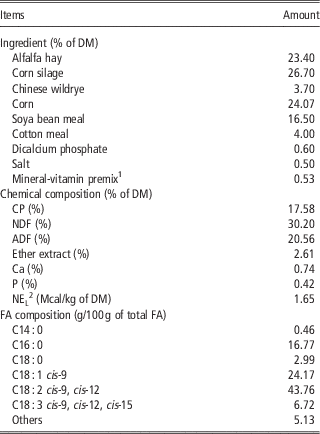
All experimental procedures were approved by the Animal Welfare Department of Inner Mongolia Agricultural University. Eight lactating Holstein cows (101±11 days in milk) were housed in a tie stall barn with free access to water. All cows received the same total mixed ration (TMR) (Table 1) formulated to meet predicted nutrient requirements (National Research Council, 2001). Food was provided twice daily at 0700 h and 1900 h after each milking. Orts were weighed, and 5% refusal of the amount of feed was allowed.
Ingredient and chemical composition of the basal diet

DM=dry matter.
1 Contained (per kg of premix, DM basis): vitamin A 700 000 IU, vitamin D 120 000 IU, vitamin E 10 000 mg, Fe 1750 mg, Cu 1600 mg, Zn 10 000 mg, Mn 3500 mg, I 84 mg; Co 42 mg.
2 Calculated by National Research Council (2001).
The eight cows were separated into four groups of two cows each, and the groups were randomly assigned to four infusion treatments in a 4×4 Latin square design. Each period lasted for 12 days, with 5 days of infusion followed by 7 days of recovery. The control treatment (CTL) was an intravenous infusate that primarily consisted of a mixture of the major C18 unsaturated FA (C18 : 1 cis-9; C18 : 2 cis-9, cis-12; and C18 : 3 cis-9, cis-12, cis-15). The cows in the other three treatment groups received similar infusates that varied with the removal of C18 : 1 cis-9 (−C18 : 1), C18 : 2 cis-9, qcis-12 (−C18 : 2); or C18 : 3 cis-9, cis-12; cis-15 (−C18 : 3). The infusates consisted of different combinations of oils enriched in C18 unsaturated FA, and each FA was designed to be supplied at a similar level in the four infusates. Olive oil (Yihai Kerry Food Marketing Co., Ltd, Shanghai, China), safflower oil (Tayuan Safflower LLC, Xinjiang, China) and flaxseed oil (Huajian Oil Co., Ltd, Shanxi, China) were selected to primarily provide C18 : 1 cis-9, C18 : 2 cis-9, cis-12, cis-15 and C18 : 3 cis-9, cis-12, cis-15, respectively. The −C18 : 1 infusate contained 70 g/day safflower oil and 91 g/day flaxseed oil. The −C18 : 2 infusate contained 76 g/day olive oil and 91 g/day flaxseed oil. The −C18 : 3 infusate contained 90 g/day olive oil and 80 g/day safflower oil. Finally, the CTL infusate contained 68 g/day olive oil, 65 g/day safflower oil and 91 g/day flaxseed oil.
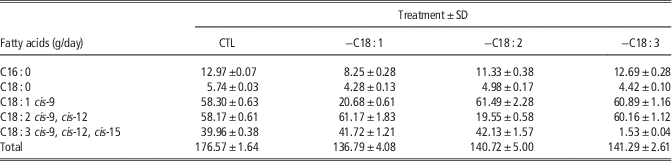
The actual FA infusion amounts (g/day) in each treatment are presented in Table 2. The cows were fitted with catheters (14 GA, 13.5 cm; Huali Medical Instrument Co., Ltd, Jiangxi, China) in the jugular vein the day before the infusion. Physiological saline was administered after the infusion treatments to maintain the catheters at adequate clarity and patency.
Actual infusion amounts (g/day) of fatty acids in each infusion treatment

CTL=intravenous infusion of the fatty acid combination of C18 : 1 cis-9, C18 : 2 cis-9, cis-12 and C18 : 3 cis-9, cis-12, cis-15; −C18 : 1 treatment=C18 : 1 cis-9 was removed from the fatty acid combination; −C18 : 2 treatment=C18 : 2 cis-9, cis-12 was removed from the fatty acid combination; −C18 : 3 treatment=C18 : 3 cis-9, cis-12, cis-15 was removed from the fatty acid combination.
Emulsion preparation and infusion procedure
Emulsions were prepared according to the method described in a previous study (Lanier et al., Reference Lanier, Suagee, Becvar and Corl2013) with modifications. The oil mixture was heated in a separate container in a water bath to ~80°C. Lecithin (10 g/l; Hongrui Jiasheng Trading Co. Ltd, Beijing, China) was then added to the oil, and the mixture was thoroughly combined by a blender (model I25; IKN Machinery Equipment Shanghai Co. Ltd, Shanghai, China). In another container, glycerol (50 g) was added to 2 l of water, and the mixture was heated to ~60°C. The oil mixture was then slowly added to the water mixture and thoroughly combined by the blender. After adjusting the pH to 8.0 with 1 M NaOH, a coarse emulsion was prepared that was subsequently passed through a homogenizer (model SRH 60-70; Shanghai Samro Homogenizer Co. Ltd, Shanghai, China) three times at 20 MPa in the first stage and 4 MPa in the second stage. The emulsion was then autoclaved for 15 min at 121°C in 500-ml bottles, and the collected emulsion was cooled to 30°C. Emulsions were prepared daily during the infusion period to ensure freshness and to reduce the chance of separation and coagulation, and they were continuously infused into the jugular vein via a peristaltic pump (model BT100-1L; LongerPump Co. Ltd, Baoding, China). The infusion began at the onset of feeding and lasted for 6 h, during which all the equipment was monitored to ensure that the infusion was continuous.
Sampling and analysis
The amounts of TMR offered and refused were recorded, and the daily DMI in each infusion period was calculated. The TMR and ort samples were collected on days 3, 4, and 5 in each infusion period and immediately dried at 65°C for further chemical analysis.
The cows were milked twice daily before feeding, and milk yields were recorded at each milking. In each infusion period, milk samples were collected during each milking on days 4 and 5, and the two milk samples collected from individual cows on the same day were combined. One of the two aliquots of each milk sample was stored at −20°C for FA analysis, and the other was stored at 4°C for milk composition analysis (MilkoScanTM model FT 120; Foss Technology Corp., Hilleroed, Denmark) and somatic cell counting (model FossmaticTM Minor Foss Integrator; Foss Technology Corp., Hilleroed, Denmark). Samples of the four emulsions were collected each day before the onset of infusion and stored at −20°C for FA analysis.
For the FA composition analysis, milk and TMR fatty acid methyl esters (FAME) were separated using a gas chromatography (model 450GC; Varian Inc., Palo Alto, CA, USA) fitted with a flame-ionization detector using a SP-2560 fused silica 100-m×0.25-mm column with a 0.20-μm film (Supelco Inc., Bellefonte, PA, USA). The oven temperature was initially held at 120°C for 5 min and then increased to 230°C at 3°C/min and held at that temperature for 3 min. The temperature was then increased to 240°C at 1.5°C/min and maintained for 13 min before being increased to 245°C at 20°C/min and held there for 6 min. The injector and detector temperatures were maintained at a constant temperature of 260°C. The split ratio was 1 : 40, and samples containing methyl esters in hexane (1 μl) were injected. Heptadecanoic acid (C17 : 0; Sigma-Aldrich Co. LLC., Shanghai, China) was used as a quantitative internal standard. Fatty acids peaks were identified using the known 37 FAME standards (Supelco 37 Component FAME mix; Supelco Inc.). The percentage of each FA was calculated by dividing the area under the FA peak (minus the peak area for C17 : 0) by the sum of the areas under the total reported FA peaks. Fatty acids were presented as g/100 g of FAME.
Statistical analysis
The data were analysed using the PROC MIXED procedure of SAS (version 9.1; SAS Institute Inc., Cary, NC, USA) according to the following statistical model:
 $$Y_{{ijk}}\,{\equals}\,\mu {\plus}C_{i} {\plus}P_{j} {\plus}T_{k} {\plus}e_{{ijk}} $$
where Y ijk is the dependent variable; µ the overall mean; C i the random effect of cow; P j the fixed effect of period; T k the fixed effect of treatment; and e ijk the random error. Least squares means were used to determine significance and are presented with the SEM throughout the paper. Multiple comparisons were conducted using Dunnett’s adjustment, and the significance was determined to be P⩽0.05.
To test the linear or quadratic effect of the unsaturation degree of the supplemental C18 unsaturated FA, contrast statements were used. The unsaturation degree of each treatment was defined by the total number of double bonds of C18 : 1 cis-9; C18 : 2 cis-9, cis-12; and C18 : 3 cis-9, cis-12, cis-15. The number of double bonds of each FA in each treatment was calculated through its number of double bonds in the FA chain by its amount of substance.
Results
Dry matter intake, milk production and milk components
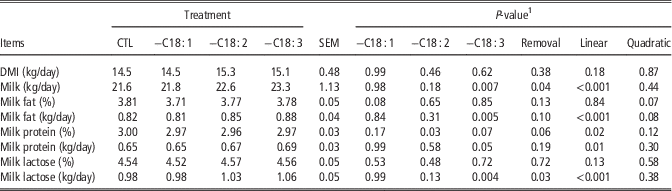
Table 3 shows the average daily DMI, milk yield and milk components. Infusion of different FA combinations did not affect DMI. Compared with the CTL treatment, removing C18 : 3 cis-9, cis-12, cis-15 increased milk yield (P<0.01). Moreover, milk yield linearly increased as the unsaturation degree of the supplemental FA decreased (P<0.001). Milk fat content tended to be lower in cows treated with −C18 : 1 than that in CTL-treated cows (P=0.08). Compared with the CTL treatment, milk protein content was lower in cows treated with −C18 : 2 (P<0.05) and tended to be lower in cows treated with −C18 : 3 (P=0.07). The milk lactose content did not change. Milk fat, protein and lactose yields were higher in cows treated with −C18 : 3 than the yields in the CTL group cows (P=0.005, 0.05 and 0.004, respectively); these yields increased linearly as the unsaturation degree of the supplemental FA decreased (P<0.001, P=0.01 and P<0.001, respectively).
Least squares means for dry matter intake (DMI), milk yield and milk components from cows receiving different infusion treatments

CTL=intravenous infusion of the fatty acid combination of C18 : 1 cis-9, C18 : 2 cis-9, cis-12 and C18 : 3 cis-9, cis-12, cis-15; −C18 : 1 treatment=C18 : 1 cis-9 was removed from the fatty acid combination; −C18 : 2 treatment=C18 : 2 cis-9, cis-12 was removed from the fatty acid combination; −C18 : 3 treatment=C18 : 3 cis-9, cis-12, cis-15 was removed from the fatty acid combination.
1 P-values: (1) control v. −C18 : 1, (2) control v. −C18 : 2, (3) control v. −C18 : 3, (4) removal=control v. removal of C18 unsaturated fatty acids, (5) linear effect of the supplemental fatty acid unsaturation degree, (6) quadratic effect of the supplemental fatty acid unsaturation degree.
Milk fatty acid composition and yield
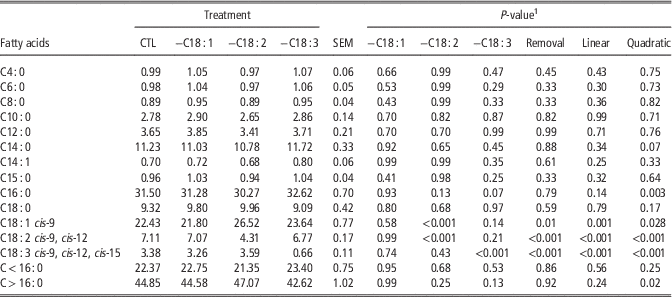
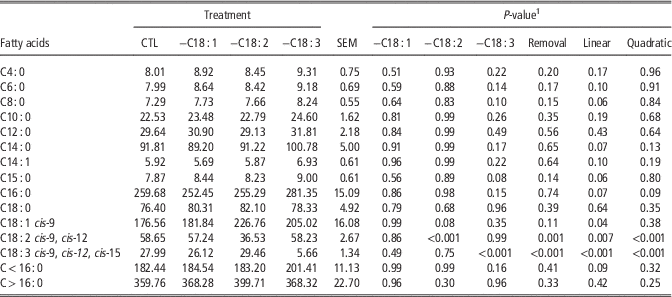
Compared with the CTL treatment, removal of C18 : 1 cis-9 did not affect FA composition (Table 4). The −C18 : 2 treatment decreased the C18 : 2 cis-9, cis-12 content in milk fat by 39% (CTL v. −C18 : 2, P<0.001), and the −C18 : 3 treatment decreased the C18 : 3 cis-9, cis-12, cis-15 content by 80% (CTL v. −C18 : 3, P<0.001). Cows given the −C18 : 2 treatment showed a higher C18 : 1 cis-9 content in milk fat than the CTL-treated cows (CTL v. −C18 : 2, P<0.001). Milk C16 : 0 content tended to be higher in the −C18 : 3 treatment than that in the CTL treatment (P=0.07). Removal of C18 unsaturated FA did not affect the milk FA contents of C4 : 0, C6 : 0, C8 : 0, C10 : 0, C12 : 0, C14 : 0, C15 : 0, C18 : 0 and <C16 : 0.
Least squares means for milk fatty acid contents (g/100 g of fatty acid methyl esters) from cows receiving different infusion treatments

CTL=intravenous infusion of the fatty acid combination of C18 : 1 cis-9, C18 : 2 cis-9, cis-12 and C18 : 3 cis-9, cis-12, cis-15; −C18 : 1 treatment=C18 : 1 cis-9 was removed from the fatty acid combination; −C18 : 2 treatment=C18 : 2 cis-9, cis-12 was removed from the fatty acid combination; −C18 : 3 treatment=C18 : 3 cis-9, cis-12, cis-15 was removed from the fatty acid combination.
1 P-values: (1) control v. −C18 : 1, (2) control v. −C18 : 2, (3) control v. −C18 : 3, (4) removal = control v. removal of C18 unsaturated fatty acids, (5) linear effect of the supplemental fatty acid unsaturation degree, (6) quadratic effect of the supplemental fatty acid unsaturation degree.
Table 5 shows the individual FA yields. Removal of C18 : 1 cis-9 did not affect the C18 : 1 cis-9 yield in milk fat. Compared with the CTL treatment, the −C18 : 2 treatment produced a lower C18 : 2 cis-9, cis-12 yield (P<0.001), and the −C18 : 3 treatment produced a lower C18 : 3 cis-9, cis-12, cis-15 yield (P<0.001). Cows given the −C18 : 2 treatment tended to show a higher C18 : 1 cis-9 yield than the CTL-treated cows (CTL v. −C18 : 2, P=0.08). Removal of C18 unsaturated FA did not affect the daily yields of C4 : 0, C6 : 0, C8 : 0, C10 : 0, C12 : 0, C14 : 0, C16 : 0, C18 : 0 and <C16 : 0, but milk C8 : 0, C14 : 0, C16 : 0 and <C16 : 0 yields showed a linear increasing trend (P=0.06, 0.07, 0.07 and 0.09, respectively) as the unsaturation degree of the supplemental FA decreased.
Least squares means for milk fatty acid yields (g/day) from cows receiving different infusion treatments

CTL=intravenous infusion of the fatty acid combination of C18 : 1 cis-9, C18 : 2 cis-9, cis-12 and C18 : 3 cis-9, cis-12, cis-15; −C18 : 1 treatment=C18 : 1 cis-9 was removed from the fatty acid combination; −C18 : 2 treatment=C18 : 2 cis-9, cis-12 was removed from the fatty acid combination; −C18 : 3 treatment=C18 : 3 cis-9, cis-12, cis-15 was removed from the fatty acid combination.
1 P-values: (1) control v. −C18 : 1, (2) control v. −C18 : 2, (3) control v. −C18 : 3, (4) removal=control v. removal of C18 unsaturated fatty acids, (5) linear effect of the supplemental fatty acid unsaturation degree, (6) quadratic effect of the supplemental fatty acid unsaturation degree.
Discussion
Dry matter intake, milk yield and milk components
Many previous studies have reported that feeding or abomasal infusion of C18 unsaturated FA negatively affects DMI (e.g. Drackley et al., Reference Drackley, Klusmeyer, Trusk and Clark1992; Christensen et al., Reference Christensen, Drackley, LaCount and Clark1994; Chelikani et al., Reference Chelikani, Bell and Kennelly2004), and in some studies (Bremmer et al., Reference Bremmer, Ruppert, Clark and Drackley1998; Benson et al., Reference Benson, Reynolds, Humphries, Rutter and Beever2001), polyunsaturated FA (C18 : 2 cis-9, cis-12 and C18 : 3 cis-9, cis-12, cis-15) appeared to have a more negative effect on DMI than monounsaturated FA (C18 : 1 cis-9). These effects on DMI might be a consequence of increased release of cholecystokinin or other peptides that affect gut motility and rumination (Benson et al., Reference Benson, Reynolds, Humphries, Rutter and Beever2001). Contrary to these results, intravenous infusion of C18 unsaturated FA in our study might not have affected gut motility and rumination, but as our study design did not include a no-infusion treatment, we could not investigate whether intravenous infusion of C18 unsaturated FA negatively affected DMI. However, the results indicated that there were no combined effects of different C18 unsaturated FA on DMI. In other words, different C18 unsaturated FA affected DMI consistently when supplied intravenously.
Two possible reasons might explain the higher milk yield when C18 : 3 cis-9, cis-12, cis-15 was removed from the FA combination: (1) additional C18 : 3 cis-9, cis-12, cis-15 inhibited milk synthesis, and (2) C18 : 3 cis-9, cis-12, cis-15 had combined effects with C18 : 1 cis-9 or with C18 : 2 cis-9, cis-12 on milk yield. No data were available from previous studies to demonstrate that individually supplementing cows with such a small amount of C18 : 3 cis-9, cis-12, cis-15 could cause an obvious negative effect on milk yield. In addition, milk yield was not altered by the −C18 : 1 or −C18 : 2 treatments compared with the CTL treatment. Moreover, milk yield linearly increased as the unsaturation degree of the supplemental FA decreased. In summary, we presumed that, with infusion in the amounts used in this study, the total unsaturation degree of the FA in the emulsion, rather than a specific FA, affected milk synthesis. Removing C18 : 3 cis-9, cis-12, cis-15 would largely decrease the unsaturation degree of the FA combination, thus increasing milk yield.
In the present study, the lower milk protein content caused by the −C18 : 2 and −C18 : 3 treatments might be attributed to a dilution effect because, relative to the CTL group, the milk protein yield of cows was not affected by the −C18 : 2 treatment and was higher in cows given the −C18 : 3 treatment. Previous studies have reported that supplementing dairy cows with fat could decrease milk protein content (Wu and Huber, Reference Wu and Huber1994; Mach et al., Reference Mach, Jacobs, Kruijt, van Baal and Smits2011; Rabiee et al., Reference Rabiee, Breinhild, Scott, Golder, Block and Lean2012). However, in a previous study, milk protein content was not affected by abomasal infusion of unsaturated free FA or triglycerides to cows (Litherland et al., Reference Litherland, Thire, Beaulieu, Reynolds, Benson and Drackley2005). In the present study, the linear increase in milk protein yield was mostly attributed to the linear increase in milk yield as the unsaturation degree of the supplemental FA decreased, and the linear increase in milk fat yield also followed the milk yield response.
Milk fatty acid
Milk C18 unsaturated FA primarily originate from feed and lipolysis from adipose tissues and are transported towards the extrahepatic tissues in vivo (Sun et al., Reference Sun, Bu, Wang, Cui, Zhao, Xu, Sun and Zhou2013). As a result, circulating concentrations of C18 unsaturated FA directly affect milk C18 FA content. In the present study, the decreased milk C18 : 2 cis-9, cis-12 or C18 : 3 cis-9, cis-12, cis-15 contents in cows in the −C18 : 2 or −C18 : 3 treatments indicated that these FA in milk were mainly limited by their circulating concentrations. Alternatively, the mammary gland might be able to convert more C18 : 2 cis-9, cis-12 and C18 : 3 cis-9, cis-12, cis-15 into milk fat. Milk C18 : 2 cis-9, cis-12 content has been shown to increase from 2.68% to 6.96% without affecting DMI and milk yield in cows given an abomasal infusion of soya oil triglycerides at 200 g/day (Litherland et al., Reference Litherland, Thire, Beaulieu, Reynolds, Benson and Drackley2005), and the content of C18 : 3 cis-9, cis-12, cis-15 has been shown to increase from 0.61% to 6.49% with a duodenal infusion of 40 g/day free C18 : 3 cis-9, cis-12, cis-15 (Khas-Erdene et al., Reference Khas-Erdene, Wang, Bu, Wang, Drackley, Liu, Yang, Wei and Zhou2010). In the present study, milk C18 : 2 cis-9, cis-12, cis-15 and C18 : 3 cis-9, cis-12, cis-15 increased at low supply levels, but C18 : 1 cis-9 did not. A similar result was observed in a previous study, in which intravenous infusion of 30 g/day C18 : 1 cis-9 did not affect milk C18 : 1 cis-9 yield (Lanier et al., Reference Lanier, Suagee, Becvar and Corl2013). In an abomasal infusion study, supplying 250 to 1000 g/day high-oleic sunflower FA to cows significantly increased the C18 : 1 cis-9 in milk fat (Drackley et al., Reference Drackley, Overton, Ortiz-Gonzalez, Beaulieu, Barbano, Lynch and Perkins2007). It is possible that milk C18 : 1 cis-9 could be increased if higher levels are supplied. The unchanged milk C18 : 1 cis-9 content in the present study may indicate that the supplemented amount of C18 : 1 cis-9 was insufficient to alter its autologous metabolism in the mammary gland. However, intravenous FA infusion could have different effects than abomasal infusion due to the various in vivo FA absorption or transportation pathways (Lanier et al., Reference Lanier, Suagee, Becvar and Corl2013), and this hypothesis requires further study. Another possible reason for the lack of a response was that the C18 : 2 cis-9, cis-12 in the infusate was a limiting factor affecting milk C18 : 1 cis-9 as a higher milk C18 : 1 cis-9 content was observed in cows given the −C18 : 2 treatment.
In a previous study, milk C18 : 1 cis-9 decreased in lactating dairy cows given a duodenal infusion of an FA mixture (25% of C18 : 1 and 67% of C18 : 2) (Wagner et al., Reference Wagner, Aulrich, Lebzien and Flachowsky1998), but the specific mechanism underlying this decrease was not determined. However, the triglyceride stereospecific positioning of different C18 FA plays an important role in regulating milk FA composition (Bernard et al., Reference Bernard, Leroux and Chilliard2008). The distribution of FA on the sn positions of a triglyceride in milk is not random (Jensen, Reference Jensen2002), and as previously reported (Tzompa Sosa et al., Reference Tzompa Sosa, van Aken, van Hooijdonk and van Valenberg2014), C18 : 1 cis-9 is preferentially esterified at the sn-1,3 position. Furthermore, another study reported that ~42.4% of milk C18 : 2 cis-9, cis-12 is located at the sn-3 position, 27.8% at sn-1, and 29.8% at sn-2 (Blasi et al., Reference Blasi, Montesano, Angelis, Maurizi, Ventura, Cossignani, Simonetti and Damiani2008). In the present study, it is possible that C18 : 1 cis-9 competed with C18 : 2 cis-9, cis-12 for esterification at the sn-1,3 position in the mammary gland when these two FA were provided in combination, and C18 : 2 cis-9, cis-12 could be predominant. Removing C18 : 2 cis-9, cis-12 from the combination could decrease this competition effect and enhance the C18 : 1 cis-9 content in milk fat. Alternatively, when supplying these two FA in combination, the mammary gland may preferentially incorporate C18 : 2 cis-9, cis-12 into milk triglycerides rather than C18 : 1 cis-9. However, in the present study, the milk yield of C18 : 1 cis-9 only showed a tendency to increase when C18 : 2 cis-9, cis-12 was removed, so the above hypothesis requires further investigation. In addition, relatively compared with the cows given the −C18 : 2 and −C18 : 3 treatments, the CTL-treated cows showed apparent transfer efficiencies of C18 : 2 cis-9, cis-12 and C18 : 3 cis-9, cis-12, cis-15 from intravenous infusion to milk output of 58% and 57%, respectively. In a previous study (Lanier et al., Reference Lanier, Suagee, Becvar and Corl2013), the transfer efficiencies of C18 : 2 cis-9, cis-12 and C18 : 3 cis-9, cis-12, cis-15 were only 38% and 28%, respectively, from the intravenous infusion of linoleic or linolenic acid-enriched triglyceride emulsions to milk output. Such lower efficiencies might contribute to the variations in the transport of these FA with apolipoproteins, which would regulate lipid metabolism (Lanier et al., Reference Lanier, Suagee, Becvar and Corl2013).
Supplementing cows with long-chain FA or long-chain FA-enriched triglycerides have been shown to decrease short- and medium-chain FA in dietary supplementation experiments (Glasser et al., Reference Glasser, Ferlay and Chilliard2008; Boerman and Lock, Reference Boerman and Lock2014) and in post-ruminal infusion experiments (LaCount et al., Reference LaCount, Drackley, Laesch and Clark1994; Litherland et al., Reference Litherland, Thire, Beaulieu, Reynolds, Benson and Drackley2005). These effects could be attributed to the supplemental FA profile, the amount of FA or the infusion site, as intravenous infusion of 30 g/day of oleic, linoleic, linolenic or docosahexaenoic acids to lactating dairy cows did not affect the de novo synthesis of FA (Lanier et al., Reference Lanier, Suagee, Becvar and Corl2013). The observed tendency of C8 : 0, C14 : 0, C16 : 0 and <C16 : 0 milk yields to increase in the present study indicated that de novo FA synthesis in the mammary gland may be regulated by the overall unsaturation degree of the supplemental FA.
Conclusions
In this study, milk yield and the yield of milk fat, milk protein and milk lactose increased as the unsaturation degree of the supplemental FA decreased. Supplementing cows with a combination of oleic, linoleic and linolenic acids decreased the milk content of C18 : 1 cis-9, possibly because the C18 : 2 cis-9, cis-12 in the supplement combination has an inhibitory effect on C18 : 1 cis-9. These results indicated that different supplemental C18 unsaturated FA might not independently affect lactation performance and the milk FA profile in dairy cows. However, additional research is needed to elucidate the specific mechanism.
Acknowledgements
The authors sincerely appreciate the colleagues and students of the College of Animal Science of Inner Mongolia Agricultural University for their assistance. This work was supported by the National Basic Research Program of China (973, grant no. 2011CB100803).