Central line–associated bloodstream infections (CLABSIs) lead to significant morbidity, mortality, and cost among hospitalized patients.Reference Klevens, Edwards and Richards 1 , Reference Perencevich, Stone and Wright 2 Over the past decade, numerous interventions have been implemented to prevent CLABSIs, and between 2008 and 2013 CLABSI rates have decreased by 46% across the United States. 3 Among the various CLABSI prevention efforts, one of the most widely adopted is the central line (CL) insertion bundle promoted by the Institute for Healthcare Improvement (IHI) and other groups.Reference Berwick, Calkins, McCannon and Hackbarth 4
A care bundle is a set of evidence-based interventions that are intended to be implemented together, under the theory that bundled interventions are more effective than separate individual interventions. The components of the CL insertion bundle include the following practices: (1) hand hygiene prior to insertion; (2) maximal barrier precautions; (3) chlorhexidine skin antisepsis; (4) optimal site selection (ie, avoidance of femoral vein in adults); and (5) daily review of line necessity. Several studies have reported on the positive impact of the CL bundle when implemented as part of collaboratives, including the Keystone intensive care unit (ICU) project in Michigan ICUsReference Pronovost, Needham and Berenholtz 5 and the VA ICU project participating in the IHI campaign.Reference Render, Hasselbeck and Freyberg 6 Both collaboratives reported significant decreases in CLABSI rates after implementation of the CL bundle.
The CL bundle has now been adopted by most hospitals across the United States; in fact, its components are required of all accredited hospitals by The Joint Commission as part of its National Patient Safety Goal to prevent CLABSIs. 7 However, data regarding compliance with the bundle elements across US ICUs, as well as the impact on CLABSI rates, are limited outside of a study or collaborative setting. Using data from a relatively small set of US hospitals in 2007 (n=250), we previously found that the CL bundle was only effective when compliance was nearly perfect (≥95%).Reference Furuya, Dick, Perencevich, Pogorzelska, Goldmann and Stone 8 Here we report on the largest study to date evaluating CL bundle compliance in nearly 1,000 US adult ICUs, as well as the relationship between bundle compliance and CLABSI rates in those ICUs.
METHODS
Objectives
The objectives of this study were (1) to describe compliance with the CL insertion bundle overall, as well as with individual bundle elements, in US adult ICUs and (2) to determine the relationship between an individual bundle element or overall bundle compliance and CLABSI rates.
Study Design, Setting, and Participants
This study was performed as part of the P-NICER (Prevention of Nosocomial Infections and Cost Effectiveness Refined) study, which evaluated infection prevention and control practices in hospitals across the United States; the larger study is described in detail elsewhere.Reference Stone, Pogorzelska-Maziarz and Herzig 9 All non-VA hospitals reporting into the Centers for Disease Control and Prevention (CDC) National Healthcare Safety Network (NHSN) CLABSI surveillance module were eligible to participate, and only adult ICUs were included in this analysis.
In the fall of 2011, hospitals that agreed to participate filled out a web-based survey about hospital characteristics as well as infection prevention practices including ICU-specific CLABSI prevention. Hospitals were asked the following questions: (1) Is a written policy in place for each CL bundle component? And (2) for each component, what were the observed levels of compliance during the last time period it was monitored? Levels of compliance were categorized as excellent (≥95%), usually (75%–94%), sometimes (25%–74%), rarely or never (<25%), or do not know/compliance not monitored. Hospitals were asked the same questions about ventilator bundle practices and catheter-associated urinary tract infection (CAUTI) prevention bundle practices (ie, whether they had a written policy and their level of compliance with each bundle component). Compliance for all of these bundles was reported based on whatever method of monitoring was being utilized in the ICU.
Other hospital characteristics obtained using the P-NICER survey or the NHSN annual survey (2011) included geographic location, hospital bed size, ICU bed size, ICU type, medical school affiliation, and resources for infection prevention and control (eg, number of infection preventionists per 100 beds). All procedures were approved by the institutional review boards at Columbia University Medical Center and the RAND Corporation.
Outcome
Hospitals reported ICU-specific monthly CLABSI rates through the NHSN. By joining the P-NICER NHSN research group, participating hospitals allowed the research team access to their CLABSI rates. For NHSN reporting, CLABSIs are defined using criteria developed by the CDC, recognized as the gold standard for CLABSI surveillance.
Statistical Analysis
Descriptive statistics were computed, and facility characteristics and CLABSI rates in the last quarter of 2011 were compared for hospitals that did and did not join the P-NICER NHSN research group. The study team did not have access to NHSN data for nonrespondents, and therefore, the latter analyses were performed by the CDC using χ2 tests or ANOVA.
We estimated multivariate Poisson regression models, with state-level fixed effects, in which the unit of analysis was an ICU month. The number of CLABSI infections in an ICU month was the outcome and CL bundle compliance was the exposure, controlling for ICU characteristics, hospital characteristics, and time. We specified the number of CL days in an ICU month in the models to account for the total population’s “at risk” time during the month. To better understand the impact of each individual bundle element as well as combinations thereof on CLABSI rates, we estimated models with alternative specifications. The first set of models included indicators for simply having a written policy and for the various levels of compliance with each individual bundle element. The second set of models included indicators for the number of bundle elements within the various levels of compliance. These models and levels of compliance were determined a priori, based on findings from previous studies and recommendations for the use of care bundles.Reference Furuya, Dick, Perencevich, Pogorzelska, Goldmann and Stone 8 , Reference Resar, Griffin, Haraden and Nolan 10 , Reference Resar, Pronovost, Haraden, Simmonds, Rainey and Nolan 11
In all models, we addressed 2 potential sources of bias. First, there might be systematic self-reporting bias across hospitals if, for example, some hospitals overreported bundle compliance in the survey and underreported CLABSI rates to NHSN to appear better than they were. Second, if CLABSI rates are driven more by an organizational “culture of safety” than by specific bundled interventions, then bundle compliance could be merely a proxy for a better organizational culture in a hospital or ICU and we might therefore see a spurious correlation between bundles and CLABSI rates. To address these potential sources of bias, we included other care bundles, ie, for ventilator care and CAUTI, as additional controls. If systematic overreporting was a problem, then the same overreporting would be expected for these other care bundles, and we might thereby see the same association between ventilator or CAUTI bundle compliance and CLABSI rates. Similarly, if bundles and infection rates were driven by general quality, we would expect to see CLABSI rates associated with better compliance with any of the bundles, whether with the CL bundle or the ventilator or CAUTI bundles. Conversely, a finding that these other care bundles were not associated with CLABSI rates would substantially mitigate these concerns.
RESULTS
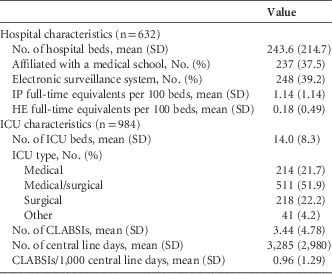
A total of 984 adult ICUs in 632 hospitals were included (Table 1); hospitals were located in 51 states and territories. Mean ICU bed size was 14.0 (standard deviation [SD], 8.3), mean hospital bed size was 243.6 (SD, 214.7), and most ICUs (52%) were medical/surgical. The mean CLABSI rate was 0.96 per 1,000 CL days (SD, 1.29). Compared with those that did not participate, hospitals that completed the P-NICER survey and joined the NHSN research group had higher numbers of patient days and admissions (P<.001), more beds (ICU, specialty, and all others; P<.05), and a higher number of infection preventionists per hospital (P=.006). Participating hospitals were more likely to be affiliated with a medical school (P=.009) and located in the northeastern or midwestern region (P<.001). For most ICU types in hospitals that did and did not participate, the pooled mean CLABSI rates in the last quarter of 2011 were similar; however, CLABSI rates were significantly higher (P=.04) for burn ICUs in hospitals that did not participate (data not shown).
Description of Participating Hospitals and Adult ICUs

NOTE. Medical ICU types include medical, medical cardiac, neurologic, respiratory; surgical ICU types include neurosurgical, surgical, surgical cardiothoracic; other ICU types include burn, trauma. ICU, intensive care unit; SD, standard deviation; IP, infection preventionist; HE, hospital epidemiologist; CLABSI, central line–associated bloodstream infection.
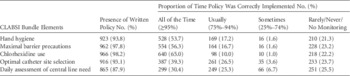
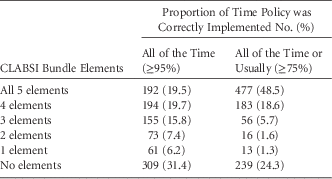
Overall, 98% of ICUs had CL bundle policies, but only 69% reported ≥95% compliance with at least 1 bundle element. Excellent compliance (ie, ≥95% in the last period monitored) for individual elements was reported by between 30% and 65% of ICUs (Table 2) and was least common for daily assessment of CL necessity (30%) and most common for chlorhexidine use (65%). Excellent compliance was most frequently not reported for any of the bundle elements (31% of ICUs). However, 20% of ICUs reported excellent compliance with all elements, and 49% reported compliance at least usually (≥75%) (Table 3).
Presence of and Compliance With Individual CLABSI Bundle Policies in Adult ICUs (n=984)

NOTE. ICU, intensive care unit; CLABSI, central line–associated bloodstream infection.
Compliance With Multiple CLABSI Bundle Policies in Adult ICUs (n=984)

NOTE. ICU, intensive care unit; CLABSI, central line–associated bloodstream infection.
Multivariate Analyses
In multivariate analysis, simply having a written policy for CL bundle elements was not associated with lower CLABSI rates (data not shown). Models in which compliance was defined as ≥95% showed the strongest associations with lower CLABSI rates. Models in which compliance was defined at levels <95% produced results that were generally in the same direction but were substantially weaker in magnitude than those in which compliance was defined as ≥95%. Therefore, we present only the latter results here, and they are the focus of our discussion.
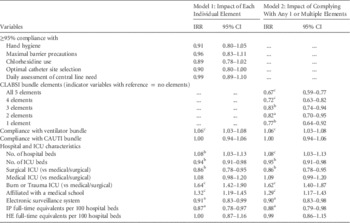
When evaluating CL bundle compliance at ≥95%, no individual bundle element was significantly associated with decreased CLABSI rates, although trends suggested that each element was protective (Table 4, model 1). When evaluating the impact of the number of bundle elements with ≥95% compliance (Table 4, model 2), lower CLABSI rates were observed for compliance with just 1 element (incidence rate ratio [IRR], 0.77; 95% CI, 0.64–0.92). Compliance with 2–4 elements also led to significant CLABSI reduction; however, ≥95% compliance with all 5 elements was associated with the greatest reduction in CLABSI rates (IRR, 0.67; 95% CI, 0.59–0.77). In both models 1 and 2, we found that compliance with the ventilator bundle was associated with a significant increase in CLABSI rates (IRR, 1.06; 95% CI, 1.03–1.08). There was no association between compliance with the CAUTI bundle and CLABSI rates (IRR, 1.00; 95% CI, 0.94–1.06).
Multivariate Regression Analysis of Associations Between ≥95% Compliance With Central Line Bundle Elements and CLABSI Rates in Adult ICUs

NOTE. CLABSI, central line–associated bloodstream infection; ICU, intensive care unit; CAUTI, catheter-associated urinary tract infection; IRR, incidence rate ratio; CI, confidence interval; IP, infection preventionist; HE, hospital epidemiologist. In addition to data shown in the table, calendar year and month were also controlled for. a P<.05.
b P<.01.
c P<.001.
Institutional characteristics significantly associated with lower CLABSI rates included smaller overall hospital size but larger ICU bed size, ICU type, and non-teaching hospitals. We found that certain infection prevention and control department resources were associated with lower CLABSI rates, including a larger number of infection preventionists per 100 beds, as well as having an electronic surveillance system.
DISCUSSION
This is the largest study to date evaluating CL bundle compliance in the United States and includes data from nearly 1,000 adult ICUs. Furthermore, this is the largest study to evaluate the relationship between CL bundle compliance and CLABSI rates, including the level of compliance at which lower CLABSI rates are seen, as well as the specific contribution of individual bundle elements and the number of elements needed.
We found that while adoption of the CL bundle was widespread, there was often less than full compliance with the bundle. This is an issue because lower CLABSI rates were seen only in ICUs with high CL bundle compliance. There was no association between CLABSI rates and simply having a written policy for the CL bundle, nor with bundle compliance lower than 75%. These results are similar to our previous study, but here we provide updated data, and the significantly larger sample size in this study allowed for more robust findings.Reference Furuya, Dick, Perencevich, Pogorzelska, Goldmann and Stone 8
We found that as long as at least 1 CL bundle element was performed very well, lower CLABSI rates were achieved; however, it did not appear to matter with which of the 5 bundle elements compliance was high. Controlling for compliance with other elements, no 1 element independently decreased CLABSI rates (model 1). Furthermore, after the first element, additional elements did not add much to CLABSI reduction unless excellent compliance with all 5 elements was achieved (model 2). Nevertheless, compliance with all 5 CL bundle elements was most strongly associated with lower CLABSI rates, with a 33% reduction in CLABSIs. This finding supports the IHI bundle concept, which states that all elements of the bundle should be implemented together. In reality, however, substantial variability and excellent compliance with the entire bundle was rare, with fewer than 20% of adult ICUs achieving this across the United States.
As expected, we found that CLABSI rates correlated with ICU type (eg, burn/trauma ICUs had higher rates than surgical ICUs). Smaller hospitals and those not affiliated with medical schools had lower infection rates, possibly due to a lower acuity of patients and less tertiary care. However, larger ICUs had lower CLABSI rates, perhaps because of the presence of resources such as experienced intensivists.
Infection prevention and control departments with greater resources, with more infection preventionists per 100 beds and with electronic surveillance systems were also associated with lower CLABSI rates. Notably, infection preventionists appear to have a measurable impact on CLABSI prevention. Infection preventionists are likely able to provide educational support and emphasis on appropriate infection prevention efforts, although it is also possible that they are a proxy for institutions that place a higher priority on infection prevention in general.
Our findings demonstrate the impact of taking infection prevention interventions that have been proven to be effective in study and collaborative settings and transferring them to the real-world setting. The Keystone ICU project in Michigan involved implementation of the 5 components of the CL bundle, and a significant reduction in CLABSI rates was achieved. Compliance with the intervention was not described, but it is reasonable to assume that because attention to the intervention was high, compliance was probably good.Reference Pronovost, Needham and Berenholtz 5 The VA ICU CLABSI initiative was implemented across all VA ICUs, and “composite” compliance with the CL bundle increased from 85% to 98% by the end of the study period. CLABSI rates were significantly correlated with this compliance, although they did not separate out the impact of individual bundle elements.Reference Render, Hasselbeck and Freyberg 6 Similar findings have been reported from other collaboratives as well.Reference Bion, Richardson and Hibbert 12 , Reference Koll, Straub, Jalon, Block, Heller and Ruiz 13 Marsteller et alReference Marsteller, Sexton and Hsu 14 demonstrated more definitively a causal relationship between the CL bundle and CLABSI rates through a multicenter phased, cluster-randomized controlled trial, but they also did not measure compliance to the bundle, nor did they distinguish the impact of the CL bundle (or its individual components) from that of other interventions that were implemented to improve the culture of safety in the institutions. However, outside of such collaboratives and the VA system, we found that there is significantly greater heterogeneity in the mix of adult ICUs across the United States.
Limitations of this study include the fact that CL bundle compliance data were collected by self-report from the hospitals’ infection prevention and control departments, leading to the possibility of self-reporting bias. By contrast, CLABSI rates were accessed directly from NHSN, but it is possible that institutions trying to appear better might underreport CLABSI rates to NHSN as well as overreport CL bundle compliance in our survey. This possibility is largely mitigated by our analysis of compliance with the ventilator and CAUTI bundles and their association with CLABSI rates. One would expect hospitals that are trying to appear better to also overreport compliance with the other care bundles, leading to a spurious association between ventilator or CAUTI bundle compliance and CLABSI reduction. However, we found the opposite, with higher ventilator bundle compliance associated with higher CLABSI rates. This makes self-reporting bias much less likely. It also suggests that CL bundle compliance is not just a proxy for hospitals with a better general culture of safety but rather that there is a very specific association between these particular CL-targeted interventions and lower CLABSI rates. Furthermore, it suggests that institutional resources and time are finite, and when attention is shifted toward care of ventilated patients, CLABSI prevention may suffer and rates may increase.
Another potential bias is sample selection. We compared participating hospitals to those in NHSN that did not participate and based on this comparison it is likely that our sample is composed of higher performers; therefore, our findings would be conservative. Finally, there is always the possibility of unmeasured confounding affecting the observed associations between compliance with CL bundle elements and CLABSI rates, although we did control for numerous different factors as described above.
In this large national survey of adult ICUs in the United States, lower CLABSI rates were significantly associated with CL bundle compliance, as long as the compliance was high (≥95%). Compliance with the entire bundle was most effective, but even excellent compliance with 1 bundle element was associated with significantly lower CLABSI rates. The variability in compliance across ICUs suggests that, at the national level, room for improvement in CLABSI reduction remains.
ACKNOWLEDGMENTS
We would like to express our gratitude to the NHSN participants.
Financial support. This study was funded by a grant from the National Institute of Nursing Research (grant no. R01 NR010107). The content is solely the responsibility of the authors and does not necessarily represent the official views of the National Institute of Nursing Research or the National Institutes of Health.
Potential conflicts of interest. All authors report no conflicts of interest relevant to this article.