INTRODUCTION
Research has shown that violence and aggression are among the main reasons for admission amongst psychiatric intensive care unit (PICU) service users (Barlow et al. Reference Barlow, Greeyer and Ilkiw-Lauvalle2000; Pereira et al. Reference Pereira, Sarson, Bhui and Paton2005). Psycho-education can be a good first step in treating the seriously mentally unwell (O'Loughlin et al. Reference O'Loughlin, Evans and Sherwood2004), in particular, anger management interventions (Renwick et al. Reference Renwick, Black, Ramm and Novaco1997; Watt & Howells, Reference Watt and Howells1999) and cognitive behavioural therapy (CBT) approaches (Beck & Fernandez, Reference Beck and Fernandez1998; Bradbury & Clarke, Reference Bradbury and Clarke2006) have been found to be effective interventions for understanding and reducing aggression. Furthermore, national PICU standards (Department of Health, 2002) state that psychosocial interventions should be provided addressing violence and aggression. However, despite evidence highlighting the appropriateness of anger management programmes (e.g., Deffenbacher, Reference Deffenbacher1999; Novaco, Reference Novaco1975a, Reference Novaco, Monahan and Steadman1994; Taylor, Reference Taylor1988) recent research suggests that such interventions are only offered in a minimal number of PICU units (Dawson et al. Reference Dawson, Kingsley and Pereira2005).
This article describes the application of a CBT informed anger management programme in a nine-bed inner city PICU in the south of England. In this clinical environment a significant number of service users displayed anger management difficulties frequently resulting in violent and aggressive behaviour, self harming behaviours and damage to property. This paper sets out to describe the content and implementation of a CBT informed anger management intervention in a PICU environment, highlighting some of the challenges of this work, and presents preliminary pre- and post-intervention data of frequency of incidents of violence and aggression.
Group implementation, adaptations and considerations for the PICU setting
A six session anger management programme was initially developed by clinical psychologists and training was given to members of the multi-disciplinary team who expressed an interest in facilitating the sessions. The programme, which ran on the PICU from February 2007 to April 2008, was initially implemented within the unit through the collaborative working of clinical psychologists, trainee clinical psychologists and occupational therapists. The sessions were subsequently facilitated by occupational therapists, mental health practitioners and mental health nurses.
When reviewing the initial programme in March 2008, it was noted that the majority of service users only attended session one and no service user progressed beyond session two. It was therefore agreed that the number of sessions should be reduced in order to impart the most pertinent information in a shorter intervention. A trainee clinical psychologist and an occupational therapist made the necessary changes and developed a two session programme with simplified content. This was run twice a week ensuring that all those attending had the opportunity to complete the course before transfer or discharge from the PICU.
It was challenging to run service user-centred group sessions which met individual’s needs on the PICU as, due to the varying wellbeing of the service users, they generally processed information at different paces and were able to retain varying amounts of information. Therefore, the group sessions were only run if the service users engaging were functioning at similar levels. Consequently sessions were predominantly run on either a two-to-one or one-to-one basis, which better met service users’ individual needs. The two session programme has been running since April 2008.
Group programme outline
Session one – understanding anger and how to recognise it
Within the first session, service users were welcomed, introduced to each other, and ground rules were discussed. These included confidentiality (and boundaries of this), commitment (to stick with the programme and work on coping techniques) and control (to share only what they felt comfortable with). Service users were encouraged to add any of their own ground rules. It was highlighted that the sessions were a forum to discuss anger and not a place to get angry in. Service users were advised that if they felt that they were becoming angry when discussing a particular issue, then they were to leave the room and return when they felt calmer.
The rest of the session focused upon the service users’ understanding of anger and its functions. Service users were asked to reflect on events over the last week and recall a time where they felt or became angry. This incident was then broken into four component parts: the person’s emotions, their thoughts, their behaviour and any physiological signs observed (Beck, Reference Beck1995). This was usually drawn on a white board using a diagram known as the ‘hot cross bun’. It was emphasised that we cannot control our emotions, but we can change our behaviour and learn how our emotions and thoughts link to our behaviour. Service users were taught that changing how we think about perceived events can also help change our behaviour. This exercise also helped service users identify personal early warning signs of anger.
Positive and negative aspects of anger and situations when anger can become a problem were then discussed. The ‘hot cross bun’ was revisited and anger as an emotion and aggression and violence as behaviours were differentiated. It was important to review how each individual experienced anger in their body, in order to aid the identification of early warning signs and recognise the need to act skilfully as soon as arousal signs are noticed. At the end of session one, service users were given ‘homework’ to complete before session two commenced. This involved keeping a record of ‘experiencing anger in my body’ based on the ‘hot cross bun’ model.
Session two – coping techniques, values and choices
At the start of session two, the ground rules agreed in session one were reviewed, and the service users’ homework was discussed and formulated into a ‘hot cross bun’. Following this a discussion about desirable versus less desirable coping methods currently used by service users was facilitated. Then information about coping skills and techniques for managing the early signs of anger was presented. Service users were encouraged to practice breathing exercises and grounding skills.
Service users were then supported to consider the consequences of the choices they make when they are angry. A ‘choices flow-chart’ helped demonstrate choices made when dealing with anger and consequences associated with these. Service users talked through the ‘ten, ten, ten, ten rule’ whereby they were asked to consider the consequences of any action they may take when angry and how these consequences will affect them in 10 minutes, 10 days, 10 months and 10 years. Supporting service users to identify what they valued in their life helped motivate behaviour change. Key points to aid skilful responses when becoming angry were then reviewed. Finally service users discussed how they could help themselves and be supported by staff to practice these skills.
METHOD
Data was collected on the demographics of each service user who participated in the anger management intervention. Additionally the frequency of incidents of violence or aggression (i.e. verbal abuse, threatening behaviour or physical aggression towards property or people) instigated by those participating in the intervention and recorded within the multi-disciplinary notes or within the ward incident book were collected pre- and post-intervention. The pre-intervention period consisted of the fourteen days prior to the start of the intervention. The time between the first anger management session and the last one completed by the service user on a single admission was considered to be the treatment period and thus data was not collected within this time frame. The post-treatment period included the fourteen days after the service user had completed their last session. The review of the anger management intervention formed part of continuing service evaluation as approved by the local Head of Research and Development within the Trust.
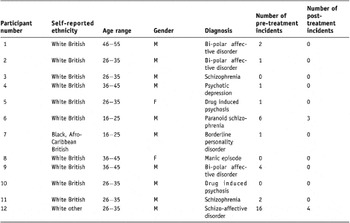
Table of demographics and pre- and post-intervention incidents of violence and aggression

RESULTS
Data was collected on twelve service users who engaged in the anger management intervention (see Table 1). Those that attended were more likely to be male and the majority of participants described themselves as white British. The most common age range was 26 to 35 years old. A Wilcoxon matched-pairs signed rank test comparing the frequency of violent and aggressive incidents indicated a statistically significant decrease post-intervention (mean = 2.8) compared to pre-intervention (mean = 0.6; p = 0.007).
DISCUSSION
This paper has described the content and implementation of a CBT informed anger management intervention in a PICU environment. Practitioners successfully delivered anger management sessions in this setting; however changes to the open ward programme were necessary in order to make the intervention more accessible and practicable. In particular, it was necessary to shorten the number of sessions, and deliver the intervention flexibly (in small groups or one-to-one sessions) in order to aid retention. Reducing the programme to two sessions ensured that service users were able to complete the programme before being transferred to another unit or ward. Additionally, the sessions were tailored around each service-user’s particular experience, in order to facilitate opportunities for engagement and allow facilitators to respond to individual needs.
Preliminary data indicated a significant decrease in violent and aggressive incidents on the ward in the two week period following participation in the anger management programme. Engagement in anger management sessions also appeared to foster therapeutic relationships, build confidence and trust through collaborative work and promote engagement in other therapeutic interventions. Although the results show a significant decrease in challenging behaviour following the programme, we cannot be sure that this was primarily due to service users attending the sessions. Other contributing factors may include the low stimulus environment; service users taking prescribed medication and/or a general progression of well-being. A further factor which may contribute to type 1 error is the potential impact of ‘regression to the mean’ whereby pre-intervention means which are above average may regress towards the average, even if the intervention has little effect. This may create a difference which is misattributed to the intervention. A larger, controlled study incorporating longer term follow-up measures would be useful, in order to test these factors.
Despite these limitations, informal quotes from service-users indicated that they had found the intervention useful:
The group’s good. It will help me in the future (Male PICU service user, 2009)
What was good? I learnt a lesson from it and can deal with issues better (Male PICU service user, 2009)
Data is currently being collected on the service users’ level of anger and their confidence in using coping strategies pre and post anger management interventions on the PICU. We also hope to collect more in-depth qualitative data on the service users’ experiences of the intervention and start to consider factors effecting readiness to engage in anger management interventions on the PICU in the future.
In conclusion, the implementation of this group demonstrates that anger management can be successfully undertaken in a PICU environment provided that the sessions are informative yet brief and used flexibly to meet individual service user needs. It would seem that there is a paucity of this type of intervention on PICUs and the results presented appear to challenge commonly held perceptions that service users on a PICU are ‘too unwell’ for psychological interventions.
ACKNOWLEDGEMENTS
The authors would like to thank Dr Viv Cowdril and Kate Willoughby for the development of the programme and assistance with implementing the programme and Vicky Hammond for co-facilitating the programme.