

1 Introduction
The ability of patients to choose their health care provider has become an essential component in many health care systems (Bevan et al., Reference Bevan, Helderman and Wilsford2010; Schlesinger, Reference Schlesinger2010), and is a central element in New Public Management (NPM) reforms. An important concept behind NPM is to let public organizations act within competitive markets to stimulate efficiency, quality and responsiveness to consumer demands. By promoting patient choice, health care providers are given strong incentives to improve their quality to reduce the risk of losing resources from not being chosen (Le Grand and Bartlett, Reference Le Grand and Bartlett1993; Le Grand, Reference Le Grand2007). Access to information about available providers, their range of services and their quality is often stressed as a crucial component of provider choice. The microeconomic theoretical assumption is that well-informed choices will lead to increased competition, which in turn is expected to benefit providers with higher quality and those more in tune with people’s preferences (Le Grand, Reference Le Grand2009).
It is not evident, however, that individuals actually search for information when choosing a provider. Studies show that, following a referral from their general practitioner, about 40% of patients report that they would search for information to help them choose a hospital or medical specialist (Rademakers et al., Reference Rademakers, Nijman, Brabers, de Jong and Hendriks2014; Victoor et al., Reference Victoor, Rademakers, Reitsma-van Rooijen, de Jong, Delnoij and Friele2014). This percentage is notably lower in studies asking patients if they had actually searched for information when choosing a hospital, with about one out of 10 patients reporting that they had done so (Schwartz et al., Reference Schwartz, Woloshin and Birkmeyer2005; Ketelaar et al., Reference Ketelaar, Faber, Braspenning and Westert2014b).
These results indicate relatively low rates of information search in choice of health care provider. This is problematic since uninformed choices may give providers less incentive to compete on quality, and instead encourage a focus on lowering their costs at the expense of quality (Le Grand and Bartlett, Reference Le Grand and Bartlett1993; Le Grand, Reference Le Grand2007).
There is limited knowledge about factors that explain individuals’ engagement in information-seeking. Most literature to date has focused narrowly on individuals’ barriers to making use of available information when choosing a provider. Previous research has, for instance, stressed low levels of health literacy and numeracy as explanations to why comparative performance information is not always used or understood by individuals (Hibbard et al., Reference Hibbard, Peters, Dixon and Tusler2007; Peters et al., Reference Peters, Dieckmann, Dixon, Hibbard and Mertz2007; Zwijnenberg et al., Reference Zwijnenberg, Hendriks, Damman, Bloemendal, Wendel, de Jong and Rademakers2012). Although more choices may lead to greater motivation and personal well-being, experiences from the health insurance market indicate that too many choices could have adverse effects on information use and willingness to switch insurance plans. The costs associated with evaluating several alternatives may outweigh the benefits of actively choosing the most favorable plan in terms of costs and coverage (Hanoch and Rice, Reference Hanoch and Rice2011a). Hence, these studies suggest that people may use information to a larger extent if it was more readily available, trustworthy, relevant, easy to interpret and limited to a smaller choice set (Hibbard et al., Reference Hibbard, Peters, Slovic, Finucane and Tusler2003; Hibbard et al., Reference Hibbard, Greene and Daniel2010; Donelan et al., Reference Donelan, Rogers, Eisenhauer, Mort and Agnihotri2011; Hanoch et al., Reference Hanoch, Wood, Barnes, Liu and Rice2011b; Ketelaar et al., Reference Ketelaar, Braspenning, Faber, Westert and Elwyn2014a). These studies do not, however, clarify why or when individuals are likely to seek information in the first place. A few studies have gone beyond the scope of analyzing the information’s content and format as barriers or facilitators to use, and have studied factors that influence individuals’ willingness to seek information when choosing a provider. Factors found to affect the inclination to search include individuals’ personal characteristics such as age, education, health status, income, gender and ethnicity (Hoerger and Howard, Reference Hoerger and Howard1995; Harris, Reference Harris2003; Tu and Lauer, Reference Tu and Lauer2008; Galizzi et al., Reference Galizzi, Miraldo, Stavropoulou, Desai, Jayatunga, Joshi and Parikh2012; Rademakers et al., Reference Rademakers, Nijman, Brabers, de Jong and Hendriks2014; Victoor et al., Reference Victoor, Rademakers, Reitsma-van Rooijen, de Jong, Delnoij and Friele2014). Factors beyond demographic and social characteristics that have been found to influence the degree of information-seeking include individuals’ willingness to switch to another provider, the distance to providers, earlier experiences of care, the degree of satisfaction with prior care, expectations of differences in provider quality and the degree of knowledge and confidence in managing one’s own health (Hoerger and Howard, Reference Hoerger and Howard1995; Harris, Reference Harris2003; Ketelaar et al., Reference Ketelaar, Faber, Braspenning and Westert2014b; Rademakers et al., Reference Rademakers, Nijman, Brabers, de Jong and Hendriks2014; Victoor et al., Reference Victoor, Rademakers, Reitsma-van Rooijen, de Jong, Delnoij and Friele2014, Reference Victoor, Delnoij, Friele and Rademakers2016).
Previous studies have suggested various explanations for individuals’ level of involvement in information-seeking when choosing a health care provider. However, a comprehensive analytical framework to describe the circumstances under which individuals engage in information-seeking does not exist. This study addresses this gap by turning to mass communication theory in general, and theories on motives for information-seeking in particular. Those theories, further elaborated upon below, show that individuals’ self-perceived motivations are essential to explaining why and when individuals pay attention to, process and learn from the information they encounter (Neuman and Guggenheim, Reference Neuman and Guggenheim2011; Glynn et al., Reference Glynn, Herbst, Lindeman, O’Keefe and Shapiro2015). Hence, this study aims to offer a more exhaustive framework for understanding under what circumstances – i.e. why and when people are likely to search for information in choosing their primary care provider.
1.1 Study setting
The study was conducted in Sweden, where primary care is mostly provided at primary health care centers (PHCCs). Unlike primary care structured around individual GPs as found in most other countries, Swedish PHCCs are staffed by multidisciplinary teams, including general practitioners, nurses and counselors. Services offered include medical examinations, basic treatment, medical care and preventive care services. Some PHCCs also provide prenatal and maternity care, as well as psychologists and dieticians (Isaksson et al., Reference Isaksson, Blomqvist and Winblad2016).
Although PHCCs may be either publicly or privately managed, all are publicly funded through tax revenues collected by the county councils – the regionally organized public authorities responsible for providing health care in Sweden. In general, citizens are urged to register themselves at a PHCC rather than with GPs directly. Choosing a provider is not mandatory, and those who do not choose are ‘passively’ registered at the closest PHCC by the county councils (Socialstyrelsen, 2010).
Previously, essentially all PHCCs were established through central planning systems directed by the county councils. Decisions on where to locate health care centers were based on population statistics on health care needs and the goal of close proximity to a local PHCC for all residents, regardless of their demographic or socio-economic background. Private providers were formally allowed in the system, but their locations had to be authorized by the county councils (Saltman and Bergman, Reference Saltman and Bergman2005; Isaksson et al., Reference Isaksson, Blomqvist and Winblad2016). In this system, patients had no choice of provider and were assigned to the PHCC closest to their residence.
This system changed radically when provider choice was introduced in Swedish primary care via national legislation in 2010, in the so-called primary care choice reform. This allowed citizens to freely choose among all primary care providers throughout Sweden (Sveriges Riksdag, 2014). Furthermore, all private providers who met certain quality requirements were allowed to establish themselves on the same conditions and with the same financial reimbursement as public providers anywhere in the counties. In line with this, citizens were allowed to choose private or public providers at the same cost. A central motive behind the reform was to create a more market-based system, with the intention of increasing quality, accessibility and private entrepreneurship (Fredriksson et al., Reference Fredriksson, Blomqvist and Winblad2013). Subsequent evaluations of the reform have demonstrated that it successfully increased the number of providers, predominantly in the form of for-profit and privately run PHCCs (Andersson et al., Reference Andersson, Janlöv and Rehnberg2014).
Sweden makes an interesting context for the purpose of this study given the existence of key facilitators and barriers to actively seeking information when choosing a primary care provider. An important incentive for information-seeking is an actual need to choose or switch provider. Facilitators for information-seeking are thus that patients are aware about their right to choose, that they can easily switch providers and that there are differences in the range of services and quality offered by providers. In the Swedish primary care system, citizens can switch provider any time during the year and access to health care is essentially free of charge, with only about 4% of total costs represented by user fees (Anell et al., Reference Anell, Glenngard and Merkur2012). Also, 80% of citizens have at least two health centers to choose from, and 95% are aware about their right to choose (Konkurrensverket, 2014). There are large variations between Swedish PHCCs in terms of services offered, accessibility and patient responsiveness (Myndigheten för vård- och omsorgsanalys, 2017). Together, these factors provide a rationale for information-seeking and comparisons between primary care providers.
Another facilitator for information-seeking is easy access to information. This is supported by the Swedish legislation on provider choice, which stresses the role of information in supporting well-informed choices. All county councils are obliged to provide citizens with easily accessible and comparative information about the different providers available (Sveriges Riksdag, 2008). Available comparative information includes opening hours, accessibility in terms of waiting times for appointments and patient satisfaction rates. There is also some information about providers’ medical quality, although this is limited to a few indicators (1177 Vårdguiden, 2015).
A significant share of the comparative information is provided through the county councils’ common web pages. Since more than 90% of the Swedish population (12+ years) has access to the Internet and 80% uses the Internet on a daily basis, this should further facilitate information-seeking (Findahl and Davidsson, Reference Findahl and Davidsson2016).
However, barriers to information-seeking also exist, mainly in the form of low patient involvement in choice. An evaluation of the primary care choice reform found that, although two out of three Swedish citizens had actively chosen a primary care provider, only 30% chose to switch to a provider other than the one assigned by the county council based on proximity (Konkurrensverket, 2014). Reasons for not switching are not well explored in the Swedish setting, but one earlier study found that a majority of citizens did not switch due to satisfaction with their current provider. Other barriers to switching, but reported to a lesser extent, included a lack of time, no available alternative providers nearby and a general ‘choice fatigue’ (Myndigheten för vård- och omsorgsanalys, 2013). Additionally, citizens do not always have access to preferred providers due to waiting times to enlist at certain health centers. Overall, these barriers to provider choice might reduce individuals’ need for information, and hence their willingness to seek information.
2 Predictors of information-seeking
To be able to explain under what circumstances, i.e. when and why, people search for information when choosing a primary care provider, we turn to theories on information-seeking derived from mass communication research.
Motive is vital for mass communication research aimed at explaining the reasons why individuals search for information. The point of departure is that information-seeking is motivated by a felt need for information (Case, Reference Case2007), where ‘need’ is defined by Grunig (Reference Grunig1989: 209) as an ‘inner motivational state’ that brings about thought and action. Hence, people engage in information-seeking to make use of the information to achieve something, and not primarily because it is made available. In the context of this study that achievement would be to attain more knowledge about available primary care providers. But often the need of something is evolved around a pre-existing need, for instance in the choice of provider, to receive better health care. A common denominator is that ‘a need’ is always instrumental in that it involves reaching a goal (Case, Reference Case2007).
Motivations can be both cognitive and emotional, and the literature suggests that they are contextual or situational in the sense that the triggering factor is evolved around the individual’s experience of a given situation rather than her/his demographic, social or cultural background (Dervin et al., Reference Dervin, Foreman-Wernet and Lauterbach2003). These situations come into existence when an individual experiences a need to seek answers to questions, is urged to reduce the feeling of uncertainty or anxiety, is compelled to make a decision or must solve a problem (Taylor, Reference Taylor1962; Belkin et al., Reference Belkin, Oddy and Brooks1982; Kuhlthau, Reference Kuhlthau1993, Reference Kuhlthau2004; Grunig, Reference Grunig1997). Since these situations involve some kind of information-gathering to resolve the problematic situation or to reduce the feeling of uncertainty, they mobilize information-seeking. For instance, a person who hesitates or feels anxious about which primary care provider to choose will more likely seek information to find the best alternative.
In the following study, we will explore if individuals’ self-perceived motivations, expressed as the need to resolve problems or clarify uncertainties, are useful predictors in explaining under what circumstances individuals search for information when choosing a primary care provider.
3 Methods
3.1 Design and data collection
The results presented are based on a survey distributed to the general Swedish population, aged 15 years or older. The research ethics board at the University of Uppsala approved the study.
3.1.1 Recruitment and participants
A net sample of 3150 respondents, divided in quotas according to the geographical organization and population size of Swedish county councils, was calculated. Survey respondents were randomly drawn from an online panel of about 100,000 panelists and invited to answer a web-based questionnaire, which was distributed until the calculated net sample was reached. The method for data collection is common when using online panels and was chosen to enable analysis on a regional and on a national level. Data collection was performed during spring of 2013. The panel was developed and maintained by the for-profit, Swedish-based market research company, TNS Sifo (currently KANTAR SIFO). Panelists were exclusively recruited from other studies based on random population samples, and panels retained by TNS SIFO. Hence, it is not possible for individuals to ‘freely register’ for the panel. Also, panelists can only participate in a restricted number of surveys per month, year and topic, and have to exit the panel after two to three years.
3.1.2 Questionnaire
The questionnaire consisted of 39 questions, 13 of which were relevant to this article. The development of the questionnaire was informed by a thorough review of studies on the public’s use of publicly reported information.
To maximize face and content validity of the survey instrument, interviews and a focus group study were performed with respondents with experience in choosing providers. Finally, the questionnaire was modified to increase comprehension and readability following a pre-test on 106 respondents, randomly drawn from the online panel mentioned above.
All respondents were asked an initial screening question about whether they had a recent experience of choosing a primary care provider or not, as well as some socio-demographic questions. The screening question consisted of four response alternatives: (1) if respondents had switched primary care provider during the last 12 months, (2) if respondents had switched primary care provider during the last three years, (3) if respondents had not switched but considered switching provider the last 12 months and (4) if respondents had neither switched nor considered switching the primary care provider. The remaining part of the questionnaire was divided into three sections, which were targeted to respondents based on their response to the screening question. Questions focused on reasons for switching, the degree of information-seeking and information preferences.
3.2 Measures
According to the literature accounted for earlier in this study, information-seeking most likely occurs when there is an effective need of information, in this case the need of finding a new provider. Hence, in the analysis, we only include individuals who have switched (switchers) or considered switching provider (potential switchers); that is, we omit respondents who answered that they had neither switched nor considered switching the primary care provider in the initial screening question of the survey (omitted n=2111, final sample n=1039).
The dependent variable ‘information search’ was derived by merging two survey questions: ‘To what extent did you search for information prior to your switching of primary care provider?’ and ‘To what extent did you search for information prior to your potential switching of primary care provider?’ Respondents had six response alternatives: not at all, to a little extent, to a neither large nor small extent, to a large extent, to a very large extent and don’t know. Hence, the survey questions focused on information-seeking in general and not specifically what information types or information sources respondents turned to when choosing a provider.
The independent variables were derived from the theoretical framework outlined earlier in the study and were operationalized by two survey questions: ‘Which of the following was the most important reason when you switched primary care provider?’ and ‘Which of the following reasons was the most important when you considered switching primary care provider?’ Respondents could select between seven response options, of which five were constructed to reflect central motivations of information-seeking identified in the mass communication literature – e.g. the experience of a problematic or uncertain situation. These were ‘moving house,’ ‘primary care provider closed offices,’ ‘a new primary care provider opened,’ ‘dissatisfaction with earlier primary care provider’ and ‘another primary care provider seemed better.’ ‘Another reason’ (open-ended question) and ‘Don’t know’ were excluded from the analysis.
In addition to the independent variables reflecting individuals’ self-perceived motivations for seeking information, we included demographic and socio-economic independent variables. Variables were those that have been found in the literature to be important predictors of individuals’ information-seeking (Hoerger and Howard, Reference Hoerger and Howard1995; Harris, Reference Harris2003; Tu and Lauer, Reference Tu and Lauer2008; Galizzi et al., Reference Galizzi, Miraldo, Stavropoulou, Desai, Jayatunga, Joshi and Parikh2012; Rademakers et al., Reference Rademakers, Nijman, Brabers, de Jong and Hendriks2014; Victoor et al., Reference Victoor, Rademakers, Reitsma-van Rooijen, de Jong, Delnoij and Friele2014). These are gender, age, education, employment, income, place of residence and self-rated health. Also, number of visits to a primary care provider in the last 12 months was included as an additional indicator of care need.
3.3 Statistical analysis
Descriptive statistics were used to describe the study population and to what extent the two groups of respondents – switchers and potential switchers – searched for information. Multiple logistic regression models were conducted on a dichotomized version of the dependent variable, where the value zero represents the response alternative ‘not at all,’ and the value one represents ‘to a little extent,’ ‘to a neither small nor little extent,’ ‘to a large extent’ and ‘to a very large extent.’ In the first regression analysis, we identified the association between considering switching due to self-perceived motivations and information-seeking while controlling for demographic and socio-economic characteristics. In the second analysis we tested the same association with actual switchers.
4 Results
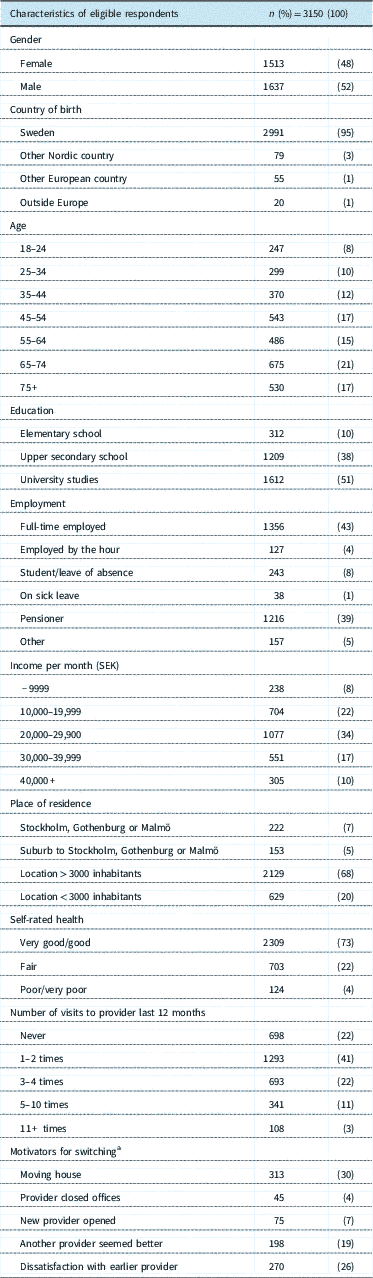
Table 1 summarizes the data and shows an even distribution of respondents regarding gender and age, but with a preponderance of elderly (65 or older). Only 5% of the respondents are foreign-born, and consequently we were not able to analyze information search behavior for this group.
Descriptive statistics for eligible respondents

Note: Proportion of respondents who replied ‘No answer/Do not know’ is as follows: country of birth (0.1%), education (0.5%), employment (0.4%), income (9%), place of residence (0.5%), self-rated health (0.4%) and number of visits to the provider in last 12 months (0.5%).
a Respondents who answered that they had not switched nor thought about switching did not respond to this question (n=2111). Proportion of respondents who replied ‘Another reason’ was 12% and ‘Don’t know’ was 0.6%.
Full-time employees, pensioners, respondents with a relatively high education level and good self-rated health dominate the sample. A majority live in a location with more than 3000 inhabitants.
4.1 The general extent of information-seeking
To better understand under what circumstances individuals seek for information, we first give an overall picture of the extent of information-seeking regarding primary health care providers. It shows that individuals, for whom the information would be relevant since they switched or thought about switching providers, search to a very limited extent (Figure 1).
The extent to which respondents searched for information when switching or considering switching the primary care provider (percent) (n=1039). Note: Respondents omitted are those who answered that they had not switched nor considered switching the primary care provider (n=2111) to the question ‘Which statement is true for you?’

A majority of both switchers and potential switchers responded that they did not search for information at all or to a little extent. However, the extent of information-seeking is slightly higher among switchers than potential switchers. Among the switchers, 17% responded that they had searched for information to a very large or large extent, while only 7% among the potential switchers did so.
4.2 Predictors associated with higher levels of information-seeking
Although respondents in general sought for information to a limited extent, certain conditions seem to be associated with higher levels of information-seeking.
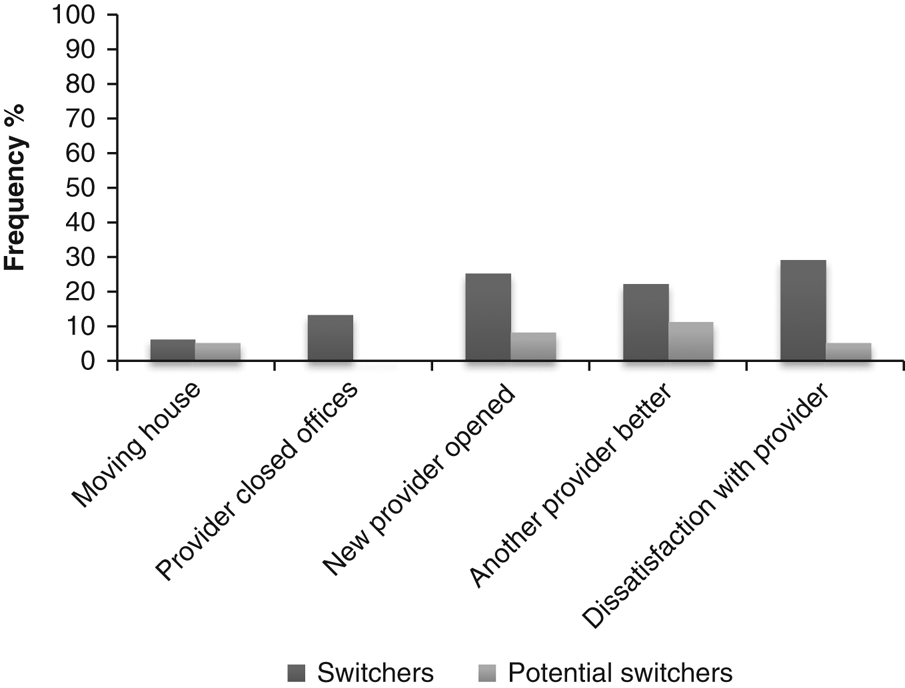
Figure 2 demonstrates that having switched or considered switching due to ‘a new provider opened’ or ‘another provider seemed better’ mobilize a somewhat greater search activity in both groups. Of the switchers, 25 and 22%, respectively, responded that they searched for information to a large or very large extent within these specific categories. The same pattern, although weaker, is seen among respondents who only considered switching – 8 and 11%, respectively, searched for information to a large or very large extent within these same categories. Yet, while almost a third (29%) among the switchers searched for information to a large or very large extent due to dissatisfaction, only 5% did so among the potential switchers.
The extent to which respondents searched for information to a large/very large extent due to different motivations for switching or considering switching (percent). Note: Respondents were omitted if they answered that they had not switched nor considered switching the primary care provider to the question ‘Which statement is true for you?’ (n=2111) and ‘Other reason’ (n=131) (13%) or ‘Don’t know’ (n=7) (0.6%) to the questions ‘Which of the following reasons was the most important when you switched primary care provider?’ and ‘Which of the following reasons was the most important when you considered switching primary care provider?’. The most common answer to the open-ended question ‘Other reason’ was that respondents’ chosen doctor switched to another primary care provider or retired. Other indicated reasons were, e.g., that the respondent wanted to belong to the same provider as other family members, that the provider offered certain services such as counselor or laboratory for medical sampling or that the respondent was not yet enlisted to a certain provider.

Lower levels of information-seeking were found among those switching or considering switching due to moving house or that the current provider closed. For instance, only 6 and 5% of switchers and potential switchers, respectively, searched for information to a large or very large extent due to moving house.
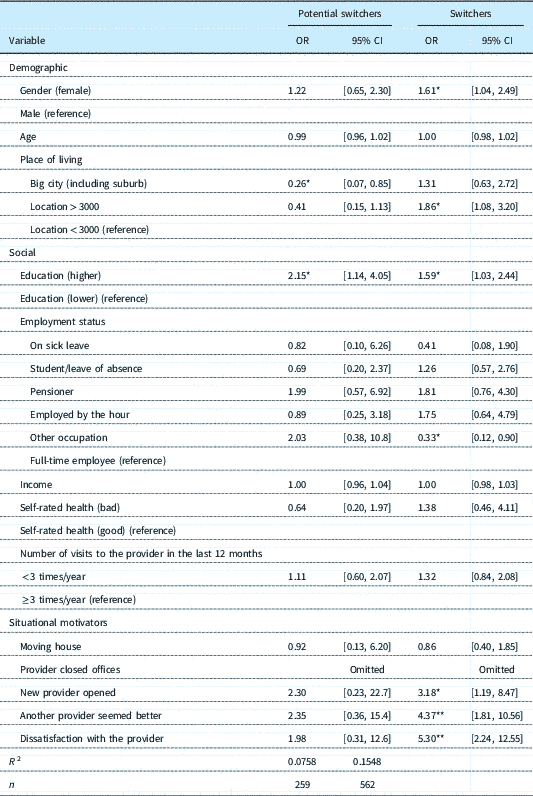
In Table 2 the correlation between respondents’ self-perceived motivations for switching primary care provider and the probability of information-seeking is tested while controlling for background characteristics.
Predictors of information-seeking

Note: OR=odds ratio; CI=confidence interval.
The dependent variable is ‘information-seeking’, which was measured on five levels but was dichotomised (0=‘not at all’; 1=‘to a small extent,’ ‘to a neither small nor large extent,’ ‘to a large extent,’ ‘to a very large extent’) for analytical reasons. The education variable was measured on three levels (elementary school, upper secondary school and university studies) but was dichotomised (lower education level vs. higher education level). Income was measured with five different intervals but was turned into a continuous variable to facilitate analysis. Self-rated health condition was dichotomised from three levels: very good/good, fair, poor/very poor into good and bad health condition. Number of visits to provider was dichotomised from five levels (0 times, 1–2 times, 3–4 times, 5–10 times, 11 or more times) into less than three times a year and three or more times a year.
*p<0.05; **p<0.001.
When analyzing potential switchers separately, we find that respondents who live in a big city and have a higher level of education are significantly associated with a likelihood of information-seeking. Living in a big city decreases the odds of information-seeking by 26%, whereas a higher education level increases the odds by 115%. However, none of the self-perceived motivations are found to be significant explanations of information-seeking among respondents who have considered switching but not done so.
Among switchers, being a woman, living in a city with more than 3000 inhabitants and higher education levels render a significant positive influence on the likelihood of information-seeking. Furthermore, ‘another occupation’ decreases the odds for information-seeking by 33%. Yet, the strongest effects were found in relation to ‘a new provider opened,’ ‘another provider seemed better’ and ‘dissatisfaction,’ with an increase in the odds ratio of more than 200% up to 430%. The results also suggest a negative relationship between the independent variable ‘moving house’ and information-seeking, though this effect was not significant. ‘Provider closed offices’ was omitted for both groups because of too few eligible respondents (n=45).
5 Discussion
The purpose of this study was to identify under what circumstances, i.e. when and why, individuals search for information when choosing a primary care provider. The overall picture is consistent with previous studies, indicating that not even individuals for whom the information would be relevant search for information to any significant extent prior to their choice of provider (Schwartz et al., Reference Schwartz, Woloshin and Birkmeyer2005; Ketelaar et al., Reference Ketelaar, Faber, Braspenning and Westert2014b; Rademakers et al., Reference Rademakers, Nijman, Brabers, de Jong and Hendriks2014; Victoor et al., Reference Victoor, Rademakers, Reitsma-van Rooijen, de Jong, Delnoij and Friele2014). Just 17% of switchers and 7% of potential switchers responded that they searched for information to any extensive degree.
Still, we can conclude that certain conditions are correlated with significantly higher levels of information-seeking as suggested in earlier mass communication research. Having switched primary care provider ‘due to a new provider opened,’ ‘another provider seemed better’ and ‘dissatisfaction with provider’ were all significant predictors of information-seeking. Hence, switchers’ experiences of having to solve a problem, such as having to find a new provider due to dissatisfaction with respect their current provider, or clarifying thoughts in a situation of uncertainty when considering another provider seem to be important motivations for information-seeking. These results hold even when expected influential background variables, such as gender and education, were taken into account. Similar conclusions were developed by Harris (Reference Harris2003), who found that a greater willingness to switch physicians and dissatisfaction with one’s current provider were strong predictors of use of information.
The results highlight the importance of taking individuals’ self-perceived motivations into account when explaining when and why they search for information in the choice of a health care provider. In fact, individuals’ demographic and socio-economic characteristics seem to play a less prominent role in information-seeking than previously assumed. However, it must be stressed that, for instance, respondents’ educational background and gender were, in line with earlier studies, also significant predictors of information-seeking.
While several predictors reflecting switchers’ experience of a problem or uncertainty related to their current provider were found to be significant, not all of them were. ‘Moving house’ was negatively but nonsignificantly associated with information-seeking. Hence, it seems as though switchers’ internally driven motivations, such as perceiving that a provider is better than another or dissatisfaction with a current provider, leads to higher odds of being an information-seeker than does the more externally provoked motivation of moving house. It might be that having to switch provider due to dissatisfaction evokes a stronger experience of a problem, and hence the need of seeking information, than just moving house. The results further support the theoretical assumption that individuals’ information need evolves in situations, which strongly trigger motivations of information-seeking. Having actually switched provider seems to stimulate a greater need of information-seeking than among respondents who have just considered switching, probably due to the more urgent need of finding another provider.
The study generates two important policy implications. First, the results underline the importance of monitoring of health service quality as a complement to the choice model in which citizens are supposed to send signals about inferior quality through their choices. Even individuals that are more likely to engage in information-seeking due to switching or considering switching provider do not seek out information to any extensive degree in their choice of health care provider. This may lead to providers shirking on quality, and providers with poor quality being more likely to remain in the market.
Second, earlier research on provider choice information suggests that individuals would use quality information to a larger extent if it was more readily available, easy to interpret and provided by trustworthy sources (Fasolo et al., Reference Fasolo, Reutskaja, Dixon and Boyce2010; Hibbard et al., Reference Hibbard, Greene and Daniel2010; Donelan et al., Reference Donelan, Rogers, Eisenhauer, Mort and Agnihotri2011). Yet, this study implies that individuals will not engage in information-seeking just because it is available or well designed. Instead, individuals’ motives for information-searching, e.g., switching due to experiencing a problem with their current provider, are at least as important – if not more important– in explaining under what circumstances people seek information.
Hence, there are reasons to have more moderate expectations on the public’s general interest in information on provider choice. Rather, this study suggests that focus should be on ensuring that the information is made available to those who effectively need it. However, further studies are warranted to examine the type of information and what sources that guide more active information seekers in their choice of provider.
6 Limitations
Our analysis has some limitations. The sample used was a non-probability sample. This disabled an analysis of non-respondents and non-response bias and might have had a negative impact on the degree of generalization of study results. In addition, the sample was somewhat biased with respect to place of birth, age, education, occupation and income. When compared to the Swedish population, respondents were to a larger extent full-time employees, senior, native-born individuals with higher education and incomes (Statistiska centralbyrån, 2013a, 2013b, 2013c, 2013d, 2013e, 2013f, 2013g, 2013h). Further, a comparison regarding number of visits to the primary care provider with a bigger survey sample, however, not fully comparable due to differences in response options, demonstrates a slight bias towards respondents with relatively few visits a year (0–4 times) (Sveriges Kommuner och Landsting, 2013).
Also, only respondents with access to the Internet were included in the study, since the sample was drawn from an online panel. Findings may therefore have overrepresented or underrepresented opinions of certain groups of respondents and thus limited generalizability to the general population. However, that the sample was biased with respect to age, education, income and active Internet use might in fact have strengthened the study’s results. Results demonstrated that few respondents had searched for information when choosing a primary care provider. This is particularly interesting since an assumption was that active Internet users and groups overrepresented in this study, i.e. elderly, with a high education and income would be more active information searchers. On the contrary, the study sample bias emphasizes that not even groups that are likely to search for more information do so to any substantial extent.
To test the importance of individuals’ experiences of problematic or uncertain situations on information-seeking, we used regression analyses. This means that we measured the effects of each predictor while holding the others constant. We thereby analyzed associations between the independent and dependent variables. However, it should be noted that this methodology excludes possible interaction effects between the variables. It might also be that some correlations are masked indirect correlations. Our analysis will ‘only’ help to identify the most essential direct effects. Interaction and/or indirect effects are excluded here and left for future research.
Also, even though the R 2 of the regression analysis increases from about 8 to 15% when analyzing switchers in Model 2, this indicates that the theoretical framework – as it is operationalized in this case – does not fully explain what predicts information search in the choice of primary care provider. Hence, there are other relevant predictors of information-seeking that were not accounted for in this study.
Furthermore, respondents could only indicate one reason for switching or thinking about switching primary care provider. This was a conscious methodological choice with the purpose to distinguish people’s most important reason for switching and thus predominant situational motive for information-seeking. Yet, it might be that people switch due to more than one reason and that the combination of the different motives would have led to stronger effects on information-seeking than now shown. However, allowing for multiple reasons for switching might also result in a general feeling of fatigue or indifference to choice and consequently lead to a negative impact on the extent of information-seeking.
Acknowledgments
The authors gratefully acknowledge The Swedish Agency for Health and Care Services Analysis (Vårdanalys) for funding the survey in the study. The authors thank Jesper Olsson, MD, at the Swedish Agency for Health and Care Services Analysis for generous help with support in the data collection and commenting on study design.
Financial Support
No sources of funding to disclose.
Conflicts of Interest
The authors have no conflicts of interest to disclose.