
I. INTRODUCTION
The comparably fast oxidation of π-conjugated polymers in ambient atmosphere prevents their use in unprotected (opto-)electronic devices.Reference Fraga Domínguez, Distler and Lüer1–Reference Gevorgyan, Heckler, Bundgaard, Corazza, Hösel, Søndergaard, dos Reis Benatto, Jørgensen and Krebs6
Although chemical antioxidants have been tested successfully in the lab for the protection of organic electronic devices against photo-oxidation,Reference Turkovic, Engmann, Tsierkezos, Hoppe, Madsen, Rubahn, Ritter and Gobsch7–Reference Salvador, Gasparini, Perea, Paleti, Distler, Inasaridze, Troshin, Lüer, Egelhaaf and Brabec9 commercial organic electronics products are protected by packaging them between barriers, which provide protection not only against oxidation of the π-conjugated components but also against the degradation of low work function electrodes or hygroscopic layers by humidity.Reference Lee, Kim, Kim, Youn, Nam, Lee, Lee, bin Mohd Yusoff and Jang10–Reference Dennler, Lungenschmied, Neugebauer, Sariciftci, Latrèche, Czeremuszkin and Wertheimer14 To achieve device lifetimes of several years and at the same time preserve some of the most important advantages of organic electronics, such as light weight and flexibility, high quality flexible barriers films have to be used, which easily may represent the most expensive part of the device.Reference Hauch, Schilinsky, Choulis, Rajoelson and Brabec15–Reference Cros, de Bettignies, Berson, Bailly, Maisse, Lemaitre and Guillerez17 In the quest of reducing the cost of packaging, a lot of mechanistic studies of the degradation processes of optoelectronic devices have been undertaken, which have revealed a comprehensive picture of the culprits for device failure.
Photo-oxidation by molecular oxygenReference Hintz, Egelhaaf, Lüer, Hauch, Peisert and Chassé18–Reference Tournebize, Seck, Vincze, Distler, Egelhaaf, Brabec, Rivaton, Peisert and Chassé22 and oxidation by ozoneReference Hintz, Egelhaaf, Lüer, Hauch, Peisert and Chassé18,Reference Cataldo and Omastová23–Reference Heeg, Kramer, Wolter, Michaelis, Plieth and Fischer29 have been identified as the most relevant mechanisms of oxidation, whereas thermal oxidation has been found to be negligible at temperatures below 100 °C.Reference Chambon, Rivaton, Gardette and Firon20,Reference Manceau, Rivaton, Gardette, Guillerez and Lemaître21
While photo-oxidation prevails in the presence of light, ozonation has turned out to be the dominant mechanism in the dark, even at relatively low ozone concentrations.Reference Sirringhaus30 In this respect, it has to be considered that while ozone concentrations in rural areas usually do not exceed 50 ppb, they can reach concentrations of up to 0.5 ppm in urban regions, in offices with copiers, or in laboratories with high voltage supplies,Reference Britigan, Alshawa and Nizkorodov31 which may lead to rapid ozonation of π-conjugated polymers, particularly during processing in air.Reference Hintz, Egelhaaf, Peisert and Chassé19,Reference Lattimer, Layer, Rhee and Scott32
The ozonation of unsaturated polymers has been studied in depth, due to its practical implications for the lifetime of rubber.Reference Lattimer, Layer, Rhee and Scott32–Reference Layer and Lattimer34 In the ozonolysis of unsaturated polymers, ozone attacks primarily the nonaromatic double bonds of the polymer.Reference Atkinson and Carter35 The reaction of ozone with aromatic compounds is generally much slower, due to the loss of aromaticity upon cleavage of the double bonds.Reference Lattimer, Layer, Rhee and Scott32,Reference Atkinson and Carter35 According to the Criegee mechanism,Reference Criegee36 an electrophilic addition of ozone to the double bond takes place, forming molozonide, which transforms into relatively stable ozonide. Ozonide is decomposed by reducing agents or heating, resulting in chain scission, forming alcohols, aldehydes, ketones, and carbonic acids as products. Also hydroperoxides are formed, especially in the presence of compounds with active hydrogens, such as water.
Ozonation of unsaturated polymers in solution is very fast but is much less so in the solid state. The more crystalline the polymer, the lower the reactivity.Reference Cataldo33 Unstretched samples of diene rubber rapidly absorb about 1.5 ozone equivalents as calculated per surface bond, after which the ozone absorption rate sharply decreases,Reference Erickson, Berntsen, Hill and Kusy37 due to the formation of a protective layer (“frosting”).Reference Cataldo33 For example, ozone has been reported to attack only a thin layer of 0.5 µm of the surface of unsaturated rubber polymers.Reference Lattimer, Layer, Rhee and Scott32,Reference Strobel, Walzak, Hill, Lin, Karbashewski and Lyons38
A wealth of research deals with the stabilization of unsaturated rubber versus ozone.Reference Layer and Lattimer34 WaxesReference Lattimer, Layer, Rhee and Scott32,Reference Layer and Lattimer34,Reference Pankratov, Yanson, Prokof'eva and Yur'ev39–Reference Choi42 and chemical antiozonantsReference Lattimer, Layer, Rhee and Scott32,Reference Bruck and Engels43–Reference Ohm46 have been proposed for static and dynamic protection, respectively. Waxes are constituted of hydrocarbons and form films of several microns in thickness, which are inert and impermeable to ozone.
Over the last twenty years, there have also been occasional reports on the reaction of π-conjugated polymers with ozone.Reference Hintz, Egelhaaf, Peisert and Chassé19,Reference Cataldo and Omastová23–Reference Kang, Neoh, Zhang, Tan and Liaw26,Reference Chabinyc, Street and Northrup28,Reference Cataldo33,Reference Kaduk and Toby47,Reference Czerwiñski, Nowaczyk and Kania48 The reaction rate of π-conjugated polymers lies between those for saturated polymers and polymers with isolated double bonds, due to the delocalization of the charge density along the backbone.Reference Cataldo33 The reaction involves the formation of charge transfer complexes and subsequent formation of positive mobile charge carriers on the polymer backbone (“polarons”),Reference Hintz, Egelhaaf, Peisert and Chassé19,Reference Nowaczyk, Czerwiński and Olewnik24,Reference Cataldo33 as well as chemical oxidation to carbonyls, carboxylic acids, and hydroperoxides.Reference Hintz, Egelhaaf, Peisert and Chassé19,Reference Cataldo and Omastová23–Reference Kang, Neoh, Zhang, Tan and Liaw26,Reference Cataldo33 The reaction pathways of oxidation depend on the chemical nature of the polymer. While polypyrroles almost exclusively exhibit oxidative cleavage of the C–C-backbone, leaving the N-atom untouched,Reference Kang, Neoh, Zhang, Tan and Liaw26,Reference Cataldo33 polythiophenes also react at the sulfur atom, yielding sulfones initially, which are further oxidized to volatile products.Reference Hintz, Egelhaaf, Peisert and Chassé19,Reference Nowaczyk, Czerwiński and Olewnik24,Reference Kang, Neoh, Zhang, Tan and Liaw26,Reference Bailey27,Reference Bailey and Hwang49 Studies of the mechanism on the model compound 2,4-diphenylthiophene suggest an initial electrophilic attack of ozone at the α-carbon position,Reference Bailey27 yielding diphenylbutenedione. Pendant alkyl groups remain more or less unaffected.Reference Hintz, Egelhaaf, Peisert and Chassé19,Reference Nowaczyk, Czerwiński and Olewnik24 While some groups have observed preferential oxidation of the film surface,Reference Cataldo33 other groups have claimed homogeneous penetration of the film.Reference Hintz, Egelhaaf, Peisert and Chassé19,Reference Kang, Neoh, Zhang, Tan and Liaw26
Chabinyc et al. found that in the dark, doping and subsequent irreversible damage of poly(3-hexylthiophene) (P3HT)-based organic field effect transistors (OFETs) in ambient atmosphere are caused by ozone, rather than by oxygen.Reference Chabinyc, Street and Northrup28 They speculate that the enhanced stability of OFETs with polymeric top gate dielectrics or thin polymeric encapsulation layers is due to the protective action of the polymer.Reference Chabinyc, Street and Northrup28,Reference Rost, Ficker, Alonso, Leenders and McCulloch50,Reference Zaumseil and Ludwigs51 As polymer films of few hundred nanometers in thickness seem to be poor gas diffusion barriers, they suggest that their protective effect is due to the destruction of ozone by chemical reaction. To test this hypothesis, we have investigated the possibility of protecting thin films of π-conjugated polymers against ozone in the dark by coating thin layers of low-cost polymers on top of these films. P3HT and poly[2-methoxy-5-(3′,7′-dimethyloctyloxy)-1,4-phenylenevinylene] (MDMO-PPV®) were chosen as representatives of π-conjugated polymers without and with exocyclic double bonds. P3HT has been one of the most popular active materials in OFETsReference Bao, Dodabalapur and Lovinger52 and in organic solar cells.Reference Lungenschmied, Dennler, Neugebauer, Sariciftci, Glatthaar, Meyer and Meyer53 MDMO-PPV is used as the active material in organic light emitting diodes.Reference Brabec, Shaheen, Winder, Sariciftci and Denk54,Reference Wienk, Kroon, Verhees, Knol, Hummelen, van Hal and Janssen55 Poly(methylmethacrylate) (PMMA) was chosen as the barrier material, due to its frequent use as solution-processed dielectric in OFETs.Reference Sirringhaus30,Reference Brabec, Gowrisanker, Halls, Laird, Jia and Williams56 The reaction of ozone with saturated polymers is usually very slow.Reference Atkinson and Carter35 However, there has been considerable interest in the ozonation of PMMA films on the background of modifying their surfaces for the growth of cells. The formation of oxygen-containing organic groups makes their surfaces more hydrophilic and allows functionalization.Reference Akers, Hoai Le, Nelson, McKenna, O’Mahony, McGillivray, Gubala and Williams57–Reference Hopkins and Badyal60 It has been found that carbonyls, carboxylic groups, and also up to 1.2 × 10⁻⁴ mol/m2 hydroperoxidesReference Fujimoto, Takebayashi, Inoue and Ikada61 are formed, at least some of them in water soluble form.Reference Ponter, Jones and Jansen62
We will show in this work that thin PMMA cover films of few tens of nanometers in thickness, such as gate dielectrics in top gate configurations of OFETs, are sufficiently good diffusion barriers to ozone but hardly react with it, so that they provide efficient and long-lasting protection against the ozonation of organic electronic devices.
II. EXPERIMENTAL
A. Sample preparation
Regioregular P3HT (Merck, Darmstadt, Germany; molecular weight M n ≈ 65,500 g/mol, RR = 95%) was dissolved in oDCB (Sigma-Aldrich, Darmstadt, Germany; 99% purity, 2% w/w) at 80 °C for 10 h. Thin layers of P3HT were coated at 100 °C on cleaned microscope slides (Menzel Gläser, Thermo Scientific, Waltham, MA; 15 min acetone and 15 min isopropanol in ultrasonic bath) by doctor blading (Coatmaster 509, Erichsen, Iserlohn, Germany; 350 µm blade height, 20 mm/s blade speed) and annealed at 120 °C for 5 min. MDMO-PPV (M n ≈ 120,000, Sigma-Aldrich Darmstadt, Germany) was dissolved in toluene (Sigma-Aldrich, Darmstadt, Germany; 2% w/w), stirred for 12 h at 80 °C, and films were coated at 50 °C by doctor blading (Erichsen Coatmaster 509, 350 µm blade height, 20 mm/s blade speed) on microscope slides. For coating on P3HT films, PMMA (Sigma-Aldrich, molecular Darmstadt, Germany; weight M w = 120,000 g/mol) was dissolved in methyl isobutyl ketone (MIBK, Merck, 99% purity, 2–6% w/w depending on the layer thickness) in a nitrogen glove box and stirred at 80 °C for 12 h. The films were cast by doctor blading at RT (blade height 350 µm, different blade speeds, depending on layer thickness) in nitrogen atmosphere. PMMA films on top of MDMO-PPV were coated from solution (2% w/w PMMA in 1-pentanol/acetone 1:1 w/w) on glass substrates at 100 °C by doctor blading. All preparations, from the preparation of the solutions to the doctor blading of the polymer films, were done in a nitrogen glove box (N2 purity at 5.0) in the dark, yielding the pristine samples. The total layer thickness of π-conjugated polymer and PMMA together was measured with AFM (the film was scratched carefully with a steel needle, in order not to scratch the glass substrate, subsequently an area of 10 × 10 µm was measured and the layer thickness was extracted from the profile after leveling it with respect to the glass substrate), while P3HT- and MDMO-PPV-layer thicknesses were measured by UV/Vis spectroscopy, using the extinction coefficients given in Table SI. The error between thicknesses calculated from UV/Vis measurements and those determined by AFM control measurements was always smaller than 5% and in most cases less than 2%. The PMMA layer thickness was determined by taking the difference of the two measurements.
B. Ozone generator
The ozone is generated by a UV-lamp (Peschl Ultraviolet GmbH, Mainz, Germany) by passing synthetic air (Westfalen AG, Münster, Germany; 20.5% O2, 79.5% N2) through a quartz tube. Two sensors (OS-4 Ozone Switch, Eco Sensors, Newark, CA) detect the ozone concentration before and after the degradation chamber. The ozone concentration is adjusted by an in-house programmed LabView P–I loop, which reads the ozone concentration using an A/D converter (WMR 4000 RS232 unit from Westphal Mess- und Reglertechnik GmbH, Dresden, Germany). The controller unit regulates the flows of the ozonated air from the quartz tube and of pristine synthetic air via two mass flow controllers (Smart mass flow T02359, Brooks Instrument B.V., Veenendaal, Netherlands). The gas mixture with the resulting ozone concentration is then passed through the sample chamber as shown in Fig. S4. The gas mixture does not get in contact with any metal parts, except for aluminum, between the two sensors, to avoid catalytic quenching of ozone.
C. Degradation kinetics
For the ozonation of P3HT and MDMO-PPV films, they were placed in the reaction chamber and exposed to controlled concentrations of ozone in synthetic air as described above. The degradation kinetics were monitored by recording the UV/Vis absorption spectra in situ, using a fiber optic spectrometer (Ocean Optics Maya 2000pro) attached directly to the degradation chamber. The light used for the UV/Vis absorption measurements did not affect the rate of ozonation.
The photo-oxidation kinetics of P3HT and MDMO-PPV films were obtained by irradiating the films by the simulated AM1.5G spectrum of a solar simulator (LOT-Oriel GmbH & Co. KG, Darmstadt, Germany, LOT LS0106) under synthetic air, either dry or saturated with water vapor, and monitoring the sample in situ by UV/Vis absorption spectroscopy (Ocean Optics Maya 2000pro, Ostfildern, Germany).
All experiments were performed at room temperature (295 K).
D. Microscopy
SEM (Hitachi 8030 SU, Tokyo, Japan, secondary electrons, lower detector, acceleration voltage 3 kV, magnification ×5k) measurements were performed on pure polymer samples as well as on coated PMMA on top of the polymer. AFM (Bruker, Ettlinghen, Germany, MultiMode AFM) measurements were performed on surfaces and scratch tests for layer thickness. AFM scratches were made with a steel needle at the same spot where the UV-Vis (focused spot 1 mm in diameter) was measured (tapping mode, 10 µm, cantilever NCH-W).
III. RESULTS
A. Oxidation of P3HT and MDMO-PPV by ozone
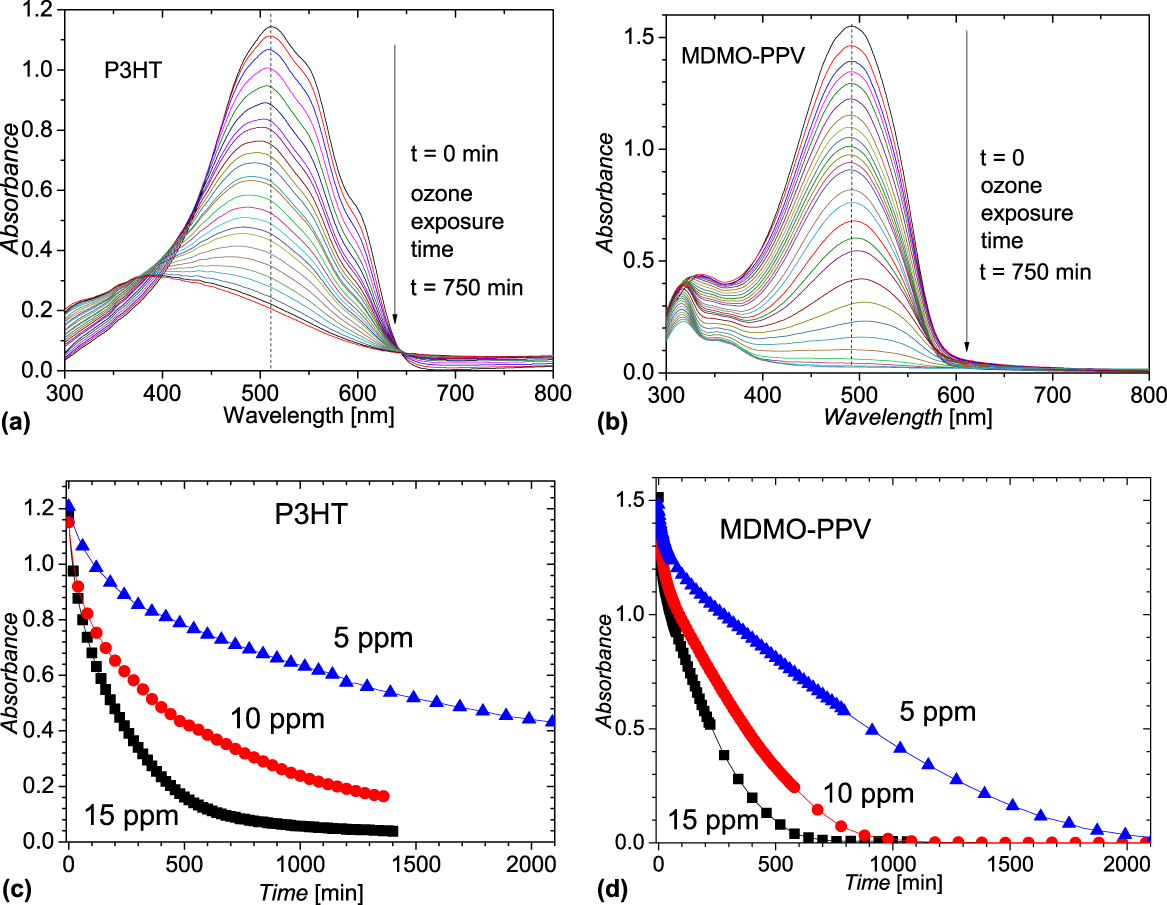
Upon exposure to ozone, the absorption spectra of both P3HT and MDMO-PPV films start bleaching. Figure 1(a) shows the reaction spectrum of a 225-nm-thick P3HT film on glass upon exposure to 15 ppm ozone in synthetic air. During bleaching, the absorption spectra also display changes in shape, such as the loss of structure on the red side of the main absorption band and the increase of absorption below 410 nm, the first observation being due to the loss of π–π-stacking, the latter being due to the formation of reaction products which correspond to shorter fragments of P3HT absorbing at shorter wavelengths.Reference Hintz, Egelhaaf, Lüer, Hauch, Peisert and Chassé18 The absorption maxima show a small blue shift during later reaction times. Figure 1(b) shows the absorption spectra of MDMO-PPV in 15 ppm ozone atmosphere. In contrast to P3HT, the absorption maxima show a small, albeit measurable red shift toward the end of the reaction. The red shift may derive from carbonyls and other reaction products which are conjugated to larger undegraded fragments of the polymer. For MDMO-PPV, no signatures of reaction products are observed in the spectral range from 300 to 1100 nm.
UV/Vis reaction spectra of π-conjugated polymers [(a) P3HT, (b) MDMO-PPV] upon exposure to 15 ppm ozone. (c) Decay kinetics of the absorption of P3HT films at 510 nm under ozone at different concentrations at a flow rate of 100 mL/min. (d) Decay kinetics of the absorption of MDMO-PPV films at 495 nm under ozone at different concentrations at a flow rate of 100 mL/min.

The plot of absorbance at fixed wavelengths, 510 nm for P3HT and 495 nm for MDMO-PPV, versus reaction time yields the degradation kinetics in Figs. 1(c) and 1(d). The left panel displays the oxidation kinetics of P3HT at three different levels of ozone concentration. As obvious, especially from the logarithmic presentations (see Fig. S1 in the Supplementary Material), the kinetics exhibit a fast initial decay but slow down significantly with increasing reaction time to attain close-to-exponential behavior. After 200 min of exposure to 15 ppm ozone, the film has been bleached to half of its initial absorbance. With decreasing ozone concentration, the degradation rate decreases. At 5 ppm ozone, the half-life of the film has increased to around 1100 min.
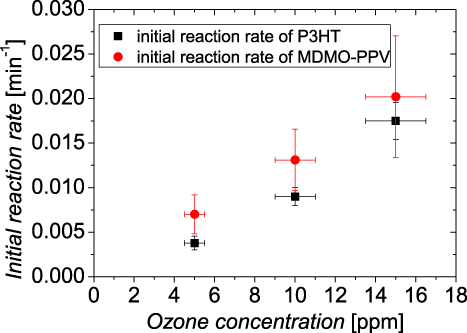
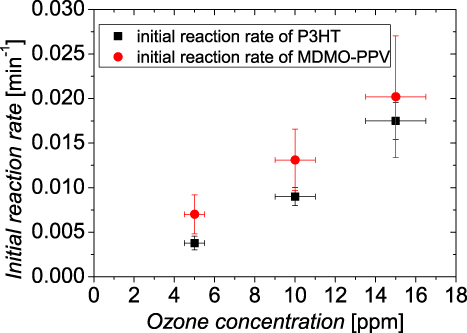
A plot of the initial rates of degradation versus ozone concentration yields a slightly superlinear behavior (Fig. 2). The initial degradation rate was taken from the slope of the respective trace in Figs. 1(c) and 1(d) during the first 5% of absorption loss, which corresponds to a sufficiently long period of time to eliminate the effect of initial fluctuations of ozone concentration. The initial rates of degradation of MDMO-PPV, which increase linearly with ozone concentration, are similar to the ones of P3HT (Fig. 2). Overall, the bleaching rate of the MDMO-PPV film is faster than that of P3HT films [Figs. 1(c) and 1(d)].
Initial reaction rates (during the first 5% of absorption loss) of films of P3HT and MDMO-PPV for different ozone concentrations, given by the UV/Vis absorption loss per minute. Horizontal error bars indicate the tolerance of the sensor, and vertical error bars indicate the uncertainty in the slope of the degradation curves.
B. Influence of PMMA on the ozone-oxidation of P3HT and MDMO-PPV
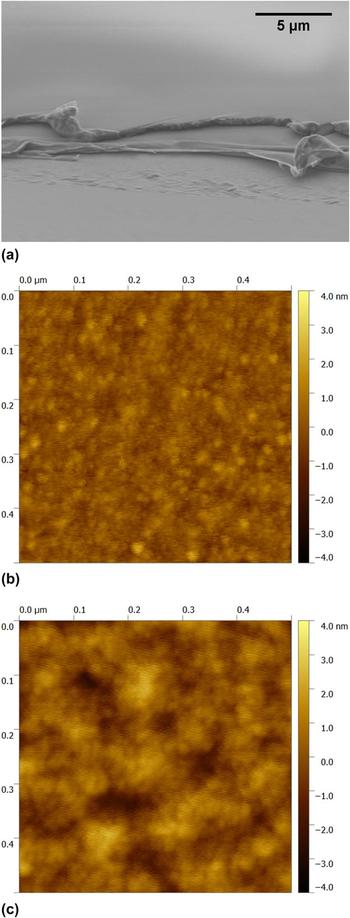
To explore their protective effect against ozone, PMMA films of different thicknesses were coated on top of 225-nm-thick films of P3HT and MDMO-PPV by doctor blading. The application of PMMA protection layers on top of P3HT results in smooth dense films [Fig. 3(a)].
Images of PMMA films on top of P3HT. (a) SEM lower detector, sample tilted by 60°, view of the scratch through a bilayer of 225 nm P3HT and 100 nm of PMMA. (b) Atomic force micrographs of a 100-nm-thick PMMA film on top of 225 nm P3HT before exposure to ozone. (c) The same film after 584 h exposure to 15 ppm of ozone.

No pin holes are detectable in scanning electron micrographs (SEM), even for very thin PMMA films as can be seen in Fig. S3. Only minor modulations of the layer thickness are monitored for both films by atomic force microscopy [Fig. 3(b)]. The rms roughness of PMMA films on top of P3HT ranges between 1.0 and 3.0 nm, which is negligible in comparison to the actual PMMA layer thicknesses of between 20 and 100 nm (Table SII).
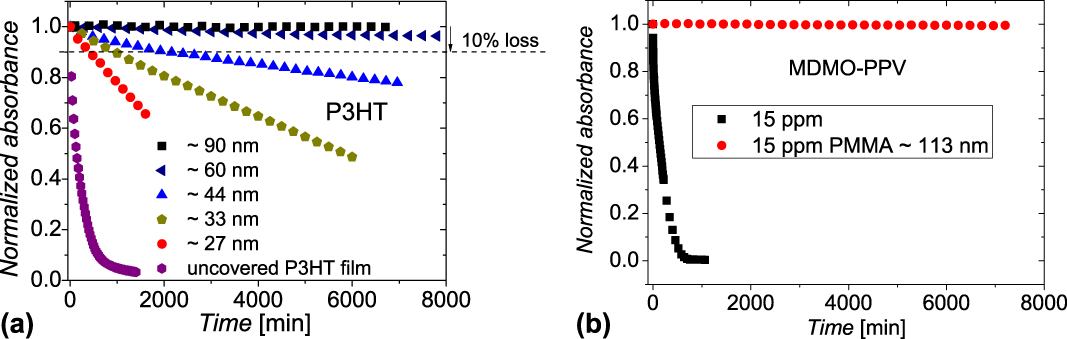
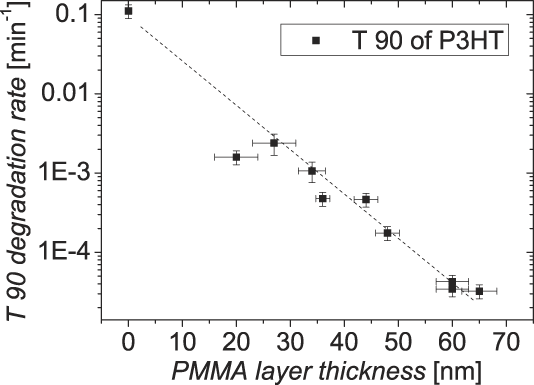
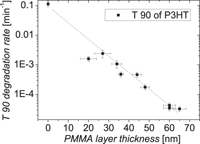
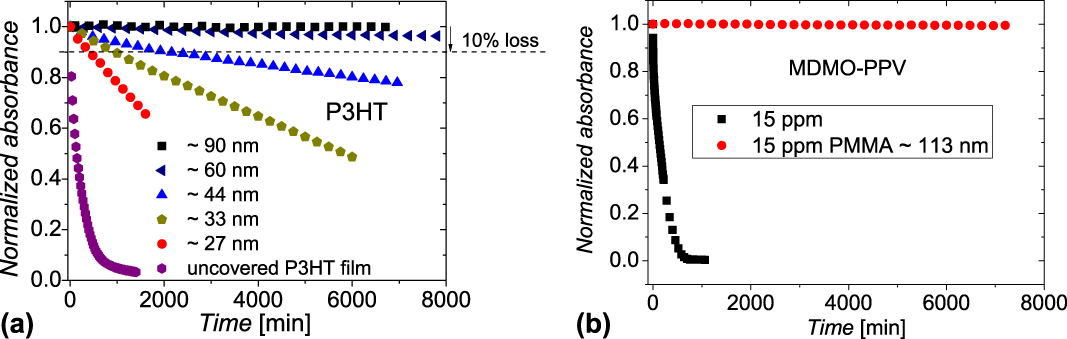
The PMMA films drastically reduce the degradation rates of P3HT films by ozone [Fig. 4(a)] and MDMO-PPV [Fig. 4(b)]. With films thicker than 90 nm, no degradation is measurable over more than 100 h of exposure to 15 ppm of ozone. For thinner films, finite degradation rates are observed, but even for films as thin as 20 nm, the degradation rate is reduced by two orders of magnitude with respect to uncovered P3HT films (Fig. 5).
Degradation kinetics of (a) P3HT and (b) MDMO-PPV at 15 ppm ozone for different PMMA layer thicknesses. All curves are normalized to the value at t = 0.
Degradation rates of 225-nm-thick P3HT films (plotted as the reciprocal T90 lifetime, when the initial UV/Vis absorbance of the P3HT film at 510 nm has been reduced to 90%) under 15 ppm O3 in synthetic air as a function of the thickness of the PMMA layers coated on top.

The protective effect scales more or less exponentially with the PMMA layer thickness (Fig. 5). A 36-nm-thick PMMA film reduces the rate by a factor of approximately 230 compared to unprotected P3HT, while a 60-nm-thick film slows the degradation down by a factor of more than 2600. MDMO-PPV with a PMMA layer of 113 nm thickness shows no degradation by 15 ppm ozone within 120 h.
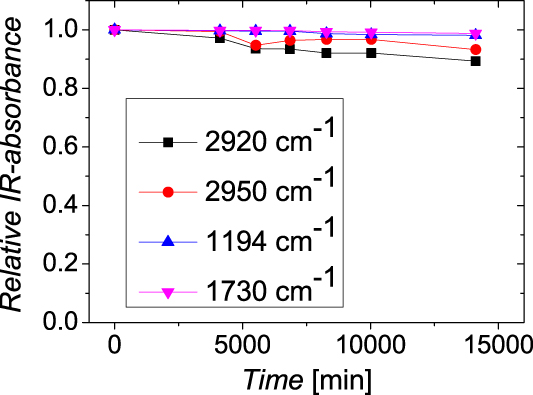
The stability of PMMA films against ozonation was monitored by FT-IR spectroscopy (Fig. S5). Only minor changes were detected in the spectrum of a 100-nm-thick film after exposure to 15 ppm ozone for about 230 h (Fig. 6). The absorbance of the alkyl–CH-stretch vibrations decreases by about 10%, while the C=O-stretch at 1730 cm−1 and C–O–C-vibrations at 1194 cm−1 remain constant within the error bar of the measurement. This is in accordance with the studies of ozonation of PMMA films which report the oxidation of the pendant methyl groups, whereas the polymer backbone is hardly affected.Reference Hintz, Egelhaaf, Peisert and Chassé19,Reference Nowaczyk, Czerwiński and Olewnik24 The signal at 3400 cm−1, corresponding to associated hydroxyl groups increases slightly. SEM and AFM micrographs (Fig. 3) only show a small increase in PMMA film square roughness from 1.1 to 3.1 nm. The peak to peak height was 4 nm before ozonation and 8 nm afterward, but no measurable loss of film thickness was observed. This is in agreement with the IR measurements of Fig. 6 and the observation that none of the samples in Fig. 4 shows a “breakthrough” effect, which would indicate exhaustion of the protective effect of PMMA by reaction with ozone. Moreover, the film remains fully soluble in chloroform, which indicates that no significant crosslinking occurs.
Normalized intensities of IR bands of a 100-nm-thick PMMA film versus time of exposure of the film to 15 ppm ozone.

C. Effect of PMMA films on the photo-oxidation rates of P3HT and MDMO-PPV
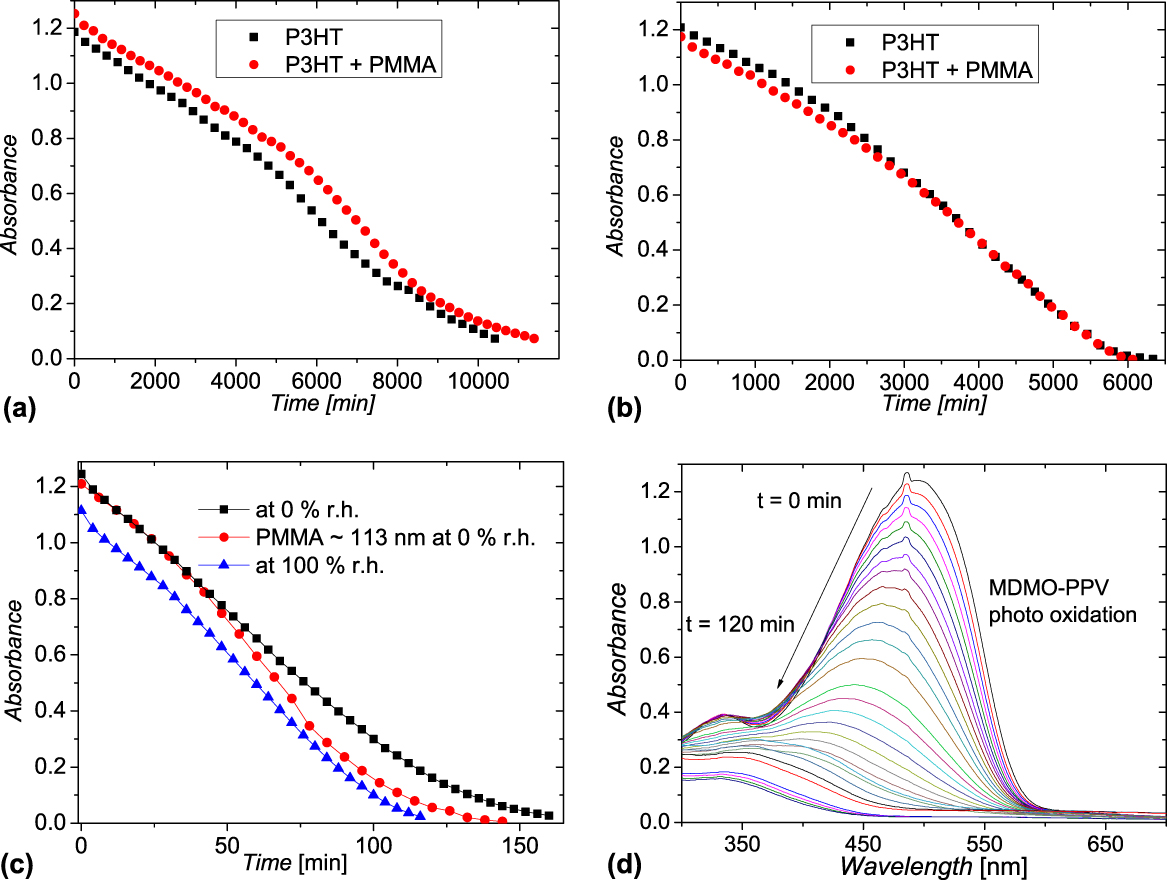
Subsequently, the protection of P3HT films against photo-oxidation by PMMA films was investigated. To this end, P3HT films were covered by PMMA films of the same thickness as for the ozonation experiments (100 nm) and exposed to the light of a solar simulator (AM 1.5) in synthetic air. The decay of the UV/Vis absorption at 510 nm versus exposure time (Fig. 7) follows the typical kinetics observed under these conditions.Reference Hintz, Egelhaaf, Lüer, Hauch, Peisert and Chassé18 The decay is almost linear at early times to accelerate slightly in the second half of the reaction and slow down again toward the very end of the reaction. In the presence of water, the degradation accelerates, e.g., at 100% r.h. at T = 295 K by about 50%.
Photo-oxidation kinetics of uncovered films of P3HT films as compared to P3HT films covered with 90-nm PMMA upon irradiation with a sun simulator (at AM 1.5 conditions). (a) Under dry synthetic air and (b) under humidified synthetic air (100% rel. humidity at 295 K). (c) Photo-oxidation kinetics of uncovered films of MDMO-PPV as compared to MDMO-PPV films covered with 113-nm PMMA under dry oxygen and under humidified oxygen conditions (100% rel. humidity) at 295 K. (d) UV/Vis reaction spectra of MDMO-PPV during irradiation of a 215-nm-thick film with the light of a sun simulator at AM1.5 conditions in synthetic air.

Interestingly, P3HT films covered by PMMA films show the same degradation kinetics as uncovered ones, both in dry and humid oxygen. In contrast to ozonation, the PMMA layers on top of P3HT do not lead to a significant decrease of the degradation rate, neither for dry nor for humidified oxygen atmosphere. Obviously, the PMMA films do not act as barriers for oxygen and water, i.e., the transmission of water and oxygen through the PMMA films is not rate limiting.
MDMO-PPV shows rapid photo-oxidation upon irradiation with the light of a sun simulator in ambient air (Fig. 7), similar to the behavior reported by Chambon et al.Reference Chambon, Rivaton, Gardette and Firon20 In contrast to P3HT, MDMO-PPV shows no accelerated degradation rate in humidified synthetic air.
PMMA layers as thick as 400 nm do not show any measureable effect on the photo-oxidation rate of MDMO-PPV. This confirms the conclusion drawn for PMMA-covered P3HT films that PMMA layers do not hinder the diffusion of oxygen and water to an extent where diffusion of these species would become rate limiting in the photo-oxidation process of the π-conjugated polymer.
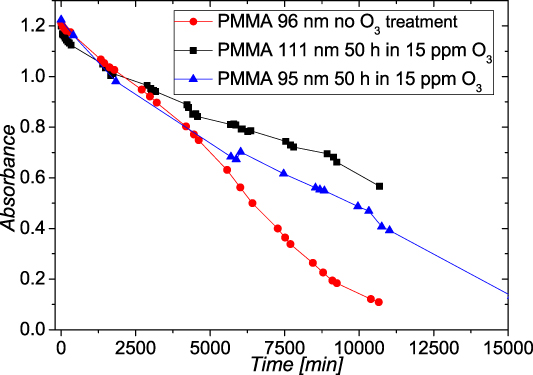
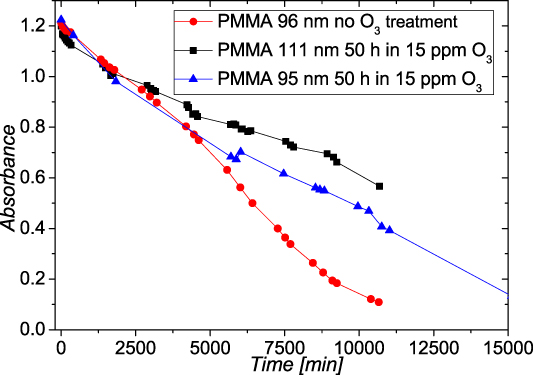
To test the hypothesis suggested by some publications that ozone treatment leads to a thin layer of impermeable PMMA frosting,Reference Lattimer, Layer, Rhee and Scott32,Reference Cataldo33,Reference Strobel, Walzak, Hill, Lin, Karbashewski and Lyons38 we exposed samples of P3HT films covered by about 100-nm-thick PMMA layers to 15 ppm of ozone in synthetic air before photo-oxidation. As obvious from Fig. 8, previous ozone exposure does not change the photo-oxidation rates significantly up to 4000 min. At 5000 min of photo-oxidation, the photo-oxidation rate of the nontreated sample increases slightly, whereas the reaction rates of the two exposed samples remain approximately the same. While the reason for this difference in kinetic behavior remains unclear, the effect of ozone treatment on the diffusion of oxygen through the PMMA film is obviously too small to cause any significant change in the photo-oxidation rate of P3HT.
Photo-oxidation of PMMA-covered P3HT films in dry synthetic air at AM 1.5 conditions after 50 h of exposure to 15 ppm ozone.
IV. DISCUSSION
Doctor-bladed thin PMMA films have been demonstrated to serve as protective layers for P3HT and MDMO-PPV films against degradation by ozone, even at ozone concentrations of 15 ppm and PMMA film thicknesses as small as 40 nm.
For PMMA layer thicknesses above 90 nm, no measurable degradation is observed for more than 500 h under 15 ppm of ozone. With decreasing PMMA film thickness, the lifetime of the P3HT layers underneath decreases dramatically. No pin holes were detected by SEM and AFM, which suggests that the residual oxidation observed for PMMA layers of less than 60 nm thickness is probably due to homogeneous diffusion of ozone through the layer.Reference Nie, Walzak and Mcintyre63,Reference Teare, Ton-That and Bradley64
The comparison of the reaction rate of ozone with P3HT to the flux of ozone through a PMMA film reveals the reason for the protective effect of PMMA against ozonation.
The ozonation rate of an unprotected film of P3HT, in terms of loss of molar density, Δn, per unit area, A, and unit time, Δt, at an ozone concentration of 15 ppm, as calculated from the rate of bleaching ΔE/Δt of the UV/Vis absorption (Fig. 5), amounts to  ${{\Delta n} \over {A \cdot \Delta t}} = {{\Delta E} \over {\varepsilon \cdot \Delta t}} = 2.5 \times {10^{ - 7}}$ mol/(m2 s), when ε = 800 m2/mol is inserted for the molar extinction coefficient of a P3HT monomer unit.Reference Wang, Dunbar, Staniec, Pearson, Hopkinson, MacDonald, Lilliu, Pizzey, Terrill, Donald, Ryan, Jones and Lidzey65 For MDMO-PPV, a similar value of 2.8 × 10⁻⁷ mol/(m2 s) is obtained from the bleaching kinetics under 15 ppm of ozone [Fig. 4(b)] and the molar extinction coefficient of the monomer unit of ε = 1600 m2/mol (Table SI). This corresponds to a consumption of around 5 × 10⁻⁷ mol/(m2 s) of ozone, assuming that two moles of ozone are needed for the bleaching of one mole of thiophene rings. For the calculation of the flux of ozone through the PMMA films, we have to resort to an estimate for the permeability of PMMA for ozone, as this value is not available in the literature.
As the diffusivity and solubility of light gases in glassy polymers scale roughly with the critical volumes and temperatures of the gases, respectively (see Table SIII),Reference Matteucci, Yampolskii, Freeman and Pinnau66,Reference Minelli and Sarti67 we assume the permeability P(O3) of PMMA for O3 to be larger than that of O2, but only slightly smaller than that of CO2, for which the permeability values are well tabulated or are obtained as the product of the data reported for the respective diffusion coefficients and solubilities.Reference Biń68–Reference Chiou and Paul71 This yields an estimated permeability of P(O3) = 1.2 × 10⁻¹¹ mol/(m bar s) of PMMA for ozone at room temperature. The ozone flux through a d = 100 nm thick film of PMMA at an ozone partial pressure of p(O3) = 15 ppm × 1 bar is then obtained as  $J\left( {{{\rm{O}}_3}} \right) = P \cdot {{p\left( {{{\rm{O}}_3}} \right)} \over d} = 1.8 \times {10^{ - 9}}$ mol/(m2 s), i.e., two orders of magnitude less than the consumption of ozone by reaction with the π-conjugated films. Consequently, the observed ozonation rate will be limited by the diffusion of ozone through the PMMA film. This result is in fair agreement with the observed reduction of the ozonation rate by the PMMA cover layers. It is also supported by the transition of the ozonation kinetics of P3HT from reaction limited to diffusion limited upon depositing a PMMA cover film (Fig. 4). Assuming the ozonation of P3HT underneath a 20-nm-thick PMMA film to be diffusion-controlled, the permeability of PMMA for O3 is obtained from the observed ozonation rate as P(O3) = 1.1 × 10⁻¹¹ mol/(m bar s), which is in fair agreement with the estimate derived above from diffusion and solubility coefficients of gas molecules of similar sizes. With increasing PMMA film thickness, the permeabilities thus calculated decrease, reaching a value of P(O3) = 10−12 mol/(m bar s) for d = 60 nm.
In the case of photo-oxidation of an unprotected P3HT film of 220 nm in thickness, at the degradation rate observed in Fig. 7(a), the consumption of oxygen is around 5 × 10⁻⁹ mol/(m2 s), if we assume a consumption of two molecules of O2 per thiophene ring. The oxygen permeability of PMMA films at room temperature is P = 4.8 cm3 mm/(m2 day bar) = 2.5 × 10⁻¹² mol/(m s bar),72 corresponding to an oxygen flux of 5 × 10⁻⁶ mol/(m2 s) through a 100-nm-thick PMMA film in air, i.e., the diffusion of oxygen through the PMMA film is three orders of magnitude faster than its consumption by photo-oxidation. Consequently, the reaction rate of photo-oxidation of P3HT films will not be reduced by PMMA cover layers, even at thicknesses of several micrometres. For MDMO-PPV, the corresponding oxygen consumption is 2 × 10⁻⁷ mol/(m2 s), also assuming a reaction with two molecules of O2 per monomer unit, a monomer extinction coefficient of ε = 1600 m2/mol (see Table SI), and a polymer density of 1.0 g/cm3.Reference Mateker, Heumueller, Cheacharoen, Sachs-Quintana, McGehee, Warnan, Beaujuge, Liu and Bazan73 Thus, also in the case of MDMO-PPV, a 100-nm-thick PMMA film will not hamper photo-oxidation at AM1.5 irradiation.
An additional contribution to the reduction of the reaction rate of ozonation by PMMA may arise from the formation of a chemically modified layer at the surface of PMMA by the reaction with ozone which is almost impermeable to ozone due to its reduced solubility in the modified layer, as has been suggested by several authors as the reason for the extremely slow rates of ozonation of films of unstressed rubber and other polymers after rapid initial uptake of ozone by the material (“frosting”).Reference Lattimer, Layer, Rhee and Scott32–Reference Layer and Lattimer34,Reference Erickson, Berntsen, Hill and Kusy37,Reference Pankratov, Yanson, Prokof'eva and Yur'ev39 However, this effect does not play a decisive role in our systems, considering that even after 50 h of exposure of PMMA to 15 ppm of ozone, the rate of subsequent photo-oxidation of the P3HT film underneath is not reduced by a measurable extent (Fig. 8). The rates of ozonation of P3HT films with PMMA cover layers are slightly higher in the first minutes of exposure to ozone (Fig. 4), but the differences to the degradation rates at later times are only minor and may also be due to changes in the P3HT layer.
Further protective effects of PMMA films on top of π-conjugated polymers may arise from the role of PMMA as an ozone sink, either due to chemical consumption or due to catalytic quenching. The reaction rate of PMMA with ozone as estimated from the loss of the alkyl C–H stretch vibration bands at around 2950 cm−1 amounts to  ${{\Delta n} \over {A \cdot \Delta t}} = {{0.1 \cdot {n_0}} \over {\Delta t}} = 5 \times {10^{ - 10}}$ mol/(m2 s) (Fig. 6), considering that 10% of the original PMMA surface loading of
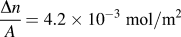 ${{\Delta n} \over A} = 4.2 \times {10^{ - 3}}\;{{{\rm{mol}}} / {{{\rm{m}}^{\rm{2}}}}}$ are bleached within 230 h and one monomer unit comprises three alkyl groups. The role of PMMA as a sacrificial antiozonant, i.e., as a sink for ozone by chemical reaction, can thus be excluded, as the ozonation rate of PMMA is about three orders of magnitude smaller than that of unprotected P3HT (Fig. 6).
Catalytic quenching of ozone has been observed both in the gas and in the solid phase.Reference Kaduk and Toby47,Reference Subrahmanyam, Bulushev and Kiwi-Minsker74,Reference Itoh, Isegame, Miura, Suzuki and Rusinov75 It may in principle also contribute to the protective effect of PMMA, as ozone quenching has been reported also by peroxy- and hydroxyl groups,Reference Czerwiñski, Nowaczyk and Kania48 which form upon ozonation of PMMA films. However, both the concentrations of these groups as well as the reaction rates with ozone are too small to reduce the ozone concentration by a substantial extent.Reference Kaduk and Toby47
V. SUMMARY AND CONCLUSION
We have shown that 5 ppm of ozone bleach the UV/Vis absorption of 220-nm-thick films of P3HT and 250-nm-thick films of MDMO-PPV by 10% within 45 min and 19 min, respectively. Ozone can thus be regarded as the main culprit for the oxidation of π-conjugated materials in the dark. PMMA films as thin as 50 nm slow down the ozonation of P3HT films by more than three orders of magnitude, whereas no protection against photo-oxidation is provided. The comparison of the experimental reaction rates of ozone and oxygen to the respective diffusion fluxes calculated from the oxygen permeability of PMMA show that the protective effect of PMMA against ozonation is fully accounted for by the reduction of ozone flux to the P3HT surface by thin films of PMMA. By contrast, the photo-oxidation rate is not affected by PMMA films because the oxygen flux, driven by the much larger pressure gradient of O2, exceeds the reaction rate by far.
Infrared spectroscopy reveals that PMMA is hardly affected by ozonation, which confirms that the protective effect of PMMA against ozonation is not of sacrificial nature. Thin PMMA cover films, such as gate dielectrics in top gate configurations of OFETs, thus provide efficient and long-lasting protection against ozone degradation of organic electronic devices.
Supplementary Material
To view supplementary material for this article, please visit https://doi.org/10.1557/jmr.2018.74.
ACKNOWLEDGMENTS
We thank Dr. Alexandru Oprea for support with the gas flow and sensor equipment. We thank E. Nadler for performing the FE-SEM and EDX measurements. The Hitachi SU8030 FE-SEM was partially funded by the German Research Council (DFG) under contract number INST 37/829-1 FUGG. The Bavarian State Government is acknowledged for financial support of the “Solar Factory of the Future” as part of the Energy Campus Nuremberg (FKZ 20.2-3410.5-4-5).