Cardiac failure is a costly, disabling condition for both adults and children.Reference Cowie, Mosterd and Wood1, Reference Reis, Holubkov and Edmundowicz2 Heart failure in children in particular is widely heterogeneous in aetiology,Reference Hoch and Netz3 age at onset, mechanisms of disease, and incidence in various regions of the world.Reference Kay, Colan and Graham4 The annual incidence due to congenitally malformed hearts is about 0.1 to 0.2 percent of live births, and the annual incidence of all cardiomyopathies in the first year of life is 4 per 100,000 live births.Reference Ferencz, Rubin and McCarter5 This heterogeneity and the lack of any reliable indicators of therapeutic efficacy in heart failure complicates therapeutic assessment, resulting in a poor prognosis after discharge from hospital, with high rates of readmission and mortality.Reference Philbin and DiSalvo6–Reference Kossovsky, Sarasin, Perneger, Chopard, Sigaud and Gaspoz8
Brain natriuretic peptide is a cardiac neurohormone synthesized by ventricular myocytes in direct proportion to expansion of ventricular volume and pressure overload.Reference Tsutamoto, Wada and Maeda9, Reference Hama, Itoh and Shirakami10 Its levels in the plasma are a well recognized marker of heart failure. This neurohormone can be upregulated very quickly in response to ventricular wall stress.Reference Maeda, Tsutamoto and Wada11–Reference Yasue, Yoshimura and Sumida13 Because the peptide has a short half-life, from 18 to 22 minutes, serial testing further enhances its prognostic value. The concentration is markedly elevated in infants and children with heart failure irrespective of aetiology.Reference Cowley, Bradley and Shaddy14 This may help evaluate and guide therapy, as it has in adults with decompensated heart failure.Reference Sodian, Loebe and Schmitt15–Reference Lubien, DeMaria and Krishnaswamy17 The concentrations of the peptide in the plasma also appear to be a more sensitive marker of heart failure than echocardiographic parameters and the measured cardiothoracic ratio.Reference Williams, Ng, O’Brien, Taylor, Li and Tan18 Previous studies in patients with heart failure suggest that reductions in levels induced by treatment may improve neurohormonal markers and the prognosis.Reference Troughton, Frampton, Yandle, Espiner, Nicholls and Richards19, Reference Murdoch, McDonagh and Byrne20 Nevertheless, data is limited regarding the prognostic value of this peptide in children with heart failure. We set out, therefore, to test the hypothesis that serial evaluation of the concentration of the peptide in the plasma effectively assesses the response to treatment and prognosis in children with decompensated cardiac failure.
Methods
Study design and approval
We carried out a retrospective review of charts from patients cared for in the intensive care units at the Texas Children’s Hospital in Houston, Texas. The study was approved by the Baylor College of Medicine Institutional Review Board.
Patients
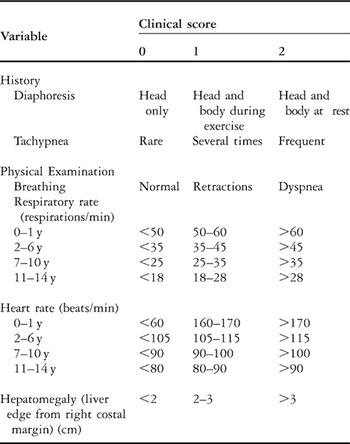
We reviewed the medical records of 82 consecutive children who were admitted to the intensive care unit for decompensated heart failure between March, 2004, and February, 2005, and who had levels of brain natriuretic peptide in the plasma measured serially. Decompensated heart failure was defined separately for patients greater than or equal to 14 years old versus those less than 14 years old. Patients aged 14 years or older were considered to have decompensated heart when in Classes III or IV of the grading system of the New York Heart Association. For patients less than 14 years old, decompensated heart failure was defined as a modified clinical score of greater than or equal to 7 points, according to a modified scoring system first described by Ross and colleaguesReference Ross, Bollinger and Pinsky21 for infants with a left-to-right shunt, and later modified by ReithmannReference Reithmann, Reber and Kozlik-Feldmann22 and LaerReference Laer, Mir and Behn23 and coworkers (Table 1). In brief, the symptoms of heart failure, specifically diaphoresis, tachypnea, breathing with abdominal retractions, increased respiratory rate, increased heart rate, and hepatomegaly, were graded on a scale of 0, 1, or 2 points according to severity. Issues with feeding, as initially described by Ross and colleagues,Reference Ross, Bollinger and Pinsky21 were not a part of the assessment. All points were summed to give a clinical score (range, 0 to 12 points); a higher score corresponded to more severe heart failure. Both heart failure of initial onset, and exacerbations of previously documented heart failure, were among the criterions for inclusion.
Clinical score*.

*Modified from Ross,Reference Ross, Bollinger and Pinsky21 Reithmann et al,Reference Reithmann, Reber and Kozlik-Feldmann22 and Laer et al.Reference Laer, Mir and Behn23 Total score: 0−2 = no heart failure; 3–6 = mild heart failure; 7–9 = moderate heart failure; 10–12 = severe heart failure.
Study protocol
Patients were admitted to the intensive care unit and treated according to accepted medical protocols for treatment of heart failure. Medications included diuretics, such as furosemide or ethacrynic acid, inhibitors of angiotensin-converting enzyme, beta-blockers, digitalis, epinephrine or norepinephrine, dopamine, phosphodiesterase inhibitors, vasopressin, and recombinant human brain natriuretic peptide, known as nesiritide. Patients were evaluated for any indications of interventional cardiac catheterization, palliative or corrective cardiac surgery for a structural heart defect, heart transplantation for endstage heart disease, mechanical circulatory support using a ventricular assist device or extracorporeal membranous oxygenation as a bridge to myocardial recovery or to transplantation for myocardial dysfunction, cardiopulmonary resuscitation after failed conventional resuscitation, severe pulmonary hypertension, and preoperative stabilization.
The initial sample for measurement was drawn within 24 hours of admission to the intensive care unit. This level was defined as the “baseline” value. Blood was also sampled whenever changes occurred in treatment, or the condition of the patient changed. The last measurement made before discharge or death was defined as the “final” value. As this study was retrospective in nature, the presenting values were known by the managing physicians. These values were used in conjunction with clinical assessment and laboratory data to develop a plan for treatment. The known levels did not influence the use of nesiritide, or other individual vasoactive medications. Brain natriuretic peptide was measured as part of the assessment of decompensated heart failure and, when possible, was compared to previous levels to assess for trends in values.
Data extrapolated from the medical records included age, sex, diagnosis, clinical symptoms, aetiology of heart failure, grading of severity of cardiac failure, therapeutic strategies during hospitalization, baseline and final levels of the peptide, relative change in levels up to the final level, percent change in the levels, calculated as final level minus initial level multiplied by 100 and divided by initial level, length of stays in intensive care and hospital, outcomes of treatment, for example, in-hospital death or survival to discharge, and adverse outcomes over 60 days, for example, death or readmission due to cardiac failure. All patients received complete follow-up. They were divided into 3 groups according to their adverse outcomes at 60 days: the readmission-free group, which was discharged without subsequent readmission or death; the readmitted group, which was readmitted within 60 days after discharge; and the nonsurvivors, who died during hospitalization or less than 60 days after discharge. The initial level, final level, change in level, and percent change in level of the peptide were correlated with combined adverse outcomes, such as in-hospital death, readmission less than 60 days after discharge, or death less than 60 days after discharge.
Measurement of brain natriuretic peptide
Levels were measured in the plasma using the Tri-age Brainnatriuretic peptide assay (Biosite Inc., San Diego, California.). This automated enzyme-linked immunosorbent assay requires a sample size of less than 0.5 millilitre of whole blood collected in ethylenediaminetetraacetic acid in order to detect a level between 5 and 5000 picograms per millilitre. All measurements were performed in the central laboratory at the Texas Children’s Hospital.
Statistical analysis
Continuous variables were expressed as the mean plus or minus the standard error of the mean, and as the median, or as absolute values where appropriate. Differences between groups underwent analysis of variance and either a 2-tailed Student’s t-test for continuous variables or a chi-square test for categorical variables. A p value of less than 0.05 was considered significant. In all cases, comparisons were first computed using raw values of the peptide, and were then verified with log-transformed values to correct for known intrinsic skewing in distribution.
Because of the small sample size and the low rate of adverse events, a combined adverse outcome of readmission and death either in hospital or less than 60 days after discharge was used for statistical analysis. The correlation between levels of the peptide and the combined adverse outcome was analyzed by logistic regression. We also computed a receiver operating characteristic curve to assess whether the final level of the peptide could distinguish between patients who had a combined adverse outcome and those whose heart failure was successfully treated.
The analyses were initially conducted in a univariate manner. Each logistic regression involved the entry of a single nominal predictor or a continuous covariate and no other predictors. In the multivariate analysis, a multiple logistic regression model was used. Factors included in the multivariate analysis were those identified by univariate analysis at a significance level of 0.05 as indicated.
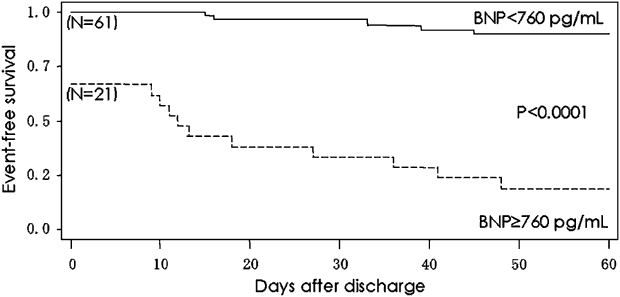
Event-free survival, that is no readmission or death, was analyzed by the Kaplan-Meier method for patients who had a final peptide level of less than 760 picograms per millilitre or of greater than or equal to 760 picograms per millilitre. Cutoff values were selected according to the result of receiver operating characteristic curve analysis in this study.
Results
Patient characteristics
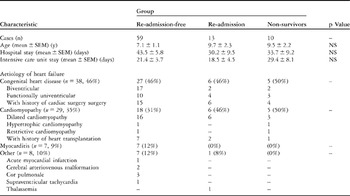
The population of 82 patients had a median age of 5.5 years, with a range fro 2 days to 21 years, a median stay of the intensive care unit of 11 days, with a range from 2 to 148 day, and a median stay in hospital of 22 days, with a range from 4 to 238 days. Half of the patients were male. In 36 patients (44 percent), the heart failure was a new event, whilst 46 (56 percent) had exacerbation of previously documented heart failure. The most frequent diagnoses were congenitally malformed hearts, in 38 patients (46%), cardiomyopathy in 29 patients (35%), and myocarditis in 7 patients (9%). Regarding the aetiology of heart failure, the incidence of ventricular systolic dysfunction, as defined by a left ventricular ejection fraction of less than 50 per cent or a shortening fraction of less than two Z scores from normal values for body surface area, was 73 percent (43 of 59), 85 percent (11 of 13), and 100 percent (10 of 10) in the readmission-free, readmitted, and nonsurviving groups, respectively. A combined adverse outcome occurred in 23 patients (28%), with 13 patients re-admitted, 7 dying in hospital, and 3 dying less than 60 days after discharge. The age, length of stay in intensive care and in hospital was similar in all groups (Table 2).
Characteristics of the patients.

Values are given as mean ± standard error of mean or as number (%) of patients. NS = not significant.
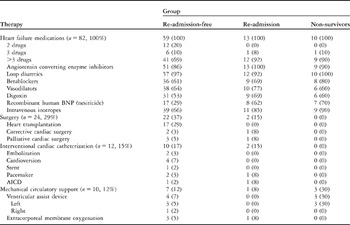
All patients received anti-failure medications during hospitalization (Table 3). In addition, 24 patients (30%) underwent cardiac surgery, including 17 who received orthotopic heart transplants, while 12 patients (15%) underwent interventional cardiac catheterization. Mechanical circulatory support was needed by 11 patients (13%). This was ventricular assistance for 7 patients, and extracorporeal membrane oxygenation in the other 4. In 32 patients (39%), we gave short-term intravenous infusions of recombinant human brain natriuretic peptide for severely decompensated failure during their hospitalization. This therapy was discontinued at least 12 hours before the final level of the peptide was measured.
Therapies used.

Abbreviation: AICD = automatic implantable cardioverter-defibrillator; BNP = Brain natriuretic peptide. Values are given as number (%) of patients.
The readmission-free group had a higher rate of cardiac surgery or heart transplantation during hospitalization than did the groups of readmitted and nonsurviving patients (37 percent, 15 percent, and 0 percent in the 3 groups, respectively). The nonsurviving group more often required mechanical circulatory support (12 percent, 8 percent, and 30 percent in the readmission-free, readmitted, and nonsurviving groups, respectively). The incidence of cardiac surgery during hospitalization was significantly higher in the readmission-free group than in the nonsurvivors (p equals 0.049). The incidence of mechanical circulatory support did not significantly differ among the 3 groups. All 10 patients who died had intractable heart failure.
Outcomes and levels of brain natriuretic peptide
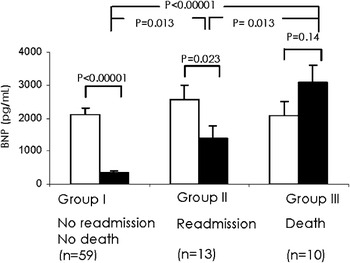
The median number of blood samples taken for assay during hospitalization was 5, with a range from 2 to 28. The median interval between initial and final measurements was 13.5 days, with a range from 4 to 122 days. The interval from the initial to final measurement was not significantly different in those who died versus the other 2 groups. Separate comparisons using raw and log-transformed peptide values yielded identical results. Figure 1 shows the initial and final levels after therapy in relation to clinical outcomes in the 3 groups. There was no significant intergroup difference in the initial levels (2107 plus or minus 202, 2557 plus or minus 463, and 2067 plus or minus 459 picograms per millilitre in the readmission-free group, the readmitted groups, and the nonsurviving group, respectively). The readmission-free group had a greater decrease in peptide (minus 1751 plus or minus 188 picograms per millilitre; p less than 0.00001) during hospitalization, with a mean final level of 356 plus or minus 55 picograms per millilitre. The readmitted group also had a decrease in level but to a lesser extent (minus 1233 plus or minus 444 picograms per millilitre; p equals 0.023), with a mean final level of 1393 plus or minus 370 picograms per millilitre. The non-surviving group had an increase in peptide during hospitalization (plus 998 plus or minus 643 picograms per millilitre; p equals 0.14), with a final level of 3066 plus or minus 564 picograms per millilitre. The percent changes in this value were minus 78 plus or minus 3 percent, minus 38 plus or minus 15 percent, and 138 plus or minus 71 percent in the readmission-free, readmitted, and nonsurviving groups, respectively. The level in the nonsurvivors increased significantly compared to those of the other 2 groups (p equals 0.001 and 0.008, respectively). The level decreased more in the readmission-free group than in the readmitted one, but the difference did not reach significance (p equals 0.28). The final levels were significantly lower in the group of those free from readmission than in the readmitted and nonsurving ones (p equals 0.013 and is less than 0.00001, respectively) and in the readmitted group than in the nonsurviving one (p equals 0.013).
Initial (white bar) and final (black bar) levels of brain natriuretic peptide (BNP) after treatment of heart failure in relation to clinical outcomes in the 3 groups. The data are expressed as the mean plus or minus the standard error of the mean. SEM: standard error of the mean.

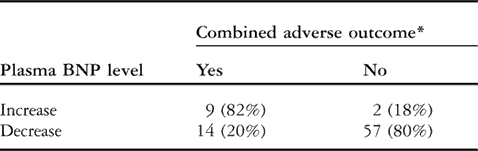
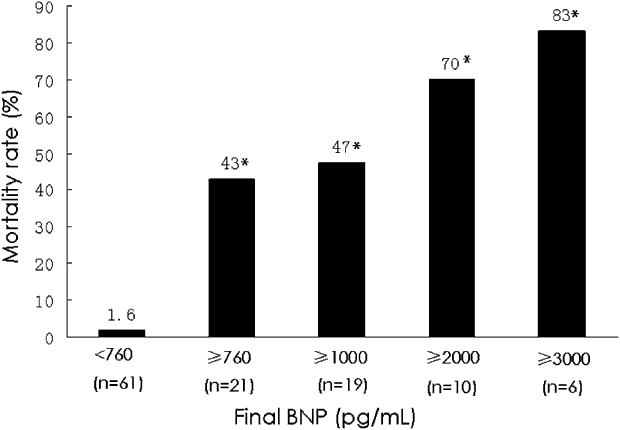
Table 4 shows a significant association between adverse outcomes and rising versus falling final levels of the peptide (p less than 0.0001). A majority of the patients (82%) with increasing levels had adverse outcomes. In contrast, most of the patients (80%) with falling levels had no adverse outcomes. Figure 2 shows the correlation between mortality and the final levels. The mortality increased from 1.6% in patients with a final level of less than 760 picograms per millilitre to 83% in patients with a final level of greater than or equal to 3000 picograms per millilitre. The intergroup differences in mortality were significant (all p less than 0.001).
Relationship between adverse outcomes and levels of the peptide during treatment.

*Readmission, in-hospital death, death <60 days after discharge. Values are given as percentages and analyzed with chi-square analysis (x 2 = 15.25; p < 0.0001). BNP = Brain natriuretic peptide.
The correlation between mortality and the final levels of the peptide. The differences in mortality among the 3 groups were significant (all *p less than 0.001). BNP: Brain natriuretic peptide.

Predictors of an adverse outcome
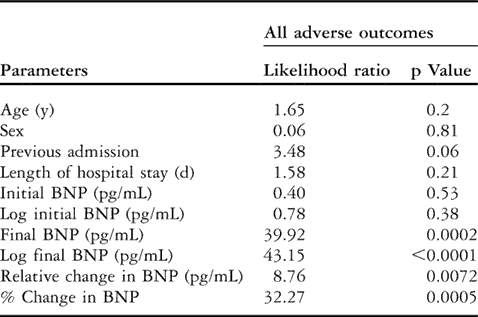
Table 5 shows the results of a univariate logistic regression analysis to predict a combined adverse outcome. Age, sex, previous admission, and length of hospital stay were not significant for predicting an adverse outcome. The variables that accurately predicted outcomes were the final levels of the peptide (p equals 0.0002), log-transformed final levels (p less than 0.0001), change in peptide levels (p equals 0.0072), and percent change in levels (p equals 0.0005). Multivariate analysis showed that only the final level of the peptide significantly predicted outcomes (p equals 0.01).
Univariate predictors of adverse outcomes.

BNP: Brain natriuretic peptide.
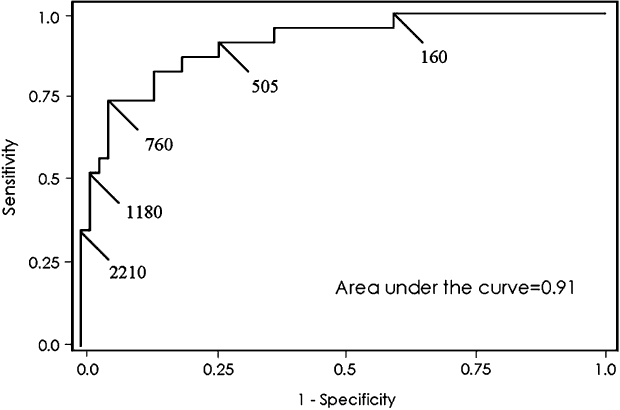
The receiver operating characteristic curve, shown in Figure 3, illustrates the sensitivity and specificity of the final measurements in differentiating patients who had adverse outcomes from those successfully treated for heart failure. Potential discrete cut-off points are labeled. The area under the receiver operating characteristic curve for all adverse outcomes was 0.91, indicating fair to good discriminatory ability. A final level of the peptide greater than or equal to 760 picograms per millilitre was a strong predictor of an adverse outcome (specificity, 93 percent; sensitivity, 74 percent; area under the receiver operating characteristic curve equals 0.91) (Table 6). A final level of less than 160 picograms per millilitre had a negative predictive value of 96 percent for adverse outcomes.
Receiver operating characteristic curve for patients with decompensated heart failure. The curve compares the sensitivity and specificity of final measurements to the rates of adverse outcomes. Discrete cut-points are labeled. The area under the curve (Cstatistic) was 0.91 for all adverse outcomes. Sensitivity, specificity, positive and negative predictive values, and accuracy are recorded for each cut-point of the receiver operating characteristic curve. AUC: area under the curve; BNP: Brain natriuretic peptide.

Sensitivity and specificity of final measurements.

BNP: Brain natriuretic peptide.
Figure 4 presents the Kaplan-Meier cumulative event-free survival for patients with a final level of less than 760 picograms per millilitre versus 760 picograms per millilitre or more.
Kaplan-Meier event-free survival for patients with a final level of the peptide of less than 760 picograms per millilitre (61 patients) versus greater than or equal to 760 picograms per millilitre (21 patients). BNP: Brain natriuretic peptide.

Discussion
Our study suggests that the final concentrations of brain natriuretic peptide measured before discharge or death may accurately predict outcomes of treatment in children admitted with decompensated heart failure. Among patients who experienced adverse outcomes, such as in-hospital death, readmission, or death within 60 days after discharge, treatment for heart failure resulted only in a mild decrease or even an increase in concentrations of the peptide. Patients with adverse outcomes had significantly higher final levels than did those with positive outcomes. Final levels of greater than or equal to 760 picograms per millilitre had a fair to good ability to distinguish patients who had adverse outcomes from those successfully treated for heart failure. A final level of less than 160 picograms per millilitre correlated with placement in the first class of the grading system of the New York Heart Association, and had a strong negative predictive value for adverse outcomes. These results strongly suggest that serial measurement of levels of the peptide during hospitalization may help clinicians decide whether to discharge children undergoing treatment for heart failure.
The onset of heart failure, with arterial underfilling manifested by decreased activation of mechanoreceptors in the left ventricle, carotid sinus, aortic arch, and renal afferent arterioles, leads to a myriad of pathophysiologic adaptations, including stimulation of the adrenergic system and activation of the renin-angiotensin-aldosterone system.Reference Hoch and Netz3, Reference Jefferies and Chang24 Because increased levels of vasoconstrictor neurohumoral factors, such as norepinephrine, renin, and endothelin-1, have been found to be significant prognostic predictors in heart failure, these vasoconstrictors may play an important role in the pathogenesis of this disease.Reference Francis, Benedict and Johnstone25–Reference Tsutamoto, Hisanaga and Fukai28 The serial use of these markers to monitor therapy is impractical, largely due to difficult assay characteristics, general instability of markers, cost, and wide-ranging, often overlapping, values.Reference Murdoch, Byrne and Morton29, Reference Klinge, Hystad and Kjekshus30 Unlike the aforementioned vasoconstrictor neurohormones, the cardiac hormones, or natriuretic peptides, have beneficial actions such as vasodilation and natriuresis. Brain natriuretic peptide is a well-recognized marker of heart failure, and it appears to be more sensitive than echocardiographic parameters and the measured cardiothoracic ratio.Reference Williams, Ng, O’Brien, Taylor, Li and Tan18 During hospitalization, testing of levels of this peptide in the plasma could be very useful to assess the response to treatment and prognosis in children with decompensated heart failure. The development of rapid assays and point-of-care testing devices has facilitated the clinical acceptance of measurement, which is increasingly popular in the routine evaluation of patients with suspected or overt heart failure.
On admission, the patients in our study had no significant difference in initial levels of the peptide. More important was the change in concentrations as a result of effective treatment. Other studies have shown that aggressive treatment with diuretics and vasodilators in patients with decompensated heart failure resulted in rapidly falling concentrations of the peptide, and intracardiac filling pressures.Reference Kazanegra, Cheng and Garcia31, Reference Johnson, Omland and Hall32 Our observations not only confirm these findings, but also show that the changes are directly related to the final clinical outcome.Reference Kazanegra, Cheng and Garcia31, Reference Cheng, Kazanagra and Garcia33 In patients with adverse outcomes, treatment may result only in a mild decrease, or even an increase, in concentrations, likely secondary to persistent wall stress and reduced effectiveness of therapy. In patients who experienced an adverse outcome, the last measured concentration was significantly higher than in those with a more positive outcome. This was consistent with other studies showing that, despite aggressive treatment for heart failure, patients with persistently high concentrations of the peptide are at high risk for an adverse outcome.Reference Cheng, Kazanagra and Garcia33–Reference Logeart, Thabut and Jourdain35 Serial measurements of this variable might, therefore, identify a subgroup of patients at high risk, for instance, those without a decrease in levels of the peptide, who would require closer monitoring and adjustment of therapeutic strategies for heart failure.
The predictive value of levels of the peptide for outcomes after treatment may be quite different in children than in adults. In our study, patients with a final level of less than 760 picograms per millilitre were reasonably likely to leave the hospital in good condition and to avoid readmission or death within the next 60 days. This adverse outcome level correlates to placement in Classes III or IV of the system of the New York Heart Association.Reference Law, Keller, Feingold and Boyle36, Reference Maisel, Krishnaswamy and Nowak37 Conversely, a final level of less than 160 picograms per millilitre, which had a strong negative predictive value for an adverse outcome in our study, correlates with placement in the first class of the system.
The value that predicts an adverse outcome is different in children than in adults admitted with decompensated heart failure. Cheng and associatesReference Cheng, Kazanagra and Garcia33 previously reported that a last measured concentration of greater than or equal to 1220 picograms per millilitre during hospitalization was a strong predictor of mortality and early readmission in adult patients admitted with decompensated heart failure. There are several interpretations for this difference. First, the adult population is very different from the population of children with regard to aetiology and presentation of cardiac disease. The neurohormonal changes, and predictive value of these changes associated with heart failure, have yet to be well delineated in children. Second, levels of the peptide rise with age, likely because the left ventricle appears to stiffen over time, stimulating production of the peptide.Reference Mir, Marohn, Laer, Eiselt, Grollmus and Weil38, Reference Koch and Singer39 The patients in our study were much younger, at a median age of 5.5 years, than those in the study by Cheng and coworkers, at 68 plus or minus 1.6 years. The children did not have the associated comorbidities often seen in the adult population, such as atherosclerotic disease, ischaemic heart disease, hypertension, or diabetes.
Although our study suggested that serial evaluation of the peptide may be an effective method for assessing the prognosis and response to therapy in children admitted to the intensive care unit with decompensated heart failure, there is a limitation to this method. In the present study, although over four-fifths of the patients with increasing concentrations during hospitalization experienced an adverse outcome, 2 patients in this group had no adverse outcome. Both patients had complex congenitally malformed hearts, and 1 of them previously underwent creation of a systemic-to-pulmonary shunt. They had a minimal increase in levels of the peptide during hospitalization, with a final level of 1230 and 716 picograms per millilitre, respectively. The relative change in values was 20 and 82 picograms per millilitre, respectively. Cardiac function was kept stable on therapy, but pressure and volume overload of the heart still existed. This may account for the persistent increased levels of the peptide in these 2 patients. On the other hand, as endstage heart failure progresses, the myocardium develops fibrosis and apoptosis, and may not synthesize neurohumoral peptides in response to increased wall tension, and this may predict a worse prognosis.Reference Miller, Burnett, Hartman, Henle, Burritt and Jaffe40 In our study, one-fifth of the patients with decreasing levels had adverse outcomes. Evaluation of the peptide, therefore, should not be used as a stand-alone test, but its highly sensitive and specific predictive value may supplement other information available to the physician for monitoring the response to treatment, and guiding decisions about further treatment or discharge. Our data, nonetheless, suggests that serial measurement of the peptide may monitor the efficacy of therapy and guide the institution of additional modalities for treatment.
Heart failure in children, in particular, has a widely heterogeneous aetiology. Serial evaluation of concentrations of the peptide in the plasma was effective in monitoring the response to treatment, and assessing the prognosis in this specific population, irrespective of aetiology. Future prospective studies that focus on subjects with ventricular dysfunction who do not undergo reparative surgery, catheterization, or transplantation are warranted, as they would be more comparable to adults described in the literature.
The small size of our sample, and low rate of adverse events, are limitations of this study. The heterogeneity of our population also posed many limitations. Moreover, ours was an observational study with a retrospective design, so the data must be interpreted with caution. We are aware that differences in therapeutic approaches, including the use of inhibitors of angiotensin converting enzyme and beta-blockers, may account for changes in levels of the peptide among the different groups.
In conclusion, children in heart failure with a higher final level of brain natriuretic peptide after treatment may be at higher risk of death and readmission. Serial evaluation of this variable, therefore, appears to be an effective method for assessing the response to treatment and prognosis in these patients. We believe that this is an interesting and useful new application for of the peptide for the purposes of monitoring. Future prospective evaluations in children with decompensated heart failure are warranted.
Acknowledgments
We are grateful to Dr G.J. Buffone, Dr William Vaughn, and Dr Frank Smart for their assistance in accomplishing this study. We also thank the entire medical, nursing, and analytical staff for outstanding cooperation during the study.
Conflict-of-Interest Disclosure Statement:Drs Jefferies, Towbin, and Chang received funding from Scios, Inc., Fremont, CA.