I. INTRODUCTION
As industrialization processes speed up and as demands for energy grow worldwide, oil spills have become a global problem.Reference Yuan, Liu, Akbulut, Hu, Suib, Kong and Stellacci1, Reference Rao, Hegde and Hirashima2 Consequently, collecting oil spills from water surface is a challenging task, which has attracted worldwide attention.Reference Liu, Jiang, Dong, Tang and Hu3, Reference Ishii, Yabu and Shimomura4 The conventional methods used to solve these problems include collection of oil from the water surface, mixing of oil with water using dispersing agents to facilitate natural degradation, and in situ burning of the oil spills.Reference Zhu, Qiu, Jiang, Wu and Zhang5, Reference Wang, Tzeng, Chen and Chang6 For the above mentioned methods have been exposed many deficiencies in the course of using induce low oil absorption rate and causing a secondary pollution. Nowadays, for the removal of oil from waters, using absorbent materials is generally considered to be one of the most efficient and facile way because of their special wettability.Reference Zhang, Wu, Wang, Long, Zhao and Xu7, Reference Liu, Liang, Zhou and Liu8 Although widely applied in practical applications, these absorbent materials still have limitations such as environmental incompatibility, low absorption capacity, poor recyclability, and so on. In particular, these materials absorb not only oils but also water, which reduces the separation selectivity and efficiency.Reference Guix, Orozco, García, Gao, Sattayasamitsathit, Merkoç, Escarpa and Wang9, Reference Nguyen, Simon, Khan, Schmutz and Mésini10 Therefore, new absorbent materials mainly include foam materials combined with high absorption capacity, efficiency, low cost, excellent recyclability, and environmental friendliness, which are important for the development of advanced oil/water separation technology.
Recently, with the development of nanotechnology, traditional sponge can be endowed with superhydrophobic and superoleophilic properties applied for oil/water separation. According to the previous reports,Reference Cheng, Gao, Guo, Shi, Chen and Shi11–Reference Li, Shi, Chen, Zhang, Guo, Su and Liu13 superhydrophobic/superoleophilic sponges could be prepared by metal deposition and followed by deposition of carbon chain thiols. For enhancing the surface forces between nanoparticles and sponge surface, the sponge needs to be treated with etching solution containing CrO3 and concentrated H2SO4.Reference Cheng, Gao, Guo, Shi, Chen and Shi11–Reference Li, Shi, Chen, Zhang, Guo, Su and Liu13 However, these processes can cause a secondary pollution. Due to the surface energy of polytetrafluoroethylene (PTFE) particles close to that of organic solvents,Reference Choi, Tuteja, Chhatre, Mabry, Cohen and McKinley14, Reference Stoebe, Lin, Hill, Ward and Davis15 they could be affined easily. Therefore, the polyurethane (PU) sponge modified by PTFE may increase the absorption rate for organic molecules. Here, a new functional PU composite sponge is prepared by the deposition of SiO2/PTFE composite particles onto the porous structure of commercially available PU sponge and then treated with chemical vapor deposition of silane to obtain high water repellency feature for the removal of organic oils from water surface.
II. EXPERIMENTAL PROCEDURE
A. Materials
All chemicals were of analytical grade and used as received. Tetraethylorthosilicate (TEOS), heptane, and toluene were obtained from Tianjin Kermel Chemical Reagent Co., Ltd. (Tianjin, China). n-Hexane was received from Shanghai Zhenxing Chemical Reagent Co., Ltd. (Shanghai, China). Ammonium hydroxide (>30 wt%), PTFE, and 3-aminopropyltriethoxysiliane were obtained from Hangzhou Gaojing Fine Chemicals Co., Ltd. (Zhejiang, China). Ethanol, pentane, oil red, and benzene were purchased from Hangzhou Changjiang Chemicals Co., Ltd. Trichlorooctylsiliane (>97 wt%) was obtained from Wuhan Jingnuo Chemical Industry Co., Ltd. (Hubei, China). Silicone oil was purchased from Fangzhou Chemical materials Co., Ltd. (Wuxi, Jiangsu, China). PU sponge was obtained from supermarket.
B. Preparation of PU sponge with superhydrophobic and superoleophilic properties
Two different sizes of amine-functionalized SiO2 (A-SiO2) and SiO2 suspensions were prepared by the hydrolysis and condensation of TEOS in ethanol solvent, similar to the Stober’s method.Reference Rossi, Shi, Quina and Rosenzweig16, Reference Nozawa, Gailhanou, Raison, Panizza, Ushiki, Sellier, Delville and Delville17 Pieces of PU sponges with dimensions of 1.0 × 1.0 × 0.6 cm3 (length, width, and thickness, respectively) were first washed by alcohol and dried at 60 °C. The deposition of PTFE particle exclusively on the porous structure of sponge was done by triboelectric charging.Reference Calcagnile, Fragouli, Bayer, Anyfantis, Martiradonna, Cozzoli, Cingolani and Athanassiou18, Reference Burkarter, Saul, Thomazi, Cruz, Roman and Schreiner19 The aminefunctionalized silica and unfunctionalized silica particles were deposited on the PU/PTFE sponge through strong electrostatic forces by immersion of these two suspensions for about 5 min sequentially. The aminefunctionalized silica and unfunctionalized silica nano particles (NPs) solution was transferred into the entire thickness of the reticulated network of the sponge’s pores by capillary action. After drying at 60 °C for about 5 min, the resulting sponge was treated by silane (octyltrichlorosilane) through vapor phase deposition to obtain water repellency feature.
C. Characterization
The microstructures of PU sponge and functional PU sponge were investigated by ULTRA-55 field-emission scanning electron microscopy (SEM; Bolin, Germany). Amine-functionalized silica and silica particles were analyzed by JSM-2100 transmission electron microscopy (TEM; Tokyo, Japan) at an accelerating voltage of 200 kV. The size distribution of particles in suspension was measured by dynamic light scattering device. The wettability of functional polypropylene fiber sponge was analyzed by the measurement of the water angles using SL200B contact angle system (Boca Raton, FL) at ambient temperature. Water droplets were dropped carefully onto the samples. The average contact angle was obtained by measuring the same sample at three different positions; the accuracy of measurement is ±1°. The weight of sponge was measured by electronic balance.
III. RESULTS AND DISCUSSION
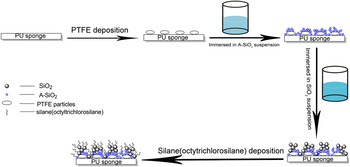
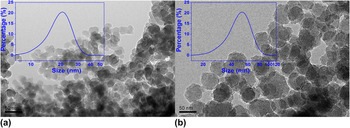
Commercially available PU sponge could be used to prepare the functionalized PU sponge with highly efficient oil/water separation capability. The scheme for the fabrication process of functionalized PU sponge is shown in Fig. 1. First, PTFE particle deposition is achieved by initially spreading a known quantity of PTFE powder on the surface of the sponge using a metal plate, followed by rubbing the metal plate against the sponge surface several times.Reference Calcagnile, Fragouli, Bayer, Anyfantis, Martiradonna, Cozzoli, Cingolani and Athanassiou18, Reference Burkarter, Saul, Thomazi, Cruz, Roman and Schreiner19 Then, the sponge was immersed into two different sizes of amine-functionalized silica and silica suspensions, subsequently. The PU/PTFE sponge modified by two different sizes of silica NPs helps to form micro-/nanostructure. To enhance the combination of these two silica NPs with different sizes by strong electrostatic forces, one of the silica NPs was functionalized by amine groups through hydrolysis of 3-aminopropyltriethoxysiliane and silica NPs in the ethanol (Fig. S1). Finally, the dried sponge is treated by silane (octyltrichlorosilane) through chemical vapor phase deposition to obtain high water repellency property. Figure 2 shows the TEM images of A-SiO2 and SiO2 particles. The size distribution of A-SiO2 and SiO2 particles with average diameter about 20 and 50 nm are shown in insets of Figs. 2(a) and 2(b), respectively (Fig. S2).
The scheme for the fabrication process of functionalized PU sponge.

TEM images of A-SiO2 (a) and SiO2 suspension (b); the insets are the size distribution of A-SiO2 particles and SiO2suspension.

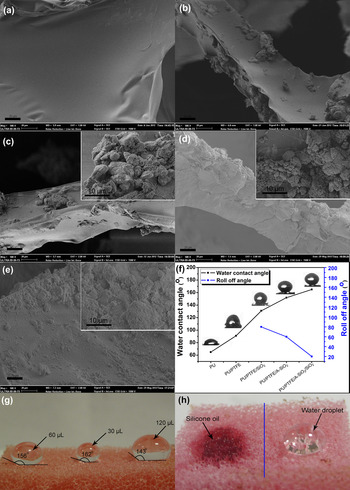
The surface morphology of the sponge samples modified by PTFE and SiO2 is shown in Figs. 3(a)–3(e). The pristine PU sponge shows the smoothest surface in comparison with the treated samples [Fig. 3(a)]. To increase the roughness of surface, the pristine PU sponge was modified by PTFE particles. The PTFE agglomerates form large roughness surface features with micrometer and submicrometer scale due to the existence of electrostatic force between these PTFE particles as shown in Fig. 3(b). To further form micro-/nanostructure, the PU/PTFE was modified by two different kinds of SiO2 NPs with different combinations. The PU/PTFE/SiO2 and PU/PTFE/A-SiO2 samples are prepared by deposition of silica NPs or amine-functionalized silica NPs only over the PU/PTFE sponge. And the PU/PTFE/A-SiO2/SiO2 sample is obtained by deposition of silica NPs and A-SiO2. Compared to the PU/PTFE/SiO2 and PU/PTFE/A-SiO2 samples, the surface of PU/PTFE/A-SiO2/SiO2 sample presents large roughness features at the micrometer, submicrometer, and nanometer scale [Figs. 3(c)–3(e)].
SEM images of PU sponge (a), PU/PTFE (b), PU/PTFE/SiO2 (c), PU/PTFE/A-SiO2 (d), and PU/PTFE/A-SiO2/SiO2 (e); the scare bars are 2 μm. The insets show higher magnification images. The WCA and ROA of the above five samples (f). Digital photograph of different volume water droplet on the surface of PU/PTFE/A-SiO2/SiO2 (g). Digital photograph of a water droplet and red oily droplet on the surface of PU/PTFE/A-SiO2/SiO2(h).

The water contact angle (WCA) and roll-off angle (ROA) measurements are carried out with 5 μL water droplet to describe the relationship between wetting properties and surface microstructure [Fig. 3(f)]. In the cases of the PU/PTFE/SiO2 and PU/PTFE/A-SiO2 samples, water droplets strongly adhere on the surface because the roughness of the surface is not large enough at the Wenzel states.Reference Xu, Wang, Ge, Lam and Ge20–Reference David and Neumann22 Interestingly, when the PU/PTFE sponge is modified by A-SiO2 and SiO2 NPs together, the WCA increases to 165° and ROA to 10°, indicating that the water droplets are easy to roll off the surface. This phenomenon suggests that surface has self-cleaning property,Reference Zhang, Dillert, Bahnemann and Vormoor23, Reference Park, Yoon and Do24 which is similar to lotus effect.Reference Rawlings, Bramble and Staniland25, Reference Gong, Wu, Liu, Sun, Zhao and Jiang26 Obviously, the addition of NPs to the surface of PU/PTFE sponge increases the scrollability and hydrophobic feature of water droplets. In the case of PU/PTFE/A-SiO2/SiO2 sample, the surface with micro-/nanostructure has a roughness enoughReference Hao, Chen, Wang, Guo, Zhang and Pang27, Reference Fan, Zhao, Wang, Li and Xu28 to trap air. When a water droplet is suspended on the rough structure, the air is trapped between the rough structures on a surface underneath the droplet, which is known as the Cassie state.Reference Wu, Shao, Wang, Zheng and Wong29, Reference Wang, Yang, Wang, Wang and Jiang30 So the water droplet can be rolled off easily. On a random rough surface, a drop gradually transitions from a fully Wenzel state to a Cassie state and ultimately to superhydrophobicity as the roughness increases.Reference David and Neumann22
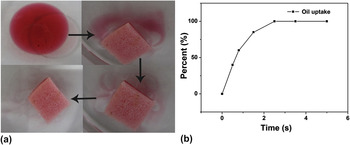
To testify the superhydrophobicity and superoleophilicity of the as-prepared PU sponge, WCA measurements were carried out. As shown in Fig. 3(g), when a 30 μL water droplet dropped on the sponge surface, a ball-like droplet is formed with the WCA at 162°. Increasing the volume of water droplet to 60 μL, the WCA decreases to 156°. When the water droplet volume is 120 μL, the WCA is only about 143°. With increasing the volume of water droplet, the air trapping is not large enough to prevent the situation of wetting transformed from the Cassie state to the Wenzel state. However, a 60 μL silicone oil droplet colored by oil red can be diffused into the sponge immediately as the droplet touched on the sponge surface, as shown in Fig. 3(h). These phenomena proved the superhydrophobicity and superoleophilicity of as-prepared PU sponge, which suggest that it could be used in oil/water separation. To testify this suggestion, the following experiment was carried out. A 0.1 mL of silicone oil colored by oil red is dropped on the surface of water. Then, a piece of as-prepared sponge with dimensions of 1.0 × 1.0 × 0.6 cm3 (length, width, and thickness, respectively) was placed on the surface of oil droplet. Due to its high water repellency and superoleophilicity, the as-prepared PU sponge floated on the water surface, and the silicone oil droplet can be absorbed absolutely in several seconds, which indicates that the as-prepared PU sponge has the high absorption ability for organic oils [Fig. 4(a)]. In the above experiment, the removal percent of oil from the water surface against the time is shown in Fig. 4(b).
Digital photographs of oil uptake process using the as-prepared superhydrophobic/superoleophilic sponge (a) and the oil removal percent form the water surface against the time (b).

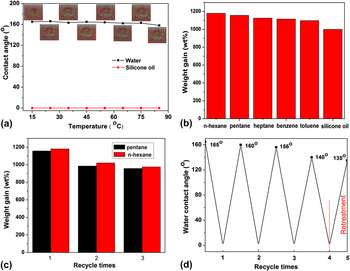
The stability of prepared PU surface is an important issue for oil/water separation system. The shape of water droplet on the superhydrophobic surface was nearly unchanged, and the WCA keeps over 158° with the temperature increasing from 15 to 85 °C [Fig. 5(a)]. Moreover, this functionalized sponge has high absorption rate for other organic solvents including normal alkane, aromatic, and common silicone oil. The weight of organic solvents that absorbed into the sponge is around 10 times over that of pristine-functionalized sponge as shown in Fig. 5(b). However, the as-prepared sponge could lose its high absorption rate after multicycle usage, as shown in Fig. 5(c). In the first cycle usage, the PU sponge’s absorption rate for pentane and N-hexane is 1157% and 1108%, respectively. After 3 times absorption/extrusion cycle usage the absorption rate for pentane and N-hexane decreases to 957% and 975%, respectively. And the PU sponge loses its superhydrophobic feature accordingly [Fig. 5(d)]. It is caused by the lose of SiO2NPs and PTFE particles during the extrusion process of organic solvents, which leads to the decreasing of roughness as well as losing the superhydrophobic feature.
Contact angle of water droplet and oil droplet at different temperature standing on the fibers (a). Absorption capacities for a selection of organic solvents and oils in terms of its weight gain (b). The absorption capacity of the PU sponge after multiple cycles was normalized by weight gain. The absorption capacity of the PU sponge after multiple cycles was normalized by weight gain (c). Reversible wettability of the functionalized PU sponge for water droplets (d).

IV. CONCLUSION
In the present study, a new absorbent composite material was prepared by deposition of PTFE and silica NPs onto the porous structure surface and then treated with chemical vapor deposition of silane to obtain high water repellency feature. Due to its superhydrophobic and superoleophilic properties, the as-prepared sponge could be applied for the removal of oil spills from water surface. This fabrication technique is easy to grasp and to be extended. So we believe that this new functionalized sponge could be realized for the large-scale commercialized production.
ACKNOWLEDGMENTS
This work was financially supported by the Qianjiang Talents Project of Zhejiang Province (Grant No. 2010R10023), the Scientific Research Foundation for the Returned Overseas Chinese Scholars, the State Education Ministry (Grant No. 1001603-C), the Natural Science Foundation of Zhejiang Province (Grant No. Y4100045), Training Foundation for the Excellent Young Talents by the Key Laboratory of Advanced Textile Materials and Manufacturing Technology (ATMT), Ministry of Education (Grant No. 2011QN04), and the National Natural Science Foundation of China (Grant No. 51133006).