Introduction
Parasitic infections pose major threats to the productivity, health and welfare of ruminants, and cervine parasitic infections are no exception. Forest musk deer (Moschus berezovskii) are valued for the musk secreted by adult males. Musk deer breeding programmes, which began in the 1950s, are not only an important ex-situ protection strategy, but also aim to provide sustainable musk resources. However, population growth of the captive musk deer remains slow, due partly to parasitic infections and associated diseases (Ying, Reference Ying1992; Sha et al., Reference Sha, Yang and Cai1998; Yang et al., Reference Yang, Sha, Cai and Cheng2001; Liu et al., Reference Liu, Cheng and Dai2002; Lu et al., Reference Lu, Qiao, Wu and Su2009). Limited data from earlier studies suggested that the principal parasite species in forest musk deer are coccidia, nematodes, cestodes and trematodes (Wu et al., Reference Wu, Jiang, Yu, Ma and Wang1983; Zhu, Reference Zhu1991; Sha et al., Reference Sha, Zhang, Cai and Wang1994, Reference Sha, Zhang, Cai, Wang and Liu1995), but details are not known concerning the quantification of these parasites.
Several copromicroscopic techniques for evaluating parasite loads have been developed, including smear microscopy, the McMaster method (Gordon & Whitlock, Reference Gordon and Whitlock1939) and FLOTAC (Cringoli, Reference Cringoli2006). Among them, the McMaster method is the most widely used and is the standard quantitative technique in veterinary parasitology, due to its low cost and high sensitivity (Pereckienė et al., Reference Pereckienė, Kaziūnaitė, Vyšniauskas, Petkevičius, Malakauskas, Šarkūnas and Taylor2007). However, many modifications to the McMaster method have been introduced to further increase the diagnostic accuracy and reliability (Wetzel, Reference Wetzel1951; Zajicek, Reference Zajicek1978; Roepstorff & Nansen, Reference Roepstorff and Nansen1998; Cringoli et al., Reference Cringoli, Rinaldi, Veneziano, Capelli and Scala2004). Although the factors influencing the performance of the McMaster method have been studied, such as the faecal preservation method (Foreyt, Reference Foreyt1986; Nielsen et al., Reference Nielsen, Vidyashankar, Andersen, DeLisi, Pilegaard and Kaplan2010; Jagla et al., Reference Jagła, Śpiewak, Zaleśny and Popiołek2013) and the flotation solution used (Cringoli et al., Reference Cringoli, Rinaldi, Veneziano, Capelli and Scala2004), there is no common faecal preservation method or flotation solution for parasite copromicroscopic detection, because of the biology of the worms and the host physiological state (Foreyt, Reference Foreyt2001; Bowman, Reference Bowman2014). Selection of the appropriate faecal preservation method and flotation solution is a prerequisite for effective clinical diagnosis of parasites by breeders and veterinarians (Ward et al., Reference Ward, Lyndal-Murphy and Baldock1997; Roepstorff & Nansen, Reference Roepstorff and Nansen1998; Cringoli et al., Reference Cringoli, Rinaldi, Maurelli and Utzinger2010).
The objectives of this study were to evaluate the methods of preservation and flotation for the detection of nematode eggs and coccidian oocysts in faeces of the forest musk deer, and to identify the best preservation method and flotation solution for forest musk deer. The findings reported herein will facilitate clinical diagnosis of parasites in forest musk deer by breeders and veterinarians.
Materials and methods
Collection and examination of faecal samples
The study was conducted at the Breeding Center of Forest Musk Deer located in Fengxian, Shaanxi Province, in the Qing Ling Mountain region (34°11′N, 106°50′E). This location has a warm temperate climate with an average annual temperature and average rainfall of 11.3°C and 634.6 mm, respectively. All musk deer were fed fresh leaves twice a day, at dawn and dusk, in summer and autumn, and dried leaves in winter and spring, which were collected from the natural habitat of wild musk deer. The plants included Anacardiaceae rhus, Picrasma chinensis, Ulmus pumila and Morus alba, among others. Supplementary artificial food consisted mainly of corn flour, soybean flour, wheat bran, some seasonal vegetables and fruit. Water was provided ad libitum. As the musk deer were allowed to live together during the day and kept individually at night, the faeces could be collected individually after the night.
In July 2013, fresh faecal samples were collected from 33 forest musk deer. Every evening from 19.00 to 20.00 hours, the breeders cleaned the faeces from each individual house to allow collection of fresh faeces from each animal the next morning. Individual forest musk deer were identified by ear tags. Each faecal sample was divided into three parts, and preserved using either freezing at − 20°C, preservation in 10% formalin or in 70% alcohol. The frozen samples were transported to our laboratory using a mobile refrigerator.
Three flotation solutions were used for copromicroscopic analysis of each preserved faecal sample. For each combination of preservation technique and flotation solution, the copromicroscopic analysis procedure was kept constant. The three flotation solutions were all saturated and included sodium chloride and sodium nitrate, both with specific gravities of 1.200, and magnesium sulphate with a specific gravity 1.280. Copromicroscopic analysis of all samples was performed within 2 weeks of sample collection.
The McMaster method was used to count parasite eggs or oocysts in each faecal sample. Up to 2 g of faeces were thoroughly ground up, mixed with 58 ml of tap water and stirred continuously for 20 min until the faecal sample was thoroughly homogenized. Each mixture was filtered into a new beaker through a standard sieve with 0.18-mm mesh, and each resulting filtrate was injected into two counting chambers of a McMaster Egg Slide Counting Chamber (Shanghai Veterinary Research Institute, Chinese Academy of Agricultural Sciences). Microscopy was performed after the eggs were allowed to float for 5 min. The eggs per gram (EPG) or oocysts per gram (OPG) were calculated as: EPG or OPG = (n/0.15) × V/m, where n is the mean number of eggs or oocysts in two counting chambers and 0.15 is the volume of each counting chamber, whereas V and m are the volume of the homogenized faecal sample and weight of faeces, respectively; in this case V= 60 ml and m= 2 g.
Data analysis
The prevalence and quantitative data were analysed statistically. The EPG or OPG values from the tests with each combination of preservation method and flotation solution were calculated. EPG or OPG value was the dependent variable, while the independent variables were the preservation method and flotation solution. The normality of the data was tested separately using a Shapiro–Wilk test, after which, because of the non-normality of the data, the Kruskal–Wallis extension test (Dytham, Reference Dytham2003) was used to reveal differences among the selected preservation methods and flotation solutions. For significant differences, the McNemar test was applied for post-hoc multiple comparisons. The significance threshold of the post-hoc multiple comparison test was 0.01 (α = 0.01). The sequential Holm–Bonferroni correction was used to control Type I error. The gold-standard flotation solution or preservation method was defined as the solution or method that produced the highest EPG or OPG (Rinaldi et al., Reference Rinaldi, Coles, Maurelli, Musella and Cringoli2011). The paired-sample t-test was used to reveal differences in the prevalence of nematode and coccidia in the faecal samples exposed to the nine combinations. All statistical analyses were performed with SPSS version 20.0 (IBM Corporation, Armonk, New York, USA).
Results
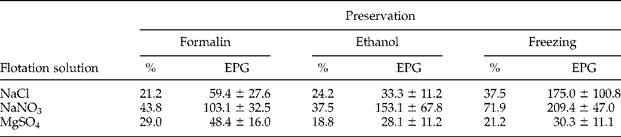
For detection of nematode eggs, the interaction between preservation method and flotation solution and the differences among the selected preservation methods were not significant (P > 0.01), but the differences among the selected flotation solutions were significant (P < 0.01). Of the nine processing combinations, the gold standard was obtained with a combination of freezing and sodium nitrate (EPG = 209.4 ± 67.8), which was significantly higher than that of the other eight combinations (table 1; P < 0.01). The difference between sodium chloride and magnesium sulphate was not significant (P > 0.01).
The prevalence (%) and mean number of nematode eggs (EPG) in faecal samples of forest musk deer preserved in formalin, ethanol or subjected to freezing and then to flotation in saturated solutions of sodium chloride (NaCl), sodium nitrate (NaNO3) or magnesium sulphate (MgSO4).

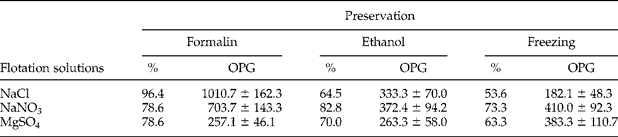
With respect to coccidian oocysts, the interaction between preservation method and flotation solution and the differences among preservation methods were significant (P < 0.01), but the differences among flotation solutions were not significant (P > 0.01). Of the nine processing combinations, the gold standard was obtained with a combination of preservation in 10% formalin and sodium chloride, with OPG = 1010.7 ± 162.3 (table 2). The post-hoc multiple comparison tests for preservation methods showed that the coccidia OPG value resulting from formalin preservation was significantly higher than that produced by the other two methods (P < 0.01), but the difference between freezing and alcohol preservation was not significant (P > 0.01).
The prevalence (%) and mean number of coccidian oocysts (OPG) in faecal samples of forest musk deer preserved in formalin, ethanol or subjected to freezing and then to flotation in saturated solutions of sodium chloride (NaCl), sodium nitrate (NaNO3) or magnesium sulphate (MgSO4).

The values of nematode and coccidian prevalence obtained from the gold-standard processing combinations were 71.9% and 96.4%, respectively. Paired-sample t-test showed that the coccidian parasite load in the faecal samples was significantly greater than the nematode load (t= − 5.62, df = 8, P= 0.001).
Discussion
There are many factors that can influence the result of faecal egg evaluation (Rupasinghe & Ogbourne, Reference Rupasinghe and Ogbourne1978; Foreyt, Reference Foreyt1986; McKenna, Reference McKenna1998; Cringoli et al., Reference Cringoli, Rinaldi, Veneziano, Capelli and Scala2004; Rinaldi et al., Reference Rinaldi, Coles, Maurelli, Musella and Cringoli2011). The results of the present study showed that the flotation solution was the most important factor influencing nematode egg estimation, with sodium nitrate being the gold standard with the highest EPG. In addition, there was an interaction between preservation method and flotation solution for coccidian oocysts, while the combination of formalin and sodium chloride was the gold standard with the highest OPG.
The effect of preservation method on parasite detection varies across the parasite taxa and the host. Preservation in potassium dichromate was more suitable for the detection of coccidia in rabbits and poultry (Garcia-Lopez et al., Reference García-López, Rodríguez-Tovar and Medina-De la Garza1996; Wunderlin et al., Reference Wunderlin, Wild and Eckert1997; Hobbs et al., Reference Hobbs, Twigg, Elliot and Wheeler1999). However, freezing was the most reliable and least biased preservation method for strongylid nematode eggs of horses (Nielsen et al., Reference Nielsen, Vidyashankar, Andersen, DeLisi, Pilegaard and Kaplan2010; Jagla et al., 2013). With respect to Dicrocoelium dendriticum and Moniezia expansa in sheep, formalin and freezing showed similar performance, but vacuum packing with storage at 4°C was the best preservation method for counting gastrointestinal (GI) strongyle eggs (Rinaldi et al., Reference Rinaldi, Coles, Maurelli, Musella and Cringoli2011). Jagla et al. (2013) suggested that chemical preservation should be considered only when the use of low temperatures to count strongylid nematode eggs is impossible. The present study found that freezing performed better than formalin and alcohol for nematode egg counting.
The type of flotation solution can significantly influence the accuracy of quantitative analyses of parasites in faeces. The present study showed that the best flotation solution was not the solution with the highest specific gravity, although it floated more faecal debris. A high amount of faecal debris makes microscopic examination difficult, as debris traps some eggs and oocysts at the bottom of the McMaster chamber and obstructs viewing (Haug et al., Reference Haug, Williams and Larsen2006; Vadlejch et al., Reference Vadlejch, Petrtýl, Lukešová, Čadková, Kudrnáčová, Jankovská and Langrová2013). In contrast, the best solution for counting GI strongyle eggs in sheep was sucrose solution, while potassium iodomercurate was best for D. dendriticum (Cringoli et al., Reference Cringoli, Rinaldi, Veneziano, Capelli and Scala2004). Taking into account the cost and ease of preparation, sodium chloride was the best solution for nematode and cestode eggs, while zinc sulphate was best for trematode eggs and nematode larvae in sheep (Rinaldi et al., Reference Rinaldi, Coles, Maurelli, Musella and Cringoli2011). In comparision, the best solution for Ascaris suum eggs in pigs was salt solution containing sucrose (Pereckienė et al., Reference Pereckienė, Kaziūnaitė, Vyšniauskas, Petkevičius, Malakauskas, Šarkūnas and Taylor2007).
In this study, the prevalence values of nematodes and coccidia in the 33 tested deer were 71.9% and 96.4%, respectively (table 1, table 2). The prevalence values of both tested parasites were higher than those in wild alpine musk deer (nematodes: 38.0%; coccidia: 49.3%; Lu et al., Reference Lu, Qiao, Wu, Wang, Hu, Pei, Zhang, Feng, Wang, Kong and Li2010) and Tianshan red deer (nematodes: 25.8%; coccidia: 0.7%; Amila et al., Reference Amila, Risalat, Aysajan, Rizihan, Zhou and Mahmut2014). The first reason for these high prevalence values is anthelmintic abuse, leading to widespread loss of effect of benzimidazole compounds and pyrantel salts which can no longer control parasite invasions (Comer et al., Reference Comer, Coles and Hillyer2001; Gawor, Reference Gawor2006; Flohr et al., Reference Flohr, Tuyen, Lewis, Minh, Campbell, Britton, Williams, Hien, Farrar and Quinnell2007). All forest musk deer are subjected to deworming several times per year, irrespective of whether they are parasite-free or infected to only a slight degree, which leads inevitably to drug resistance in parasites (Jagla et al., 2013). The second reason for the high prevalence is that the host has been under stress for a lengthy period (Oppliger et al., Reference Oppliger, Clobert, Lecomte, Lorenzon, Boudjemadi and John-Alder1998; Ran, Reference Ran2013). Forest musk deer are very shy, solitary animals that are particularly susceptible to several stressors commonly encountered in captivity, including increased population density (He et al., Reference He, Wang, Li, Liu, Liu, Liu, Qi and Hu2014), disturbances caused by human activities, and changing food types (Liu, Reference Liu2008; Lang, Reference Lang2013). Finally, cross-contamination is a potentially significant, but often ignored, factor that increases the risk of parasitic infection.
The present study provides details of the optimized preservation method and flotation solution for detection of parasite eggs or oocysts in faecal samples, as well as a simple and easy counting method, for use with forest musk deer. These findings lay the foundation for parasitological surveillance in wild and captive forest musk deer. Furthermore, we confirmed that captive forest musk deer suffer from serious parasite invasions and require targeted management.
Acknowledgements
We thank the staff of the Breeding Center of Forest Musk Deer in Shaanxi Province, especially Mr Cun-xuan Li and Mr. Bao-qing Liu for their help and support. We are grateful to Jonathan Warner for his professional scientific editing advice to substantially improve the style of English writing and grammar. Our deepest gratitude goes to the anonymous reviewers and the editors for their careful work and thoughtful suggestions that have helped improve this paper substantially.
Financial support
This work was financed by the Species Salvation Program of the Department of Fauna and Flora and Nature Reserve Management, State Forestry Administration of China (no. musk deer 2013).
Conflict of interest
None.
Ethical standards
The authors assert that all procedures contributing to this work comply with the ethical standards of the relevant national and institutional guides on the care and use of laboratory animals. The faecal sampling (non-invasive method) was carried out under the authority of a scientific permit issued by the Shaanxi Forestry Bureau, Shaanxi, China. Our non-invasive sampling method was used to collect faeces only.