Introduction
Atypical antipsychotics (AAPs) are frequently associated with adverse metabolic effects in patients with schizophrenia (Holt, Reference Holt2008, Association CP., 2012). These metabolic adverse effects include weight gain, increased risk of diabetes, and dyslipidemia. AAPs seem to differ in terms of their metabolic risk (Allison et al., Reference Allison1999, Newcomer Reference Newcomer2005) with Clozapine and Olanzapine associated with greater risk.
While weight gain is implicated as the mediating factor for Olanzapine-related dyslipidemia (Kinon et al., Reference Kinon, Basson, Gilmore and Tollefson2001; McIntyre et al., Reference McIntyre, McCann and Kennedy2001), there is also evidence pointing to direct, weight-gain-independent effects of these medications on lipid (Vik-Mo et al., Reference Vik-Mo, Birenaes, Ferno, Jonsdottir, Andreassen and Steen2008; Vidarsdottir et al., Reference Vidarsdottir, Vlug, Roelfzema, Frolich and Pijl2010b) and glucose metabolism (Vidarsdottir et al., Reference Vidarsdottir, deLeeuw van Weenen, Frolich, Roelfzema, Romijn and Pijl2010a; Guenette et al., Reference Guenette, Hahn, Cohn, Teo and Remington2013).
Schizophrenia and dementia in the treatment naïve states, are also strongly associated with diabetes (Dixon et al., Reference Dixon2000; Bissells et al., Reference Bissells, Staekenborg, Brunner, Brayne and Scheltens2006).
Atypical or second-generation antipsychotic medications are widely used in the treatment of psychosis and behavioral problems in elderly patients. It is estimated that as many as half of all antipsychotic prescriptions are, in fact, for people over the age of 65 years (Holt, Reference Holt2008).
The data about metabolic side effects of these medications, however, are largely collected from younger and middle-aged adults. Research specific to the elderly, as in many areas of psychiatry, is lacking. But now, with an aging cohort of AAP users, there is greater need to investigate the effects of these medications on the aging human physiology (Alexopoulous et al., Reference Alexopoulous, Streim, Carpenter and Docherty2004).
These medications have been associated with an increased risk of cerebrovascular disease and death in elderly with dementia (Alexopoulous et al., Reference Alexopoulous, Streim, Carpenter and Docherty2004) with the US Food and Drug Administration (FDA) issuing a black box warning against its use within this population (Administration FDA, 2005). As the incidence of diabetes and other metabolic disorders also increases with age, it remains uncertain whether the increased risk of cerebrovascular mortality could be attributable (at least in part) to the metabolic adverse effects of these medications (Guenette et al., Reference Guenette, Chintoh, Remington and Hahn2014).
There is conflicting evidence about the extent of weight gain caused by AAPs in the very old, in comparison to younger adults. There may be a wide range of weight responses with some gaining, and others losing or experiencing no change (Guenette et al., Reference Guenette, Chintoh, Remington and Hahn2014).
Recent expert opinion concludes that risk in elderly with AAP use remains largely undetermined (Guenette et al., Reference Guenette, Chintoh, Remington and Hahn2014) and that monitoring metabolic parameters should be at baseline, 3–4 months later and then annually (Holt, Reference Holt2008). It might, however, be reasonable to monitor metabolic parameters less aggressively if the overall prognosis is poor, and especially if caregiver and patient preferences align with this view (Guenette et al., Reference Guenette, Chintoh, Remington and Hahn2014).
Thus, the objectives of this study were to examine the AAP-associated changes in metabolic parameters using a case controlled longitudinal design, and controlling for important variables like dementia and its severity.
Method
Study design
This is an observational case-control study collecting metabolic data on elderly patients treated with AAPs in the Mental Health Services for Older People (MHSOP) of the Auckland District Health Board from 1 Jan 2008 to 1 Jan 2014. MHSOP is a community old-age psychiatric and in-patient service with entry criteria being based on patients with age-related issues, or “graduates” with mental illness that re-present with an episode of illness after a substantial period out of services. Diagnostic criteria used in this service are based on DSM -IV-TR (American Psychiatric Association, 2000).
Inclusion criteria were being prescribed an AAP for a minimum of 3 months’ continuous duration for the first time, with baseline metabolic blood testing (within 12 months prior to starting an AAP) and at least one post-exposure blood result (defined as 3 months to 12 months after AAP initiation). Data on AAP dose, diagnosis, and other medications were collected.
Controls were identified as any patients within the service within the defined period (2008–2014) who were never prescribed an AAP, but who also had had metabolic blood testing at least twice, and at least over a 3-month period. The controls were identified by alphabetically listed National Hospital Index numbers and collection was stopped when the number reached 301.
Clinical data collection
Once participants were identified, all data were extracted by searching electronic patient records. The electronic patient record at the service was complete for all data that was required by this study. A number of predictors of interest were collected, including demographic information and psychiatric and other medical diagnoses. If dementia was diagnosed, then the subtype and severity was recorded: mild, moderate, or severe based on cognitive testing results (Morris, Reference Morris1993). APP details such as date of initiation, type, and dose were noted. Also, recorded were use of potential confounding medications such as antihypertensives, lipid modifying, and antidiabetic medication, and details of whether these were started before or after AAP use. Also collected was smoking status (coded as: current, ex, never, and unknown).
Outcome data collected included biochemical measures, cardiovascular events, and death. Measures of HbA1c, fasting glucose, total cholesterol, LDL, ratio, and fasting triglycerides were recorded in relation to AAP exposure (in months) and compared with controls. Triglycerides and serum glucose measurements were recorded only if they were fasting (as determined by specification on the electronic blood result). Clinical events of cardiovascular disease (stroke, myocardial infarction) were obtained by examining medical discharge summaries, and death was ascertained via the electronic record system.
Institutional approval was gained from the Auckland District Health Board prior to data extraction.
Statistical analysis
All analyses were conducted using SPSS version 23 software and SAS version 9.4 software. Statistical significance was accepted at two sided p < 0.05.
Analysis of change in metabolic data from baseline to the last observation was performed for all patients who had baseline and at least one follow-up metabolic measure.
A comparison of means for metabolic data within the same group of patients was performed using a paired (or dependent) samples t-test. A Wilcoxon signed-rank test was also performed on medians of these data. Statistical significance was compared between both parametric and non-parametric tests to confirm normal distribution of the data.
Separate linear regression models were fitted for each metabolic factor, including HbA1c, fasting glucose, total cholesterol, ratio, LDL, and fasting triglycerides. These were used to look for significant effects of the pre-defined confounders (age, gender, ethnicity, disease modifying medications, and smoking) for changes in metabolic measures in the cases group over time, and then further models were used to examine the effect of single predictors of interest (diagnosis of dementia, dementia severity, AAP type, and dose). Each model was adjusted for significant confounders if any were identified for each parameter. Missing data were excluded from the regression analysis without imputation.
Logistic regression was used to examine whether any of the pre-defined confounders had any significant effect on the hard endpoints.
Similarly, in the between-groups analyses of cases versus controls, logistic, and linear regression models were used for the outcomes as above, and all other co-variates of interest were tested and kept in the final model if statistically significant.
Results
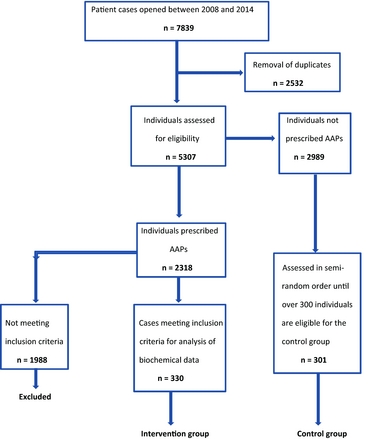
A total of 5,307 patient cases were identified for the specified study period (Figure 1) and 330 cases were identified as meeting inclusion criteria for data collection and analysis. The majority of excluded cases lacked baseline or post-treatment blood testing in the defined timeframe. Individuals on AAPs prescribed before the beginning of the study period, those not AAP naïve, and those on multiple AAPs were also excluded. Of the 2,989 patients never prescribed an AAP, 301 were identified as controls after meeting eligibility criteria.
Flow chart of patients.

Baseline patient characteristics
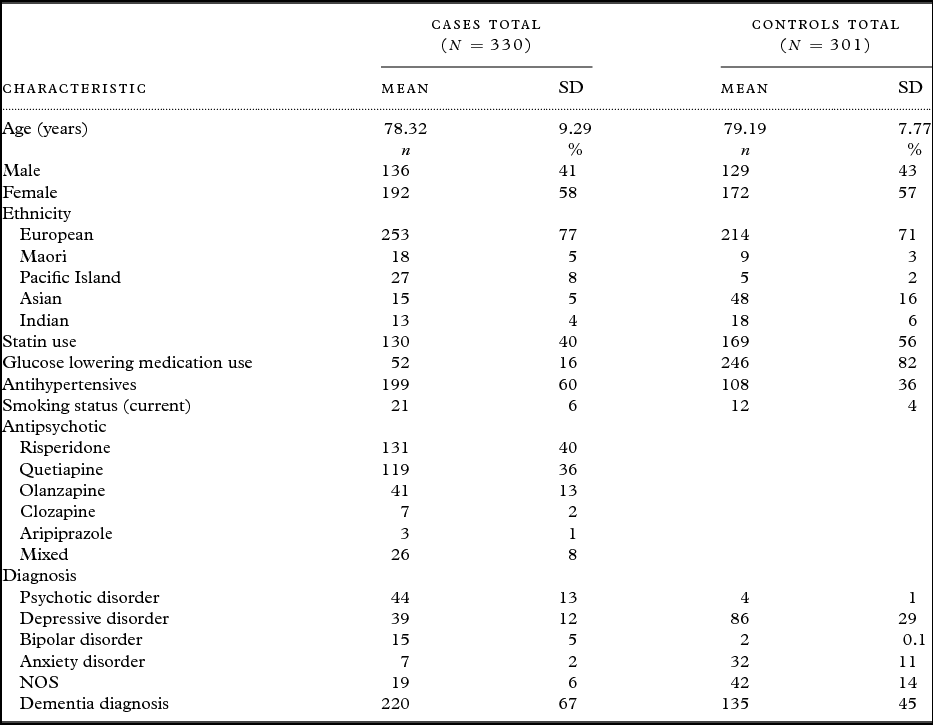
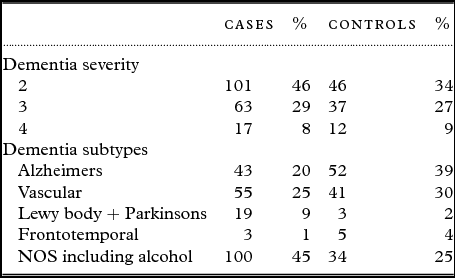
A total of 330 patients from MHSOP met eligibility criteria as cases. Demographic data, psychiatric diagnoses, and AAP use at baseline are summarized in Table 1. Dementia severity and dementia subtypes are summarized in Table 2. Metabolic data at baseline is included in Table 3.
Baseline patient characteristics

Dementia characteristics

Analysis of results

*Adjusted model- all other covariates of interest were tested and kept in final model if statistically significant.
The mean age for cases was 78.3 years (range= 50–101). A total of 59% were female, 41% were male; 77% were European, 5% were Maori, 8% were Pacific Island, 4.5% were Asian, and 4% were of Indian descent; 40% were using statins, 16% were using glucose lowering medications, and 60% were using antihypertensives at some point in the study; 6% were current smokers.
Average daily doses of AAPs were risperidone 0.8 mg, quetiapine 29.7 mg, olanzapine 7.0 mg, clozapine 55.4 mg, and aripiprazole 6.7 mg. Chlorpromazine equivalents calculated using estimates (Woods, Reference Woods2013) were 40mg/day for risperidone, 39.6 mg/day for quetiapine, 140mg/day for olanzapine, and 89.3 mg/day for aripiprazole.
The control group showed largely similar characteristics with mean age at 79.2 years, with 57% female; 71% were European, 3% Maori, 2% Pacific Island, 16% Asian, and 6% Indian. Statin use was 56% and antihypertensive use 36%. Glucose-lowering medication use seemed higher at 82%; 4% were current smokers.
Metabolic changes with atypical antipsychotic use in the cases group over time
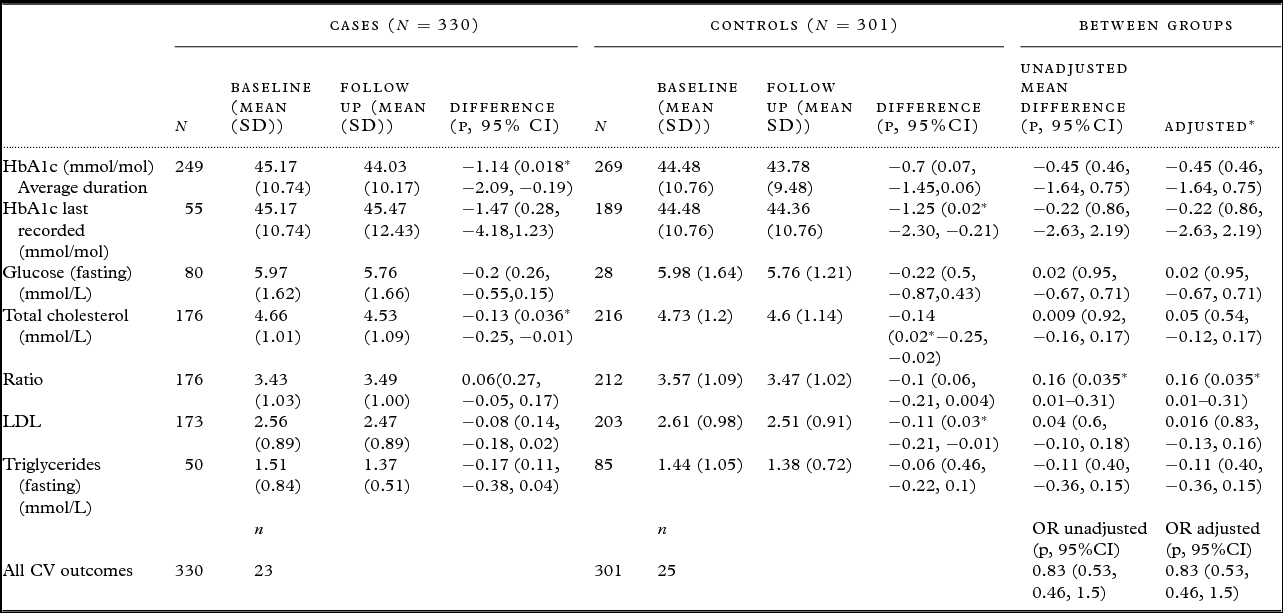
Baseline, follow-up and mean differences in metabolic data in cases are summarized in Table 3.
The baseline means HbA1c in the cases was 45.17 mmol/mol (SD 10.74). The follow-up mean HbA1c was 44.03 mmol/mol (SD 10.17). The mean difference in HbA1c in the cases was −1.14 mmol/mol (SD 7.59), which was statistically significant (p = 0.018, 95% CI −0.19 to −2.09). The mean duration of follow-up for HbA1c was 8 months (range 3–12 months). The mean duration of follow up for last recorded HbA1c was 25 months (range 12–83 months) but the mean difference between baseline and last recorded HbA1c was not statistically significant. Those with longer duration of follow up HbA1c corresponded to longer durations of AAP therapy.
Also statistically significant was the mean difference in total cholesterol of −0.13 mmol/L (p = 0.036, 95% CI −0.008 to −0.245).
There was no significant change in fasting glucose, fasting triglycerides, cholesterol ratio, and LDL cholesterol.
Using linear regression modeling, the use of antidiabetic medication was significantly associated with greater reduction in both post (−3.20 mmol/ mol, p = 0.02) and last HbA1c (−9.31 mmol/mol, p = 0.004) in the cases group over time. Antihypertensive use was also found to be significantly associated with this outcome, but associated with greater increase (6.60 mmol/mol, p = 0.03).
Age and ethnicity were significant confounders in change of total cholesterol, with each one year of age associated with a 0.16 mmol/L reduction in change of cholesterol (p = 0.03). Within the ethnicity data, it was specifically the difference between Indian and European ethnicities that explained this significant confounder in change in total cholesterol (0.72 mmol/L further increase in change of total cholesterol, p = 0.004). Patients with dementia also had further reduction in total cholesterol compared to those without a dementia diagnosis (−0.31 mmol/L, CI −0.54 to –0.080 p = 0.0085).
Age was also found to be a significant confounder for change in cholesterol ratio (−0.02 mmol/L p = 0.01), although the overall change in ratio was not significant.
Age and ethnicity were also significant confounders for change in LDL, although again, there was no overall significant change shown in LDL for the cases over time.
Duration of antipsychotic use and smoking status were significant confounders for change in fasting triglycerides, with having a dementia diagnosis trending toward significance as a predictor variable once the confounders were adjusted for (−0.35 mmol/L, p = 0.07).
No significant confounders or predictors of hard endpoints of cardiovascular outcomes were identified using logistic regression.
Metabolic changes in cases versus control groups over time
The only significant metabolic parameter difference found between cases and controls was in the change in cholesterol ratio. There was a mean difference of 0.16 mmol/L between groups (95%CI 0.01–0.31, p = 0.036).
There were no other significant differences between groups. Ethnicity and having a dementia diagnosis were found to be significant covariates of change in cholesterol. Age was also a significant predictor of change in LDL.
Discussion
This is a large study that has examined metabolic parameters as a primary outcome in an elderly mental health population, and with a case controlled longitudinal study design. The change in metabolic parameters, both within the cases over time, and between cases and controls, when statistically significant are clearly clinically quite insignificant. However, the mean results for HbA1c show that this population as a whole falls into pre-diabetes territory, which requires action in the form of diet/lifestyle modification and repeat monitoring (Braadvedt et al., Reference Braadvedt2012).
Unlike many other studies in this area, this study has controlled for several important confounders such as pre-existing and de novo metabolic disorders, use of antidiabetic, cholesterol-lowering and some other cardiovascular medications, as well as smoking status. We have also examined the usual predictors of interest such as age, gender, ethnicity, and diagnosis, but also perhaps more uniquely, further predictors such as severity of dementia, medication subtypes, and dose effects over time.
We have also excluded prior antipsychotic treatment so cases are treatment naïve and not confounded by previous treatment effects.
Also, important to this study is New Zealand's ethnically diverse aging population, with the small numbers of Maori cases being analyzed still providing important information about this poorly researched sub-group.
We could not detect any change in hard outcomes of cardiovascular disease between groups. While the data for this were largely reflective of morbidity, that was only captured in secondary healthcare utilization, (and could be a type 1 error), given the sufficient powering of this study for a number of relevant outcomes, it is could be said that we have been unable to demonstrate any hospital-level greater financial burden from adverse metabolic side effects in our elderly patients from this class of medication.
This study has several limitations. Once potential cases who had used an APP were identified, the main reason for exclusion appeared to be lack of metabolic data (that is, either baseline or post-treatment blood tests were missing). Thus, there exists the potential for bias in the lack of representation of the source population. The control group had much higher rates of antidiabetes medication (and statin use) compared to the cases. This may suggest that the control group was likely to reflect the subgroup of mentally unwell elderly patients who already had type 2 diabetes or established/at risk of cardiovascular disease. There was a lack of baseline weight recording in the electronic record, and therefore no BMI calculations. Abdominal girth and blood pressures were also not routinely collected. Not all cardiovascular modifying agents were able to be included. And apart from smoking, other aspects of lifestyle (such as diet and exercise) were unexamined. The focus of this study was on diabetes and cholesterol risk, and including all other cardiovascular predictors of interest was out of our scope. We also did not collect data for place of abode (i.e. community dwelling vs. institutions) which may have influenced variables like access to food and quality of diet. These variables may be relevant to weight gain as a mechanism for AAP-associated metabolic dysregulation seen in younger populations. Finally, while the study had sufficient powering to detect significant results in the main outcomes, there were likely insufficient numbers for sub-group analysis of effects within separate diagnoses like schizophrenia, severity classes of dementia, and also insufficient numbers to compare between individual antipsychotics.
The CATIE-AD (Zheng et al., Reference Zheng, Mack, Dagerman and Hsiao2009) study is one of the few randomized controlled trials examining metabolic changes in Alzheimer's disease. It showed that AAP use, especially Olanzapine and Quetiapine, was associated with weight gain. Elderly women were found to be more susceptible and this was possibly due to the higher fat-to-lean body mass ratio (Zheng et al., Reference Zheng, Mack, Dagerman and Hsiao2009). There was a relationship between weight gain and duration of treatment (Zheng et al., Reference Zheng, Mack, Dagerman and Hsiao2009). The increases in weight and waist circumference, as well as decrease in HDL, on Olanzapine, were reported to be similar to a large randomized controlled trial in younger adults with schizophrenia (Zheng et al., Reference Zheng, Mack, Dagerman and Hsiao2009). However, the Alzheimer's disease patients had substantially better profiles for all of those measures at baseline (Zheng et al., Reference Zheng, Mack, Dagerman and Hsiao2009). Of note, no significant changes were noted in blood pressure, glucose, and triglycerides over this 36-week study but the authors have highlighted that the study may have been underpowered to observe this finding due to substantial non-fasting data having been excluded for this analysis (Zheng et al., Reference Zheng, Mack, Dagerman and Hsiao2009).
Other data collected from randomized controlled trials and observational studies suggest that the rate of metabolic adverse events is lower in elderly compared to younger individuals with schizophrenia (Holt, Reference Holt2008).
A recent literature review on AAP-induced metabolic changes in the elderly found that the majority of studies, most of which included dementia patients, suggest an apparent low vulnerability to these changes (Guenette et al., Reference Guenette, Chintoh, Remington and Hahn2014). However, due to the heterogeneity in study design, it was not possible to comment on sub-populations and differential risks (Guenette et al., Reference Guenette, Chintoh, Remington and Hahn2014). This review also did not identify any prospective studies examining metabolic parameters as a primary outcome measure, and the majority of included studies failed to control for important variables like the severity of dementia (Guenette et al., Reference Guenette, Chintoh, Remington and Hahn2014).
A large study has found that the risk seems even lower in those over 75 years of age (Feldman et al., Reference Feldman, Hay, Deberdt and Kennedy2004) – a subgroup in which the rates of dementia would be higher. Age itself appears to be negatively correlated with antipsychotic-induced weight gain with a study reporting a 0.6 kg weight gain reduction for every extra 10 years of age (Smith et al., Reference Smith2008).
In the setting of advanced dementia, there is more uncertainty about this issue. Weight loss is common with up to 54% of elderly in residential care being underweight (Kennedy et al., Reference Kennedy, Bymaster, Schuh and Calligaro2001); reflective at least in part, of the physiological anorexia associated with aging per se, even in healthy elderly individuals. Several studies in dementia populations show absolute weight loss despite treatment with AAPs (Street et al., Reference Street, Clark and Gannon2000; Goldberg, Reference Goldberg2001; Gurevitz et al., Reference Gurevitz, Costakis and Leiter2009). It could be argued that weight loss seems more of a concern than weight gain in the sub-group of elderly with dementia (White et al., Reference White, Pieper and Schmader1998).
Looking at glucose metabolism specifically, only a minority of studies have shown change in this context (Sernyak et al., Reference Sernyak, Leslie, Alarcon, Losonczy and Rosenheck2002; Hwang et al., Reference Hwang, Yang, Lee and Thai2003; Feldman et al., Reference Feldman, Hay, Deberdt and Kennedy2004; Kisely et al., Reference Kisely, Cox, Campbell, Cooke and Gardner2009; Lipscombe et al., Reference Lipscombe2009; Lipscombe et al., Reference Lipscombe2011; Erickson et al., Reference Erickson2012). Most of these have been in diagnostically mixed populations with variable methodology. We have demonstrated a small improvement in HbA1c over 3–12 months of treatment with AAP, while acknowledging the use of antidiabetic medication as a significant confounder. Antidiabetic medication was not however, a significant co-variate of change in glucose metabolism between cases and controls. Our findings support the view that there is clinically insignificant change in glucose metabolism with the use of AAPs in this elderly population bearing in mind the limitations of this study.
Similarly, in lipid metabolism, only a minority of studies have shown disrupted lipid metabolism in this context with Olanzapine being most implicated (Hwang et al., Reference Hwang, Yang, Lee and Thai2003; Yang et al., Reference Yang, Tsai and Hwang2005; Zheng et al., Reference Zheng, Mack, Dagerman and Hsiao2009; Martinez et al., Reference Martinez, Peris Martí, Gomar Fayos, Navarro Gosalbez, Quintana Vargas and Muelas Tirado2010). Conversely, there is also indirect evidence suggesting an improvement in lipid profile (Erickson et al., Reference Erickson2012) with one study showing favor for Risperidone (Deberdt et al., Reference Deberdt2005). Again, the populations are diagnostically mixed but there is one study showing unfavorable changes in a dementia setting (Zheng et al., Reference Zheng, Mack, Dagerman and Hsiao2009). We have demonstrated a small, clinically insignificant, improvement in total cholesterol over 3–12 months of treatment with AAP, and therefore our findings support the view that there is clinically insignificant change in total cholesterol specifically with the use of AAPs in this elderly population, again bearing in mind the limitations of this study.
There are several factors that may help explain the low vulnerability to antipsychotic-related metabolic side effects in this population.
Even though the mechanisms underlying the changes in AAP-related dyslipidemia have not been fully elucidated, research has demonstrated that weight gain is the mediating factor in causing Olanzapine-related dyslipidemia (Kinon et al., Reference Kinon, Basson, Gilmore and Tollefson2001; McIntyre et al., Reference McIntyre, McCann and Kennedy2001). Weight gain is also one of the most established risk factors for diabetes. It is possible that one reason that elderly have reduced AAP-associated metabolic disorders is due to a lower vulnerability to weight gain (Guenette et al., Reference Guenette, Chintoh, Remington and Hahn2014) related to dementia (particularly if severe), other illnesses and the physiological anorexia of aging. There is also a potential ceiling effect for AAP-related side effects and this is based on the schizophrenia literature showing that young, treatment-naïve patients are the most vulnerable to weight gain (Alvarez-Jimenez et al., Reference Alvarez-Jimenez2008).
Similarly, those with a pre-disposition to developing metabolic syndrome may have already done so by the time they reach old age. It is possible that the 20–25 year reduction in life span for people with schizophrenia (Newman and Bland, Reference Newman and Bland1991; Harris and Barraclough, Reference Harris and Barraclough1998), which is largely attributed to cardiovascular disease (Marder et al., Reference Marder2004; Balf, Reference Balf2008), means that the majority of those who are pre-disposed to metabolic diseases are not even reaching old age (Guenette et al., Reference Guenette, Chintoh, Remington and Hahn2014).
Another important consideration is the relatively lower dose of AAP used to treat late-onset psychiatric illness as well as the behavioral and psychological symptoms of dementia. Therefore, a potential dose–response relationship between AAPs and metabolic side effects may be missed in elderly populations.
Finally, methodological issues need to be considered. Insufficient powering of efficacy trials examining adverse side effects has been implicated in many being unable to detect metabolic adverse effects, especially in the absence of weight gain (Guenette et al., Reference Guenette, Chintoh, Remington and Hahn2014). Indeed, with one exception (Hwang et al., Reference Hwang, Yang, Lee and Thai2003), all of the studies reporting an association between AAP use and disrupted glucose metabolism were large, retrospective epidemiological analyses (De Deyn et al., Reference De Deyn2004; Feldman et al., Reference Feldman, Hay, Deberdt and Kennedy2004; Hammerman et al., Reference Hammerman, Dreiher, Klang, Cunitz, Cohen and Goldfracht2008; Lipscombe et al., Reference Lipscombe2009; Lipscombe et al., Reference Lipscombe2011; Erickson et al., Reference Erickson2012). This study has sufficient power to detect some significant changes but it might, like many others, be not sufficiently powered to detect changes in fasting-only data like the triglyceride level.
There is a known paucity of metabolic monitoring in people (young and old) prescribed these medications (Copeland et al., Reference Copeland, Parchman, Zeber, Lawrence, Downs and Miller2010; Mitchell et al., Reference Mitchell, Delaffon, Vancampfort, Correll and De Hert2012), which may lead to an under-estimating of the incidence of side effects. Inadequate monitoring was a major reason for exclusion in this study despite the study protocol and prospective design, reflecting the real-world challenge of this problem.
As per existing guidelines, cardiovascular risk factors should be addressed for the elderly who are not receiving palliative care. As people are living longer and longer with the geriatric syndromes of dementia, frailty and sarcopenia, the lines between treatment of disease and palliative care are blurring. From the findings of this study and others though, it might be argued that a sub-group of elderly patients, particularly those with advanced dementia being prescribed antipsychotics should NOT undergo the same metabolic monitoring required of younger individuals taking these medications (Cohn and Sernyak, Reference Cohn and Sernyak2006). Even though we have not demonstrated differential risk with the severity of dementia, it could also be argued from a palliative perspective to reduce monitoring particularly in advanced stages of dementia, with consideration of patient and caregiver wishes.
Unanswered questions and future research
As other authors have argued, the association between AAP exposure and metabolic side effects may not be as significant in the elderly population (Barak and Aizenberg, Reference Barak and Aizenberg2003). The financial and quality of life implications of reduced metabolic monitoring in the growing palliative dementia setting are significant. Therefore, there is a need for further research in this area with additional well-designed, well-funded, large, multi-center prospective studies to further explore the relationship between glucose dysregulation, dyslipidemia, and antipsychotic use in the elderly.
Conflict of interest
None.
Description of authors’ roles
E. Chacko was the lead investigator, was involved with the study design, supervised the statistical analysis, and wrote the paper. S. Boyd designed the metabolic monitoring program, cooperated with the study design, and supervised the data collection. R. Murphy had input into biochemical aspects of the study design and interpretation.
Acknowledgments
The authors would like to acknowledge funding from the A+ Trust for three summer studentships for this work.