In The Piano in America: 1890–1940, Craig Roell observed that “the piano industry has played a significant but unrecognized role in bringing about business practices that are associated with consumer society.”Footnote 1 His discussion covers piano advertisements through the early 1930s and notes that, although these initially addressed only readers already in the market, some began to transcend this limitation, “adopt[ing] strategies of selling that reflected the transformation of American society into consumer culture.”Footnote 2 Advertisements began, in Roell's words, “[impressing] upon customers that piano study improved the mind, contributed self-discipline, prevented melancholy, bred contentment, and increased general culture … gave the dignity of accomplishment, helped one make friends and meet a better class of people, and led to community leadership.”Footnote 3 Thus, marketing strategies—and advertisers’ reasons for employing them—developed in conjunction with the changing socioeconomic climate of the United States. During the 1940s and 1950s, piano companies continued to experiment with more aggressive marketing techniques that helped to shape an emerging consumer culture. Through these advertisements, we can trace the development of methodologies that, by means of an increasingly sophisticated understanding of the contemporary range of consumers and their interests, came to target distinct and different market segments. The present study explores midcentury piano advertising strategies by examining ads printed in Etude, the Music Magazine between 1940 and 1957, the year the magazine discontinued publication.Footnote 4 As a highly circulated music magazine, the Etude found its pages graced with ads for numerous manufacturers offering pianos at every level of the marketplace. Thus, it provides a convenient repository of representative material.Footnote 5 Theoretically targeted at anyone interested in music, though much of its content was oriented toward private studio teachers and their students, the Etude featured articles on topics both historical and contemporary, advice columns, interviews, and piano music. My perusal of other magazines from the forties and fifties, such as Better Homes and Gardens, Good Housekeeping, House Beautiful, Life, the New Yorker, the Saturday Evening Post, and Time, has revealed no type of advertisement not found in the Etude, and it is virtually certain that the Etude printed the period's most important piano advertisements.
Contrasting Baldwin advertisements illustrate the company's developing methodology at midcentury.Footnote 6 One from 1941 is simple in concept, picturing the instrument in a sumptuous domestic setting, accompanied by text that describes the skill with which it was constructed and the beauty of its sound, as well as a testimonial from and photograph of Serge Koussevitzky.Footnote 7 By both implicit and explicit means, this ad associates the piano with prestige and high culture, while seeming to assume the reader's interest as a potential consumer. In contrast, a Baldwin ad from 1957 assumes nothing, seeming to focus instead on convincing the reader to want any musical instrument, piano or otherwise. Featuring a brooding, high-contrast photograph of an angst-ridden child, the accompanying text reads:
Progress, great and necessary force that it is, is not without its penalty. Today has fostered a trend from “do-it-yourself” to “do-less-yourself.” … In our modern, restless world the need to create … with the hands … the mind … the heart has never been greater than it is today. […] How we regain the joys of self-expression—the spiritual life born from “doing” is a matter of personal choice. We, at Baldwin, as makers of the piano, offer this popular instrument for your consideration. Here is the way to true creativity … […] to fulfillment … […] a way to the special world of happiness that music alone attains. […] Far more than that: piano builds poise and popularity … stimulates the mind … […] and brings family “togetherness” into the home.Footnote 8
Baldwin here addresses anxious parents, or attempts to awaken their anxiety, asserting that music in the form of a Baldwin piano would aid their children's intellectual and social development. Why are these advertisements so different from each other?
By the early twentieth century, fundamental changes in US society had accompanied an overall increase in wealth and an unprecedented new level of access to consumer goods and media. As culture became ever more a realm of products, and an individual's relationship with those products grew ever more open to personal choice, more permeable ideas of cultural affinity emerged to supersede the stricter social divisions that had defined past eras. Merchants began to recognize varied consumer motivations by offering differentiated product lines and by using differentiated marketing techniques. The first step toward segmentation was acknowledging that although not everyone began as a potential customer, some people might be convinced with appropriate effort. As early as 1911, minister-turned-journalist Herbert N. Casson opined in a book on advertising that “perhaps the most frequent cause of failure in selling is the vague this-is-for-nobody-in-particular aspect of the advertisement. There is no aim—no direct appeal.”Footnote 9 Along the same lines, in 1918, Ralph Starr Butler, the United States Rubber Company's director of commercial research (then an emerging field of inquiry), suggested that “[t]he far-seeing manufacturer will refuse to limit his vision to the expressed demand for his product, and will find in the field that he wishes to cover, if he will only seek them out, a constantly increasing number of people to whom his product can be made to appeal as a necessity.”Footnote 10 According to historian Susan Strasser:
With this advice, Butler articulated the central concept of modern marketing: an expanding market that was not defined by supply and demand but shaped by energetic manufacturers who understood that markets could be developed. Techniques like market segmentation and targeted promotion emerged in tandem with this idea of the malleable market[.]Footnote 11
By midcentury, market segmentation was an accepted feature of the commercial landscape. Writing in 1956, near the end of the present study's time period, marketing researcher and later executive Wendell R. Smith observed:
Market segmentation … consists of viewing a heterogeneous market (one characterized by divergent demand) as a number of smaller homogeneous markets in response to differing product preferences among important market segments. It is attributable to the desires of consumers or users for more precise satisfaction of their varying wants … [and] is essentially a merchandising strategy, merchandising being used here in its technical sense as representing the adjustment of market offerings to consumer or user requirements.Footnote 12
Without claiming credit for either the concept or the term, Smith concluded that “[m]any examples of market segmentation can be cited; the cigarette and automobile industries are well-known illustrations. Similar developments exist in greater or lesser degree in almost all product areas.”Footnote 13 Indeed, according to American Studies scholar Juliann Sivulka, it was in the 1920s that:
U.S. manufacturers … developed products for clearly defined groups of customers for the first time. This concept would later become known as marketing strategy. For example, Detroit-based General Motors, under chairman Alfred Sloane's leadership, advanced a three-point strategy to capture the mass marketplace, from farm boys to corporate executives. GM initially offered nine brand-name models—“a car for every purse and purpose”—to appeal to every income and lifestyle of the mass market[.]Footnote 14
Historian Lizabeth Cohen also identifies the GM strategy as “the first major success” with market segmentation, but goes on to describe its significant limitation:
[I]n keeping with how mass markets themselves were understood to be divided in the era before widespread market segmentation, by differentiation more between products than users, General Motors and other early segmenters tended to vary their products to appeal to different “price classes,” income groups that … were separated more by ability to buy than by taste.… It would not be until Smith and [Pierre] Martineau [discussed presently] in the late 1950s, followed by scores of other marketing innovators, espoused the new concept of market segmentation that segments would emerge as unique markets to be sold substantially different products.Footnote 15
To this might be added that the segments could also be sold essentially the same products in substantially different ways. As described in what follows, piano advertisements of the forties and fifties show an awareness of these different possibilities and seem to embody early market segmentation principles.
No matter what strategy of persuasion marketers employed, however, advertisements had to reach their target audiences through tangible forms of media. Perhaps unsurprisingly, early understandings of market segmentation and advertising placement also focused on consumer spending power. J. Walter Thompson, a pioneer of magazine advertising, wrote in 1887 that magazines were a better choice of venue than newspapers because the incomes of magazine readers were more predictable. Certain magazines granted “entrance to the better class of homes, where the other is never admitted. … [J]udicious advertisers seek to reach people having both TASTE for their goods and the MEANS to gratify it.”Footnote 16
Here Thompson acknowledged that people had different tastes as well as different means but apparently assumed sufficient correlation between the two to render further differentiation unnecessary:
The great bulk of business, aside from the necessities of life, comes from the people of moderate or independent means associated with at least fair refinement and culture. The ignorant classes have no inclination to spend money for other than the necessaries of life; the poor have none to spend.Footnote 17
For Thompson, the same advertisement could work effectively on anyone with the same spending ability. And for decades, advertisers focused more on getting optimal circulation in the most appropriate venues than on crafting audience-sensitive messages.Footnote 18 For many commodities, a marketing strategy based mainly on multiple price-points and judicious ad placement did, and still does, work relatively well. Other kinds of products, however, such as automobiles and pianos, have proven to be less tied to a potential customer's financial status.
In cases like these, consumers potentially can be convinced by emotion to break the bank. As advertisers increasingly recognized the possibility of such persuasion, they realized a corresponding truth: consumers with similar financial means might nevertheless have different priorities. But the key words here are “potentially” and “possibility.” Some consumers could be persuaded, but others presumably could not. Having gone through this reasoning themselves, marketing researchers wanted to know how they could discover and unlock such lucrative potential. As we have already seen, Wendell R. Smith had acknowledged “consumers[’] … varied wants,” but he did not elaborate, considering the matter to be complex and individual. By 1958, however, Pierre Martineau, the Chicago Tribune’s director of research and marketing, articulated what must by then have been widely understood, at least intuitively, by those designing advertisements and campaigns:
While income has generally been the most widely used behavioral indicator in marketing, social-class membership provides a richer dimension of meaning. The individual's consumption patterns actually symbolize his class position, a more significant determinant of his buying behavior than just income. … The kinds of things a person will or will not buy are strongly related to his class membership[.]Footnote 19
That is, as Martineau continued, for a member of a given social class, “[w]here he buys and what he buys will differ not only by economics but in symbolic value.”Footnote 20 Consciously or not, this understanding had clearly affected piano marketing beginning more than a decade prior: virtually every advertisement discussed in what follows attempted to make use of this “symbolic value,” whether by resonating with consumers who already held particular beliefs or by inculcating and then animating them anew. But how quickly were new strategies for doing so developed, and at what rate did they change?
Although Baldwin used such different ads in 1941 and 1957, the company seems to have felt that the market for pianos had not completely changed but merely expanded its potential consumers. As much is indicated by Baldwin's use of an endorser-based campaign featuring the famous pianist Walter Gieseking as late as 1954. In other words, although Baldwin felt its new consumers—members of an expanding middle-class fed by the war economy—required more aggressive, text heavy ads emphasizing particular anxieties and aspirations, its original public could be satisfied by a more passive approach appealing simply to exquisite quality. In fact, the following survey of examples from the Etude indicates that piano companies increasingly perceived the existence of such market segmentation by the late 1940s, and, following a period of experiment, developed a stratification of ads targeted to diverse markets.
In general, piano advertisements of the forties and fifties had two main properties. First, each was aimed at one or more target markets, recognizing that different consumers would have different reasons for purchasing a piano. Second, each attempted to appeal to those reasons by using one or more identifiable “hooks.” Therefore, either a target market or a hook may be the primary feature of a given ad. Here I have included, as Table 1 and Table 2, statistical accounts of the surveyed ads as organized by both hook and overall market, respectively. I have divided the overall market into “advanced” and “entry-level” categories to signify those who were simply deciding which piano to buy and those who were considered to be possible piano purchasers if touched by just the right advertisement, respectively.Footnote 21 Some ads were clearly addressed to one overall market, and others seem designed potentially for both.
Statistical breakdown of piano ads in Etude, 1941–57, sorted by “hook.”
(B: Baldwin; Br: Bremen; C-N: Cable-Nelson; E: Everett; F: French; G: Gulbransen; K: Kimball; L: Lester; MH: Mason and Hamlin; S: Steinway; SC: Story and Clark; St: Starck; W: Wurlitzer)

Advanced-targeted ads versus entry-level-targeted ads, Etude, 1941–57.

Ads with the “prestige” hook assert that a particular piano is the finest available, that it does honor to those who own it, that the best musicians endorse it, and other variations on this theme. This hook was directed at both advanced and entry-level markets. “Juvenile pedagogy” is directed at the social aspirations of entry-level buyers and consists of the idea that owning a piano will help the intellectual, social, and/or moral development of one's children—though some such ads emphasize music as instrumental to that development in a practical sense, and others stress music's intrinsic value. “Furniture” consists of the idea that the piano should be purchased as a decorative element. “Furniture only” indicates decoration to be the sole element of an ad, implying that the decision to purchase it relies entirely on extra-musical concerns. Finally, “child image/reference” describes an ad that pictures or mentions children, but, because it does not explicitly refer to their particular benefit from the piano, is not necessarily correlated with advanced or entry-level strategies. In addition to these hooks and target markets is the category “institution.” From the perspective of advertisers, institutions joined individual already-in-market consumers to comprise the advanced overall market group. Few ads were directed at the unaffiliated private teacher as distinct from the institution. Some fifties ads suggest that teachers recommend particular pianos to their pupils and thus fall under the heading of “juvenile pedagogy.” Such advertisements had the double function of creating the more general impression that the instruments they advertised were likely to be endorsed as suggested.
Early forties ads, like those of the prior era, primarily enumerate features of the piano, thereby targeting those already in the market. Sometimes they feature additional text pertaining to the sheer glory of music itself or the suitability of even so advanced an instrument for the less-accomplished player; these are manifestations of the “prestige” hook that demonstrate its dual purpose and had been regularly in evidence for decades.Footnote 22 The 1941 Baldwin ad discussed previously includes not only this sort of material but also the piano's price (“from $995”) in an apparent attempt to convince prospective customers of their ability to afford the high-end instrument. This would not likely have deterred an “advanced” customer—though it carried the small risk of offending those who found money matters entirely off-putting—but may have been thought encouraging to those placed further toward the entry level.Footnote 23 Even the mention of price was only somewhat innovative. Steinway had previously included prices in its ads, accompanied by discussion of financing terms or of the instrument's enduring value as an investment.Footnote 24 The Baldwin ad, however, simply quotes the price, as if written on a tag. In a hedge par excellence, affixing the tag to a conventional prestige advertisement allowed Baldwin to avoid the potential charge of “merely selling so much wood, felt, strings, duco [glue], and metal at a price,”Footnote 25 but still address price-point in a frank and concrete fashion. And this hedging strategy served dual purposes: some potential customers might discover their ability to afford the Baldwin, and certain others might be attracted by assurance of its expense; according to Roell, “Baldwin management was very much aware that if Baldwin prices were lowered, the company would ‘lose caste to [its] strongest competitor’ … Steinway prices determine[d] Baldwin prices.”Footnote 26 All things considered, with its appeals to multiple audiences on multiple levels, the Baldwin ad is a sophisticated piece of marketing.
A September 1941 ad for Wurlitzer is less practically oriented, but although it appeals mainly to aesthetics, they are of the extra-musical variety.Footnote 27 It nods to the prestige angle, carrying the slogan “A Famous Name in Music for Over 200 Years,” but focuses on marketing the piano as an attractive piece of furniture: in this instance, a spinet model that comes in “rich, warm pastel colors” and “finished in the new Wurlitzer plastic fabric.” The instrument is illustrated in a well-appointed domestic setting, with stylish furniture and, in a further appeal to idealized family life, a painting above the piano of a small boy playing in a forest.
Although Baldwin's and Wurlitzer's 1941 advertisements seem aimed at somewhat different prospects, both contain hedging elements. Baldwin's has a line directed at the amateur (“a piano which will clothe the simple melodies of the less accomplished pianist in a wealth of colorful tone”) and mentions the price. Wurlitzer's highlights the instrument's attractiveness as furniture, and with its pictured painting perhaps attempts to stimulate domestic sentiment, but still appeals to history and tradition with reference to the company's two hundred years of existence. A second common feature of the two advertisements is that both are targeted to readers already in the market. Although they endeavor to convince their audience to buy particular pianos, they make no special attempt to win new interest in pianos generally.
By the later 1940s, in an example of market segmentation, an increasing number of piano advertisements were targeted specifically at one of two distinct groups or had text directed toward each: those already in the piano market and those who needed convincing to buy a piano. Appeals to the former tended to extol the virtues of a particular brand or model, and appeals to the latter tried to sell the reader on the status, benefits, or (extra-musical) cultural associations of piano ownership. An ad that deals with cultural associations is one for Wurlitzer from October 1945. Part of a series featuring the “origins” of various popular American songs, including “Dixie” and “America,” this one highlights “Turkey in the Straw”:
A rollicking old-time Saturday night barn dance. A country fiddler sawing away at a boisterous, lilting tune … “Turkey in the Straw.” Rafters ringing with the merry shouts of the young folks. Floors swaying to the rhythmic stomp of heavy shod feet.Footnote 28
The ad's imagery is of the type of dance described, and its total message, reliant on nostalgia, implies that the piano represents not only the music of the United States but also the country itself; the music is used to evoke extra-musical associations. Wurlitzer probably expected this ad's message to be well received in wartime, and its patriotism may qualify as a “prestige” hook, albeit one with a vernacular tinge. The text proceeds to inform the reader that “… disappearing are many of the clumsy, old-style pianos in American homes—largely replaced by the modern Wurlitzer Spinette.” Through this suggestion of planned obsolescence, Wurlitzer may have hoped to worm its way into the minds of those who already owned pianos, as well as to associate itself with youth and technological advancement. By announcing that “Wurlitzer has completed its war work and its factories are returning to the manufacture of peacetime products,” the ad served notice of a presumably increased availability of product and exploited an ambient feeling of wellbeing and goodwill.
The Wurlitzer ad draws heavily on extra-musical sentiments and concepts but relies on music to convey them in a way that still assumes the reader's belief in its intrinsic value. As time went on, manufacturers understandably tried to find—or to express more explicitly—other reasons for the purchase of pianos. In the twenties and thirties, domestic imagery had frequently appeared in piano advertisements but mainly to imply an overall sense of cultural elevation. Already in the 1930s, some ads had tried to lure potential buyers with imagery of children. These stressed music's intrinsic value, under the assumption that parents already wished to transmit it to their children, and they offered the piano as the means to that end. A 1930 Steinway campaign featured photographs of children and such text as “The father who has in common with his son one great melody … one sweet, surpassing song, has not been left entirely behind.”Footnote 29 Although the latter appeal is more sentimental than utilitarian, others, like “[music] assists your children through their most difficult times to a sane and beautiful life,”Footnote 30 approach the more direct and practical, auguring things to come: a move away from the assumption, in Martineau's words, that “given the same income, the poor man would behave exactly like the rich man,” and toward the realization that even with the money to afford an item, a potential customer had to be convinced to want it.Footnote 31 On the other hand, as Roell observes, the text of such an ad does its convincing by “[identifying Steinway] with the waning Victorian tradition of the home as the center of social life and cultural development, with values which were considered lasting and true. This approach would appeal to those consumers searching for the stability that such a tradition would offer in a rapidly changing world.”Footnote 32 Thus, what the Steinway campaign offers is a way of preserving past values and traditions. Its message is more backward-looking than that of the 1957 Baldwin ad discussed above—which in other respects seems heavily inspired by it—and those of others yet to be described. Instead of stressing music for its own sake or as a way of connecting to one's elders, the 1957 Baldwin ad, typical of the newer type it exemplifies, highlights the creativity and mental stimulation that are music's byproducts as tools for living in, not for resisting or retreating from, the modern world.Footnote 33
By the later forties, the “juvenile pedagogy” hook was in full force as part of the “prospective” ad type. Notable is an ad for Gulbransen, a company that as early as the twenties used an “easy to play” slogan in its ads for player pianos, from May of 1947.Footnote 34 Its text, which begins “America's Outstanding Piano Appeals to Children,” places it squarely into the pedagogy category. “From the moment they start their music study,” the text continues, “children are enchanted with the Gulbransen Spinet piano[.]” Although centered on the children's experience, this advertisement still assumes that readers already want their children to play. Oddly, its imagery is limited to a small photograph of a console model. Full-scale iconography of children was reserved for more sumptuous displays, such as the elaborate illustration in a Baldwin offering of September 1947 that invokes a hybrid of juvenile pedagogy and prestige.Footnote 35 Along the left side of the page, a mother and daughter are seated at the keyboard of a grand piano, and at lower right, a father, home from the office, sits in an easy chair observing them. The text reads: “[t]he magic spell of music draws a curtain between the cares of the day and the pleasures and relaxations of evening. How completely your Baldwin captures and contains that mood!” Although this ad does not directly state that the daughter is learning to play, such circumstance is suggested by the picture. Both picture and text dwell mainly on the apparent pleasure taken by the father but imply that his pleasure is caused at least in part by the fact of the child's playing. An additional subtext is also present: that the mother is passing on to her daughter a skill that has contributed to her status as model homemaker. Although hedge text assures the advanced market reader that the Baldwin is “chosen by the world's great masters as the instrument of their art[,]” the ad clearly tries to sell the idea of the piano itself, rather than merely a certain brand of instrument. At the same time, although it seems directed mainly to the entry-level prospect and its evocation of traditional values is implicit rather than direct, its implied prestige may for some readers have combined potently with its explicit practicality.
Still later, in the 1950s, advertisers began portraying music and the piano as not only appropriate and pleasant for a household with children but also important to their development for even extra-musical reasons. This approach appealed to parental anxiety about the potential success and failure of their children in an increasingly competitive economic (and sometimes, perhaps, amorous) environment. Rather than take for granted that parents wanted to teach their children music, ads closer to midcentury increasingly reflected a perceived need to create that desire by additional prodding.
Manufacturers needed not only to create new customers but also to attract repeat business. From the mid-1940s onward, a secondary purpose of the prestige type of advertisement was to induce current piano owners to desire a new instrument, whether for reasons of fashion or “improved” product. The concept of promoting the piano as a piece of furniture, seen in the 1945 Wurlitzer ad discussed above, was also behind a 1947 series of ads for Jesse French, a subsidiary of Selmer. This series unabashedly presented pianos primarily as fashionable furniture, publicizing their designer, Alphonse Bach. By focusing entirely on the instrument's look and feel, with no attempt to sell the novice on piano ownership, French sought to convince those already interested in pianos that its style was superior to other makers’ (and, perhaps, to convince those interested in stylish furniture that their piano was a must-have item).Footnote 36 A subseries of the French ads explores the history of keyboard instruments, including clavichord, virginal, harpsichord, and dulcimer, purely from the standpoint of physical appearance. A large image of an old instrument is paired in each vertically oriented half-page ad with a smaller picture of the contemporary console version, a female model draped (in decidedly non-playing stance) across its bench. The juvenile pedagogy hook sometimes featured in such ads as well. An installment from September 1947 features the harpsichord, along with the claim that “During the Renaissance musical instruments became more than acoustical machines” and contains hedging text intended to assure any piano teachers reading that “You can recommend [it] without hesitation … knowing it will attract the pupil [and] give parents pride of ownership.”Footnote 37 Shortly after its instrument-as-furniture series, French joined a burgeoning legion of manufacturers that made the juvenile pedagogy hook their primary strategy.
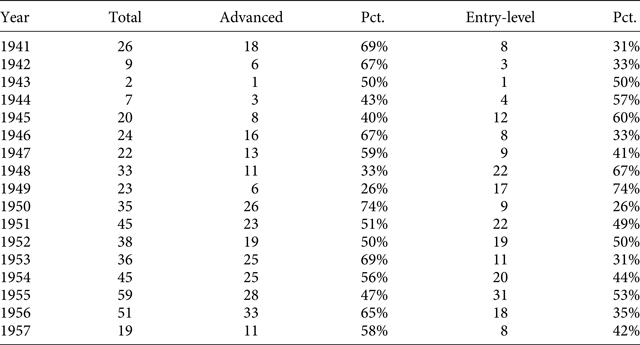
The overall growth through the 1940s of advertisements that touted the piano as parenting tool or stylish furniture may be seen in Table 1. The total number of ads tended to increase after the war years, but the ratio of already-in-market to prospective targeted ads fluctuated. It is easier to see the fluctuation in Table 2, which shows the ratio for each year inventoried.
Table 2 can be divided into two periods. From 1941 until 1952, there is a marked lack of consistency, but thereafter, apparent advanced ads outnumber entry-level ads in all but one year. The number of advanced ads remains steady after 1952, but the entry-level number continues to fluctuate.
Despite its inconsistency, the first period shown by Table 2 can be divided into shorter segments. In 1946 and 1947, especially the former, there were significantly more advanced than entry-level ads, but in 1948 and 1949, there was a drastic percentage shift in favor of an entry-level target group. In 1950, advanced ads multiplied again, but 1951 and 1952 show an equalization of advertising effort. Perhaps experimentation was taking place: the spate of parent-oriented ads in 1948 and 1949, launched in conjunction with the baby boom, may have been less successful than hoped, leading to a reaction against it in 1950, but in 1951, entry-level ads were plentiful again, possibly owing to the boom's continuance.Footnote 38
After 1952, advanced-market advertising appears at first blush to have regained supremacy. But this apparent trend instead casts light on further developments. Advanced ads became increasingly perfunctory, while those designed for entry-level consideration instead grew ever more elaborate and arresting. These changes of approach, combined with the stability in number of advanced ads and year-to-year fluctuation of the entry-level type, suggest that manufacturers were more confident about their methodology and expenditure when dealing with the former group than with the latter.
Effective marketing requires strategic experimentation, so it is no surprise that ratio adjustments continued throughout the period studied. From March 1949 comes a typical advanced ad, featuring exclusively the “prestige” hook and targeted at those already in the market. It features a close-up image of a pianist's hands playing on the keyboard, accompanied by the slogan “Pianists of Today Choose Baldwin.”Footnote 39 No meaningful information about the particular piano is given, nor is any reason suggested why the reader should desire one, either specifically or in general. Rather, Baldwin here attempts only to associate itself with musical prestige. It provides a list, not limited to pianists, of outstanding musicians who supposedly used the instrument and advises readers to “let the considered opinion of these experts be [their] guide.” This approach contrasts with that of Baldwin's ad from 1941, which, though it expresses much the same sentiment, is notably wordier. It might be that by 1949, because advanced consumers were professionals or serious hobbyists looking to buy high-end instruments, companies confident of maintaining this market increasingly produced such perfunctory ads, saving their heavy artillery for attempts to cultivate the entry-level consumer. The more limited advertisements, which might be termed a “calling-card” variety, were usually smaller, and doubtless cheaper, than previous, more elaborate essays in the same genre but served equally well to keep the brand's name before the public, their quiet confidence subtly projecting an aura of quality. Although the same sort of branding had been behind the earlier “prestige” ads and had always been an important aspect of piano marketing, the increase in calling-card advertisements can be seen as further evidence of the industry's market segmentation consciousness. For the individual who has already decided to buy some version of a product, branding can be all important; it is also important to the undecided, who may someday decide to buy. Ads of the calling-card type thus offer great value, serving a dual purpose while allowing most advertising resources to be put toward more expensive and extensive entry-level appeals.
Smaller companies continued to promote their wares in terms reminiscent of earlier prestige hooks. An ad for Bremen from December 1949 touts spinet instruments with such phrases as “exacting standards,” “superior musical instrument,” and “your key to a lifetime of musical enjoyment.”Footnote 40 Bremen's key-on-shield logo and Gothic-script nameplate are typical period examples of affected prestige. Although the number of ads I have categorized as advanced stayed consistent throughout the next decade, this apparent stability was largely driven by smaller manufacturers and largely with ads of the calling-card variety. More established companies, such as Steinway and Baldwin, continued to issue small numbers of calling cards but increasingly limited their prestige appeal to hedge text in entry-level-oriented ads.
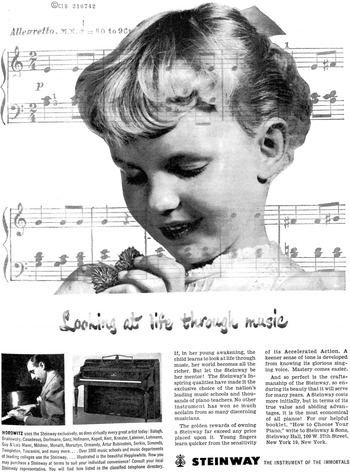
From the late forties, then, it was the entry-level customer toward whom nearly all companies, in all segments of the market, addressed their larger, wordier advertisements. Steinway published eighteen entry-level advertisements between 1941 and 1957, ten after 1950, with an approach exemplified in October 1949 (Figure 1, below).Footnote 41 This ad promotes the piano as advantageous to a home with children and also includes prestige hedge text; it therefore uses the “prestige,” “pedagogy,” and “prospective” hooks. Graphically, the ad features a large picture of a little girl examining a pair of clovers, superimposed on two systems of piano music. Underneath this image is the slogan “Looking at Life Through Music.” Subsequent text claims that doing so will make “her world […] all the richer” and exhorts the reader to “Let the Steinway be her mentor.” This ad also appeals to the prestige impulse by informing the reader that Steinway is the “exclusive choice of the nation's leading music schools” and that “no other instrument has won so much acclaim from so many discerning musicians,” a list of whom is provided at left. Above this smaller text are separately pictured Vladimir Horowitz and an upright piano.Footnote 42 Finally, the ad mentions that a Steinway could be purchased on installment terms. Steinway continued to emphasize affordability consistently in its advertising, which was probably meant to encourage entry-level customers, who would have been thought less likely than advanced prospects to consider the instrument a professional expense or, perhaps for some, a matter of obsession. It did not hurt, however, that to state the instrument's nevertheless high price might have served equally well as a statement to advanced consumers of its quality.
Steinway ad as it appeared in Etude, October 1949. Courtesy of Steinway & Sons.

By the mid-1950s, Steinway and Baldwin had both launched dramatic campaigns aimed directly and almost exclusively at the entry-level market. Their often full-page installments were designed to convince uncertain Cold War–era parents of their children's desperate need for a piano to save them from the grips of apathy and depression, or at least a stupor caused by comic books and TV dinners. In March 1956, Baldwin published an ad for its midrange Acrosonic model that featured prestige (music presented as an inherent good), pedagogy, and “prospective” messages. Here, a photograph of a small boy playing with blocks is accompanied by the question “What do Billy's blocks have to do with piano lessons?” The remaining text reads, in part:
Billy loved his blocks, remember? Built bridges, skyscrapers, tunnels. The hands fumbled but that eager young mind was already demanding a purpose. Today, at six, that purpose seems to be comic books and TV. So what do you do? Give young Bill something to build with again. Start his piano lessons when he starts to school … on the instrument he will respect … the beautiful, clear-voiced Acrosonic by Baldwin. Music will become a fascinating project for that eager young mind; a colorful, exciting new world to explore. Bill will be a happier boy, a finer man because you gave him a purpose.Footnote 43
A second Baldwin example, from March of 1957, takes similar rhetoric still further.Footnote 44 This full-page effort portrays a small girl lying on a carpet, head resting on hands and wide-eyed gaze fixed directly at the reader. Large text beneath reads “Mommie, will I live happily ever after, too?” Below, the disembodied narrator continues, “The fairy tale is ended. The child has finished with listening. The hard reality of a rainy afternoon drowns the little dream that the world rings with laughter alone … this year nearly three million children […] will spend too many idle, insecure hours [and] idleness breeds unrest.” All this gloom is dispelled, though, with assurance that through the purchase of a piano, parents can “enrich the solitary hours and stimulate the surge of happiness that comes from within,” by introducing their children to “the joys of music” with the aid of teachers who have “discovered simplified methods that make fun out of the beginner's musical experiences.” Hedge text hints at the furniture motivation (“a wide choice of handsome traditional and contemporary styles in the exact finish for your decor”) and at affordability (“[your dealer] will arrange financing”). The prestige hook is just barely present, in the reference made to music's intrinsic value, but aside from that, the ad is almost desperately persuasive and almost wholly practical in character.
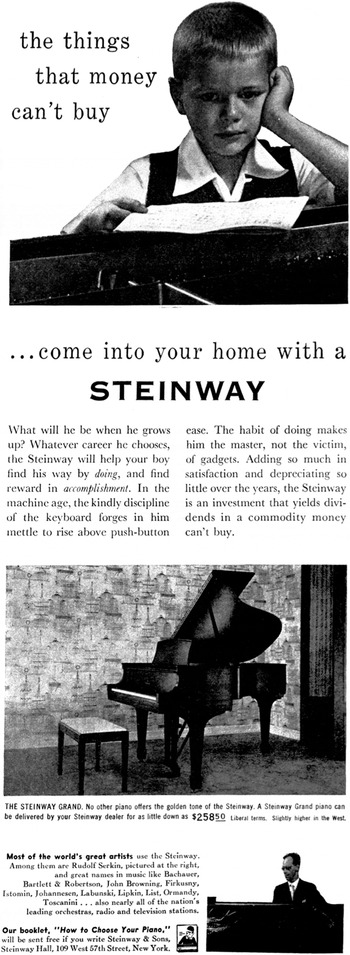
In 1955, Steinway had entered the aggressively entry-level fray with a series using dramatic child portraiture and the slogan “the things that money can't buy.” A January installment (Figure 2, below) features a boy's head resting on his cocked arm, accompanied by text proclaiming that “Whatever career he chooses, the Steinway will help your boy find his way by doing, and find reward in accomplishment. In the machine age, the kindly discipline of the keyboard forges in him mettle to rise above push-button ease. The habit of doing makes him the master, not the victim, of gadgets.”Footnote 45 Perhaps for reasons of price, the Steinway ad emphasizes durability: “the Steinway is an investment that yields dividends in a commodity money can't buy.” In all these later 1950s ads, the piano is presented as a tool more for living than for simply music-making, and the emotion accessed is concern about the future, not nostalgia for the past. Although they contain text designed to remind readers of the quality, beauty, and prestige of the piano itself, these ads are not directed toward the advanced customer but rather toward the aspirations of the entry-level prospect.
Steinway ad as it appeared in Etude, January 1955. Courtesy of Steinway & Sons.

During the early fifties, other companies also appealed more directly and practically than ever to the nurturing impulse of parents, with images of mothers and children at the piano accompanied by assertions of the instrument's positive effect on charm, grace, and character. Gulbransen's 1954–55 advertisement uses both prestige and pedagogy hooks to target prospective new piano buyers. Like many others, it includes a portrait of a little girl, above whom can be read the slogan “Gulbransen, America's smartest piano fashions.”Footnote 46 The highly gendered text continues: “Meet my daughter, Mr. Mendelssohn. Some day she'll walk up the aisle to your Wedding March. But first I want her to know how to play your Spring Song. I want everything that's beautiful to come to her. I'm making sure it will… by giving her a Gulbransen to create beauty for herself.” This advertisement invokes the idea of music's intrinsic value but with the subtext that such value can itself be used to promote social aspiration. Earlier ads had done the same but with less emphasis on the personal aspect of the transaction than was now being placed. In the Gulbransen example, it is not music, or even the piano, that is ultimately presented as the agent of “making sure” the daughter receives “everything that's beautiful,” but the parent, by making the purchase. It is, of course, an inherent subtext of any advertisement that the consumer is deciding whether or not to purchase the product and thereby acquire its claimed benefits. But Gulbransen's use here of the first person makes it vivid and explicit.
With its slogan, “More people buy Wurlitzer Pianos than those of any other name,” a 1955 ad for that company suggests a certain prestige-by-association, but its overall framework places the instrument firmly in a domestic and pedagogical setting, using prospective and pedagogy hooks.Footnote 47 Accompanying an illustration of a boy at the keyboard, his mother overseeing the lesson with her hand on his shoulder, an additional text describes the piano as “the perfect foundation on which to develop the most desirable aspects of a child's personality,” declaring it to “provide the youngster with the satisfaction and inspiration necessary for rapid progress.” The combination here of imagery and phrasing is cleverly ambiguous. If one reads at face value, the “rapid progress” seems a reference to the ongoing lessons. But the mention of personality could mean to imply more. Earlier ads, of course, offered the piano as a way to influence children's personalities, but this Wurlitzer example is crafted after the forward-looking fashion of the fifties, making no explicit mention of the traditional values that the reader is nevertheless free to imagine represent the personality's “most desirable aspects.”
Table 1 lists 141 ads with a “juvenile pedagogy” message, 107 of them from 1949 or later. Most prolifically represented in this category are the companies responsible for the latter two examples: Gulbransen presented thirty-three such advertisements, and Wurlitzer twenty-six. French had twenty-two, Baldwin twenty-one, most for its “Acrosonic” model, and Steinway nineteen. These totals are only for ads explicitly suggesting that children should be given piano lessons or that they would enjoy playing the advertised instrument. Additional ads, as the table also indicates, feature gratuitous portraits of children to which the text makes no reference.
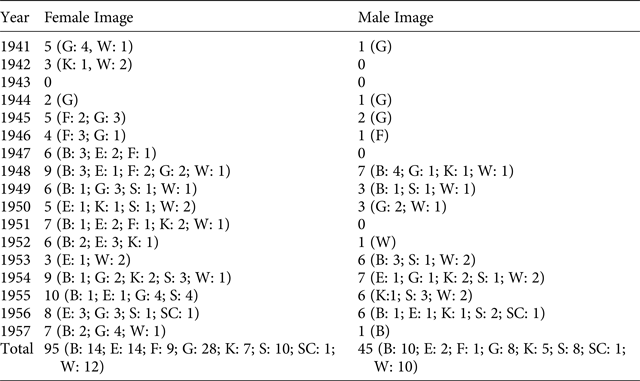
The gendered quality of Gulbransen's “Mr. Mendelssohn” ad, as well as, to a lesser but still notable extent, the 1955 and 1956 offerings of Baldwin and Steinway, indicates that parents of male and female children were targeted separately, with different strategies. Within the overall corpus of surveyed ads, as shown in Table 3, images of females outnumbered those of males by a count of ninety-five to forty-five (just over 2:1), but the gap narrowed with the passage of time. From 1952 onward, the ratio had narrowed to forty-three to twenty-seven (1.59:1), and between 1952 and 1956, it was only thirty-six to twenty-six (just 1.38:1). The increase in imagery of boys might signify a conscious effort within the industry to court every possible household.Footnote 48
Human imagery in piano ads in Etude, 1941–57.

Piano advertisements also moved beyond the household with dual-purpose campaigns that, although outwardly targeting educational professionals, continued marketing clandestinely to the entry-level home market. Related to advertisements with the pedagogy hook are those which, beginning in the fifties, turned to schools and institutions as potential customers, in part by emphasizing durability and ease of maintenance. By associating their brand names with particular institutions, companies attempted to create a sense of official sanction. An ad for the Jesse French “Scholastic” model, from April of 1954, reports its systematic use at Notre Dame University. According to the ad, the Scholastic “presents piano value that is truly outstanding” and “has the excellence of tone demanded by teachers and fine musicians… and the built-in stamina for top performance under the most active school-room or studio use,” all “in spite of its surprisingly modest price.” Larger text proclaims the Scholastic “realistically priced” and “the best buy for schools and studios!”Footnote 49 Although this advertisement was clearly aimed at institutional purchasers, it prominently invokes such normally entry-level factors as value and practicality; by doing so, it serves the secondary purpose of also courting these individual readers.
In September of 1954, a similar ad for Everett featured the same hooks. Occupying a full page, its imagery depicts the removal from a school of an elderly full-sized upright while the children embrace their new spinet. Its text exhorts the target audience, in this case institutional purchasers, to “stand out … stand up!” It proclaims the Everett to be a “fine professional piano,” “highly serviceable,” and even “one of the lowest-priced school pianos you can buy!” A caption for the picture reveals it to depict “one of 18 Everetts delivered to schools in Temple, Texas,” as “the unanimous choice of the school board and a special committee of four musicians.”Footnote 50 Thus, although it focused on the instrument's propriety for school use, this advertisement had the additional utility of potentially attracting customers who particularly trusted school boards as arbiters of quality. In addition to their other purposes, both the French and Everett ads attempted to suggest subliminally that their pianos were good for children, the tried and true approach to entry-level prospective customers.
Another primary target of dual-purpose ads was the private teacher, who advertisers frequently tried to entice with teacher discounts or offers of booklets explaining the merits of piano study that could be distributed to potential pupils. Booklet offers, employing a combination of pedagogy, prospective, and in-market hooks, were included in ads by Jesse French and Everett. In 1952, Jesse French made available a booklet titled “How to choose the Best Piano.” “When parents put you on the spot,” their ad suggested, “find the answer in this valuable free booklet. … You want them to get fullest value for their money—yet you want to be sure your recommendation is sound.”Footnote 51 Presumably, the booklet championed the Jesse French piano. French probably hoped to gain customers through teacher recommendation but also likely hoped that the booklet's sheer existence would make the general public feel that teachers supported its product. Thus, the entry-level customer was indirectly targeted.
Another booklet was offered by Story and Clark in an ad appearing in October 1956 that pictured a little girl at the keyboard. About the booklet, the ad states that it “is not an ‘advertisement’. It only barely mentions our name. We feel very sure that if it is helpful to the cause of music itself, we will be amply rewarded.” Titled “Yes!—Your Child can now learn to Play the Piano Quickly!” it purportedly answered such questions as “How are modern lessons made so easy?” “How soon can my child play real tunes?” and “Is ‘talent’ necessary?”Footnote 52 As the advertisement essentially admits, these answers were likely self-serving. The Story and Clark ad was aimed more directly at the entry-level consumer than the teacher, but both it and that for Jesse French, as well as the institution-targeted advertisements, attempted to draw upon the prestige of intrinsically valuable musical effort as well as the notion of its practical advantages for childhood development, thereby communicating with the broadest possible audience.
Even as many companies relegated their explicitly advanced-market appeals to calling cards and hedging text, others, such as Story and Clark, Gulbransen, and Everett, continued running slightly longer such ads. A February 1956 Story and Clark ad, for example, used prestige, in-market, and furniture hooks. Its iconography is limited to a depiction, complete with bust, of the piano itself, which bears the high-aiming model designation “French Provincial.” The text includes a line about the instrument's “incomparable Storytone MAHOGANY Sounding Board” and the closing slogan “instruments of quality, by one family for nearly 100 years.”Footnote 53
Despite their disparate character, the last two ads described were issued by the same company, emphasizing that by the mid-1950s, the piano industry had developed distinct advertising strategies aimed at distinct groups of consumers. Advanced-market advertisements focused on branding, relying on the implication of prestige and the claim of quality, and entry-level advertisements focused on persuasion by arguing that piano ownership was practical and beneficial. Even new varieties of hybrid ads, aimed most outwardly at institutions and teachers, were nevertheless directed on varying levels toward distinct markets. The clarity of the differentiation indicates the industry's awareness of a segmented marketplace. At the same time, the variety and fluctuation of strategic concentration seen in Tables 1 and 2 suggests considerable experimentation with how to take advantage of that awareness. The continued focus across market segments on the instrument's durability and beauty as well as its educational value also illustrates the piano's special status among consumer products. The piano could be a status symbol, a piece of furniture, a professional tool, or an investment in the future of one's children, but regardless, it was a major purchase, not to be taken lightly. To be successful, piano advertisements had to touch the hearts and minds of their audience more deeply than those for trousers, sofas, or even automobiles—they had to sell consumers on their ability to provide, in Steinway's terms, “the things money can't buy.” For this reason, analysis of mid-twentieth-century piano advertisements reveals contemporary understandings of the cultural marketplace.