Introduction
During lactation, the mammary gland synthesizes and secretes large amounts of proteins. The four caseins, αS1, αS2, β and κ, represent 80% of the total protein concentration of ruminant milk. In the goat species, the αS1-casein (CSN1S1) locus is characterized by an extensive polymorphism, the main feature of which is that it is qualitative as well as quantitative (Grosclaude et al., Reference Grosclaude, Martin, Ricordeau, Remeuf, Vassal and Bouillon1994). Thus at least 18 alleles (reviewed in Neveu et al., Reference Neveu, Riaublanc, Miranda, Chich and Martin2002; Moioli et al., Reference Moioli, D’Andrea and Pilla2007) have been detected so far at this locus and shown to be associated with four different levels of CSN1S1 in milk ranging from 0 (e.g. CSN1S1 0) to 3.6 g/l per allele (e.g. CSN1S1 A and B). This last class is associated with a high CSN1S1 concentration in milk compared with the defective classes, which are associated with an intermediate (e.g. CSN1S1 E ) or low (e.g. CSN1S1 F ) concentration of CSN1S1 in milk. This polymorphism strongly influences milk composition and thus affects the technological and sensorial properties of milk. High levels of CSN1S1 have been found to be associated with higher total protein and casein concentrations, with smaller casein micelles containing less calcium, better cheese-making potential with higher yields and firmer curds but poorer organoleptic character with a less-pronounced goat flavor (Remeuf, Reference Remeuf1993; Lamberet et al., Reference Lamberet, Degas, Delacroix-Buchet and Vassal1996; Clark and Sherbon, Reference Clark and Sherbon2000). Moreover, CSN1S1 polymorphism also shows an unexpectedly positive correlation with milk-fat concentration (Barbieri et al., Reference Barbieri, Manfredi, Elsen, Ricordeau, Bouillon, Grosclaude, Mahé and Bibé1995). Recently, a comparison of milk fatty acid (FA) profiles between ‘high’ and ‘low’ genotype goats showed differences in the proportions of at least 17 FAs, especially for medium-chain FA and Δ-9 desaturated FA, suggesting that this polymorphism has an impact on mammary lipogenesis and desaturase activity (Chilliard et al., Reference Chilliard, Rouel and Leroux2006) and thus could affect the nutritional quality of goat dairy products. In addition, immunohistochemistry studies coupled with electron microscopy analyses have shown that mammary epithelial cells (MEC) in goats carrying CSN1S1-defective alleles present a strongly reduced rate of transport of the other caseins to the Golgi apparatus, whereas whey protein secretion is not significantly affected (Chanat et al., Reference Chanat, Martin and Ollivier-Bousquet1999). This leads to an accumulation of immature caseins in the rough endoplasmic reticulum, causing a dilatation of the cisternae in conjunction with an increase in the amount of several endoplasmic reticulum-resident proteins (Chanat et al., Reference Chanat, Martin and Ollivier-Bousquet1999). Moreover, it has been suggested that this intracellular transport dysfunction disturbs the whole secretion process, including that of lipids (Neveu et al., Reference Neveu, Riaublanc, Miranda, Chich and Martin2002).
To decipher the pathways modified in MEC related to the CSN1S1 polymorphism, a first-generation ruminant macroarray grouping 400 mammary gene probes was used to study mammary gene expression. The comparison of mammary transcriptome profiles between ‘high’ and ‘low’ CSN1S1 genotype goats made it possible to identify, among the 400 genes analyzed, 3% of differentially expressed genes, mainly involved in protein biosynthesis, DNA damage repair, cell trafficking or the cell cycle (Leroux et al., Reference Leroux, Le Provost, Petit, Bernard, Chilliard and Martin2003). To supplement these investigations, we undertook gene expression profiling experiments to compare the mammary gland from lactating goats of different CSN1S1 genotypes using a bovine oligonucleotide microarray enlarged to 8379 gene probes. This cross-hybridization approach was used due to the lack of caprine microarray, and is previously described (Ollier et al., Reference Ollier, Robert-Granie, Bernard, Chilliard and Leroux2007).
Material and methods
Animals and management
Six peak-lactation Alpine goats (48 ± 2 days post partum at the beginning of the experiment) from the Lusignan experimental station (France), with similar milk yield and number of lactations, were assigned to two groups on the basis of their genotype at the CSN1S1 locus determined using restriction fragment length polymorphism of PCR products and allele-specific amplification by Labogena (Jouy-en-Josas, France) as described by Chilliard et al. (Reference Chilliard, Rouel and Leroux2006). One group (named Reference) comprised three animals carrying two reference alleles (two AA goats and one AB) and the second group (named Defective) comprised three other animals carrying two defective alleles (three EF goats). The goats were housed in individual stalls and milked at 0800 and 1600 h over a period of 2 weeks. They had free access to water and were fed ad libitum twice daily just after milking with an orchardgrass hay-based diet with a 35 : 65 forage-to-concentrate ratio. Goats were cared for and handled in compliance with the INRA Animal Care Committee guidelines.
Milk sampling and analysis
During the 2 days before slaughter, milk yield was recorded (from 4 consecutive milkings) and milk samples (30 ml per milking) were collected to analyze milk fat and protein concentrations (C.I.L.A.L., Theix, France; Association of Official Analytical Chemists, 1997). The significance of differences between the two CSN1S1 genotype groups was analyzed with the non-parametric Mann–Whitney U test using the free R 2.1 software (http://www.r-project.org) and differences were considered significant at P < 0.05.
Mammary tissue sampling and RNA isolation
All goats were slaughtered just after milking to eliminate most of the milk contained in the glands. Immediately after death, approximately 50 g of mammary tissue were collected under sterile conditions in the secretory area containing lobulo-alveolar structures (acini), immediately frozen in liquid nitrogen and stored at −80°C. Mammary total RNA was prepared and its quality was checked as previously described (Ollier et al., Reference Ollier, Robert-Granie, Bernard, Chilliard and Leroux2007).
DNA microarray and data analysis
Due to the lack of caprine microarray and because structural genomic studies of domestic animals have shown that goats are closely related to bovine species (Schibler et al., Reference Schibler, Vaiman, Oustry, Giraud-Delville and Cribiu1998), caprine transcriptomic analyses were performed using a bovine oligonucleotide microarray as previously described (Ollier et al., Reference Ollier, Robert-Granie, Bernard, Chilliard and Leroux2007). This array represents 8379 unique genes from the Bovine Genome Oligo Set V1.1 (Operon Biotechnologies, Cologne, Germany) supplemented by 50 genes chosen for their implication in mammary metabolism and spotted in duplicate. This platform has been deposited in NCBI’s Gene Expression Omnibus (GEO, http://www.ncbi.nlm.nih.gov/geo/) and is accessible through GEO Platform accession number GPL4594. Fluorescent-labeled complementary DNA (cDNA) from each mammary tissue sample was obtained and hybridized as previously described (Ollier et al., Reference Ollier, Robert-Granie, Bernard, Chilliard and Leroux2007) using the Pronto Plus Direct System (Promega, Charbonnières, France and Corning B.V. Life Sciences, NE Schiphol-Rijk, The Netherlands). Each microarray was co-hybridized with one Reference CSN1S1 genotype sample and one Defective CSN1S1 genotype sample, and this was repeated in a dye-swap manner for a total of 12 values per gene (six slides and three independent comparisons). Image acquisition and analysis, data pre-processing and Lowess normalization were performed as previously described (Ollier et al., Reference Ollier, Robert-Granie, Bernard, Chilliard and Leroux2007). Data have been deposited in NCBI’s Gene Expression Omnibus and are accessible through GEO Series accession number GSE6637. Statistical analyses were performed using R 2.1 software: after controlling the variance of each gene, log ratios between Defective and Reference genotypes were analyzed by a standard Student’s t test to detect differentially expressed genes between the two groups. Probability values were adjusted using the Bonferroni correction for multiple testing at a level of 1% to eliminate false positives. The identity and function of all the differentially expressed genes were analyzed as described earlier (Ollier et al., Reference Ollier, Robert-Granie, Bernard, Chilliard and Leroux2007) and the web-accessible program DAVID (Database for Annotation, Visualization, and Integrated Discovery) was used to distribute the differentially expressed genes among functional categories and biochemical pathways and to identify statistically over-represented functional categories within a given list of genes based on a modified Fisher’s exact P value (Dennis et al., Reference Dennis, Sherman, Hosack, Yang, Gao, Lane and Lempicki2003). To predict putative transcription factor binding sites, computer-assisted sequence analysis of promoters selected from the Gene2Promoter module of Genomatix software (http://www.genomatix.de/) was performed using the MatInspector module of the Genomatix GEMS Launcher.
Quantitative real-time RT-PCR
Single-strand cDNA obtained from total RNA by reverse transcription (RT) was amplified by PCR carried out on the LightCycler system (Roche Molecular Biochemicals, Indianapolis, IN, USA) using the LightCycler FastStart DNA Master SYBR Green I kit (Roche Applied Science, Meylan, France) as previously described (Ollier et al., Reference Ollier, Robert-Granie, Bernard, Chilliard and Leroux2007) with 10 pmol of specific primers (Eurogentec, Seraing, Belgium): CSN1S1, 5′-GAAGATGTGCCCTCTGAGCGTTAC-3′ (forward) and 5′-ACCAGCTGGGGCACGTTGTAT-3′ (reverse); FTH1, 5′-CTGGTTTCCCACAGCCACA-3′ (forward) and 5′-ATGCACTGCCTTGGTGACC-3′ (reverse); and GPAM, 5′-ACCAGCAGTTCATCACCTTC-3′ (forward) and 5′-GTACACGGCAACCCTCCTCT-3′ (reverse). Specificity and efficiency of the amplifications were checked as previously described (Ollier et al., Reference Ollier, Robert-Granie, Bernard, Chilliard and Leroux2007). For each cDNA amplified, the RNA quantification was determined from a calibration curve. This curve was obtained from serial five-fold dilutions in water of a goat mammary cDNA library used as an external standard. To compare studied mRNA amounts between samples, they were expressed using arbitrary units. Elsewhere, amplifications of SCD and cyclophilin (used as an internal standard) messenger RNA (mRNA) were performed using the LightCycler FastStart DNA Master HybProbe kit (Roche Applied Science) with 10 pmol of each primer and Taqman probe (Applied Biosystems, Warrington, UK) as described by Bernard et al. (Reference Bernard, Rouel, Leroux, Ferlay, Faulconnier, Legrand and Chilliard2005) and Bonnet et al. (Reference Bonnet, Leroux, Faulconnier, Hocquette, Bocquier, Martin and Chilliard2000), respectively. Results are expressed as the mRNA copy number of each gene of interest relative to the cyclophilin mRNA copy number.
Results and discussion
Validation of the animal model
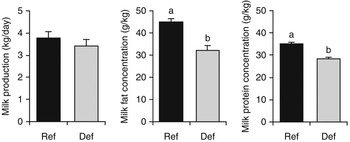
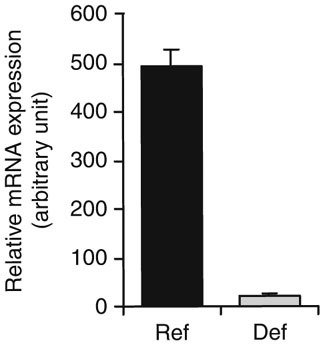
Analysis of milk composition showed significantly lower fat (−12.6 g/kg) and protein (−6.7 g/kg) concentrations in the Defective than in the Reference CSN1S1 genotype group, whereas milk production did not differ (Figure 1). These results are in agreement with previous studies (Grosclaude et al., Reference Grosclaude, Martin, Ricordeau, Remeuf, Vassal and Bouillon1994; Chilliard et al., Reference Chilliard, Rouel and Leroux2006). Moreover, real-time RT-PCR mRNA quantification revealed a marked downregulation of CSN1S1 expression in Defective compared with Reference genotype goats (Figure 2). This result is in accordance with previous studies showing that CSN1S1 E and F alleles were related to a lower amount of mammary CSN1S1 mRNA compared with the CSN1S1 A allele, possibly due to a decrease in mRNA stability (Leroux et al., Reference Leroux, Mazure and Martin1992; Perez et al., Reference Perez, Leroux, Bonastre and Martin1994).
Milk production, milk fat and protein concentrations in Reference (Ref) and Defective (Def) CSN1S1 genotype lactating goats. Values are mean ± s.e. (n = 3). Significant differences between the two genotypes are indicated by different letters (P < 0.05).

CSN1S1 mRNA quantification using real-time RT-PCR in mammary tissue of Reference (Ref) and Defective (Def) CSN1S1 genotype lactating goats. Values (normalized to cyclophilin mRNA level) are mean ± s.e. (n = 3).

Mammary gene expression comparison between Defective and Reference CSN1S1 genotype goats
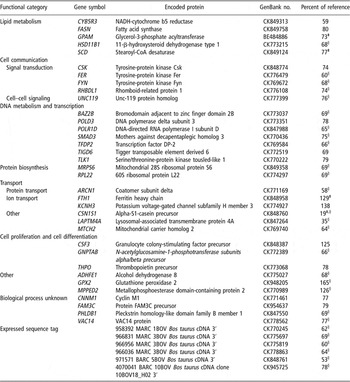
Mammary transcriptome analyses were performed using a bovine oligonucleotide microarray representing 8379 genes. Among them, 7359 oligonucleotides were hybridized by the caprine mammary samples studied. Student’s t tests and correction for multiple testing using the Bonferroni procedure (P < 0.01) allowed 41 differentially expressed genes in mammary tissue to be identified between the two CSN1S1 genotypes (Table 1). These genes were classified into nine functional categories according to Gene Ontology annotation. A total of 31 out of the 41 differentially expressed genes had Gene Ontology annotation. The others were annotated as expressed sequence tag or were genes involved in an unknown biological process.
Differentially expressed genes in the mammary tissue of Defective compared with Reference CSN1S1 genotype lactating goatsFootnote †

† Values are mean percents of Reference (n = 3) of mRNA abundance in mammary tissue of Defective goats revealed by the microarray analysis (P < 0.01).
‡ Differentially expressed genes validated by real-time RT-PCR.
§ Genes also differentially expressed between the two CSN1S1 genotypes in the food-deprivation experiment.
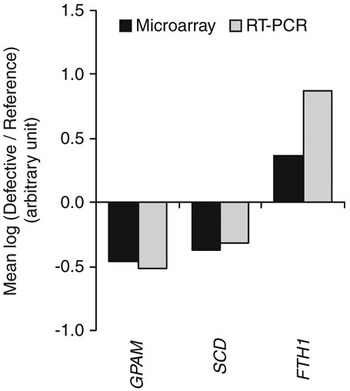
These results were validated by measurements performed on six other lactating goats (three Reference and three Defective CSN1S1 genotype goats), which were food deprived for 48 h (data not shown but deposited in NCBI’s Gene Expression Omnibus and accessible through GEO Series accession number GSE6642). Due to the impact of food deprivation on mammary transcriptome (Ollier et al., Reference Ollier, Robert-Granie, Bernard, Chilliard and Leroux2007), these goats were not included in the present experiment but made it possible to validate the results obtained from the ad libitum-fed goats. Indeed, whatever the nutritional status, 27 genes (66% of the 41) were identified as differentially expressed between the two CSN1S1 genotypes (Table 1). In other respects, in addition to the validation of downregulation of CSN1S1 in Defective compared to Reference genotype goats (Figure 2), changes in expression of two downregulated genes, GPAM and SCD (chosen because of their implication in lipid metabolism), and one upregulated gene randomly selected, FTH1 (encoding the heavy subunit of ferritin corresponding to the major intracellular iron storage protein), revealed by microarray analysis were confirmed by real-time RT-PCR (Table 1 and Figure 3). Altogether, these results give confidence concerning the genes identified in the present study.
Confirmation of differential expression of three selected genes identified by microarray analysis, using real-time RT-PCR mRNA quantifications in mammary tissue of Defective and Reference CSN1S1 genotype lactating goats. Values are mean log ratios (n = 3) of Defective mRNA abundance relative to Reference mRNA abundance. A negative value means gene downregulation in Defective compared with Reference genotype goats, whereas a positive value means gene upregulation in Defective compared with Reference genotype goats.

Goat’s CSN1S1 polymorphism affects expression of genes involved in lipid metabolism
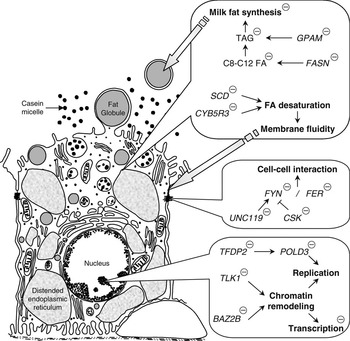
Interestingly, the web-accessible program DAVID (Dennis et al., Reference Dennis, Sherman, Hosack, Yang, Gao, Lane and Lempicki2003) indicated that our differentially expressed gene list was specifically enriched in genes involved in lipid biosynthesis (P = 0.011) compared with the other biological processes represented. In particular, the gene expression of FASN was lower in the mammary tissue of Defective than of Reference CSN1S1 genotype goats (Table 1). This gene encodes the FA synthase, a multifunctional protein that catalyzes the mammary de novo synthesis of short-chain and mainly medium-chain FAs (Smith, Reference Smith1994). Mammary FA synthase activity was also significantly lower in the Defective than in the Reference group (data not shown), suggesting that the lower FASN mRNA abundance led to a lower abundance of its protein. This result is in accordance with a recent study showing lower milk secretion of medium-chain saturated FA in Defective than in Reference CSN1S1 genotype goats (Chilliard et al., Reference Chilliard, Rouel and Leroux2006). Another gene involved in lipid metabolism, GPAM, was downregulated in Defective compared with Reference genotype goats (Table 1). This gene encodes the glycerol-3-phosphate acyltransferase that catalyzes the esterification of FA on glycerol-3-phosphate in the sn-1 position, which is the first step in triacylglycerol biosynthesis (Coleman et al., Reference Coleman, Lewin and Muoio2000). Altogether, these results suggest that the low fat concentration associated with CSN1S1 deficiency is linked to a lower synthesis of key lipogenic enzymes (Figure 4).
Differentially expressed genes identified by microarray analysis and their putative link with alterations of mammary epithelial cell functions in Defective CSN1S1 genotype lactating goats (from Chanat et al., Reference Chanat, Martin and Ollivier-Bousquet1999; Neveu et al., Reference Neveu, Riaublanc, Miranda, Chich and Martin2002; Chilliard et al., Reference Chilliard, Rouel and Leroux2006 and present study). Abbreviations used are: BAZ2B, bromodomain adjacent to zinc finger domain 2B; CSK, tyrosine-protein kinase Csk; CYB5R3, NADH-cytochrome b5 reductase; FA, fatty acid; FASN, fatty acid synthase; FER, tyrosine-protein kinase Fer; FYN, tyrosine-protein kinase Fyn; GPAM, glycerol-3-phosphate acyltransferase; POLD3, DNA polymerase delta subunit 3; SCD, stearoyl-CoA desaturase; TAG, triacylglycerol; TFDP2, transcription factor DP-2; TLK1, serine/threonine-protein kinase Tousled-like 1; UNC119, Unc119 protein homolog.

In addition, among the differentially expressed genes involved in lipid metabolism, HSD11B1, encoding the 11-β-hydroxysteroid dehydrogenase 1 that catalyzes reversibly the conversion of the stress hormone cortisol to the inactive metabolite cortisone (Frick et al., Reference Frick, Atanasov, Arnold, Ozols and Odermatt2004), was downregulated in Defective compared to Reference CSN1S1 genotype goats. More interestingly, it was also observed that the expression of SCD, SMAD3 and CYB5R3 was lower in the mammary gland of Defective genotype goats (Table 1). SMAD3 encodes a protein that belongs to a large family known as cytoplasmic mediators, which regulate the transcription of target genes (Heldin et al., Reference Heldin, Miyazono and ten Dijke1997), including the SCD gene (Samuel et al., Reference Samuel, Nagineni, Kutty, Parks, Gordon, Prouty, Hooks and Wiggert2002). Moreover, stearoyl-CoA desaturase (encoded by the SCD gene) and NADH-cytochrome b5 reductase (encoded by the CYB5R3 gene) are components of a FA-desaturase system directing the synthesis of Δ-9 unsaturated FA. This enzymatic complex affects the FA composition of milk triacylglycerols and membrane phospholipids. The lower expression of the SCD gene reported here is not in accordance with the association described earlier between CSN1S1-defective alleles and higher Δ-9 desaturation ratios for C10:0, C14:0, C17:0, C18:0, t11-C18:1 and t13-C18:1 milk FAs (Chilliard et al., Reference Chilliard, Rouel and Leroux2006), which give an estimate of in vivo mammary Δ-9 desaturase activity. Therefore, the downexpression of the SCD and CYB5R3 genes does not seem to affect the milk triacylglycerol FA composition of goats carrying defective alleles. However, it could modulate the FA composition of membrane phospholipids. The hypothesis of this impact of CSN1S1 genotype needs to be investigated since this composition influences membrane fluidity and cell–cell interaction, which can alter cell metabolism (reviewed in Ntambi, Reference Ntambi1999; Figure 4).
Goat’s CSN1S1 polymorphism affects expression of genes involved in cell–cell interaction
Five genes downregulated in Defective compared with Reference CSN1S1 genotype goats are related to cell communication: CSK, FER and FYN, encoding tyrosine-protein kinases, RHBDL1 and UNC119, encoding a protein involved in cell–cell signaling (Table 1). Interestingly, previous studies have shown that the Csk and Unc119 proteins provide regulatory control of the Fyn kinase function (Takeuchi et al., Reference Takeuchi, Kuramochi, Fusaki, Nada, Kawamura-Tsuzuku, Matsuda, Semba, Toyoshima, Okada and Yamamoto1993; Gorska et al., Reference Gorska, Stafford, Cen, Sur and Alam2004). Fyn and Fer kinases are able to regulate cell–cell adhesion through tyrosine phosphorylation of β-catenin, a key component of the adherens junction, resulting in a disruption of this junction type (Piedra et al., Reference Piedra, Miravet, Castano, Palmer, Heisterkamp, Garcia de Herreros and Dunach2003). Moreover, it was suggested that the poorly known protein encoded by RHBDL1, the rhomboid-related protein 1, functions in association with proteins at intercellular junctions to facilitate cell–cell interaction (Pascall and Brown, Reference Pascall and Brown1998). It is worth noting that cell–cell junctions, which establish and maintain epithelium three-dimensional organization, are essential to proper MEC function. In fact, these complexes have essential contributions both to tissue structure and to cell signaling since they are structural elements involved in stabilizing the cell layer and providing the permeability barrier between the epithelial lumen and the underlying stroma (Carraway et al., Reference Carraway, Ramsauer and Carraway2005). Thus, the downregulation of FER and FYN observed in Defective CSN1S1 genotype goats suggests a stronger cell–cell interaction that could be linked to MEC function modification (Figure 4).
Is goat’s CSN1S1 polymorphism linked to different chromatin organization?
Regarding the DNA metabolism and transcription functional category, we report a lower expression of the TFDP2 and POLD3 genes in Defective than in Reference genotype goats (Table 1). The TFDP2 gene encodes the transcription factor DP-2 that forms a heterodimer with a factor encoded by the E2F gene family (reviewed in Dyson, Reference Dyson1998). This complex can activate the E2F-dependent transcription of target genes, including those important in DNA synthesis, such as DNA polymerase α. The POLD3 gene encodes the subunit 3 of DNA polymerase δ that serves an essential function in replication (reviewed in Burgers, Reference Burgers1998). To explore whether DP-2 might regulate POLD3 expression, we searched for potential E2F/DP-2 binding sites using MatInspector software. Interestingly, computer-assisted sequence analysis of the human POLD3 promoter (Genomatix accession number GXP_47292) revealed the presence of one putative binding site for the E2F-4/DP-2 heterodimeric complex with a matrix similarity higher than the optimized matrix threshold defined by Genomatix. This finding suggests that the downregulation of POLD3 in Defective CSN1S1 genotype goats may be the result of a lower expression of TFDP2 than in the Reference group (Figure 4). In addition, another gene downregulated in Defective compared with Reference genotype goats, TLK1 (Table 1), encodes a kinase with maximal activity linked to ongoing DNA replication (Sillje et al., Reference Sillje, Takahashi, Tanaka, Van Houwe and Nigg1999). Previous studies have shown that the mammalian protein kinase TLK1 is able to phosphorylate histone H3 (Li et al., Reference Li, DeFatta, Anthony, Sunavala and De Benedetti2001) and the histone chaperone Asf1, a chromatin assembly factor, suggesting it may regulate chromatin assembly during DNA replication (Sillje and Nigg, Reference Sillje and Nigg2001; Figure 4). Another gene involved in chromatin remodeling, BAZ2B, was less expressed in Defective than in Reference genotype goats (Table 1). The protein BAZ2B interacts with the human homolog of ISWI, an ATP-dependent chromatin-remodeling factor, indicating that BAZ2B is likely to be a component of chromatin-remodeling complexes (Jones et al., Reference Jones, Hamana, Nezu and Shimane2000; Figure 4). Moreover, regulation of the chromatin structure, which presents a barrier to transcription factors, is crucial to the control of transcription. In Defective goats, only five genes were upregulated, whereas most of the differentially expressed genes between the two genotype groups were downregulated (36 genes). Thus, the lower transcriptional activity of these genes could be associated with a different chromatin organization, suggested by the downregulation of TLK1 and BAZ2B, in Defective (Figure 4) compared with Reference CSN1S1 genotype goats.
Conclusion
In summary, the transcriptomic analyses reported here show a modification of the mammary gene expression profile in parallel to the intracellular dysfunction previously observed in MEC of animals carrying defective CSN1S1 alleles. This experiment highlights genes involved in lipid synthesis, in agreement with milk fat concentration modification. Moreover, several differentially expressed genes between the two genotypes could affect membrane fluidity or cell–cell interaction, suggesting a different organization of the mammary epithelium. In addition, the variation in expression of the genes involved in chromatin remodeling may reveal a different chromatin organization according to the CSN1S1 genotype. The effect of this genotype on the expression of genes highlighted in our experiment is probably not direct and could be due to the effect of this genetic polymorphism on the cellular transport and morphology described by Chanat et al. (Reference Chanat, Martin and Ollivier-Bousquet1999). Thus, it must be postulated that rough endoplasmic reticulum dilatation altered by CSN1S1 polymorphism is associated with several structural modifications of MEC, which contribute to disturbing cell function (Figure 4). Moreover, some genes involved in other biological processes such as protein biosynthesis, transport and cell proliferation and cell differentiation were identified as differentially expressed between both genotypes and need further investigations to be related to the CSN1S1 polymorphism. Elsewhere, 24% of the differentially expressed genes identified in our experiment have no known function and merit a thorough investigation. All these results open up new fields of research to better understand the biosynthesis and secretion of ruminant milk.
Acknowledgments
The authors thank S. Bes, M. Goutte and C. Labonne for their technical assistance, P. Béraud for secretarial assistance, A. Combeau and his team for management of the animals and R. Jailler and his team for slaughtering the animals. S. Ollier was funded by an INRA and ‘Auvergne’ regional grant.