Internalizing disorders in children and adolescents (anxiety, depression, worry) are among the most common forms of psychopathology (Brumariu & Kerns, Reference Brumariu and Kerns2010; Last, Perrin, Hersen, & Kazdin, Reference Last, Perrin, Hersen and Kazdin1996). Lifetime prevalence estimates suggest that up to 33% of children ages 5–17 experience internalizing disorders, and unipolar major depression in late childhood and adolescence is ranked among the highest with regard to global burden of disease (Costello, Egger, & Angold, Reference Costello, Egger and Angold2005). Internalizing problems may originate as early as toddler and preschool age (Tandon, Cardeli, & Luby, Reference Tandon, Cardeli and Luby2009), and their prevalence increases over time (Costello, Mustillo, Erkanli, Keeler, & Angold, Reference Costello, Mustillo, Erkanli, Keeler and Angold2003). Because distress, depression, and anxiety strongly undermine multiple aspects of children's adaptive functioning and subjective wellbeing, particularly for girls (Guyer, Choate, Grimm, Pine, & Keenan, Reference Guyer, Choate, Grimm, Pine and Keenan2011), basic research that elucidates developmental pathways of risk and informs intervention and prevention efforts is of critical importance. However, perhaps because children's internalizing disorders are introverted in nature and less disruptive than externalizing problems, their understanding has lagged behind (Tandon et al., Reference Tandon, Cardeli and Luby2009).
Interparental conflict long has been seen as a common and substantial risk factor for children's psychopathology (Emery, Reference Emery1982), and a large body of literature has highlighted links between conflict and children's internalizing disorders (for a recent review, see Rhoades, Reference Rhoades2008). Recent research has increasingly emphasized a process-oriented approach to elucidate causal mechanisms that account for negative developmental cascades set in motion by exposure to conflict. Further, there has been an increasing interest in moderators of that process, to highlight under what conditions and for whom interparental conflict is most detrimental.
In their influential theory and prolific research, Davies, Cummings, and colleagues proposed an emotional security construct (Davies & Cummings, Reference Davies and Cummings1994) as one important mechanism explaining the impact of interparental discord on children. Emotional security encompasses a set of the child's emotional, cognitive, and behavioral responses to interparental conflict. Children are invested in feeling emotionally secure within the family unit; exposure to interparental anger and conflict, particularly destructive conflict resolution strategies, undermines their emotional security. A substantial body of work has shown that children's sense of emotional insecurity about the interparental relationship mediates the link between conflict and children's behavior problems and maladjustment (Cummings, George, McCoy, & Davies, Reference Cummings, George, McCoy and Davies2012; Cummings, Goeke-Morey, & Papp, Reference Cummings, Goeke-Morey and Papp2003; Cummings, Schermerhorn, Davies, Goeke-Morey, & Cummings, Reference Cummings, Schermerhorn, Davies, Goeke-Morey and Cummings2006; Davies, Harold, Goeke-Morey, & Cummings, Reference Davies, Harold, Goeke-Morey and Cummings2002; Harold, Shelton, Goeke-Morey, & Cummings, Reference Harold, Shelton, Goeke-Morey and Cummings2004).
A recent study by Cummings and colleagues (Reference Cummings, George, McCoy and Davies2012) demonstrated that interparental conflict during early childhood predicted behavior problems in adolescence via emotional insecurity about the interparental relationship in early school age, providing strong evidence for emotional security hypothesis across several key developmental periods. This was an advancement over prior research that had primarily relied on either cross-sectional or short-term (e.g., 1 year) longitudinal designs (Davies, Cicchetti, & Martin, Reference Davies, Cicchetti and Martin2012; Davies, Sturge-Apple, Winter, Cummings, & Farrell, Reference Davies, Sturge-Apple, Winter, Cummings and Farrell2006). Cummings et al. (Reference Cummings, George, McCoy and Davies2012) explicitly called for long-term longitudinal, process-oriented research on the role of interparental conflict in child adjustment. Longitudinal designs spanning multiple years are key to elucidating mechanisms of the impact of conflict on child adjustment (Davies & Cummings, Reference Davies, Cummings, Cicchetti and Cohen2006), consistent with the tenets of developmental psychopathology.
An important conceptual issue related to research on emotional security concerns the distinction between the construct of children's emotional security about the interparental relationship and the construct of their attachment security to the parents. The issue is complex at many levels. Although those constructs are conceptually related, they are nevertheless distinct. Understanding children's sense of security involved in multiple, overlapping family relationships, and differences and similarities between emotional security about the interparental relationship and attachment security within the child–parent relationships, is an important goal of developmental psychology and psychopathology. Interparental conflict may exert its impact on children's adjustment because it engenders both insecurity about the interparental relationship (a “direct pathway”) and insecurity in the child–parent relationship (an “indirect pathway”; Cummings & Davies, Reference Cummings and Davies2002, Reference Cummings and Davies2010; Davies & Cummings, Reference Davies, Cummings, Cicchetti and Cohen2006; Davies & Sturge-Apple, Reference Davies and Sturge-Apple2007; Davies, Winter, & Cicchetti, Reference Davies, Winter and Cicchetti2006). Davies, Winter, et al. (Reference Davies, Winter and Cicchetti2006) describe a putative complex cascade from interparental conflict to disrupted parenting to the child's undermined sense of security with the parent and to future adjustment problems.
Although research has supported links between the quality of interparental relationships and children's attachment security to parents (Belsky & Fearon, Reference Belsky, Fearon, Cassidy and Shaver2008), this relation requires greater empirical attention. Schermerhorn, Cummings, and Davis (Reference Schermerhorn, Cummings and Davies2008), in a study that followed 6-year-olds over 3 years, found meaningful links among children's representations of and reactions to conflict, security about marital conflict, and security in parent–child relationships, captured in the MacArthur Story Stem Battery (Bretherton, Oppenheim, Buschsbaum, Emde, & the MacArthur Narrative Group, Reference Bretherton, Oppenheim, Buchsbaum and Emde1990). However, few studies have directly addressed mutual relations among features of interparental conflict, the child's attachment security to the parents (conceived and measured as a construct separate from emotional security about the interparental relationship), and his or her future adjustment and behavior problems, particularly in a long-term longitudinal design. This is a notable gap, given very robust relations between parent–child insecurity and internalizing problems (Belsky & Nezworski, Reference Belsky and Nezworski1988; Brumariu & Kerns, Reference Brumariu and Kerns2010; DeKlyen & Greenberg, Reference DeKlyen, Greenberg, Cassidy and Shaver2008).
We have located only a few studies that have addressed such relations. Sturge-Apple, Davies, Winter, Cummings, and Schermerhorn (Reference Sturge-Apple, Davies, Winter, Cummings and Schermerhorn2008) found that highly destructive, negative interparental conflict observed in the laboratory was associated with 6-year-old children's concurrent representations of insecure attachment to the parents, assessed in the MacArthur Story Stem Battery (Bretherton, et al., Reference Bretherton, Oppenheim, Buchsbaum and Emde1990). That insecurity in turn predicted children's poor engagement in school, rated by teachers over the next 2 years.
Davies et al. (Reference Davies, Harold, Goeke-Morey and Cummings2002) studied concurrent relations among mother-reported destructive interparental conflict, their self-reported parenting practices, their sixth- to eighth-grade children's attachment security to the parents, assessed using several self-report instruments, and children's externalizing and internalizing behavior problems, reported by mothers and children. In that study, the relations were more complex: interparental conflict indirectly predicted children's insecurity with the mothers, and that link was mediated by poor parenting practices. In turn, children's insecure attachment with the parents predicted heightened levels of both types of behavior problems.
Although informative, those studies have several gaps. They have all relied on children's perceptions of their attachment security to parents, assessed either by narrative, semiprojective story stems, or by direct reports. Observer-based measures would provide distinct advantages (e.g., eliminating shared method variance for more rigorous tests of relations with interparental conflict and child maladjustment). In the present study, we implemented observer-rated children's attachment security with each parent (Attachment Q-Set [AQS]; Waters, Reference Waters1987). The AQS data came from objective informants (trained coders) and were based on a large sample of broad, scripted but naturalistic, observed parent–child interactions in the laboratory (Boldt, Kochanska, Yoon, & Koenig Nordling, Reference Boldt, Kochanska, Yoon and Koenig Nordling2014). Van IJzendoorn, Vereijken, Bakermans-Kranenburg, and Riksen-Walraven (Reference Van IJzendoorn, Vereijken, Bakermans-Kranenburg and Riksen-Walraven2004) concluded in their meta-analysis that observers' AQS can be a valid measure of attachment, with good discriminant, convergent, and predictive validity.
Moreover, we have not found a study that has followed children for more than 2–3 years. The current study examines the path from interparental conflict and the child's attachment security to both parents at age 2 to their internalizing behavior problems in early preadolescence, at age 10. A longer term longitudinal follow-up provides a valuable test of the model linking features of interparental conflict, child security to the parents, and future child adjustment.
Conflict is a complex, multidimensional phenomenon, and that complexity needs to be considered in studies of its impact on children. The extant research on marital discord has differentiated between adaptive, constructive conflict and maladaptive, destructive conflict (e.g., McCoy, Cummings, & Davies, Reference McCoy, Cummings and Davies2009; McCoy, George, Cummings, & Davies, Reference McCoy, George, Cummings and Davies2013). Conflict may also vary in severity from minor squabbles to full-blown fights. The emotional aftermath of conflict may also vary. It may entail a reduction of tension and increased closeness or continued tension and heightened negativity that continue to permeate the interparental relationship. Those differences have distinct implications for children.
Destructive conflict strategies (e.g., stonewalling, aggression), intense and severe arguments, and unresolved, lingering emotional tension undermine children's emotional security, but constructive strategies (e.g., cooperative problem solving, effective resolutions) and well-resolved conflicts and restoration of good feelings and closeness result in largely adaptive responses and coping skills (Goeke-Morey, Cummings, Harold, & Shelton, Reference Goeke-Morey, Cummings, Harold and Shelton2003; McCoy et al., Reference McCoy, Cummings and Davies2009). In the current study, we decided to integrate multiple dimensions of interparental conflict into three more global, psychologically meaningful composites: maladaptive conflict (destructive strategies and high severity of conflict), adaptive conflict (cooperative strategies and effective resolution), and the emotional aftermath of conflict.
The issue of children's gender as a moderator of the impact of interparental conflict on their adjustment is far from settled (Buehler et al., Reference Buehler, Anthony, Krishnakumar, Stone, Gerard and Pemberton1997). Cummings et al. (Reference Cummings, George, McCoy and Davies2012) found no differences between boys and girls in the processes they examined, but occasionally sex differences in vulnerability and sensitivity to interparental conflict have been reported (Hetherington, Cox, & Cox, Reference Hetherington, Cox and Cox1985; Zaslow, Reference Zaslow1989), especially in short-term longitudinal designs. Girls tend to be more sensitive to interpersonal distress and disruption than boys (Crawford, Cohen, Midlarsky, & Brook, Reference Crawford, Cohen, Midlarsky and Brook2001), and girls are at higher risk for anxiety and depression starting in adolescence (Albano, Chorpita, & Barlow, Reference Albano, Chorpita, Barlow, Mash and Barkley2003; El-Sheikh, Keiley, Erath, & Dyer, Reference El-Sheikh, Keiley, Erath and Dyer2013; Keenan et al., Reference Keenan, Hipwell, Chung, Stepp, Stouthamer-Loeber and Loeber2010; Keenan & Shaw, Reference Keenan and Shaw1997; Rudolph & Hammen, Reference Rudolph and Hammen1999). An early review (Emery, Reference Emery1982) suggested that discord and divorce may increase girls' long-term risk for internalizing problems. Thus, examining processes linking interparental conflict to child adjustment separately for boys versus girls, over an extended time span, is a worthwhile research enterprise and an important goal for developmental psychopathology.
Studying links between interparental discord and children's attachment security to parents may offer a promising window into antecedents of internalizing problems for boys and girls. Having extensively reviewed the literature on parent–child attachment security and children's internalizing problems, Brumariu and Kerns (Reference Brumariu and Kerns2010) stated that they had failed to find consistent support for the notion that gender moderates those associations. Insecurity with parents seems a universal risk factor for adjustment problems. However, the link between features of interparental conflict and the young child's security with parents may be moderated by children's gender, with girls responding with increased insecurity. That in turn may lead to long-term increased risk for internalizing problems, such as depression, anxiety, or worry.
In summary, in the present 8-year longitudinal study that included mothers, fathers, and children we examined the process through which maladaptive and adaptive features of interparental conflict at toddler age impact children's internalizing problems in early preadolescence. We proposed that children's attachment security with the parents is an important developmental mechanism of the impact of conflict on internalizing problems. Attachment security was assessed using robust observational methods, and it was examined as a mediator of the long-term effects of conflict on internalizing behavioral problems. We also examined that process separately for boys and girls, focusing in particular on possible differences in the impact of conflict on children's attachment security.
Method
Participants
Two-parent community families from a college town, a small city, and rural areas and towns in the US Midwest, who had normally developing infants (N = 102), volunteered for this longitudinal study. The families ranged broadly in education. Among mothers, approximately 25% had a high school education (or less), 54% had an associate or college degree, and 21% had a postgraduate education. Among fathers, the respective figures were approximately 30%, 51%, and 20%. The annual incomes ranges were less than $20,000 (8%), $20,000–$40,000 (17%), $40,000–$60,000 (26%), and over $60,000 (49%). In terms of the ethnicity, 90% of mothers were non-Hispanic White, 3% Hispanic, 2% African American, 1% Asian, 1% Pacific Islander, and 3% other. Among fathers, 84% were non-Hispanic White, 8% Hispanic, 3% African American, 3% Asian, and 2% other. In 20% of families, one or both parents were non-White.
Overview
We report data collected at two time points. When children were 2 years old (n = 100), trained observers produced measures of children's attachment security based on observations of mother–child and father–child dyads during 2.5-hr laboratory sessions, one with each parent (5 hr/child). Following the sessions, the families were contacted by mail and asked to complete and to mail back the reports about their marital conflicts and resolution strategies they employed. Sixty-two mothers and 62 fathers (124 parents, 30 girls) completed and returned the reports. When children were 10 years old (n = 82), parents reported on their children's internalizing problems. In the current paper, we focus on the subset of 62 families that reported on their conflict following the sessions at age 2. There were no significant differences between these families and the families that did not provide such data (n = 38) with regard to key study variables (ts = –0.63 to 1.95, ns).
In addition, following Cummings et al. (Reference Cummings, George, McCoy and Davies2012), we wished to control for the continuity of the dependent variable. A large literature supports a view that early negative emotionality confers vulnerability to future internalizing problems (e.g., Caspi, Moffitt, Newman, & Silva, Reference Caspi, Moffitt, Newman and Silva1996; Chronis-Tuscano et al., Reference Chronis-Tuscano, Degnan, Pine, Perez-Edgar, Henderson and Diaz2009; Karevold, Røysamb, Ystrom, & Mathiesen, Reference Karevold, Røysamb, Ystrom and Mathiesen2009; Rothbart & Bates, Reference Rothbart, Bates, Damon, Lerner, Damon and Lerner2006). In addition, the importance of controlling for earlier measures has been stressed in general methodological literature on testing mediation over time (Hoyle & Robinson, Reference Hoyle, Robinson, Sansone, Morf and Panter2003). As a consequence, we used a parent-report measure of children's negative emotionality available at 2 years, as a covariate.
All sessions were conducted by female experimenters (Es) and videotaped for future coding. The laboratory included a naturalistic living room and a sparsely furnished playroom.
Interparental conflict measures, 2 years
Mothers and fathers completed Conflict and Problem-Solving Scales (CPS; Kerig, Reference Kerig1996). Several measures were created, based on the extant research on the impact of conflict on young children.
Maladaptive conflict
The composite scores of maladaptive conflict were created in several steps, starting with the scores of four destructive strategies (avoidance, stonewalling, verbal aggression, and involving the child in conflict) and then weighing by the severity of conflict. Parents reported the frequency of destructive conflict tactics used over the prior year using a 4-point Likert scale (0 = never, 3 = often). Each parent provided the scores for self and the spouse (4 scores/family). Strategies included (a) avoidance (e.g., giving in, changing the subject, leaving the room), (b) stonewalling (e.g., complaining, threatening to end the relationship, withdrawing love or affection), (c) verbal aggression (e.g., making accusations, name-calling, saying something hurtful), and (d) child involvement (e.g., becoming angry with child instead of partner, arguing in front of child).Footnote 1
There was agreement between self and partner ratings of maternal behaviors for avoidance (r = .46), stonewalling (r = .67), verbal aggression (r = .65), and child involvement (r = .55; all ps < .05). There was also agreement between self and partner ratings of paternal behaviors for avoidance (r = .63), stonewalling (r = .35), verbal (r = .54), and child involvement (r = .61; all ps < .05). We averaged the scores across self and partner ratings for each parent to minimize the likelihood of Type I error and produce more reliable estimates (e.g., El-Sheikh et al., Reference El-Sheikh, Keiley, Erath and Dyer2013). Next, maternal and paternal scores were summed to provide cumulative estimates of conflict strategies deployed by both parents.
Cumulative estimates of each of the four destructive conflict strategies were correlated (rs =.32–.73, Cronbach α = 0.82) and were summed to create a total score of destructive conflict tactics deployed by parents. That total score was then weighted by the degree of the severity of conflict. Severity of conflict was assessed via parental ratings of the degree to which they disagree about 21 content areas on a 100-point scale (0 = no problem at all, 100 = severe problem). Maternal and paternal ratings correlated for severity (r = .47, p < .001); thus, scores were averaged across partners. The weights for severity scores were established as follows: the weight of 1 corresponded to the severity scores that were 1 SD below the mean or lower, the weight of 2 to the scores between 1 SD below the mean and the mean, the weight of 3 to the scores between the mean and 1 SD above, and the weight of 4 to the scores higher than 1 SD above the mean. The families that employed destructive strategies most frequently and whose conflicts were the most severe had the highest scores on maladaptive conflict.
Adaptive conflict
To create composite scores for adaptive conflict, we adopted a similar approach that first identified cooperative conflict strategies and then weighed them by efficacy of conflict resolution. Parents reported the frequency of cooperative tactics (e.g., talking it out, listening to partner's point of view) over the prior year using a 4-point Likert scale (0 = never, 3 = often). There was agreement between self and partner ratings of maternal behaviors for cooperation (r = .51) and paternal behaviors for cooperation (r = .45); thus, we averaged the scores across self and partner ratings for each parent. Maternal and paternal scores were then summed. Parents also reported on the efficacy of conflict resolution by indicating the average proportion of 21 different marital problems they are able to solve to their mutual satisfaction using a 100-point scale (0 = never, 100 = always). Maternal and paternal ratings (Cronbach αs = 0.94 and 0.89, respectively) correlated for efficacy (r = .23, p < .08); thus, scores were averaged across partners. A weighting approach analogous to that of maladaptive conflict was used: the efficacy of conflict resolution was weighted as 1 = score lower than 1 SD below the mean, 2 = between 1 SD below the mean and the mean, 3 = between the mean and 1 SD above the mean, and 4 = higher than 1 SD above the mean. Thus, families that used the cooperative strategies most frequently (e.g., trying to understand the partner's perspective, finding a solution that meets the needs of both partners) and were most successful at resolving disagreements in a mutually beneficial manner obtained the highest scores.
Aftermath of conflict
To assess the emotional aftermath of conflict, we used the CPS measure that captures the emotional tone following problem-solving attempts. This measure taps multiple outcomes of disagreements, including three positive outcomes (e.g., feeling closer after an argument), two neutral outcomes (e.g., no resolution but agree to disagree), and eight negative outcomes (e.g., feeling angry and annoyed, the whole family ends up feeling distressed, holding grudges, tension lingers). We followed the CPS standard instructions. Those outcomes are first rated by participants from 0 (never) to 3 (usually), then positive outcomes are rated by 2, neutral outcomes are weighted by 1, and negative outcomes are weighted by –2, with possible scores ranging from –48 to 24. Higher scores reflect more positive, higher quality conflict resolutions characterized by more affectively positive and less negative aftermath, and lower scores reflect lingering tension, alienation, continued negative feelings, and absence of reconciliation. Maternal and paternal ratings were significantly correlated (r = .52, p < .001); thus, their scores were averaged across partners.
Children's attachment security with parents, 2 years
Observed contexts
Trained coders observed each mother–child and father–child dyad during the entire 2.5-hr laboratory sessions in multiple, broadly ranging and psychologically diverse contexts, including free time, play time, multiple chores, in contexts when several competing tasks were present, in challenging discipline contexts, and at times in which a stranger or a visitor was present (total of 5 hr/child).
Coding
Based on the observations, the coders completed the AQS (Version 3; Waters, Reference Waters1987), sorting 90 cards into nine 10-card piles ranging from 1 (“most uncharacteristic”) to 9 (“most characteristic”) of the child, separately for the child with the mother, and with the father. Each sort was then correlated with a criterion sort that represents the “ideal secure child” and the final security scores were created according to the standard instructions. Coders established reliability using 30 parent–child cases, drawn from the present study and an unrelated study of mothers and toddlers, observed in fully comparable contexts (total of 20 mother–child cases and 10 father–child cases). The intraclass correlation was .88. Children's security scores with mothers and fathers robustly correlated, r (89) = .72, p < .001, and they were averaged into one overall score of the child's security with the parents.
Children's internalizing behavior problems, 10 years
Parent-reported child internalizing behavior problems
Mothers and fathers completed Child Symptom Inventory—4 (CSI-4; Gadow & Sprafkin, Reference Gadow and Sprafkin2002; Sprafkin & Gadow, Reference Sprafkin and Gadow2002). The CSI-4 is a very well-established instrument that corresponds to DSM-IV, with excellent psychometric properties (Gadow & Sprafkin, Reference Gadow and Sprafkin2002; Sprafkin & Gadow, Reference Sprafkin and Gadow2002).
We used symptom severity scoring, based on each parent's ratings of the CSI-4 items from 0 (never) to 3 (very often). We created a broadband measure of internalizing problems by adding the scales of depression, generalized anxiety disorder, specific phobia, obsessive–compulsive disorder, posttraumatic stress, tic disorder, social phobia, and separation anxiety for both mothers and fathers (Cronbach α = 0.73).
In addition, recall that we wished to control for children's early vulnerability to internalizing behavior problems, using a conceptually pertinent measure obtained at 2 years. Mothers and fathers had completed the Early Child Behavior Questionnaire (Putnam, Gartstein, & Rothbart, Reference Putnam, Gartstein and Rothbart2006) that included negative affect scales (anger, fear, shyness). Those were averaged into a composite of the child's negative emotionality then averaged across parents, r (63) = .44, p < .001. Those scores served as the covariate (although they are not included in Table 1 for the sake of clarity).
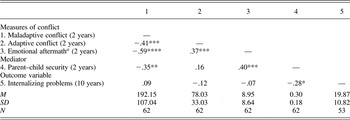
Descriptive statistics for conflict dimensions, parent-child security and internalizing problems
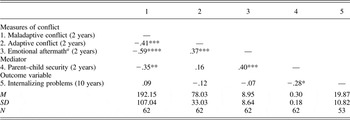
a Higher scores on emotional aftermath are indicative of more positive resolutions, characterized by more positive and less negative affect expression within the family unit following conflict.
*p < .05. **p < .01. ***p < .005. ****p < .001.
Data analyses
Data were analyzed using Mplus software (Muthén & Muthén, Reference Muthén and Muthén2010) to address missing data (i.e., data from the nine families who did not participate in the 10-year assessment) using full information maximum likelihood, considered superior to other methods of handling missing data (Enders & Bandalos, Reference Enders and Bandalos2001). Missing data status was not associated with any demographic characteristics (rs = –.24 to .16, ps > .05). A first stage and direct effect conditional process model (Preacher, Rucker, & Hayes, Reference Preacher, Rucker and Hayes2007) was tested such that the link between conflict and parent–child attachment was moderated by gender. We examined three measures of conflict in separate models: maladaptive conflict (destructive strategies, severe and intense disagreements), adaptive conflict (cooperative strategies, effective resolutions), and the emotional aftermath of conflict. In each tested model, internalizing problems were regressed on conflict, child gender, parent–child attachment, and Gender × Conflict. Parent–child attachment was regressed on conflict, child gender, and Gender × Conflict. Child early negative emotionality at age 2 was included as the covariate in all analyses.
A bootstrap approach (Shrout & Bolger, Reference Shrout and Bolger2002) was implemented. Bootstrapping provides an empirical approximation of sampling distributions of indirect effects to provide confidence intervals of estimates. If zero does not fall within the confidence interval, one can conclude that an indirect effect is different from zero. A bootstrapping sampling method has become the preferred method for testing indirect effects for multiple reasons, including (a) no assumptions need to be made about the shape of the sampling distribution, (b) power is maximized while minimizing Type I error rate, and (c) no particular formula for the standard error is required (MacKinnon, Lockwood, & Williams, Reference MacKinnon, Lockwood and Williams2004; Preacher et al., Reference Preacher, Rucker and Hayes2007; Shrout & Bolger, Reference Shrout and Bolger2002).
We performed a nonparametric resampling method (bias-corrected bootstrap) with 5,000 resamples drawn to derive the 95% confidence intervals for the indirect effects of conflict on internalizing symptoms through emotional security mechanisms. Given that the tested models were just identified (i.e., number of identifying restrictions equaled number of estimated parameters), no indices of global fit are reported.
Results
Preliminary analyses
Means, standard deviations, and correlations among variables are reported in Table 1. Overall maladaptive and adaptive conflict dimensions were moderately inversely related with each other, and related to emotional tone following conflict, in the expected directions. Boys and girls did not differ significantly on key study variables (ts = –1.02 to 1.88, ns). Correlations between each of the conflict measures and child internalizing symptoms were not significant, suggesting that links may be specific to boys versus girls, or may only be present when a mediator is included as an intervening variable. Children's security with parents was moderately negatively associated with internalizing symptoms. Further, children's security with parents was significantly negatively linked with overall maladaptive conflict and positively linked with positive aftermath of conflict.
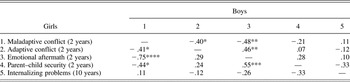
Correlations among variables for boys versus girls are reported in Table 2. Boys' and girls' correlations between parent–child security and internalizing problems were fully parallel, whereas correlations between each of the features of conflict and parent–child attachment security differed in magnitude for girls and boys. For girls, there were moderate to large significant correlations between two conflict measures (maladaptive conflict and emotional aftermath) and attachment security. For boys, those correlations were small in magnitude and not significant. This pattern of correlations further supports the implementation of a first-stage conditional process analysis that models gender differences in the link between the features of conflict and parent–child attachment but not in the association between attachment and internalizing problems.
Correlations among variables for boys versus girls

Note: Correlations for girls are below the diagonal, and correlations for boys are above the diagonal.
*p < .05. **p < .01. ***p < .005. ****p < .001.
Conditional process analyses
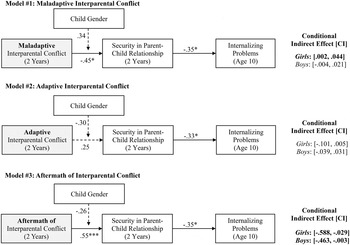
Results of conditional process models are reported in Figure 1. As discussed by Preacher et al. (Reference Preacher, Rucker and Hayes2007), the conditional indirect effects (i.e., the value of the indirect effect conditioned on one or more values of a moderator) are the parameters of interest in the estimation of a moderated mediation model, and the bootstrap confidence interval for the conditional indirect effects is the preferred inferential method. As stated by Hayes (Reference Hayes2013), “statistically significant moderation of a path in a mediation model is not a necessary condition for an indirect effect to be moderated” (p. 396). This was the case in the present study. The overall conditional indirect effect (from maladaptive conflict to security with parents to internalizing problems) was significant at a given level of a moderator (for girls), but not at other levels (for boys), in the absence of a significant moderated path. Thus, although we report results of the path analysis, the key parameters are the conditional indirect effects of conflict on internalizing symptoms via parent–child security, for girls versus boys, which are also reported in Figure 1. Conditional indirect effects via the mediator are reported with bias-corrected bootstrap 95% confidence intervals for each of the three measures of conflict (i.e., maladaptive conflict, adaptive conflict, and conflict aftermath). If a confidence interval does not include 0, we infer the presence of an indirect effect. Those conditional indirect effects are shown in bold type in Figure 1.
Coefficients are standardized. Confidence intervals (95% CIs) are provided for estimates of indirect effects of conflict on internalizing problems through security in parent–child relationship for girls and boys. Significant indirect effects are in bold. *p < .05. ***p < .005.

Consistent with the tenets of attachment and large body of extant evidence, children's attachment security at toddler age significantly predicted lower internalizing problems at age 10. Further, maladaptive parental conflict was associated with children's lower attachment security to parents, and more positive emotional aftermath of conflict was associated with higher security.
In summary, for two dimensions of interparental conflict (maladaptive conflict and emotional aftermath of conflict) we supported the proposed significant indirect pathways to internalizing problems through the child's undermined security of attachment to the parents. Maladaptive conflict predicted higher levels of internalizing problems for girls, and the effect was mediated by a significant decrease in their attachment security with the parents. In contrast, the indirect effect of maladaptive conflict on internalizing problems via attachment security was absent for boys. The pathway from emotional aftermath of conflict to internalizing problems through security of attachment to parents was significant for both boys and girls. It is somewhat surprising that there were no associations between adaptive conflict and children's security to parents.
Discussion
Interparental conflict is one of the most prevalent risk factors in young children's lives, and its implications for their emotional adjustment continue to be extensively studied. This investigation makes a useful contribution to that large body of research due to several unique elements. We heed Cummings' and Davies' calls for long-term studies of the impact of marital discord and examine children's internalizing problems assessed 8 years after the measurement of conflict. We target a broad age range that included two key developmental periods: toddler age for exposure to conflict and early preadolescence for the assessment of internalizing problems. Our confidence in the findings is enhanced by the fact that we were able to control for children's early negative emotionality, broadly considered a diathesis for internalizing disorders, measured at toddler age.
Assessing interparental conflict at toddler age is important for several reasons. Marriages are most discordant during early child-rearing years (Belsky & Rovine, Reference Belsky and Rovine1990). Detrimental effects of conflict on children may be most pronounced in early childhood because of neurobiological plasticity within the hypothalamus–pituitary–adrenal axis and its implications for long-term regulatory processes (Gunnar & Quevedo, Reference Gunnar and Quevedo2007). In addition, in toddlerhood, the quality of child–parent relationships, most prominently indexed by attachment security or insecurity, remains key for concurrent and future adaptation or maladaptation, and security remains a salient goal (Cummings, Davies, & Campbell, Reference Cummings, Davies and Campbell2000; Davies & Sturge-Apple, Reference Davies and Sturge-Apple2007; Marvin & Britner, Reference Marvin, Britner, Cassidy and Shaver2008).
Our approach to assessing interparental conflict, integrating its various features, appears useful. Children's exposure to overall maladaptive (destructive, intense) conflict, infused with poorly resolved anger and heightened family tension in its aftermath at toddler age increased the risk for internalizing symptoms in early preadolescence. Whereas maladaptive and destructive forms of conflict have been widely examined as risk factors for child maladjustment, the aftermath of conflict has received considerably less attention. The results of the present study suggest that the negative emotional tone, lingering tension, and failure to reach marital reconciliation following conflict play an important role in the trajectory of child adjustment, undermining parent–child attachment security and increasing the risk for internalizing problems 8 years later. Consequently, we propose that this aspect of conflict be routinely included in investigations of the role of interparental discord in child adjustment.
It is perhaps surprising that adaptive conflict was not linked to internalizing problems via the tested mediator. One possible explanation for this nonsignificant pathway can be found in emerging research on constructive conflict and child adjustment. It has been proposed that constructive forms of conflict enhance children's positive social functioning (e.g., McCoy et al., Reference McCoy, Cummings and Davies2009) and, consequently, they may be unique to interpersonally oriented aspects of child adjustment such as empathy, social skills, or prosocial behavior. If so, then our outcome measure (internalizing problems) may have not been sensitive to such effects. Alternatively, constructive conflict may be linked to internalizing disorders, but through a different mechanism (e.g., constructive regulation of anger as a protective factor), rather than parent–child attachment security.
Perhaps of the most importance, we examined a conceptually plausible mechanism of the process linking marital discord with children's adjustment using robust observational measures of the child's security with both parents based on 5 hours of observations of the child's interactions with the parents, in broadly ranging, scripted yet naturalistic contexts, generated by trained coders using a well-established attachment security instrument. A large body of literature has supported the detrimental effect of interparental conflict on child adjustment via the child's undermined sense of emotional security about the interparental relationship (a direct pathway; Davies & Cummings, Reference Davies, Cummings, Cicchetti and Cohen2006). In the present study, we aimed to examine the mediating role of insecurity in the parent–child relationship, an indirect pathway (Davies & Cummings, Reference Davies, Cummings, Cicchetti and Cohen2006; Davies, Winter, et al., Reference Davies, Winter and Cicchetti2006). Although studies have shown that marital conflict undermines children's attachment security (Howes & Markman, Reference Howes and Markman1989; Owen & Cox, Reference Owen and Cox1997; see Belsky & Fearon, Reference Belsky, Fearon, Cassidy and Shaver2008, for review), the extended sequence from conflict to security to internalizing problems has rarely been examined.
We explored whether the proposed developmental path from early exposure to conflict to children's security to internalizing symptoms differed for boys and girls. Gender differences in response to marital discord are not well understood; however, girls tend to be more sensitive to interpersonal distress (Crawford et al., Reference Crawford, Cohen, Midlarsky and Brook2001; Rudolph & Hammen, Reference Rudolph and Hammen1999) and are at greater risk for internalizing problems starting in adolescence (Keenan & Shaw, Reference Keenan and Shaw1997). Results of the present study suggest that maladaptive interparental conflict undermines girls' sense of security with parents; that in turn leads to more internalizing problems in early preadolescence. That indirect effect was not present for boys. A more negative emotional tone following marital arguments was associated with greater internalizing problems for both genders via less security in the parent–child relationship. Thus, the aftermath of conflict may have relatively pervasive effects on the family system, contributing to internalizing problems for both genders, whereas destructive conflict tactics may impact family security in such a way that only creates a vulnerability for girls. An important direction in future research is to identify the unique pathways (e.g., via parenting difficulties, coparenting problems, dampened positive affect in the parent–child relationship, parental depression and emotional unavailability) through which different dimensions of conflict undermine emotional security in the family, and the differential effects of these disparate pathways on the development of boys versus girls.
The study had several limitations. The most obvious limitation was the modest sample size. Although we used an analytical approach that is particularly appropriate for small samples (bootstrapped confidence intervals; MacKinnon et al., Reference MacKinnon, Lockwood and Williams2004), the results, however promising, should be seen as preliminary, interpreted with caution, and replicated in a larger sample.
In addition, the sample was relatively ethnically homogenous and low in risk, consisting of well-functioning, two-parent community families. Children were also largely typically developing, and their level of internalizing problems was comparable to the normative group as reported in the CSI manual (Gadow & Sprafkin, Reference Gadow and Sprafkin2002). On average, children were in the low severity range. Note that our broadband measure of internalizing problems was very well distributed; however, only three girls and two boys were above the T score of 70 (high severity) on the key scales (generalized anxiety disorder, depressive disorder). Parental relationships were generally relatively harmonious, as evidenced by very low reported rates of physical aggression during interparental arguments. Because of those characteristics of the sample, we again urge caution in generalizing the results and stress the importance of future replications. However, it was notable that even in this well-functioning group of families and children, we were able to demonstrate the proposed significant indirect paths from early conflict to future internalizing problems. Future work with more at-risk populations (highly discordant marriages, children with elevated psychopathology scores) will likely show amplified negative cascades (Davies, Winter et al., Reference Davies, Winter and Cicchetti2006). Finally, interparental conflict and parent–child attachment security were assessed concurrently in the present study.
Despite the limitations, the study makes useful contributions to our understanding of the role of specific features of interparental conflict with regard to children's adjustment. Security with parents was identified as a key mechanism through which maladaptive, destructive, and unresolved interparental conflict during toddler age leads to internalizing problems 8 years later during preadolescence. This finding provides support for an emotional security theory (Davies & Cummings, Reference Davies and Cummings1994) that posits that conflict undermines security about not only the interparental relationship but also the parent–child relationship, with implications for multiple family relationships. To the extent that children are exposed to greater maladaptive conflict and negativity following conflict, their emotional security in the family is undermined, potentially setting the stage for dysfunctional developmental processes (e.g., greater emotional reactivity and affect dysregulation) that are linked to internalizing problems. In particular, the relatively novel construct of conflict aftermath demonstrated significant pathways to internalizing problems for both boys and girls. Tension and negative affect arising from unresolved conflict between the parents appears to permeate throughout the family system, undermining security in multiple family subsystems. As such, examinations of conflict aftermath may be especially relevant in future research guided by an emotional security theory. The results add to the growing literature on family conflict and its implications for children and, if replicated, will help inform prevention and intervention efforts directed at family systems.