Introduction
The representation of social groups in advertising has been a major concern in academia. Though several studies have investigated representations of ethnicities and gender in television advertisements (e.g. Furnham and Mak Reference Furnham and Mak1999; Taylor and Stern Reference Taylor and Stern1997), research focusing on older people has been scant and mainly in the context of the United States of America (USA), starting in the 1970s (Francher Reference Francher1973; Harris and Feinberg Reference Harris and Feinberg1977). In contrast, only a few studies investigating the representation of older people in advertising in Asian countries exist (Lee, Kim and Han Reference Lee, Kim and Han2006; Ong and Chang Reference Ong and Chang2009; Zhang, Song and Carver Reference Zhang, Song and Carver2008). Specifically, Japan, which has been highly affected by demographic changes, has received little attention in this research area.
Our research is the first longitudinal study (1997 and 2007) on the world's third-largest advertising industry (World Advertising Research Center 2012) on this topic, which gives us the opportunity to investigate developments and changes over a decade. The representation of older people should be a major social concern because it has the potential to influence society's perception of them (Gerbner et al. Reference Gerbner, Gross, Signorielli and Morgan1980). Television advertisements are of the most concern, since they are the most widely consumed form of advertisements across all age groups in Japan (Nihon Shinbun Kyokai 2010).
More and more countries around the world are experiencing ageing populations. In fact, all of the G-20 countries are ageing increasingly (United Nations 2012). Japan is a particularly interesting example of an ageing society because it has the highest percentage of older people in the world, which we define in this study as those 50 years and above. While Japan also has adopted the World Health Organization's definition of ‘older person’ (kōreisha in Japanese) as 65 years or older, this definition was extended to the 50–64 age segment (called shinia=senior in Japanese) by Japanese advertising agencies (Dentsu Senior Project 2007; Hakuhodo Elder Business Suishinshitsu 2006) based on the importance of the baby-boom generation (those born between 1947 and 1949 or 1951 in Japan). We have followed this more inclusive definition of older people, which is used by Japanese advertising agencies, because the majority of television advertisements in our sample that featured older people employed those in the age group 50–64 years (79.8 per cent in 1997 and 85.0 per cent in 2007); thus only a very small amount of the television advertisements actually featured the 65+ age group. The 50+ definition is also commonly used in academic marketing research and in business practices, both in Japan and other countries, though it is by no means a homogenous market segment (Carrigan and Szmigin Reference Carrigan and Szmigin2000; Kohlbacher and Chéron Reference Kohlbacher and Chéron2012; Yoon and Powell Reference Yoon and Powell2012).
Because of the increasing importance of older people throughout the world, especially in Japan, this research focuses on the representation of older people in television advertisements and the possible effects of such depictions on both older and younger television audiences (Gerbner et al. Reference Gerbner, Gross, Signorielli and Morgan1980). This research also analyses whether advertisements reflect social changes and if the representation of older people in Japanese television advertising indicates the rising importance of older people (Harwood and Anderson Reference Harwood and Anderson2002). The increasing proportion of older people in many countries makes this issue ever more pressing.
Theoretical framework
There are several theories relevant to research on older people in advertisements. Some scholars suggest that advertisements reflect society and culture (Acevedo et al. Reference Acevedo, Nohara, Arruda, Tamashiro and Brashear2006). For example, McLuhan (Reference McLuhan1994: 232) stated that ‘the historians and archaeologists will one day discover that the ads of our time are the richest and most faithful daily reflections that any society ever made of its entire range of activities’. Similarly, Frith and Mueller (Reference Frith and Mueller2003: 234) agreed that if advertisements want to be resonant to target audiences, ‘they need to reflect the social norms practiced in a given society’. Goffman (Reference Goffman1979: 8) argues similarly that advertising can reflect ‘fundamental features of the social structure’, such as values, beliefs and norms. Goffman also makes clear that these portrayals do not necessarily depict how we actually behave, but how we think we should behave and what behaviour is desirable. As a result, advertisements are full of messages about cultural norms and values and thus these can be interpreted from advertisements. Another theory related to the idea that advertisements reflect society is ethnolinguistic vitality theory (Giles, Bourghis and Taylor Reference Giles, Bourghis, Taylor and Giles1977), which addresses the content of advertising and is important for understanding the position of a group within a society (Zhang et al. Reference Zhang, Harwood, Ylänne-McEwen, Williams, Wadleigh and Thimm2006). It evaluates a group's strength in society based on status, demographics and institutional support, which includes the group's representation in the media. In short, using the media is only one of several ways to evaluate the group's strength. Content analysis of groups in the media indicates the groups’ value and respect within a society. In other words, frequent and positive representations directly indicate a group's vitality, strength and influence in society (Abrams, Eveland and Giles Reference Abrams, Eveland, Giles and Kalbfleisch2003; Harwood and Anderson Reference Harwood and Anderson2002), while rare and negative representations indicate that the group has little influence in society. Thus, the claim of the ethnolinguistic vitality theory is that one can use media representations to analyse the role and influence a social group has within society.
Another reason for the importance of analysing advertising content is connected with its possible effects. Though the results of content analysis cannot demonstrate effects on audiences, content analysis is an essential first step in the process of grasping the possible impacts of media influence (Riffe, Lacy and Fico Reference Riffe, Lacy and Fico2005). Two theories that are especially helpful for understanding the possible effects of advertising are social cognitive theory and cultivation theory. Social cognitive theory (Bandura Reference Bandura, Bryant and Oliver2009) claims that learning about the social environment can occur through direct or vicarious observations (such as watching television). People model their behaviour based on these observations, for example, about appropriate age roles. Thus, both younger and older people may learn about appropriate behaviour and roles for their respective age groups through advertising and the media. Cultivation theory (Gerbner Reference Gerbner1998) argues that television has an even stronger influence. Television, a major storyteller of our time, plays an important role in creating often-distorted views of reality, especially for heavy viewers. Watching television produces a worldview for the viewers’ images of social behaviour, norms and values that are consistent with those provided on television. In short, those who watch a lot of television may believe that older people are only a small proportion of the entire population because they are seen rarely on television, or they may obtain negative feelings about older people because of negative stereotypes portrayed in the media. Both of these theories emphasise the social influence of media images. Research has confirmed that both of these theories are accurate in that the media has an influence on how older people regard themselves (Donlon, Ashman and Levy Reference Donlon, Ashman and Levy2005; Korzenny and Neuendorf Reference Korzenny and Neuendorf1980; Mares and Cantor Reference Mares and Cantor1992) and how they are regarded by younger people (Gerbner et al. Reference Gerbner, Gross, Signorielli and Morgan1980; Passuth and Cook Reference Passuth and Cook1985). In addition, research has shown that self-stereotyping of older people can even lead to negative physiological effects such as impaired memory performance (Westerhof et al. Reference Westerhof, Harink, Van Selm, Strick and Van Baaren2010).
Literature review and research questions
During the last decades there have been several articles on the representation of older people in television advertisements. These studies are, however, predominantly from Anglophone countries such as the USA, Canada, the United Kingdom (UK) and Australia. Only a few English-language studies have also investigated this topic in other countries, such as South Korea (Lee, Kim and Han Reference Lee, Kim and Han2006; Ong and Chang Reference Ong and Chang2009), China (Zhang, Song and Carver Reference Zhang, Song and Carver2008), Malaysia (Ong and Chang Reference Ong and Chang2009) and Germany (Kessler, Schwender and Bowen Reference Kessler, Schwender and Bowen2010).
The following overview of existing literature helps situate our results in a more global context. However, comparisons between our research and past studies require caution because earlier research was based upon different cultural contexts, sample sizes and sampling methods (prime time versus whole day, duplicated versus unduplicated television advertisements), and varying definitions of ‘older people’ (ranging from age 45 or older to age 65 years or older). Because of these issues of comparability (Prieler et al. Reference Prieler, Kohlbacher, Hagiwara and Arima2011) and the partially contradictory results, we have decided to state research questions (RQs) instead of research hypotheses. Our research questions are derived and adapted from previous research on social groups focusing on the following areas: frequency of representation, perceived importance, the image of older people, social interaction, setting, product categories and social change.
Frequency of representation
RQ1: Is the proportion of television advertisements that employ older people higher or lower than the proportion of older people in the Japanese population?
Over- or under-representation of social groups in the media is a possible indicator of their importance or relevance within society. It can also affect public knowledge and perceptions of these groups as well as the view that society has of these groups (Abrams, Eveland and Giles Reference Abrams, Eveland, Giles and Kalbfleisch2003). For example, young people may come to believe that the number of older people in the population is small (Gerbner et al. Reference Gerbner, Gross, Signorielli and Morgan1980). Many previous studies have found that older people were under-represented in television advertisements compared to the demographic reality. This was true in articles published in the USA (Atkins, Jenkins and Perkins Reference Atkins, Jenkins and Perkins1990–91; Greco Reference Greco1993; Langmeyer Reference Langmeyer1993; Lee, Carpenter and Meyers Reference Lee, Carpenter and Meyers2007; Peterson and Ross Reference Peterson and Ross1997; Roy and Harwood Reference Roy and Harwood1997). For example, Gerbner et al. (Reference Gerbner, Gross, Signorielli and Morgan1980) reported that the under-representation of people began somewhat under the age of 50 for prime-time advertisements. Langmeyer (Reference Langmeyer1993) reported that 12.3 per cent of television advertisements featured people age 60 or older, although this group constituted 16.7 per cent of the population. Research defining older people as age 45 or older (Peterson and Ross Reference Peterson and Ross1997), age 50 or older (Atkins, Jenkins and Perkins Reference Atkins, Jenkins and Perkins1990–91) and age 55 or older (Lee, Carpenter and Meyers Reference Lee, Carpenter and Meyers2007) obtained similar results. The under-representation of older people has also been found in other parts of the world, such as Australia (Higgs and Milner Reference Higgs and Milner2006), South Korea (Lee, Kim and Han Reference Lee, Kim and Han2006; Ong and Chang Reference Ong and Chang2009) and Germany (Kessler, Schwender and Bowen Reference Kessler, Schwender and Bowen2010). Lee, Kim and Han (Reference Lee, Kim and Han2006) reported that older people were represented in 8.0 per cent of advertisements though they constituted 12 per cent of the population in South Korea. Ong and Chang (Reference Ong and Chang2009) also found the same under-representation in South Korea (8.6% versus 13.3%) and Malaysia (2.5% versus 6.6%). However, a few studies have reported results that were closer to demographic reality, such as in China (Zhang, Song and Carver Reference Zhang, Song and Carver2008), the UK (Simcock and Sudbury Reference Simcock and Sudbury2006) and the USA (Lee, Kim and Han Reference Lee, Kim and Han2006).
Perceived importance
RQ2: In which roles do older models most frequently appear?
It is also necessary to examine the roles older people play in the advertisements (i.e. major, minor or background roles) because numerical representations can only provide a limited picture of the perceived importance of older people. The roles that older people play in advertisements may indicate their perceived social value. For example, a major role for an older person could indicate importance. Through watching television, the audience learns what roles are ‘appropriate’ to older people and forms beliefs about these groups (Abrams, Eveland and Giles Reference Abrams, Eveland, Giles and Kalbfleisch2003; Gerbner et al. Reference Gerbner, Gross, Signorielli and Morgan1980), thus cultivating an image of what roles older people should play in society. In studies that have investigated the roles played by older people in television advertisements, the overall trend in the USA and the UK is that more older people appear in minor or background roles than in major roles (Greco Reference Greco1993; Roy and Harwood Reference Roy and Harwood1997; Simcock and Sudbury Reference Simcock and Sudbury2006). For example, Roy and Harwood (Reference Roy and Harwood1997) reported 38.2 per cent in major roles, 19.5 per cent in minor roles and 52.8 per cent in background roles. Greco (Reference Greco1993) found that older people were featured mainly in minor roles (56%) in 1985, followed by major roles (32%) and background roles (12%); similarly in 1990, 27 per cent of older people were in major roles, 41 per cent in minor and 32 per cent in background roles. In contrast to these findings, research in South Korea has found that more older people play major roles than minor or background roles (Lee, Kim and Han Reference Lee, Kim and Han2006; Ong and Chang Reference Ong and Chang2009). For example, Lee, Kim and Han (Reference Lee, Kim and Han2006) found that there are more older people in major roles (86.1%) than in minor roles (13.9%), and Ong and Chang (Reference Ong and Chang2009) reported that older people were depicted mainly in major roles.
Image of older people
RQ3: Are older people predominantly portrayed in a favourable or an unfavourable way?
A few studies on older people have analysed the portrayal or image of older people. This variable is important to understand if older people are portrayed in positive or in negative ways. Most studies have found that older people were more often portrayed positively than negatively (Langmeyer Reference Langmeyer1993; Ong and Chang Reference Ong and Chang2009; Roy and Harwood Reference Roy and Harwood1997; Simcock and Sudbury Reference Simcock and Sudbury2006). Langmeyer (Reference Langmeyer1993) found that older people were being described as helping, knowledgeable, happy and confident. Lee et al. (Reference Lee, Carpenter and Meyers2007) had similar results, finding that older people were associated mostly with positive attributes such as ‘active’, ‘happy’ and ‘healthy’. Roy and Harwood (Reference Roy and Harwood1997) reported that older people were generally depicted positively and were featured as strong, active, happy and lucid (not confused). Similar findings were also true in an East Asian context, where Ong and Chang (Reference Ong and Chang2009) found more than 70 per cent of older people in South Korean advertisements were depicted as happy, lucid, emotionally strong and active; this was found to a much lesser extent in Malaysian advertisements. Finally, Peterson and Ross (Reference Peterson and Ross1997) observed that while older people were more often depicted favourably than unfavourably, younger models were portrayed more favourably than older ones. Sixty-six per cent of people in the 45–64 age group were shown in a desirable way, while only 54 per cent of people 65 years and older were shown favourably. Similarly, 34 per cent of people in the age segment 45–64 years were shown in an undesirable way, while the same was true for 46 per cent of the age group 65 years and older.
Social interaction
RQ4: With which age groups are older people predominantly depicted?
As with previous representations, the perceived value of older people may be inferred from the depiction of their social interactions. Considering whether older people are shown alone or together with other age groups, and identifying the groups they interact with, is important. Though the categories varied, most studies concluded that older people appear with age groups other than their own in more than 70 per cent of advertisements (Greco Reference Greco1993; Roy and Harwood Reference Roy and Harwood1997). Greco (Reference Greco1993) reported older people in multiple age groups in 78 per cent of advertisements in 1985 and 70 per cent of advertisements in 1990, while only 14 per cent appeared alone in 1985 and 22 per cent in 1990. Similarly, Roy and Harwood (Reference Roy and Harwood1997) found 76.4 per cent of older people appear with multiple age groups and only 13.0 per cent appear exclusively with other older characters. These findings may imply that older people are not regarded as valuable enough to appear only with members of their own age group but that other age groups must generally appear with them.
Setting
RQ5: In which types of setting are older people likely to be shown in television advertising?
Another important variable for the content analysis of social groups is setting (Furnham and Mak Reference Furnham and Mak1999), which may convey to television audiences that the lives of older people are confined to certain settings and connected activities. Surprisingly, this category has only scarcely been used in previous research that analyses the portrayal of older people. The few findings in this area are mixed. Some research has found that more than half of advertisements with older people are in home settings (Swayne and Greco Reference Swayne and Greco1987), which may be in line with the stereotype of older people not being active and mostly staying at home. Other research has found that older people are predominantly in outside settings (Ong and Chang Reference Ong and Chang2009; Robinson Reference Robinson1998). For example, Robinson (Reference Robinson1998) reported 63 per cent of older people were in outside settings, while only 8.7 per cent were in home settings; these findings were consistent with magazines but not with newspapers where the home setting was dominant.
Product categories
RQ6: Which product categories are older people most commonly associated with in television advertising?
The products associated with particular social groups indicate the preoccupations, competencies and values of those associated with them (Mastro and Stern Reference Mastro and Stern2003). For example, the strong association between women and cosmetic products emphasises the importance society assigns to female beauty and contributes to their sexualisation (Luyt Reference Luyt2011). Needless to say, such limited portrayals lead to a distorted knowledge of various social groups. Older people in television advertisements, for their part, are most often used to promote foods/beverages. This is true for the USA (Atkins, Jenkins and Perkins Reference Atkins, Jenkins and Perkins1990–91; Greco Reference Greco1993; Lee, Carpenter and Meyers Reference Lee, Carpenter and Meyers2007; Lee, Kim and Han Reference Lee, Kim and Han2006; Miller, Leyell and Mazachek Reference Miller, Leyell and Mazachek2004; Roy and Harwood Reference Roy and Harwood1997), the UK (Simcock and Sudbury Reference Simcock and Sudbury2006), South Korea (Lee, Kim and Han Reference Lee, Kim and Han2006) and China (Zhang, Song and Carver Reference Zhang, Song and Carver2008). Other product categories that feature older people are financial/insurance (Lee, Kim and Han Reference Lee, Kim and Han2006; Ong and Chang Reference Ong and Chang2009) and medication/health (Atkins, Jenkins and Perkins Reference Atkins, Jenkins and Perkins1990–91; Lee, Carpenter and Meyers Reference Lee, Carpenter and Meyers2007; Ong and Chang Reference Ong and Chang2009; Robinson Reference Robinson1998).
Older people and social change in Japan
RQ7: Were there any changes in how older people were represented in Japanese television advertisements between 1997 and 2007, and were these changes connected with social changes in Japan?
Our last research question tries to answer the question about how closely advertisements actually reflect change in society. The percentage of people age 50 or older increased significantly from 34 per cent of the population in 1995 to 41.9 per cent in 2005, according to census data (Ministry of Internal Affairs and Communications 1995, 2005). Furthermore, Japanese people in their fifties, sixties and seventies or older own 21, 31 and 28 per cent of total personal financial assets, respectively, which means that people age 50 or older hold approximately 80 per cent of total personal financial assets in Japan (The Nikkei Weekly 2010: 4). In short, older people are increasingly important in Japan, not only from a demographic perspective but also from a business perspective (Kohlbacher Reference Kohlbacher, Coulmas and Lützeler2011). It is, therefore, not surprising that consumers and advertising agency staff in Japan expect an increasing number of older people to appear in television advertisements in the coming years (Kohlbacher, Prieler and Hagiwara Reference Kohlbacher, Prieler and Hagiwara2013) because using older people in television advertising is a way to target this age group. This research will analyse if these changes are reflected in the advertisements from 2007 compared to advertisements from 1997.
Method
We have chosen television advertisements for analysis as television is clearly the media most widely used by all age groups in Japan, where 89.8 per cent report daily use, followed by 62.7 per cent for newspapers (Nihon Shinbun Kyokai 2010). Television advertising holds the biggest share (57.8%) of the mass communications advertising budget (cf. Nikkei Kōkoku Kenkyūjo 2009). The Japanese population has the most contact with television advertising (92.9%), followed by newspapers (84.2%) and magazines (63.6%). While newspaper advertisements have an older and internet advertisements a younger audience, television advertising is popular across all age groups (Nihon Shinbun Kyokai 2010). Television advertising, then, is the advertising form with the broadest influence, particularly because it is the easiest to understand, the most entertaining, and the most spoken about with other people (Nihon Shinbun Kyokai 2010). Taken together, these factors can increase our understanding of how television advertisements shape the audience's perception of social groups.
The sample for this research is drawn from a database of television advertisements that includes all advertisements being broadcast for the first time on any given day in the Greater Tokyo Area on the five commercial television stations: TV Tokyo, TV Asahi, Fuji Television, TBS and NTV. This means that the database contains no duplicates. In order to establish a representative sample, we have randomly chosen 28 days with an equal distribution of weekdays over one year (for both 1997 and 2007). This resulted in 1,495 unduplicated television advertisements in 1997 and 1,477 in 2007: 2,972 in total. Within these, the 1997 advertisements included 1,236 advertisements with people; the 2007 advertisements included 1,220 advertisements with people.
Two Japanese doctoral students, who were blind to the research questions, undertook the coding of all television advertisements independently. Reliability coefficients, as measured by Cohen's kappa, ranged between 0.692 (image in 2007) and 0.960 (role in 1997). Hayes (Reference Hayes2005) notes that an agreement of 0.700 is sufficient if reliability is corrected for chance, all coders code all units and disagreements between the coders are resolved. Our coders took all of these steps. While our reliability for image was slightly lower in 2007, it was still above the recommended chance-corrected agreement of 0.600 by Neuendorf (Reference Neuendorf2011). Age proved to be relatively easy to code because most people who appeared in the advertisements clearly fit either within the 0–49 or the 50+ age groups. Only a few cases were ambiguous, indicated in the high inter-coder reliabilities of 0.933 for 1997 and 0.924 for 2007.
Variables
We used variables from previous research (Lee, Kim and Han Reference Lee, Kim and Han2006; Mastro and Stern Reference Mastro and Stern2003; Roy and Harwood Reference Roy and Harwood1997; Simcock and Sudbury Reference Simcock and Sudbury2006) that seemed to be particularly useful for analysing social change in the representation of older people in Japanese television advertisements, and further developed them in pilot studies (Prieler Reference Prieler, Kohlbacher and Herstatt2008). The unit of analysis in this study is the television advertisement. As a result, this study discusses the proportion of television advertisements in which older people show specific characteristics. The overall depiction of how older people are represented was coded in the few cases when more than one older person appeared in an advertisement.
Age
A character's age was estimated to be either in the 0–49 range, or else 50 years and older. We used three ways to estimate: (a) in some cases, the character's age was known (e.g. for celebrities); (b) there was a reference to the age of the character within the advertisement; or (c) age was indicated by the physical appearance of the character, i.e. hair colour, thinning of hair or wrinkles (Simcock and Sudbury Reference Simcock and Sudbury2006).
Role
Both major roles and minor roles were investigated. Major roles depict the most prominent characters in advertisements and commonly involve speaking parts and close-ups. People in minor roles are present longer than three seconds or appear several times, speak little or not at all, and support the major role. Advertisements including one older person in a major role and one older person in a minor role were coded as both. People in the background role were not examined for this study, since we reasoned that the faces of people in background roles are often unclear, making the coding of age problematic.
Image
The image of the older person in the television advertisement was coded in the following way: favourable, neither or unfavourable (Simcock and Sudbury Reference Simcock and Sudbury2006). A favourable depiction was one where older models were shown as authoritative, competent, skilful, or controlling and/or enjoying a particular activity. An unfavourable portrayal was one where older models were shown as incompetent (comical or otherwise), helpless, a victim, weak or displaying stereotypically negative behaviour associated with age (e.g. bad temper, forgetfulness).
Social interaction
This variable investigates whether older people are interacting with other people in advertisements. The social interactions of older people with other people were coded in the following way: alone, with older people, with adults (younger than 50), with a child or with multiple generations. If several social interactions appeared, the most prominent one was coded.
Setting
The setting is the place where the older person appears in the commercial. If there were several settings, the dominant setting was coded. The setting was coded from the perspective of the older person. For example, for a waiter in a restaurant serving food, the setting would be ‘workplace’, but the setting would be ‘other indoors’ for the person being served. We coded the following settings: home (inside), workplace (inside), other inside, outside and other.
Product category
The product categories in this research, which are in accordance with the product categories commonly used in Japan, were provided by the database of television advertisements; these product categories were as follows: foods/beverages, services/leisure, cosmetics/toiletries, distribution/retailing, pharmaceuticals/medical supplies, automobile/related products, real estate/housing, finance/insurance, household products, apparel/fashion/accessories/personal items, precision instruments/office supplies, home electric appliances/audio-visual equipment, publications, materials and other (see Table 1).
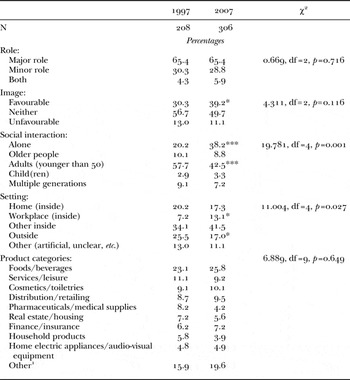
Roles, social interactions, settings and product categories associated with older people

Notes: The significance levels for differences between sub-categories are based on post hoc tests using adjusted standardised residuals. 1. The product categories automobile/related products, apparel/fashion/accessories/personal items, precision instruments/office supplies, publications, and materials were added to the ‘other’ product category due to low cell counts. df: degrees of freedom.
Significance levels: * p<0.05, ** p<0.01, ***p<0.001.
Results
The results of this study are based on chi-square analyses that were executed on a sample of unduplicated television advertisements that included people. Because we were interested in both the overall significant differences between 1997 and 2007 for each category, and which sub-categories contributed to this significance, we broke the results down even further using the adjusted standardised residuals (ASRs) for post hoc tests. In turn, we will try to answer each research question while simultaneously addressing RQ7 regarding the changes between the years 1997 and 2007.
RQ1 asked if the proportion of television advertisements that employ older people is higher or lower than the proportion of older people in the Japanese population. The number of Japanese television advertisements including older people increased between 1997 and 2007. In all television advertisements featuring people, 208 advertisements (16.8%) featured older people in 1997; this number increased to 306 advertisements (25.1%) in 2007. This was an increase of 49.4 per cent and is statistically significant (χ2=59.868, df=1, p<0.001). In both years, older people were significantly under-represented in Japanese television advertisements, based on data from the 1995 census (34.0%) and the 2005 census (41.9%) (1997: χ2=161.410, df=1, p<0.001; 2007: χ2=141.749, df=1, p<0.001). Although the 50+ population segment increased by 23.2 per cent, the number of advertisements with older people increased even further by 49.4 per cent, which led to a lower under-representation of older people in 2007 than in 1997.
RQ2 investigated the perceived importance of older people by analysing the roles in which older people most frequently appear. In Japanese television advertisements, older people were shown predominantly in major roles (65.4% in 1997 and 65.4% in 2007), followed by minor roles (30.3% and 28.8%); in a few cases, older people playing different roles appeared together in one television advertisement (4.3% and 5.9%). There were also more advertisements with older people playing major roles than minor roles. The results for roles were consistent between 1997 and 2007 (χ2=0.669, df=2, p=0.716).
RQ3 examined the image of older people in television advertisements and asked whether older people are predominantly portrayed in favourable or unfavourable ways. Older people were depicted more often in favourable ways (30.3% in 1997 and 39.2% in 2007) than in unfavourable ways (13.0% and 11.1%). Many advertisements could not be coded in one way or the other and were thus coded as ‘neither’ (56.7% and 49.7%). Overall, there was no significant difference between the image of older people in 1997 and 2007 (χ2=4.311, df=2, p=0.116). Examining changes in the sub-categories using ASRs, however, indicated that there was a significant change for the favourable image sub-category (ASR=±2.1), which increased from 30.3 to 39.2 per cent from 1997 to 2007.
RQ4 investigated the age groups with which older people were predominantly depicted. There was a significant change in this respect between the two years (χ2=19.781, df=4, p=0.001). Older people were most often shown with adults younger than 50 years old. This finding was true in 57.7 per cent of the advertisements in 1997 and 42.5 per cent in 2007. Though a significant decline occurred in the number of times older people appeared in advertisements with adults younger than 50 between 1997 and 2007 (ASR=±3.4), it was still the dominant category for both years, especially when compared to the number of times older people appeared with other older people (10.1% in 1997 and 8.8% in 2007). There was no significant change in the incidence of older people appearing with their own age group between 1997 and 2007 (ASR=±0.5). The incidence of older people shown alone did increase, however (20.2% in 1997 and 38.2% in 2007; ASR=±4.3).
RQ5 focused on the settings in which older people were portrayed in television advertising. There was a significant change between the two years in terms of the setting (χ2=11.004, df=4, p=0.027). Older people appeared predominantly in other inside settings, such as restaurants (34.1% in 1997 and 41.5% in 2007). Outside settings were the second most common setting (25.5% and 17.0%), though this significantly decreased (ASR=±2.3). Home settings were placed third with 20.2 per cent in 1997 and 17.3 per cent in 2007. Workplace settings ranked fourth, but increased significantly from 7.2 per cent to 13.1 per cent (ASR=±2.1). Finally, older people were also shown in other settings, such as artificial backgrounds (13.0% and 11.1%).
RQ6 focused on the association with which product category older people are commonly portrayed. Older people were in advertisements mostly for foods/beverages (23.1% in 1997 and 25.8% in 2007) and services/leisure (11.1% and 9.2%). These categories were followed by cosmetics/toiletries (9.1% and 10.1%) and distribution/retailing (8.7% and 9.5%). Overall, the results for product categories were similar for both years (χ2=6.889, df=9, p=0.649).
Discussion
This study showed a significant increase in advertisements featuring older people between 1997 (16.8%) and 2007 (25.1%). This increase reflects the increasing number of people in Japanese society who are 50 years or older and their importance in the Japanese marketplace. The increasing depiction of older people in television advertising is a reflection of society and shows that older people enjoy rising importance and presence in society, albeit still low overall. However, in the context of demographic reality, older people were significantly under-represented in both years, though slightly less in 2007 than in 1997. The percentage of television advertisements with older people increased more than the percentage of older people within Japanese society.
While our results were in accordance with the majority of studies in the past 30 years, the fact that older people were still significantly under-represented in our 2007 sample is striking given their importance in both demographic reality and in the Japanese marketplace. This finding is even more surprising because our definition of older people, which included people 50 years of age or older, was rather broad. In addition, there has been an influential body of literature claiming that Japanese people highly respect older people (e.g. Palmore and Maeda Reference Palmore and Maeda1985) based on the traditional dominance of Confucianism, which demands respect towards older people (O'Leary Reference O'Leary1993). The use of honorific language in Japan and priority seating for older people support this observation (Koyano Reference Koyano1989). However, there is substantial empirical evidence to the contrary (Koyano Reference Koyano1989; Levy Reference Levy1999) which debunks these myths of the ‘honorable elder’ in Japan (Koyano Reference Koyano, Formanek and Linhart1997; Tsuji Reference Tsuji, Formanek and Linhart1997). Overall, it seems that negative images of old age prevail in Japan (Formanek Reference Formanek, Coulmas, Conrad, Schad-Seifert and Vogt2008), or at least that both positive and negative views exist at the same time (Prieler et al. Reference Prieler, Kohlbacher, Hagiwara and Arima2009).
In addition to cultural reasons, there may be other explanations for the under-representation of older people in advertising. As some researchers have suggested, advertising agencies generally believe that older models alienate younger consumers. In the UK and the USA, the advertising industry itself has a rather youthful profile (Greco Reference Greco1989; Szmigin and Carrigan Reference Szmigin and Carrigan2000). Additionally, older people tend to identify with people five to ten years younger than themselves (Stephens Reference Stephens1991) and thus respond better to younger models than those of the same age (Greco Reference Greco1989). This is also true in Japan (Kohlbacher and Chéron Reference Kohlbacher and Chéron2012). Regardless of the reasons for the under-representation of older people, its effects on the television audience could result in an assumption that older people are only a small part of the population, with little importance and relevance to society (Gerbner et al. Reference Gerbner, Gross, Signorielli and Morgan1980; Prieler et al. Reference Prieler, Kohlbacher, Hagiwara and Arima2011). The under-representation of older people in advertising might also reflect the fact that older people still do not have enough powerful support groups in Japan (Abrams, Eveland and Giles Reference Abrams, Eveland, Giles and Kalbfleisch2003).
While cultural respect for older people did not affect their frequency of representation in advertising, respect for older people might appear in other ways, as in the case of the roles they play. In both 1997 and 2007, older people in Japanese television advertisements usually played major roles. This is in contrast with several previous studies conducted in the USA and in the UK (Greco Reference Greco1993; Roy and Harwood Reference Roy and Harwood1997; Simcock and Sudbury Reference Simcock and Sudbury2006), though it is in accordance with studies on East Asia (Lee, Kim and Han Reference Lee, Kim and Han2006; Ong and Chang Reference Ong and Chang2009). These findings, including our own, may result from the fact that East Asian cultures are based on Confucian values, which stipulate the importance and special status of older people within society. While this status might not lead to a higher number of older people in advertisements, it could mean that they will be represented in more important roles than in the West. However, this is only one way to interpret the data. Another possible reason is that in South Korea as well as in Japan, more than 50 per cent of television advertisements include celebrities, and celebrities are commonly shown in major roles (Choi, Lee and Kim Reference Choi, Lee and Kim2005; Prieler et al. Reference Prieler, Kohlbacher, Hagiwara and Arima2010). As other research has shown, celebrities can be good at representing older people in advertising (Yoon and Powell Reference Yoon and Powell2012). Whatever the reasons, the predominance of older people in major roles may show the actual importance of older people in society as stated by ethnolinguistic vitality theory (Abrams, Eveland and Giles Reference Abrams, Eveland, Giles and Kalbfleisch2003; Harwood and Anderson Reference Harwood and Anderson2002). This may, in turn, teach the audience about their importance in society, as suggested by social cognitive theory (Bandura Reference Bandura, Bryant and Oliver2009).
While there were no significant changes in older people's perceived importance between the two years (1997 and 2007), there were changes in the image of older people. There were more older people portrayed favourably in 2007 than in 1997 (39.2% versus 30.3%). This change seems to be in accordance with the theory that television advertisements reflect changes in society and culture. The general findings of more favourable depictions in both years are in accordance with previous research in countries such as the USA, Great Britain, South Korea and Malaysia (Langmeyer Reference Langmeyer1993; Ong and Chang Reference Ong and Chang2009; Roy and Harwood Reference Roy and Harwood1997; Simcock and Sudbury Reference Simcock and Sudbury2006). However, our results must also be observed in the context of the finding by Peterson and Ross (Reference Peterson and Ross1997), who observed that younger models within the older age segment were portrayed more favourably than older ones, and also that our sample employs predominantly younger models within the older age segment (50–64 years). In short, there were obvious changes in the image of older people between the two years. However, the majority of depictions of older people were neither favourable nor unfavourable, but neutral. This is another significant finding of our research and our contribution to the state of the field. Previous research has focused only on binary variables, which does not tell the whole story of representations of older people.
There was also a significant change in the social interactions of older people in advertisements between the two study years. Our results on the social interaction between older people and other age groups were in accordance with previous studies, which found that older people appear predominantly with people other than their own age group in advertisements. However, while previous studies found that older people appeared with people other than their own age group more than 70 per cent of the time (Greco Reference Greco1993; Roy and Harwood Reference Roy and Harwood1997), we found far fewer examples of this. In contrast to Robinson (Reference Robinson1998), our study did not find increased instances of older people portrayed with their own age group, but rather that older people were increasingly shown alone (20.2% for 1997; 38.2% for 2007). Our results are in strong contrast to all previous studies investigating this variable and thus may point towards the increasing importance of older people in Japan. In the past, television commercials rarely depicted an older person alone; instead, older people usually appeared in multi-generational groups. However, this situation has changed, which may indicate greater importance of older people in Japanese society.
This study has found inside settings, such as restaurants, to be the most predominant setting for advertisements featuring older people. This finding requires further research because previously strong categories such as home and outside ranked only second and third, respectively. These findings suggest that older people were generally depicted as active and not sitting passively at home. Outside settings and other inside settings are connected with forms of activity. Relatedly, there was a significant increase in the use of the workplace setting between 1997 and 2007, revealing an overall trend of depicting older people as more active. This characterisation might be connected with the increasingly ageing workforce in Japan (Kohlbacher Reference Kohlbacher, Coulmas and Lützeler2011). Overall, these representations of active older people might show the audience that older people are still active members of Japanese society and not passive, as some stereotypes about them suggest. These findings, however, must be observed in the context of our sample, which predominantly contained individuals from the 50–64 age group.
Our study has also confirmed previous research in other countries on product categories associated with older people in television advertisements: foods/beverages clearly dominated our sample. A reason for this commonality might be that within food advertisements, multiple generations are especially common since the producers want to emphasise that all generations will enjoy the product (Prieler Reference Prieler, Kohlbacher and Herstatt2008). Other reasons might be the general importance of food in Japan and the credibility of older models especially in advertising for traditional products. The dominance of foods/beverages within our sample, however, must be seen in perspective, since this product category is also overall the strongest in Japanese television advertising, as shown in previous work (Prieler et al. Reference Prieler, Kohlbacher, Hagiwara and Arima2009). The results that we found for product categories such as services/leisure, cosmetics/toiletries and distribution/retailing are not in line with previous research and thus need further exploration. In contrast to previous research, the product categories typically associated with older people, such as the pharmaceuticals/medical supplies product category, were not found to be associated with older people in this study. This finding might be connected with the fact that the majority of our advertisements included older people in the age group 50–64 years, for whom pharmaceuticals and medical supplies products are less important than for older cohorts.
As this article has shown, there were several changes in Japanese advertising that may reflect the increasing importance of older people within Japanese society. The increasing appearances of older people in advertising in primarily major roles, alone and in the workplace, may suggest this increase in importance. Additionally, the increasing favourable depiction of older people shows a change in how older people are portrayed. Japanese advertising agencies apparently have come to understand and adapt to the fact that older people have become an important force within Japanese society and are a prominent market segment.
However, the situation has yet to come to maturity and it remains to be seen if legislation is necessary, as some scholars have previously suggested (Carrigan and Szmigin Reference Carrigan and Szmigin2000). Even though the number of television advertisements with older people has increased, in 2007 older people were still highly under-represented. This is an area where advertisements still have to improve, since watching television advertisements is also a way to learn about older people (Bandura Reference Bandura, Bryant and Oliver2009). The current under-representation of older people might lead to misconceptions about older people by all age groups and could also lead to the development of a negative self-image among older people (e.g. feeling denied by society) (Donlon, Ashman and Levy Reference Donlon, Ashman and Levy2005; Gerbner et al. Reference Gerbner, Gross, Signorielli and Morgan1980; Mares and Cantor Reference Mares and Cantor1992). Advertising agencies might see this as a purely social issue; however, the representation of older people also has an influence on the whether or not an audience likes an advertisement, the company image, and the consumer's intentions for purchasing products and services (Festervand and Lumpkin Reference Festervand and Lumpkin1985; Kohlbacher, Prieler and Hagiwara Reference Kohlbacher, Prieler, Hagiwara, Yi, Xiao, Cotte and Price2011; Kolbe and Burnett Reference Kolbe and Burnett1992; Robinson, Gustafson and Popovich Reference Robinson, Gustafson and Popovich2008).
Finally, we should mention the limitations of this research as well as avenues for future research. Our definition of older people was 50 years or older, which might lead to different results than a definition of 65 years or older. However, this definition choice is in accordance with academic marketing research and business practices in Japan and other countries (Carrigan and Szmigin Reference Carrigan and Szmigin2000; Dentsu Senior Project 2007; Hakuhodo Elder Business Suishinshitsu 2006; Yoon and Powell Reference Yoon and Powell2012) and has been used in previous research (Atkins, Jenkins and Perkins Reference Atkins, Jenkins and Perkins1990–91; Harris and Feinberg Reference Harris and Feinberg1977; Hiemstra et al. Reference Hiemstra, Goodman, Middlemiss, Vosko and Ziegler1983; Higgs and Milner Reference Higgs and Milner2006; Simcock and Sudbury Reference Simcock and Sudbury2006). Additionally, though we gathered a random sample from two different years in an attempt to cover a period of ten years, we can only claim representativeness for these two years. While we found an increase of older people in major roles and a more favourable image of this age group, we also suggest conducting more qualitative investigations into the representation of older people to provide a more contextual analysis of the data. Television advertisements are also part of a bigger media environment, so one should also investigate whether representations in advertisements are similar (as suggested by cultivation theory) or different to those in programming. In addition, content analysis can obviously only comment on the content itself and thus possible effects can only be assumed. Though some studies have been performed, further research is required to determine the effects of and responses to different representations of older people. While this study and its results are limited to a single country, the Japanese case shares many similarities with previous studies around the world. We have also found some particularities that point towards similarities in the representation of older people in other East Asian countries. Therefore, we suggest further research in the form of comparative studies on the representation of older people in neighbouring countries in Asia and in other parts of the world.
Acknowledegements
We would like to thank the Yoshida Hideo Memorial Foundation for supporting this project and Dr Clemens Tesch-Römer for commenting on an earlier draft of this article.