INTRODUCTION
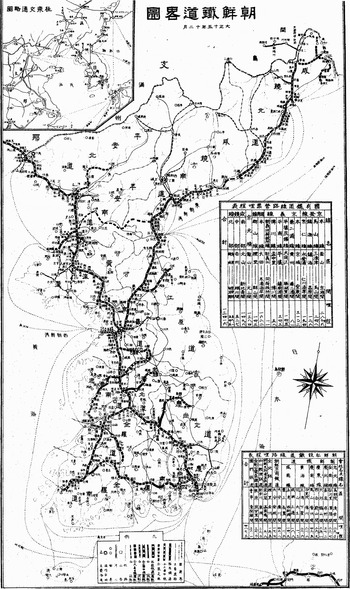
New interpretations constantly grow around a familiar story, like life along colonial railways. From the vast plains of America to the subcontinent of India, scholars have noted, railroads played a pivotal role in inscribing power on uncharted terrain.Footnote 1 They facilitated conquest, opened lands for settlement, and fueled the colonial extractive economy. And railroads were more than mere “tools of empire.”Footnote 2 From missionaries and administrators in the field to interlocutors in the distant metropole, Europeans celebrated railroads and their locomotives as vehicles of their “civilizing mission” on the benighted colonial frontier.Footnote 3 Not only did railroads reshape local lands into well-ordered spaces of production, they also remade their non-European dwellers by uplifting them from their alleged state of cultural decline. An instrument of progress, industry, and rationality, the railroad was the personification of the model colonizer: it captured lands as well as the minds of their inhabitants, not by brute force but by the sheer power of modernity (see figure 1).
Map of Korean Railways, 1926. Source: Senkōkai, ed. Chōsen Kōtsūshi (Tokyo: Yamato Yoichi, 1986). © Government-General of Korea. Note of Acknowledgment: This map was originally produced and published by the Chōsen Sōtokufu [Government-General of Korea] in December 1926.

Arriving late to the task of national and imperial construction in the closing decades of the nineteenth century, Japan brought this power of the locomotive to bear on its single-minded mission to catch up with the West.Footnote 4 Outside of the home islands, crisscrossed by nearly five thousand miles of railroad by the turn of the century, nowhere was Japan's ambition etched more deeply than on the Korean peninsula. The Japanese territorial colonization of Korea went hand in hand with railway building and other infrastructural projects, with a level of financial commitment no other empire would match. By the end of Japanese rule in 1945, Korea possessed “the most developed rail system in Asia outside of Japan.”Footnote 5
Yet, life along the railroads did not always evolve according to the transformative design of their planners—colonial projects could also be derailed. In Korea, as elsewhere in colonial Asia and Africa, building railroads, much as they were designed to consolidate territorial control, paradoxically sharpened ethnic and economic divisions and produced resistance that could weaken the imperial hold.Footnote 6 The picture could become even more complicated. As I aim to show in this paper, railway infrastructures forged a new social and economic geography, spreading tensions across, not merely along, the colonizer-colonized binary. The growth of new subjectivities, moreover, introduced contingency, even chaos, to a rational design of governance that was predicated on the stability of this dichotomy.
Such was the scene that unfolded around the railway stations on the peninsula, where the emergence of swarms of petty Korean and Japanese freight carriers threatened to throw the local transportation industry into disarray. If railroads were the arteries of empire, freight-forwarding agents were numerous capillaries fueling the network of unequal exchange between colony and metropole. As new rail lines were built, freight cars gradually replaced ground transportation facilities for distributing cargo, leaving short-distance conveyance of goods in the hands of petty local carriers. In forging backward and forward linkages, therefore, railway building not only stimulated the growth of local commerce and industry, but they, in turn, created more jobs for carrying their products, indeed to the point of saturating the transportation industry. By the 1920s, as many colonial officials observed, competition among local transport agents became mutually destructive and began to seriously disrupt the state management of railways.
The colonial state's response to this problem was economic rationalization, a viable alternative to what they considered the unfettered growth of free-market economy. The idea was to consolidate local transport businesses by bringing them under a single corporation, following the recent metropolitan example. Though the Japanese authorities had dominant control over the Korean economy, transport consolidation in the colony proved to be at least as thorny as in the metropole. The process lasted for over a decade and involved thousands of Korean and Japanese carriers and their families, along with the entire range of local producers, merchants, and traders who relied on them. The length of the controversy itself was a clear testament to the real challenges the colonial state faced in realizing its transformative will. Not the least of these challenges was governing a multi-ethnic social body which did not remain divided along the lines of ethnicity at all times. If the idea of rationalization appealed to Japanese and Korean carriers alike, it met greater resistance from both communities who often united themselves as one labor force.
Neither this narrative of state struggle for control nor that of joint action by Korean and Japanese carriers sits comfortably with the conventional view of Korean economy under Japanese rule.Footnote 7 While the focus of scholarly debate has long shifted from whether to how colonial Korea experienced modernizing changes without political emancipation, few works have located these changes outside of the binary contest between Korean national capital (minjok chabon) and Japanese colonial capital. More critically, many scholars continue to operate on one premise that dies hard: that, for better or worse, the Government-General of Korea single-handedly and quite successfully transformed the colonial economy. To be sure, the Japanese in Korea resembled less a European-style colonizer than a modernizer when compared to other empires in the twentieth century, especially the British and the French in Africa, or “empires-on-the-cheap.”Footnote 8 In keeping with the credo of naichi enchō (extension of the mainland) Japan basically extended to its overseas territories the domestic logic of a “developmental state,” a pattern of extensive bureaucratic control over the economy that drove Japan's frenetic catch-up with the West.Footnote 9 Yet for these very reasons, a proclivity to treat the state as the dominant and sole agent of modernization, along with the danger of conflating colonialism with modernization,Footnote 10 has persisted with surprising tenacity.Footnote 11
While “seeing like a state”Footnote 12 this way can all too easily render Japan as a developmental-authoritarian colonialism writ large, it can also miss much that was happening on the ground.Footnote 13 By taking the colonial authority for granted without fully understanding its limits, we run the risk of according the state more transformative power than it actually exercised. Such an approach also assumes colonial governance was more unified and coherent than it was. By the same token, it assumes local response or resistance to the state was more unitary and consistent than it was. Moreover, the vantage point of the state, if taken uncritically, presupposes the elimination of local knowledge and practices, discounting the possibility that colonial modernization could take effect through them.
Particularly in the sphere of political economy, where state control is presumed rather than problematized, we need a more in-depth analysis of how the colonial state implemented its specific policies on the ground and, more importantly, what local-level forces mediated or intervened in the process. Instead of assuming power always flowed unidirectionally, we must pay greater attention to how it was exercised, negotiated, and dispersed among non-state actors beyond the formal structures of rule. Following the comparative insights of Timothy Mitchell, Frederick Cooper and others, in short, we need to undertake more micro-analysis of colonial power by looking through the state, instead of merely looking at it.Footnote 14
For the present case, important guideposts have already been laid in this direction. A generation of scholars concerned with the culture and discourse of the Japanese empire has begun to look beyond the state, highlighting the multiplicity of lived experience of local actors and tracing the process of identity formation across the ruler-ruled divide.Footnote 15 More recently scholars of Korea concerned with the notion of “colonial modernity” have re-conceptualized Japanese rule in terms of “cultural hegemony,” a fluid, dynamic, and contingent space of local encounter and Korean subject formation.Footnote 16
I propose to advance these arguments further by deepening rather than loosening engagement with political economy,Footnote 17 and disaggregating the colonizer, a task often bypassed by scholars of Japanese colonialism.Footnote 18 Using the largely unexamined case of transport consolidation, one of the biggest economic issues of the colonial era, I want to illustrate two main points. First of all, the transformation of the colonial economy entailed the growth of new forms of solidarity and stratification in the space of unequal encounter between settlers and Koreans, both of whom were positioned ambivalently vis-à-vis the state. Instead of treating state and settlers as a unitary category,Footnote 19 I pay attention, as Ronald Robinson has done, to how colonial governance required winning the collaboration of two rather distinct local groups, indigenous elites and settlers.Footnote 20 The Government-General of Korea was no exception. Japanese freight carriers, as we will see, were never a homogenous lot, far less a servant of the state. More important, unlike European settlers, they could forge fluid and potent alliances with like-minded Koreans in the same trade. In promoting consolidation, furthermore, the colonial bureaucrats had to depend on metropolitan capitalists whose power and influence often extended beyond the state's reach.
In working with these diverse groups, colonial planners who set the tone and direction of consolidation were nonetheless continually forced to make compromises, accept policy failures, and improvise their strategies of governance along the way. More broadly, then, this paper participates in the on-going, multidisciplinary efforts to explore the limits of empire.Footnote 21 By tracing changing dynamics of cooperation between policy-makers and local economic actors, I want to explain not so much how the state ruled from above as how it worked through the very social fabric of the colony. That is, how the state consistently sought local and informal channels for transforming the Korean economy even as it exercised authoritarian control. Contrary to the stock image of a competent and effective modernizer, as we shall see, the colonial state proceeded with transport consolidation in halting ways.
Instead of portraying the story as moving along according to a single state will, I will tease out from a variety of sources availableFootnote 22 four different yet intertwining narratives of consolidation and examine the process through the lenses of the colonial state, Koreans, Japanese settlers, and metropolitan capitalists—a tapestry of voices that drove the colonial political economy of Korea. As I will show, what initially appeared as a classic colonial contest between Japanese modernizers and Korean resistors evolved into a multi-faceted conflict among transport firms, shippers, capitalists, and the Railway Bureau. Tracing their shifting patterns of alliance and conflict, I argue, is crucial for understanding how the colonial political economy was transformed from above as well as from below, by the imperial center as well as on the periphery.
RAILWAY-BUILDING AND THE GROWTH OF CARRIERS IN COLONIAL KOREA
Railways and freight carriers were partners in Japan's territorial colonization of Korea. After defeating China in 1895 and then Russia in 1905 in two imperialistic wars over the peninsula, Japan finally brought under its control all of Korea's key railways—including the Seoul-Pusan Line, the Seoul-In'chŏn Line, and the Seoul-Ŭiju and Masanp'o military lines that formed Korea's longitudinal trunk rail line.Footnote 23 Each war, too, brought a wave of Japanese migrants who established nodes of settler power at key cities such as Pusan, In'chŏn, and Seoul, and gradually penetrated the interior to develop new cities such as Taejŏn. As the newly arrived settlers opened small freight transportation services, some of the Korean commercial agents called yŏgak and kaekchu, who had traditionally handled freight forwarding and warehousing as a side business, began to specialize in the trade as well.Footnote 24 A growing web of railways, settlers, and transport businesses that emerged along their tracks spun the new colonial geometry of Korea, which was formally annexed in 1910.
The first Governor-General of Korea Terauchi Masatake (1910–1916) continued to reshape Korea's economic geography by building more railways as part of his massive infrastructure building. They were, however, designed less for developing industries than for transforming Korea into an agricultural colony, maintaining internal security, and above all developing a military and economic artery to the Chinese continent. For this purpose, a grid of Korean railways, initially run by the colonial Railway Bureau, was in 1917 entrusted to the management of the South Manchurian Railway Company.Footnote 25
The railway network continued to expand in the 1920s, and so did the number of local carriers that sustained Japan's imperial economy. In Seoul, the ancient capital of Chosŏn dynasty where the Japanese rulers established their seat of authority, transportation businesses sprawled around the Seoul Train Station, itself a grand architectural display of colonial power. At this largest terminal in Korea goods from the metropole via port cities, and raw materials from the provinces, arrived daily on packed freight cars, and numerous Japanese and Korean transport agents operated, “rubbing shoulders with each other on a daily basis.”Footnote 26
Typical of Korean stores in Seoul was Taech'ang Unsongjŏm (owner: Ma Wŏn-yŏng), founded with a capital of 3,000 yen and located on the main street of Namdaemun. The store was run by three clerks and hired five day-wage laborers. It mainly handled merchandize of local Korean and Japanese businesses and household items for moving, and cargo in transit arrived from and left for various provinces in Korea as well as Manchuria, China, and Japan. Though Korean transport firms tended to be modest in terms of capital and scale of operation, many staked out a solid business territory and secured Korean shippers as main clients by taking advantage of their detailed knowledge of the land and face-to-face relations with local residents.Footnote 27
Japanese carriers ranged widely from large to small firms, but overall they operated on bigger capital and wider areas than their Korean counterparts, and many became relatively established by the 1930s. A typical example was Kirihara Transportation Store located in the town of Hōrai-machi, another hub of transport businesses in the city. I interviewed its former owner Kirihara Tsunetoshi, who from a young age helped out his father's business (opened in 1921) and later inherited it. He remembered that his store was equipped with a few dozen horse carriages and two-wheeled carts, and employed as many as thirty Korean workers. Using a dozen or so Korean workers each time, they would pick up cargo from Osaka and Nagoya landed at the port of Inch'ŏn, and transport it by rail to Seoul. Once the cargo arrived at the Seoul Station, goods and merchandize were then delivered either by human-pulled two-wheeled carts (daihachi guruma) to nearby retailers and Japanese-run factories, including one owned by the tobacco monopoly bureau of the Government-General, or by horse carriages to more distant locations.Footnote 28
Though more vulnerable to vicissitudes of the freight-forwarding industry, Korean carriers overall drew on cultural capital they had accumulated in their localities to maintain “tenacious vitality and numerical predominance”Footnote 29—representing 60 to 70 percent of transport firms specializing in the delivery of small-lot consignments at the time.Footnote 30 Conversely, Japanese carriers relied on the workings of the imperial economy, monopolizing large consignments from fellow settlers and in some cases enjoying special privileges as officially patronized agents. Even so, catering mainly to Japanese customers limited their business performance. By the late 1930s Kirihara himself found it impossible to survive the intensifying competition without cultivating the Korean clientele, and hired “several skilled and knowledgeable Koreans” and started business with local Korean rice millers. How the settler carriers operating on the imperial circuits of exchange and the Korean carriers capitalizing on the web of local trust and knowledge came to intersect in the process of consolidation is a story that unfolded largely beyond the official design, as we will see.
From early on, the Japanese authorities in Korea grew increasingly alarmed at the “reckless” competition among local carriers, a situation that closely paralleled metropolitan Japan. Because anyone with a carrying pole (tenbinbō) and a two-wheeled “rear car” could freely manage a freight-forwarding service, many “unpropertied” and capital-poor Japanese at home competed to start such a business—by 1907, there were as many as five thousand at each rail station.Footnote 31 In Korea, local administrators identified the source of growing trouble in undercapitalized and mostly Korean carriers operating at small stations in the countryside.Footnote 32 To survive the competition, they allegedly employed unfair business practices, caused problems such as poor handling and delivery of goods, lost and damaged cargo, failed to pay freight fares, and set rates randomly, all of which seriously harmed the shippers and disrupted the state management of railways and rail stations where carriers large and small competed for cargo.Footnote 33
In order to prevent such adverse effects on the railways, the Japanese authorities took some rudimentary measures to curb the growth of small freight carriers while realigning existing carriers with more standardized practices. Drawing on the metropolitan example, as early as 1907 they began to grant official approval (shōnin) to businesses on the basis of such criteria as the volume of cargo and the amount of freight payment, a practice that after annexation was fully institutionalized as a “system of authorized transport agents.”Footnote 34 By granting authorized firms various benefits, including rebates on freight fares, guaranteed storage space in the station, and even free railway passes, this system increasingly differentiated the industry between a small and privileged group of authorized firms and the vast mass of unauthorized and mostly Korean carriers, whose sense of “discrimination” underlay their later opposition to the consolidation that was the culmination of this practice.
Authorizing transport agents was but an indirect method of rationalizing the industry. That the colonial state did not directly resort to a licensing system (kyoka sei) is curious, given that Terauchi had already issued ordinances to impose such a system on the press, corporations, and other areas of activity in the colony. The official decision in 1918 to revise and strengthen the system of authorized transport agents indicates that this system worked to a certain extent in streamlining the operations of local carriers, at least initially.Footnote 35 The colonial authorities also successfully placed Korea's transportation industry under more direct control of Japanese capital by inviting two large transportation companies from the metropole—Naikoku Tsūun (hereafter Tsūun) in 1907 and Kokusai Unsō (later Kokusai Un'yuFootnote 36) in 1923—which together claimed a dominant share of the industry.Footnote 37
These measures notwithstanding, the number of small and unauthorized freight carriers continued to climb, especially during the wartime boom when many new private companies emerged to expand the railway network,Footnote 38 creating “excessive competition” at almost every terminal.Footnote 39 Its harmful effect on the railway management worsened during the post-World War I recession, when freight theft and abuse of bills of lading became prevalent.Footnote 40 And yet a more compelling reason for the state to refrain from coercive regulation emerged following the outbreak of the March First Movement in 1919.
Arguably the first and the last assertion of mass Korean nationalism against colonial rule, this momentous event caught the Japanese by complete surprise as independence demonstrations swept across the peninsula, drawing over two million participants from all walks of life. Above all, it demonstrated the utter failure of military rule and its repressive policies that had nearly silenced Korean public life and engendered antagonism at all levels of society. Having mistaken this silence for a sign of submission and grossly underrated Korean capacity for mass resistance, the Japanese authorities were compelled to retool their ruling strategy by balancing coercion with accommodation.
In order to meet the conflicting imperatives of legitimacy and control, the new Governor-General Saitō Makoto (1919–1927, 1929–1931), on one hand, pursued conciliatory policies dubbed “cultural rule” by relaxing surveillance on Korean lives and tolerating moderate nationalist activities, and, on the other, enlarged the colonial police to stamp out radical dissent. At the heart of his strategy of counterinsurgency was collaboration with local capitalists, Korean as well as Japanese.Footnote 41 Intent on fostering their class-based solidarity and co-opting them as local allies to the new regime, Saitō removed the Company Law and encouraged a limited degree of industrialization in Korea.Footnote 42 To avert labor and peasant unrest, he also mobilized these bourgeois elites through an array of pro-government organs intended to penetrate into lower reaches of Korean society and co-opt men of influence.Footnote 43 In response, upwardly mobile local businessmen sought official subsidies and patronage for their new ventures as well as protection from nationalists.
The process of consolidation in the 1920s took shape within this new framework of alliance and interdependence between the state and capitalists. As a first step toward consolidating transportation operations, in 1922 the colonial state created an accounting organ, later restructured as the Korea Transport Accounting Corporation, which was headed by a Japanese settler president and joined by a few Korean elites. The Accounting Corporation operated like a modern-day credit company to allow cash-hungry carriers to make timely freight payment to the railways, with an ulterior goal to bring a horde of small-scale Korean carriers under its control.Footnote 44 To lure as many Korean members as possible, the company made a gesture of accommodating their business customs by offering to administer both current accounting and routine accounting twice a month, in addition to providing simpler accounting services for small-scale Korean firms.Footnote 45
ACT ONE: KOREAN RESISTANCE AND PARTICIPATION
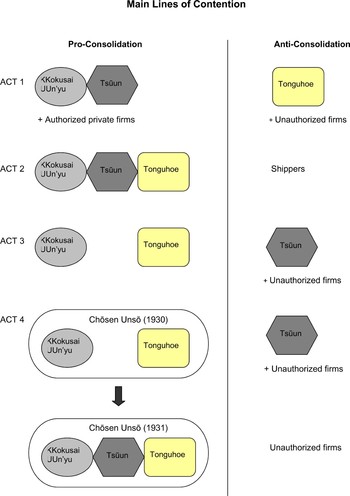
The idea of joining the Accounting Corporation did not appeal to the Koreans, however. Instead, leading Korean carriers organized and put up dogged resistance to what they viewed as Japanese encroachments on their business turf. In December 1922, they created their own organization, the Sŏnun Tonguhoe (hereafter Tonguhoe), under the leadership of Pak Mun-jip, an officially approved freight-forwarding agent based in Seoul.Footnote 46 Differences in clientele and customs aside, there was a deeper ideological reason for their move. As the Korean founders put it plainly, “our foremost goal is to circumvent the monopoly and tyranny of the Japanese-centered Korean Transport Accounting Corporation.”Footnote 47 Thereby the Korean carriers waged an ethnic struggle against the state and its local Japanese allies, ushering in a contest between colonizer and colonized which marked the first phase of transport consolidation (see figure 2).
Main Lines of Contention in the Transportation Consolidation in Colonial Korea, ca. 1922–1931.

It was no accident that the Tonguhoe emerged during the effervescence of Korean “cultural nationalism”Footnote 48 in the early 1920s—a time when the Japanese government assiduously sought a new basis of political legitimacy. Korean moderate nationalists, in particular, sought to turn Saitō's policy of accommodation into claims to greater participation in the colonial economy by launching programs such as the Korean Production Movement to foster native industry, mass literacy, and economic self-sufficiency. This spirit of nationalist assertion permeated through members of the Tonguhoe, which soon fell to young entrepreneurs such as Kang Chang-hŭi, who quickly pressured its first chair, Pak Mun-jip, to resign from his post on suspicion of being “pro-Japanese.”Footnote 49 The association's activities were designed to foster solidarity and welfare among its four hundred Korean members, and geared toward the broader goal of Korean self-strengthening. For “developing Korean-centered transportation industry,” the Tonguhoe directly took up the role of enlightening local Korean carriers in business knowledge and elevating their quality of service through the publication of a monthly bulletin, the Sŏnun ŭi bŏt.Footnote 50 Though the overall freight volume they handled did not pose a serious threat to the Japanese, the Tonguhoe soon gained considerable leverage as the representative of numerically preponderant Korean carriers.
When transport consolidation became imminent in the mid-1920s, the Japanese planners saw it as imperative to co-opt the Tonguhoe lest it become a disruptive force. In response to the metropolitan move toward nation-wide consolidation in 1926, and having also recently retrieved the administrative authority over the Korean Railways from the South Manchurian Railway Company, the colonial Railway Bureau began seriously to plan the creation of a consolidation company and bring Korea's small freight transport businesses under its organizational umbrella. This measure, they hoped, would eliminate rate wars and excessively competitive practices inimical to quality service, in addition to fostering “the spirit of kyōson kyōei (coexistence and co-prosperity) between carriers and shippers.”Footnote 51
The Saitō administration knew that transplanting metropolitan practices on the colonial terrain would not be as easy as in Terauchi's times—but they learned the hard way, all the same. Inspired by the metropolitan move, in January 1927 the Railway Bureau drafted the new “Regulations and Procedures Concerning the Approval of Transport Agents.”Footnote 52 This proposal outlined an official plan to raise both qualifications for application and standards of evaluation in approving transport firms for the goal of “eliminating numerous petty firms and improving the status of transport businesses as a whole.” The authorities drafted this proposal with the intention to proceed with consolidation more gradually than in Japan, where the Railway Ministry pursued a rather coercive process of horizontal consolidation centered on three dominant corporations: Naikoku Tsūun, Kokusai Unsō, and Meiji Unsō.Footnote 53 The process in Korea, by contrast, would be a more gradual, mass-based vertical consolidation of large and small Japanese and Korean firms, which in turn entailed the reconciling of divergent needs and interests of shippers.
Nonetheless, the proposal invited immediate protest from local carriers. It drew their intense suspicion that it was part of an official ploy to enforce consolidation following the recently adopted metropolitan policy of recognizing only one firm as an authorized agent at each station.Footnote 54 If such a policy were implemented in Korea, five out of six firms that operated at each station on average would be immediately put out of business. In other words, a Darwinian struggle for survival in free-market competition would be replaced by an even harsher rationalizing logic of artificial selection. The Tonguhoe was among the first to denounce such a disquieting prospect. The “policy of one firm at one station” implied by the draft, the Tonguhoe leaders feared, would not only gloss over the differences in clientele and scale of operation between Korean and Japanese carriers. As Kang Chang-hŭi ruefully told a local reporter, “It would ultimately allow people with more capital to exercise rights” and “would lead officially unapproved and fragile Korean carriers to be completely absorbed by the Japanese.”Footnote 55 “If the authorities truly wished to curb the proliferation of firms and improve the transport industry,” Kang and his colleagues argued, “it would be more appropriate for the Koreans and Japanese each to set up a separate corporation under the policy of ‘two firms at one station.’”Footnote 56
Faced with the outpouring protest of carriers, the Railway Bureau immediately retracted the draft. Their instant reaction drove one point home: rationalization could not be simply imposed from above, but must be promoted as a “voluntary” action among local carriers. This official conviction increased over time, as the forcible process of consolidation in Japan triggered waves of resistance around the country.Footnote 57 Such a resistance, if replicated in the colony, would give perfect fodder for the nationalist movement, which showed a renewed resurgence in February 1927 when moderates, radicals, and communists joined hands in forming the Sin'ganhoe as a united front of their activity.Footnote 58 Those on the left of the nationalist movement, especially, saw consolidation as a matter of a socialist revolution, as the editor of a Korean daily Chosŏn Ilbo averred: “Consolidation was not an issue of transport firms alone, but a problem of the small propertied class and of all oppressed ethnic groups around the world.”Footnote 59
The caution and care with which the officials subsequently approached the task of promoting “voluntary consolidation” among carriers was explained by Toda Naoharu, director of the Railway Bureau: “In light of Japan's example, even if it were possible to steamroll the consolidation, Korea's situation is different from Japan and would not permit such a measure. The foremost thing we must consider is the relationship between Japanese and Korean carriers. That is, although transportation consolidation is a purely economic problem, to complicate and politicize this issue must be absolutely avoided.”Footnote 60 The colonial planners confronted a unique dilemma in balancing the needs of economic control and political legitimacy in order to avert further unrest from below.
Convinced that “dispelling Korean misunderstanding is the only possible way to complete a consolidation,”Footnote 61 the Railway Bureau decided to work through a few hundred authorized Japanese and Korean transport agents by entrusting them with the task of promoting consolidation under the aegis of Tsūun and Kokusai Un'yu. At the state's behest, these authorized carriers formed the Association for Korean Transport Consolidation (hereafter, the Consolidation Association) as an institutional basis for promoting multi-ethnic consolidation. They sent out a letter soliciting membership to transport firms all over the country, claiming the purpose of consolidation was ostensibly to “completely wipe out discrimination between Japanese and Koreans.”Footnote 62
The Tonguhoe had its own plan, however. In February 1927, the month the Sin'ganhoe was born, the Tonguhoe declared its decision to restructure itself as a corporation with an aim to “absolutely oppose the policy of one firm at one station.”Footnote 63 This announcement seems to have deeply troubled Pak Mun-jip and two other Korean representatives of the Consolidation Association, who now refused to cosign their names on the letter of solicitation to the Tonguhoe, most likely in fear of pro-Japanese accusations. In late July, the Tonguhoe held a large national rally of Korean transport firms and passed a collective resolution to “support the policy of two firms at one station and oppose a Korea-wide consolidation.”Footnote 64 The Korean leaders then toured along the railway lines, appropriating the tools of domination as vehicles of resistance in propagating their message. As anti-consolidation protest spread and gathered momentum in the provinces, it increasingly assumed the form of ethnic confrontation between Japanese consolidators and Korean resistors. In defiance of Japanese-led consolidation, for instance, the Korean carriers in Taegu proposed “a Korean-only consolidation,” while those operating along the Masan Line similarly called for the creation of “a Korean-only corporation.”Footnote 65 It appeared to be a classic colonial situation.
Behind their insistence on a Korean-only consolidation lay a rather complex set of claims, including those the Japanese consolidators utterly failed to anticipate. Distrustful of the rhetoric of ethnic equality, the Korean carriers argued that benefits of consolidation would not be evenly distributed between Japanese and Koreans by the Railway Bureau, which had unduly favored the former. More compelling was a claim that the Koreans simply knew better methods of doing business. While recognizing their relative lack of financial capital, the Korean carriers still asserted that many of them possessed substantial cultural or ethnic capital. In addition to real estate and trust in local communities, they claimed, the Koreans had accumulated distinct skills and experience and had developed their own methods of dealing with cases of failure or loss, all of which made their businesses more successful than their Japanese counterparts. The sharing of freight with large-scale Japanese firms would only increase the costs of smaller Korean businesses while eliminating their competitive advantages since the freight would be allocated in an arbitrary manner.Footnote 66
The overall message of Korean carriers was loud and clear. They operated in a well-functioning indigenous economy based on a close-knit web of local exchange and patronage, while the Japanese operated in an ill-fitted colonial structure superimposed on it. The Koreans evoked a sense of self-confidence, even superiority, by stressing that their customs worked far better than those transplanted from the imperial metropole—in effect they inverted the commonly held Japanese view of Korean carriers as feeble and short in capital.Footnote 67 Rhetorical or real, such claims imparted a new political meaning to local and hitherto marginalized economic practices by bringing numerous small Korean carriers into the sphere of colonial politics, into a space of contention with state, settlers, and metropolitan capital.
Korean carriers posed an unexpectedly large obstacle to the concerted Japanese effort at persuading them to join their plan. While the Japanese planners continued to rally support for consolidation, touting its benefits such as greater security of business and reduced competition, the colonial state also backed their effort on the ground and behind the scenes. While the Railway Bureau formally announced its commitment to transport consolidation in May 1927, it had already begun to encourage horizontal consolidation among local carriers at each station by offering a freight rebate in exchange for their participation in vertical consolidation.Footnote 68 At the same time, it increasingly applied pressures on dissenting firms by openly obstructing their operations at various train stations.Footnote 69 By the summer of 1927, the consolidators managed to obtain support from 519 firms at 127 major stations.
But even after securing this support, the Japanese planners soon discovered just how hard it was to keep the Korean participants in their ranks. For instance, when selecting members on the preparatory committee for a new consolidation company and determining their overall jurisdiction, one local paper reported, “Doubts and disagreements poured one after another from the Korean carriers, throwing the floor into great confusion and ultimately causing forty-odd Koreans to walk out of the meeting.”Footnote 70 Once they were brought into the consolidation plan, a more focused and intense struggle ensued between Japanese and Korean members who competed for a greater share of control over the proposed company. Settler and Korean “collaborators” still prioritized their divergent ethnic interests over their inchoate occupational solidarity.
In the midst of such uncertainty the consolidators somehow managed to select twenty-five Japanese and Koreans each for the preparatory committee.Footnote 71 The newly chosen representatives immediately set out to persuade the director of the Tonguhoe, Kang Chang-hŭi, and its members to join hands with them. While negotiations and bargaining between the two sides dragged on, the state again stepped in. Though on the surface the Railway Bureau maintained a “hands-off approach” to consolidation,Footnote 72 it did not hesitate to wield its oppressive hand when necessary. The Tonguhoe representatives were directly summoned by the authorities and apparently admonished for resisting consolidation as “extremely regrettable on the level of naisen yūwa [harmony between Japanese and Koreans].”Footnote 73 Persuasion mixed with coercion eventually brought about the desired outcome. As a result of the joint maneuvers of the state and pro-consolidation carriers, the Korean leaders began to sway gradually, and “finally on September 10, the Tonguhoe which held a casting vote changed its attitude completely” and formally proposed to cooperate with the Consolidation Association the next day.Footnote 74
This did not mean that the Korean leaders now served at the bidding of the Japanese, however. They agreed to join the consolidation plan, but made their cooperation conditional. As one of their demands, they requested existing Korean members of the preparatory committee be replaced with members of their own organization. Smarting from the settler domination of the committee, the Tonguhoe leaders insisted that at least the Korean members be re-elected from their own trusted circle. “If this condition is not met,” they are said to have threatened, “we will counter through other means.”Footnote 75 The issue at stake was no longer consolidation but control over its process, and the Koreans demanded a rightful share of it. Having conceded to the Japanese under duress, the Korean carriers quickly modified their tactics and adapted to the new stage of struggle. To maintain their stake in the process, they bargained hard with the state and its allies by capitalizing on heightened Japanese anxiety about nationalism to negotiate more favorable terms of cooperation. This strategy seems to have worked, since the Japanese side almost entirely accepted the Korean demands. The preparatory committee members were now increased to thirty-five Japanese and Koreans each; of the thirty-five Koreans, twenty-three were newly elected from the Association of Korean Carriers and twelve others were re-elected from the former Korean members.Footnote 76
Even after being co-opted into the plan, the Tonguhoe leaders continued to set the terms of cooperation to the extent possible, since Korean support proved critical to putting the consolidation plan on track as well as ensuring its smooth implementation thereafter. When the new preparatory committee began working on the specifics of the statutes for a consolidation company, for instance, it took up many proposals submitted by the Korean members in its formal agendas. Such subtle gestures of accommodation suggest a process of bargaining at work, driven not only by Japanese concern to avoid trouble but Korean anxiety to keep check on the Japanese monopoly on power. The standard proposal for consolidation finally passed by the preparatory committee unmistakably showed that a bargain had been struck between its Japanese and Korean members. In addition to affirming the basic official principle of “one firm at one station,” it stipulated that company executives would be appointed on the basis of head count rather than capital and the number of posts divided equally between Japanese and Koreans, much to the satisfaction of the Korean carriers.Footnote 77
ACT TWO: JAPANESE SETTLER OPPOSITION
After the Tonguhoe leaders joined the consolidation plan, the issue became more about the consolidation itself, not colonial politics per se. Well before they joined the consolidators the situation was already complicated by the rising opposition from local Japanese and Korean shippers, led by powerful settler merchants and manufacturers in Seoul. Rationalization was a mixed blessing for local commercial establishments: it could regulate the disorderly and unfair practices of local transport firms, but monopoly could also undercut economic freedom, impair business performance, and worse still, hamper Korea's overall industrial progress. In weighing the pros and cons of rationalization, the merchants' abacus ultimately deemed consolidation a risky proposition: merits of competition might be still greater than its costs. Thereby, local merchants and businessmen under settler leadership emerged as a second major force of opposition to be reckoned with.
The merchants' initial skepticism turned into dead-set opposition to consolidation after a face-to-face meeting with its planners in July 1927. Hosted by the chair of the Seoul Chamber of Commerce, Watanabe Sadaichirō, who offered to mediate the issue, this discussion forum provided the first opportunity for dialogue between consolidators (the Railway Bureau director Toda and local representatives of Tsūun and Kokusai Un'yu) and twenty shippers' representatives led by powerful settlers, Saitō Hisatarō and Toshima Yūjirō.Footnote 78 As it turned out, their meeting served anything but to dispel the merchants' doubts. Instead it brought to the surface inherent contradictions in the consolidation plan that would beleaguer the authorities for the next decade. Throughout the meeting Toda and representatives of the two corporations stressed reduced transportation costs and other benefits consolidation could bring to shippers. One nebulous issue, however, was remuneration (hōshōkin), to be paid to carriers for giving up their family businesses and vested interests to merge with the new consolidation company. Compensating hundreds of carriers this way would require the new company to perform well and yield substantial long-term returns. As the consolidators themselves frankly admitted, however, “during the first three or four years at least, the company [was] expected to struggle and depend heavily on the support of the Railway Bureau” before it became a paying concern.Footnote 79
That said, Toda did not specify the exact nature and extent of state supervision in the management of the new corporation, far less offer to assume the risk for private investments. The official reasoning, to be reiterated time and again, was that consolidation had not moved beyond its preparatory stage, and the Railway Bureau was devoid of legal authority to regulate what had always been in the realm of “free competition,” especially the company's rate structure. To the shippers, such official vagueness made the promise of economic benefits ring hollow. While not fundamentally opposed to the idea of consolidation, the merchants wondered how the new corporation could possibly guarantee enough hōshōkin to a mass of would-be-unemployed carriers and more than a 10 percent dividend to its shareholders, while at the same time promising shippers reduced freight-handling fees. Even the host Watanabe was compelled to point out such “contradictions” in the rhetoric of mutual benefit, asserting, “That's just not possible.” For their part, the merchants feared the consolidation would ultimately shift the responsibility of compensation onto shippers: they would end up having to bear the costs of consolidation by paying higher fees to carriers, not to mention the effects of “tyranny of a monopoly” such as rampant rate-setting and a decline in the quality of service, which Toshima feared as “a problem nothing more grave to we merchants.” Toshima and fellow shippers thus demanded the state guarantee “absolute supervision” over the company to prevent it from abusing its authority, or else “we cannot agree to an abstract talk.”Footnote 80
But the Railway Bureau officials gave only a vague reply, and on countless other occasions continued to repeat their homily about “the need for cooperation between shippers and carriers.” Not surprisingly, the settler merchants remained unconvinced of the benefits of consolidation, and dismissed the plan as “too idealistic” and “inconsistent.” In a statement they subsequently issued, the settlers even questioned the official rationality in enforcing consolidation, citing how it had already “betrayed the ideal of so-called improvement” by antagonizing carriers in Japan.Footnote 81 Seeing an unbridgeable gulf of opinion between the consolidators and shippers, the Seoul Chamber of Commerce decided to reserve its attitude toward the issue on the grounds that the reason for consolidation still remained “flimsy.”
Faced with protest not only from carriers but also from powerful settlers, in early August the Railway Bureau made a gesture of distancing itself even further from the consolidation plan by adopting a “policy of silence” to put the matter on hold “until the appropriate time.”Footnote 82 This policy, of course, masked behind-the-scenes maneuvers to pressure the Tonguhoe and other dissenters into cooperating with the plan, but the Railway Bureau continued to maintain its vagueness about its role in the new company. Aside from its traditional reluctance to control carriers' business performance, for instance by prescribing minimum and maximum rates, that the colonial state should labor so hard to appear as a disinterested arbiter in the whole process is partly explained by the economic dominance of settlers in the colony. The Saitō administration from its inception worried that local settlers, with their characteristic penchant for supremacy, could exert a corrosive influence on the official effort at Korean accommodation.Footnote 83 This was especially the case in the freight transportation sector, where numerous settler carriers operated in competition with Korean carriers, a situation quite rare in the colonial world. The Japanese consolidators thus had to walk a tight rope in enforcing their plan, for any failure to take proper measures would “immediately provoke ethnic antagonism and jealousy” which could easily escalate into “a political problem.”Footnote 84
Abstaining from direct intervention may have been an indirect way to lure Korean carriers into the consolidation plan, but so far as winning settler cooperation it merely backfired. Continued official ambiguity not only further antagonized local merchants but also alienated more prominent bourgeois elites who controlled local chambers of commerce. Each meeting with consolidators and the Railway Bureau officials seemed merely to clarify their points of disagreement while highlighting state inaction. Following one such meeting, seven exasperated regional chambers of commerce asserted a collective stance of opposition,Footnote 85 while individual chambers passed their own resolutions against consolidation, abandoning their hitherto “lukewarm attitudes.”Footnote 86 Faced with these developments, Watanabe Sadaichirō, head of the Korea League of Chambers of Commerce, was forced to withdraw altogether from the task of mediation.Footnote 87
The shippers' opposition grew into a wave of protest around the country, drawing in Korean and Japanese rice millers and grain dealers as well as wholesalers and lumber merchants. Building on this momentum, leading merchants and manufacturers in Seoul set up the Korea Shippers' Society to launch “an exaggerated propaganda war.”Footnote 88 It went so far as to boycott the use of transport firms who supported the consolidation plan. Against the mounting shippers' opposition, intriguingly, the Tonguhoe leaders raised the most trenchant voice of criticism. Highlighting the “sacrifice” of carriers who “have already abandoned concern for business performance and resolved to go along with consolidation,” Kang Chang-hŭi and the Korean leaders rebuked the shippers' “self-centered” action as “an intolerable humanitarian problem.”Footnote 89
That the Korean carriers issued such an acerbic public statement on their own is telling. It demonstrates that they cooperated with consolidation without being fully subsumed under Japanese control, and continued to maintain their internal solidarity under the Tonguhoe's leadership. But equally it shows how the lines of ethnic division began to blur on both sides of the conflict, pitting a group of Japanese and Korean supporters of consolidation against a multi-ethnic coalition of anti-consolidation groups that embraced a diverse array of commercial and regional interests. Most unexpected was that hundreds of ordinary Korean carriers formed a united front with local settlers in defiance of the state and in defense of laissez-faire capitalism. They did so not only on the local level but also on a nation-wide scale, the likes of which had never before been seen.
As anti-consolidation protest spread with increasing fervor, the movement for consolidation gradually fragmented from within. Some participating carriers began to demand remuneration in a lump sum of cash, and showed reluctance to contribute their assets to the proposed company. Many transport firms simply changed their minds and withdrew their support for the plan. To make matters worse for the Railway Bureau, the headquarters of the two agents of consolidation, Tsūun and Kokusai Un'yu, came to dismiss the projected remuneration of four million yen as “an overestimation” for the current state of Korean transportation industry. Undoubtedly stirred by the currents of opposition, they now refused to invest beyond the required minimum levels to cover the extra capital needed for founding the new company.Footnote 90 Ultimately, the first attempt at consolidation ended in failure.
ACT THREE: NON-COOPERATION OF METROPOLITAN FIRMS
The refusal of Tsūun and Kokusai Un'yu to contribute their capital was inauspicious. Indeed, the Japanese corporations who held the fate of consolidation in their hands turned out to be far less committed to rationalization than the officials had hoped. Following the first failure, the move for consolidation in Korea was soon re-ignited by the birth of Kokusai Tsūun, a consolidation company in Japan, in 1928. Though the company would run into various problems,Footnote 91 Japan's steadfast move toward rationalization emboldened the executives of Kokusai Un'yu and especially those of Tsūun who had participated in founding the company. Before redrafting their proposal, the consolidators concentrated their energies on winning the support of shippers by giving them more assurance of state supervision, and managed to get powerful merchants to agree to cooperate with the plan for the time being.Footnote 92
But things soon turned in unexpected directions: opposition began to emerge from within the pro-consolidation faction. This occurred immediately after the Railway Bureau, buoyed by the shippers' support, announced its plan to handle directly the collection and delivery of freight on small-lot consignments by designating its carriers from the fall of 1929 onwards.Footnote 93 Seeing this as a decisive step toward consolidation, those private carriers who had largely paid lip service or remained neutral to the consolidation plan now came to openly reject the idea, demurring particularly at the rate of remuneration. If the state directly handled the small-lot freight, which constituted 80 percent of the total revenue, it would be almost tantamount to forcing private carriers to suspend their business.Footnote 94 Their desperate concern for survival was palpable in a petition submitted to the Police Affairs Bureau by carriers from twenty-three major stations: “We two thousand transport firms and their employees, Korean laborers, and their family members totaling about one hundred thousand Japanese and Koreans feel a serious threat to our livelihoods.”Footnote 95
If the carriers' petition fell on deaf ears of the colonial officials, it moved the civilian agents of consolidation so strongly that many of them ended up resigning from the preparatory committee.Footnote 96 The sheer force of opposition from private carriers, paired with the continued difficulty in preventing the growth of new firms, seemed to be the main factors that shook their confidence in the proposal, but some private carriers may never have endorsed the plan wholeheartedly. When the preparatory committee convened to discuss the proposal in April 1929, a group of powerful carriers walked out of the meeting, leaving a statement that clarified the intention of 248 private carriers to withdraw their support from the plan. Seeing this, affiliates of Tsūun quickly judged the current proposal was doomed and they too resigned from their posts, ultimately leading the head office in Tokyo to pull out. As a result, the second attempt at consolidation broke down and the plan again suffered a setback.Footnote 97
A turnabout by the very agent of consolidation, Tsūun, flew in the face of the state's rationalization scheme. Following the second failure, indeed, Tsūun and anti-consolidation groups of private Japanese and Korean carriers formed a united front of opposition, turning into a third major obstacle to consolidation now led entirely by Kokusai Un'yu.Footnote 98 To be sure, this alliance was no more than a marriage of convenience. Tsūun was not inherently opposed to the idea of consolidation, only to the idea of carrying it out to the exclusion of many private carriers and without the state's pledge to ride herd on the new company.Footnote 99 By contrast, many private carriers appeared to be genuinely threatened by the idea of enforcing rationalization at the expense of economic freedom.
Nonetheless, their opposition took on a life of its own. As a result, the local freight-forwarding industry became increasingly polarized between the pro-consolidation faction led by Kokusai Un'yu, the Tonguhoe, and some private Japanese carriers, and the anti-consolidation group led by Tsūun and dissenting private Japanese and Korean carriers. This lead to “a scramble for freight in every province.” Contrary to the expectations of the Ministry of Railways in Japan, the vicious propaganda war generated the peculiar phenomenon that Tsūun, an agent of consolidation in the metropole, now allied itself with Korea's anti-consolidation groups, whereas Korea's pro-consolidation groups linked up with Kokusai Un'yu, which was not part of the metropolitan consolidation.Footnote 100
Faced with this extraordinary situation, the colonial Railway Bureau tried to win back Tsūun's support by dispatching its representative to Tokyo. But Tsūun resolutely maintained its stance of opposition, as the president Nakano Kinjirō explained: “We cannot join a consolidation that makes us uneasy by abandoning years of achievement in business. … As long as it is an economic consolidation, it should naturally proceed according to profit calculation.”Footnote 101 Here lay another level of conflict running through the consolidation plan: tension between state concern with the expansion of what the officials called “public interest” and corporate interests centered on shareholders and profit. To official dismay, Tsūun, unwilling to sacrifice its gains for greater benefits of the empire, adopted a pragmatic rather than a patriotic approach to consolidation. Such an attitude was common among metropolitan capitalists who were generally reluctant to invest in what they considered a high-risk and unprofitable colonial venture without guarantees on profits.
The Railway Bureau's difficulties in prevailing over the two corporations, moreover, underscored the colony's structural dependence on metropolitan capital. The limits of the colonial state became particularly apparent during Japan's financial retrenchment in the late 1920s, which forced Korea and other colonies to operate on a tighter budget than had previously been approved by the Diet. This meant that the creation of a consolidation company hinged almost entirely on the goodwill of the two metropolitan companies, since capital contributions from private carriers amounted to only a fraction of the needed amount. Moreover, that Tsūun and Kokusai Un'yu already had sure footholds in Japan and Manchuria, respectively, made them less vulnerable to pressures or potential loss of support from the Government General of Korea.Footnote 102
All the same, the lines of conflict constantly shifted and the boundaries between the two factions remained porous. Just as much discord existed beneath the guise of unity in the pro-consolidation faction, a rift soon emerged within the alliance of convenience between Tsūun and anti-consolidation carriers. As a result of the Railway Bureau chief Toda's behind-closed-doors overtures toward Tsūun, and his willingness to consider some official measures to prevent the growth of new firms, Tsūun once again relaxed its attitude and ultimately returned to the consolidation plan in late 1929.Footnote 103 The Railway Bureau also managed to dispel the lingering skepticism of leading Japanese merchants by accepting their demands that it abandon the policy of “one firm at one station,” set reasonable maximum rates for small-lot consignments, and create a supervisory organ over the new company that included shippers' representatives.Footnote 104
Almost as soon as the coalition was restored, however, the two companies plunged into a struggle for control. Tensions that had always lurked behind their endless rounds of negotiations came to the fore in February 1930 as they worked to finalize details of a proposal concerning capital contribution from each company and ownership of the new corporation.Footnote 105 Tensions may have also stemmed from the fundamentally different characters of the two companies. As “a civilian corporation founded on the principle of laissez-faire economy,” Tsūun had always adhered to an entrepreneurial and metropolitan-oriented approach. In contrast, Kokusai Un'yu developed under the aegis of the South Manchurian Railway Company, which explained its statist outlook and its close connections to the Railway Bureau.Footnote 106
Around this same time, moreover, Tsūun and other participating firms grew alarmed by a surge of transport businesses that posed a renewed obstacle to rationalization, and by the state's failure to do anything about it. Many powerful carriers did withdraw from the consolidation upon learning that the Police Affairs Bureau had no intention of legally restraining the growth of new firms, betraying such a promise made earlier by the Railway Bureau. As a result, one local paper observed in a sardonic tone, “The Railway Bureau appears to have completely lost its trust among transportation firms.”Footnote 107 Tsūun had another legitimate reason to be concerned: Japan's recent consolidation quickly came to be perceived as a failure, as the new consolidation company demonstrated weak initial performance and encountered continued resistance from carriers.Footnote 108 With his usual candor, the president Nakano admitted, “we unthinkingly carried out a consolidation in Japan” and concluded, “we cannot hastily create a company [in Korea] when it does not have much prospect of profit.”Footnote 109 For all of these reasons, Tsūun again withdrew from the consolidation plan, and the process came to a standstill.Footnote 110
The breakdown that followed Tsūun's withdrawal was followed by a vicious war of lobbying and propaganda, which the local press reported as “a battle of capital” between Tsūun and Kokusai Un'yu, with private carriers caught in between.Footnote 111 A schism also emerged within the Tonguhoe, leading some members to withdraw their support, reasoning the consolidation plan had evolved from the time they had joined to become “disadvantageous to the Koreans.”Footnote 112 The proposed creation of a new corporation indeed appeared to fail again, but this time Kokusai Un'yu and the Railway Bureau stood firm. Heartened by the pledges of support from Kokusai Un'yu's headquarters and the Railway Bureau, in March 1930 Kokusai Un'yu-affiliates, pro-consolidation private carriers, and the Tonguhoe swiftly moved to establish a new corporation that would instantly absorb all participating firms, with paid-in capital of one million yen. The new corporation, Chōsen Unsō (Chōsen Unsō Kabushiki Kaisha), was founded with the head of the Seoul branch of Kokusai Un'yu, Kawai Naosaburō, as the executive director. At the time of its inauguration, the company embraced a total of 921 transport firms (K. 545, J. 376).Footnote 113
ACT FOUR: CONTINUED RESISTANCE OF KOREAN AND JAPANESE CARRIERS
As it turned out, the birth of a consolidation company was only the beginning of a new chapter of struggle. The creation of Chōsen Unsō without the participation of Tsūun signaled but a partial victory for its planners. The official vision of “voluntary consolidation” was also seriously compromised by the absence of hundreds of private carriers from the new company. The ensuing years saw continued, and increasingly radical, resistance from four hundred-odd anti-consolidation firms, led by a reassembled coalition of Tsūun firms, a faction led by Hong Chong-hŭi that had separated from the Tonguhoe, and a league of private Japanese carriers.Footnote 114 A fierce conflict between the newly founded corporation and anti-consolidation groups ensued at every station.Footnote 115 Remarkably, the controversy would last for another decade, marking the last phase of transportation consolidation in Korea.
The Korean and Japanese carriers left out of the consolidation now resorted to more drastic measures of resistance. On 27 April 1930, the day of Chōsen Unsō's inauguration ceremony, the dissenting coalition led by Tsūun submitted a petition to Governor-General Saitō stating their vexation in no subtle terms. The petition skewered the Railway Bureau for “abusing its authority to impose an irrational consolidation” and creating “a scandal unknown in a glorious reign,” and warned it “would ultimately cause a serious ideological problem detrimental to Japanese rule.”Footnote 116 Not only did the carriers charge the colonial state with irrationality, turning its argument for rationalization on its head, but by deliberately evoking the threat of Korean nationalism, they tried to turn the issue of consolidation back into a matter of colonial politics. Having found that their petition to the Governor-General yielded no effect, in early May the carriers even tried to turn their grievance into a national issue at the Imperial Diet by directly petitioning the prime minister and other leaders in Tokyo.Footnote 117
Upon hearing the news that Chōsen Unsō was affirmed as the only officially designated transportation firm in Korea,Footnote 118 the panic-stricken anti-consolidation groups issued another sweeping tirade against the Railway Bureau, accusing it of “going against the imperial wish of isshi dōjin [equal treatment, equal favor] to tempt, force, and control carriers” and “throwing the entire industry into a tangle and confusion.”Footnote 119 Alarmed by their bold and “radical” action, Seoul's police authorities demanded the carriers correct the “seditious words and phrases” in their resolution and refrain from petitioning the Railway Bureau.Footnote 120 Ignoring such police warnings, the carriers' representatives appealed to the bureau chief directly, while 240-odd carriers conducted a sit-in, under the watchful eyes of local policemen hastily dispatched to the scene.Footnote 121
Though their efforts proved in vain, the anti-consolidation groups continued to wage an elaborate propaganda war that soon turned into “an economic battle pure and simple.” By unifying their accounting operations, anti-consolidation carriers imposed on Chōsen Unsō a tough competition for freight,Footnote 122 which was aggravated by the effect of Japan's financial depression that reduced the amount of commercial traffic and volume of cargo.Footnote 123 This encouraged such cases of misconduct as issuing bills of lading without having received cargo, while causing a general slackening in business activity and increasing anxiety among employees, all of which amounted to “a state of chaos beyond the Railway Bureau's control.”Footnote 124
Both factions began to show signs of fatigue after nearly half-a-year of reckless conflict. When a new executive of Kokusai Un'yu visited Seoul in late October and announced the headquarters' support for another attempt at consolidation led by Chōsen Unsō, therefore, it served as a catalyst for both sides to approach each other once again. With the mediation of the president of the Bank of Korea, the representatives of the two factions met and negotiated behind the scenes,Footnote 125 and finally reached an agreement for a “great consolidation” in May 1931.Footnote 126 As a result, the economic battle between the two factions came to an end, with parity in status between Tsūun and Kokusai Un'yu in the management of Chōsen Unsō confirmed.
At the same time, one must note that after the establishment of the Chōsen Unsō in 1930 Korean status and leverage diminished markedly. The four Korean executives, including the Tonguhoe leader Kang Chang-hŭi, all tendered resignation a few months later, reasoning that they were given little role in the management and were not even consulted on important matters.Footnote 127 The “great consolidation” a year later brought a further decline in their status, with only two Koreans appointed to the executive board—Kang Chang-hŭi, who agreed to return to the company, and Hong Chong-hŭi.Footnote 128 By this time the Japanese planners felt they had already laid a firm foundation for peninsula-wide consolidation. In the following years they increasingly dropped their gestures of accommodation as a combination of police crackdowns on radicals and internal strife within the nationalist movement lessened their fear of nationalism.
Nonetheless, the company worked hard to absorb the remaining as well as new transport firms, who organized a more coherent force of opposition. According to the reminiscences of Adachi Naruhisa, who coordinated with leading Korean carriers such as Kwak Tu-yŏng of P'yŏngyang in mobilizing mass resistance against Chōsen Unsō, they drew inspiration from a parallel movement launched by undesignated firms in Japan to combat “discriminatory treatment” by the Railway Ministry. With the backing of leading merchants in local chambers of commerce, the carriers established the Korea Transportation Alliance as the organizational base of their opposition. By the spring of 1932, the alliance embraced fifteen hundred firms with a total of over fifty thousand Korean and Japanese members including storeowners, clerks, and workers, forming “one large labor organization” with “a substantial voice against the Railway Bureau and Chōsen Unsō.”Footnote 129
In the ensuing years, with continued support and protection from the colonial state, Chōsen Unsō would come to handle about 60 percent of the total volume of freight, leaving 40 percent still in the hands of private firms. The ease with which one could set up a transport business—it required little capital, but just a signboard and some storage space—encouraged the continued growth of petty transport firms, which by the mid-1930s even began to resemble the pre-consolidation situation.Footnote 130 To counter this trend, the Railway Bureau strengthened its support for Chōsen Unsō by, for instance, promoting its monopolistic status as an officially designated agent in handling freight between Korea and Manchuria. But such official efforts at rationalization continued to meet enduring resistance from private carriers. It was only after the outbreak of the Pacific War, when the colonial government finally introduced a licensing system, that all remaining firms were brought completely under the control of Chōsen Unsō and the policy of “one firm at one station” was fully instituted in Korea.
CONCLUSION
As the story of consolidation shows, rationalization was far from a seamless project moving according to a state will. As the controversy wore on, each round of negotiation and contestation produced a new matrix of contestation, generating convenient and often precarious alliances among diverse interest groups. Their protean engagement brought out multiple forces and layers of conflict that drove the colonial political economy: ethnic friction between Koreans and Japanese; ideological conflict between rationalization and laissez-faire capitalism; a rivalry for control between giant corporations; and a clash of interest between policy-makers and private capitalists. Alliances and conflicts forged in such multi-faceted encounters among Koreans, settlers, and metropolitan capitalists continually made and remade the local contours of colonial rule, diverting official policy from the state's initial plans.
Essentially designed to weed out small indigenous capital and bring the industry under Japanese control, the process of consolidation nonetheless revealed a colonial social body in flux. Whether in opposing or supporting the state, settlers and Koreans, from capitalists down to petty freight carriers, forged fluid political alignments across differences of ethnicity, class, and locality. Unequal engagements between colonizer and colonized did not preclude the formation of new solidarities, a process that unfolded quite outside of state efforts at social engineering. Hence, while the Koreans shared general animosity toward Japanese discriminatory practices, they differed in their strategies for remaining competitive within such a discriminatory system. By the same token, Japanese colonizers were a more motley group, and metropolitan capitalists a less patriotic lot, than scholars have often assumed. Indeed, a substantial number of settlers found more common ground with Korean carriers than with bigger corporate interests based in the metropole.
Ultimately, complete defiance was impossible, but the collective resistance of Korean and Japanese carriers at least succeeded in imposing serious limits on policy implementation. Their protest reveals a startling conclusion that the controversy had the effect of postponing for more than a decade the implementation of the policy of “one firm at one station” that the Government-General had been promoting since the mid-1920s.
This conclusion, in turn, leads us to rethink more broadly the nature and limits of the colonial state. Out of concern to balance the requirements of control and order, the colonial regime, on the defensive after 1919, sought to expand its hegemony by working through local intermediaries and indirect methods of rule, for the most part limiting itself to intermittent enforcement of its will. Rather than a reduction of state power or authority, we see an expansion, however gradual and halting, of the state's capacity to govern by using coercion more selectively, incorporating informal strategies into formal techniques of governance, and accommodating non-governmental actors in the ruling structure, all of which induced significant changes in statehood.
More than a mere policy shift from “military” to “cultural rule,” however, such changes in governing strategy should be seen as part of a complex and long-term process of local improvisation and unequal dialogue with an increasingly diverse social body, composed of Koreans and local Japanese settlers as well as metropolitan interlocutors. From the example of consolidation we may infer that the growth of new social and class formations closely intertwined with the evolution of the state itself, allowing the Government-General neither to rule its subjects according to dualistic ethnic divisions nor to become a simple custodian of bourgeois class interests. The colonial state was continually forced to adopt its techniques of rule to the increasingly complex social reality, as ethnicity or class as units of governance lost their administrative utility.
What we need, then, is a fuller examination of the process of co-production between state and society. This is not to underrate the power of colonial state, nor to place state and society on a par with each other. Rather, it is to pay attention to changes effected by multiple actors within the hegemonic structure, and to agency not reducible to the state. The example of transport consolidation suggests that the colonial state's need to minimize the political cost to empire by to some degree accommodating local economic interests increased in the face of mounting Korean nationalism. This meant that even as the state pursued its assimilative policy of naichi enchō, it more often preferred to govern through local actors and institutions rather than merely relying on its extensive police and bureaucratic networks. To what extent the Japanese rulers alternated between formal and informal strategies of governance or welded the two tiers into a coherent ruling strategy merits further investigation.