Introduction
Early identification of weed and other seeds, evaluation of changes in soil seedbank and purity of seed crops could lead to improvement of weed management (Granitto et al., Reference Granitto, Verdes and Ceccatto2005; Slaughter et al., Reference Slaughter, Giles and Downey2008). Weed seed identification is usually more difficult than for cultivated varieties, as they tend to have large variation compared to seeds belonging to the same crop species (Chtioui et al., Reference Chtioui, Bertrand, Dattée and Devaux1996). Seed identification is often specialized and done visually by experts, which is therefore subjective and requires a high level of skill (Chtioui et al., Reference Chtioui, Bertrand and Barba1998). Visual identification of weed seeds is time consuming, tedious and, even with expert knowledge, inherently inconsistent (OuYang et al., Reference OuYang, Gao, Liu, Sun, Pan, Dong, Yue, Wei, Wang and Song2010), and especially difficult when a high degree of similarity exists between species (Chtioui et al., Reference Chtioui, Bertrand and Barba1998). In addition, due to the subjectivity of these methods, there is a risk of confusion between different inspectors under different circumstances (Majumdar and Jayas, Reference Majumdar and Jayas2000). Therefore, it is important to implement repeatable and rapid automated methods to identify and classify weed seeds (Venora et al., Reference Venora, Grillo, Shahin and Symons2007).
New techniques such as machine vision have a bright future for the accurate automatic identification of weed seeds. Machine vision is divided into two parts: (a) measurement features and (b) pattern recognition based on the obtained features (Snyder and Qi, Reference Snyder and Qi2010). In this technique, characteristics of external variables such as size, shape, colour and surface texture of seeds can be extracted using imaging systems and classification methods (Chtioui et al., Reference Chtioui, Bertrand and Barba1998). Thus, the seeds can be identified using extracted morphological features (Granitto et al., Reference Granitto, Verdes and Ceccatto2005). Image processing algorithms implemented by machine vision are more accurate and efficient in measuring seed size than highly experienced inspectors working by microscope (Venora et al., Reference Venora, Grillo, Shahin and Symons2007). The benefits of such methods are considerable in seed classification. For example, Granitto et al. (Reference Granitto, Navone, Verdes and Ceccatto2002) used machine vision techniques to identify 57 species of weeds and demonstrated promising results. Fawzi et al. (Reference Fawzi, Fawzy and Mohamed2010) studied 11 Silene species using light and electron microscopic morphology to determine the importance of seed coating as a taxonomic character. Seeds were kidney shaped or spherical–kidney shaped and their colour was green to brown. The length of the seeds was between 0.5 and 1.2 mm.
Some image processing algorithms are available for pattern recognition and to extract the seed morphological characteristics, of which canonical discriminant analysis (CDA) and artificial neural networks (ANN) are two main approaches (Granitto et al., Reference Granitto, Navone, Verdes and Ceccatto2002).
Canonical discriminant analysis is a supervised learning technique of statistical pattern recognition (Jain et al., Reference Jain, Duin and Mao2000). The application of statistical methods in pattern recognition was first formalized by Chow (Reference Chow1965). During the learning process, multivariate CDA defines optimal boundaries between the clusters of values in the parameter space. The performance of a classification depends on the separability of the classes. This suggests that the centres of clusters within the measurement space should be sufficiently separated. However, investigations of seed identification have shown that linear discriminators do not often yield satisfactory performances (Chtioui et al., Reference Chtioui, Bertrand, Dattée and Devaux1996). This method has been employed in agricultural science for various purposes, such as species genetic diversity, plant morphology, seed systematic and classification, and seed quality testing (Olesen et al., Reference Olesen, Carstensen and Boelt2011, Reference Olesen, Nikneshan, Shrestha, Tadayyon, Deleuran, Boelt and Gislum2015; Hoyo and Tsuyuzaki, Reference Hoyo and Tsuyuzaki2013; Eizenga et al., Reference Eizenga, Ali, Bryant, Yeater, McClung and McCouch2014; Padonou et al., Reference Padonou, Kassa, Assogbadjo, Fandohan, Chakeredza, Glèlè Kakaï and Sinsin2014; Pometti et al., Reference Pometti, Bessega, Vilardi, Ewens and Saidman2016; Roy et al., Reference Roy, Marndi, Mawkhlieng, Banerjee, Yadav, Misra and Bansal2016; Tungmunnithum et al., Reference Tungmunnithum, Boonkerd, Zungsontiporn and Tanaka2016; Şeker and Şenel, Reference Şeker and Şenel2017).
In recent years, ANN has become used widely for forecasting in various fields of research including finance, power generation, pharmaceutical, water and environmental resources (Li et al., Reference Li, Zecchin and Maier2014, Reference Li, Maier and Zecchin2015; Qiu et al., Reference Qiu, Song and Akagi2016; Velásco-Mejía et al., Reference Velásco-Mejía, Vallejo-Becerra, Chávez-Ramírez, Torres-González, Reyes-Vidal and Castañeda-Zaldivar2016; Monteiro et al., Reference Monteiro, Guimarães, Moura, Albertini and Albertini2017). In agriculture, ANN is one of the main machine learning models which have been used widely (van Evert et al., Reference van Evert, Fountas, Jakovetic, Crnojevic, Travlos and Kempenaar2017). The main idea of ANN for processing data is based on the way the nervous system and brain function in order to learn and create knowledge. Biological neural networks are able to learn based on a system through which adaptive learning takes place, which means that the system is trained using different examples, so when new entries are entered, the system will produce ‘the right answer’, which is subjective (Kasabov, Reference Kasabov1996). Artificial neural networks are based on training, and through this training, the mechanisms of the phenomenon are estimated (Kohonen, Reference Kohonen2012). These networks demonstrate very high efficiency in estimation and approximation (Kasabov, Reference Kasabov1996).
Considering the importance of weed seed identification, the present study attempted to identify three species of Amaranthus genus, commonly referred to as ‘amaranth’. The species of this genus are among the most troublesome weeds in many crop production systems and cause substantial losses to many crops (Horak et al., Reference Horak, Peterson, Chessman and Wax1994; Sellers et al., Reference Sellers, Smeda, Johnson, Kendig and Ellersieck2003; Horak and Loughin, Reference Horak and Loughin2009). The seeds of Amaranthus species are very similar, so that seed identification is very difficult and usually done based on the capsule characteristics (Horak et al., Reference Horak, Peterson, Chessman and Wax1994). In the current experiment, an attempt was made to classify three species of Amaranthus, including Amaranthus albus L. (white amaranth), Amaranthus retroflexus L. (red-root amaranth) and Amaranthus viridis L. (slender amaranth), based on shape characteristics of the seeds using machine vision technique and ANN and CDA as pattern recognition methods, to assess the accuracy of the methods.
Materials and methods
Seed collection and identification
The current experiment was conducted in 2013 to identify seeds of three species of the genus Amaranthus, using a machine vision approach and methods of ANN and CDA. In order to provide the seeds required, the target species were identified and seeds collected from farms around Mashhad (36°81′N, 59°82′E, 985 m a.s.l), in northeast Iran. According to the United Nations Environment Program, the climate of seed collection areas is considered as moderate semi-arid, with an average annual temperature of 14 °C and 253 mm of annual precipitation (Ashraf et al., Reference Ashraf, Yazdani, Mousavi-Baygi and Bannayan2014). The farms belonged to Ferdowsi University of Mashhad and the commercial firm Astan Quds Razavi; almost 1200 ha were monitored. To this end, the three Amaranthus species were identified and collected by walking in farms, in two sampling stages including mid-October and mid-November. The distance between sampling points was >250 m, to ensure that no spatial correlation occurred among selected populations (Guisan and Theurillat, Reference Guisan and Theurillat2000). In order to consider the variation among populations, sampling was done from different locations and at two different times. To ensure correct identification of the collected species, the collected plants were transferred to the Institute of Plant Sciences, Ferdowsi University of Mashhad and identified by botany experts. Then, the seeds of each species were isolated and prepared by cleaning and drying before randomly selecting 200 seeds of each species for further analysis.
Extraction of the shape characteristics of the seeds
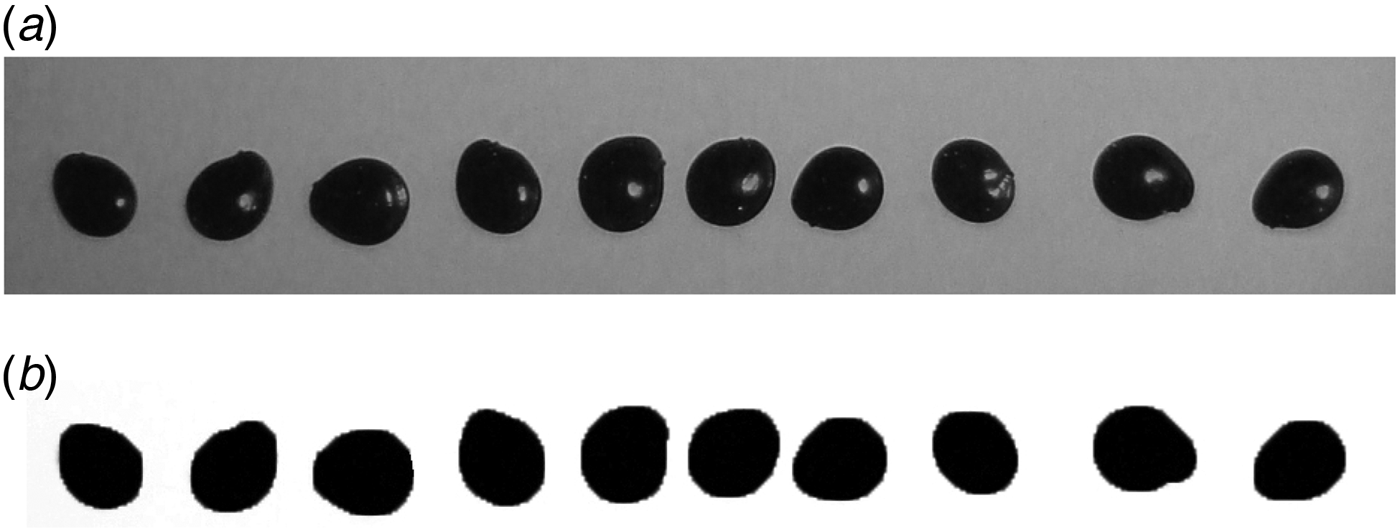
To extract the shape characteristics of the collected seeds, 200 images were taken of each species of Amaranthus using a digital camera (Sony, Cybershot DSC-W70, Japan) attached to a stereo microscope. Therefore, the images of 600 seeds of three species of Amaranthus were captured. Adobe Photoshop CS6 Extended software was used to modify the images, such as removing shadows, creating a good resolution between the seeds and the foreground and removal of other noises in the images (Fig. 1). The corrected images were segmented by thresholding (Liu et al., Reference Liu, Cheng, Ying and Rao2005), using image processing software JMicroVision v 1.2.7 to process and extract the seed morphological features from segmented images. Hence, 13 morphological features, including area, perimeter, orientation, length, width, eccentricity, compactness, equivalent circular diameter, elongation, ellipticity, rectangularity, solidity and convexity were extracted. Each of the extracted 13 variables could have different effects on the identification of different species of amaranth seeds (Cervantes et al., Reference Cervantes, Martín and Saadaoui2016). In order to find the most influential variables, the backward method was used by means of the software SPSS v. 17.00, and seven variables were derived.
Modifying images of amaranth species in order to increase the resolution of the seeds and background. (a) Original image and (b) modified image.

Classification of the seeds
The ANN and CDA methods were used to identify the seeds. For this purpose, the two sets of normalized data of shape characteristics of each Amaranthus species were applied, which included a series of data (overall, 13 shape characteristics data were extracted and a set was obtained from the backward method). Data were normalized by Johansson Transformation or Box–Cox methods by means of the software Minitab v. 15.1.1.0. Normalized data can contribute to increasing the accuracy of seed identification. Dubey et al. (Reference Dubey, Bhagwat, Shouche and Sainis2006) used neural networks to identify three varieties of wheat and stated that if the data were not normal, the neural network was not able to classify the wheat seeds.
Canonical discriminant analysis was applied to highlight among-group variation and minimize within-group variation (Li et al., Reference Li, Boyd, Odom and Dong2013). In CDA, the group variables are transformed into an identity matrix and group means are calculated. A principal component analysis was conducted on the calculated means and eigenvalues obtained by dividing between-group variations by within-group variation. In order to obtain the canonical variables, the principal components are transformed into the space of the original variables, then the boundaries are obtained (Chen et al., Reference Chen, Bui, Krzyzak and Krishnan2013). After data preparation, in order to classify the seeds by CDA, Wilks' Lambda method was applied to two sets of normalized shape data of Amaranthus species, using SPSS v. 17.00. The Wilks' Lambda evaluates the performance of the discriminant analyses and is the ratio of the within-group variation and the total variation. This statistic is used to test the significance of the discriminant function and provides an objective means of calculating the chance-corrected percentage of agreement between real and predicted groups (Khemiri et al., Reference Khemiri, Gaamour, Ben Abdallah and Fezzani2018).
Artificial neural networks are information-processing systems consisting of networks of simple interconnected processing elements (neurons) which are able to construct a mathematical model to predict the complex behaviour of a phenomenon. An ANN consists of three layers: input, hidden and output layers. The input layer provides information on the studied phenomenon; the hidden layer performs computations in which the level of complexity is determined. In the hidden layer, transfer functions are specified to determine the learning process and relevant weights between corresponding neurons (Alvarez, Reference Alvarez2009). The output layer transfers the determined data from the hidden layer to the outside of the network. Generally in ANN, data are compiled from the input layer, and after passing through the hidden layer are excluded from the output layer (Kasabov, Reference Kasabov1996; Alvarez, Reference Alvarez2009). There are different numbers of neurons in each layer. The number of neurons in the input and output layers is determined based on the purpose of the study and the research question. The neuron numbers in hidden layers may be adjusted by trial and error (Dubey et al., Reference Dubey, Bhagwat, Shouche and Sainis2006).
In order to identify the seed by ANN, the normalized morphological data were used as the input layer of neural networks. The number of input neurons was considered to be 13 (total morphological characteristics or predictive variables derived from the seeds) and seven (the predictor variables derived from backward regression). The number of neurons in the output layer was three, based on the number of Amaranthus species. Artificial neural network performance depends on the choice of the number of hidden layers (Ramchoun et al., Reference Ramchoun, Idrissi, Ghanou and Ettaouil2017): hence, during construction of the ANNs, one to ten hidden layers were used and tested. To classify seeds of the studied species of Amaranthus, various neural networks such as Multilayer Perceptrons Neural Networks, Generalized Feed Forward Neural Networks, Modular Neural Networks and Principal Component Analysis Neural Networks were tested and the best network was selected based on the highest classification accuracy. In the current study, the learning rules of Momentum, and Levenberg Marquardt and also the functions of TanhAxon, SigmoidAxon, Linear TanhAxon, Linear SigmoidAxon, SoftMaxAxon, LinearAxon and Axon were tested as transfer functions. After construction of the neural networks, the learning rule and transfer function with the highest classification accuracy were selected. The software NeuroSolution v. 5.00 was used to build the neural networks. In the current experiment, overall convergence of the training was obtained via a learning epoch (one cycle through a training process) of 1000, so further repeats of the learning epoch had no significant increase in network performance.
Precision validation
In the current experiment, to avoid increasing the error and over-estimation, ANN training was terminated using the cross-validation stopping method, which stops the training network at the point of the smallest error in the validation data set (Amari et al., Reference Amari, Murata, Muller, Finke and Yang1997; Benedetti et al., Reference Benedetti, Mannino, Sabatini and Marcazzan2004). So, 15% of the data were allocated as the validation data set. Thus, with the determination of error between the desired output and the actual output, and its increase during network training, the training operation was stopped. In addition, 15% was allocated for network testing and evaluation of accuracy. The remaining 70% of the data were used for network training. In the method of least mean square error of the training data, 20% of the data were allocated for the network test and the remaining 80% were allocated for network training.
A t test was used for statistical comparison of seed classification accuracy between the two sets of input data in each of the ANN and CDA methods and also between the two methods.
Results
Seeds shape description
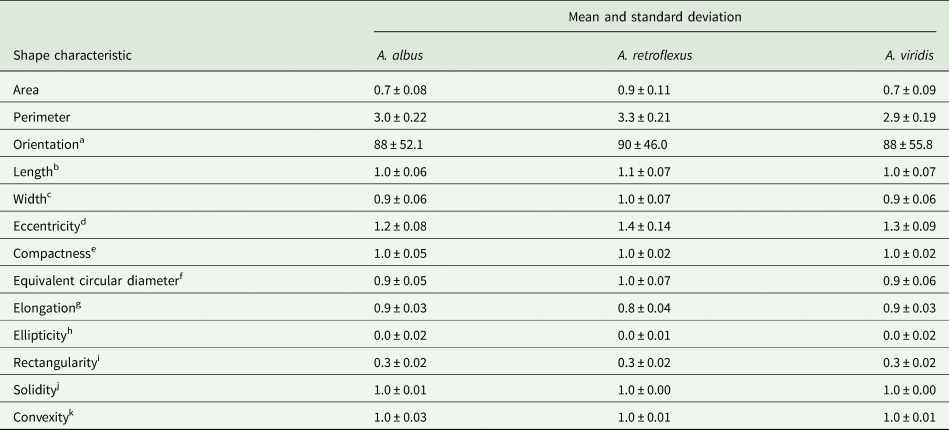
The mean and standard deviation of shape characteristics of Amaranthus species are shown in Table 1. The maximum value of the standard deviation of the three species of Amaranthus was observed in orientation, and the minimum in ellipticity, rectangularity, solidity and convexity (Table 1). The results showed that A. retroflexus had larger seeds than the other two species, and A. viridis had the smallest seeds. Other traits related to the seed size and shapes of the studied seeds are shown in Table 1.
The mean and standard deviation (±) of morphological characteristics of 200 seeds of each of three species of Amaranthus spp.

a Angle between the horizontal axis and the major axis of the ellipse equivalent to the seed (0–180°, anti-clockwise).
b Calliper length along the orientation axis of the seed.
c Calliper length along the orientation axis + 90° of the seed.
d Ratio between the major and the minor axis of the ellipse equivalent to the seed (first- and second-degree moments).
e Ratio of the area of the seed to the area of a circle with the same perimeter.
f Diameter of a circle with the same area as that of the seed.
g Ratio of the length to the width.
h Ratio of the area of an ellipse (formed with length and width as axes) to the area of the seed.
i Ratio of the area of a rectangle (formed with length and width as sides) to the area of the seed.
j Ratio of the area of the seed to the convex area.
k Ratio of the convex perimeter to the perimeter of the seed.
Artificial neural network
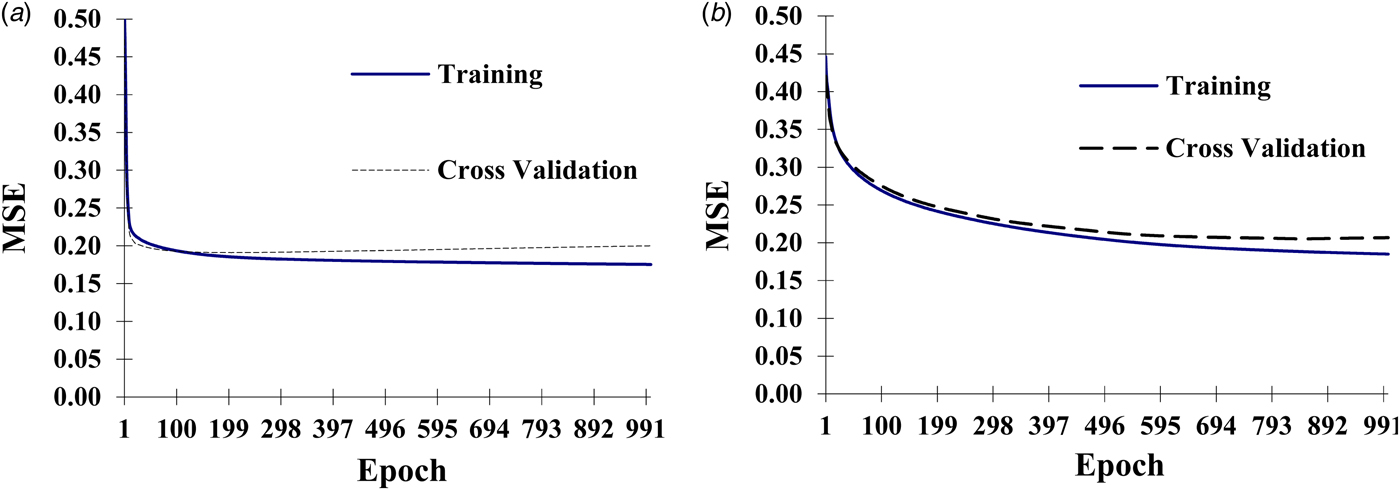
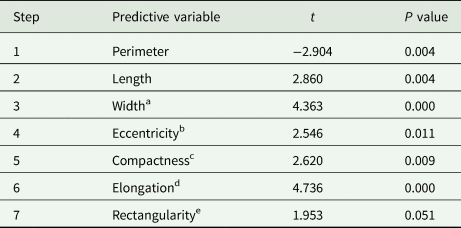
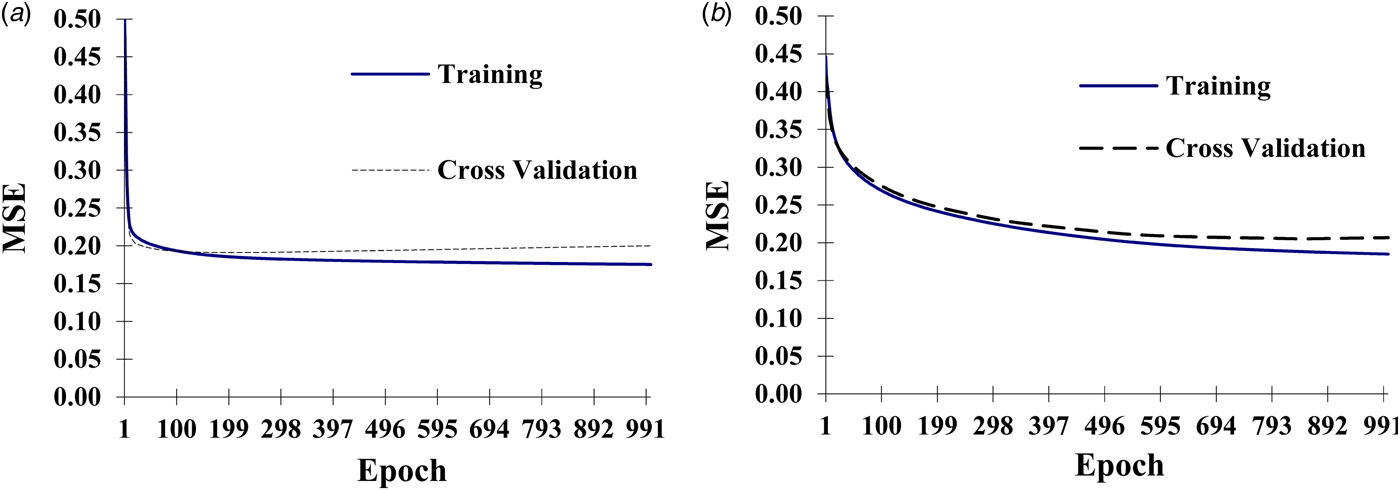
Based on the results of the backward regression method, the predictor variables such as perimeter, length, width, eccentricity, compactness, elongation and rectangularity were the best predictors for A. viridis, A. retroflexus and A. albus (Table 2). The outputs of backward regression were used as a data set to build the neural networks. A Generalized Feed Forward Neural Network with five hidden layers for seven (extracted from backward regression) data series and a Principal Component Analysis Neural Network with three hidden layers for 13 (total data) data series were the best networks for identification and classification in Amaranthus species. In these networks, a stopping criterion of cross-validation performed better in comparison to a stopping criterion of minimum mean square error of the training set and yielded more proper networks with classification accuracy. Mean square errors of the training set and cross-validation of 13 normal input variables were 0.175 and 0.191, respectively. This network was stopped in epoch 204 (Fig. 2a). After reaching the minimum mean square error of cross-validation, the training process continued for some time to ensure proper network training. It is recommended that network training should be continued for a period of time to eliminate the risk of lack of proper training data, after the first test error starts to increase (Masters, Reference Masters1993). Also, mean square error of the network training and cross-validation that consisted of seven normal data input of predictor variables was 0.185 and 0.205, respectively, and the network was stopped in epoch 847 (Fig. 2b).
The mean square error (MSE) of the training (continuous line) and cross-validation (broken line) procedure of networks including (a) seven and (b) 13 normal input variables.
Backward regression analysis of predictive variables with a significant effect on the classification of different species of Amaranthus spp
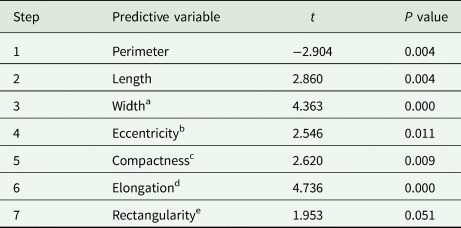
a Calliper length along the orientation axis + 90° of the seed.
b Ratio between the major and the minor axis of the ellipse equivalent to the seed (first- and second-degree moments).
c Ratio of the area of the seed to the area of a circle with the same perimeter.
d Ratio of the length to the width.
e Ratio of the area of a rectangle (formed with length and width as sides) to the area of the seed.
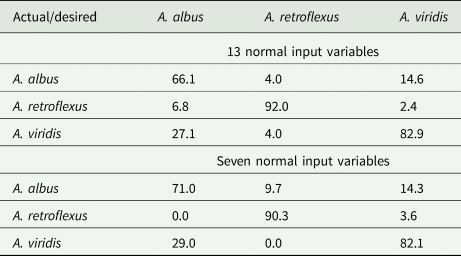
After testing neural networks, the network consisted of 13 normal input predictor variables with an overall classification accuracy of 81.1%, and species A. retroflexus, A. viridis and A. albus were classified by values of 90.3, 82.1 and 71.0%, respectively (Table 3). Furthermore, in the neural network consisting of seven normal input predictor variables, species A. retroflexus, A. viridis and A. albus were classified by values of 92.0, 82.9 and 66.1%, respectively (Table 3); however, this network had an overall classification of 80.3%. The results showed that the use of shape characteristics can be very helpful in identifying the seeds of three species of Amaranthus. Granitto et al. (Reference Granitto, Navone, Verdes and Ceccatto2002) used six morphological, four colour and two textural characteristics for identification of seeds from 57 different weed species and illustrated that the maximum separation accuracy of seeds was in relation to their morphological characteristics.
Studied species identification accuracy (%) of Artificial Neural Network on the normalized data of 13 and seven predictor variables (network stopping criterion, increase in the mean square error of validation process)
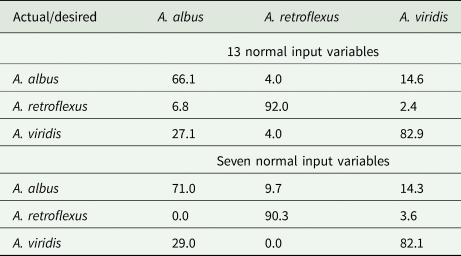
The results of ANN for normalized data of Amaranthus species showed that the neural network built from 13 normal input predictor variables had higher accuracy compared with the neural network built from seven normal input predictor variables. Although the difference was not statistically significant, it can be concluded that increasing the predictor variables could increase the quality of neural network training.
Canonical discriminant analysis
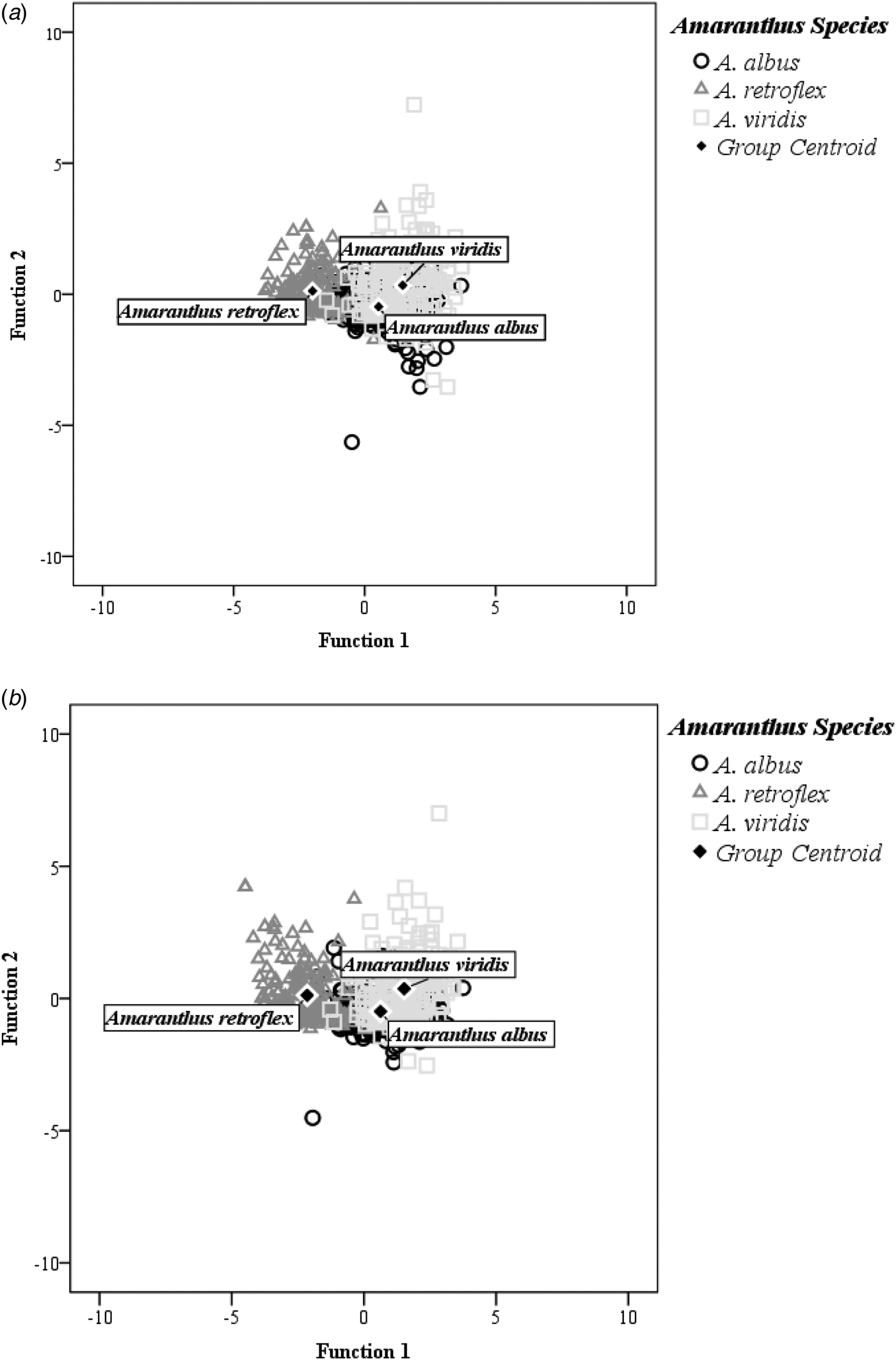
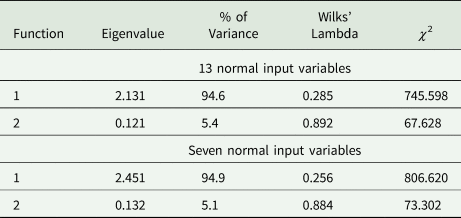
The results of the CDA method on morphological characteristics of Amaranthus species showed that in both the 13 and seven normal predictor variables, discriminate functions significantly described the differences among the Amaranthus species in the model and fit the data well (Table 4). As a consequence, the three studied Amaranthus species were significantly classified from each other based on seed morphological characteristics. A. retroflexus, compared to A. albus and A. viridis, had more distinctive morphological features; however, A. albus and A. viridis showed more similarities to each other (Fig. 3).
Bi-plots of canonical discriminant functions for shape characteristics of three studied Amaranthus species. (a) Seven and (b) 13 normal input variables.

Summary of canonical discriminant functions was used in the analysis for the classification of Amaranthus species using 13 and seven normal input variables. All functions were significant (P ⩽ 0.01)

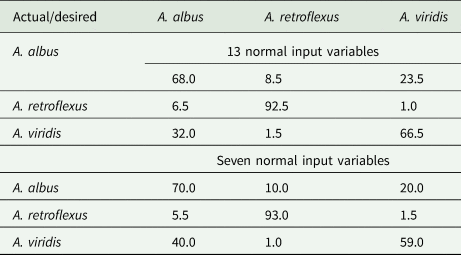
Identification accuracy of Amaranthus species by the CDA method showed that in both the 13 and seven normal variables input, the highest identification accuracy was achieved for A. retoflexus, in which the accuracy of the seven normal variables (93.0%) was more than in the 13 variables input (92.5%). In addition, detection percentage in the species A. albus was more than A. viridis in the models with both input data set (Table 5). The overall identification percentage of applied models with the 13 and seven normal variables input were 75.7 and 74.0%, respectively, which did not show significant difference.
Studied species identification accuracy (%) of canonical discriminant analysis on the normalized data of 13 and seven predictor variables

Discussion
Considering the characteristics that provide the potential to increase seed classification accuracy is very important in seed identification. Various characteristics such as shape, size, colour and texture of seeds have been considered for seed classification (Paliwal et al., Reference Paliwal, Visen and Jayas2001; Granitto et al., Reference Granitto, Navone, Verdes and Ceccatto2002, Reference Granitto, Verdes and Ceccatto2005; Liu et al., Reference Liu, Cheng, Ying and Rao2005; Dana and Ivo, Reference Dana and Ivo2008; Chen et al., Reference Chen, Xun, Li and Zhang2010; OuYang et al., Reference OuYang, Gao, Liu, Sun, Pan, Dong, Yue, Wei, Wang and Song2010). However, regarding the smooth surface and same colour of the surface of seeds examined in the current study, the identification of seeds of the three species was investigated based on the morphological characteristics. Seed morphology is considered as an effective factor for seed description and analysis of intra- and inter-specific differences between plant species and varieties, but for the species studied here, due to the small size of the seeds and high similarities between the seeds of the three species, visual identification of each is almost impossible by non-specialists. On the other hand, some situations, such as soil seedbank surveys, require identification of a large number of different weed species seeds (Gardarin et al., Reference Gardarin, Dürr and Colbach2009) and using the visual method is very difficult in these cases.
The development of computer vision capabilities allows a reliable and fast identification and classification of seeds, even for non-specialists (Tellaeche et al., Reference Tellaeche, Pajares, Burgos-Artizzu and Ribeiro2011). Using image processing to extract several quantified seed morphological features can be an efficient tool in comparative taxonomy (Cervantes et al., Reference Cervantes, Martín and Saadaoui2016). The developments of imaging systems are mainly based on the computation of geometrical characteristics of the seeds because they have forms (shape factor, aspect ratio, length ratio, etc.) which can be identified (Perez et al., Reference Perez, Lopez, Benlloch and Christensen2000; Onyango and Marchant, Reference Onyango and Marchant2003). Anouar et al. (Reference Anouar, Mannino, Casals, Fougereux and Demilly2001) identified the seeds of four varieties of carrots based on size, using a machine vision system. In a study by OuYang et al. (Reference OuYang, Gao, Liu, Sun, Pan, Dong, Yue, Wei, Wang and Song2010), identification accuracy of five varieties of rice by ANN was 86.65%. Liu et al. (Reference Liu, Cheng, Ying and Rao2005) evaluated a neural network to identify the seeds of six rice varieties and obtained an average identification accuracy of 84.83%.
The average identification accuracy of the ANN and CDA methods in the current study (based on seven and 13 morphological features of the seeds) were >80 and 74%, respectively. Dubey et al. (Reference Dubey, Bhagwat, Shouche and Sainis2006) illustrated that the combination of ANN with image processing had the potential to identify different varieties of wheat and they were able to identify three varieties of wheat with an accuracy >80%. Liu et al. (Reference Liu, Cheng, Ying and Rao2005) developed a neural network model to identify six varieties of rice seeds, with identification accuracies between 74 and 95%. Paliwal et al. (Reference Paliwal, Visen and Jayas2001) used a neural network to classify the grains of two varieties of wheat, barley, oats and rye. They considered four morphological traits, namely Feret diameter, area, width and compactness, as input layer and reported identification accuracies for wheat and oats of about 97% and for barley and rye of about 88%. In the study of Shrestha et al. (Reference Shrestha, Deleuran, Olesen and Gislum2015), CDA was used for pairwise discrimination of 11 cultivars of tomato, with an accuracy between 85 and 100%. The results of the current study showed that A. retroflexus was identified as the highest accuracy in both ANN (90 and 92.3%) and CDA (92.5 and 93%) methods, while the other two species were identified with accuracy between 66.1 and 82.9% for ANN and 59 and 70% for CDA, respectively. All shape characteristics of A. albus and A. viridis were very similar; however, A. retroflexus differed strongly from the other two species in terms of area, perimeter, length and eccentricity. Owing to this, A. albus and A. viridis were misidentified as each other rather than A. retroflexus. A. retroflexus is an aggressive weed in semi-arid environments such as Mediterranean areas (Lovelli et al., Reference Lovelli, Perniola, Ferrara, Amato and Di Tommaso2010). Accurate seed identification of the weed can be important in weed management programmes and the use of machine vision can be helpful in this regard.
In the current study, two sets of data were used (n = 7 and n = 13 normalized morphological data) in order to identify the seeds of Amaranthus species using ANN and CDA. The results showed that all 13 seed morphological traits achieved higher classification accuracy than seven seed morphological traits in both ANN and CDA methods; however, the difference was not statistically significant. In some studies, the omission of some characteristics resulted in decreased seed identification. For example, Dana and Ivo (Reference Dana and Ivo2008) used computer image analysis to describe seeds of 53 flax cultivars and stated that significant multivariate clustering was obtained by using a non-reduced data set composed of four morphological and three colour features of the seeds. In the current study, data reduction had no significant effect on seed identification, so a reduced data set (perimeter, length, width, eccentricity, compactness, elongation and rectangularity) could be suggested as the input data.
Comparison between ANN and CDA methods revealed that average accuracy of the studied species seed identification of ANN and CDA methods (for both the seven and 13 morphological features) was 80.7 and 74.8%, respectively, although this difference was not statistically significant. The CDA method showed higher accuracy in the identification of A. retroflexus species compared with the ANN method. Meanwhile, recognition accuracy in A. viridis was higher with ANN in comparison with CDA. Also, identification of A. albus species in ANN and CDA methods was almost the same. In total, the results indicated that recognition accuracy of the ANN method to identify the studied Amaranthus species was higher than CDA. Chtioui et al. (Reference Chtioui, Bertrand, Dattée and Devaux1996), in a study on comparison of discriminant analysis (DA) and ANN to identify weed seeds based on morphological and textural characteristics, reported that ANN had higher accuracy than DA. Ronge and Sardeshmukh (Reference Ronge and Sardeshmukh2014) developed the ANN and k-nearest neighbour (k-NN) methods for the classification of four Indian wheat seed varieties: 120 images (40 images of four classes, ten images of each class) were taken and converted into greyscale images. Texture features of wheat varieties were extracted. The feature group which gave highest percentage of accuracy in classification was determined. The ANN method showed average accuracies of 66.68–100%, while average accuracies of k-NN were 39–85%. Their results showed that ANN outperformed k-NN.
In most studies of automatic identification of plant seeds, different varieties of crops have been investigated (Dehghan-Shoar et al., Reference Dehghan-Shoar, Hampton and Haslett1998; Majumdar and Jayas, Reference Majumdar and Jayas2000; Anouar et al., Reference Anouar, Mannino, Casals, Fougereux and Demilly2001; Marini et al., Reference Marini, Zupan and Magrì2004; Liu et al., Reference Liu, Cheng, Ying and Rao2005; Dubey et al., Reference Dubey, Bhagwat, Shouche and Sainis2006; Dana and Ivo, Reference Dana and Ivo2008; OuYang et al., Reference OuYang, Gao, Liu, Sun, Pan, Dong, Yue, Wei, Wang and Song2010) and less attention has been paid to weeds (Granitto et al., Reference Granitto, Navone, Verdes and Ceccatto2002, Reference Granitto, Verdes and Ceccatto2005; Xinshao and Cheng, Reference Xinshao and Cheng2015); that is, in studies on weeds, the seeds of weed species from different families have hardly been considered. The seeds of different weed species are different in terms of size, shape and surface texture and can even be identified visually. Based on a review of scientific literature by the authors, seed identification of closely related species of a weedy genus has not been studied. Meanwhile, in the current study, three species of Amaranthus genus with very similar seeds were investigated. The classification accuracy, especially in the cases of A. retroflexus (in the both ANN and CDA methods) and A. viridis (in the ANN method), has excellent potential for identification of these species.
Conclusion
In the current study, the overall accuracy of the ANN and CDA methods was 80.7 and 74.8% in studied seed recognition. The identification of A. retroflexus was >90% in both ANN and CDA models. The identification accuracy of A. viridis in the neural network method was >80%; however, it was 66.5 and 59% in the CDA method for the total input data and the stepwise regression derived data, respectively. Although there is no significant difference between the overall accuracy of ANN and CDA methods, ANN had high accuracy in identifying two of the three studied species while CDA had an acceptable accuracy in identifying only the seeds of A. retroflexus. Weed species seed identification is a professional work carried out by specialists; however, using new methods of identification, it can be provided for non-specialists. Utilization of weed seed automatic identification techniques and application of the results could lead to the quick and easy identification required in agricultural research.
Financial Support
This research received no specific grant from any funding agency, commercial or not-for-profit sectors.
Conflict of interest
The authors have no conflict of interest to declare.
Ethical standards
Not applicable.