Implications
Two coat colour types segregate in Massese sheep: black and grey. This paper showed that mutations in the agouti signalling protein (ASIP) and melanocortin 1 receptor (MC1R) genes are associated with these two coat colour types in this breed, even if other genetic factors could be involved. In particular, the presence of different alleles containing a duplicated ASIP gene associated with the grey coat colour opens up other questions on its effects on reproduction and production traits that should be further investigated in comparison with other breeds.
Introduction
Coat colour is one of the most important traits that can be used to distinguish farm animal breeds. This trait is influenced by a large number of genes (Bennett and Lamoreux, Reference Bennett and Lamoreux2003) that are involved in determining the presence, distribution and biochemical activities of the melanocytes. These specialized cells synthesize eumelanins and pheomelanins, determining black/brown and red/yellow colours, respectively. Two main loci (Agouti and Extension) control and regulate the relative amount of these two melanin types in skin and hair (Searle, Reference Searle1968). The Agouti locus encodes for the agouti signalling protein (ASIP; Bultman et al., Reference Bultman, Michaud and Woychik1992). This small paracrine signalling molecule interacts with the product of the Extension locus that encodes for the melanocortin 1 receptor (MC1R). MC1R is a seven transmembrane domains protein belonging to the G-protein coupled receptor present on the surface of the melanocyte membrane (Robbins et al., Reference Robbins, Nadeau, Johnson, Kelly, Roselli-Rehfuss, Baack, Mountjoy and Cone1993). Eumelanin synthesis is induced by the binding of MC1R with the α-melanocyte-stimulating hormone (αMSH). Alternative binding of MC1R with αMSH and ASIP causes a pigment-type switching from eumelanins to pheomelanins (Lu et al., Reference Lu, Willard, Patel, Kadwell, Overton, Kost, Luther, Chen, Woychik, Wilkison and Cone1994; Ollmann et al., Reference Ollmann, Lamoreux, Wilson and Barsh1998).
The Agouti and Extension loci show epistatic interactions with few exceptions. The presence of wild-type Extension alleles is usually needed for the expression of the Agouti allele. Dominant Extension alleles determine eumelanin production and black coat colour, whereas recessive alleles determine red/yellow/pale pigmentation due to pheomelanin synthesis. On the contrary, dominant Agouti alleles cause pheomelanin production, whereas recessive alleles determine eumelanin accumulation and black/dark coat colour (Searle, Reference Searle1968).
Gain-of-function and loss-of-function mutations of the MC1R gene determining dominant or partially dominant black/dark and recessive or partially recessive red/yellow/pale coat colour phenotypes, respectively, have been described in a large number of mammals including, for example, mice (Robbins et al., Reference Robbins, Nadeau, Johnson, Kelly, Roselli-Rehfuss, Baack, Mountjoy and Cone1993), humans (Valverde et al., Reference Valverde, Healy, Jackson, Rees and Thody1995) and several farm animals like cattle (Klungland et al., Reference Klungland, Våge, Gomez-Raya, Adalsteinsson and Lien1995; Joerg et al., Reference Joerg, Fries, Meijerink and Stranzinger1996; Rouzaud et al., Reference Rouzaud, Martin, Gallet, Delourme, Goulemot-Leger, Amigues, Ménissier, Levéziel, Julien and Oulmouden2000), pigs (Kijas et al., Reference Kijas, Wales, Törnsten, Chardon, Moller and Andersson1998 and Reference Kijas, Moller, Plastow and Andersson2001), horses (Marklund et al., Reference Marklund, Johansson Moller, Sandberg and Andersson1996), dogs (Everts et al., Reference Everts, Rothuizen and van Oost2000; Newton et al., Reference Newton, Wilkie, He, Jordan, Metallinos, Holmes, Jackson and Barsh2000), cats (Eizirik et al., Reference Eizirik, Yuhki, Johnson, Menotti-Raymond, Hannah and O’Brien2003; Peterschmitt et al., Reference Peterschmitt, Grain, Arnaud, Deléage and Lambert2009), rabbits (Fontanesi et al., Reference Fontanesi, Tazzoli, Beretti and Russo2006) and goats (Fontanesi et al., Reference Fontanesi, Beretti, Riggio, Dall’Olio, Gómez González, Finocchiaro, Davoli, Russo and Portolano2009a). In sheep, classical genetic studies have identified two alleles at the Extension locus: the dominant black (E D) allele caused by two missense mutations in the MC1R gene (p.M73K and p.D121N) and present in the Norwegian Dala, Corriedale, Damara, Black Merino, Black Castellana and Karakul breeds (Våge et al., Reference Våge, Klungland, Lu and Cone1999 and Reference Våge, Fleet, Ponz, Olsen, Monteagudo, Tejedor, Arruga, Gagliardi, Postiglioni, Nattrass and Klungland2003; Royo et al., Reference Royo, Alvarez, Arranz, Fernández, Rodríguez, Pérez-Pardal and Goyache2008); and the wild type (E +) allele widely distributed in most breeds (Searle, Reference Searle1968; Sponenberg, Reference Sponenberg1997). We recently identified another MC1R missense mutation (p.R67C) in the Valle del Belice breed that we suggested to cause the recessive e allele at the ovine Extension series (Fontanesi et al., Reference Fontanesi, Beretti, Riggio, Dall’Olio, Calascibetta, Russo and Portolano2010a).
The coding region of the ASIP gene is determined by three exons (2, 3 and 4, according to the nomenclature in mice). The ASIP protein sequence contains a secretion signal, a basic amino-terminal domain, a proline stretch and a cysteine-rich carboxy-terminal domain that folds in a characteristic knot structure. The cysteine-rich domain is responsible for melanocortin binding activity in vitro (Kiefer et al., Reference Kiefer, Ittoop, Bunce, Truesdale, Willard, Nichols, Blanchard, Mountjoy, Chen and Wilkison1997; McNulty et al., Reference McNulty, Jackson, Thompson, Chai, Gantz, Barsh, Dawson and Millhauser2005). A large number of alleles have been described at the Agouti locus in mice, with most having been characterized at the DNA level (e.g. Bultman et al., Reference Bultman, Michaud and Woychik1992; Miltenberger et al., Reference Miltenberger, Wakumatsu, Ito, Woychik, Russell and Michaud2002). Mutations at this locus affecting or associated with coat colours or skin pigmentation have been also identified in other species. These mutations can affect both coding (rat, Kuramoto et al., Reference Kuramoto, Nomato, Sugimura and Ushijima2001; horse, Rieder et al., Reference Rieder, Taourit, Mariat, Langlois and Guerin2001; dog, Kerns et al., Reference Kerns, Newton, Berryere, Rubin, Cheng, Schmutz and Barsh2004; Berryere et al., Reference Berryere, Kerns, Barsh and Schmutz2005; cat, Eizirik et al., Reference Eizirik, Yuhki, Johnson, Menotti-Raymond, Hannah and O’Brien2003; fox, Våge et al., Reference Våge, Lu, Klungland, Lien, Adalsteinsson and Cone1997; rabbit, Fontanesi et al., Reference Fontanesi, Forestier, Allain, Scotti, Beretti, Deretz-Picoulet, Pecchioli, Vernesi, Robinson, Malaney, Russo and Oulmouden2010b) and non-coding/regulatory regions (human: Kanetsky et al., Reference Kanetsky, Swoyer, Panossian, Holmes, Guerry and Rebbeck2002; cattle: Girardot et al., Reference Girardot, Guibert, Laforet, Gallard, Larroque and Oulmouden2006). In sheep, at least three mutations were suggested to cause the non-agouti recessive black coat colour (Norris and Whan, Reference Norris and Whan2008; Royo et al., Reference Royo, Alvarez, Arranz, Fernández, Rodríguez, Pérez-Pardal and Goyache2008; Gratten et al., Reference Gratten, Pilkington, Brown, Beraldi, Pemberton and Slate2010): a 5 bp deletion in exon 2 (g.100-105delAGGAA, denoted D5), a missense mutation in exon 4 (g.5172T>A or p.C126S) and a regulatory mutation only indirectly deduced but not yet characterized. Another deletion of 9 bp in exon 2 (g.10-19delAGCCGCCTC, denoted D9), positioned just 10 bp after the ATG start codon, would result in the loss of a tripeptide that might partially impair the ASIP function (Norris and Whan, Reference Norris and Whan2008). In addition, a copy number variation (CNV) of a large genomic region including the ovine ASIP gene has been shown to be the genetic cause of the dominant white/tan (A Wt) Agouti allele in sheep, determining white hair colour (Norris and Whan, Reference Norris and Whan2008).
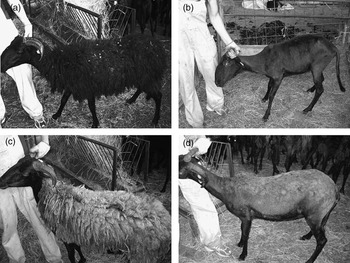
Massese is an Italian local sheep breed that accounts for about 5000 animals registered to the herd book. It is considered a dairy breed that was originated in the province of Massa and that nowadays is mainly reared in the Tuscany and Emilia Romagna regions. Massese is also considered one of the few black Italian sheep breed. However, sheep have black skin and horns and black or grey hairs (Figure 1). It is also worth mentioning that the apparent grey coat colour in some of these animals could be due to the presence of pale hairs in a black background. Owing to the presence of these two coat colour types, this breed is an interesting model to evaluate the effects of coat colour gene polymorphisms on this phenotypic trait.
Black Massese sheep before (a) and after (b) shaving. Grey Massese sheep before (c) and after (d) shaving.

Here, we analysed the ASIP and MC1R genes in Massese sheep and showed that mutations at these two loci are associated, even if not completely, with the two coat colour types of this breed: black and grey.
Material and methods
Animals and samples
Hair root or milk samples were collected from 161 adult (1 to 7 years old) Massese sheep of four different flocks (14, 5, 69 and 73 sheep from flocks A, B, C and D, respectively). The hair colour of these sheep was recorded during sample collection based on visual classification by two independent persons (L.F. and S.D.) using a classification into two classes: black (n = 121) or grey (n = 40; Figure 1). The grey class included animals with different greyness, from pale to dark grey. Hair root samples were also collected from 10 Appenninica (from two flocks), 10 Bergamasca (from one flock) and 10 Sarda (from two flocks) sheep with white hair and unpigmented skin.
DNA extraction and genotyping
DNA was extracted from milk using the Wizard® Genomic DNA Purification kit (Promega Corporation, Madison, WI, USA) and from hair roots using rapid extraction methods (Russo et al., Reference Russo, Fontanesi, Scotti, Tazzoli, Dall’Olio and Davoli2007).
PCR-RFLP was used to genotype the animals for four missense mutations: three missense mutations have been identified in the ovine MC1R gene and determine the putative recessive e allele (c.199C>T or p.R67C) and the black dominant E D allele (c.218T>A or p.M73K and c.361G>A or p.D121N) at the Extension locus (Våge et al., Reference Våge, Klungland, Lu and Cone1999; Fontanesi et al., Reference Fontanesi, Beretti, Riggio, Dall’Olio, Calascibetta, Russo and Portolano2010a); another missense mutation has been identified in exon 4 of the ovine ASIP gene (g.5172T>A or p.C126S; Norris and Whan, Reference Norris and Whan2008) and is associated with black non-agouti coat colour.
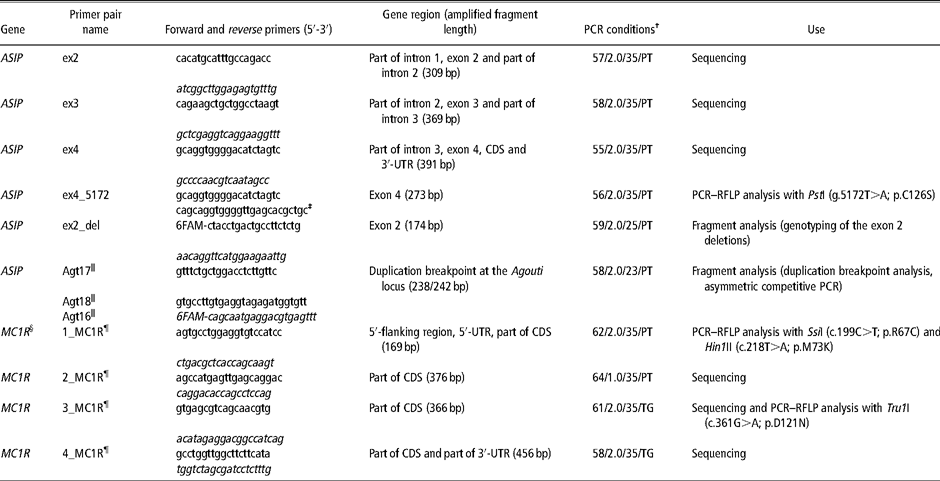
PCR analyses were carried out in a volume of 20 μl containing a 10 to 100 ng DNA template, 1 U DNA EuroTaq DNA polymerase (EuroClone Ltd, Paington, Devon, UK), 1X PCR Buffer, 2.5 mM dNTPs, 10 pmol of each primer and optimized MgCl2 concentrations (from 1.0 to 2.0 mM). PCR profile was as follows: 5 min at 95°C; 35 amplification cycles of 30 s at 95°C, 30s at 58°C to 64°C, 30 s at 72°C; 5 min at 72°C (Table 1).
Primer sequences and PCR conditions for MC1R and ASIP sequencing, PCR-RFLP and fragment analyses
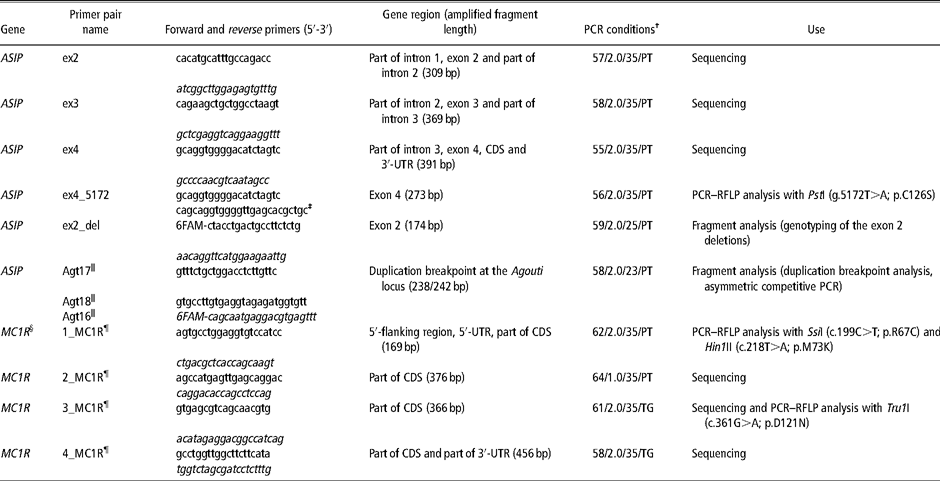
†Annealing temperature (°C)/MgCl2 concentration (mM)/no. of cycles/thermal cycler (TG = TGradient thermal cycler; PT = PT-100 thermal cycler).
‡The underlined base in primer reverse inserts an artificial restriction site for PstI when allele g.5172T is present in the amplified product.
§The MC1R gene is constituted by only one exon.
||Primers reported by Norris and Whan (Reference Norris and Whan2008).
¶Primers reported by Fontanesi et al. (Reference Fontanesi, Beretti, Riggio, Dall’Olio, Calascibetta, Russo and Portolano2010a).
Restriction enzyme digestion was obtained with 5 μl of PCR product in a total of 25 μl of reaction volume including 5 U of restriction enzyme and 1X reaction buffer. The resulting DNA fragments were electrophoresed in 10% polyacrylamide : bisacrylamide 29 : 1 TBE 1X gels. DNA bands were visualized with 1X GelRed Nucleid Acid Gel Stain (Biotium Inc., Hayward, CA, USA). Details of the PCR-RFLP protocols used for the analysis of the three MC1R missense mutations have been already reported in Fontanesi et al. (Reference Fontanesi, Beretti, Riggio, Dall’Olio, Calascibetta, Russo and Portolano2010a; see also Table 1). The g.5172T>A ASIP polymorphism was genotyped inserting an artificial restriction site for PstI during amplification with a mismatched reverse primer. Digestion of a 273 bp amplified fragment with PstI endonuclease (Fermentas; recognition sequence CTGCAG) at 37°C overnight produced two fragments (251 and 22 bp) when allele g.5172T was present, whereas only one fragment (undigested product) was obtained when allele g.5172A was present.
Fragment analysis was used to genotype the sampled sheep for the D5 and D9 deletions already reported in exon 2 of the ASIP gene (Smit et al., Reference Smit, Shay, Beever, Notter and Cockett2002; Norris and Whan, Reference Norris and Whan2008). PCR amplification was carried out as described above but in a 10 μl final volume including a 5′ 6-FAM-labelled primer (Table 1). Amplified products were loaded on an ABI3100 Avant capillary sequencer (Applied Biosystems, Foster City, CA, USA). For this analysis, 1 to 2 μl of reaction product was diluted in 10 μl of Hi-Di formamide (Applied Biosystems) and added to 0.1 μl of Rox-labelled DNA ladders (500HD Rox, Applied Biosystems). Labelled DNA fragments were sized using GeneScan version 3.7 and Genotyper version 3.7 software (Applied Biosystems).
Fragment analysis was also used to identify if the sampled animals carried a duplicated DNA copy including the ASIP gene (Norris and Whan, Reference Norris and Whan2008). For this analysis, a three-primer multiplex PCR was used to amplify both the junction between the duplicated DNA copies and the 5′-breakpoint sequences as reported by Norris and Whan (Reference Norris and Whan2008). Primers Agt16 and Agt18 spanning the junction between the duplicated copies produced a unique PCR product of 242 bp, whereas Agt16 and Agt17 spanning the 5′-breakpoint sequence produced a fragment of 238 bp. The amplification was carried out by asymmetric competitive PCR as described by Norris and Whan (Reference Norris and Whan2008) with few modifications (10 μl of final reaction volume and 25 cycles), with the Agt16 primer labelled in 5′ with 6-FAM. If the amplification resulted in these two fragments, the animal carried at least a copy of the duplicated chromosome region, whereas when only the fragment of 238 bp was obtained the animal did not carry any duplicated DNA region. Obtained fragments were analysed by capillary electrophoresis on an ABI3100 Avant sequencer (Applied Biosystems) as reported above. The relative ratio between the peak height of the two fragments (when a duplicated DNA copy was present) was calculated and compared between animals.
Sequencing
Sequencing of the three coding exons (exons 2, 3 and 4) with partial intronic regions of the ASIP gene and of the single exon MC1R gene was carried out for nine Massese sheep. PCR primers and conditions for amplification of these ASIP and MC1R gene fragments are reported in Table 1. Before sequencing, 3 to 5 μl of these PCR products were treated with 2 μl of ExoSAP-IT® (USB Corporation, Cleveland, Ohio, USA) following the manufacturer’s protocol. Cycle sequencing of the PCR products was obtained with the Big Dye version 3.1 kit (Applied Biosystems) and sequencing reactions, after a few purification steps using EDTA 0.125 M, Ethanol 100% and Ethanol 70%, were loaded on an ABI3100 Avant sequencer (Applied Biosystems). All sequences were visually inspected and aligned using the BioEdit version 7.0.5.2 (http://www.mbio.ncsu.edu/BioEdit/bioedit.html) and the CodonCode Aligner (http://www.codoncode.com/aligner) software.
Data analysis
Association between DNA markers and coat colours was tested using 2 × 2 contingency tables with Fisher’s exact test implemented in the procedure FREQ of SAS version 8.02 (SAS Institute Inc., Cary, NC, USA). Haplotypes including the exon 2 deletions and the g.5172T > A single nucleotide polymorphism (SNP) were inferred using the PHASE program version 2.1 (Stephens et al., Reference Stephens, Smith and Donnelly2001) in Massese sheep that did not carry any duplicated DNA region. Evaluation of the Hardy–Weinberg equilibrium was obtained with χ 2 analysis from the HWE software program (Linkage Utility Programs, Rockefeller University, New York, NY, USA).
Results
ASIP and MC1R genotypes
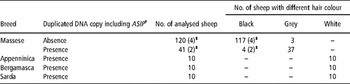
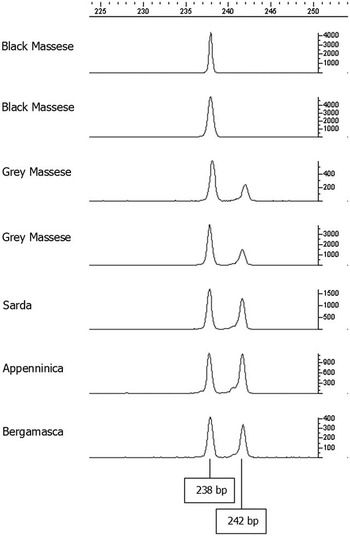
Analysing 161 Massese sheep with the assay designed to test the presence of a duplicated copy allele including the ASIP gene, one fragment of 238 bp was amplified in 120 animals, indicating that they did not carry any duplication at this locus. However, two fragments of 238 and 242 bp were amplified in 41 Massese sheep (7, 14 and 20 in flocks A, C and D, respectively), meaning that at least a duplicated copy allele was present in these animals (Table 2). The same assay was applied to the Appenninica, Bergamasca and Sarda sheep and all showed both DNA fragments (Table 2), as expected from their coat colour, according to what was indicated by Norris and Whan (Reference Norris and Whan2008). The relative ratio between the two fragment peaks in the 41 Massese sheep was 2.57 ± 0.26 on average (ranging from 3.26 to 1.94). The relative ratio in the Appenninica, Bergamasca and Sarda sheep was around 1 (1.07 ± 0.01). Figure 2 shows the different electrophoretic patterns observed in Massese sheep and in the other ovine breeds.
Results of the duplication breakpoint analyses at the Agouti locus (ASIP gene) in the investigated sheep

Association with different hair colours.
†Absence = amplification of the 238 bp fragment only. Presence=amplification of the 238 and 242 bp fragments (Norris and Whan, Reference Norris and Whan2008).
‡Numbers in parenthesis indicate the sheep carrying the E D allele at the Extension locus.
Electropherograms showing the results of the asymmetric competitive PCR used to evaluate the absence (only one fragment of 238 bp) or presence (two fragments of 238 and 242 bp) of a duplicated copy allele including the ASIP gene.

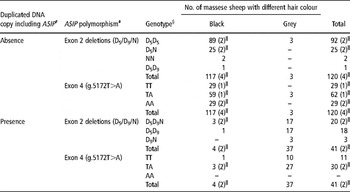
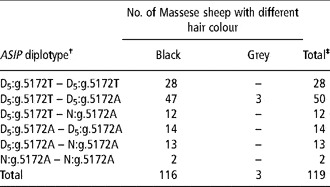
Results of the genotyping for the exon 2 deletions and for the g.5172T>A polymorphism in exon 4 of the ASIP gene in Massese sheep are reported in Table 3, separately for the animals without a duplicated copy allele and for the animals with a duplicated copy allele. For the first group, three alleles were identified. The most frequent one was D5 (87.5%), followed by an allele without any deletion (allele N; 12.1%), whereas allele D9 was observed in one sheep only of flock A (0.4%). No allele with both the D9 and D5 deletions was identified. The three identified exon 2 alleles were observed in four genotypes with D5D5 (76.7%) that was the most frequent one (Table 3). In these sheep, the two alleles of the g.5172T>A SNP showed exactly the same frequency (50%). The g.5172TA genotype was the most frequent (51.7%). Both polymorphic regions (exon 2 deletions and exon 4 SNP) were in Hardy–Weinberg equilibrium considering the whole Massese sampled population (P = 0.96 and P = 0.71, respectively) or analysing the data independently for the two flocks with a larger number of samples (P = 0.63 and P = 0.32 for flock C; P = 0.81 and P = 0.37 for flock D). Haplotypes between the exons 2 and 4 polymorphic regions/sites were inferred with P ⩾ 0.99 for all animals, except for the only sheep that carried the D9 allele (that had genotypes D5D9 and g.5172TA). Three haplotypes were deduced in the remaining 119 sheep. All these haplotypes were putatively non-functional as they carried one (haplotype 1: [D5:g.5172T]) or the other (haplotype 2: [N:g.5172A]) or both (haplotype 3: [D5:g.5172A]) non-functional sites. Their observed frequencies were 49.6%, 12.2% and 38.2%, respectively. The six possible haplotype combinations (diplotypes) are reported in Table 4. Considering all sampled Massese sheep that did not carry any duplicated copy ASIP allele, the diplotypes were in Hardy–Weinberg equilibrium (P = 0.48). The Hardy–Weinberg equilibrium of the diplotypes was also observed in flock D (P = 0.74), whereas significant departure was evidenced in flock C (P = 0.04), probably due to population stratification.
Association between Massese hair colour and genotypes of the ASIP exons 2 and 4 mutations and the absence/presence of a duplicated DNA copy including the ASIP gene

†Absence = amplification of the 238 bp fragment only. Presence = amplification of the 238 and 242 bp fragments (Norris and Whan, Reference Norris and Whan2008).
‡D5 = g.100-105delAGGAA; D9 = g.10-19delAGCCGCCTC; N = normal exon 2 allele without deletions.
§In the sheep with duplicated DNA copy including ASIP, the genotypes are reported as genotyping results.
||Numbers in parenthesis indicate the sheep carrying the E D allele at the Extension locus.
ASIP diplotypes (haplotype combinations) in Massese sheep without any duplicated DNA copy including the ASIP gene

†Haplotypes have been inferred between ASIP the exons 2 and 4 mutations. D5 = g.100-105delAGGAA; N = normal exon 2 allele without deletions.
‡One sheep carrying the D9 deletion was not included as it was not possible to infer with high confidence its haplotypes. Therefore, the total number of considered animals was 119 instead of 120.
Different results were obtained in the 41 Massese sheep that carried a duplicated copy ASIP allele. However, owing to the reason that a duplicated copy allele was present, it was not possible to distinguish the different single copy alleles from the multiple ASIP copies present in one allele. Therefore, genotypes are reported as genotyping results (Table 3). Almost half of the animals (48.8%) carried all three exon 2 alleles (D5D9N), whereas 43.9% resulted with genotype D5D9 and the remaining 7.3% had genotype D9N. Another indication of the presence of CNV was the excess of heterozygous sheep at the g.5172T > A SNP (73.2%; Table 3). Departure from the Hardy–Weinberg equilibrium was highly significant (P = 0.000018), but this result is clearly biased by the presence of duplicated copies in which one copy (or more copies) could carry the g.5172T allele and the other(s) could carry the g.5172A allele. Similar results are common in loci with CNV (Fontanesi et al., Reference Fontanesi, Beretti, Riggio, Gómez González, Dall’Olio, Davoli, Russo and Portolano2009b).
The genotyping results obtained from the sheep of the other breeds, all of whose animals carried duplicated copy alleles, were, in general, different from those obtained in the 41 Massese sheep. Eight Sarda sheep had genotype D5N and two showed only the N allele. Six Appenninica sheep had genotype D5N, two had only allele N, one had all three alleles and one was with genotype D5D9. Among the 10 analysed Bergamasca sheep, 5 were D5N, 3 were D5D9N and 2 had only allele N.
Three missense MC1R mutations were genotyped in all Massese sheep, as in part reported by Fontanesi et al. (Reference Fontanesi, Beretti, Riggio, Dall’Olio, Calascibetta, Russo and Portolano2010a). Six out of 161 animals carried the dominant black E D allele. They had genotype E DE +, whereas all other sheep were E +E +. Therefore, the frequency of the E D allele we observed in this breed was about 2%. Of these six animals, two carried a duplicated copy ASIP allele (Tables 2 and 3). The E D allele was not identified in the Sarda, Appenninica and Bergamasca genotyped animals.
Association between ASIP and MC1R polymorphisms and coat colour in Massese sheep
Of the 161 Massese sheep we collected, 121 were classified as black (75%) and 40 as grey (25%). This is a good approximation of the frequency of these two coat colours in this breed as the animals were sampled randomly in the four flocks considered. The analysis of the genotyping data (Table 3) clearly indicated that polymorphisms in the ASIP and MC1R genes affect coat colour in Massese sheep. First of all, the presence of a duplicated copy allele including the ASIP gene was highly significantly associated with the grey coat colour (P = 9.4E-30, Fisher’s exact test). Almost all animals with a duplicated copy allele (37 out of 41) showed uniform apparent grey hair (even if with different intensities of grey) and almost all animals without a duplicated allele (117 out of 120) were completely black. Only a few animals did not follow these rules: three grey sheep did not carry any duplicated copy allele and four black animals carried a duplicated copy allele. Of the latter four sheep, two were heterozygous at the MC1R locus; namely, they carried a dominant black allele (E D). This is the reason because, despite the ASIP duplication that may determine grey colour, these two animals were black, according to the epistatic action of the Extension locus over the Agouti locus. Therefore, the inconsistencies between genotypes in the ASIP and MC1R genes and coat colour were for only 5 out of 161 Massese sheep, all belonging to flock D. The animals for which there was no correspondence between ASIP and MC1R genotypes and coat colour, as well as the other four animals with ASIP D5D5 genotype, were sequenced for both genes. However, no other mutations were identified in addition to those that have been already reported (Norris and Whan, Reference Norris and Whan2008; Fontanesi et al., Reference Fontanesi, Beretti, Riggio, Dall’Olio, Calascibetta, Russo and Portolano2010a).
In addition to the role of the duplicated DNA copy including the ASIP gene in determining the grey colour in Massese sheep, the black colour of a few Massese animals was due to the MC1R E D allele (that was heterozygous with a wild-type allele in six sheep), as indicated above. However, almost all other black sheep (excluding the few exceptions indicated above) carried the non-functional ASIP alleles (haplotypes 1 to 3; Tables 3 and 4) that can be considered the black recessive non-agouti alleles at the Agouti locus (Sponenberg, Reference Sponenberg1997; Norris and Whan, Reference Norris and Whan2008; Royo et al., Reference Royo, Alvarez, Arranz, Fernández, Rodríguez, Pérez-Pardal and Goyache2008).
In the 41 Massese sheep with a duplicated ASIP allele, the relative ratio between the peaks of two amplified fragments obtained in the assay, compared to that of other white breeds, clearly indicated a non-equal content of the two amplified regions, which can be interpreted with the fact that these Massese animals were heterozygous for an allele harbouring a duplicated DNA region including the ASIP gene with the other allele without any duplication. As a consequence, the duplicated copy allele(s), which was (were) associated with the grey coat colour, can be considered dominant (or partially dominant) over the non-duplicated copy alleles, which are associated with black coat colour. Following this assumption, the frequency of the duplicated copy allele(s) in the analysed Massese population was 12.7% (10.1% in flock C and 13.7% in flock D). The departure from the Hardy–Weinberg equilibrium was significant considering all sampled Massese sheep (P = 0.014) but not in flock C (P = 0.208) or in flock D (P = 0.074). It is also interesting to note that of these 41 Massese sheep, 18 had genotype D5D9 (17 of them were grey and one was black) with g.5172TT or g.5172TA. Considering that these animals were heterozygous with a non-duplicated allele, it is likely that this single copy allele harbours D5 (according to its allele frequency in the Massese population) included in haplotypes 1 or 2 (with g.5172T or g.5172A). Therefore, the duplicated copy allele(s) (in sheep showing the D5D9 genotype) may carry two (or more) copies of the D9 allele or both the D5 and D9 alleles. Both these ASIP variants are predicted to be non-functional or partially functional (Norris and Whan, Reference Norris and Whan2008), but their effects on coat colour in Massese sheep seem evident and apparently indistinguishable from the effects of other duplicated alleles, coding for at least a functional ASIP, that are associated with grey coat colour. As a matter of fact, even if the grey of the animals classified in this coat colour category varied in intensity (from pale to dark), there was no association between the duplicated copy genotype and the degree of greyness (data not shown). The grey colour could be derived by the presence of pale hairs in a black skin background, but this issue should be further investigated as we did not analytically determine the melanin contents in the different Massese sheep. The classification of the Massese animals into the two coat colour categories (black and grey) cannot discriminate between differences in distribution/ratio of eumelanic and pheomelanic fibres among sheep.
Discussion
As recognized early by classical genetic experiments, black coat colour in sheep can be due to homozygosity of a recessive non-agouti allele (A a) at the Agouti locus or to the presence of a dominant Extension allele (E D). Black determined in these two ways is not phenotypically distinguishable (Searle, Reference Searle1968; Sponenberg, Reference Sponenberg1997). More recently, a few other studies have investigated polymorphisms in the ovine ASIP and MC1R genes and evaluated their effects on hair colour in several sheep breeds/populations (Våge et al., Reference Våge, Klungland, Lu and Cone1999 and Reference Våge, Fleet, Ponz, Olsen, Monteagudo, Tejedor, Arruga, Gagliardi, Postiglioni, Nattrass and Klungland2003; Norris and Whan, Reference Norris and Whan2008; Royo et al., Reference Royo, Alvarez, Arranz, Fernández, Rodríguez, Pérez-Pardal and Goyache2008; Fontanesi et al., Reference Fontanesi, Beretti, Riggio, Dall’Olio, Calascibetta, Russo and Portolano2010a; Gratten et al., Reference Gratten, Pilkington, Brown, Beraldi, Pemberton and Slate2010).
We evaluated the effects of ASIP and MC1R gene variants on Massese sheep coat colour. In black, solid-coloured animals, at least three frequent ASIP haplotypes ([D5:g.5172T], [N:g.5172A] and [D5:g.5172A]) were detected with an additional rare haplotype including the D9 allele (with g.5172T or g.5172A). These haplotypes may correspond to different A aAgouti alleles. Six different diplotypes, which were originated combining the three major haplotypes, were almost completely associated with black coat colour (Table 4). The presence of more than one putative A aAgouti allele (characterized by the combination of D5 and the exon 4 SNP) was also observed in a feral population of Soay sheep in which different morphs segregate (Gratten et al., Reference Gratten, Pilkington, Brown, Beraldi, Pemberton and Slate2010). In addition, another putative A a allele present in this wild population as well as in black Merino sheep was suggested to be caused by a cis-regulatory mutation that might control ASIP gene expression (Norris and Whan, Reference Norris and Whan2008; Royo et al., Reference Royo, Alvarez, Arranz, Fernández, Rodríguez, Pérez-Pardal and Goyache2008; Gratten et al., Reference Gratten, Pilkington, Brown, Beraldi, Pemberton and Slate2010). A regulatory mutation (probably the same) was also supposed to be the most important cause of the recessive black coat colour phenotype in the Spanish Xalda breed, together with the less frequent D5 allele (Royo et al., Reference Royo, Alvarez, Arranz, Fernández, Rodríguez, Pérez-Pardal and Goyache2008). According to the data obtained, we could not deduce the presence of an ASIP regulatory mutation in the analysed Massese sheep as the observed genotypes could all explain the black coat colour in their animals (Table 4). If this additional regulatory mutation is present in the Massese breed, it would have a very low frequency.
The duplicated ASIP copy allele(s) observed in Massese sheep could correspond to the A Wt allele and/or to the other intermediate Agouti-locus alleles (e.g. grey and tan, A gt; light grey, A kg; grey, A g) that may produce uniform mixtures of eumelanic and pheomelanic fibres resulting in a grey colour (Sponenberg, Reference Sponenberg1997). We tended to believe that more than one of these alleles (or additional forms of the A Wt allele) are present in Massese sheep, and probably in several other breeds. The duplication detected by a specific designed PCR assay is not actually represented by only one sequence. Heterogeneity of the duplicated ASIP sequence was clearly evidenced by the analysis of the exon 2 deletions. Striking differences are evident comparing the exon 2 genotyping results of Massese sheep carrying a duplicated allele with those of other white sheep breeds. For example, the putative partially functional D9 allele was always present in the grey Massese sheep (with a duplicated copy allele) but was not detected in the Sarda breed and was rare in the Appenninica and Bergamasca breeds. It was predicted that at least a fully functional copy of the ASIP gene should be present in a duplicated allele (A Wt allele) to cause the white phenotype (Norris and Whan, Reference Norris and Whan2008). The grey coat colour could be determined by the presence in duplicated ASIP alleles of the supposed partially functional D9 variant together with the putative non-functional ASIP haplotypes carrying D5 and/or A or, in the alternative, with putative fully functional ASIP haplotypes. Another possible explanation of the grey coat colour could be due to the fact that Massese sheep with this phenotype may be heterozygous with one of the three frequent non-agouti haplotypes (1, 2 and 3), and therefore the duplicated copy allele(s) might be partially dominant. Segregation of dominant white (or partially dominant) and recessive black coat colours, similar to that observed in Massese sheep, occurs in the Spanish Xalda breed (Royo et al., Reference Royo, Alvarez, Arranz, Fernández, Rodríguez, Pérez-Pardal and Goyache2008). The duplicated copy allele(s) (A Wt or others) might have been introduced by crossing with other white breeds or it could be part of the original genetic pool from which the current Massese breed was originated. As a matter of fact, a duplicated copy allele including the ASIP gene could have been originated earlier after the domestication process of the sheep and single copy non-functional alleles (determining the non-agouti black phenotype) might be derived by non-homologous recombination (Norris and Whan, Reference Norris and Whan2008; Gratten et al., Reference Gratten, Pilkington, Brown, Beraldi, Pemberton and Slate2010). CNV are unstable genomic regions and non-homologous recombination could also create heterogeneity in the number of copies and in their organization (Cooper et al., Reference Cooper, Nickerson and Eichler2007). This could also be the reason for the differences in the duplicated ASIP variants that we observed in the Massese and other sheep breeds.
Association between Massese coat colour and polymorphisms in the ASIP gene was highly significant. However, a few animals did not follow the expected rule. We also excluded the presence of the missense mutation in the tyrosinase-related protein 1 (TYRP1) gene responsible for coat colour variation in a feral population of Soay sheep (Gratten et al., Reference Gratten, Beraldi, Lowder, McRae, Visscher, Pemberton and Slate2007; data not shown). All of these few animals belonged to the same flock in which other genetic factors could segregate and modify the effects of the ASIP alleles. We tended to exclude the possibility of sampling errors or of misclassification of these animals. However, different levels of greyness could be due to environmental factors or to the age of the animals. No additional MC1R polymorphisms were detected apart from the few animals carrying the E D allele that contributed to explain the coat colour in two sheep that otherwise would have been grey as they carried a duplicated ASIP allele. The other four animals with this allele were not different from the other black sheep, as a result of which their coat colour was determined by the recessive non-agouti alleles.
Furthermore, it is interesting to note that a mild selection pressure (as deduced by the departure from the Hardy–Weinberg equilibrium) could have been operated against the duplicated copy allele(s). It could be possible that sheep homozygous for a duplicated copy allele would be much more white than heterozygous animals and for this reason they might not be registered in the Massese breed herd book. Homozygous putative white animals could be culled whereas heterozygous sheep would not be eliminated, preserving the grey morph in the Massese populations. As a matter of fact, if strong selection pressure, both against heterozygous and homozygous grey/white animals would be applied, the duplicated copy allele(s) could be quite easily eliminated. A few breeders consider the grey Massese sheep more productive in terms of milk yield in a single lactation, but this information has not been experimentally verified as yet. Nevertheless, the duplicated alleles might have negative pleiotropic effects represented by reduced fecundity and greater seasonality in reproduction as evidenced in Icelandic sheep for the A Wt allele or by decreased fertilization rate as reported for a grey allele (Adalsteinsson, Reference Adalsteinsson1970 and Reference Adalsteinsson1975). Massese sheep are characterized by a partial seasonality of oestrus, which can occur at any time during the year (Franci et al., Reference Franci, Pugliese, Acciaioli, Parisi and Lucifero1999), and this trait could be due to the usual black coat colour that might exclude or maintain in heterozygosity the duplicated copy allele(s) with putative negative effects when homozygous. Further studies are needed to evaluate the effects of ASIP alleles on production and reproduction traits in the Massese breed.
Another issue of particular interest is the possible association between ASIP alleles and prion protein (PrP) alleles. The ASIP and PrP genes are both located on sheep chromosome 13, about 15 cM apart (Sawalha et al., Reference Sawalha, Bell, Brotherstone, White, Wilson and Villanueva2009). Polymorphisms at the ovine PrP gene are associated with susceptibility to scrapie. Selection against some PrP alleles is the basis of current breeding programmes implemented to control this disease (Vascellari et al., Reference Vascellari, Aufiero, Nonno, Agrimi, Vaccari, Basilicata, Falcaro, Mancin, Marcon and Mutinelli2005; Hunter, Reference Hunter2007; Dawson et al., Reference Dawson, Moore and Bishop2008). Sawalha et al. (Reference Sawalha, Bell, Brotherstone, White, Wilson and Villanueva2009) showed a strong significant association of PrP genotypes with coat colour in Badgerfaced Welsh Mountain and Shetland sheep, probably due to Agouti locus alleles. The implication of these associations is that selection to increase resistance to scrapie based on PrP genotypes could modify ASIP allele frequencies in Massese and, in turn, change the ratio between black and grey animals with possible effects on other traits.
Acknowledgements
We thank Associazione Provinciale Allevatori of Bologna, Ferrara and Forlì-Cesena for their collaboration during the sampling and Prof. Riccardo Bozzi (University of Firenze) for providing some references. This work was supported by MiPAAF Selmol funds.