INTRODUCTION
Coastal populations of marine mammals depend on habitats frequently used for human recreational activities. For example, Atlantic bottlenose dolphins (Tursiops truncatus, Montagu, 1821) are frequently encountered close to shore during summer months, most likely due to food availability and shallow nursery areas (Würsig & Würsig, Reference Würsig and Würsig1979; Scott et al., Reference Scott, Wells, Irvine, Leatherwood and Reeves1990; Wells, Reference Wells and Roat1993; Barco et al., Reference Barco, Swingle, Mclellan, Harris and Pabst1999). During these months, there is also an increase in boating accidents throughout the United States, suggesting an increase in frequency of recreational activities during these times (Salerno, Reference Salerno2006). In 2005, approximately 72% of the boating accidents reported occurred between May and August (Salerno, Reference Salerno2006). The increase in recreational boating activities corresponds with the higher frequency of sightings of bottlenose dolphins in coastal areas during the summer, demonstrating a need to assess the effects of recreational boating on dolphin behaviour and well-being.
Studies examining interactions between boats and dolphins have shown effects ranging from changes in behaviour (Bejder et al., Reference Bejder, Dawson and Harraway1999; Nowacek et al., Reference Nowacek, Wells and Solow2001; Hastie et al., Reference Hastie, Wilson, Tufft and Thompson2003; Lusseau, Reference Lusseau2003; Constantine et al., Reference Constantine, Brunton and Dennis2004; Goodwin & Cotton, Reference Goodwin and Cotton2004) to physical injury and death (Wells & Scott, Reference Wells and Scott1997; Nowacek et al., Reference Nowacek, Wells and Solow2001). Changes in dolphin behaviour in the presence of boat traffic have been described in some detail. Examples include increases in group cohesion (Bejder et al., Reference Bejder, Dawson and Harraway1999; Nowacek et al., Reference Nowacek, Wells and Solow2001; Ribeiro et al., Reference Ribeiro, Viddi and Freitas2005), increases in group synchrony (Hastie et al., Reference Hastie, Wilson, Tufft and Thompson2003), changes of behavioural state (Nowacek et al., Reference Nowacek, Wells and Solow2001; Lusseau, Reference Lusseau2003; Constantine et al., Reference Constantine, Brunton and Dennis2004; Ribeiro et al., Reference Ribeiro, Viddi and Freitas2005), increases in dive duration (Janik & Thompson, Reference Janik and Thompson1996; Nowacek et al., Reference Nowacek, Wells and Solow2001; Lusseau, Reference Lusseau2003) and changes in direction of travel (Goodwin & Cotton, Reference Goodwin and Cotton2004). Many of these examples suggest an evasive response to boat traffic although some instances involving commercial fisheries and shrimp boats have an opposite effect with animals feeding off by-catch and following these types of vessels (Shane, Reference Shane, Leatherwood and Reeves1990b).
Determining if short-term changes in behaviour represent a ‘biologically significant’ effect is difficult (Wright, Reference Wright2006). Immediate or short-term changes in behaviour could represent short or long-term effects on a population. Short-term changes in behaviour can include many of the changes described in previous literature including increases in dive duration, changes in direction of travel, etc. However, long-term impacts or effects include changes such as reduced health and viability of a population. Short-term changes in activity budgets that reduce amount of time feeding as seen in a study with killer whales (Orcinus orca) could represent long-term challenges by reducing energy acquisition (Williams et al., Reference Williams, Lusseau and Hammond2006). These short-term changes could also have a greater impact on a population depending on resource availability.
Some studies have also shown changes in habitat use by dolphins in relation to boat traffic (Sorensen et al., Reference Sorensen, Medved, Hyman and Winn1984 Baker & Herman, Reference Baker and Herman1989; Wells, Reference Wells and Roat1993; Lusseau, Reference Lusseau2004, Reference Lusseau2005; Bejder et al., Reference Bejder2006b). Bejder et al. (Reference Bejder2006b) reported a decrease in dolphin abundance in one location based on increasing tourism. This decrease was not considered an overall threat to this population in Shark Bay, Australia as other nearby locations without boat-based tourism increased in abundance throughout the same time period (Bejder et al., Reference Bejder2006b). The dolphins in another study in the same geographical location remained in the high-traffic area and showed moderate responses to experimental approaches by boats (Bejder et al., Reference Bejder, Samuels, Whitehead and Gales2006a). Moreover, dolphins that left the high-traffic area showed longer lasting changes in behaviour (Bejder et al., Reference Bejder, Samuels, Whitehead and Gales2006a). Understanding the impacts for animals that relocate versus animals that remain in areas of high boat traffic could be critical for mediating effects of boat traffic on other marine mammal populations that are limited to specific habitats due to available resources.
Within the state of Mississippi there are approximately 304,000 registered boats (MS Department of Wildlife, Fisheries and Parks; Gail Marshal, personal communication). Most (97.6%) of these boats are registered for the use of pleasure or recreation. Given the potential impact of boating activity on bottlenose dolphins within the Mississippi Sound, the primary goals of the present study were to examine the immediate effects of high-speed personal watercraft on Atlantic bottlenose dolphin behaviour and to compare such effects with those reported for different dolphin populations.
MATERIALS AND METHODS
Boat surveys
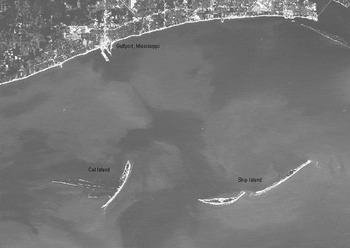
Opportunistic surveys were conducted from either a 7 m vessel with a 225 Ram injection Evinrude outboard motor or a 10 m vessel powered by a 135 horse power outboard mounted in the bow. Surveys were conducted in the Mississippi Sound (30º13′22.6″N 89º01′36.5″W) near Cat and Ship Islands (see Figure 1) from September 2003 through to August 2005. The weather permitting, surveys were conducted four days a month, resulting in a total of 329 encounters with groups of Atlantic bottlenose dolphins during the sampling period. All surveys began in Gulfport, Mississippi, and included the transits to the study area that day. After surveying the waters around an entire island for dolphins, additional time was spent surveying the waters around the other island. All surveys began at approximately 0830 h and continued until approximately 1400 h.
A satellite image of the study area in the Mississippi Sound.

Data collection
When a group of dolphins was sighted, the research vessel followed the animals to allow data collection. A group was defined as any dolphins within 100 m of one another exhibiting similar behaviour. Upon approach, the group's behaviour was coded as ‘evasive’, ‘approached vessel’ or ‘neutral’. ‘Evasive’ was coded for all groups of dolphins that travelled away from the boat. ‘Approached vessel’ was coded for all groups that travelled towards, oriented towards or travelled alongside the research vessel if this travel direction was different from the group's original path. ‘Neutral’ was coded for any group whose behaviour was not affected by the research vessel. Only groups coded as ‘neutral’ were used for the analyses reported in this paper, given that we were interested in the effects of high speed boats more so than the effects of our research vessel. Behavioural data were recorded using a Sony DCR-HC65 digital video recorder. During video recording, the largest possible group of animals was sampled to provide the most accurate indices of group behaviour. For photo-identification purposes, individual fins were photographed using a Canon EOS 10D digital camera with a Canon EF 100-400 mm f/4.5-5.6L IS USM Telephoto Zoom Lens. Environmental data and acoustic data were also collected but were not analysed for this study.
Data analysis
Videos were scanned for the presence of boats. When boats were present during an encounter, the type of boat was noted. Analysis of dolphin behaviour focused on the ten minutes preceding and the ten minutes following the period in which a passing, high-speed, personal watercraft was closest to the dolphins. A high-speed personal watercraft was defined as any personal watercraft that produced a wake and was within ~100 m of the focal group of dolphins. All distances were estimated based on the locations of the dolphins and the passing watercraft, and were likely less than the approximated 100 m. Individual animal identification from digital still photography was used to remove groups of same individuals to prevent pseudo-replication. Continuous recording was used to compare group activity, group cohesion, group synchrony, and dive duration before and after the presence of a high-speed personal watercraft.
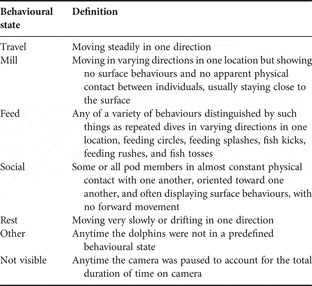
Group activity was recorded based on definitions from Shane (Reference Shane, Leatherwood and Reeves1990a). Behavioural states included travel, mill, feed, social, rest, other and not visible (Table 1). Group cohesion was calculated based on the surfacing patterns of the animals. A surfacing cohesive group consisted of dolphins that surfaced simultaneously within one adult body length (approximately 4.5 m) of one another. In such cases, the total number of individuals was recorded. Group synchrony was defined as individuals surfacing simultaneously regardless of the distance of the animals from one another. Dive duration was scored based on the time in-between seeing any individual dolphin due to the limitations of identifying individual dolphins on video.
Behavioural definitions adapted from Shane (1990a) used to assess behavioural states.

Two repeated measures multiple analyses of variance were used to examine differences in behavioural states between conditions. Analyses were run on groups based on behaviour during the pre-condition. The first analysis included groups that spent a majority (>50%) of the time travelling during the pre-condition (travel). The second analysis included groups that spent less than a majority (<50%) of the time travelling during the pre-condition (non-travel). Univariate analysis of variance was conducted on all significant results. Additionally, a paired samples t-test was used for analysis of all additional variables to ascertain any significant differences.
RESULTS
There were 329 encounters with dolphins during the study period. Boats were present in 137 (42%) of those encounters. 120 of these encounters were removed due to: (1) the boats not meeting the definition used for this study for high-speed personal watercraft; (2) there were insufficient video records of dolphin behaviour; or (3) individual dolphins were identified in multiple groups. Insufficient video records included any encounter with less than 10 minutes of video recording before and 10 minutes of video recording after the passing of a high-speed personal watercraft. Since all encounters were opportunistic, there were instances where less than 10 minutes of video was recorded prior to the passing of a high-speed personal watercraft. The resulting sample size was 17 encounters with a high-speed personal watercraft closer than ~100 m to the focal group of individuals.
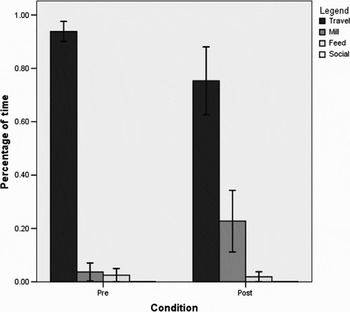
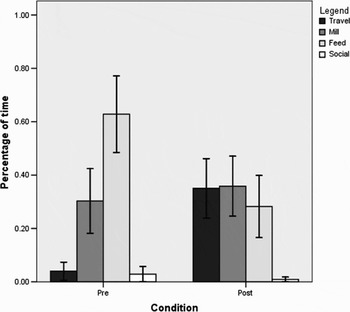
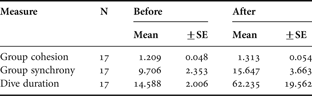
Table 2 summarizes the results concerning dive duration, group cohesion and breathing synchrony. The presence of a high-speed personal watercraft significantly increased dive duration (paired t 16 =x02212;−2.392, P < 0.05), the clustering of individuals (paired t 16 =x02212;−3.038, P < 0.01), and breathing synchrony (paired t 16 = −2.150, P < 0.05). In addition, the presence of a high-speed personal watercraft changed the group's behaviour within the first minute of the boat's presence in 47% of the encounters. Figures 2 and 3 present a summary of the activity budgets for the dolphins before and after the passing of high-speed personal watercraft. Analyses of behavioural states revealed a significant change in overall behaviour for the non-travel groups. However, no significant differences were observed for the travel groups (non-travel, F 3,8 = 4.522, P < 0.05; travel, F 2,4 = 0.981, P = not significant (n.s.)). Further analyses revealed a significant increase in travelling behaviour and a significant decrease in feeding behaviour for the non-travel groups comparing the pre- to the post-condition (travel, F 1,10 = 8.949, P < 0.05; feed, F 1,10 = 7.558, P < 0.05). There were no significant differences in milling or social behaviours for the non-travel groups (mill, F 1,10 = 0.131, P = n.s.; social, F 1,10 = 1.000, P = n.s.).
Activity budgets for travelling groups of Atlantic bottlenose dolphins before and after crossing of a high-speed personal watercraft.

Activity budgets for non-travelling groups of Atlantic bottlenose dolphins before and after crossing of a high-speed personal watercraft.

Results examining effects of high-speed personal watercraft on group cohesion, synchrony, and dive duration.
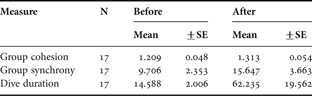
N, number; SE, standard error.
DISCUSSION
The results of this study suggest that high-speed personal watercraft have an immediate impact on Atlantic bottlenose dolphin behaviour. The observed increase in dive duration and travelling behaviour suggests that dolphins attempt to avoid high-speed personal watercraft. These changes in behaviour are similar to behaviours reported on dolphin predator avoidance observed in the presence of some shark species (Tayler & Saayman, Reference Tayler and Saayman1972; Conner & Heithaus, Reference Connor and Heithaus1996). In addition, the passing of a high-speed personal watercraft also resulted in an increase in both group cohesion and group synchrony. These changes might reflect a behavioural response to a possible threat, perhaps by reducing an individual's risk of injury by reducing both the distance between group members and the disparity of individual behaviours. All of these results, combined with a decrease in feeding behaviour for non-travelling groups, demonstrate an immediate short-term change in dolphin behaviour. Repeated or multiple short-term changes taken together may produce significant long-term effects for the dolphin population located within the Mississippi Sound.
For example, it is possible that repeated exposure to high-speed personal watercraft could significantly decrease the overall time spent foraging and socializing. This could affect the health of individual dolphins and the viability of the dolphin population in the Mississippi Sound. Although effects from repeated predator avoidance are difficult to demonstrate in mammals and birds, repeated predatory avoidance by fish and invertebrates has resulted in reduced reproductive output (e.g. Skelly & Werner, Reference Skelly and Werner1990). It seems reasonable to assume that slowed growth rates as a result of a decrease in foraging could also impact mammal and bird species (Lima, Reference Lima1998). A decrease in an individual's body condition as a result of reduced foraging efforts could result in lower fecundity for females and decreased competitive ability for males (Hik, Reference Hik1995; Sinclair & Arcese, Reference Sinclair and Arcese1995; Lima, Reference Lima1998). If this held true for dolphins, then a decrease in foraging and socializing behaviours as a result of repeated avoidance of high-speed personal watercraft could have an impact that might be considered ‘biologically significant’ on the dolphin population within the Mississippi Sound.
It is difficult to determine what is ‘biologically significant’ in terms of impacts of anthropogenic factors on marine mammals (Wright, Reference Wright2006). For example, the results of the current study demonstrate short-term effects, but it is not clear whether these effects will result in long-term challenges such as reduced health and viability of the population. Clearly, there is still much that needs to be done in order to increase our understanding of the wide range of possible effects of personal watercraft on dolphin behaviour as well as the significance of such effects. Further research should examine differences between slow and high-speed watercraft, as well as ascertain the effects of varying distances on the impact of watercraft on dolphin behaviour. Longitudinal studies are needed to examine the relationship between individual growth rates, rates of reproduction and frequency of watercraft. Continued systematic evaluation will provide needed information on any detrimental effects of personal watercraft on marine mammals, including dolphins' use of particular habitats.
ACKNOWLEDGEMENTS
The authors thank students, interns, and volunteers at the Marine Mammal Behavior and Cognition Laboratory at the University of Southern Mississippi for their assistance in data collection and analyses. We also thank the members of the Institute for Marine Mammal Studies for their assistance in data collection and two anonymous referees of this manuscript for their helpful comments and insight. This project was supported in part by the Dolphin Communication Fund at the University of Southern Mississippi and by grants awarded to Stan Kuczaj from the Department of Commerce and the Institute of Marine Mammal Studies. All research efforts were conducted under permit no. 1041-1701 through the National Marine Fisheries Service.