In the 1970s and 1980s, Scottish critics accused vaudeville singer Harry Lauder of epitomizing all that was wrong with Scottish culture. Writing during a period of resurgent nationalism, these scholars attacked the ‘“pathological” discourses of Tartanry and Kailyard’, which characterized Scots as rural, tartan-wearing sentimentalists unable to negotiate the challenges of modern industrialization.Footnote 2 As Cairns Craig wrote in the 1982 collection Scotch Reels,
This turning of the back on the actuality of modern Scottish life is emblematically conveyed in the figure of Harry Lauder – Kailyard consciousness in tartan exterior – who evacuates from his stage persona, indeed from his whole identity, the world of the Lanarkshire miners from which he began.Footnote 3
For Craig and others, Lauder's romanticized depiction of Scottish life ignored the realities of his own personal history and turned Scottishness into a series of stereotypical gestures and expressions.
So successful was Lauder's portrayal of Scottishness that he came to represent the archetypal Scot in the Anglo-American cultural imagination throughout much of the twentieth century. Historian Arthur Herman observes that ‘[i]n Punch cartoons, the thrifty Scot was always portrayed as a country bumpkin of the Harry Lauder type, with a tattered bonnet, a tartan cloak, and an almost impenetrable Scottish burr’.Footnote 4 Douglas M. Gunn similarly argues that the autobiographical anecdotes that were central to Lauder's act and later appeared in his conversational memoirs actively promoted the ‘canny Scot’ stereotype.Footnote 5
Although critics of the 1970s were correct in identifying Lauder's role in shaping perceptions of the Scottish, they refused to acknowledge the potential significance of his songs and sketches for Scottish audiences. Beginning in the 1990s, revisionist accounts of kailyard and tartanry argued that stereotypical portrayals of Scottish national identity served an important and potentially subversive function within Scottish society.Footnote 6 In a 1996 essay, Alasdair Cameron and Adrienne Scullion challenged the reactionary nationalism of the 1970s and 1980s, claiming that
the totemic images of the Scotch comic . . . were approved and even celebrated as symbols of a nationality which, under normal circumstances, audiences were never allowed to express. These images, be they nostalgic, parochial or romantic, were produced and maintained within the entertainment ecology of Scotland but were given their universal power and currency by their appeal to the Scottish diaspora of North America and the Empire.Footnote 7
Lauder's unapologetic representation of Scottish types promoted a distinct national identity that could flourish alongside Scotland's membership within the United Kingdom while supporting diasporic fantasies of home.Footnote 8 As theatre historian Ian Brown concludes, ‘within the framework of the Union it was essential to find easily identifiable and specifically Scottish symbols that might mark the continuing identity of the equal partner in the Union that Scotland constituted’.Footnote 9 Lauder provided those symbols.
The vilification of Lauder by later generations of critics says much about the apparent seamlessness of his portrayal of the Scottish national character. But as this article details, Lauder's Scottishness was a carefully crafted performance, a collaborative effort between Lauder and his American agent, William Morris, that centred on Lauder's embodiment of the ‘canny Scot’ stereotype. This performance served multiple objectives within the context of early twentieth-century vaudeville, two of which I examine here. First, stories of Lauder's ‘characteristic’ Scottish thrift worked to deflect commentary about the star's status as a highly paid foreign commodity. By planting stories and arranging interviews that represented Lauder as a skilled and cunning Scot, Morris addressed growing anxieties that men, as well as women, were becoming mere cogs in the machine of corporate Broadway capital. Second, Morris's representation of Lauder as the epitome of all things Scottish guaranteed the loyal patronage of the Scottish diaspora.Footnote 10 Reviews of Lauder's performances frequently note the presence of boisterous Scottish well-wishers, including many dressed ‘in the costume of their native land’.Footnote 11 Scottish Americans both celebrated and used Lauder's celebrity to promote their community organizations, reaffirming their place within the broader American public sphere during a period when mass immigration was dramatically changing the cultural fabric of the United States.
The ‘social life’ of a vaudeville performer
In September 1908, theatrical papers on both sides of the Atlantic were abuzz with word that American agent William Morris had offered Harry Lauder $5,000 a week, ‘the highest salary ever earned by a vaudeville artist’.Footnote 12 After months of negotiations, Lauder had finally succeeded in cancelling his engagements in London and Glasgow so that he might undertake a twenty-week tour of the newly formed Morris circuit. But when quizzed about his ‘enormous salary’, Lauder denied that he would receive the full amount, noting that a substantial percentage would go towards paying fees for breaking his contracts. ‘My real object’, he told reporters, ‘is to familiarize myself with the people of the United States, and if I can do that this year, I shall go back next in the hope of bringing home a few Yankee dollars’.Footnote 13 Not everyone was convinced by Lauder's denial, however. Citing a ‘well-known English actor’, The New York Times reported that the ‘canny Scotch comedian’ was simply trying to avoid paying British government income tax on the full amount – one shilling for every pound earned.Footnote 14
Although Lauder was, in fact, telling the truth – approximately two thousand of his $5,000 salary covered cancelled contracts – the American press continued to draw on Scottish stereotypes in its coverage, representing the singer as a shrewd and thrifty man, eager to make money but unwilling to spend it.Footnote 15 Rather than challenge this unflattering depiction of his client, as one might expect, William Morris opted to play into it, with Lauder's full participation.Footnote 16 Stories of the star's thrifty behaviour appeared in American newspapers throughout the late autumn and early winter of 1908–9 and again the following year, coinciding with Lauder's tours of the United States.Footnote 17 In what follows, I argue that Lauder's performance of Scottish thrift was closely entangled with his performance of masculinity; it was by playing into Scottish masculine stereotypes that he (with Morris) distanced himself from the negative taint of commodification.
To date, scholarship on the commodification of actors, dancers, and other performing artists has been led by feminist scholars interested in critiquing the patriarchal structures, institutions and practices that have supported and continue to support the exploitation of female performers. In Actresses as Working Women, Tracy C. Davis identifies the hidden semiotic codes that encouraged male audiences to see chorus girls and other supporting female players as sexual objects ripe for the plucking. Theatre historians Claudia D. Johnson, Katie N. Johnson and Kirsten Pullen have similarly explored the lingering and sometimes overlapping relationship between actresses and prostitutes (women who appeared in public for money), while M. Alison Kibler, Susan Glenn and Kim Marra have emphasized the strategies used by female performers to challenge, rework or outright deny commodification by male managers.Footnote 18 Materialist feminist theorists such as Jill Dolan, Elin Diamond and Sue Ellen Case have likewise enriched discussions of spectatorship and female agency by analysing the role of playtexts, theatrical space, directorial decisions and other material factors in promoting heterosexist ways of seeing female bodies onstage.Footnote 19 Collectively, this scholarship offers a lively and politically pointed account of the commodification of female performers.
Yet while numerous accounts of the commodification, objectification and sexual exploitation of female performers exist thanks to three generations of feminist scholars, comparatively few studies have focused on the commodification of male performers.Footnote 20 As a result, the term ‘commodification’ is invariably defined in negative and highly gendered terms, as a process that culminates in the unwilling transformation of human (female) subjects into saleable objects – usually at the hands of men.
In his oft-quoted introduction to The Social Life of Things: Commodities in Cultural Perspective, Arjun Appadurai defines a commodity as ‘any thing intended for exchange’.Footnote 21 Rather than distinguish between commodities and goods or products of other kinds, Appadurai emphasizes the ‘dynamics of exchange’, arguing that any and every thing – objects, animals, humans, ideas – has the potential to become a commodity, though not all things exist in a ‘commodity phase’ at all times. Whenever a person or thing enters an exchange relationship with another thing, it moves from the ‘commodity candidacy’ phase of its ‘social life’ into the ‘commodity phase’. Once the exchange is over, the person or thing returns to its former state of ‘commodity candidacy’ until such time as it enters another exchange relationship.
Appadurai's broad definition of ‘commodity’ offers another way to understand the commodification of theatrical performers. By acknowledging that any and every performer always already exists in a state of commodity candidacy it is possible to look more closely at what happens when performers enter the commodity phase of their ‘social lives’. How and why does a female performer's entrance into the commodity phase differ from a male performer's? A black performer's from a white performer's? A ‘foreign’ performer's from an American performer's? What strategies are available to performers when they enter the commodity phase? What happens when they transition from one stage of their ‘social life’ to another? This line of questioning does not presume (nor does it deny) that commodification is inherently oppressive but rather calls attention to the material conditions that shape performers’ experiences of and participation in commodification.
Like all performers working in a theatrical market, Lauder moved in and out of the ‘commodity phase’ multiple times each year, for example as he negotiated contracts with managers, collaborated with songwriters, recorded records and ‘sold’ representations of himself to journalists. As commodity and seller in one, he was always at risk of being conflated with that other famous hybrid, the prostitute. But Lauder seems to have been keenly aware of his commodity status and eager to control his own movement within the capitalist marketplace. By placing himself in an exchange relationship with Morris – i.e. offering his services as a performer in exchange for a salary – he not only participated in his commodification but also, significantly, defined his exchange value by insisting that Morris cover the cost of his broken contracts. In so doing, Lauder controlled his circulation within American vaudeville and avoided the problematic equation of commodification with femininity and passivity.
By 1900, the commodification of male performers was publicly visible in a way that unnerved many American theatre critics and audiences. Unlike earlier generations of actor–managers like Edwin Booth, who marketed themselves while overseeing the daily operations of a theatre company, the new generation of matinée idols were properties contracted to an unseen (typically male) manager/producer who selected the plays and packaged his stars to meet the demands of a predominantly female audience.Footnote 22 Anxiety over the perceived loss of the actor's independence was exacerbated by his increasing association with hordes of emotional young women expressing their undying devotion. As Gaylyn Studlar observes in her analysis of film idol Rudolph Valentino, actors who attracted large crowds of adoring female fans were often perceived as effeminate, sexually dubious and threatening, the antithesis of the self-made man.Footnote 23
The consolidation of theatrical booking processes and the use of trust-building tactics in both the legitimate theatre and vaudeville placed further restrictions on performers, male and female alike. Although undertaking a vaudeville tour was often seen by ‘legitimate’ stage performers as an exciting opportunity to assert greater authority over where, when and what they performed,Footnote 24 such tours were increasingly subject to specific, often inhibiting, conditions. Whereas vaudevillians had previously contracted with several circuits each year, by 1908 they were prohibited from contracting with any theatre owner, manager or agent who was not a member of the United Booking Office (UBO) run by B. F. Keith. Performers who broke this clause were immediately released from their contracts and blacklisted by the UBO.Footnote 25
Despite these tactics, the UBO was unable to force all vaudeville artists to accept such limited terms. Indeed, part of what made Harry Lauder's $5,000 salary such a newsworthy story was its association with William Morris, the independent agent who had effectively stolen the Scottish singer from two of the most successful producing managers in the legitimate theatre.
Lauder enters the commodity phase
Harry Lauder made his American debut in November 1907 at the New York Theatre, the headquarters for the ‘Advanced Vaudeville’ circuit operated by Marc Klaw and Abraham Erlanger. Although Klaw & Erlanger's theatrical interests were primarily tied up with legitimate theatre booking, management and production, the partners had ventured into vaudeville in February 1907 at William Morris's urging. Morris had previously booked talent for Willie Hammerstein and Percy Williams, two of vaudeville's most successful managers, but when these men opted to join the UBO in early February 1907, they took many of Morris's clients with them. Rather than admit defeat, Morris turned to Klaw & Erlanger and, within days, plans for a new ‘Advanced Vaudeville’ circuit were under way, much to the delight of the theatrical press, who speculated on the outcome of impending ‘vaudeville war’.Footnote 26
This particular war was a short one. Despite early successes, including luring major European stars like Lauder to the United States, numerous factors – declining houses on the road, an intense theatre-building boom, and fallout from the Panic of 1907 – led to the demise of ‘Advanced Vaudeville’.Footnote 27 In November 1907, mere days after Lauder's arrival in New York, Klaw & Erlanger signed a deal with the UBO declaring that they would remain out of vaudeville for at least a decade.Footnote 28 William Morris was not privy to these negotiations and was therefore (fortuitously) exempt from the ten-year ban. While understandably outraged by Klaw & Erlanger's betrayal,Footnote 29 he embraced the opportunity to start his own vaudeville circuit and show up his former partners by stealing Lauder out from under their noses.
In January 1908, Variety reported that Marc Klaw would soon be travelling to Europe to secure Lauder's release from his London commitments.Footnote 30 Weeks before, while Lauder was still playing at the New York Theatre, Klaw & Erlanger had announced that they ‘had placed the comedian under a contract to reappear [in New York] each season for a term of years’.Footnote 31 If Klaw succeeded in negotiations with Lauder's London managers, the producing duo would feature the star in upcoming musical comedies. Less than a week later, Morris boarded an ocean liner bound for Liverpool. Travelling under an assumed name to avoid being detected, he set out to convince Lauder to abandon Klaw & Erlanger, leave his music hall contracts and become a headliner in Morris's newly formed vaudeville circuit.
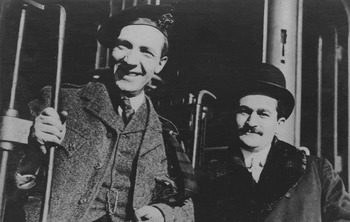
On 15 February, Morris cabled his New York office to report that he had signed Lauder to an eight-week contract for $3,000. A later report clarified that the contract was ‘open’, which meant that Lauder was willing to undertake a longer vaudeville stint should Morris manage to convince his London managers to postpone their contracts with him.Footnote 32 Unlike Klaw & Erlanger, who had ‘placed’ Lauder ‘under contract’ as one might ‘place’ a criminal under arrest, Morris had signed Lauder to an ‘open’ contract that positioned the performer as an equal in the exchange relationship and granted him greater flexibility in arranging matters. Should Lauder manage to ‘free’ himself from other contracts, Morris would happily extend his contact and his American tour (Fig. 1).
Harry Lauder in Scottish dress with his agent William Morris at his side, c.1908–9, at the beginning of a working relationship that lasted several decades. Photographer unknown. Courtesy: Harry Ransom Humanities Research Center, the University of Texas at Austin.

Ultimately, it was the complexity of the British music hall booking system that drove Lauder's salary up from $3,000 to $5,000.Footnote 33 Unlike vaudeville acts, music hall performers were expected to contract with individual music hall managers and many performed nightly in multiple theatres. Performers of Lauder's stature often signed lengthy contracts that guaranteed years of employment but were difficult to break.Footnote 34 By contrast, the consolidation of the vaudeville booking system meant that performers no longer were responsible for contracting with individual theatre managers but rather paid a percentage of their income to a booking agent, who arranged for a lengthy tour (on average between fifteen and thirty weeks) along a single circuit of theatres.Footnote 35 Not surprisingly, the simplicity of the American system, which only required acts to perform between two and five times each day in a single location, appealed to many music hall performers, who happily crossed the Atlantic when approached by American agents. The challenge for performers like Lauder was convincing multiple music hall managers to release them from their contracts so they were free to appear elsewhere.Footnote 36 After several more weeks of negotiations, the singer finally secured his release from reluctant managers with the financial support of William Morris.Footnote 37
Thus when Lauder explained to American reporters that he would not be taking home the full amount of his record-breaking salary, he was certainly telling the truth. But this revelation also threatened to undermine his status as a skilful negotiator and self-determining individual by representing him instead as an indentured servant who owed his liberation to Morris. Anxiety about Lauder's perceived emasculation through commodification helps to explain why Morris devoted so much energy to a marketing campaign that emphasized Lauder's thriftiness and cunning in financial matters. By drawing attention away from the lengthy negotiations that had extended Lauder's ‘commodity phase’, Morris sought to reaffirm his client's subjectivity while playing into American stereotypes of the ‘canny Scot’.
Performing thrift/performing Scottishness
When Harry Lauder first returned to England in December 1907 after five weeks of playing to sold-out crowds at the New York Theatre, he spoke to reporters about his experience in the ‘land of dollars’. Asked whether he had brought his $12,500 earnings ($2,500 a week) home, he replied that only half of it (a thousand pounds in gold) had travelled with him: the rest remained in the United States. Lauder's American shopping spree was unexpected from a man who otherwise typified stereotypes of Scottish behaviour – an irony that was not lost on American journalists. As one writer quipped, ‘If this is true Mr. Lauder certainly cast Scotch traditions to the winds during his visit to New York. A Scotchman who will spend $5,000 in five weeks is worthy of a niche in the Hall of Fame’.Footnote 38
Ten months later, any lingering questions about Lauder's atypical (un-Scottish) attitude towards money were resolved by numerous accounts of the performer's frugality. ‘Harry Lauder has been represented as a man who was never known to spend a cent for other than bare living expenses’, the New York Telegraph reported. ‘The Scotchman has been considered by universal acclaim the president, incorporator and managing director of the International Order of Tight Wads’.Footnote 39 ‘You know Lauder is rather fond of holding onto his money’, echoed the Toledo News Bee in recounting the story of an outraged waiter chasing Lauder down the street for failing to tip him properly.Footnote 40 Instead of denying these stories, Lauder acknowledged the Scottish reputation for thrift. In an interview with the New York Telegraph, he presented a mini-history of Scottish culture and society, in which he attributed Scottish thrift to centuries of toil and struggle, compounded by long-standing ethnic rivalries between Highlanders and Lowlanders. ‘Racial traits, in my opinion, are matters of circumstances and environment’, he explained. ‘The closeness and thrift of the Scotch can be traced back to historical circumstances.’Footnote 41 While this interview may have been ‘canned’ – that is, prefabricated by Morris's staff and distributed in a press package – it nevertheless positioned Lauder as the archetypal ‘canny Scot’.
Morris complicated Lauder's portrayal of thriftiness with reports about the singer's charitable donations. For example, upon Lauder's return to the United States in 1909, Morris's brother Hugo told reporters that the performer had willingly volunteered his services at the ship's concert and donated fifty dollars towards the Seaman's Fund.Footnote 42 Rather than undoing Morris's other promotional work, such stories kept alive the question of Lauder's ‘true’ disposition: was he really a skinflint or was it all a performance? This marketing tactic recalls those used by nineteenth-century showman P. T. Barnum. Just as Barnum published contradictory accounts of freakish wonders like the Feejee mermaid to keep audiences guessing and talking about his museum, Morris seems to have purposefully ‘leaked’ stories that challenged previous press reports, presenting his client as a fascinating enigma.Footnote 43
In fact, Morris's decision to build his marketing campaign around Lauder's offstage performance of frugality can be read as a bizarre inversion of P. T. Barnum's promotional campaign for international singing sensation Jennie Lind. As Neil Harris details, Barnum alerted American audiences to the ‘Swedish Nightingale's’ forthcoming tour in 1850 by publishing accounts of the many charities she supported with the proceedings from her public appearances, firmly situating her within the prevailing ideology of ‘true womanhood’.Footnote 44 By emphasizing Lind's kindness, purity and charity and de-emphasizing her rapid circulation within a capitalist economy, Barnum addressed middle-class Americans anxieties about lavish displays of wealth and high-earning female performers. Although Morris framed his star in a much less flattering way, he nevertheless shared Barnum's primary motivation, namely shifting public discourse away from discussions of the vast sums of money his client was earning towards discussions of his client's attitude towards money. By accentuating Lauder's stereotypical Scottish frugality, he de-emphasized the singer's status as vaudeville's most eagerly sought-after commodity and a foreigner at that, reconstituting him as a masculine subject emerging from a lengthy and very public ‘commodity phase’.
Newspaper articles and interviews frequently represented the singer as a careful manager of resources, a hard worker who embodied the Protestant work ethic. Many of these stories recounted the singer's Horatio Alger-like rise from humble beginnings as a coal miner to his glorious success as the world's most highly paid vaudeville performer.Footnote 45 While acknowledging his status as the most highly paid and therefore most valued performer in vaudeville, these stories characterize Lauder as an active, willing participant in his own commodification, a ‘canny Scot’ who succeeded in getting the salary he felt he deserved. These stories illustrate how, in historian Arthur Herman's words, ‘The Scottish reputation for thrift became merely the reverse side of his reputation for hard work, good business sense, and his penchant for success’.Footnote 46 Herman attributes the rise of the thrift stereotype to a combination of factors, including Scotland's ‘long legacy of national poverty’, its deep Calvinist heritage and the international success of Scottish intellectuals, politicians, lawyers and economists. ‘By the middle of the eighteenth century the impressive sight of Scotsmen on the make was glaringly apparent to all’, he writes.Footnote 47 The stereotype of the thrifty Scot thus emerged from within and without, from the material conditions and values that shaped Scottish society and from the reactionary accusations of those who felt threatened by Scottish success. In light of the stereotype's complicated history, Lauder's embrace of the ‘thrifty Scot’ role may be interpreted as a deliberate strategy to deflect public anger away from him personally. By confirming American suspicions of the ‘Scot on the make’, he implied that his success as a foreigner was linked to an inherent ethnic tendency; it was something that lay beyond his control.
Descriptions of Lauder's thoughtful – if somewhat severe – attitude towards money differed significantly from the stories that circulated about high-earning female performers. As M. Alison Kibler has shown, women who earned more than a thousand dollars a week in vaudeville were regularly depicted as irrational, irresponsible consumers, who gave no thought to their fiscal future as they frittered away their money buying dresses, jewellery and other trinkets.Footnote 48 These representations were entirely consistent with the gendering of consumption at the turn of the twentieth century, typified by accounts of the overstimulated, emotionally vulnerable female shopper unable to resist the lures of urban department stores.Footnote 49 When juxtaposed with accounts of feminine indulgence, stories of Lauder's rational, responsible consumption (or abstinence from consumption) reaffirmed his masculine identity.
Lauder's portrayal of rational consumption may also have struck a chord with American audiences concerned about fluctuating financial markets. His first New York appearance in the fall of 1907 coincided with a major Panic on Wall Street that had rocked the country and led to calls for economic reform.Footnote 50 ‘I am told that Scotsmen become liberal spenders and careless money-tossers’ when they immigrate to the United States’, Lauder noted in a 1909 interview. ‘It is the climate, the environment. Sometimes I myself am almost tempted to buy a drink. So far, however, I have held fast, but I may los[e] my grip at any moment’.Footnote 51 Although joking, Lauder's portrayal of consumer susceptibility to the lures of American commerce (and alcohol) may have resonated strongly with American audiences, particularly men, concerned that they too were losing a ‘grip’ on their financial situation.
Performing Scottish national identity
Lauder's performance of thrift was but one of a series of ‘ethnicized’ performances orchestrated by Morris in an effort to brand Lauder as the epitome of all things Scottish. Dressed in a kilt offstage as well as on and surrounded by a cadre of bagpipers wherever he travelled, the singer reaffirmed and legitimated existing stereotypes about the clothing, music, language, behaviour and disposition of the Scottish. For example, when asked whether he ever got cold wearing a kilt, he replied, ‘I'm never so comfortable as in the Highland costume, whatever the weather’.Footnote 52
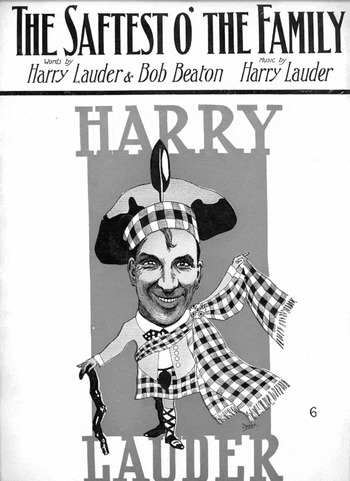
In many respects, Morris's promotional campaign was an extension of Lauder's onstage portrayal of Scottish types. These ranged from the sincere suitor in ‘I Love a Lassie’, to the daft but endearing schoolboy in ‘The Saftest o’ the Family’ (Fig. 2). During his 1907 appearance at the New York Theatre, Lauder delighted audiences with his expansive sampling of Scottish types and the apparent ease with which he slipped from one character to another. ‘The secret of Lauder's power is that he resorts to only the simplest method of portraying character’, explained one reviewer. ‘He builds up his types so instantly and projects them into his hearers’ sympathies in a flash’. The writer then comments on Lauder's delivery of monologues ‘in jargon as Scotch as the heather itself, yet perfectly understandable . . . The slightest of “burrs” and a rolling of the “r” puts the plaid all over his language’.Footnote 53
Sheet music for one of Lauder's most beloved songs, ‘The Saftest o’ the Family’, 1904. Sold for ten cents a piece, sheet music like this extended Lauder's name, image and characters far beyond the vaudeville stage. Author's collection.

As the above quote suggests, what distinguished Lauder from other ethnic impersonators, particularly those portraying Irish or Dutch/German characters, was his apparent authenticity and the affective connection he established with audiences. For as much as he portrayed a series of caricatured types in his songs, Lauder also performed out of character, speaking directly to the audience between numbers and often between verses of songs. In his analysis of music hall singing, Peter Bailey explains how, in breaking role, the performer not only ‘becomes most obviously accessible to the audience as himself or herself’, but also paradoxically strengthens the characterization ‘through the revelation of the self that is invested in the role’. He concludes that these ‘shifts in and out of role and self, artifice and autobiography, allowed the audience to see, as it were, the joins in the performance’.Footnote 54 Part of the pleasure, then, for audiences viewing such acts came from observing how the machinery of performance works. In other words, by stepping out of character, music hall singers like Lauder not only strengthened their affective bond with the audiences, but also allowed the audience in on the joke, exposing the artifice of their performances.
Yet while Lauder's performance style may have highlighted the performativity of the Scottish types he portrayed onstage, his offstage appearances in Highland dress, his piper escort and his performances of thrift affirmed, to the contrary, that the Lauder who seeped through the performances was no fake Scot but the real thing. This assurance of authenticity was particularly important for members of the Scottish diaspora looking for cohesive symbols of the homeland during a period of rapid cultural and economic change. Lauder's portrayal of Scottish frugality and his overall projection of a coherent, readily identifiable Scottish type gave Scottish Americans a chance to celebrate Scottish culture and perform their membership within the Scottish diaspora.
Between 1890 and 1920, approximately 250,000 Scottish Americans lived in the United States, many of whom belonged to one of the 1,200 local Scottish societies that sprang up in this period.Footnote 55 Often named after St Andrew, the patron saint of Scotland, these societies were charitable organizations dedicated to helping the poor. Many Scottish Americans were also avid members of ‘Caledonian’ clubs, which sponsored game days, complete with Highland dancing, pipe bands and games of strength and endurance.Footnote 56 Such performances of ethnic identity became increasingly important to the Scottish diaspora as waves of immigrants from eastern and southern Europe entered the United States, transforming the demographic and cultural make-up of the country. Even as the Scottish themselves were outnumbered by the arrival of millions of immigrants – Italians, Russians, Germans, Hungarians, Swedes, Poles – loud, flamboyant and decidedly masculine displays of Scottish culture heightened Scottish visibility within the evolving social imaginary.
Harry Lauder's tours of the United States gave Scottish Americans an ideal opportunity to stage bold spectacles of Scottishness. For example, when Lauder arrived in New York in 1908, he was greeted by a pipe band, likely made up from members of the recently formed New York Scottish Highlanders.Footnote 57 In December, when he performed in Pittsburgh, he was greeted by the more established Pittsburgh Bagpipe Band Society, founded in 1900.Footnote 58 Similar spectacles greeted Lauder in Washington, Philadelphia, Boston, Chicago and other stops on his multi-city tour. Scottish societies also used Lauder to boisterously declare their presence. At a performance in Chicago, for example, the Scottish Americans in attendance ‘made themselves audible in hoarse cries that seemed to express pleasure’. Towards the end of the performance,
one of the Scots mounted the platform . . . and thundered an announcement that after the show was over Mr. Lauder ‘would have much pleasure in meeting only’ – and then he mentioned the organizations whose members would be privileged to grasp the hand of the great man.Footnote 59
By claiming a close connection to Lauder, these organizations affirmed their importance and legitimacy within the larger cultural community.
The displays of Scottish pride that accompanied Lauder on his travels are also significant when considered alongside the spectacles staged by militant Irish nationalists in this period. In January 1907, a large group of Irish protestors led by members of the nationalist Clan na Gael and Gaelic League organizations shouted down the Russell Brothers, a vaudeville duo best known for their ‘Irish servant girl’ act, forcing them off the stage of the Victoria Theatre. Although the Russell Brothers changed the name of the act and cut the most offensive material for their subsequent appearance at the Orpheum in Brooklyn, the Irish protestors refused to accept this compromise, pelting the stage with eggs and lemons. In the end, over twenty men were arrested for their participation in the ‘Orpheum Riot’. In her analysis of these events, M. Alison Kibler situates the explosive reaction to the Russell Brothers within the ‘the overlapping contexts of the transatlantic Gaelic Revival, physical force nationalism, and martial ethnocentrism of the Irish in America’.Footnote 60
Lauder's arrival in New York nine months after the ‘Orpheum Riot’ and his return to New York the following year encouraged the articulation of a distinctive Scottish nationalism that, unlike its Irish counterpart, was not antithetical to Scottish membership within Great Britain but which nevertheless supported diasporic fantasies of the homeland. Beginning in the mid-nineteenth century, a form of ‘unionist nationalism’ developed in Scotland, which supported efforts to celebrate Scotland's unique history and heritage without threatening the nation's position within the Union.Footnote 61 By the turn of the century, many Scots at home and abroad had adopted a ‘unionist nationalist’ perspective, positioning themselves, either explicitly or implicitly, in opposition to the militant nationalism promoted by the Gaelic League.
Thus while Lauder's performance of thrift was a clever promotional strategy arranged by William Morris to draw attention away from his commodity status, it also legitimated a bold spectacle of nationalist sentiment at a time when Scottish Americans were reclaiming their Scottish heritage. Through the consumption of Lauder performances, books, records and various related Lauder-commodities, thousands of men and women embraced their Scottish identity, while affirming Lauder's economic and affective value as the epitome of all things Scottish.