Although cross-sectional studies offer valuable insights about the determinants of specific policy choices, it is now widely accepted that a richer understanding of policy cycles in any particular domain demands analysis of a decade or more.Footnote 1 Scholars have increasingly turned their attention to historical patterns of policy development, seeking to explain the dynamics of policy stability and change over time.Footnote 2 The predominant depiction of policy development that emerges from this literature is a stepped, evolutionary pattern characterized by relatively long periods of policy stability, punctuated by moments of significant change.Footnote 3 However, recent studies suggest that the historical pattern of policy change may vary depending on the characteristics of the policy domain under examination and the nature of the policy subsystem that surrounds it.Footnote 4
This article focuses on a specific policy domain—emergency management policy—which is defined here as a course of action chosen by public authorities to address unforeseen, urgent situations that pose a serious risk to life, health, or property, and that exceed the normal coping capacity of organizations and governments. Historical analyses of emergency management in the United States generally tell a story of “disaster-driven evolutionary changes,”Footnote 5 whereby periods of relative policy stability are disrupted by major emergencies, which prompt governments to adopt a new course of action. These accounts portray a cyclical, contingent pattern of policy development, involving repeated attempts to address the “emergency problem” in the aftermath of sporadic disasters. Whereas emergency management is normally the province of technical experts working with little attention from elected officials and the general public, major emergencies subject policies to critical scrutiny, giving rise to a brief flurry of policy redesign, which is normally focused on the most recent event.Footnote 6 Occasionally new policies supplant previous ones, but in most cases they are “layered” on top of one another, gradually increasing the scope and complexity of emergency management.
With the above model as its point of departure, this article traces the history of emergency management policy in the province of Ontario. Before 1950, Ontario had virtually no formal procedures, at either the provincial or local level, to cope with emergencies. Sixty years later, there are detailed provincial response plans and every municipality is required to implement a comprehensive program to prevent, prepare for, respond to, and recover from emergencies. What factors contributed to this seemingly dramatic policy transformation? In what ways have the goals and instruments of emergency management policy changed throughout this period? The article evaluates variation in policy scope and content over six decades, and examines the conditions that gave rise to policy change throughout this period.
The longitudinal analysis confirms the broad contours of the pattern noted above: current policy is the result of a long, evolutionary process involving many rounds of policy development, and emergencies were the primary impetus for most of the policy cycles. However, by applying insights from existing studies of event-driven policy change, and by disaggregating policy content into multiple components, the analysis uncovers a more complex and nuanced picture of policy development. In addition to domestic emergencies that focused critical attention on emergency management, there is also evidence of other change-inducing mechanisms, including circumstances in the broader political environment that disrupted otherwise stable policy routines, emergencies in other jurisdictions that impelled policymakers to consider potential, future harms, and ideas circulating in the international community, which were incorporated into domestic practice. Furthermore, it finds that although emergency management policy has evolved in a fragmented, piecemeal pattern, over time successive cycles of policy redesign have resulted in a robust framework for dealing with emergencies.
Students of American disaster policy will note similarities between the history of emergency management in the United States and that of Ontario, particularly since many major emergencies mobilized policy communities on both sides of the Canada-U.S. border. Perhaps the most notable difference is the influence of the federal government. Whereas American historical accounts attribute much of the national and subnational policy development in this field to the leadership of the federal government, and to the Federal Emergency Management Agency (FEMA) in particular, Canada’s system has evolved in a more decentralized fashion. There is no federal agency analogous to FEMA, and provincial policy frameworks have evolved in relative isolation from one another. Although the article examines a single provincial case, Ontario’s historical experience is fairly representative of the changing nature of emergency management policy in other provinces, and in Canada as a whole.
THE POLITICAL CONTEXT OF EMERGENCY MANAGEMENT
Analysts have long observed that emergency management is a low-salience political issue, which generally attracts little public attention.Footnote 7 Under normal conditions, emergencies are not regarded by citizens and politicians as a pressing problem requiring sustained government intervention. Although citizens expect governments to plan for emergencies and to be sufficiently prepared when disaster strikes, there is rarely any explicit public demand for emergency management programs.Footnote 8 Furthermore, both the costs and benefits associated with emergency management are diffuse, so interest groups seldom form to lobby for or against policies in this area.
The characteristics of emergency management policy therefore approximate those of what May refers to as “policies without publics”—low-salience policies that attract little public attention, and that address problems with diffuse impacts, such that there are few incentives for interests to mobilize.Footnote 9 Unlike most issue areas, in which coalitions of interests compete to influence policy choices, as Birkland notes, policy design in the world of policies without publics is dominated by “technical experts acting on their sense of the public interest, not by interest groups or elected officials acting on behalf of public demands for improved policy.”Footnote 10 The community of experts operates with little political scrutiny and there are few opportunities for public participation.
Indeed, in an atmosphere of public and political apathy, emergency management policymaking is dominated by a relatively small, specialized subsystem of government practitioners, policy analysts, private-sector consultants, academics, and nongovernmental agencies. Policy-relevant dialogue about the nature of the problem, policy goals, and preferred instruments flows through various channels, including knowledge-sharing networks, working groups, conferences, and professional development events, but these venues target a specialized audience. The policy specialists are insulated from the political system not because of any active effort to exclude “outsiders” but rather because most people are indifferent to emergency management.
Due to the closed and autonomous nature of the policy subsystem, dominant ideas and values typically crystallize into a stable “policy image,” a shared understanding that structures how policymakers think about and approach the issue. The specialized membership of the subsystem and the dominance of the accepted policy image create a “policy monopoly” that is seldom challenged and tends to remain stable over time. The result is a normal pattern of policy change that is incremental, involving only minor adjustments to the existing course of action.Footnote 11 However, as explained below, emergency management policy is occasionally subjected to wider scrutiny or challenge, setting the stage for significant policy change.
MECHANISMS OF POLICY CHANGE
This section draws on existing policy literature to explain three broad factors that are likely to foster change in emergency management policy. These include: (1) alterations in the political environment that affect the operating conditions of the policy subsystem; (2) attention-focusing events that trigger policy critique, and (3) new ideas and information derived from experience and practices observed in other jurisdictions, which are incorporated into policy design.
Changes in the Political Environment
Emergency management policy, like all areas of public policy, is subject to change as a result of events or circumstances in the broader political environment. Particularly relevant in this domain are changes at the macropolitical level, such as a change of government, cabinet shuffle, or turnover of key administrators, which can bring to office actors with ideas, values, and beliefs different from those of their predecessors.Footnote 12 For instance, a new elected official might have previous experience with emergencies and thus seek to prioritize and expand emergency management. An administrator taking up a key position might arrive with innovative ideas regarding policy goals or the means by which to achieve them. Of course, new personnel could also choose to maintain the status quo or even reverse previous policy changes.
Socioeconomic conditions can also have an impact on emergency management policy. Public and political apathy between disasters normally permits subsystem members to adopt policies they believe are optimal, within budgetary limits. However, in periods of economic stress, emergency management is vulnerable to fiscal austerity measures, as the hidden nature of the work makes it difficult to demonstrate its value in nonemergency periods, and there is no broad constituency of beneficiaries to mobilize in its defense.Footnote 13
Focusing Events and Policy Windows
In many policy domains, it has been observed that a sudden, unexpected incident can act as a “triggering mechanism,” which draws attention to a problem and precipitates a reexamination of policy.Footnote 14 In his analysis of agenda-setting and alternative selection, for instance, Kingdon refers to a “focusing event” as a relatively rare occurrence that suddenly attracts public and political attention to a problem, creating a critical moment in which the problem, policy, and political streams of the policy system are aligned.Footnote 15 This short-lived “policy window” is an opportunity for a “policy entrepreneur”—a skilled advocate with political resources and access to decision-makers—to propose a preferred solution to the problem highlighted by the event.Footnote 16
Major emergencies and disasters are the quintessential focusing events. In his extensive analysis of focusing events and the policy process, Birkland notes that the novel and unexpected character of disasters is inherently attractive for news media coverage, which in turn arouses the attention of a broader public and provokes questions about the adequacy of policies to address the precipitating hazard.Footnote 17 The surge of attention in the postdisaster period temporarily elevates the salience of the emergency problem, creating a political incentive for elected officials to propose or endorse new policies. All of this activity can disrupt an otherwise stable policy subsystem, as change-oriented groups claim the current policy has failed and advance an alternative course of action in hopes of undermining the policy monopoly. Evidence of disasters as the catalyst for issue expansion and policymaking activity is found in various policy domains.Footnote 18
Both Kingdon and Birkland stress that a focusing event is an opportunity only and does not automatically result in policy change. For change to occur, the policy window must be seized by a persuasive policy entrepreneur or organized coalition of interests to promote an alternative proposal.Footnote 19 But as noted above, the low-salience world of emergency management offers little incentive for such concerted mobilization. A flurry of interest in the postdisaster period can motivate new actors to temporarily enter the policy milieu, but their attention quickly wanes as seemingly more pressing problems occupy the public agenda, and emergency management is again relegated to the periphery.Footnote 20 As Birkland puts it: “After disasters, public and policy-makers’ interest in disaster preparation, mitigation and relief rapidly but briefly increases, driven either by their need to respond or by dramatic news media accounts of disasters in neighboring states or communities. The interest in disasters and possible responses to disaster then fades rather quickly. The next disaster rekindles interest, and the cycle repeats.”Footnote 21
However, a major emergency or disaster can also prompt subsystem members themselves to question the adequacy and appropriateness of current policies.Footnote 22 Sometimes a major event has direct negative impacts that the members regard as evidence of policy failure. In other cases a smaller emergency, or a disaster in another jurisdiction, foreshadows potential future harms. As the experts reflect on such focusing events, they evaluate anomalies observed between the accepted policy image and actual experience, and adjust courses of action in an attempt to reconcile the two. As such, while major emergencies and disasters can be exogenous shocks to the emergency management policy subsystem, they can also trigger an endogenous change mechanism—policy learning—whereby policymakers apply knowledge accumulated from experience to revise policy designs.Footnote 23
Policy Learning
Policy learning involves a notable shift in the behavior of subsystem members toward a problem, which results from the incorporation of new ideas and information into policy design.Footnote 24 May asserts, for instance, that learning can influence policy design at both a strategic and operational level.Footnote 25 The former, dubbed social policy learning, involves a rethinking of fundamental causal beliefs about the nature of a problem and policy goals for addressing it, which results in either reaffirmation or alteration of these key policy components. In the latter form—instrumental learning—information about policy performance is used by policymakers to evaluate “the viability of policy instruments or implementation designs,”Footnote 26 which results in adaptation and adjustment in an attempt to more effectively achieve policy objectives.
In some cases, policy learning stems from the observed performance of policies that, when perceived as a failure, can prompt a rethinking of fundamental policy goals or implementation strategies. In this policy domain, a reevaluation can be triggered by a disaster, which serves as a focusing event and mobilizes subsystem members to reflect on the experience, consider new ideas, and apply accumulated information to policy design.Footnote 27 As Birkland notes, “there is prima facie evidence of learning if policy changes in a way that is reasonably likely to mitigate the problem revealed by the focusing event.”Footnote 28 A longitudinal study of flood management policy in Florida, for example, concludes that policymakers learn from repeated flood events by proposing increasingly rigorous policies to reduce flood risks.Footnote 29 Policy learning also involves drawing lessons from ideas or practices observed in other jurisdictions.Footnote 30 Faced with complex problems, policymakers naturally look for solutions that have proven effective in other places. All governments take some measures to protect citizens from emergencies, and many of the problems facing emergency managers are virtually universal, so policymakers have many opportunities to learn from practices adopted elsewhere.
Based on the discussion above, it is reasonable to expect that emergency management policy in a particular jurisdiction evolves over time as a result of both incremental adjustments and moments of significant change. Moreover, the issue-attention dynamics of the policy field, which result from the sudden and unexpected nature of emergencies, suggest a pattern of policy development that is cyclical, involving sporadic, repeated attempts to address the emergency problem. The objective of the historical analysis presented below is to assess how the three broad factors discussed above influenced the development of Ontario’s emergency management policy, and to analyze the pattern of policy evolution over time.
MEASURING POLICY CHANGE
How does one measure policy change? Emergency management policy content generally includes a set of desired ends, which range from high-level ideas about ultimate goals to precise, operational objectives selected to target certain types of emergencies in specific contexts. Policy content also includes an implementation strategy involving various instruments—exhortation, spending, legislation, regulation, and so on—which provides the means to achieve the policy goals. Each of these policy components can change over time.
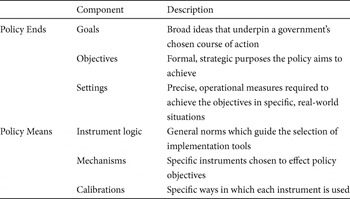
Here the article draws on a model developed by Howlett and Cashore, which offers a taxonomy of six policy elements subject to change over time.Footnote 31 The ends or aims of policy can be conceptually separated into three parts: (1) general policy goals, which are the broad ideas that underpin a government’s chosen course of action; (2) programmatic objectives, which refer to formal, strategic purposes the policy aims to achieve; and (3) settings, meaning precise, operational requirements to achieve the objectives in specific, real-world situations. Policy means—the implementation strategy chosen to achieve policy goals—comprise three interrelated elements: (1) an instrument logic, meaning the general norms that guide the selection of implementation tools; (2) mechanisms, which are the specific instruments chosen to effect policy objectives; and (3) calibrations, meaning the specific ways in which each instrument is used. These six objects of policy change are summarized in Table 1. Distinguishing between the policy elements equips the analyst with a sensitive instrument to detect variations in policy scope and content, and to identify patterns of policy development.
Objects of policy change

Source:
Adapted from Michael Howlett and Benjamin Cashore, “The Dependent Variable Problem in the Study of Policy Change: Understanding Policy Change as a Methodological Problem,” Journal of Comparative Policy Analysis 11, no. 1 (2009): 33–46.
The next section presents the historical analysis of Ontario’s emergency management policy from 1950 to 2010, which is divided into a number of distinct periods. For each phase, changes in the various policy elements are evaluated and the influence of the change drivers identified above is assessed.
EMERGENCY MANAGEMENT POLICY IN ONTARIO
Ontario is located in east-central Canada and, with roughly 12 million inhabitants, is the country’s most populous province. It has a Westminster-style political system: the head of government is the premier, who is the leader of the party with the most seats in the Legislative Assembly, a unicameral legislature whose members represent the province’s 107 electoral districts. The provincial bureaucracy is organized into departments and agencies under the executive authority of cabinet ministers selected by the premier.
Over the past sixty years, emergency management policymakers in Ontario have faced two primary challenges. The first has been to ensure that the provincial government itself has a capacity to respond to emergencies. Securing human and financial resources has often been a struggle for provincial emergency planners, because the benefits of their work normally go unnoticed, except in the rare event that an emergency requires provincial mobilization. The second challenge has been to find ways of ensuring local governments plan for emergencies. Provincial officials have utilized various policy instruments in order to bring about municipal action in this area.
Civil Defense (1950–1960)
The origins of emergency planning in Ontario can be traced to the late 1940s. After World War II, all levels of government became active in civil defense, which involved planning for an armed attack on Canada, particularly one involving nuclear weapons. A Civil Defense Organization was created in the federal Department of National Defense in 1948, and its coordinator was tasked with establishing a liaison with provincial and municipal governments.Footnote 32 The policy goal of civil defense planning, as articulated through official government statements, was to minimize the effects of an enemy attack on the civil population.Footnote 33
Effective civil defense planning required coordination among federal, provincial, and municipal authorities, so the logic guiding implementation was that of a partnership among the three levels of government. At a federal-provincial conference in 1950, delegates negotiated an intergovernmental division of labor whereby Ottawa would establish broad, national policy priorities, while the provinces would coordinate local planning and provide support materials and training.Footnote 34 Ontario’s Municipal Act was amended in 1950 to authorize municipal governments to pass by-laws establishing civil defense committees,Footnote 35 and a central Civil Defense Committee was formed in the Department of the Provincial Secretary. This small unit was responsible for coordinating and supporting municipal civil defense, which it achieved largely through information-based instruments, such as planning guides and training courses. Financial incentives were also employed: in 1952, the Civil Defense Financial Assistance Program was created to provide federal and provincial grants to local governments to pay for training, exercises, and equipment.
By the mid-1950s, most municipalities were participating in regional Civil Defense Organizations and were establishing collaborative preparedness programs. Policy development centered on two objectives: protecting citizens from direct impacts of a nuclear attack, and preserving government decision-making capacity and services. Specific settings to achieve these objectives included mapping evacuation routes from urban areas, surveying buildings that could serve as fallout shelters, and stockpiling items like radiological detection equipment and medical supplies. The threat of nuclear war dominated Ontario’s emergency planning throughout the 1950s, driven largely by federal persuasion and financial incentives.
Peacetime Emergency Measures (1960–1975)
In October 1954, the Toronto region was struck by Hurricane Hazel, a massive tropical storm that brought high winds and torrential rain, causing the worst flooding in two hundred years.Footnote 36 The storm killed 81 people and left nearly 7,500 homeless, and the estimated total cost of the disaster was over $1 billion.Footnote 37 Although the hurricane was portrayed in media reports as an unexpected “act of God,” policymakers interpreted its impacts as the tragic outcome of poor planning decisions.Footnote 38 The event generated significant debate among the members of the emergency management subsystem, who noted that the existing war-oriented policy focus was insufficient to address the risks posed by natural hazards. By the late 1950s they had become convinced that planning should extend beyond its narrow focus on civil defense to address “peacetime” emergencies.
Reflecting the new policy image, in 1960 the government announced that emergency planning would be spearheaded by a new Emergency Measures Branch in the Department of Planning and Development.Footnote 39 The Emergency Measures Act was passed in 1963, which distinguished between emergencies caused by “real or apprehended war, invasion or insurrection” and those triggered by natural causes.Footnote 40 It set out a prescriptive implementation strategy, specifying that every municipality “shall formulate a plan to provide for the continued functioning of municipal government and the necessary services of the municipalities in the event of an emergency.”Footnote 41 The Emergency Measures Branch was authorized to collect and amend the plans, and to make subsequent regulations with respect to local emergency planning. The regional Civil Defense Organizations were renamed Emergency Measures Organizations, and by the mid-1960s there were forty-six such units across the province, covering 96 percent of the population.Footnote 42
The 1964 annual report of the Emergency Measures Branch reflected the new policy direction, stating that “the main emphasis in our work is being placed on developing the means of combating local natural emergencies.”Footnote 43 At a federal-provincial conference in June 1965, provincial delegates lobbied the federal government for increased attention to peacetime emergencies. Interest in peacetime emergency planning was heightened in November of the same year by the “Great Northeastern Blackout,” in which a cascading system failure interrupted power to nearly 30 million people in Ontario, New York State, and New England.Footnote 44 Various types of potential peacetime emergencies—hurricanes, floods, airplane crashes, and so on—began to figure more prominently in local disaster simulation exercises, as well as in provincial information materials distributed to municipalities.Footnote 45
Whereas emergency management before 1960 had been oriented exclusively to threats originating from outside Canada’s borders, the shocking devastation of Hurricane Hazel in 1954 prompted policymakers to reconsider the appropriateness and efficacy of this war-oriented focus. The general policy goal of peacetime emergency measures, which expanded on that of the civil defense period, was to ensure an effective response to both war-related and peacetime threats in order to minimize their impacts on citizens. Programmatic objectives remained the protection of life and property and the continuity of government and public services. However, targeting a broader range of hazards meant that the suite of specific, operational policy settings grew considerably, to include priorities such as structural flood protection, public education, and backup power generation.
The creation of the Emergency Measures Branch marked a change in instrument logic, which shifted the implementation strategy from a bottom-up, partnership approach to a centralized system of formal oversight. In order to compel local action, the province chose a more coercive implementation mechanism, using legislation to mandate municipal emergency plans and to monitor compliance. Municipal governments put up little resistance to this top-down mandate, mainly because they still had access to federal and provincial grants to finance their programs.
Regressive Change: The “Lead Ministry” Approach (1975–1980)
Although the expanded, peacetime policy image had become firmly entrenched among members of the policy subsystem, many provincial politicians continued to regard emergency planning as a primarily war-related function.Footnote 46 In the late 1960s, treaties signed by the global nuclear powers established a period of détente, diminishing fears of nuclear war and the Government of Canada’s interest in supporting local emergency planning. By 1973, the annual federal grants had been halved, Footnote 47 and were eliminated completely a few years later. Ontario temporarily increased its funding to sustain the local Emergency Measures Organizations, but soon announced that emergency planning would be restructured.Footnote 48
In 1975, Ontario’s economy was weakened by recession and the province faced a $1.6 billion deficit.Footnote 49 Preparing for a fall election, the governing Progressive Conservative party implemented a number of austerity measures, including a plan to reduce the size of the public service by 2.5 percent. In introducing the annual budget, then Treasurer Darcy McKeough announced that “all programmes are being reviewed with a view to eliminating those, such as the Emergency Measures Organization, which have outlived their usefulness.”Footnote 50 It was later confirmed that the Emergency Measures Branch would be eliminated and replaced by a “lead ministry” strategy, which would decentralize emergency planning by assigning individual departments the responsibility for preparedness within their functional areas.Footnote 51 The announcement came as a shock to the emergency planners, who recognized that they had failed to adequately sell decision-makers on the importance of the new policy objectives.Footnote 52 The unit ceased operations at the end of 1975.Footnote 53 In April 1976, a bill was passed that repealed the Emergency Measures Act and did away with provincial grants, effectively eliminating both the legal and financial impetus for local emergency planning.Footnote 54
By the late 1970s, therefore, the scope of Ontario’s emergency management policy had been scaled back dramatically. Although the provincial government claimed that emergency preparedness would remain a priority, there was no longer a central organization to coordinate plans. The instrument logic appeared to reflect a belief that emergency planning was of declining importance. The primary implementation instrument—the Emergency Measures Act—had been repealed, rendering municipal emergency planning discretionary. Intergovernmental grants were discontinued, removing the chief financial incentive for municipalities to plan for emergencies.
Technological Emergency Planning (1980–1990)
At the end of the decade, two high-profile focusing events again increased the salience of emergency preparedness. The first was a partial core meltdown at the Three Mile Island nuclear power plant near Harrisburg, Pennsylvania, in March 1979.Footnote 55 In its wake, the media probed Ontario’s readiness for a nuclear accident or other serious emergency. As one journalist wrote, “A nuclear crisis raises the question of how well the province is prepared to cope with other calamities—floods, fires, lethal chemical spills—all more likely than a runaway reactor.”Footnote 56 These concerns was underscored seven months later when, in November 1979, a Canadian Pacific train derailed near Mississauga, a community just west of Toronto.Footnote 57 When several ruptured tanker cars leaked their contents, vapors ignited, triggering a massive explosion and fire. Upon discovering that some of the derailed cars contained chlorine, emergency officials evacuated more than two hundred thousand residents, many of whom could not return to their homes for nearly a week.Footnote 58
The Three Mile Island crisis and the Mississauga train derailment generated significant attention among provincial politicians and the public, creating pressure for policy change. The derailment indicated weaknesses in the province’s capacity to handle major emergencies and signaled that municipal emergency planning was insufficient to manage transportation risks. In response, the Progressive Conservative government, by this time in its third term of office, ordered an official inquiry to investigate railway safety concerning dangerous goods. Among many other recommendations, the inquiry report asserted that municipal governments should be given clear authority to undertake emergency measures.Footnote 59
The government moved swiftly, reversing its previous policy decision by creating a new Emergency Planning Office in the Ministry of the Solicitor General in May 1980.Footnote 60 Its functions were essentially those of the former Emergency Measures Branch: developing provincial plans and response resources, and facilitating and supporting municipal emergency planning.Footnote 61 A discussion paper was circulated to local governments in 1981, outlining proposed legislation that would give municipal authorities the power to declare emergencies and to pass by-laws providing for emergency programs.Footnote 62 Feedback from municipalities was generally positive, but they asserted that provincial grants should be created to support local planning.Footnote 63
The Emergency Plans Act was passed in 1983, requiring all provincial departments to formulate a plan governing the necessary provision of services during an emergency, and these plans would be coordinated through the Emergency Planning Office. With respect to municipal planning, the legislation borrowed heavily from the 1963 Emergency Measures Act, but this time the language was permissive, stating that “the council of a municipality may pass a by-law formulating or providing for the formulation of an emergency plan.”Footnote 64 The provincial government chose not to provide any new financial assistance.
Meanwhile, the members of the policy subsystem had turned their attention to the risk of a large-scale accident at one of Ontario’s five nuclear power generation plants. In its first years of operation, the Emergency Planning Office spent considerable time consulting with communities and stakeholders and a number of exercises were held to test nuclear response procedures.Footnote 65 A document providing guidance on nuclear emergency planning was distributed to municipalities in 1984,Footnote 66 and a Provincial Nuclear Emergency Plan was completed in 1986.Footnote 67 This was the same year as the worst nuclear disaster in history, in which an explosion and fire at the Chernobyl nuclear power plant in Ukraine caused the release of a large amount of radioactive material.Footnote 68 Heightened public and political concern sparked by this focusing event accelerated nuclear emergency planning in Ontario.Footnote 69 The Emergency Planning Office was renamed Emergency Planning Ontario and was expanded to include a special nuclear preparedness unit, which would assist communities with nuclear emergency planning.Footnote 70
The policy focus on technological emergencies was also reinforced by a disastrous accident at a pesticide factory in Bhopal, India, in 1984, which released a lethal chemical gas.Footnote 71 Nearly three thousand people were killed within the first few days and more than three hundred thousand others were exposed to the toxic fumes.Footnote 72 The disaster focused public and political attention on industrial safety and prompted officials in many jurisdictions, including Ontario, to evaluate whether emergency plans were adequate to cope with major industrial accidents.Footnote 73 A primary outcome was the Major Industrial Accidents Council of Canada (MIACC), a nonprofit association of public officials, industrial actors, trade unions, academics, and others, formed to integrate municipal and industrial planning to prevent and manage emergencies involving hazardous materials.Footnote 74
Ontario’s emergency management policy changed significantly throughout the 1980s. By the end of the decade, a centralized agency had been reestablished in the provincial bureaucracy and emergency planning legislation was back in place. The general policy goal was to prepare, at both the provincial and local level, for an effective response to emergencies triggered by both natural hazards and technological risks. The policy objectives of the earlier periods—protecting life and property, and assuring the continuity of government and public services—were preserved, but were expanded to include a greater emphasis on prevention. This wider policy focus necessitated new “on-the-ground” settings, such as training hazardous material teams, exercising nuclear emergency protocols, and integrating technological risks into land-use plans.
Drawing lessons from the focusing events noted above, emergency management professionals became convinced that achieving effective preparedness at the community level would require a partnership between municipal governments and industry. Working from this implementation logic, Emergency Planning Ontario sponsored the activities of MIACC and assisted the organization in developing professional best practices concerning joint municipal-industry emergency planning.Footnote 75 MIACC had professional credibility, which lent support to the provincial government’s objective of encouraging good-quality municipal emergency planning.
Integrated, All-Hazards Emergency Management (1990–2003)
In the early 1990s, a new paradigm of “integrated, all-hazards” emergency management had taken root in the United States and other countries, driven largely by an expanding body of research on the causes and consequences of disasters.Footnote 76 The model advocated plans flexible enough to address any emergency, regardless of the triggering event. Furthermore, it expanded the policy goals beyond the traditional focus on preparedness and response to include hazard mitigation—actions to prevent or reduce the impacts of emergencies—and recovery, which involved planning to restore a community after an emergency. The United Nations’ declaration of the 1990s as the International Decade for Natural Disaster Reduction served to further diffuse these ideas through the international policy community, prompting governments in many countries, including Canada, to focus more attention on emergency management.Footnote 77
The ideas resonated with the members of Ontario’s policy subsystem, who sought to emulate the approach within the province. A Provincial Emergency Response Plan was completed in 1992, which integrated the emergency-related responsibilities of the various provincial ministries and established a coordinated framework for response.Footnote 78 Reflecting its broadened objectives, Emergency Planning Ontario was renamed Emergency Measures Ontario (EMO) in the mid-1990s, and its internal structure was adjusted to direct resources toward mitigation and recovery.
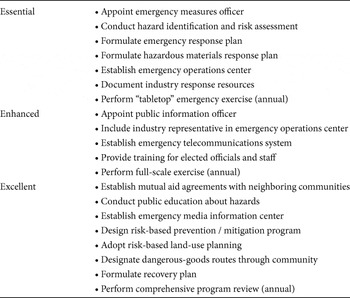
Most hazard mitigation measures, such as land-use zoning to limit property exposure in floodplains, necessitated action by municipal governments, so operationalizing the integrated, all-hazards model required local buy-in. In 1997, EMO launched a program called Partnerships Toward Safer Communities, which was the first concerted attempt to standardize municipal emergency planning.Footnote 79 Municipalities were exhorted to partner with local industry to implement an emergency program complying with three progressive sets of standards—Essential, Enhanced and Excellent—which are summarized in Table 2. Although the program was voluntary, successful implementation carried prestige for communities, as Certificates of Achievement were awarded to those that proceeded through the various levels.Footnote 80
Partnerships toward safer communities: Standards

Source:
Adapted from Major Industrial Accidents Council of Canada, Community Self-Assessment Tool (Ottawa, 1999), 10–11.
Influenced by ideas circulating in the international policy community, during the 1990s Ontario’s emergency planners adjusted their policy focus toward ensuring provincial ministries and local communities were prepared with flexible plans and procedures to respond to any type of emergency. As the standards in Table 2 indicate, the programmatic objectives were expanded considerably during this period to include prevention and mitigation of emergencies and measures to facilitate effective community recovery. Specific, operational settings included, for instance, establishing designated routes for the transportation of dangerous goods, implementing hazard-warning protocols, and formulating recovery plans. However, the primary emergency legislation during this period, a slightly revised version of the Emergency Plans Act, continued to reflect a noncoercive instrument logic, as municipalities were authorized, but not required, to formulate emergency plans.Footnote 81 Emergency Measures Ontario adapted to this legal framework by employing a different instrument—the Partnerships Toward Safer Communities program—which set out specific performance standards and publicly recognized participating communities.
Risk-Based, Comprehensive Emergency Management (2003–2006)
In January 1998, eastern Ontario was struck by a massive ice storm, which severely damaged power transmission infrastructure and left millions without electricity.Footnote 82 A total of sixty-six municipalities declared a state of emergency, the highest number of simultaneous community emergencies for a single event in the province’s history. Although many of the affected communities had emergency plans, these had not been well maintained and many municipal officials were unfamiliar with their contents.Footnote 83 Critics attacked the permissive nature of provincial policy concerning municipal emergency planning and pointed to the storm’s impacts as a striking indicator of failure.Footnote 84
The Progressive Conservative government under the leadership of premier Mike Harris, which had secured a second term of office in the 1999 election, responded to the negative attention by directing EMO to formally evaluate local emergency planning and recommend ways to improve Ontario’s policy framework.Footnote 85 A review team developed a proposal, which outlined mandatory standards for municipal emergency management, and it was to be submitted to the cabinet in October 2001. However, the intergovernmental political climate at the time was hostile toward top-down mandates, as the Harris government had undertaken a massive service realignment between the province and municipalities in its first term (1995–99), which had generated considerable resentment from local governments.Footnote 86 Because the proposal was a significant departure from current practice, the review team was skeptical that it would be adopted.Footnote 87
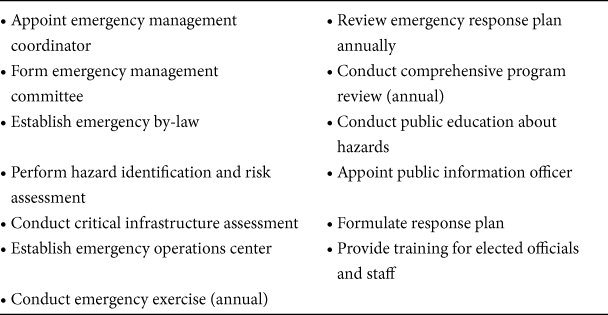
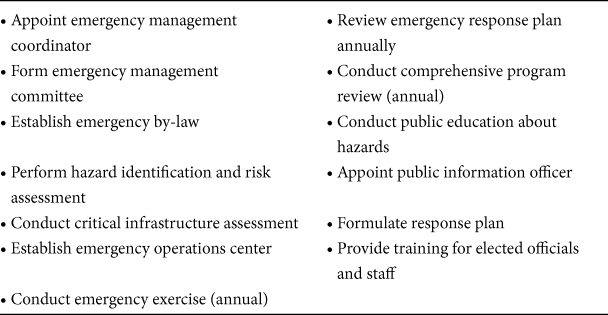
The terrorist attacks of September 11, 2001 (9/11) were ultimately the catalyst for policy change. The event focused media and public attention on the state of community readiness for disasters, and the government faced difficult questions from opposition politicians in the Legislative Assembly.Footnote 88 Recognizing that a policy window had opened, EMO officials moved swiftly to capitalize on the unusual political interest, proposing new legislation that would give authoritative sanction to their policy proposal. The premier and cabinet were persuaded, and in December 2001 the government introduced a bill to replace the Emergency Plans Act with the Emergency Management Act, requiring every municipality to implement a comprehensive emergency management program.Footnote 89 Emergency Measures Ontario was renamed Emergency Management Ontario and its budget was doubled. Standards for municipal programs were mandated through regulations passed in 2004 (Table 3).
Municipal emergency management program standards
Source:
Ontario, Ontario Regulation 380/04 (Toronto, 2004).
The general goal governing Ontario’s emergency management policy after 9/11, as articulated in a framework document published by EMO, was “to ensure that a proactive, coordinated and comprehensive approach to managing emergencies is in place to reduce the significant risks faced by Ontario communities.”Footnote 90 The policy image had expanded to incorporate a heavier emphasis on terrorism, which had rapidly become a central concern for the emergency planning community.Footnote 91 The revised policy incorporated three notable objectives. First, emergency management was to be risk-based, meaning hazards would be assessed, and those that presented the greatest risk would be prioritized. Second, emergency management was to be comprehensive, meaning that it was to incorporate the four “pillars of emergency management”: prevention and mitigation, preparedness, response, and recovery.Footnote 92 Third, high priority was given to hardening “critical” infrastructure systems, such as water distribution networks and electricity grids, to protect them from both natural hazards and terrorist threats. But the most significant change was made to the implementation strategy, which shifted from a permissive, discretionary approach to a top-down, mandatory framework of performance standards and annual reporting requirements.
A number of factors underpinned the emergence of risk-based, comprehensive emergency management. The policy cycle was arguably rooted in the Partnerships Toward Safer Communities program, which set out specific, measurable standards that provincial authorities hoped would systematize local emergency management. The failure of this voluntary program was ultimately signaled by the devastating impacts of the 1998 ice storm, which focused negative public and political attention on the perceived inadequacy of emergency planning. Within the subsystem, the event convinced provincial policymakers that a more coercive instrument was necessary to compel municipalities to undertake comprehensive planning, and this instrumental learning was evidenced by their proposal calling for mandatory standards. When the terrorist attacks of 9/11 again raised the salience of emergency management, the planners were ready to exploit the policy window, marketing their proposal as a solution to the emergency problem.
Emergency Management and Civil Protection (2006–2010)
Two significant emergencies in 2003 prompted further policy changes. The first occurred in March, when dozens of people in Toronto were infected by an outbreak of Severe Acute Respiratory Syndrome (SARS).Footnote 93 The second involved a major power blackout in August, which left 50 million people in Canada and the United States without electricity, including 9 million in Ontario.Footnote 94 A provincial state of emergency was declared in both cases, and postemergency assessments were critical of preparedness and response procedures.
Upon winning the election in October 2003, a new Liberal government initiated a review of Ontario’s emergency management policies.Footnote 95 Several months of hearings with experts and the public resulted in a report, which recommended legislation to clarify executive emergency powers.Footnote 96 In June 2006, the Emergency Management Act was amended and renamed the Emergency Management and Civil Protection Act, providing more authority for the premier to issue emergency orders in the interests of public safety.Footnote 97 Changes were also made to the administrative structure. A Commissioner of Emergency Management was appointed to advise the government on emergency management policy and to coordinate provincial emergency response.Footnote 98 In December 2007, this office was subsumed within a broader portfolio of Deputy Minister of Emergency Planning and Management.Footnote 99
Meanwhile, the SARS crisis focused the attention of the policy subsystem members on the risks associated with an infectious disease outbreak, and this hazard has since been prioritized at both the provincial and local level. Particular attention has been devoted to planning for an influenza pandemic—the rapid, widespread transmission of a novel and highly contagious strain of the influenza virus. Since 2003, the Government of Ontario has implemented a range of pandemic preparedness measures, and an integrated provincial response plan was issued in 2008.Footnote 100 Many municipalities have also prepared pandemic plans, as strongly encouraged, but not required, by the provincial government.Footnote 101
EVALUATING POLICY CHANGE
Ontario’s current emergency management policy has developed over time, involving a sequence of repeated attempts by public authorities to address the emergency problem. This section summarizes changes in the scope and substance of policy throughout the period using the six-component framework outlined above. It then assesses the overall pattern of policy development.
Scope and Substance of Policy Change
Goals. The broad goal of Ontario’s emergency management policy has remained relatively stable throughout the sixty-year period. The general idea governing policy development in the civil defense era, which continues to underpin emergency management today, is that public resources are required to ready the province and its communities to cope with unexpected events. This involves ensuring that provincial units are organized to respond to emergencies, and that municipal governments have measures in place to cope with hazards within their borders.
Objectives. The formal, programmatic purposes of emergency management policy have evolved over time as the range of perceived threats has expanded. Early civil defense planning centered on protecting citizens from the direct impacts of a nuclear attack and the preservation of government decision-making capacity and services. In response to the devastating effects of Hurricane Hazel, the focus of emergency planning was expanded in the 1960s to include peacetime emergencies such as natural disasters, which required less generic and more location-specific measures. In response to technological risks in the 1980s, partnerships with local industry were prioritized, to augment municipal response resources and to prevent emergencies.
In the 1990s, the policy focus shifted in response to ideas circulating in the international community, which emphasized measures to reduce vulnerability, mitigate the impacts of emergencies, and ensure an effective recovery. In the post-9/11 era, terrorism and infectious disease outbreaks assumed greater prominence, necessitating more extensive collaboration between professional emergency managers, law enforcement officials, and health-care providers. Due to the number and diversity of potential threats communities face, modern emergency management doctrine embraces a risk-based approach, which involves identifying hazards and directing resources to those that pose the greatest risk.
Settings. As the policy objectives have expanded, so has the range of “on-the-ground” settings required to put them into effect. Whereas planning in the civil defense era involved a relatively narrow set of response-related activities, such as establishing emergency shelters and designing evacuation protocols, modern, contemporary emergency management involves dozens of operational measures targeted at prevention, preparedness, response, and recovery.Footnote 102 This extensive suite of policy requirements has developed cumulatively over many years as disasters have revealed new planning challenges and lessons have been drawn from emergency experiences in other jurisdictions.
Instrument logic. Ontario has long recognized that policy intervention is required to influence the content and quality of municipal emergency planning, but the norms guiding instrument selection have changed over time. Whereas municipal governments were regarded as partners in the civil defense period, provincial policy became more prescriptive in the 1960s, reflecting the logic that municipalities must be compelled to plan for peacetime emergencies. This contrasts with the repeal of emergency planning legislation and the dismantling of the Emergency Measures Branch in the 1970s, which appeared to signal a belief that emergency planning is a local function, to be supported only passively by the province. Although the legislation and bureaucratic structure were reinstated in response to technological emergencies in the early 1980s, the implementation strategy continued to reflect a preference for a noncoercive approach, since municipalities were empowered, but not required, to produce emergency plans. This logic prevailed until 9/11, which again precipitated a shift to a more prescriptive implementation strategy, involving mandated program standards and a formal reporting regime.
Mechanisms and calibrations. The instruments chosen to compel municipal planning have been remarkably consistent over the period, but the calibrations—the specific ways in which the tools have been used—have varied over time. First, for most of the past sixty years, there was some form of emergency-related legislation, which set out the powers and responsibilities of municipal governments. But as the provincial instrument logic varied, so too did the nature of the emergency statutes. Whereas municipalities had a permissive mandate in the civil defense period, legislation concerning planning for peacetime emergencies in the 1960s was more prescriptive. The law was repealed completely in 1976, but was then reinstated in 1983, albeit once more in a permissive form. The statutory framework survived until 9/11, when a new law was passed, compelling all municipalities to engage in comprehensive emergency management.
Second, information-based instruments have been a consistent element of the provincial implementation strategy. Throughout each of the periods of policy evolution, the Government of Ontario distributed published materials to orient municipalities toward the province’s current policy priorities, and provided training to indoctrinate local officials in new approaches and techniques. The quantity and diversity of information dissemination has increased over time as emergency management objectives have broadened in scope.
Third, despite a long-standing demand from local governments for funding to support emergency planning, the provincial government has consistently resisted spending as an implementation instrument. Provincial grants offered in the civil defense period were eliminated in the 1970s and were never reinstated, reflecting an apparent belief that emergency management is a local function, which should be funded through the municipal budget. Finally, Ontario has long relied on exhortation as a means to spur municipal planning for emergencies, and the nature of provincial-municipal communication in this field has evolved over time. For decades provincial officials struggled to persuade reluctant municipal politicians to invest in emergency planning. Today they frame emergency management as a matter of due diligence, meaning that local governments have a moral and legal obligation to take reasonable precautions to protect citizens and their property from hazards.
Pattern of Policy Development
Over the past sixty years, Ontario’s emergency management policy has undergone a number of distinct cycles of policy development. Only one period, the budget-cutting years of the mid-1970s, involved a significant termination or reversal of the existing policy approach. In most cases, policy objectives and settings were expanded and “layered” on top of one another to create a more comprehensive course of action. Most changes were relatively minor and incremental, but their cumulative effect over time has significantly transformed the scope and content of emergency management policy.
Although the specialized nature of emergency management gives experts considerable autonomy in policy formulation, the subsystem is nevertheless subject to changing circumstances in the broader political system. For instance, the beliefs of key decision-makers, coupled with a recession, prompted the provincial government to eliminate the Emergency Measures Branch in the mid-1970s, which had a significant impact on emergency management policy for the next five years. Similarly, the election of a new Liberal government in 2003 prompted a review of emergency management and subsequent changes to provincial policy. However, over the sixty-year period, changes in the macropolitical arena have not played a major role in the development of Ontario’s emergency management policy. Neither changes in the partisan political leadership nor in the senior administration of the department responsible for emergency management, resulted in significant shifts in policy scope or content.
Policy change was primarily driven by events—major domestic emergencies, as well as disasters in other jurisdictions—which focused attention on emergency planning. However, there is little evidence of issue expansion or interest-group mobilization in the sense that a broader range of participants became actively involved in the policy dialogue. Elected officials responded to public attention and critique in the aftermath of major emergencies by making some legislative and administrative changes, but the specifics of policy development were ultimately deferred back to the subsystem, the members of which adjusted the policy approach based on their professional judgment of the needs and priorities in this field. Even after 9/11, the most striking focusing event to occur during the period, it was the subsystem specialists who served as policy entrepreneurs, exploiting the policy window to propose their preferred course of action.
Learning has been the primary mechanism of policy change, whereby the specialists amended the province’s course of action to fit with ideas and information learned from emergency experience, and to incorporate attractive ideas and practices observed elsewhere. Most of the policy changes over the sixty-year period reflect instrumental learning, in that policymakers mainly adjusted operational settings and instrument mechanisms and calibrations in response to evidence of poor policy performance. However, the evolution of the ideas and objectives that underpin emergency management policy reflects some prima facie evidence of social policy learning over time. For instance, whereas disasters were once considered random “acts of God,” today there is widespread acceptance in the policy community that although hazards trigger emergencies, efforts to reduce vulnerability can significantly mitigate their ultimate impacts.Footnote 103 Policy learning is also evidenced in the transfer to Ontario of ideas developed in the international policy community: the expansion of policy objectives in the early 1990s to include hazard mitigation and disaster recovery stemmed from ideas that had taken hold in the United States and other countries. This illustrates how practices can diffuse among jurisdictions through interested policy actors.
CONCLUSION
All governments must formulate policies to address unforeseen, urgent situations that pose a serious risk to life, health, or property, and that exceed the normal coping capacity of organizations and governments. Ontario’s emergency management policy has changed considerably over the past six decades. What began as a narrowly focused civil defense effort in the 1950s has expanded into a comprehensive course of action designed to prevent or reduce hazard impacts, increase community preparedness, strengthen response capacity, and aid in restoring and rehabilitating affected communities.
Consistent with historical accounts of emergency management in the United States, this longitudinal analysis confirms that policy in this domain evolves through a sequence of repeated attempts to improve policy performance. Policy change is primarily incremental in nature, involving relatively modest adjustments to policy objectives and settings, and instrument mechanisms and calibrations, by specialists with expertise in this field. Major emergencies and disasters are focusing events that set the stage for more significant policy change, but mainly insofar as they trigger internal mobilization, whereby experts redesign policies to incorporate learned ideas and information.
The dynamics of policy stability and change is one of the most intriguing aspects of policy analysis. This article has applied theoretical insights from the policy literature to examine and explain the evolution of emergency management policy—a “policy without a public,” which is handled almost exclusively by a closed, autonomous subsystem. It is hoped that the findings contribute to the comparative study of policy dynamics across different policy domains.