INTRODUCTION
The ascomycetes that inhabit the intertidal zone of sandy beaches constitute an ecological group of marine saprobic microorganisms that live between or on the surface of sand grains. These fungi represent a key component of the biodiversity in intertidal habitats, because they degrade organic matter containing lignin, cellulose or chitin deposited by the sea on marine beaches contributing to the process of remineralization of the nutrients (Kohlmeyer & Kohlmeyer, Reference Kohlmeyer and Kohlmeyer1979; González, Reference González, Felder and Camp2009). Additionally, other trophic levels depend on these saprotrophic fungi to cleave lignocellulose that can enter the food web through mycophagic invertebrates and bacteria (Newell & Porter, Reference Newell, Porter, Weinstein and Kreeger2000). Marine ascomycetes have been reported to be important sources of novel bioactive metabolites that may have biotechnological applications; also they are useful as bioindicators, and potentially as bioremediators of beaches polluted with hydrocarbons since they have been proved to use n-hexadecane, n-tetradecane, l-hexadecene and pristane as sole carbon sources for growth (Kirk & Gordon, Reference Kirk and Gordon1988; Kirk et al., Reference Kirk, Dyer and Noe1991; Liberra et al., Reference Liberra, Jansen and Lindequist1998; González & Hanlin, Reference González and Hanlin2010).
Since the pioneering study of Barghoorn & Linder (Reference Barghoorn and Linder1944) on marine lignicolous species, the study of marine fungi inhabiting sandy beaches was notably enhanced with the publication of Kohlmeyer & Kohlmeyer (Reference Kohlmeyer and Kohlmeyer1979), followed by several studies undertaken by Kohlmeyer (Reference Kohlmeyer1960, Reference Kohlmeyer1962, Reference Kohlmeyer1963, Reference Kohlmeyer1968a) and Tubaki (Reference Tubaki1966, Reference Tubaki1968). Subsequently, many papers on sand beach fungi have been published; some recent contributions are those of authors who have described new species of this group of fungi (Koch, Reference Koch1986; Nakagiri & Tokura, Reference Nakagiri and Tokura1987; Kohlmeyer & Volkmann-Kohlmeyer, Reference Kohlmeyer and Volkmann-Kohlmeyer1989, Reference Kohlmeyer and Volkmann-Kohlmeyer1997; Sundari et al., Reference Sundari, Vikineswary, Yusoff and Jones1996; Abdel-Wahab et al., Reference Abdel-Wahab, Nagahama and Abdel-Aziz2009; Jones et al., Reference Jones, Sakayaroj, Suetrong, Somrithipol and Pang2009). Presently, 530 species of marine fungi are described, and only 64 of them have been recorded in Mexico (González et al., Reference González, Hanlin and Ulloa2001; Jones et al., Reference Jones, Sakayaroj, Suetrong, Somrithipol and Pang2009; Velez et al., Reference Velez, González, Rosique-Gil, Cifuentes, Reyes-Montes, Capello-García and Hanlin2013; Velez et al., in press).
The first study of marine fungi in Mexico was made by Kohlmeyer (Reference Kohlmeyer1968b), and since then only few reports have been published (González & Herrera, Reference González and Herrera1993; González et al., Reference González, Herrera, Ulloa and Hanlin1998, Reference González, Hanlin, Herrera and Ulloa2000, Reference González, Hanlin and Ulloa2001; González, Reference González, Felder and Camp2009; González & Hanlin, Reference González and Hanlin2010; Velez et al., Reference Velez, González, Rosique-Gil, Cifuentes, Reyes-Montes, Capello-García and Hanlin2013). So, the diversity of marine ascomycetes inhabiting around 70% of the Mexican coasts on the Pacific Ocean, Gulf of Mexico and the Caribbean Sea remains mostly unexplored (González et al., Reference González, Hanlin and Ulloa2001; Velez et al., Reference Velez, González, Rosique-Gil, Cifuentes, Reyes-Montes, Capello-García and Hanlin2013). Consequently, the geographic and ecological patterns of these fungi remain poorly understood.
Moreover, Mexican beaches represent highly populated and deteriorated ecosystems (Merino, Reference Merino1987). Especially, the littoral of the Tabasco State in the Gulf of Mexico where large offshore petroleum developments of the Petróleos Mexicanos, one of the world's largest petroleum companies, are negatively affecting the marine biodiversity (Botello et al., Reference Botello, Gofii and Castro1983; Rivera-Arriaga & Villalobos, Reference Rivera-Arriaga and Villalobos2001; Petróleos Mexicanos, 2013). This area is also characterized by high fecal pollution due to the discharge of wastewaters from human settlements (Rosas et al., Reference Rosas, Yela and Báez1985). Velez et al. (Reference Velez, González, Rosique-Gil, Cifuentes, Reyes-Montes, Capello-García and Hanlin2013) conducted a preliminary evaluation of the diversity of marine fungi from one site in Tabasco State (Paraíso Beach) as part of a large-scale survey of the Gulf of Mexico, and barely reported two species concluding that the diversity of marine ascomycetes might be threatened by anthropogenic activities in this region. Several authors have noted the critical need to study the biodiversity inhabiting endangered ecosystems (i.e. Kerr et al., Reference Kerr, Sugar and Packer2000). Considering that the coastline of Tabasco State represents a particularly highly deteriorated ecosystem, the importance of registering the mycobiota at a local scale in this area is evident.
Therefore, the aims of this work were (1) to estimate the diversity of marine arenicolous ascomycetes from 10 sandy beaches spread along the coast of the state of Tabasco, (2) to assess patterns of community differentiation given by geographic distance, (3) to determine the association between abundance and community structure and (4) to evaluate the relationship between the sand textural parameters and the biodiversity registered in the studied beaches.
MATERIALS AND METHODS
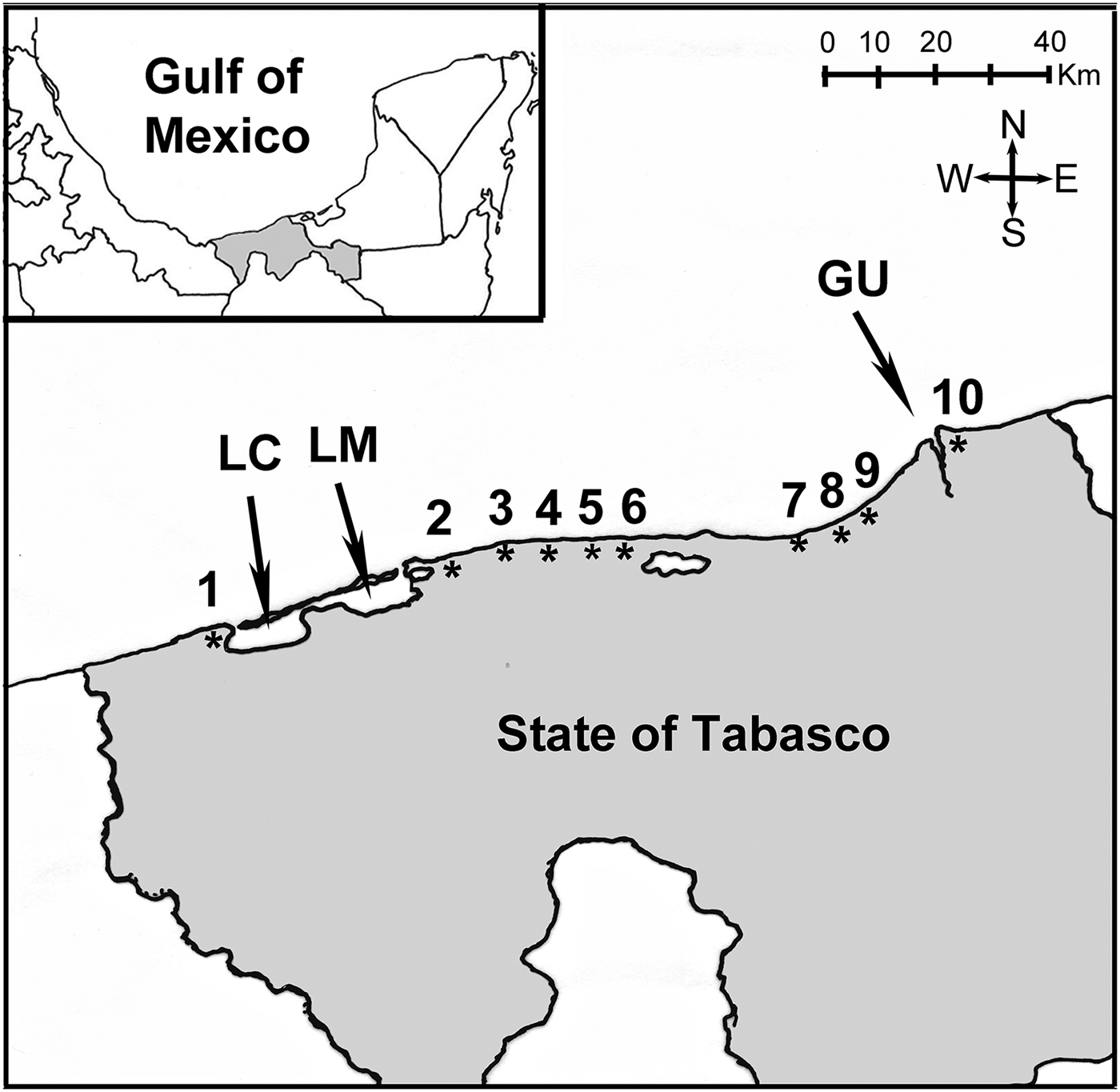
Tabasco State is located in the southeast of Mexico with 184 km of coastline in the Gulf of Mexico. For more than 60 years, the oil industry has been present in the littoral of this state, resulting in highly petroleum-polluted coastal ecosystems (Botello et al., Reference Botello, Gonzalez and Diaz1991; Ponce-Vélez et al., Reference Ponce-Vélez, Vázquez-Botello, Díaz-González and García-Ruelas2012). Ten exposed sandy beaches were sampled during low tide (Figure 1). We collected a total of 200 samples in the intertidal zone consisting of washed-up detritus (woody debris, algae wrack and other organic remains) covered with moist sand from the collecting site placed in Ziploc® plastic bags. In the laboratory, the samples were incubated for 12 months in moist chambers at 25°C and a 12 h photoperiod under cool white lights (to induce the production of fungal reproductive structures), and examined monthly for the presence of fungi. The ascomata that developed on sand grains in moist chambers, were used for observation and isolation. To identify the recovered fungi, ascomata were removed from sand grains with a flame-sterilized needle, then opened in a drop of distilled water on a slide using dissecting needles, and covered with a cover slip. We identified the ascomycetes based on the morphology of ascomata, asci and ascospores, using the taxonomic keys of Kohlmeyer & Kohlmeyer (Reference Kohlmeyer and Kohlmeyer1979), Kohlmeyer & Volkmann-Kohlmeyer (Reference Kohlmeyer and Volkmann-Kohlmeyer1991), Hyde & Sarma (Reference Hyde, Sarma, Hyde and Pointing2000) and Jones et al. (Reference Jones, Sakayaroj, Suetrong, Somrithipol and Pang2009). Fungi were measured and photographed using a Nikon Eclipse 80i. For preservation, dehydrated specimens, slides and cultures were deposited at the Colección de Hongos del Herbario Nacional (MEXU) of Instituto de Biología, Universidad Nacional Autónoma de México.
Location of the studied beaches in the coast of the State of Tabasco in the Gulf of Mexico: (1) Sánchez Magallanes (18° 17′ 38.75″ N 93° 52′ 18.53″ W), (2) Tupilco (18° 25′ 47.1″ N 93° 25′ 18.3″ W), (3) La Unión (18° 26′ 03.2″ N 93° 22′ 22.3″ W), (4) Dorada (18° 26′ 12.7″ N 93° 18′ 16.9″ W), (5) Mar de Plata (18° 26′ 18.1″ N 93° 17′ 20.9″ W), (6) Paraíso (18° 26′ 19″ N 93° 13′ 4.3″ W), (7) Pico de Oro (18° 27′ 0.6″ N 92° 52′ 14.8″ W), (8) Unnamed beach (18° 30′ 10.47″ N 92° 46′ 27.70″ W), (9) Miramar (18° 29′ 40.9″ N 92° 47′ 04.4″ W), (10) El Bosque (18° 36′ 43.7″ N 92° 40′ 41.9″ W). Arrows: GU, Grijalva/Usumacinta delta; LC, Lagoon El Carmen; LM, Lagoon Machona.

Species richness (N) was considered as the number of species registered in a site. The frequency of occurrence (F) was calculated from number of occurrences of a specific taxa divided by the total number of samples ×100 (Magurran, Reference Magurran2004). The species diversity of each beach was calculated using Shannon–Wiener (H′) species diversity index. Correlations between distance matrices for taxon composition and geographic location, and taxon composition and overall abundance were analysed using the Mantel test. The diversity data and distance matrices of marine ascomycetes recorded from the beaches of the Gulf of Mexico were analysed utilizing the statistical software R version 2.15.2 (R Development Core Team, 2012) using the packages: ade4, vegan, gclus, FD, FactoMineR, perturb, Hmisc, ape and raster (Paradis et al., Reference Paradis, Claude and Strimmer2004; Dray & Dufour, Reference Dray and Dufour2007; Laliberté & Shipley, Reference Laliberté and Shipley2011; Hendrickx, Reference Hendrickx2012; Hurley, Reference Hurley2012; Hijmans & Etten, Reference Hijmans and van Etten2013; Husson et al., Reference Husson, Josse, Le and Mazet2013; Oksanen et al., Reference Oksanen, Blanchet, Kindt, Legendre, Minchin, O'Hara, Simpson, Solymos, Stevens and Wagner2013; Harrell Jr & Dupont, Reference Harrell and Dupont2014).
Lastly we analysed the sand textural characteristics of the studied beaches as proposed by Carranza-Edwards (Reference Carranza-Edwards2001) and compared the results with the biodiversity recovered from each site.
RESULTS
We observed a wide variation in the amount and assemblage of substrata in the studied beaches. Sánchez Magallanes Beach was dominated by a great amount of plant debris, principally mangrove and water lily remains; in Tupilco Beach we mainly recorded palm leaf remains; in the beaches of La Unión, Dorada, Mar de Plata, Miramar and unnamed we registered palm leaf and driftwood remains, though in the beaches of Miramar and unnamed the amount of litter was greater than in the beaches of La Unión, Dorada and Mar de Plata since the latter are located near a complex of private beach houses where organic litter is cleaned away periodically; the beaches of Paraíso and Pico de Oro represent important beach destinations in the State of Tabasco, consequently the organic litter is cleaned away very often, so we were only able to find a few palm and timber remains; in El Bosque Beach substrata was primarily water lily debris. Moreover, we detected an association between a small amount of substrata in the beach (in touristic sites where wrack is cleaned) and low diversity values of marine fungi. However, high diversity values were obtained from beaches where the wreckage was diverse, containing water lily, plant, driftwood and mangrove remains.
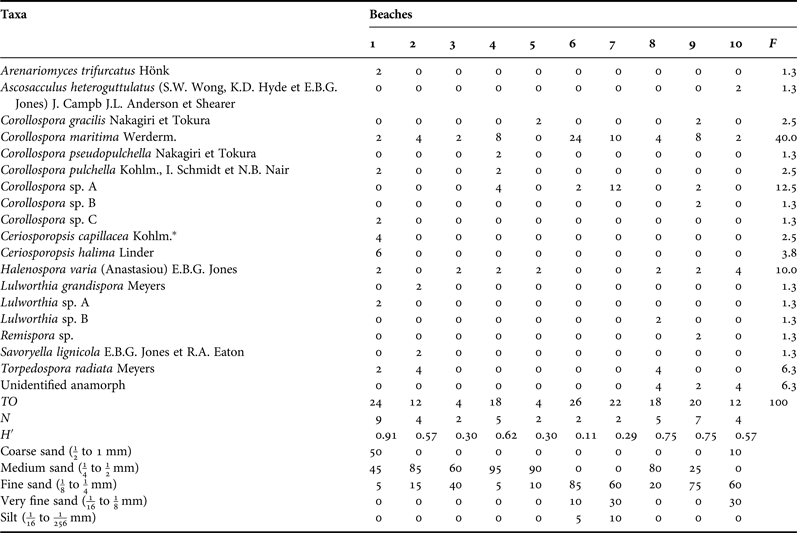
Out of 200 samples, 160 presented fungal development and supported 19 ascomycetes (Table 1). The beaches of Paraíso (H = 0.11) and Pico de Oro (H = 0.29) obtained the lowest values of diversity, whereas Sánchez Magallanes Beach exhibited the highest value (H = 0.91). In the studied beaches we registered strict marine arenicolous fungi (Corollospora and Arenariomyces members), core mangrove fungi (Lulworthia grandispora), freshwater species (Ascosacculus heteroguttulatus) and cosmopolitan marine species (Corollospora maritima, Torpedospora radiata, Ceriosporopsis halima and Savoryella lignicola) (Jones & Pang, Reference Jones and Pang2012). The hydrocarbonoclastic species C. maritima was the most dominant marine fungus. The rare ascomycete C. capillacea was recorded for the first time in Mexico.
Diversity of arenicolous marine ascomycetes from deteriorated beaches in the coast of Tabasco State, Mexico, and sand textural parameters of the collection sites
Sampled beaches: (1) Sánchez Magallanes, (2) Tupilco, (3) La Unión, (4) Dorada, (5) Mar de Plata, (6) Paraíso, (7) Pico de Oro, (8) Unnamed beach, (9) Miramar, (10) El Bosque. F=frequency, TO = total number of occurrence, N = species richness, H′ = Shannon's diversity index, *new record for Mexico. Sand textural parameters are given in percentages.
The geographic distance among the studied sites was not correlated with the species composition (r = 0.1393, P = 0.2103). Moreover, our results showed that diversity and overall abundance were positively correlated (r = 0.5909, P = 0.0002). Finally, we found no clear trend in the relationship between grain size and the diversity observed (Table 1). In the beaches with the lowest diversity values, the grain size composition varied, comprising mostly fine sand (Paraíso Beach) and medium sand (La Unión Beach and Mar de Plata Beach). Whereas in the sites with the highest diversity values, the grain size composition also differed, finding mostly coarse sand and medium sand (Sánchez Magallanes) and fine sand (El Bosque).
DISCUSSION
The 200 sampling units examined supported a total of 19 ascomycetes belonging to the families of Halosphaeriaceae and Lulworthiaceae (Table 1). The Halosphaeriales is the largest order of marine fungi and is comprised of saprophytic ascomycetes occurring on a wide range of substrata whereas the Lulworthiaceae are typically found growing on submerged wood or seaweed (Jones et al., Reference Jones, Johnson and Moss1983, Reference Jones, Sakayaroj, Suetrong, Somrithipol and Pang2009; Kohlmeyer et al., Reference Kohlmeyer, Spatafora and Volkmann-Kohlmeyer2000). Correspondingly, we recorded members of the Halosphaeriales occurring in diverse organic substrata. However, the members of the Lulworthiaceae were strictly found in wood substrata.
The beaches of Paraíso (H = 0.11) and Pico de Oro (H = 0.29) exhibited the lowest values of diversity. This finding agrees with previous observations of low levels of marine mycodiversity in Paraíso beach (Velez et al., Reference Velez, González, Rosique-Gil, Cifuentes, Reyes-Montes, Capello-García and Hanlin2013). This result might be associated with the geographic proximity of these beaches to the discharge delta of the Grijalva/Usumacinta Rivers, the biggest and one of the most polluted in Mexico (Yáñez-Arancibia et al., Reference Yáñez-Arancibia, Ramírez-Gordillo, Day, Yoskowitz and Cato2009). Furthermore, this hydrological system is related to the second largest oceanic region disturbed with a severe and prolonged oxygen deficiency, referred to as a ‘dead zone’ (Rabalais et al., Reference Rabalais, Turner and Wiseman2002; Day et al., Reference Day, Yáñez-Arancibia, Mitsch, Lara-Domínguez, Day, Jae-Young, Lane, Lindsey and Zárate-Lomelí2003; Yáñez-Arancibia & Day, Reference Yáñez-Arancibia and Day2004). The low diversity values might also be related to the impact of the local petroleum industry, since the beaches of La Unión, Mar de Plata and Paraíso are located opposite the off-shore oil extraction platforms Teocalli and Yaxche, and close to Dos Bocas, an important petroleum storage and distribution site (Petróleos Mexicanos, 2009). Furthermore, these two beaches represent important tourist destinations, where debris (including mollusc and crustacean exoskeletons, plant material, driftwood, algae and seaweeds, seagrasses, etc.) is cleaned from the intertidal zone. Therefore, marine fungi inhabiting the coastline are left with no substrata for degradation, which decreases their diversity since these organisms are saprobes.
The highest diversity was obtained from the beach of Sánchez Magallanes (0.91). This result may be related to the geographic location of this beach, which is close to Santa Ana mouth, positively influencing the beach by contributing to a greater quantity and diversity of organic remains originating from El Carmen/Machona mangrove forests (lagoon/estuarine system). Perhaps the greater quantity of diverse substrata benefits the proliferation of marine fungi. Hence, substrata diversity and abundance is an important driver of the diversity of marine fungi inhabiting sandy beaches.
The diversity recovered from the 10 beaches of the State of Tabasco was typical of what has been reported in tropical beaches, with the important presence of the arenicolous genus Corollospora (Jones, Reference Jones, Isaac, Frankland, Watling and Walley1993; Volkmann-Kohlmeyer & Kohlmeyer, Reference Volkmann-Kohlmeyer and Kohlmeyer1993). The members of this genus characteristically represent obligate marine arenicolous ascomycetes. These fungi form their ascomata attached to grains of sand or other hard substrates, and have distinctive and exclusive adaptations to the beach environment conferring on them advantages over exogenous marine fungi (Kohlmeyer & Volkmann-Kohlmeyer, Reference Kohlmeyer and Volkmann-Kohlmeyer1987; González & Hanlin, Reference González and Hanlin2010).
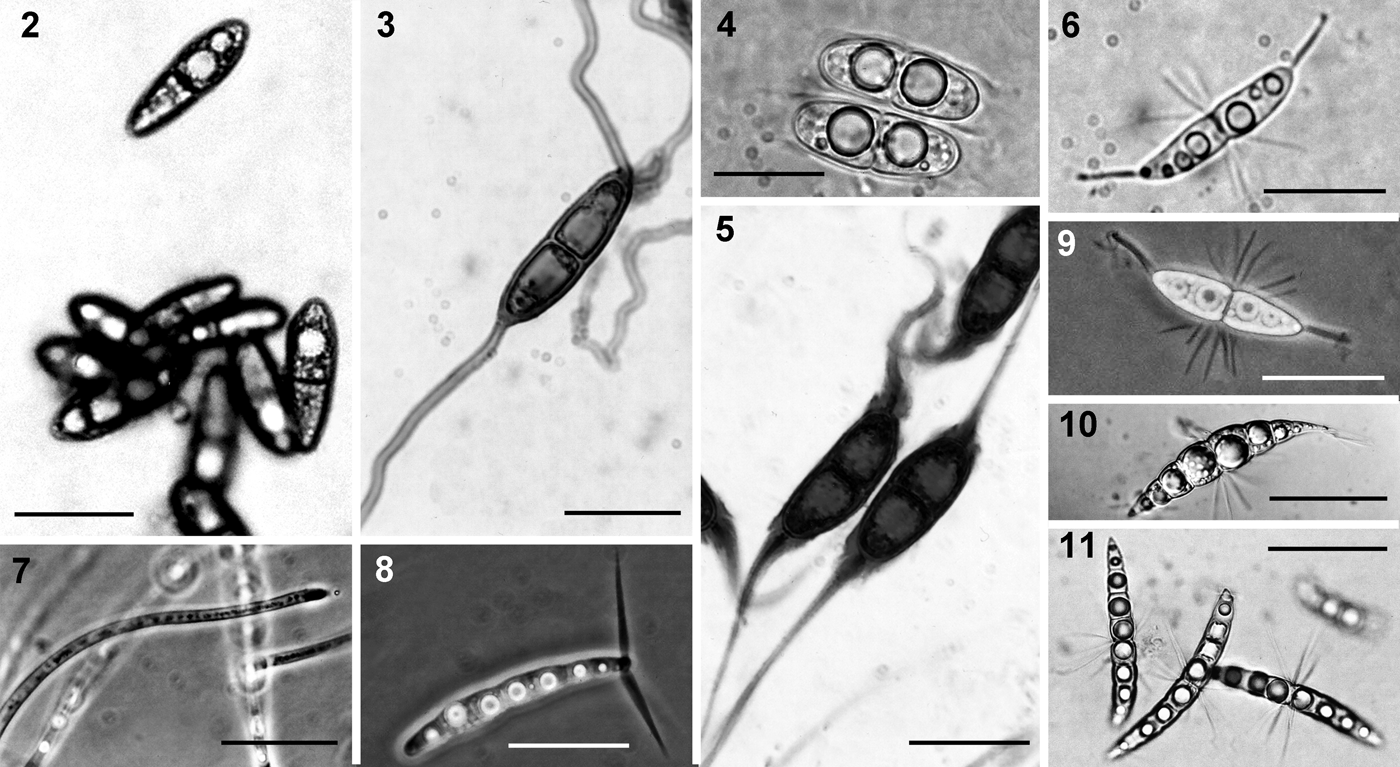
The marine species Arenariomyces trifurcatus, C. halima, Corollospora gracilis, C. pseudopulchella, C. pulchella, L. grandispora, S. lignicola, T. radiata and Halenospora varia are recorded for the first time in the State of Tabasco. However, these species have been previously reported in marine sandy beaches in Mexico (González et al., Reference González, Hanlin and Ulloa2001). Furthermore, C. capillacea was recorded for the first time in Mexico (Table 1, Figures 2–11). This uncommon ascomycete was described from subtidal wood in Martinique (French Antilles), and has been recorded occurring in intertidal driftwood from Taiwan, and from Indian beaches (Kohlmeyer, Reference Kohlmeyer1981; Nambiar & Raveendran, Reference Nambiar and Raveendran2010; Pang & Jheng, Reference Pang and Jheng2012). The presence of this marine taxon in the beach might be due to the occurrence of the spores in water and wood remains originating from the adjacent mangrove forest of El Carmen lagoon.
Ascospores of marine ascomycetes from the coast of Tabasco State, Mexico. (2) Ascosacculus heteroguttulatus. (3) Ceriosporopsis capillacea. (4, 5) Ceriosporopsis halima. (6) Corollospora gracilis. (7) Lulworthia grandispora. (8) Torpedospora radiata. (9) Corollospora maritima. (10) Corollospora pulchella. (11) Corollospora pseudopulchella. Figs 2, 3, 5, stained with gentian violet; 7, 8, 9 with dark field microscopy. Scale bars: 2, 30 µm; 3, 4, 5, 8 and 9, 20 µm; 6 = 25 µm, 7, 75 µm; 10 = 40 µm; 11 = 50 µm.
A collection resembling A. heteroguttulatus was observed in the El Bosque beach, the nearest sampling site to the Grijalva/Usumacinta delta. This freshwater fungus was previously recorded as a dominant species from a heavily polluted urban freshwater lagoon located far from the Gulf coast (Rosique-Gil et al., Reference Rosique-Gil, González and Cifuentes2008). Nonetheless, the information about the viability and ecological function of freshwater ascomycetes in the marine ecosystems is still unclear.
Corollospora maritima was present in almost all of the beaches, having the highest abundance (F = 40.0). The presence of this species in nine of the 10 studied beaches, as well as its high frequency of occurrence, suggests that this species has a wide range of adaptation that permits it to inhabit and fulfil its ecological function in the studied beaches (González & Hanlin, Reference González and Hanlin2010). Additionally, the ability of C. maritima to break down hydrocarbon compounds has granted tolerance to petroleum pollution, allowing this species to inhabit oil-contaminated beaches.
According to the first law of geography, the similarity between two observations often decreases as the distance between them increases (Tobler, Reference Tobler1970). However, our results showed that the geographic distance among the studied sites was not correlated to the species composition (r = 0.1393, P = 0.2103). This finding suggests that geographic proximity is not a strong factor shaping marine fungal communities in the coastline of Tabasco, and might be more related to the amount and variety of debris present in each site, since we observed that in beaches with greater quantity and heterogeneity of debris the fungal diversity was higher. Therefore, future work should focus on the importance of considering the debris type as a fundamental factor determining fungal diversity. Additionally, it has been reported that biotic factors (i.e. competition) play an important role in marine fungal communities (Jones, Reference Jones2000). Hence, we tested the relationship between abundance and species composition in the studied sites. Our results showed that diversity and overall abundance were positively correlated (r = 0.5909, P = 0.0002), implying that the presence of some species inhibits the occurrence of others, thus influencing the overall abundance. Even though literature on antagonistic relationships of marine fungi is scarce, some marine species found in this study such as A. trifurcatus and C. maritima have been reported to have antifungal activity (Strongman et al., Reference Strongman, Calhour, Miller, Miller and Whitney1987; Panebianco et al., Reference Panebianco, Tam and Jones2002). Additionally, our findings support the observations made by Miller (Reference Miller, Hyde and Pointing2000) demonstrating that antibiosis could be a major determinant of population structure of terrestrial fungi.
According to the qualitative examination of the textural parameters in the sand, there is no clear trend in the relationship between grain size and the diversity observed (Table 1). In the beaches with the lowest diversity values, the grain size composition varied, comprising mostly fine sand (Paraíso Beach) and medium sand (La Unión Beach and Mar de Plata Beach). In the sites with the highest diversity values, the grain size composition also differed, finding mostly coarse sand and medium sand (Sánchez Magallanes) and fine sand (El Bosque). Although grain-size parameters might give some indication of environmental conditions and transport dynamics, studies on macroinvertebrates have proved there is no significant effect of grain size on taxa microdistribution (Culp et al., Reference Culp, Walde and Davies1983). It is possible that substrate composition is a major determinant of the diversity and distribution of marine fungi rather than textural parameters of the sand.
ACKNOWLEDGEMENTS
The senior author thanks the Consejo Nacional de Ciencia y Tecnología (CONACYT) for a scholarship and the Posgrado en Ciencias Biológicas, Universidad Nacional Autónoma de México. We are grateful to Jaime Gasca-Pineda for the guidance with statistical analyses. The authors also thank Mario Eduardo Sosa for assistance during fieldwork and the División Académca de Ciencias Biológicas, Universidad Juárez Autónoma de Tabasco for their support to perform this work.
FINANCIAL SUPPORT
This study was funded by project CONACYT (CB-60502). The authors also wish to thank the Instituto de Biología, Universidad Nacional Autónoma de México for supporting field expeditions and laboratory work.