1. BACKGROUND
Conservation of built heritage involves use of urban space and thus opportunity cost. The more developed the economy, the higher the land price, and the more expensive the built heritage conservation is. The problem is that the value of built heritage, while not necessarily lower than that of property development, cannot be easily measured through the market.Footnote 1 Built heritage conservation thus often has to rely on government intervention through urban planning.Footnote 2 But if the government also fails to do so, is there any alternative? This article examines the role of the voluntary sector, the “third way” other than the market and the state, in built heritage conservation, based on a case study in Hong Kong.
In 2001–02, a long-established charity in Hong Kong—the Tung Wah Group of Hospitals—earmarked about US$1.4 million to restore a historical complex, the Tung Wah Coffin Home, to its traditional architectural appearance. In 2005, the Coffin Home won two heritage conservation awards, one conferred by the Antiquities and Monuments Office (AMO) of the Hong Kong Government, and the other one by the United Nations Educational, Scientific and Cultural Organization (UNESCO).Footnote 3 This occurred at a time when the Hong Kong general public was becoming more concerned about conserving local heritage.
The tradition of heritage conservation in Hong Kong has been weak. The early British colonial government was preoccupied with the economic and strategic value of the place. Local cultural heritage was regarded as irrelevant at best, and politically dangerous at worst. It was not until 1976 that the first legislation on heritage conservation—the Antiquities and Monuments Ordinance—was enacted. Yet, heritage conservation still did not attract any serious public attention. The majority of the population was made up of “transients” who came to Hong Kong as refugees or migrants from mainland China. Lacking a sense of belonging, they were more concerned about economic than cultural issues.Footnote 4
However, since the late 1990s, voices have emerged in Hong Kong for conserving local heritage. Through literature writings and mass culture such as movies and television, collective memories were articulated for a number of demolished historical buildings. In response to such sentiment, in 2004, the government published a document to solicit public views on the existing built heritage conservation policy. At about the same time, plans for the reconstruction of some old urban areas, most notably that for Lee Tung Street in Wan Chai area, evoked grassroots conservation movements. In December 2006, the government's action to demolish an old pier resulted in direct confrontation between police and protesters. In view of rising public pressure, the government announced a list of 496 buildings that were being considered for public protection, and decided to enlist more people into the government's Antiquities Advisory Board, a statutory body whose decisions have no binding authority. Nevertheless, these moves could not prevent the emergence of new conservation groups.Footnote 5
In short, growing public demand in recent years has put the Hong Kong government under increasing pressure to be more proactive in heritage conservation. But the above-mentioned successful conservation of the Tung Wah Coffin Home was accomplished not by the government, but by a charity. What does this case tell us about the role of the voluntary sector and its relationship with the government in providing heritage conservation? As will be pointed out later, heritage conservation by voluntary organizations has been quite common among developed countries. Does the case of the Tung Wah Coffin Home suggest that Hong Kong is following this pattern? What are the limitations of this approach, as revealed in the experience of other countries? Before answering these questions, we will first define heritage conservation as an intergenerational public good, to highlight the importance of the voluntary sector in the provision of this kind of good.
2. PROVISION OF HERITAGE CONSERVATION AS AN INTERGENERATIONAL PUBLIC GOOD
Built heritage is a kind of cultural capital whose value
can be attributed to a building, a collection of buildings, a monument, or more generally a place, which is additional to the value of the land and buildings purely as physical entities or structures, and which embodies the community's valuation of the asset in terms of its social, historical or cultural dimension.Footnote 6
To conserve heritage is thus to supply a cultural capital. Because the benefit of such effort is available to all members of the society (i.e., nonexcludable), and consumption of such benefit by one does not reduce its availability to another (i.e., nonrival), heritage conservation is a public good.Footnote 7 More specifically, it is a kind of intergenerational public good, meaning that its benefits are available not only to the present but also to future generations. This is so because heritage contains “bequest value,” which refers to “the value placed on the asset as an object to be bequeathed to future generations.” Hence, “If we tear down a historic building now, our children and grandchildren will never see it; if we take action to preserve it, they, and their descendants in turn, will be among the beneficiaries of our decision.”Footnote 8 Other examples of intergenerational public goods include eradicating disease and curbing global warming.Footnote 9
Due to the characteristics of nonexcludability and nonrivalry, public goods, once provided, are available to both payers and nonpayers. There is thus an incentive for the latter to free-ride on the former. Rational individuals will therefore tend not to pay for the goods, even if they actually have a desire for the good. The result is that individual rational actions fail to sum up to collectively desirable outcomes. Due to these well-known free-rider and prisoner's dilemma problems, the market is not expected to supply the socially optimal amount of public goods. Private provision of intergenerational public goods is even more difficult, because the more generations are involved, the larger the group size, and thus the more serious the free-rider problem will be. Heritage conservation possesses all the characteristics of an intergenerational public good. It is therefore not easily available from the market.
However, over the last few decades, with the rise in tourist “engazement”—a process through which built heritages are transformed into cultural imagery—there has been a growing trend of manufacturing cultural heritage attractions for tourist consumption.Footnote 10 That is, by commercializing built heritages, this intergenerational public good could be made into a lucrative commodity. Such a market-oriented approach has been criticized for being biased in favor of globally recognizable cultural icons that can generate tourist income, while local heritages that have limited business value are largely unconserved. There is thus a contested relationship between the economic potential and the cultural significance of heritage conservation.Footnote 11 On one side of the debate, tourism is regarded as an “unstoppable juggernaut, erasing all that is local and particular.”Footnote 12 The other side contended that localities need not be mere recipients of global forces; rather, tourism can serve as a “transaction process incorporating the exogenous forces of global market demands and multinational corporations, as well as the endogenous powers of local residents, elites and entrepreneurs.”Footnote 13 Moreover, it has been argued that tourist income provides “an imperative post-hoc justification” for heritage conservation projects that involve high economic cost.Footnote 14
We agree that the relationship between heritage and tourism could be complementary, in the sense that heritage could attract tourists, while tourist income could generate economic resources for heritage conservation. However, this should not lead one to confuse the nature of cultural heritage with tourist attraction. The “conventional wisdom, at least among decision makers,” that investment in heritage must be beneficial in economic terms, is indeed a “pressing and imminent danger.”Footnote 15 We will take the “culturalist” stand to argue that “the valuation of cultural heritage involves a wide range of values, of which economic values are only one dimension.”Footnote 16 According to UNESCO,Footnote 17cultural heritage, to be worth its name, should contain “outstanding universal value from the point of view of history, art or science.” Economic values are even not included in this official definition. As such, cultural heritage is foremost an intergenerational public good, which value may not be recognized by the market. It is because of this that most often cultural heritage is not available from the market.
A usual solution to this market failure problem is to empower the state to set the incentive or coercive system for the provision of socially desirable but economically nonviable public goods. This rationale has also been used to argue for the provision of cultural heritage goods by the government.Footnote 18 Such an approach may work under the setting that state officials are given political and career incentives to do so.Footnote 19 However, according to the median voter theorem, in cases where the governments involved are popularly elected, politicians' calculations will result in the situation that only the median voter's preference will be satisfied.Footnote 20 This theorem will thus predict that, if heritage conservation is not desired by the median voter, the government will not provide it either. Even if the government does step in, it is questionable whether bureaucrats are in the position to judge which and how many heritage goods should be produced. Their real concern may be about budget, job, power, and prestige, instead of culture. Government intervention may therefore end up in government failure.Footnote 21 In the case of intergenerational public goods, public provision is even more difficult, because future generations' demand for the goods is unpredictable, while suppliers (politicians) are usually preoccupied by short-term concerns.Footnote 22
Such unreliability of the market and the state has led to resort to voluntary organizations as the “third way.” This has given rise to “demand theories” that attempt to account for the existence of the voluntary sector in terms of market failure and government failure. On the other hand, “supply” of voluntary organizations has been explained as “outlets for altruism.” That is to say, the voluntary sector could be expected to step in to provide public goods when such action generates moral satisfaction to its members for the achievement of altruistic goals or causes that they approve of.Footnote 23 Contributions in this sector are motivated by voluntarism, defined as “actions taken freely by individuals, groups, or organizations that are not compelled by biological need or social convention, mandated or coerced by government, or directed principally at financial or economic gain, regarded as beneficial by participants or the larger society.”Footnote 24 Such behavior would be inconceivable to classical political economists, who tend to assume that human beings are selfish individuals. However, experimental researches since the early 1990s have found that voluntary contributions to public goods do exist and cannot be dismissed as negligible.Footnote 25 In other words, when the market and the state both fail as a result of individualistic calculations, a voluntary sector motivated by altruistic concern provides a possible alternative.
Then, is the preceding applicable to heritage conservation? As Peacock and Rizzo asked, “Can heritage services with publicness features be provided by voluntary arrangements?”Footnote 26 In the following, we respond to this question by examining a case of successful heritage conservation by a voluntary organization in Hong Kong, under an environment that neither the market nor the government has sufficient incentive to provide such an intergenerational public good. We put the case in international perspective and then reflect on the advantages and limitations of the voluntary sector in achieving heritage conservation.
3. THE CASE OF TUNG WAH COFFIN HOME
The Tung Wah Coffin Home is a built heritage of the history of overseas Chinese labor. In the mid-nineteenth century, with the emergence of Hong Kong as a trade port, there was a constant flow of mainland Chinese people to this British colony to make a living. Many of them died alone on this “alien” island. Moreover, the early Hong Kong colonial government had no policy or measure about how to handle Chinese corpses, leaving many of the corpses to be buried cursorily. According to Chinese custom, it would be a big misery if the deceased were not properly buried in a foreign place. Hence, in 1875 a local temple established a charity coffin home to house coffins awaiting shipment to the hometown. The coffin home was later handed over to Tung Wah Hospital, a major charity formed in 1870 by a group of local gentry and businesspeople (see next section). In 1899, the coffin home was renamed Tung Wah Coffin Home, and in the following year, it moved to a larger piece of land provided by the government (which is the present location). During the subsequent decades, the large flow of Chinese labor to the United States and Southeast Asia resulted in a significant increase in the demand for the Coffin Home's service. It was estimated that from 1870s to the mid-1940s, as high as 100,000 sets of bones were handled by the Coffin Home. However, in the 1970s, with the gradual change of social customs and the increasing popularity of cremation, the demand for the Coffin Home's service began to decline. In 1999, the number of service arranged by the Coffin Home fell to zero.Footnote 27
Over the past century, the Coffin Home has undergone a number of reconstructions, renovations, and expansions.Footnote 28 Today, it occupies an area of over 6,000 square meters. The whole complex consists of 91 rooms, two halls, some gateways, a pagoda, and a garden, built during different periods of time. As such, it bears various architectural styles, ranging from traditional Chinese and vernacular architecture, to the modern style of the West, to a hybrid of both. A major restoration work of the Coffin Home was carried out in 2004. In the next year, it won the AMO's Award of Honour in the Heritage Preservation and Conservation Awards. The adjudicators stated,
The Coffin Home demonstrates excellence in conservation practice applied to a group of historical buildings. By restoring the historical buildings with traditional local knowledge and exceptional conservation techniques, the Coffin Home is successful in preserving a significant architectural topology in the Asia-Pacific region, and thereby protecting an important chapter of the history of the overseas Chinese.
In October 2005, the Coffin Home also won UNESCO's Award of Merit in the Asia-Pacific Heritage Awards, in recognition that the Coffin Home preserves “a unique building typology and an important cultural institution which reflects the evolving social history of Hong Kong.”Footnote 29 Indeed, the Coffin Home is an important heritage of Hong Kong, demonstrating the unique historical role of this former British colony in the worldwide network of overseas Chinese, the philanthropic tradition of the Chinese community, and the changing Chinese burial culture and customs. Our next task is to examine the nature of the conserver of this built heritage, the Tung Wah Group of Hospitals.
4. THE VOLUNTARY ORGANIZATION TUNG WAH
The Tung Wah Group of Hospitals is one of the most established charitable institutions in Hong Kong. Its origin could be traced to the mid-nineteenth century, when many mainland Chinese sojourners died in this British colony, with the corpses left unattended on the hills. In 1851, nine years after Hong Kong was ceded to the Britain, a group of local gentry and businessmen formed on their own initiatives and resources a common ancestral hall. Known as Kwong Fook I-ts'z, this hall housed the death tablets and coffins awaiting shipment to the hometown. Some poor and terminally sick people also came here to wait for death. In 1869, the local press reported on the poor sanitary conditions of the I-ts'z and raised the question of whose official responsibility was this. Being embarrassed and anticipating annoyance from London, the colonial government in Hong Kong intended to demolish the I-ts'z. But a group of local merchant-elites convinced the government to provide land and funding for the conversion of the I-ts'z into a Chinese charity hospital, leading to the establishment of the Tung Wah Hospital in 1870.Footnote 30
The founding of Tung Wah could be seen as part of the tradition of organizing charitable agencies by local elites in modern Chinese history. In the 1850s and 1860s, as the power of the imperial Qing Dynasty to deliver state services was seriously weakened by political unrest and rebellions, local gentry and merchants took the initiative to form philanthropic organizations that not only provided charitable services to local communities but also laid the basis for autonomous political power. Tung Wah was founded against such Chinese background, but in the British colony Hong Kong. Apart from providing free traditional Chinese health care services, Tung Wah also ran charitable schools and organized societies for the protection of women and children. Moreover, like other “benevolent halls” in late-Qing China, Tung Wah became, to a certain degree, a self-governing body by serving as an informal “tribunal” to settle disputes among Chinese people. This helped the early British colonizers to maintain social stability at a time when they knew little about local customs and traditions.Footnote 31
That is, from the very beginning, Tung Wah was a voluntary, autonomous supplier of social services that the state—the Hong Kong colonial government—was unable to provide efficiently. During the earlier colonial period, it served as “the single authoritative communication channel between the government” and local communities. All through the twentieth century, Tung Wah's role was challenged by the emergence of other social organizations, on the one hand, and increasing cooptation of local elites into the government, on the other. Yet, Tung Wah has remained to be one of the most powerful and prestigious charities in Hong Kong. As of March 2007, it ran a total of 19 medical and health centers, 52 schools, and 137 community service centers, with an annual total recurrent expenditure of over $560 million.Footnote 32
5. THE TUNG WAH COFFIN HOME CONSERVATION PROJECT
Tung Wah and the Architectural Firm
As mentioned, today the Coffin Home no longer provides any major social services. Yet, it is an important heritage of Tung Wah. By the late 1990s, despite regular maintenance, the Coffin Home had become somewhat dilapidated. Options open to Tung Wah's senior management about how to handle this were limited by the legal restrictions on land use. The land of the Coffin Home was provided to Tung Wah by the government through a “private treaty grant,” according to which, Tung Wah was required to pay the government just a nominal fee, and the land could only be used for the specified purpose.Footnote 33 Tung Wah might apply for renovation and conversion of the Coffin Home into a columbarium. This would generate revenue to Tung Wah by selling niches for storing cinerary urns. The demand for such service in Hong Kong has been surging, due to limited supply of cemetery land and a shift from coffin burial to cremation since the 1960s.Footnote 34 However, sale of niches in the columbarium would result in gradual decline of Tung Wah's right over the property. Moreover, while more columbaria could be provided by the private or public sector, the Coffin Home—as a transit rather than a permanent place for corpse/bone coffins—is a unique historical asset of Tung Wah.Footnote 35
The other option would be to restore the Coffin Home without altering its form of usage. This would incur only cost but no revenue. However, this would preserve the originality and uniqueness of the Coffin Home, and it would be more consistent with Tung Wah's tradition of respecting ancestors. Without much dispute, Tung Wah's senior management adopted this approach. From 2001 to 2002, a restoration plan for the Coffin Home was prepared, and the Board of Directors approved it with a budget of about $1.4 million. The job commenced in January 2003 and was completed in March 2004.Footnote 36
Originally, the Tung Wah management only had a rough idea of restoration in mind. Following its Property Division's recommendation, the project was commissioned to an architectural firm that has experience in built heritage conservation.Footnote 37 Among this firm's portfolio is the Western Market project, which involved the renovation of an Edwardian-style building (built in 1906 and declared a historical monument of Hong Kong in 1990) into a market that reopened in 1991.Footnote 38 Architects of the firm, on their first site visit, were amazed by the historicity, antiquity, and uniqueness of the Coffin Home. Although they were given a relatively free hand in the project, the guiding principle was to restore the complex as much as possible in accordance with its original architectural appearance.Footnote 39
At the same time, a number of local historians were invited by Tung Wah to conduct archival researches on the history of the Coffin Home.Footnote 40 When the project was almost completed, the architectural firm suggested submitting it for competition for AMO's heritage awards. However, both the Tung Wah management and the architectural firm emphasized that winning this award had never been a motivation of the project. According to them, during the entire planning and design process, no reference was made to AMO's criteria for the competition of the awards. The participation in the competition was only incidental. That is to say, the Coffin Home was conserved not in response to the Hong Kong government's heritage award scheme. On the contrary, the Tung Wah management and the architectural firm intentionally kept a distance with the government agent AMO, to prevent bureaucratic and legislative inflexibilities.Footnote 41 This brings us to the relationship between Tung Wah and the government in this built heritage conservation project.
The Government
As mentioned, Hong Kong's first legislation on heritage conservation—the Antiquities and Monuments Ordinance—was enacted in 1976. While this ordinance laid the legal foundation for heritage conservation in Hong Kong, it has been regarded as “rather inflexible in that it provides only one form of conservation (i.e., to declare buildings as monuments).”Footnote 42 Once a place, building, site, or structure is declared a monument, no excavation, demolition, removal, obstruction, defacement, or building can be carried out on it without permission (section 6 of the ordinance). Even very minor work will need to be approved by numerous committees. That is, the owner will lose autonomy over it. This is one of the reasons why the Tung Wah management and the architectural firm had not informed the AMO of the Coffin Home restoration work until the project was submitted for competition for the heritage award.Footnote 43
The AMO and the Antiquities Advisory Board were established in 1976 following the enactment of the ordinance. The Antiquities Advisory Board is a statutory body to advise the government on matters relating to antiquities and monuments, and the AMO provides secretarial and executive support to the Board in conserving places of historical and archaeological interest.Footnote 44 In 2001, these two agents launched the first competition for the Hong Kong Heritage Awards, with the purpose of giving “recognition and encouragement to the community and schools for commendable achievement in heritage conservation or heritage education.” The move was in response to the then Chief Executive of the Hong Kong Government Tung Chee Wah's policy addresses of 1998 and 1999, which called for efforts to foster in the public a sense of belonging and identity, through preservation and promotion of local heritage.Footnote 45
In 2004, the second competition for these awards was launched with the same objective.Footnote 46 The AMO was originally unaware of the Tung Wah Coffin Home project. It was amazed by this submission, which eventually won the 2005 Award of Honour of the Heritage Preservation and Conservation Awards. One of the adjudicators of the competition was a UNESCO consultant. Under his advice, Tung Wah submitted the project also for UNESCO's heritage competition and subsequently won its 2005 Award of Merit in the Asia-Pacific Heritage Awards.Footnote 47
6. HERITAGE CONSERVATION BY THE VOLUNTARY SECTOR: INTERNATIONAL PERSPECTIVE
The Tung Wah Coffin Home thus provides a case of successful built heritage conservation by a voluntary organization in Hong Kong. While heritage conservation by the voluntary sector is rather new in Hong Kong, it is quite common among developed countries. In fact, in Europe where the idea of heritage conservation originated, the initiative has come mainly from voluntary organizations. The British National Trusts, founded in 1895 (England, Wales, and Northern Ireland) and 1931 (Scotland), provide leading examples in this regard.Footnote 48 The general public contributes to heritage conservation through these long-established, charitable, not-for-profit membership organizations. With a membership of 3.5 million (about 5% of the population), the National Trusts are larger in size than the combined membership of all the major political parties in the United Kingdom. Moreover, they own large number of properties (including castles, country houses, and historic sites) and land “held in trust,” making them the largest single private landowner in the country.Footnote 49 In Ireland, since the 1960s, the National Trust, the Irish Georgian Society, and various action groups have played an increasing role in lobbying for heritage conservation. More recently, even Sweden has joined this trend of increasing reliance of the voluntary sector (such as the St. Erik Society, the Stockholm County Heritage Foundation) to preserve cultural heritage.Footnote 50 In the Netherlands, voluntary labor for the cultural heritage sector is as large as 6% of total professional labor, leading to the view that “a major part of the valuation of cultural heritage needs to be realized in the third sphere.”Footnote 51
Compared with Europe, heritage conservation in the United States has been more regarded as an individual rather than a civic duty. Consequently, the private sector of the United States has played a larger role in heritage conservation. In 1853, when the government was still apathetic about preservation, the Mount Vernon Ladies' Association of the Union was established as the first private organization that aimed at saving individual landmark buildings. By the end of the Second World War, there had been increasing awareness of the need for a national voluntary association to bring together separate preservation efforts, leading to the establishment of the National Trust for Historic Preservation in 1949. One of its major tasks is to assume ownership of historic properties that the federal government has problems with owning, or to help identify potential owners to take care of these properties with protective covenants. In 1966, the National Trust began to receive matching funds from the federal government; but in 1998, it returned to a purely private nonprofit organization. During this period, the size of its membership grew more than 24-fold (from 10,700 to about 260,000). Private donations have been the major source of financing throughout the history of the Trust. Apart from the Trust, there are now some other 3,000 organizations engaged in preservation education, advocacy, and restoration projects. On the other hand, governments at all levels—federal, state, and local—have significantly expanded their involvement in preservation. The result is a growing partnership between the state and the voluntary sector in heritage conservation.Footnote 52
7. REFLECTIONS ON THE CASE
In Hong Kong, the market economy, characterized by laissez-faire and high land prices, is unfavorable to built heritage conservation. Emerging conservation groups have thus been pressuring the government to provide this intergenerational public good. However, there has not been sufficient public support for such demand. According to a poll conducted during the 2006–07 campaign to conserve the Queen's Pier (one of the most important local heritage conservation movements in Hong Kong's history, which attracted wide public attention), only 24% of the respondents considered heritage conservation as a top concern, and 64% regarded the old pier as an obstacle to urban development.Footnote 53 Given such weak public interest in cultural heritage, the government may afford not to pay particular attention to conservation voices. It is against such a background that the voluntary organization Tung Wah presented the Coffin Home as a successful case of built heritage conservation. Does this signal that the voluntary sector in Hong Kong is following its counterparts in many developed countries to play a more direct role in heritage conservation?
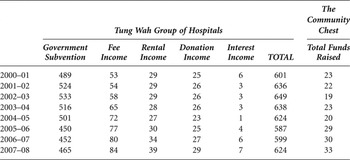
It has been claimed that Hong Kong has a “sizable and vibrant” voluntary sector, consisting of “a large variety of organizations and groups varying in mission, size, activities, beneficiaries, and funding sources.” As of 2002, total annual expenditure of the sector was estimated to account for about 1.8% of Hong Kong's gross domestic product (GDP), and full-time employees represented 7.9% of the total local workforce. In addition, 8.2% of the population contributed volunteer labor. The majority of the voluntary organizations provided educational, welfare, district and community-based, health, and philanthropic services. Most of them received heavy state funding. Government subvention accounted for the largest or second-largest financial source for about 40% of the voluntary organizations, a ratio that is high by international standards. Many nongovernment organizations (NGOs) even relied on the government for as much as 90% of their funding.Footnote 54 In the case of Tung Wah, government subvention accounted for an average of about 80% of the organization's gross income in recent years (see Table 1). In addition, as already mentioned, the charity received land at nominal cost from the government.
Financial Income of Tung Wah and the Community Chest (US$ million)

Source: Tung Wah Group of Hospitals, Annual Report, various years; Community Chest of Hong Kong, Annual Report, various years.
Such a high degree of financial dependence on the state may lead one to the view that voluntary organizations in Hong Kong have limited autonomy. This is, however. not entirely true. According to Lee, there is a “symbiotic yet conflictual relationship”Footnote 55 between the state and the voluntary sector in Hong Kong. The picture of a largely state-funded voluntary sector emerged only after the 1950s. Before this, the government was either unwilling or incapable of providing welfare services to its population, leaving the work largely to local civic associations and church organizations. In the 1960s, in response to a number of social policy proposals and a series of social riots, the government began to expand funding for existing voluntary organizations as partners in social provision. By the 1970s, it had become the major funder of Hong Kong's voluntary providers of health care, public housing, education, and social services. At the same time, the government adopted a top-down approach in community building, thereby politically aligning the voluntary sector with the state. The state has thus been able to contain the voluntary sector through financial and administrative measures. On the other hand, since many of the voluntary organizations (including Tung Wah) had existed long before the government began to provide social services, the government has relied on voluntary organizations for their expertise and experience. As a result, voluntary organizations in Hong Kong, led by public service professionals, have acquired sufficient autonomy to breed issue-based social activism and to play an important role in promoting the emergence of civil society.Footnote 56
In short, within certain limit, voluntary organizations in Hong Kong have been able to take the initiative to identify social issues. Yet, heritage conservation had not been their concern until recent years. As mentioned at the beginning of this article, the tradition of heritage conservation in Hong Kong has been weak. Voluntary contributions in this regard hardly existed before the 1990s. The first private fund for heritage conservation—the Lord Wilson Heritage Trust—was established in 1992. The founding trust capital of about $5.5 million aside, donation to this fund was minimal until the end of the decade.Footnote 57 In more recent years, some nonprofit conservation groups, learned societies, professional bodies, and local communities have emerged. They have contributed expertise and resources to monitor government actions, advocate appropriate policies, promote public awareness, mobilize participation, and initiate projects.Footnote 58 As the general strategy of these groups is to generate more public pressure on the government to preserve heritages, they function as pressure groups on the issue of heritage conservation. What is unique of the Tung Wah Coffin Home project is that it offers a case of direct provision of built heritage conservation by a voluntary organization. In fact, the entire history of the Coffin Home, from its early formation to the present conservation, is the result of charity.Footnote 59
To be sure, in the process of conserving the Coffin Home, Tung Wah has enjoyed certain advantages as an established voluntary organization. First, it is abundant in resources and autonomous in financial management. As can be seen in Table 1, Tung Wah's gross annual income ranged from $587 million to $649 million in recent years. The donation income it receives, as a single charity, is even comparable to that of the Community Chest of Hong Kong, a joint fund-raising body representing 144 social welfare agencies. While Tung Wah did publicize the Coffin Home's winning of the two heritage awards, the case was not mentioned at all in the organization's fund-raising campaigns, because donors may regard heritage conservation as being too luxurious to justify charity support. In fact, the $1.4 million cost for the conservation of the Coffin Home did not come from donations but from the revenue of a funeral parlor operated by Tung Wah. In the process of preparing the budget for the Coffin Home conservation project, what the Tung Wah management needed to consider was economic affordability, but not the market axiom of maximizing returns. However, unlike cultural facilities run by the government, the Coffin Home does not need to prove its popularity in terms of number and frequency of visits. To the contrary, it restricts entry to selected visitors (such as scholars and students) under special arrangement, in order not to “disturb ancestors.” Such a model of operation is not possible for the market or the government, but only for a well-established voluntary organization like Tung Wah.Footnote 60
Second, as BrudneyFootnote 61 and SalamonFootnote 62 noted, in many countries the voluntary sector exists due to historical reasons, as it provided long-time services to the community even before establishment of the state. Tung Wah also enjoys such advantages. As already mentioned, it was founded soon after the establishment of the British colonial government in Hong Kong, and it served as a self-governing body when the colonial state still lacked the knowledge and institutions to govern the local community. Such century-long history provides Tung Wah with a unique edge in heritage conservation. Being entrusted with the management of a number of historic temples in Hong Kong, Tung Wah is probably more experienced than the government in maintaining cultural heritage.Footnote 63 It runs its own museum to house the organization's archives and relics. The museum, which was originally the main hall building of a hospital established by Tung Wah in 1911, was listed by the AMO as a Grade I Historical Building. Through this museum, Tung Wah has been active in organizing archival researches on the social and medical history of Hong Kong in general and that of Tung Wah in particular.Footnote 64 In fact, in the process of conducting this research, the present author is deeply impressed by many of the staff and volunteers of Tung Wah for their enthusiasm and passion for cultural heritage. Such voluntarism, in contrast with economic utilitarianism and government officialism, provides a strong impetus for achieving heritage conservation.
In short, the Tung Wah Coffin Home does suggest that the voluntary sector of Hong Kong is beginning to use its advantages in achieving heritage conservation. As noted by a UNESCO advisor in the presentation ceremony of AMO's 2004 heritage awards, there are “new actors playing important roles in heritage conservation in Hong Kong. Schools, community groups and private sector foundations and corporations are all beginning to take a lead role in advocating, setting standards, and financing local conservation projects.”Footnote 65 Other recent examples in this regard include the initiative of some local professionals to explore the possibility of establishing a heritage fund based on international experience;Footnote 66 a philanthropist's offer to donate to the government a half-century-old family big house as a built heritage for public conservation;Footnote 67 another philanthropist's proposal to donate the late martial arts legend Bruce Lee's former residence for construction into a public museum;Footnote 68 and the decision of the Hong Kong Jockey Club, the largest private donor of charity funds in Hong Kong, to fund heritage projects.Footnote 69 On the other hand, according to government officials, they were inspired by the case of the Coffin Home and were exploring the possibility of applying this “model”—heritage conservation in partnership with the voluntary sector—to other cases.Footnote 70 Along this line, the government has launched a pilot scheme by which seven historical buildings may be entrusted to charities or NGOs for “creative conservation.”Footnote 71
8. LIMITATIONS AND POTENTIAL
In conclusion, however, it should be noted that there are certain limitations in generalizing the Tung Wah Coffin Home as a successful case of built heritage conservation by the voluntary sector. In the first place, while Tung Wah enjoys exceptional financial strength, most voluntary organizations are weak in economic resources. As Salamon noted, one of the major causes of “voluntary failure” is “philanthropic insufficiency”—the “inability to generate resources on a scale that is both adequate enough and reliable enough to cope with the human service problems of an advanced industrial society.”Footnote 72 More specifically, voluntary conservation organizations, even those in developed countries such as Ireland and Sweden, face challenges due to lack of financial resources.Footnote 73 This is also true for most voluntary organizations in Hong Kong. For example, in 2007 when the government invited partnership with charities or NGOs to revitalize “Lui Seng Chun,” a Grade I Historical Building that has been left vacant for many years, most NGOs responded that the annual maintenance cost, estimated at about $77,000, was too high for them.Footnote 74
Second, while voluntary organizations on their own do not have enough resources, partnership with the government is often thwarted by a lack of trust. There is the concern that the idea of “community-driven”—the notion that in the long run, NGOs should replace the government as the leading agent in cultural development—is the government's pretext to cut subsidies.Footnote 75 This, however, should not prevent giving the government the benefit of the doubt. In the case of the Coffin Home, as mentioned in section 5, the Tung Wah management preferred not to invite government participation, so as to avoid bureaucratic and legislative inflexibilities. Nevertheless, in the end Tung Wah participated in AMO's heritage award competition, to obtain official recognition of the value of the Coffin Home. In fact, as far as heritage conservation is concerned, the tension between voluntary organizations and the government does not seem insurmountable. After all, given the problems of market failure, government failure, and voluntary failure, partnership between the voluntary sector and the government seems to be the most viable approach to achieve heritage conservation. Moreover, invaluable experience is available from the voluntary sector in Europe and the United States, which, as already mentioned, has long been playing an important role in built heritage conservation.