Introduction
An excess of stressful events during childhood has been reported in depressive disorders (Lloyd, Reference Lloyd1980; Paykel, Reference Paykel1982; Faravelli et al. Reference Faravelli, Ambonetti, Pallanti, Sacchetti, Conte and Vita1986; Heim et al. 2008 b), anxiety disorders (Faravelli et al. Reference Faravelli, Webb, Ambonetti, Fonnesu and Sessarego1985; Tweed et al. Reference Tweed, Schoenbach, George and Blazer1989; Bandelow et al. Reference Bandelow, Späth, Tichauer, Broocks, Hajak and Rüther2002), post-traumatic stress disorder (PTSD) (Copeland et al. Reference Copeland, Keeler, Angold and Costello2007; Zlotnick et al. Reference Zlotnick, Johnson, Kohn, Vincente, Rioseco and Saldivia2008), schizophrenia (Janssen et al. Reference Janssen, Krabbendam, Bak, Hanssen, Vollebergh, de Graaf and van Os2004; Read et al. Reference Read, van Os, Morrison and Ross2005; Ucok & Bikmaz, Reference Ucok and Bikmaz2007), eating disorders (de Groot & Rodin, Reference de Groot and Rodin1999; Wonderlich et al. Reference Wonderlich, Crosby, Mitchell, Thompson, Redlin, Demuth, Smyth and Haseltine2001; Thompson & Wonderlich, Reference Thompson, Wonderlich and Thompson2004), substance abuse (Simpson & Miller, Reference Simpson and Miller2002; Dube et al. Reference Dube, Felitti, Dong, Chapman, Giles and Anda2003; Reed et al. Reference Reed, Anthony and Breslau2007; Back et al. Reference Back, Brady, Waldrop, Yeatts, McRae and Spratt2008) and personality disorders (Bierer et al. Reference Bierer, Yehuda, Schmeidler, Mitropoulou, New, Silverman and Siever2003; Chard, Reference Chard2003; Goodman et al. Reference Goodman, New and Siever2004; Johnson et al. Reference Johnson, Cohen, Chen, Kasen and Brook2006). The effect of childhood traumata for psychopathology during adulthood is believed to be mediated by the hypothalamus–pituitary–adrenal (HPA) axis, that, once over-activated during the developmental processes, would remain permanently unstable, overdriven, vulnerable or dysfunctional (Nemeroff, Reference Nemeroff2004; Joëls et al. Reference Joëls, Krugers and Karst2008; Tyrka et al. Reference Tyrka, Wier, Price, Ross, Anderson, Wilkinson and Carpenter2008), possibly due to transcriptional/epigenomic mechanisms (Meaney & Szyf, Reference Meaney and Szyf2005; Weaver et al. Reference Weaver, Meaney and Szyf2006).
Functional abnormalities of the HPA axis have in fact been widely reported in psychiatric disorders, including depression (Carroll, Reference Carroll and Burrows1977; Heim et al. 2008 a), bipolar disorder (Daban et al. Reference Daban, Vieta, Mackin and Young2005), anxiety disorders (Risbrough & Stein, Reference Risbrough and Stein2006; MacKenzie et al. Reference MacKenzie, Odontiadis, Le Mellédo, Prior and Baker2007), eating disorders (Lo Sauro et al. Reference Lo Sauro, Ravaldi, Cabras, Faravelli and Ricca2008), schizophrenia (Walker et al. Reference Walker, Mittal and Tessner2008), substance abuse (Gerra et al. Reference Gerra, Leonardi, Cortese, Zaimovic, Dell'Agnello, Manfredini, Somaini, Petracca, Caretti, Baroni and Donnini2008), dissociative symptoms (Bob et al. Reference Bob, Fedor-Freybergh, Jasova, Bizik, Susta, Pavlat, Zima, Benakova and Raboch2008), dementia (Magri et al. Reference Magri, Crivello, Barili, Sarra, Cinchetti, Salmoiraghi, Micale and Ferrari2006), and PTSD (Atmaca et al. Reference Atmaca, Kuloglu, Tezcan, Onal and Ustundag2002; Yehuda et al. Reference Yehuda, Halligan, Golier, Grossman and Bierer2004c; Griffin et al. Reference Griffin, Resick and Yehuda2005; Delahanty & Nugent, Reference Delahanty and Nugent2006). In particular, an abnormal response to the Dexamethasone (Dex) Suppression Test (DST) has been repeatedly documented (Schreiber et al. Reference Schreiber, Lauer, Krumrey, Holsboer and Krieg1996; Nestler et al. Reference Nestler, Barrot, DiLeone, Eisch, Gold and Monteggia2002; Simpson & Miller, Reference Simpson and Miller2002; Ceskovà et al. Reference Cesková, Kaspárek, Zourková and Prikryl2006; Back et al. Reference Back, Brady, Waldrop, Yeatts, McRae and Spratt2008). Whereas non-suppression is the commonest abnormal response, hyper-suppression has been reported in PTSD patients and in patients with a history of child abuse when low dose Dex has been used (Yehuda et al. Reference Yehuda, Boisoneau, Lowy and Giller1995a, Reference Yehuda, Kahana, Binder-Brynes, Southwick, Mason and Gillerb, Reference Yehuda, Halligan, Grossman, Golier and Wong2002, Reference Yehuda, Golier, Halligan, Meaney and Bierer2004a, Reference Yehuda, Golier, Yang and Tischlerb; Goenjian et al. Reference Goenjian, Yehuda, Pynoos, Steinberg, Tashjian, Yang, Najarian and Fairbanks1996; Newport et al. Reference Newport, Heim, Bonsall, Miller and Nemeroff2004; Rohleder et al. Reference Rohleder, Joksimovic, Wolf and Kirschbaum2004).
Neither the abnormalities of the HPA axis, nor the excess of traumatic stressful events during childhood seem to be specific to any diagnostic group and a limited number of studies have evaluated both the early stress and the HPA axis in adult patients suffering from mental disorders (Bremner et al. Reference Bremner, Vermetten and Kelley2007; Bradley et al. Reference Bradley, Binder, Epstein, Tang, Nair, Liu, Gillespie, Berg, Evces, Newport, Stowe, Heim, Nemeroff, Schwartz, Cubells and Ressler2008; Gerra et al. Reference Gerra, Leonardi, Cortese, Zaimovic, Dell'Agnello, Manfredini, Somaini, Petracca, Caretti, Baroni and Donnini2008; Heim et al. 2008 a). None has adopted a trans-diagnostic approach.
The present paper is aimed at evaluating the hypothesis that early events and DST non-suppression are related to a particular subset of symptoms occurring across several diagnostic entities rather than to specific diagnostic groups. Childhood stressors, DST and psychiatric symptoms have been evaluated in a group of moderately to severely ill psychiatric out-patients, selected independently of the diagnosis.
Method
The study was carried out at two University Psychiatric Units, one in Florence and the other in Pisa. Both provide intensive (i.e. on a daily basis) out-patient treatments, especially directed at severe mood, anxiety and eating disorders. These clinics were selected because of the need for having sufficiently severe cases non-hospitalized, since it is reported that staying in hospital may influence the cortisol response (Copolov et al. Reference Copolov, Rubin, Stuart, Poland, Mander, Sashidharan, Whitehouse, Blackburn, Freeman and Blackwood1989).
Subjects who met the following criteria were included in the study: (1) aged between 18 and 65 years; (2) any Axis I diagnosis as assessed by the Structured Clinical Interview for DSM-IV – Patient Version 2.0 (SCID-P; First et al. Reference First, Spitzer, Gibbon and Williams1995); (3) acute phase of the illness, i.e. the onset of the episode had to occur within a couple of months of the intake and the severity had to be sufficient to warrant intensive treatment; patients in whom the severity of illness was apparently declining were not included. The exclusion criteria were substance abuse or dependence, organic mental disorder, physical illnesses altering HPA axis function such as Cushing disease, obesity (body mass index >30 kg/m2), thyroid dysfunctions, chronic infections, pregnancy or breast-feeding, epilepsy, concomitant treatment with oral contraceptives, L-dopa, β-blockers, metirapone, ketoconazole, lithium, anticonvulsants, including those used as mood stabilizers, as it is known that anticonvulsants may induce false positive DST results (Putignano et al. Reference Putignano, Kaltsas, Satta and Grossman1998), contraindications to Dex administration, such as congestive heart failure, K+ depletion, hypertension, peptic ulcer, erosive oesophagitis, coagulation impairments, diabetes mellitus, ocular hypertension, glaucoma, severe osteoporosis, hypersensitivity to Dex.
A total of 93 consecutive patients were enrolled in the study, 49 from Florence University and 44 from Pisa University. Since the medical staff of the two institutions were overlapped, the two samples were combined. There were no age, gender and diagnoses differences between the two centres.
The patients were evaluated before the commencement of their treatment (within the first 2 days of intake) and were drug free whenever possible (in a minority of cases the already ongoing treatment was not stopped). After the enrolment in the study, saliva samples were taken at 08:00 hours and 20:00 hours on the first day and participants were given a 0.5 mg dose of Dex to take at home the same evening at 23:00 hours; a third saliva sample was taken the next morning at 08:00 hours. Saliva was collected into a device using a cotton swab that was chewed by the patients for 2 min and then inserted in a double-chamber plastic tube. The saliva samples were refrigerated at 4°C (for a maximum of 10 h) and were eventually stored at −20°C. Salivary cortisol levels were analysed by using a Roche (Switzerland) immunoassay (Elecsys), a competitive polyclonal antibody assay that uses a magnetic separation step, followed by electroluminescence (Chiu et al. Reference Chiu, Collier, Clark and Wynn-Edwards2003). All assays were conducted blind to diagnostic status or group and all the laboratory preliminary tests to evaluate recovery rate, sensitivity and reproducibility were amply satisfactory (intra-assay reliability 4.4%; inter-assay 9.5%).
Apart from the absolute values of saliva cortisol in the three samples, and their percent and absolute daily variations (cortisol at 08:00 hours minus cortisol at 20:00 hours), the ratio between cortisol levels after Dex administration and cortisol levels before Dex administration at the same hour (08:00 hours) was calculated and called Suppression Index (SI), (Newport et al. Reference Newport, Heim, Bonsall, Miller and Nemeroff2004).
In total, 33 healthy subjects, drawn from the hospital personnel, with no history of chronic physical diseases, allergies or current infections and not taking regular medication, were recruited as controls. They were matched with the patients for age (40.1±14.0 and 43.6±15.4, respectively) and gender (48.5% and 50.2% of females, respectively) and underwent the same assessment procedures as the patients. The study was approved by the Local Ethics Committee and informed written consent was obtained by all patients.
Clinical assessment
In order to have a comprehensive evaluation of psychiatric symptoms not influenced by a previous diagnostic selection, patients were given a series of rating scales combined in a single instrument. This derives from an earlier study, where a large number of patients were evaluated by means of several rating scales (Faravelli et al. Reference Faravelli, Servi, Arends and Strik1996). The items derived from different scales that proved to be redundant and clearly explored the same aspect, with comparable definitions and with reciprocal correlations (r) greater than 0.85, were excluded. The definitions of items contained in the original instruments were left unchanged. When needed, quantification within a single item was modified to give each item the same weight. Each symptom is scored on a 5-point severity scale (0=absent, 1=dubious, 2=mild, 3=moderate and 4=severe). A score of at least 2 was considered for a symptom to be present.
There were 121 symptoms, including almost all the symptoms in both the DSM-IV and ICD-10.
These items were inserted into one single instrument, the Florence Psychiatric Interview (Faravelli et al. Reference Faravelli, Bartolozzi, Cimminiello, Cecchi, Cosci, D'Adamo, Di Mattro, Di Primio, Fabbri, Lo Iacono and Paionni2001), which has been fully validated. The SCID-P and the Brief Psychiatric Rating Scale (BPRS; Overall & Gorham, Reference Overall and Gorham1962) were also administered.
The events occurring during the first 15 years of life were also studied. Loss events were evaluated by the method described by Faravelli et al. (Reference Faravelli, Ambonetti, Pallanti, Sacchetti, Conte and Vita1986) ; death of parents, prolonged separation from parents, divorce/de facto separation of parents, death of cohabiting relatives, severe illnesses of the child were taken into account. Childhood physical and sexual abuse was investigated using the questions provided by the Childhood Experience of Care and Abuse Questionnaire (Bifulco et al. Reference Bifulco, Brown and Harris1994). All the interviews for early life events were made before the assessment of saliva cortisol.
The events occurred during the year prior to the onset of the index episode were also collected and evaluated according to the method described elsewhere (Faravelli et al. Reference Faravelli, Catena, Scarpato and Ricca2007) (semi-structured interview and independent assessment).
Statistical analyses
Student's t test for the comparison of continuous variables and χ2 for the discontinuous variables were used. The binary logistic regressions were made using the Enter method as provided by the Statistical Package for Social Sciences (SPSS 15; SPSS Inc., USA).
Results
Saliva cortisol pre- and post-Dex: comparison of patients and healthy controls
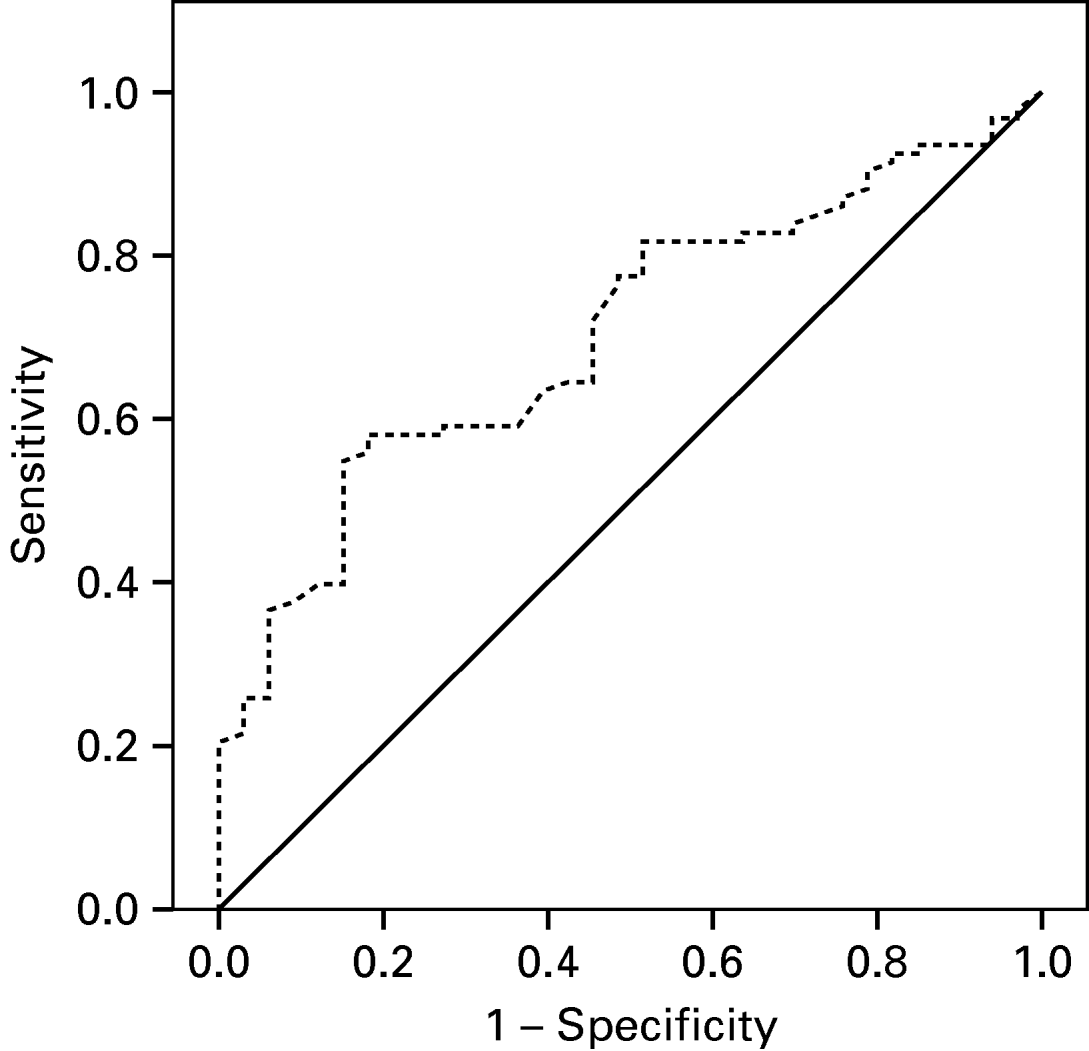
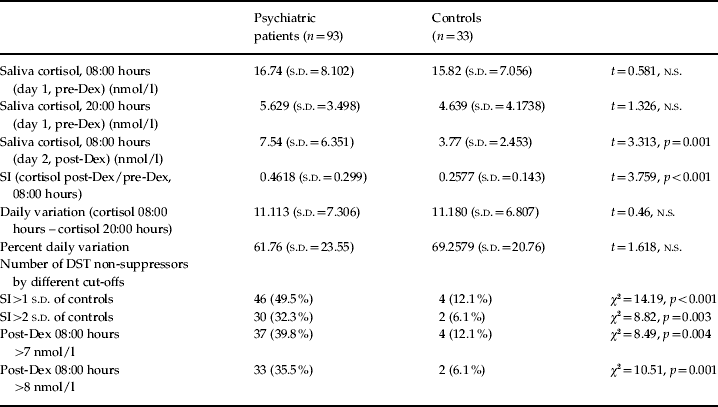
Basal cortisol levels (08:00 hours and 20:00 hours) and their absolute and percent diurnal variation did not differ between patients and healthy control subjects, while significantly higher cortisol concentrations were found in the patient group after Dex administration. The post:pre-Dex ratio (SI) was also notably higher in patients as compared with healthy control subjects (Table 1, Fig. 1).
ROC curve: sensitivity and specificity of post-dexamethasone saliva cortisol. Psychiatric cases versus healthy controls.

Basal and post-dexamethasone (Dex) saliva cortisol in psychiatric patients and healthy controls

SI, Suppression Index; DST, Dexamethasone Suppression Test.
Considering different cut-off points for dividing suppressors from non-suppressors, both the SI and the absolute post-Dex saliva levels were able to separate patients from controls. As we aimed at the greatest specificity, a post-Dex saliva cortisol level >8 nmol/l was selected to define the condition of non-suppression on the basis of a ROC analysis.
No statistically significant differences were found between suppressor and non-suppressor patients for age or gender. As stated before, among patients the saliva cortisol was measured before the commencement of treatment so that the majority of cases were drug free. In a few (n=9) cases, however, the already ongoing treatment was maintained. Non-suppression, however, was not influenced by the treatment.
DST, diagnoses and symptoms
A total of 39 patients (41.1%) met more than one current diagnosis, including co-morbidities (i.e. more diagnoses than cases). There were at least 10 cases in the following categories: major depression (MDD); bipolar disorder; panic disorder; any mood disorder; any anxiety disorder; any eating disorder. For each of these, the proportion of DST escapers was significantly higher than that of the control subjects. On the other hand, the comparisons between the diagnostic groups in no case approached significance. Using one diagnosis per case (the one more meaningful on clinical grounds), the results were repeated. The association between cortisol suppression and co-morbidity was also evaluated, although non-suppressor patients showed higher rates of co-morbidity than suppressor patients (51.1% v. 35.5%), such a comparison was not significant (χ2=2.287, p=0.188). There were no differences between suppressor and non-suppressor patients in the BPRS total scores (35.63±9.83 and 36.00±9.66 respectively, t=–0.177, p=0.860).
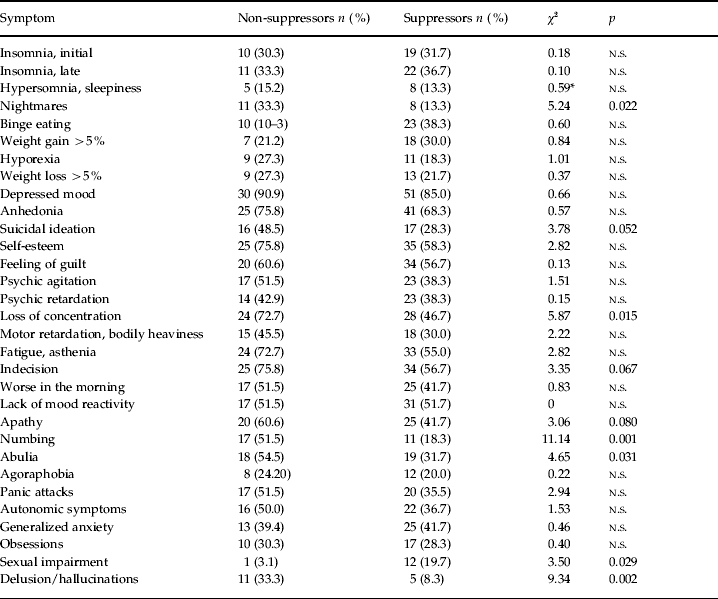
Of the 121 symptoms initially taken into account, only 31 were present with frequencies that allowed statistical comparisons. Non-suppressors showed a significant higher incidence of specific symptoms, such as nightmares, suicidal ideation, loss of concentration, indecision, apathy, numbing, abulia, sexual impairment and psychotic symptoms (Table 2).
Current symptoms in suppressor (n=60) and non-suppressor (n=33) patients (only symptoms occurring in at least 15% of patients considered)

Childhood traumata and DST
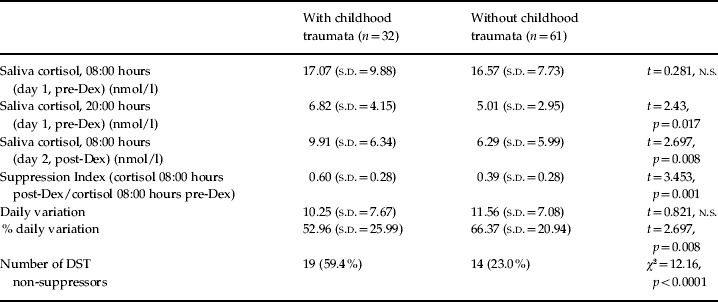
Of the 93 patients interviewed, four (all females) reported early experiences of sexual or physical abuse. All the four abused patients were non-suppressors, compared with 14 (23%) of those who did not report serious traumata during childhood (p=0.005, Fisher's exact test). Of the 29 cases who reported loss events (such as death of or prolonged separation from parents, severe physical illness, etc.), 16 (55.2%) were non-suppressors (χ2=7.14, p=0.008 v. those with no traumatic events). As all the cortisol values of the cases with childhood abuse were in the same ranges of those with loss events, those two groups were combined. A history of an early trauma was significantly associated with higher saliva cortisol at 20:00 hours pre-Dex and at 08:00 hours post-Dex and with a lower percent daily variation of saliva cortisol.
The number of DST non-suppressors was also significantly higher among those with early trauma (Table 3). Given that there were only two non-suppressors among healthy controls, the relationship of early trauma with DST in healthy subjects cannot be explored. It is, however, of interest that both non-suppressors reported a history of childhood abuse.
Basal and post-dexamethasone (Dex) saliva cortisol by experience of traumatic events during childhood

DST, Dexamethasone Suppression Test.
Childhood traumata, diagnoses and symptoms
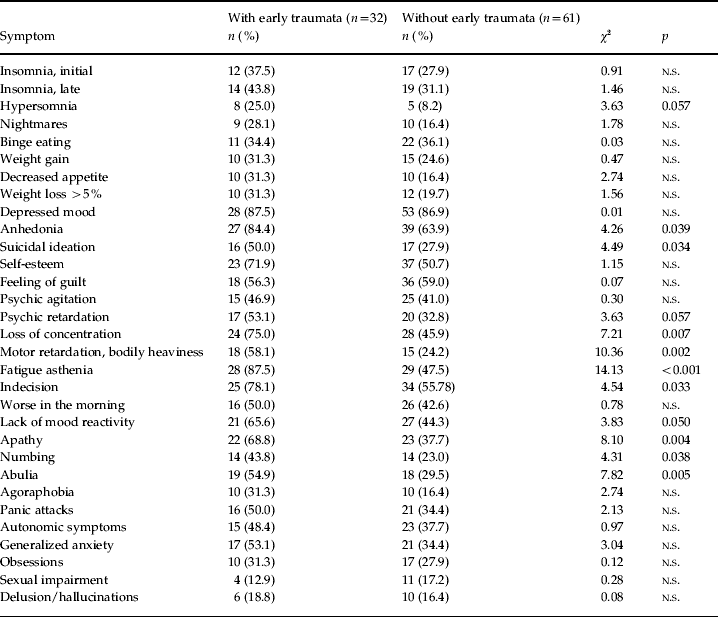
The occurrence of loss and abuse events (combined) during childhood was cross-tabulated against the current diagnoses. When compared with each other, no diagnostic category was significantly associated with a past history of loss/abuse. Childhood events, however, were significantly associated with some symptoms, especially those of the depressive series (Table 4).
Frequency of present symptoms by childhood traumata (only symptoms occurring in at least 15% of patients considered)

DST and recent stressful events
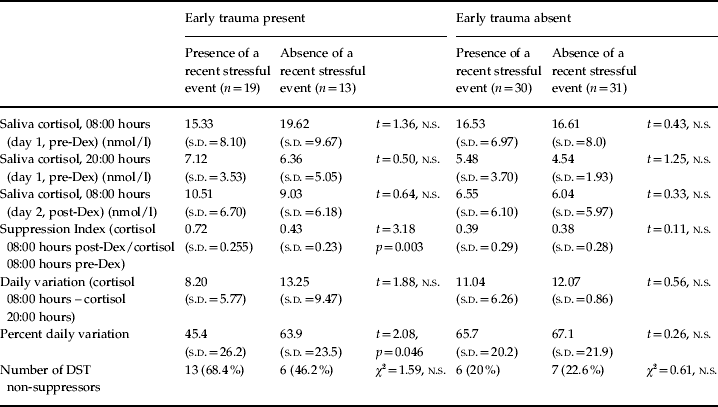
In total, 49 patients reported a severe stressful life event during the year preceding the onset of the current pathology. Overall, the presence of a recent event was not linked to the levels of saliva cortisol, either before or after Dex, neither was the rate of non-suppressors.
However, the suppression indices and the percent daily variation were significantly associated with the presence of a recent stressor in the patients with a history of childhood. (Table 5).
Relationship between recent stressful events and saliva cortisol, with patients with and without a history of childhood traumata considered separately

DST, Dexamethasone (Dex) Suppression Test.
Characterizing patients with early trauma and patients with Dex non-suppression
The condition of DST suppression versus non-suppression was used as dependent variable in a binary logistic regression analysis, where age, gender, marital status, education, diagnoses, current symptoms (those occurring in at least 15% of cases), recent life events and childhood stressful events were the covariates. The only variables significantly and independently associated with DST non-suppression were childhood trauma (B=3.34, s.e.=1.01, p=0.01), delusions/hallucinations (B=2.64, s.e.=1.15, p=0.021), loss of concentration (B=3.05, s.e.=1.53, p=0.046) and loss of self-esteem (B=3.53, s.e.=1.62, p=0.030), with diagnoses and occurrence of a recent stressful event devoid of associations. This model, using the aforementioned four variables, could correctly identify 78.5% of the cases.
Discussion
Retrospective recall may bias the assessment of early events in several ways. The poor reliability of the memories relevant to childhood (Widom & Morris, Reference Widom and Morris1997; Molnar et al. Reference Molnar, Buka and Kessler2001; Copeland et al. Reference Copeland, Keeler, Angold and Costello2007; Zlotnick et al. Reference Zlotnick, Johnson, Kohn, Vincente, Rioseco and Saldivia2008), the ‘search for meaning’, by which the subjects tend to search the reasons for the present distress in their past experiences, the attitude of the interviewer, who may or may not encourage the patient, all affect the accurate retrieval of past events. We have tried, on the basis of previous experiences, to take into account events likely to be reliably recorded and verified, such as loss by death or separation of parents or divorce. For sexual abuse we decided to keep a high threshold for occurrence, only the cases where either another informant confirmed the event or there was a legal consequence were considered. This is the reason why the occurrence of childhood abuse is much lower than usually reported in psychiatric samples. We are aware that limiting the events in this way reduces the sensitivity of the method, as the finer psychological subjective reactions to the events are lost. Given that we have found a clear association between early events and clinical variables, sufficient sensitivity is retained, whereas selective recall of the past induced by the present pathology was minimized or excluded.
The procedure chosen for DST (saliva cortisol, 0.5 mg Dex, one single post-Dex cortisol measurement in the morning) may also be criticized. Admittedly, it is a rough indicator of the HPA axis function. Saliva cortisol, however, is a good and sensitive indicator of free (unbound) plasma cortisol (Umeda et al. Reference Umeda, Hiramatsu, Iwaoka, Shimada, Miura and Sato1981; Laudat et al. Reference Laudat, Cerdas, Fournier, Guiban, Guilhaume and Luton1988; Raff, Reference Raff2000; Cohen et al. Reference Cohen, Venkatesh, Galligan and Thomas2004; Nishiyama et al. Reference Nishiyama, Thlaygi, Zayour, Hejal and Arafah2005), it is stable (Reid et al. Reference Reid, Intrieri, Susman and Beard1992; Chiu et al. Reference Chiu, Collier, Clark and Wynn-Edwards2003; Tiefenbacher et al. Reference Tiefenbacher, Lee, Meyer and Spealman2003), sensitive to variations (Shinkai et al. Reference Shinkai, Watanabe, Kurokawa and Torii1993; Viardot et al. Reference Viardot, Huber, Puder, Zulewski, Keller and Muller2005) and its use for DST is well established (Hanada et al. Reference Hanada, Yamada, Shimoda, Takahashi and Takahashi1985; Kahn et al. Reference Kahn, Rubinow, Davis, Kling and Post1988; Copolov et al. Reference Copolov, Rubin, Stuart, Poland, Mander, Sashidharan, Whitehouse, Blackburn, Freeman and Blackwood1989; McCracken & Poland, Reference McCracken and Poland1989; Castro et al. Reference Castro, Elias, Quidute, Halah and Moreira1999, Reference Castro, Elias, Elias and Moreira2003; Gozansky et al. Reference Gozansky, Lynn, Laudenslager and Kohrt2005). The use of low doses of Dex was initially proposed in order to explore increased suppression in patients affected by PTSD (Yehuda et al. Reference Yehuda, Southwick, Krystal, Bremner, Charney and Mason1993; Newport et al. Reference Newport, Heim, Bonsall, Miller and Nemeroff2004) and later used also in MDD (Sarai & Matsunaga, Reference Sarai and Matsunaga1986; Heim & Nemeroff, Reference Heim and Nemeroff2001; Juruena et al. Reference Juruena, Cleare, Papadopoulos, Poon, Lightman and Pariante2006), eating disorders (Díaz-Marsá et al. Reference Díaz-Marsá, Carrasco, Basurte, Sáiz, López-Ibor and Hollander2008) and burnout (Kudielka et al. Reference Kudielka, Bellingrath and Hellhammer2006). It appears to be useful and sensitive (Costantin Faria et al. Reference Costantin Faria, Cobra, Sousa e Silva, Rezende Melo, Neves Rocha, Sukusima Hayashi, Faria, de Souza e Almeida, Kater and Langui2008), it is presently the first line diagnostic test for Cushing's syndrome (Pecori Giraldi, Reference Pecori Giraldi2009) and is well correlated with the response to the usual dose of 1 mg (Huizenga et al. Reference Huizenga, Koper, de Lange, Pols, Stolk, Grobbee, de Jong and Lamberts1998; Matsunaga & Sarai, Reference Matsunaga and Sarai2000). We did not measure afternoon post-Dex cortisol, in the exploratory study (unpublished observations), however, the number of ‘late escapers’ was too small to justify a further saliva sample. The levels of circulating Dex, which might be a potential confounder, were not measured. Evaluation of the precise neuroendocrine changes is in fact beyond the scope of this study. Our results, with only 2/33 non-suppressors among healthy controls, confirmed that a reasonable specificity was attained. Clinically, non-suppression to DST is an abnormal functional state, related to the HPA axis, fairly common in psychiatric patients, inexpensive and easy to perform. The clinical characterization of these patients is in itself worthy of interest.
Finally, we have purposely avoided using diagnostic processes. This is somewhat unusual, though not new. The lack of diagnostic specificity seems to be common in psychiatry. Moreover, having one single diagnosis is unusual in psychiatry, where co-morbidity is the rule (Kessler et al. Reference Kessler, Chiu, Demler, Merikangas and Walters2005). It would be more logical to reverse the course of the research process: first to clarify an abnormality among the broad spectrum of psychiatric disorders and then to explore the clinical aspects (including the diagnosis) that are related to such abnormality. Such a ‘functionalization’ of diagnoses, proposed initially by van Praag (Reference van Praag1997, Reference van Praag2001a, Reference van Praagb, Reference van Praag2004), may lead to the identification of specific endophenotypes, which may, in turn, help to resolve questions about etiological models of mental disorders (Gottesman & Gould, Reference Gottesman and Gould2003).
The fact that DST, though distinguishing between psychiatric cases and healthy subjects, does not differ among psychiatric diagnoses was reported earlier (Arana et al. Reference Arana, Wilens and Baldessarini1985; Copolov et al. Reference Copolov, Rubin, Stuart, Poland, Mander, Sashidharan, Whitehouse, Blackburn, Freeman and Blackwood1989).
An increasing number of papers suggest that early events influence the HPA axis response during adulthood psychopathology (Bremner et al. Reference Bremner, Vythilingam, Vermetten, Adil, Khan, Nazeer, Afzal, McGlashan, Elzinga, Anderson, Heninger, Southwick and Charney2003). Newport et al. (Reference Newport, Heim, Bonsall, Miller and Nemeroff2004) found that depressed women with a history of child abuse showed hyper-suppression (i.e. lower cortisol) after low dose DST. Newport et al.'s sample was made up of survivors of child abuse with a large prevalence of PTSD and it has been reported that MDD patients co-morbid with PTSD have a different HPA response (Oquendo et al. Reference Oquendo, Echavarria, Galfalvy, Grunebaum, Burke, Barrera, Cooper, Malone and John Mann2003; de Kloet et al. Reference de Kloet, Vermetten, Lentjes, Geuze, van Pelt, Manuel, Heijnen and Westenberg2008). The same group found that early traumata are associated to increased post-Dex cortisol production in male depressives (Heim et al. 2008 a). The same result was found in women with Borderline Personality Disorder (Rinne et al. Reference Rinne, de Kloet, Wouters, Goekoop, DeRijk and van den Brink2008).
To our knowledge, this is the first study dealing with this issue following a trans-diagnostic approach.
We found that:
(1) Low dose DST using saliva cortisol distinguishes the psychiatric patients from normal controls.
(2) An abnormal response to Dex does not distinguish between diagnoses, but is associated with a subset of symptoms, which occur transversally through several diagnostic groups.
(3) DST non-suppression is associated with early life events.
(4) A recent stressful event seems to affect the HPA response only in those subjects who have also been exposed to early traumata.
(5) A history of childhood traumata, HPA axis abnormalities and a few psychiatric symptoms seem to constitute a strict triad, which is independent of the diagnosis.
First, the possibility of a type II error is implicit in all the comparisons where we failed to detect differences (e.g. lack of differences in the rate of early events between patients and controls, comparisons among diagnostic groups). In almost none of the cases in which we did not find significant results, however, there were trends for differences. Second, as the measurement of saliva cortisol was temporarily close to the interview, individuals with a history of childhood trauma could have found the recall and discussion of their trauma experiences stressful. The observed effect of childhood trauma on HPA axis might therefore be linked to the differential effect of the interview procedure. Given that that non-suppression is also linked to the presence of symptoms clearly pre-existing the interview for early events, this interpretation seems less plausible.
Our results may be considered in different ways. On one hand, they give a further contribution to the position that considers early traumata as risk factor for adult psychopathology via the HPA axis. Having considered actual loss events rather than subjectively recalled memories gives further strength to our findings.
On the other hand, being early events and DST abnormal response associated with specific symptoms, rather than with specific diagnoses, some reflections on present classifications should be stimulated. The existence of a stress-related subset of symptoms ranging through different diagnostic groups could explain some inconsistencies, including the high rate of co-morbidity.
A final point is that as few of the control subjects showed a dysfunctional response to DST, in spite of having the same rate of childhood events as psychiatric patients, the early trauma, per se, is not sufficient to induce an abnormal response to Dex.
According to the authors, the considerations recently published by Pariante & Lightman (Reference Pariante and Lightman2008), regarding the HPA axis in MDD could be extended to all the psychiatric disorders where emotion/affectivity represents the core of symptomatology. The existence of a stress-related syndrome ranging aspecifically across psychiatric disorders is plausible. It would be at the same level as the general syndrome in internal medicine, with some symptoms (e.g. abulia, loss of concentration, numbing, sexual impairment, anhedonia, fatigue) being the analogue of fever, pallor, asthenia, etc.
Acknowledgement
This study was partially supported by MPS Foundation grant no. 36059.
Declaration of Interest
None.