Introduction
Conative Theory of Mind
Theory of mind was originally studied in great apes and preschoolers to establish the phylogenetic and ontogenetic boundaries of intentional thinking and mental states. As a result of new behavioral and neuroimaging evidence (Shamay-Tsoory & Aharon-Peretz, Reference Shamay-Tsoory and Aharon-Peretz2007; Hein & Singer, Reference Hein and Singer2008), ToM was partitioned into cognitive ToM, concerned with cognitive beliefs and reading the information content of people's minds, and affective ToM, concerned with emotions. We also distinguish between expressing what someone feels or wishes to appear to feel (affective ToM) and exerting influence on what someone else feels, as in irony and empathy (conative ToM). Cognition, emotion, and conation have long been regarded as separable components of mental function, from German faculty psychology of the 18th century and Scottish and British association psychology of the 19th century to more recent trilogies of mind whereby cognition is parsed into cognitive, affective, and conative components (Hilgard, Reference Hilgard1980).
This paper studies the understanding of conative theory of mind (ToM), a term we adopt to refer to communicative interactions involving one person trying to influence the mental and emotional state of another. Whereas cognitive ToM is concerned with reading information in other people's minds, conative ToM is concerned with understanding how we influence what others think and feel.
Conative ToM: Ironic Criticism and Empathic Praise
Irony and empathy, prototypical forms of conative ToM, convey an interpersonal evaluation concerned with influencing others’ thoughts and feelings (unlike non-literal metaphors that simply comment on semantic properties such as height [e.g., “That building is a real giraffe!”]). The interpersonal valence is negative in irony, positive in empathy.
Ironic criticism (more than 90% of ironic utterances: Dews, Winner, Nicolaides, & Hunt, Reference Dews, Winner, Nicolaides and Hunt1995) conveys a judgment while muting its evaluative force (Dews & Winner, Reference Dews and Winner1997), mutes criticism (Harris & Pexman, Reference Harris and Pexman2003), or establishes social distance through a negative assessment of actions (Haverkate, Reference Haverkate1990). One function of ironic criticism is to manipulate the feelings of a hearer (Hutcheon, Reference Hutcheon1992) by inducing negative affect involving disapproval, contempt, or scorn (Sperber & Wilson, Reference Sperber and Wilson1995).
Empathy has been measured from: diary self-reports of generosity such as lending money to friends (e.g., Rameson, Morelli, & Lieberman, Reference Rameson, Morelli and Lieberman2012); self-reported altruism (e.g., Tankersley, Stowe, & Huettel, Reference Tankersley, Stowe and Huettel2007); vicarious embarrassment (Krach et al., Reference Krach, Cohrs, de Echeverria Loebell, Kircher, Sommer, Jansen and Paulus2011); vicarious rewards (e.g., Mobbs et al., Reference Mobbs, Yu, Meyer, Passamonti, Seymour, Calder and Dalgleish2009); response to others’ pain (e.g., Hein, Silani, Preuschoff, Batson, & Singer, Reference Hein, Silani, Preuschoff, Batson and Singer2010; Singer et al., Reference Singer, Seymour, O'Doherty, Kaube, Dolan and Firth2004; Olsson, Nearing, & Phelps, Reference Olsson, Nearing and Phelps2007); listening to sad stories (Decety & Chaminade, Reference Decety and Chaminade2003); and prosocial behavior toward a rejection victim (Masten, Morelli, & Eisenberger, Reference Masten, Morelli and Eisenberger2011). We study empathic praise (“the little white lie”) that involves many of the same conative mechanisms as irony, with the difference that the intentions of the ironist are negative, involving criticism, while those of the empathist are positive, involving praise or comfort.
What Makes Irony and Empathy More Difficult Than Literal Statements?
Ironic and empathic statements are both indirect speech acts in which meaning is referentially opaque, that is, not directly expressed in the words. In ironic criticism, the speaker makes a positive statement to convey a negative evaluation about a poorly performed job, while in empathic praise, the speaker makes a positive statement to convey a comforting evaluation while being aware that a job has been poorly performed. Conative communications are complex, furthermore, because they involve not only what the speaker actually believes about what he or she is saying (beliefs), but also the effect the speaker's utterance is meant to have on the listener (intentions), who may feel amused, persuaded, comforted, or criticized, what linguists refer to as perlocutionary effects (Crystal, Reference Crystal1997). Beliefs and intentions may be discordant. In empathic praise, where a positive utterance from the speaker may be used with comforting intonation to offer support for the hearer, the speaker may believe that the hearer has done a bad job but says something positive to make the hearer feel better about him- or herself.
Conative Theory of Mind In Children With Traumatic Brain Injury
Children with traumatic brain injury (TBI) display impairments in social-affective communications and discourse (Dennis, Wilkinson, & Humphreys, Reference Dennis, Wilkinson and Humphreys1998; Dennis & Barnes, Reference Dennis and Barnes2000, Reference Dennis and Barnes2001; Dennis, Purvis, Barnes, Wilkinson, & Winner, Reference Dennis, Purvis, Barnes, Wilkinson and Winner2001; Chapman et al., Reference Chapman, Sparks, Levin, Dennis, Roncadin, Zhang and Song2004). The current study contrasts irony and empathy within an experimental framework designed to clarify how children with TBI understand specific elements of these forms of social communication. It replicates and expands the scope of an earlier study on irony and empathy (Dennis et al., Reference Dennis, Purvis, Barnes, Wilkinson and Winner2001), and involves a much larger sample size for each of the two TBI severity groups, which, combined with a narrower age range, increases statistical power for investigating interactions between group and outcomes (literal truth, irony, empathy). It provides a more theoretically cogent basis for comparing literal, ironic, and empathic statements and for comparing cognitive beliefs and affective intentions. It links the various dependent variables to the broader literature on direct and indirect speech acts. Methodologically, it studies a comparison group of children with orthopedic injuries (rather than healthy controls) to explore whether group differences are due to trauma or psychological factors associated with trauma, stress, and hospitalization, or to TBI.
We have three specific aims.
1. To compare children with TBI and OI controls on three forms of conative communication, literal truth, ironic criticism, and empathic praise. Following the literature on adult TBI (e.g., McDonald, Reference McDonald1992, Reference McDonald2000), we predicted that the TBI groups would display more difficulties than OI controls in understanding indirect speech acts involving irony and empathy compared to literal truth statements of the same form.
2. To compare level of performance on ironic criticism and empathic praise and the ability to discriminate between them. We predict that the literal truth condition will be easier for all groups than the non-literal conditions, within which the empathy condition may be easier than the ironic condition because positive interpersonal affect is generally the default option for children (Winner & Leekham, Reference Winner and Leekham1991).
3. To identify the sources of difficulty in three forms of conative communication according to two key dimensions: the direct or indirect nature of the communication, and whether belief or intention is probed. In healthy children, comprehension of belief precedes comprehension of social intent in development (Ackerman, Reference Ackerman1981, Reference Ackerman1982; Hancock, Dunham, & Purdy, Reference Hancock, Dunham and Purdy2000; Pexman & Glenwright, Reference Pexman and Glenwright2007), so we predict that belief will be easier than intent and that the difference will be especially large in the TBI groups.
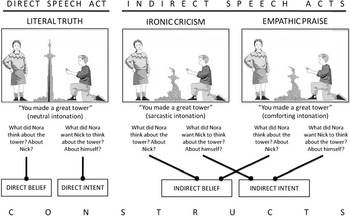
The experimental design is articulated in a deconstruction in Figure 1. Imagine a social situation involving Nora commenting on how Nick has performed a task. In the literal truth scenario (left), Nora is presented as a person who likes to talk to people, and her utterance “You built a great tower!” maps transparently on to meaning because Nick's tower is well made [half of the literal truth scenarios, not pictured, involved Nora saying that a bad job was poorly done]. In the ironic criticism scenario (middle), Nora is presented as a person who likes to bug and annoy people, and her sarcastic utterance “You built a great tower!” is opaque with respect to meaning because Nick's tower is poorly made, and conveys criticism and/or disapproval. In the empathic praise scenario (right), Nora is presented as a person who likes to cheer people up, and her empathic utterance “You built a great tower!” is opaque with respect to meaning because Nick's tower is poorly made, and conveys comfort and/or support.
Aim 1 compares the direct speech acts (Literal Truth) with the two indirect speech acts (Ironic Criticism and Empathic Praise). Aim 2 compares the two indirect speech acts to each other. Aim 3 evaluates two sources of task difficulty (direct vs. indirect speech act and belief vs. intention). Portions of this figure have been previously published by Dennis et al. (Reference Dennis, Purvis, Barnes, Wilkinson and Winner2001).

Various comparisons reveal what the child understands about these social scenarios. One comparison concerns the difference between direct and indirect speech acts—that is, between literal truth, where there is transparency between what the speaker says and believes, and ironic criticism and empathic praise. Another contrast is between beliefs (what the speaker believes about the task and the person) and intentions (what the speaker wants the hearer to think and feel about his or her performance and himself or herself). Another is the relative difficulty of understanding the negative versus positive intentions involved in ironic criticism versus empathic praise.
Method
Participants
Participants included 8- to 13-year-old children previously hospitalized for either a TBI or OI who had been injured between 12 and 63 months before testing. All children were injured after 3 years of age, the majority after 4 years of age.
Exclusion criteria for both TBI and OI groups were as follows: (a) history of more than one serious injury requiring medical treatment; (b) premorbid neurological disorder or mental retardation; (c) child abuse or assault; (d) severe psychiatric disorder requiring hospitalization; (e) sensory or motor impairment that prevented valid administration of study measures and (f) primary language other than English. Children in full-time special education classrooms were excluded (in all but one case), although those with a history of premorbid learning or attention problems were not excluded.
Recruitment occurred in three sites: Toronto (Canada), Columbus (US), and Cleveland (US). Among eligible children, 82 (47%) with TBI and 61 (26%) with OI agreed to enroll. The participation rate was significantly higher for TBI than OI. However, participants and non-participants in both groups did not differ in age at injury, age at initial contact, sex, race, or census tract measures of socioeconomic status (SES; i.e., mean family income, percentage of minority heads of household, and percentage of households below the poverty line). Participants and non-participants did not differ on measures of injury severity (i.e., mean length of hospital stay, median Glasgow Coma Scale score for children with TBI).
The human data included in this manuscript were obtained in compliance with formal ethics review committees at Nationwide Children's Hospital in Columbus, Case Western Reserve University/Rainbow Babies and Children's Hospital and University Hospitals Case Medical Center in Cleveland, and the Hospital for Sick Children in Toronto. Parent consent and child assent was obtained before testing.
All participants were assessed at least 6 months post injury. Of the 128 children who completed the task, 71 had sustained a TBI. The TBI group had a lowest GCS (Teasdale & Jennett, Reference Teasdale and Jennett1974) score of 12 or less after resuscitation or 13–15 with positive imaging for brain insult or depressed skull fracture. TBI children were grouped by injury severity: GCS scores 9–15 defined a complicated Mild/Moderate TBI group (n = 50) and GCS scores 3–8 defined a Severe TBI group (n = 21). The OI group (n = 57) involved children hospitalized for fractures not associated with any loss of consciousness or other indications of brain injury (e.g., skull or facial fractures).
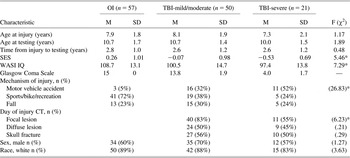
Participant demographics, including sex, race, socioeconomic status (Yeates & Taylor, Reference Yeates and Taylor1997), WASI IQ, age at injury, age at time of test, and time since injury are shown in Table 1. The socioeconomic composite index (SCI) was significantly higher for the OI group than for either TBI group, with the Severe TBI group having the lowest mean SCI. The groups also differed in the distribution of mechanism of injury, with injuries arising from motorized vehicles being most common in the Severe TBI group and those arising from sports and recreational events being most common among the OI group. The group differences in SCI were no longer significant when injury mechanism was taken into account. Therefore, we did not treat SCI as a covariate in data analyses, because the SCI differences appeared to be intrinsic to the injury groups. When a covariate is an attribute of a disorder, or is intrinsic to the condition, it is not meaningful and can be potentially misleading to “adjust” for differences in the covariate (Dennis et al., Reference Dennis, Francis, Cirino, Schachar, Barnes and Fletcher2009). Our findings are consistent with epidemiological studies showing that the risk of TBI, particularly those linked to motorized vehicles, is highest for children of lower SCI and minority status (Brown, Reference Brown2010; Howard, Joseph, & Natale, Reference Howard, Joseph and Natale2005; Langlois, Rutland-Brown, & Thomas, Reference Langlois, Rutland-Brown and Thomas2005; McKinlay et al., Reference McKinlay, Kyonka, Grace, Horwood, Fergusson and MacFarlane2010; Parslow, Morris, Tasker, Forsyth, & Hawley, Reference Parslow, Morris, Tasker, Forsyth and Hawley2005; Yeates, Williams, Harris, Round, & Jenkins, Reference Yeates, Williams, Harris, Round and Jenkins2006).
Demographic and early injury characteristics of study participants

*p < 0.05
Measure
The Literal Truth, Ironic Criticism, and Empathic Praise Task (Dennis et al., Reference Dennis, Purvis, Barnes, Wilkinson and Winner2001)
Six pictured situations, (a) tidying a room, (b) baking a cake, (c) raking a leaf pile, (d) building a block tower (Figure 1), (e) erasing a blackboard, and (f) fixing a bike, were presented in each of three forms: literal truth, ironic criticism, and empathic praise, with the 18 scenarios presented in a pre-determined random order.
Each scenario involved simultaneous presentation of a picture, a narrative, and an audiotape of the speaker's utterances recorded by a professional actor and a psychologist with neutral, ironic, or empathic intonation (which facilitates comprehension of irony and empathy, de Groot, Kaplan, Rosenblatt, Dews, & Winner, Reference de Groot, Kaplan, Rosenblatt, Dews and Winner1995). Participants were told the goal (e.g., to build a tower), the outcome (e.g., “the tower was…”), speaker character (e.g., “she liked to chat and talk to people”; “she liked to bug and annoy people”; “she liked to cheer people up”), and what the speaker said (e.g., “You made a great tower”). Different first names and different pictures were used for different items.
Participants were asked two factual questions, what happened in the picture, and what the speaker said about the event; two belief questions, what the speaker thought about the task, and about the doer; and two intent questions, what the speaker wanted the hearer to think about the task, and what the speaker wanted the hearer to think about him- or herself. A final factual question about what the speaker said about the event probed for memory for key information about the questions that had been asked. Questions for the tower scenario are in Appendix A, and scoring is described in Appendix B.
For the seven key scores (Literal Truth, Ironic Criticism, Empathic Praise, Direct Belief, Direct Intent, Indirect Belief, Indirect Intent), raw data were converted to percentage of correct responses for each score. Data were first analyzed using group membership as a between-subjects factor and scenario type (literal vs. ironic vs. empathic) as the within-subjects factor in repeated-measures analyses of variance. To address our first aim, trials involving literal scenarios were contrasted with an average of trials involving ironic and empathic scenarios, using single-degree-of-freedom planned contrasts that compared Severe TBI versus OI and Mild/Moderate TBI versus OI. To address the second aim, a second analysis compared ironic and empathic scenarios with single-degree-of-freedom planned contrasts comparing Severe TBI versus OI and Mild/Moderate TBI versus OI. To examine the third aim, the data were analyzed using group membership as a between-subject factor and direct versus indirect and belief versus intent as within-subjects factors in a repeated-measures analysis of variance. Single-degree-of-freedom planned contrasts were used to test for three-way interactions (between group membership, direct vs. indirect speech acts, and belief vs. intent) and two-way interactions (between group membership and direct vs. indirect speech acts and group membership and belief vs. intent). Age at testing was treated as a covariate in all analyses; preliminary tests indicated that the relationship between age and outcomes did not vary significantly across groups.
Debate continues about whether information in early CT reports might improve upon GCS scores in predicting outcomes (Levin et al., Reference Levin, Hanten, Roberson, Li, Ewing-Cobbs, Dennis and Swank2008), and whether quantitative CT measures can predict 6-month global outcome (Yuh et al., Reference Yuh, Cooper, Ferguson and Manley2012). We explored whether time-of injury CT reports were related to performance in the TBI group, independent of the GCS score that was the basis of group assignment. CT scan reports for each participant were coded independently by authors MD and KOY for the presence of various lesion types, with one point assigned for the presence of each abnormality. These included focal injuries (focal intracranial contusion; intraparenchymal, intracerebral, or intraventricular bleed; subarachnoid hemorrhage; subdural hemorrhage; epidural hemorrhage; extradural/extra-axial blood), diffuse injuries (punctuate hemorrhage or petecchia; swelling/edema/effacement of sulci/attenuation of gray-white matter; abnormal/compressed/displaced/asymmetric ventricles; abnormal/ obliterated/ hyperintense cisterns; midline shift; brain herniation; mass effect), and skull fractures (linear or depressed skull fracture in frontal, parietal, occipital or temporal bone; basilar skull fracture). Two measures were extracted from these ratings: CT-focal injury (maximum points = 6) and CT diffuse injury (maximum points = 7).
Results
Direct Versus Indirect Speech Acts
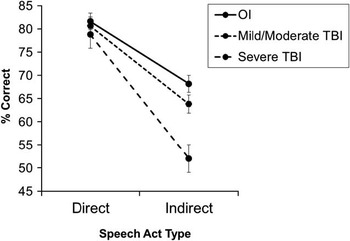
The repeated-measures analysis revealed a significant main effect for Group, reflecting overall higher accuracy for children with OI than for those with TBI (72.66% for OI; 69.43% for Mild/Moderate TBI; 60.95% for Severe TBI), F(2,124) = 6.49, p = .002, η2 = .095, and a significant main effect for scenario type, reflecting significantly higher overall accuracy for Direct than for Indirect Speech Acts (80.34% for literal, 61.72% for ironic, 60.98% for empathic scenarios), F(2,123) = 4.59, p = .012; η2 = .07. Age was also positively related to performance of all three speech acts, F(1,124) = 21.67, p < .001, η2 = .15. Planned contrasts revealed that the Severe TBI versus OI interaction for Direct versus Indirect Speech Act was significant F(1,124) = 18.73, p < .001, η2 = .13, such that the Severe TBI group was significantly worse than the OI group on Indirect Speech Acts but did not differ from OI on Direct Speech Acts. The Mild/Moderate TBI versus OI interaction for Direct versus Indirect Speech Act was not significant F(1,124) = 2.15, p = .146, η2 = .02. Figure 2 displays the mean proportion of correct responses for the three groups across the Direct and Indirect trial types, adjusted for test age.
Percentage of correct responses on direct and indirect speech acts (adjusted for age at testing, with standard error bars).

Ironic Criticism Versus Empathic Praise
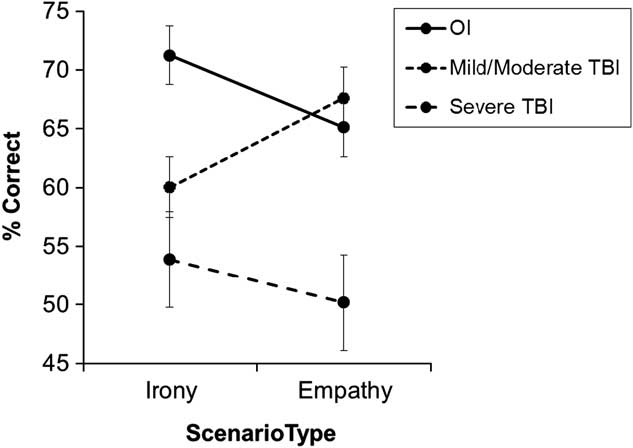
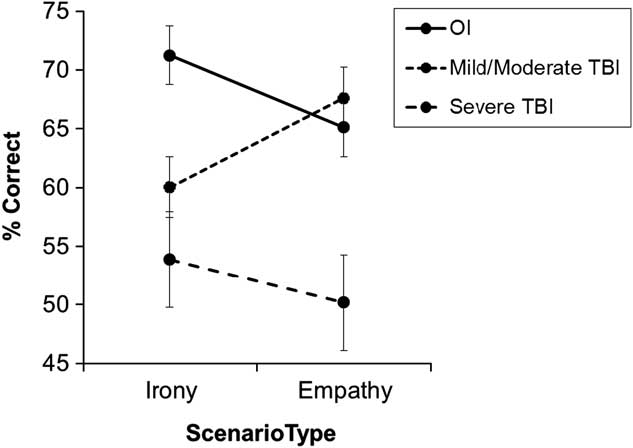
Figure 3 displays the mean percentage of correct responses for the three groups across the ironic and empathic scenarios, adjusted for test age. Planned contrasts revealed that the Mild/Moderate TBI versus OI interaction for Ironic Criticism versus Empathic Praise was significant F(1,124) = 7.26, p = .008, η2 = .055, such that the Mild/Moderate TBI group was significantly worse than the OI group on Ironic Criticism (p = .009) but did not differ from OI on Empathic Praise (p = .423). The Severe TBI versus OI interaction for Ironic Criticism versus Empathic Praise was not significant F(1,124) = 0.13, p = .722, η2 = .001, because the Severe TBI group was significantly worse than OI on both forms of indirect speech (p = .002 for Ironic Criticism; p < .001 for Empathic Praise).
Percentage of correct responses on ironic criticism and empathic praise scenarios (adjusted for age at testing, with standard error bars).
Belief Versus Intent/Direct Versus Indirect Speech Acts
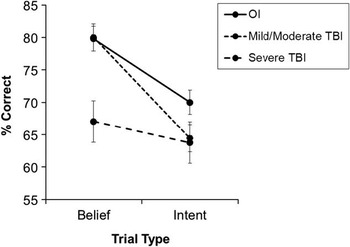
The main effect of Belief versus Intent was not significant, F(1,124) = 1.93, p = .168, η2 = .015, although participants generally performed better on Belief than Intent trials (75.62% vs. 66.07%). The test of the overall Group by Belief versus Intent interaction was significant, F(2,124) = 4.24, p = .017, η2 = .06; both the OI and Mild/Moderate TBI groups performed significantly better on Belief than Intent trials, but the Severe TBI group did not. Figure 4 illustrates the mean percentage of correct responses on the Belief and Intent trial types, adjusted for test age.
Percentage of correct responses on Belief versus Intent trial types (adjusted for age at testing, with standard error bars).

The interaction of Direct versus Indirect and Belief versus Intent was not significant F(1,124) = 1.06, p = .305, η2 = .01. The three-way interactions involving group were not significant either. Planned contrasts for the two-way interaction comparing Belief versus Intent revealed that the Severe TBI versus OI interaction was not significant, F(1,124) = 2.28, p = .133, η2 = .018, because the Severe TBI group was less accurate than the OI group on both beliefs and intentions. In contrast, the Mild/Moderate TBI versus OI interaction was marginally significant F(1,124) = 3.24, p = .074, η2 = .025, because the Mild/Moderate group was less accurate than the OI group on Intent trials (p = .094) but did not differ on Belief trials (p = .926).
Task Recall and SES
The groups did not differ significantly on either immediate or delayed (after all the questions of interest had been answered) memory for what the speaker said; they performed at ceiling on the former (100% accuracy in all three groups) and near ceiling on the latter (97–98% accuracy in all three groups). The groups did differ significantly on the situation comprehension questions, but accuracy was greater than 90% in all three groups. Moreover, the primary findings were unchanged when situation comprehension was included as a covariate in the analysis. More specifically, although situation comprehension was a significant predictor of overall task performance across groups, F(1,123) = 5.82, p = .017, η2 = .05, the Severe TBI versus OI interaction for Direct versus Indirect Speech Acts remained significant, F(1,123) = 14.81, p < .001, η2 = .11, when situation comprehension was controlled. Similarly, the Mild/Moderate TBI versus OI interaction for Ironic Criticism versus Empathic Praise remained significant F(1,123) = 7.24, p = .008, η2 = .06; the overall Group by Belief versus Intent interaction was significant, F(2,123) = 3.14, p = .047, η2 = .05; and the Mild/Moderate TBI versus OI interaction for Belief versus Intent remained marginally significant F(1,123) = 3.23, p = .075, η2 = .026. Thus, task recall and comprehension was generally excellent, and variations in comprehension did not account for either between- or within-group differences.
The lack of evidence for recruitment bias shows that the group difference in SES is intrinsically related to TBI severity and is not a function of biased sampling. We examined the average within-group correlations between SES and task performance to determine how SES relates to task performance independent of the intrinsic differences between groups in SES. The average within-group correlations between SES and task performance were small, although the correlation with ironic communication was significant (i.e., r = .14 with literal, .22 with ironic, .06 with empathic).
Injury Severity
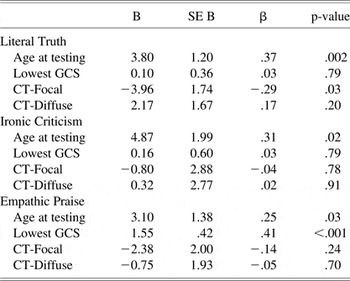
The diffuse and focal CT abnormality scores, lowest post-resuscitation GCS score, and age at testing were entered into simple linear regressions predicting Literal Truth, Ironic Criticism, and Empathic Praise in children with TBI. The overall regression model for Ironic Criticism was not significant, R 2 = .10, F(4,63) = 1.71, p = .16, whereas the models for Literal Truth and Empathic Praise were significant, R 2 = .19, F(4,63) = 3.76, p = .008, and R 2 = .30, F(4,63) = 7.75, p < .001, respectively. Age at testing accounted for unique variance in all three outcomes. The focal CT abnormality score was negatively associated with Literal Truth, B = −3.96, SE = 1.74, β = −.29, p = .026, but not with the other two outcomes. The diffuse CT abnormality score did not predict any outcome. The GCS score was positively associated with Empathic Praise, B = 1.55, SE = .42, β = .41, p < .001, but was not a unique predictor of any other outcome. Table 2 summarizes the regression models for these three outcome measures.
Regression models predicting Literal Truth, Ironic Criticism, and Empathic Praise

Discussion
This study documents the sensitivity of an experimental comprehension task of ironic criticism and empathic praise to impairments of conative communication in children with TBI. Group differences emerged on indirect speech acts involving conation, but not on structurally and linguistically identical direct speech acts; thus, the findings suggest that school-age children with TBI have somewhat specific deficits in this domain of social skills relative to their OI peers. Conative communication deficits in children with milder or moderate TBI were less widespread and more selective than those of children with more severe injuries.
All children could perform the task. The OI group performed well, but not perfectly, on all components of the task, showing that the task is suitable for children in our age range, and has appropriate floors and ceilings. As hypothesized, there is a direct speech act advantage for all groups, even with identical task demands and questions in literal truth, ironic criticism, and empathic praise.
One question is whether the selective pattern of results can be ascribed to domain-general abilities like IQ or working memory, when working memory demands have been equated across the three key conditions within the task. Although working memory is involved in any effortful cognitive task, working memory is not an explanation of cognitive task performance if items are equated for working memory demands. Because the literal, ironic, and empathic statement formats were identical, and each scenario (cake, leaves, tower, etc.) was presented in literal, ironic, and empathic forms, the working memory demands and content were the same throughout, yet even the Severe TBI group did not differ from the OI group on literal statements, but showed significant differences on indirect statements. This was true although all groups had near perfect immediate and delayed recall of the critical information about what the literal, ironic, or empathic speakers said.
Cognitive functions are interrelated and correlations may exist among outcome measures, especially when all are affected by TBI. We believe we cannot know the direction or the magnitude of the relationships based on simple correlations or regressions without testing alternative theoretical models of relationships among variables through causal modeling. To assert prima facie that working memory influences conative ToM would be to assume that the relation is directional and causal, when this has not actually been demonstrated. General-purpose skills like working memory may themselves be shaped by social abilities (Huang & Galinsky, Reference Huang and Galinsky2011).
As hypothesized, most children (in the Mild/Moderate TBI and OI groups) found the more cognitive component of the task (i.e., belief) easier to understand than the more conative function (i.e., intention). This is consistent with developmental data showing that cognitive ToM involving belief develops before intentionality of the type involved in irony and empathy. Because we found no evidence for differential effects of direct versus indirect speech acts on belief versus intent (either two-way or in interaction with group), belief and intent and the type of speech act appear to have independent effects on task performance. Conative ToM, concerned with exerting influence over what others think and feel, is somewhat independent from cognitive ToM, which is concerned with mindreading.
The Mild/Moderate TBI group performed more poorly than the OI group on indirect speech acts involving ironic criticism, but as well as the OI group on those involving empathic praise. This need not mean that they had mastered the second-order intentions underlying empathy; they may have adopted a default literal interpretation of the empathic utterances, ignoring the intentions, a strategy that would have led them to good performance because in empathic praise, what is said actually matches what was meant (what differs is the reality of the job). The Mild/Moderate TBI group may also show an asymmetric mastery of irony and empathy. In either event, children with Mild/Moderate TBI do not understand the full range of indirect speech acts, which includes both positively and negatively valenced conative communication. The Severe TBI group has a more widespread conative impairment. Compared to those with less severe injuries, children with Severe TBI have a more basic deficit, because they failed to understand beliefs. To the extent that beliefs tap cognitive problems and intentions tap both conative and cognitive problems, the Severe TBI group demonstrates cognitive as well as conative deficits in attempting to understand ironic criticism and empathic praise, whereas the Mild/Moderate TBI group exhibits primarily conative problems.
Despite their difficulties with irony and empathy, children with TBI understood referentially transparent conative information (direct speech acts in which a speaker offers praise for a well done job or criticism of a poorly done job). Children with TBI may have problems in understanding interpersonal communications, not only because of their social nature, but also because of their referential opacity.
In this study, we have focused on decomposing comprehension difficulties for children in understanding ironic and empathic utterances. The empathy studied here, the comforting (“little white”) lie, is of interest because it is parallel in structure (but not in intentional valence) with ironic utterances within a paradigm that equates for task demands, allowing us to study the conative valence of the second-order intentions (positive in empathy, negative in irony). We did not study other forms of empathy, such as lending money to friends (e.g., Rameson et al., Reference Rameson, Morelli and Lieberman2012); self-reported altruism (e.g., Tankersley et al., Reference Tankersley, Stowe and Huettel2007); vicarious embarrassment (Krach et al., Reference Krach, Cohrs, de Echeverria Loebell, Kircher, Sommer, Jansen and Paulus2011); vicarious rewards (e.g., Mobbs et al., Reference Mobbs, Yu, Meyer, Passamonti, Seymour, Calder and Dalgleish2009); response to others’ pain (e.g., Hein et al., Reference Hein, Silani, Preuschoff, Batson and Singer2010; Singer et al., Reference Singer, Seymour, O'Doherty, Kaube, Dolan and Firth2004; Olsson et al., Reference Olsson, Nearing and Phelps2007); listening to sad stories (Decety & Chaminade, Reference Decety and Chaminade2003); and prosocial behavior toward a rejection victim (Masten et al., Reference Masten, Morelli and Eisenberger2011). Nor did we study obscure forms of irony, such as speaking ironically to express understanding of a statement as being ironic (Gibbs, Reference Gibbs1984; Gibbs, O'Brien, & Doolittle, Reference Gibbs, O'Brien and Doolittle1995), or irony that reveals speaker emotion rather than affecting hearer emotion (Leggitt & Gibbs, Reference Leggitt and Gibbs2000). We studied school-aged children but not preschoolers, adolescents, adults or geriatric adults. We have not explored the consequences of conative deficits for social adjustment. We have not reported brain correlates of disordered irony and empathy. A further limitation is that we have studied the comprehension of irony and empathy, but not the spontaneous expression of ironic and empathic utterances in naturalistic settings, such as the playground. However, social cognition concerns how children think about their social world, and this is typically tested in comprehension paradigms (of facial expressions, of the content of someone else's mind, of irony and empathy).
In the end, what do deficits in understanding irony and empathy mean for children with TBI? Irony and empathy are not rhetorical flourishes in the social world. Instead, they lubricate the wheels of social discourse. Irony has historically been regarded as a form of literary rhetoric and empathy as a form of vicarious or simulated experience. Irony and empathy are often presented as very different constructs when studied in widely varying experimental or descriptive paradigms; however, both forms of non-literal communication share several features, including an awareness of intentions in oneself and others, the communication of affective praise or blame, and the exertion of affective influence on another person. Sarcasm involves a social evaluation of praise, blame, and responsibility, but allows these to be communicated without angry confrontation. Irony and empathy modulate social distance: Irony mutes criticism and establishes social distance, while empathy gives comfort and maintains connectedness. Irony and empathy express social rules, and allow the modulation of emotional expression according to these rules. Deficits in understanding the social, conative function of indirect speech acts like irony and empathy have widespread and deep implications for a child's success in the social world of the home, classroom, playground, and sports arena; in effect, for involvement in children's key life situations (McCauley et al., Reference McCauley, Wilde, Anderson, Bedell, Beers, Campbell and Yeates2012).
Acknowledgments
Preparation of this study was supported by National Institute of Child Health and Human Development Grant 1 RO1 HD 04946, “Social Outcomes in Pediatric Traumatic Brain Injury,” to Keith Yeates. No conflicts of interest exist.
Example of a Literal Truth Scenario
While looking at Figure 1 (left panel), the child heard the following vignette and was asked the following questions:
Examiner says: “Nick decided to build a LEGO tower. When he was finished it looked just like this…” (Examiner shows picture of left panel).
Q1 (Situation Comprehension): Examiner points to tower: “What was Nick's tower like?”
Examiner says: “Nora looked at the tower. She likes to chat and talk to people. She said…” (play tape recorder) ‘You made a great tower!’ (neutral intonation).
Q2 (Literal Recall): Examiner points to Nora. “What did Nora say?”
Q3 (Belief Task): “What did Nora think about the tower?”
Q4 (Belief Person): “What did Nora think about Nick?”
Q5 (Intention Task): “What did Nora want Nick to think about the tower?”
Q6 (Intention Person): “What did Nora want Nick to think about himself?”
Q7 (Delayed Recall): Examiner points to Nora: “What was it that Nora said?”
Example of an Ironic Criticism Scenario
While looking at Figure 1 (middle panel), the child heard the following vignette and was asked the following questions:
Examiner says: “Nick decided to build a LEGO tower. He couldn't get the blocks to stay together, and it looked just like this…” (Examiner shows picture of middle panel).
Q1 (Situation Comprehension): Examiner points to tower: “What was Nick's tower like?”
Examiner says: “Nora looked at the tower. She likes to bug and annoy people. She said…” (play tape recorder) ‘You made a great tower!’ (sarcastic intonation).
Q2 through Q7 as above.
Example of an Empathic Praise Scenario
While looking at Figure 1 (right panel), the child heard the following vignette and was asked the following questions:
Examiner says: “Nick decided to build a LEGO tower. He couldn't get the blocks to stay together, and it looked just like this…” (Examiner shows picture of middle panel).
Q1 (Situation Comprehension): Examiner points to tower: “What was Nick's tower like?”
Examiner says: “Nora looked at the tower. She likes to cheer people up. She said…” (play tape recorder) ‘You made a great tower!’ (comforting intonation).
Q2 through Q7 as above.
Appendix B Factual questions (facts of the event, what the speaker said) were scored as either correct (1) or incorrect (0). Belief and intent questions were scored as correct (2), underspecified (1), or incorrect (0) where a correct response related the appropriate valence to the belief (i.e., correct response to literal scenario example: the tower was great) or intention (i.e., correct response to literal scenario example: Nick is great at making towers), an underspecified response identified the valence vaguely (“he is nice”), and an incorrect response failed to identify the correct valence.