


1. Introduction
Industry funding has become the major source of income for scientific research. In addition to economic forces causing this trend, a number of nonprofit and government agencies (e.g., the Gates Foundation, the Wellcome trust, the President’s Council of Advisors on Science and Technology, the Food and Drug Administration) are recommending more collaboration between industry and academia (Drazen Reference Drazen2015). The entire field of biomedicine is undergoing a massive shift along these lines as pharmaceutical companies shift their research and development work into universities under the rubric of translational medicine (Robinson, Reference Robinsonforthcoming). Similarly, most of the work assessing the safety of industrial chemicals is conducted by the companies that produce them (Conrad and Becker Reference Conrad and Becker2011). Yet concurrent with this shift toward industry funding, there has been growing concern with the ways in which industry “bends science” (McGarity and Wagner Reference McGarity and Wagner2008).
The focus of this concern has been with the conflicts of interest created by industry partnership and how to manage them (Lo and Field Reference Lo and Field2009; Elliott Reference Elliott2014). Such concerns have led some to suggest that industry-funded research should be assigned less weight (Resnik and Elliott Reference Resnik and Elliott2013; Holman and Bruner 2015). Others find this antithetical to the very nature of science, in which facts are assessed independent of the personal qualities of the authors (Conrad and Becker Reference Conrad and Becker2011). Moreover, industry scientists react very strongly to the idea that their work is suspect. For example, Brain, Stavely, and Ortego (Reference Brain, Stavely and Ortego2016, 1071) note that while society is distrustful of research produced by researchers affiliated with industry, “this is a peculiar and seemingly illogical behavior given that employees in government, industry and academia are all sourced from the same educational system, from the same academic institutions, and often from the same laboratories, mentors and advisors, which instill commensurate scientific training, education, experience, integrity, morals, and ethics. Consequently, an insinuation of affiliation bias categorically ignores educational equality and job opportunity/availability, and is therefore completely irrational.” Whether or not concern with affiliation bias is irrational, one shared assumption is that conflicts of interest operate by causing researchers to bias their results in favor of a secondary interest (e.g., corporate profits) at the expense of a primary interest (e.g., truth). The insinuation of those distrustful of industry is that researchers with industry ties have either willfully compromised their integrity or been unwittingly corrupted. It is no wonder why industry researchers bristle at such distrust.
While not disregarding problems caused by conflicts of interest, the purview offered by social epistemology can highlight entirely distinct mechanisms that produce industry-favorable outcomes without any individual researcher being corrupted by industry. In order to highlight such effects, we first consider the antiarrhythmic drug disaster. We argue that while conflicts of interest were present, they were not the primary cause of the disaster. Instead, the tragedy resulted from the following features of the scientific community: (1) an initial diversity of views, (2) a merit-based structure, and (3) the ability of industry to selectively distribute resources.
Without a countervailing force, we argue that these features are sufficient to tip an otherwise honest epistemic community toward pro-industry conclusions. This effect occurs not by altering the view of any particular individual but as a result of the selective pressures that naturally exist in the scientific community. In section 2, we formalize this intuition using a formal model of social inquiry put forth by Zollman (Reference Zollman2010) and show that the above three conditions produce a distortion in group belief. Finally, we consider a number of possible countermeasures. Here we show how some practices that may seem to promote unbiased inquiry (i.e., independent funding) actually exacerbate the problem if not implemented with additional restrictions.
2. Class 1 Antiarrhythmic Drugs: A Confluence of Interests
The Cardiac Arrhythmia Suppression Trial (CAST) was convened to determine whether antiarrhythmic drugs prevented heart attacks. An arrhythmia (i.e., an irregular heartbeat) precipitated the majority of heart attacks, and it was believed that if arrhythmias could be suppressed, then heart attacks could be prevented as well. The CAST randomized clinical trial showed how dangerous relying on such theories is, and this historical episode has been used by philosophers as a paradigm case for the use of randomized clinical trials (e.g., Howick Reference Howick2011). The trial showed that not only were antiarrhythmic drugs ineffective, but they dramatically increased the odds of a patient dying in general and dying from a heart attack in particular (CAST Investigators Reference Investigators1989). Because antiarrhythmic drugs were both harmful and widely prescribed, it is estimated that their use caused tens, if not hundreds, of thousands of deaths (Moore Reference Moore1995).
Yet we can push the problem back and ask why a causal explanation was a plausible basis for widespread prescription. This is even more perplexing when one realizes that when Harvard professor Bernard Lown (Reference Lown1979) first proposed the arrhythmia suppression hypothesis, he did so with caution. Indeed, he specifically warned that “commonly used antiarrhythmic agents may sometimes aggravate arrhythmia and thus threaten survival” (317) and claimed that “in the vast majority of patients, [heart arrhythmias] require no treatment” (321). Because of such concerns, the cardiological research team around Harvard adopted a number of cautious positions. They employed the Lown grading system to stratify patients by risk (limiting treatment to high-risk patients) and tested drugs using death as a primary end point rather than rely on the arrhythmia suppression hypothesis in evaluation (Graboys et al. Reference Graboys, Lown, Podrid and DeSilva1982).
Lown’s caution was not universally shared. There was a diversity of opinion on what methods should be used to judge efficacy, how dangerous antiarrhythmic drugs were, and what populations stood to benefit. Two researchers in particular, Joel Morganroth and Robert Winkle, were enthusiastic about the therapeutic potential of antiarrhythmic drugs and were making their reputations by using a surrogate endpoint to measure antiarrhythmic efficacy (Morganroth et al. Reference Morganroth, Michelson, Horowitz, Josephson, Pearlman and Dunkman1978; Winkle Reference Winkle1978). While there were intermediate positions between Lown’s Harvard group and researchers like Morganroth and Winkle, these positions represented ends of the spectrum in multiple respects.Footnote 1 First and foremost, the measures of efficacy (arrhythmia suppression) promoted by Winkle and Morganroth could be demonstrated in a matter of days or weeks, whereas long-term survival would take years to demonstrate and would cost far more to investigate.
It should not be terribly surprising that when pharmaceutical companies looked for academic researchers to partner with, they reached out to researchers like Morganroth and Winkle. Likewise, when pharmaceutical manufacturers convened a conference of cardiac researchers to discuss how such drugs should be evaluated by the FDA (Food and Drug Administration), it was Morganroth whom they arranged to chair the conference. The conference accepted three presentations that addressed the measurement of efficacy. They first argued that measuring prevention of cardiac death was “unreasonably expensive” and detailed how arrhythmia suppression could be used as a surrogate endpoint (Hoffman Reference Hoffman, Morganroth, Moore, Dreifus and Michelson1981). A second speaker argued that the Lown classification system was inappropriate for research purposes (Campbell Reference Campbell, Morganroth, Moore, Dreifus and Michelson1981). Finally, Morganroth himself elaborated how arrhythmia data should be analyzed (Reference Morganroth, Morganroth, Moore, Dreifus and Michelson1981). While researchers with alternative views were in attendance, they were not provided with the stage.
During the early 1980s the industry continued to fund studies that used arrhythmia suppression as a measure of efficacy, and it slowly became the default methodology in the community, used by researchers both with industry funding (e.g., Morganroth Reference Morganroth, Moore, Dreifus and Michelson1986) and without (e.g., Pratt et al. Reference Pratt1986). Rather than actively oppose researchers that held unfavorable views, industry simply chose not to fund their work. For example, as Moore (Reference Moore1995) details in his account of the antiarrhythmic drug disaster, although Winkle originally received industry funding, after he identified a potential for deadly side effects and began much more rigorous investigations of antiarrhythmic drugs, pharmaceutical companies merely canceled their contracts with him. In contrast, researchers that continued to hold industry-friendly views, continued to receive generous funding and as a consequence published prolifically. In so doing, they became highly influential members of the cardiology community; like Morganroth, they were asked to write textbooks, organize symposia, and sit on FDA advisory panels (Moore Reference Moore1995).
It is worth noting that the researchers such as Morganroth were not hacks. The views they put forward after they began working with industry were no different from before.Footnote 2 Moreover, many industry-funded researchers played lead roles in the CAST that eventually showed the danger of antiarrhythmic drugs (CAST Investigators Reference Investigators1989). While industry-funded researchers faced conflicts of interest, they could honestly say that they did not hold their views because they worked for industry. In fact, it was the other way around. The community did become biased, but as a result of an industrial selection effect: it was because of the views researchers antecedently held that industry contracted them in the first place. Because the method they advocated yielded industry-friendly results, industry provided them with resources to promote their position, and because these resources allowed them to be immensely productive, they attained positions of influence within the community and built a scientific consensus around their view. Most crucially, to bias the scientific consensus, industry did not need to corrupt a single individual; they merely changed the selection pressures inside of a merit-based system.
3. Network Epistemology
As illustrated in the previous section, industry can play a large role in shaping an epistemic community by providing institutional and financial support to select researchers. This, we contend, can result in industry-favorable outcomes, despite the fact that all agents in the epistemic community are just motivated by a desire to discover the truth. In this section, we turn to a simple formal model of group inquiry pioneered by Kevin Zollman (Reference Zollman2010) that has been previously used to investigate the medical research community (Holman and Bruner Reference Holman and Bruner2015). Above, we argued that the eventual scientific consensus among medical researchers was the result of industrial selection; however, readers may harbor a concern that even if researchers were not intentionally skewing results, they must have been unconsciously affected by the funding they received. In the simulations below, we allay such concerns by examining a community of (myopically) rational Bayesian agents whose beliefs and decisions regarding what experiments to run are unquestionably unaffected by whether they receive such funding. After briefly introducing Zollman’s model, we make three alterations to explore the effect industry has on scientific inquiry.
Zollman’s model consists of a group of individuals who all have the choice of taking one of two actions (call them A and B). These actions can be taken to represent a variety of things, such as the administration of different drug regimens or even the application of competing scientific theories. Each action leads to success with some probability (pA and pB for A and B, respectively) and results in failure otherwise. To make this concrete, if the action in question corresponds to administering a drug regimen to a patient, then a ‘success’ would hold if the individual recovers. During each time period of the model, individuals perform E times the action they believe is more likely to be successful. Individuals then update their beliefs on the basis of these data.Footnote 3 Furthermore, individuals take into account not just the data they themselves produce but also the data generated by those they are connected to on a social network. In other words, individuals share information with others in their community. Our model makes three alterations to Zollman’s.
First, we relax the assumption that all researchers are equally productive. Instead, individuals vary with regard to how many experiments or trials they conduct per period. Some are able to perform a large number of trials in a given time period, while others are more limited in their productivity.
Second, and perhaps most important, we assume that individuals performing the same action need not have the same probability of success. In other words, individual i’s success rate with action A ( ) need not be equal to j’s success rate with action A (
 ). We determine agent i’s initial level of success when performing action A by a draw from a normal distribution centered at pA with variance σ 2. Likewise,
 is determined by a draw from a normal distribution centered at pB with a variance of σ 2. This modification to the baseline model captures the fact that while individuals are ostensibly performing the same action when they both, say, administer drug regimen A, they may be using different metrics to determine whether the outcome was in fact a ‘success.’ Thus, the value of
 and
 specifies the methodological bias of agent i.
Finally, we incorporate an exit-entry dynamic into our model to capture the turnover that routinely takes place in real epistemic communities. In each round, with probability e, one individual will be randomly selected to leave the community. This agent will be replaced by a new individual, j. Agent j is randomly assigned beliefs regarding the efficacy of actions A and B. Additionally, agent j’s productivity level (i.e., the number of actions j takes per round) is also randomly assigned. Finally, the values of  and
 will be inherited from another individual in the epistemic community as if being trained in proper methods by a researcher in the existing community. Furthermore, the chance that agent j adopts the methodological bias of another individual, k, is determined by the productivity of agent k. In particular, the probability that j adopts the methodological bias of agent k is
 , where Ek is the productivity level of agent k. We believe this exit-entry dynamic is descriptive of real epistemic communities. Newcomers to an academic community are influenced by the previous generation of researchers, and more influential researchers are more likely to train new members joining the community.
The exit-entry dynamic described above is an instance of the so-called Moran process from evolutionary biology. The Moran process is a standard model of evolutionary change for a finite population. Traulsen, Claussen, and Hauert (Reference Traulsen, Claussen and Hauert2005) show that as the number of individuals in the population increases, the dynamics of the Moran process approximates the behavior of the widely used replicator dynamics, a standard model of cultural and biological evolution. Thus, the Moran process is an apt model for our purposes and has been used to model the process of cultural evolution in small populations (e.g., Wagner Reference Wagner2015).
4. Results
4.1. Baseline Results
We now run a number of simulations of the above model to determine the likelihood that the community converges on the more successful action. Recall that the likelihood individual i achieves success when performing action A is  and that this value is initially determined by a draw from the normal distribution N(pA,σ 2).
We find that as the initial level of methodological diversity in the community (σ 2) increases, the community is less likely to converge to the superior action. In fact, many simulation runs result in all individuals performing the less successful action when σ 2 takes on moderate values. Details regarding our simulations are illustrated in figure 1. To better understand the connection between σ 2 and the reliability of the network, consider the case in which action A is superior to action B (i.e.,  ). If σ 2 is set to zero, then
 for any agent i in the community. However, when σ 2 is greater than zero, it is possible for an individual to adopt a methodology that suggests B is superior (i.e.,
 ). This possibility becomes all the more likely as the value of σ 2 increases. Thus, for moderate to large values of σ 2 it is possible that a large number of individuals adopt a methodology that favors B. This significantly affects not only the beliefs of others in the network (they receive information from their peers suggesting that B is superior to A) but also shapes the methodological bias of newcomers. Accordingly, as methodological diversity increases, the community is less likely to converge on the superior act.Footnote 4
Proportion of individuals performing the superior act as a function of the variance of the normal distribution that initially sets the methodological biases of agents in the community. Simulations are of 20-person epistemic communities,  ,
 ,
 ,
 (blue),
 (orange),
 (green).

4.2. Industry Funding
We now allow for the possibility of industry funding. We assume that when individuals receive funding from industry their productivity each round increases by F.Footnote 5 This has two effects. First, it makes the recipient more influential in the short run—now that she is conducting more trials, she will have a larger impact on her peers. Second, however, it means that she is more likely to train new members of the community (recall that newcomers adopt the methodological bias of others in proportion to their productivity). In this way industry can indirectly influence beliefs as well as the composition of the epistemic community.
In line with the antiarrhythmic drug case study discussed in section 2, we consider a situation in which there are two options: treatment with an antiarrhythmic drug or no treatment. Throughout, we assume that withholding “treatment” is in fact superior to an antiarrhythmic drug ( ). Industry chooses to fund an individual, i, if
 . In other words, industry has an established threshold, and if individuals are using a methodology that increases the apparent efficacy of the drug above this threshold, they will receive industry funding.
Figure 1 illustrates how the inclusion of industry funding affects the reliability of the epistemic community. We find that even low values of F and T significantly lower the chances that the network converges to the superior action and that as the amount of funding doled out (F) increases, a true consensus becomes less likely. Also note that industry can only effectively manipulate the community when there is methodological diversity in the community (i.e., when  ). If there is no methodological diversity to begin with, then industrial selection does not occur.
4.3. Industrial and Independent Sources of Funding
As we have seen, industry can have a sizable effect on the accuracy of an epistemic community. One countervailing force that could potentially nullify the effect of industry funding is for an alternative independent agency (e.g., the National Science Foundation [NSF], National Institutes of Health [NIH]) to fund members of the community. In this section we consider the influence an ‘NSF’ funding body has on an epistemic community that also receives industry funding.
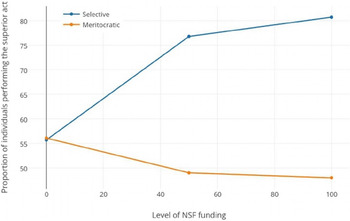
Just as we did with industry, we must specify how, exactly, the NSF allocates funds. We consider a meritocratic policy in which the NSF funds the most productive researchers and a selective policy in which the NSF neglects work done for industry when assessing a researcher’s credentials. First, we consider the meritocratic policy in which the NSF funds any researcher above a specified ‘productivity threshold’. Note that any help agents may have received from industry will go toward their meeting the threshold set by the NSF. Thus, those with industry-favorable views may luck out twice—once due to industry and yet again if industry funding allows them to qualify for additional help from the NSF. We contrast the meritocratic policy with a selective policy, in which individuals are once again funded if they meet the ‘productivity threshold’, but this time additional trials provided by industry are not counted when determining whether the agent qualifies for NSF support.Footnote 6
Figure 2 shows the results of simulations comparing the effect these two policies have on the reliability of the epistemic community. As is evident, when industry is discriminatively funding researchers with favorable methodological biases the NSF does best to adopt the selective policy. A meritocratic policy actually compromises the epistemic community because it results in the NSF disproportionately funding individuals with industry-favorable biases. The implementation of the selective policy, however, significantly improves the epistemic community.
Proportion of individuals performing the superior act as a function of the level of NSF funding and NSF funding policy. Simulations are for 20-person epistemic communities,  ,
 ,
 ,
 .

5. Conclusion
The primary concern about industry funding has heretofore been that a researcher will face a conflict of interest and either intentionally or unintentionally place corporate profits over truth. This same conception also leads industry-funded researchers to vehemently assert that their research has not been corrupted by corporate sponsorship. Our claim is that it is entirely possible for every individual researcher to remain unaffected by industry funding and for the community as a whole to be biased. Indeed, our simulation results show that in a merit-based system, in which researchers must make methodological decisions that affect their estimates of efficacy, a community can be biased even if it is made up of rational agents who are completely unaffected by receiving industry funding. Furthermore, the effect of “industrial selection” is all the more insidious because individuals may truly believe that their work has not been compromised.
Industrial selection biases a community without compromising the integrity of any individual. Yet the effect on individuals has been the focus of concern with industry funding. In the policy document put together by Douglas et al. (Reference Douglas, Elliott, Maynard, Thompson and Whyte2014) on guidance for responsibly accepting industry funding, the primary concern is with integrity and credibility of the researcher (or group) accepting the funds. To address these issues they recommend policies to protect whistle-blowers, maintenance of a diversity of funding, freedom to publish, regular interaction with a broader range of stakeholders, and securing oversight from an independent third party. While we are not disparaging any of these recommendations, even perfect compliance with such guidance does not address the threat caused by industrial selection.
In the case of the antiarrhythmic drug disaster, there was legitimate scientific disagreement about proper methodology. There was no whistle to be blown, conferences with dissenters regularly occurred, and the entire process was overseen by the FDA. Each individual researcher maintained a credible position, and we can charitably grant that every scientist preserved the integrity of his or her research. What happened was not that individual results were corrupted but that certain ways of probing the world were favored over others. Industry was able to survey the community, identify whose research methods were most economically beneficial, and then increase the amount of research done with those methods and, thus, the probability that those researchers would attain positions of influence.
Douglas et al. (Reference Douglas, Elliott, Maynard, Thompson and Whyte2014) suggest that individuals should seek a diverse array of funding. While this would no doubt address some problems at the individual level, our results suggest that simply having an independent agency fund top researchers may actually make things worse. It is worth noting that many industry-funded researchers in the antiarrhythmic drug disaster also received grants from the NIH (Moore Reference Moore1995). While the prospect of funding agencies ignoring scientific work done during grant assessment might face opposition, it is clear that to address the problem of industry funding we must also consider the community-level effects of policies.
Finally, while a policy that would address industrial selection may be unpopular, awareness of the phenomena itself may provide an avenue for productive dialogue with industry scientists, as it opens up the possibility of discussing industry bias without impugning the credibility of individuals. Kitcher (Reference Kitcher1993) showed that a scientific community can be arranged such that it makes “good epistemic use of the grubbiest motives” (305). We take our results to show the inverse, that some community structures will systematically yield biased results even if they are populated by epistemic angels.

 pA=.5
 pB=.45
 T=0.03
 F=0
 F=20
 F=100
 pA=.5
 pB=.45
 T=0.04
 F=20,σ2


