Introduction
The 2015 Global Assessment Report on Disaster Risk Reduction (GAR15)Reference Codreanu, Ngo, Robertson and Celenza 1 demonstrates the compelling need for disaster risk reduction (DRR) actions using disaster risk education (DRE) as the backbone for achieving the combined goals agreed upon at recent international conferences 2 - 4 in coping with the reality of increasing recurrent, small-scale, localized disasters, as well as the anticipated large ones which have not yet occurred. 5 Priority 3 of the Sendai Framework specifically identifies the “use (of) knowledge, innovation, and education” as requirements “to build a culture of safety and resilience at all levels.” 2 According to the Hyogo Framework for Action Monitor, 6 over 100 countries have now dedicated national institutional arrangements for DRR, with 85 of them being through multi-stakeholder platforms. However, there is little evidence that risk information is adequately informing DRR, or whether such information translates into not only end-user risk knowledge, but also end-user behavioral change and DRR skills. The paradigm shift towards a culture of prevention has not been observed 6 in the face of a significant increase in the global drivers for disaster risk (increasing hazard exposure, increasing levels of inequality, rapid urban development, and environment degradation). Essentially, risk information has not translated into risk knowledge. 5
Previous research 7 , Reference Codreanu, Celenza and Alabdulkarim 8 has shown that, to date, DRR efforts targeting teenagers are not associated with the expected outcome of behavioral change. Consequentially, DRR providers’ assumptions are to be challenged.
It is widely known that the first 72 hours after a disaster are critical from many viewpoints, including survival of the individual and prevention of becoming a secondary victim. During this period, the Emergency Medical Services (EMS) are focused on the recovery of critical services and facilities, and less so on the needs of the individual. Additionally, mitigation of further negative consequences on the built environment might require temporary interruption of some essential services (water, electricity, or gas). Such scenarios require an individual to recognize and adapt to the new environment by improvisation, and by relying on previous knowledge and skills that may have never been tested before. Such skills will maintain the basic necessities for human life: oxygen, water, food, warmth, and shelter. In some countries, teenagers take part in disaster education lessons, which are expected to result in a behavioral change towards preparedness. However, a comprehensive, overall measurement tool for such skills and knowledge is missing.
The aims of this multi-national study of the terminal year of high-school students are four-fold:
-
1. To propose the construct of a novel, collective, and comprehensive measure of disaster survival knowledge and skills in the critical first 72 hours, or 72-hour response preparedness (72-RP);
-
2. To assess this new outcome variable 72-RP as a function of discussions about disasters, a surrogate measure of behavioral change in individual disaster preparedness; 7 , Reference Codreanu, Celenza and Alabdulkarim 8
-
3. To explore the relationship between 72-RP and a series of independent predictors (discussions about disasters with family/friends, the respondent’s perception of own country at risk of disasters, age, gender, and participation in school lessons about disasters) in association with additional country-specific characteristics; and
-
4. To explore the relationship between 72-RP, significant independent predictors, the perceived entities responsible for DRE, and their selected interactions.
Methods
A representative sample of 3,829 final-year high-school students were enrolled in an international, multi-center, prospective cross-sectional study using a 27-item, pre-validated, written survey which enquired about knowledge, knowledge of skills, and attitudes towards disasters 7 (Appendix 1; available online only). Nine countries (Bahrein, Croatia, Cyprus, Egypt, Greece, Italy, Portugal, Romania, and Timor-Leste) with different disaster exposure risk and economic development were surveyed. The study has been coordinated from Western Australia using additional local research personnel in each country.
Ethical Committee approval was obtained from the relevant national institutions (Department of Health, Human Research Ethical Committee, West Australian Country Health Services 2010:33/22.11.2010; West Australian Government Department of Education D10/0780282/15.12.2010; and the University of Western Australia Human Research Ethics Committee RA/4/1/5715/14 November 2012). Although all questionnaires were anonymous, where the local Ethical Committee’s guidelines required, formal informed written consent was obtained from the participant and/or his/her parents/legal guardians. Each survey was conducted during class hours in the presence of the European Masters in Disaster Medicine-Alumnus data collector, or a local school teacher.
Analysis of the data was performed using the statistical software IBM SPSS ver. 22 (2014: IBM Corporation; Armonk, New York USA).
Pairwise exclusion of variables required for some of the analyses resulted in up to 43 questionnaires being excluded from analysis, resulting in 3,786 valid questionnaires retained for these instances. There were no variables with more than five percent missing values, and there were no patterns identified in the missing data; therefore, those values were considered missing at random, and pairwise exclusion was appropriate. All hypotheses were tested at a significance level of .05.
Answers related to questions which could record more than two values (ie, “Yes,” “No,” “Don’t Remember/Don’t Know,” and “Depends”) were recoded; that is, answers other than “Yes” were added to the “No” group resulting in dichotomous values (1=“Yes,” and 0=“No”).
A list of acceptable words and reasonable synonyms was compiled in order to code the qualitative data captured by systematic elicitation of free lists as proxy for individual experiences (eg, explain how would you make water safe to drink). Componential analysis was used to validate the answers (eg, “filtration” was not acceptable as an example of making safe-to-drink water, rather “filtration with…,” or “microfiltration”).
A total of 13 questions tested the respondents’ theoretical knowledge and knowledge of skills about several essential attitudes and activities necessary in an evolving, or post-disaster environment. One of the questions enquired about the respondent’s knowledge of turning off the gas supply into their house. Since no previous knowledge of the existence of gas supply to the household was available, this question was omitted from analysis. Only one question required ranking by the respondent: Which means of communication is likely to fail first in a disaster?
One question required the respondents to select two out of a list of eight possible entities which they would identify as being responsible for their DRE. Full details of the recoding of the answers have been described previously.Reference Codreanu, Celenza and Alabdulkarim 8 In brief, regression analysis was not applied to the undecided category, and the combinations chosen by less than one percent of the respondents were excluded from the analysis.
The respondents also were asked to indicate only one system (means) of communication which would be overwhelmed (fail) first in a disaster situation; however, some indicated more than two. These results were recoded into two categories; that is, one response and undecided (two or more responses). The respondents were not asked to rank their responses; consequently, the answers of those who indicated two or more systems could not be ordered. For this reason, regression analysis was not applied to the “undecided” category.
In order to address the stated aims, a series of intermediary steps were developed, as follows.
1. Construct of a Novel, Collective, and Comprehensive Measure of Disaster Survival Knowledge and Skills in the Critical First 72 Hours (72-RP).
The outcome variable concept resulted from the amalgamation of all the attitudes and knowledge of skills tested. Within these, and as in real life, some were deemed more important than others, and a hierarchy had to be established. This was achieved by utilizing analytical hierarchy processing (AHP),Reference Codreanu, Celenza and Ngo 9 which allows reaching the solution to an Eigen value problem. The method was chosen as it supports multi-criteria decision, derives ratio scales from paired comparison criteria (eliminating logical inconsistencies), while still allowing for small inconsistencies in judgment. Pairwise comparisons are a validated method which allows recognizing whether one criterion is more important than another, in the absence of quantitative measurements.
2. Exploring the Correlation Between 72-RP and Discussions About Disasters with Family and/or Friends.
Previous research 7 , Reference Codreanu, Celenza and Alabdulkarim 8 proposed that discussions about disasters with friends and/or family could be used as a surrogate measure for behavioral change, on an individual level, for disaster preparedness. Would such discussions, in isolation, be necessary and sufficient to also translate in a change of the individual’s attitudes and knowledge of skills? In order to investigate the relationship between the proposed outcome variable (72-RP) and discussions about disasters, a Spearman rho product-moment correlation coefficient, and its coefficient of determination, was calculated.
3. Exploring the Relationship Between 72-RP and a Series of Independent Predictors in Association with Additional Country-Specific Characteristics (Model 1).
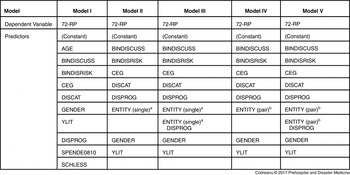
Here, backward elimination was used in multivariate logistic regression to identify significant predictors for 72-RP. The first, fullest version of the model included the following independent variables: age, gender, participation in school lessons about disasters, existence of a national disaster educational program (NDEP), discussions about disasters with family and/or friends, the respondents’ perception of their respective countries’ disaster risk, the country’s economic group, its reported governmental spending on education between 2008-2010, youth literacy rate, and disaster risk ranking (Table 1).
Prediction Models

Note: Entities excluded from the analysis: Charity, Internet, Radio, Local Government & Charity, Self & Charity, TV & Charity, Self & Radio, Radio & Local Government, School & Radio, Internet & Charity, Family & Radio, Internet & Local Government, Radio & Internet, Radio & Charity, and Undecided.
Abbreviations: BINDISCUSS, discussions about disasters with family/friends (binned); BINDISRISK, respondent’s perception of own country at risk of disasters; CEG, the country’s economic development classification; DISCAT, the country’s disaster risk ranking; DISPROG, the existence of a national disaster educational program; SCHLESS, participation in school lessons about disasters; SPENDE0810, spending on education during 2008-2010 as percentage of Gross Domestic Product; YLIT, youth (15-24) literacy rates (%).
a Single entities are: Family, Self, School, Radio, TV, Internet, Charity Organizations, and Local Government.
b Pairs of entities are: Radio & TV, Family & Self, Family & School, TV & Internet, School & Local Government, Self & Internet, Family & Charity Organizations, Family & Local Government, TV & Local Government, Family & Internet, Family & TV, School & TV, Self & Local Government, Self & School, School & Internet, Self & TV, and School & Charity Organizations.
4. Exploring the Relationship Between 72-RP, Significant Independent Predictors, the Perceived Entities Responsible for DRE, and Their Selected Interactions.
The final prediction equation required four intermediate steps.
A. Predicting 72-RP as Function of the Single Entities Responsible for DRE (Model II)—In order to explore whether specific entities were significantly associated with predicting response preparedness, Model II was constructed by amalgamating the significant main effect predictors from Model I with selected single entities.Reference Codreanu, Celenza and Alabdulkarim 8 After checking for assumptions, logistic regression was used to identify the significant predictors for 72-RP.
B. Exploring Significant Interactions Between the Educational Delivery Method and the Entities (Single) Responsible for DRE (Model III)—Model III explored the independent predictors’ main effects, as well as the two-way interactions between the educational delivery method(s) and entities responsible for DRE. In the construct of the equation, all non-significant predictors identified in Model II were eliminated, parsimony was reflected by observing the interaction terms which would reflect real-life situations, and hierarchy was respected by ensuring that all the terms of the interaction, whether or not they had a significant main effect as single predictors, were represented. The selections are based on common-sense grounds, as no formal theory to underpin such interactions exists. The resulting model contained seven independent variables (discussions about disasters with friends and family, NDEP, gender, country disaster risk, youth literacy rate, one’s country perceived risk of disasters, and country economic group); five entities responsible for DRE (Family, Self, School, TV, and Local Government); and the interactions between these and the method of educational delivery (respectively). The multivariate logistic regression model used dummy variables for the entities responsible for DRE contrasted against the largest main effect predictor (Family).
C. Predicting 72-RP as Function of the Pairs of Entities Responsible for DRE (Model IV)—In order to explore whether specific pairs of entities were significantly associated with predicting response preparedness, Model IV was constructed in a similar fashion to Model II, while respecting the exclusion criteria previously described.
D. Exploring Significant Interactions Between the Educational Delivery Methods and the Pairs of Entities Responsible for DRE (Model V)— Similar to Model III, Model V contained the same common trunk of independent variables, 17 pairs of entities responsible for DRE, and the interactions between these and the significant method of educational delivery (NDEP). The multivariate logistic regression model used dummy variables for the entities responsible for DRE contrasted against the largest main effect predictor (School & Local Government).
Results
There were no variables with more than five percent missing values and there were no patterns identified in the missing data; therefore, those values were considered missing at random and pairwise exclusion was appropriate.
Descriptive Statistics
All valid entries for age (N=3,783; missing n=46; M=17.39; SD=.85; 95% CI, 17.36-17.41; range=14-21) were suitable for further analysis as they plotted along a reasonably straight Q-Q line, and the very few outliers did not have any influence on the mean.
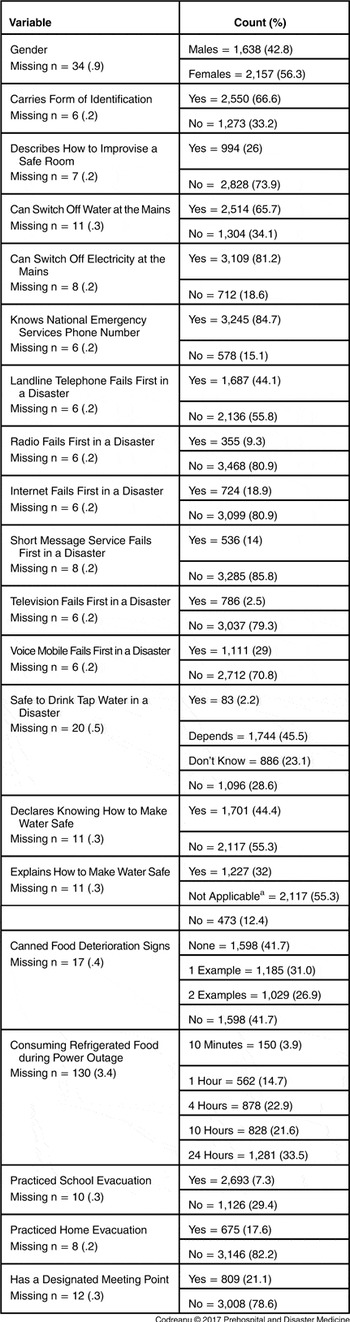
In addition to the descriptive statistics already reported,Reference Codreanu, Celenza and Alabdulkarim 8 the results for the new independent variables are summarized in Table 2. Just over two-thirds of the respondents (N=2,550; 66.5%) would carry a form of identification, but only one-quarter of them (N=1,273; 26%) had been able to describe a reasonable way to improvise a safe room. A significant majority of the students reported being able to switch off electricity power at the mains (N=3,109; 81.2%), but only 65% (N=2,514) were confident to do the same for water. Only 3,245 (85%) students were able to write the EMS phone number valid in their country. Correctly identifying mobile voice telephony as the first mean of communication that would fail in a disaster was done by 1,111 (29%) respondents, while fixed telephony was selected by 1,687 (44.1%), and television by 786 (20.5%). Almost one-half of the students stated that water potability would depend on the type of disaster (N=1,744; 45.5), but more than one-half (N=2,117; 55.3%) declared not knowing how to make water safe to drink. Out of the 1,701 (44.4%) who declared knowing how to make water potable, only 1,227 (32%) were able to state an acceptable method (relative percentage 72.1%). Forty-one percent of the respondents were not able to indicate any sign of canned food deterioration, whereas 1,185 (30.9%) were able to record one, and 1,029 (26.9%) recorded two acceptable signs. The majority of respondents (N=1,281; 33.5%) stated that refrigerated fresh food was safe to be consumed 24 hours after power outage, whereas only 878 (22.9%) indicated the correct four hours as a safe interval. School evacuation was practiced by 2,693 (70.3%) of the students, but only 675 (17.6%) practiced evacuation of their own homes. The existence of a pre-determined meeting point in case of separation from the rest of the family was stated by 809 (21.1%) respondents.
Summary of Frequencies

a Not applicable denotes a that an answer was not expected since it followed a negative answer to a previous question.
1. Construct of the Outcome Variable: 72-RP.
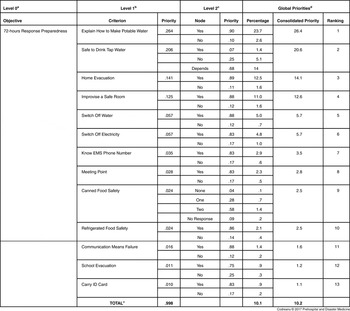
After defining the objective of the decision algorithm process, the relevant criteria (questions) and nodes (answers) were compared in categories and sub-categories with respect to the objective, in order to find their weights based on pairwise comparisons (which criterion in each pair is more important, and how much more on a one-to-nine AHP scale). The AHP scale attributes a value of one for Equal Importance, three for Moderate Importance, five for Strong Importance, seven for Very Strong Importance, and nine for Extreme Importance (two, four, six, and eight values in-between). The sum of the priorities for each node resulted in the global priority of each criterion, which, in turn, resulted in the final ranking (Table 3).Reference Goepel 10 , Reference Goepel 11
Analytic Decision Hierarchy and Resulting Ranking of Attitude/Knowledge of Skill

Abbreviations: EMS, Emergency Medical Services; ID, identity card.
a Level 0 denotes the outcome variable of which a decision is to be made (the objective).
b Level 1 denotes the individual criteria which are used to reach a decision (hierarchy levels).
c Level 2 denotes the values which can be attributed to each criterion (nodes).
d Global priorities are calculated using an Excel (2010: Microsoft Corporation; Redmond, Washington USA) template file by using the row geometric mean method. It involves the following steps:Reference Goepel 10 , Reference Goepel 11
- two consistency indices (ratio and geometric) are calculated,
- a level of consistency (between 0 and 1) is chosen,
- if the consistency ratio exceeds the selected level of consistency, the top 3 inconsistent pair-wise comparisons are highlighted to allow for a judgment adjustment,
- the judgment resulting in lower inconsistency is offered for selection,
- using the eigen vector method, the final priorities are shown in a summary sheet,
- for the solution of the eigenvalue problem, the power method algorithm is applied with a fixed number of 12 iterations,
- different judgment scales are implemented,
- the final selection results from either each individual participant in the process, or an aggregation of individual judgments based on the weighted geometric mean of all participants’ judgments
e The total of percentages is not exactly 100% due to rounding up of calculations.
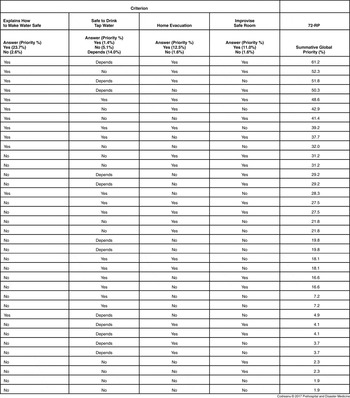
Criterion referenced category of standard-setting is the method of choice in establishing the cut-off point for competency-based assessments;Reference Goepel 12 however, the ethical constraints in the design of disaster medicine research make this method inapplicable. As the outcome variable, 72-RP was defined as the set of criteria of which summative global priorities total equal or above 50%. The resulting selection represented a reasonable hurdle rate for the respondents who need to help themselves without food, water, and shelter, and was in keeping with accepted survival requirements.Reference Abdulghani, Ponnamperuma and Amin 13 The respondents whose answers matched these set criteria were selected and formed the consolidated positive predictor for the outcome variable (Table 4).
Construct of 72-hours Response Preparedness (72-RP) as Summative Global Priorities for Criteria with Consolidated Priorities Above 50%

2. Exploring the Correlation Between 72-RP and Discussions About Disasters with Family and/or Friends.
After checking for assumptions, the Spearman rho test returned a small, 14 , Reference Tabachnick and Fidell 15 positive correlation between the two variables [ρ=.06; N=3,828; P<.001] suggesting that very little of the outcome variable was associated with discussions (coefficient of determination=.003; percentage of variance=.31%). Therefore, this predictor in isolation, although necessary, was not sufficient to explain a significant variance in the outcome variable and additional independent predictors were required in order to construct the prediction model.
3. Predicting 72-RP as Function of a Series of Independent Predictors (Model I).
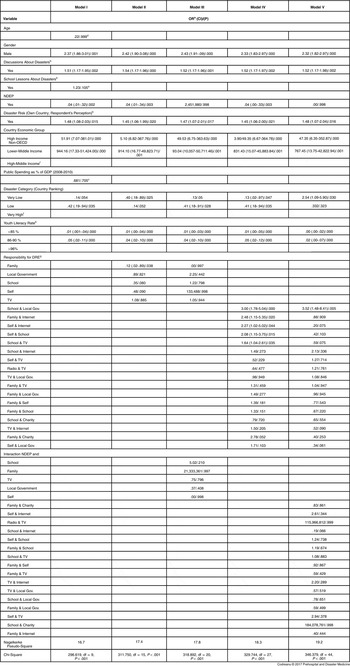
Model I did not show any intercorrelation between 72-RP and the predictors (tolerances<1.00). The model was statistically significant [χ2 (9, N=3,735)=296.619; P<.001] and explained 7.6%-16.7% of the variance in preparedness. Expenditure on education, age, and school lessons did not make a unique, significant contribution to the model. Male gender, discussions about disasters with friends and family, and perception of one’s country disaster risks were positively associated with the outcome; the strongest positive predictor was living in a lower-middle income country (OR=944.16; CI=17.34-51,424.00; P<.001), followed by high-income, non-Organization for Economic Co-operation and Development (OECD) country (OR=51.91, CI=7.07-381.01, P<.001). Negative significant association was recorded for NDEP, one’s country disaster risk ranking, and literacy rate (Table 5).
Results from the Regression Models I-V

Notes: 1. The coefficients for the perceived entities responsible for DRE are in contrast with School & Local Gov.
2. For a continuous independent variable, OR, and its associated CI, represent the difference for an increment of 1-year in age. For categorical independent variables, the way ORs are expressed depends on the reference category. The ratio A:B can be equally expressed as B:A. To express all OR in a common direction, the comparator category can be reversed when a factor shows a negative association. Each of the coefficients for the entities responsible for DRE represent the difference between that entity and the reference category (School & Local Gov.) for the respondents in the baseline category of NDEP. The coefficients for each interaction between the entity responsible for DRE and the educational intervention represent how much the NDEP contrasts vary for each entity, relative to the size of the NDEP effect among those respondents who chose School & Local Gov. To estimate the size of the effect among other entities responsible for DRE relative to School & Local Gov.: β(entity) + β(interaction)=C, and then Exp(C)=OR.
Abbreviations: CI, confidence interval; DRE, disaster reduction education; GDP, Gross Domestic Product; M, mean; NDEP, national disaster education program; OECD, Organization for Economic Co-operation and Development; OR, odds ratio; P, significance value.
a OR value significant at P<.05.
b Denotes binned category.
c Denotes variable eliminated at step 2.
d Denotes variable eliminated at step 3.
e Denotes variable eliminated at step 4.
f Denotes reference variable.
g The following single/pairs of entities have been excluded as representing less than 1% of responses: Charity Organizations, Internet, Radio, Local Government & Charity Organizations, Self & Charity Organizations, TV & Charity Organizations, Self & Radio, Radio & Local Government, School & Radio, Internet & Charity Organizations, Family & Radio, Internet & Local Government, Radio & Internet, Radio & Charity Organizations, and Undecided.
4. Exploring the Relationship Between 72-RP, Significant Independent Predictors, the Perceived Entities Responsible for DRE, and Their Selected Interactions (Models II-V).
A. Predicting 72-RP as Function of the Single Entities Responsible for DRE (Model II)—Model II was statistically significant [χ2 (15, N=3,829)=311.750; P<.001] and explained a larger proportion of the variance. All the significant predictors from Model I maintained their significance and direction, whereas from the list of the entities responsible for DRE, only Family was recorded as making a unique, statistically significant contribution, albeit in a negative sense (OR=.12; CI=.02-.89; P=.038; Table 5).
B. Exploring Significant Interactions Between the Educational Delivery Methods and the Single Entities Responsible for DRE (Model III)—Model III [χ2 (26, N=3,786)=327.805; P<.001] did not return any significant interaction between the existence of a NDEP and single entities responsible for DRE. There was no change in the significance and direction of the predictors from Model II, with the exception of the disaster ranking of the respondent’s country (very low risk to a low risk; OR=.41; CI=.18-.91; P=.028; Table 5).
C. Predicting 72-RP as Function of the Pairs of Entities Responsible for DRE (Model IV)—Model IV [χ2 (27, N=3,786)=329.744; P<.001] suggested that the strongest significant predictor from the possible pairs of entities was School & Local Government (OR=3.00; CI=1.78-5.04; P<.001), followed by Family & Internet (OR=2.48; CI=1.15-5.35; P=.020). In addition, NDEP and a very low disaster risk country ranking returned a statistically significant, negative association with the outcome variable (Table 5).
D. Exploring Significant Interactions Between the Educational Delivery Method(s) and the Pairs of Entities Responsible for DRE (Model V)—Model V [χ2 (44, N=3,786)=346.379; P<.001] did not return any significant interaction between a NDEP and any of the pairs of entities responsible for DRE, retaining only School & Local Government as statistically significant (OR=3.52; CI=1.48-8.41; P=.005). The prediction equation suggests that 72-RP is significantly higher in males (OR=2.32; CI=1.82-2.97; P=.000; Table 5).
Discussion
To the best of the authors’ knowledge, this is the first study which has explored the relationships between a list of independent variables, respondent and country-specific, and a derived surrogate measure for 72-RP as the outcome variable.
The small, yet statistically significant correlation between discussions about disasters with family and friends and disaster response preparedness (as defined in this study) is noteworthy in the sense that such discussions, although necessary, are not sufficient to result in additional knowledge of skills in the population studied. This result suggests that different and/or additional factors need to be considered and involved if the expected effect is a behavioral change.
It is well known that the vast majority of DRR programs target the populations of developing countries, leading to the assumption that teenagers from highly developed countries are more prepared than the rest. This expectation has been challenged by the prediction equation of Model I. The results suggest that students living in lower-middle income countries are significantly better prepared to adapt to the requirement of the first 72 hours post-disaster environment than ones from highly developed economies. Teenagers from the latter countries may be falsely reassured by their surrounding abundance. Globalization of the drivers for disaster risk, and the ease of travel, translates into the possibility of any of the representatives of the studied population to be confronted with an adverse environment post-disaster.
The existence of a NDEP is a significant negative predictor for preparedness, in contrast with its positive association with discussions about disasters. 7 This finding casts doubts on the efficiency of the efforts of the reported national institutions dedicated to DRR. 5 Participation in school lessons about disasters, per se, has not resulted in a significant association with the studied outcome, thus challenging the assumption that participation in such activities is an effective way of increasing the individual’s disaster preparedness.
Family, as single entity responsible for DRE (Model II), is negatively associated with better preparedness in terms of attitudes and knowledge of skills. This finding is counter-intuitive and requires further study, especially as it involves a bi-directional relationship between the respondent and the family. Possible explanations are that teenagers may not believe that the skills taught by parents are the appropriate ones or that the teaching “methods” might not be constructive. It also might be that such skills are better taught, learned, and experimented with in a more competitive environment. The addition of interactions (Model III) between the single entities and the only significant educational intervention (NDEP) did not return any positive result, suggesting that the mere existence of such programs does not translate into any measurable effect.
Five pairs of entities were identified as statistically significant, positive contributors to Model V. However, the analysis of the interaction between these entities and a NDEP resulted in only one significant finding (Model V), suggesting that the best approach to an effective improvement in attitudes and knowledge of skills of the studied population requires a partnership between NDEP and schools and local governments. This finding is in contrast with the best entities and educational methods necessary to involve teenagers in discussing about disasters, 7 , Reference Codreanu, Celenza and Alabdulkarim 8 and supports the little correlation between such discussions and an expectation of increased skills. This is to say that the indigenous, family discussions and knowledge does not necessarily translate into practice, suggesting that DRR efforts have been misguided.
In contrast to female students being more likely to discuss about disasters with families and friends,Reference Codreanu, Celenza and Alabdulkarim 8 male respondents’ survival attitudes and knowledge of skills were more developed. Females have long since been identified as a prime vulnerable group when it comes to exposure to disasters,Reference Cohen 16 - Reference Enarson and Chakrabarti 18 and they become even more marginalized post-disaster. One of the significances of Model V finding resides in confirming that the last two decades of DRR efforts have not impacted upon the gender drivers of vulnerability, even at the teenage level.
Limitations
In the context of this study, the primary outcome of 72-RP is a novel derived measure of disaster preparedness and results from allocating weights to the various criteria tested. While the AHP is a robust method, its inherent subjective construct leaves room for different final results based on the allocation of points on the AHP scale. Therefore, these weights should be considered as intuitive (global) weights, reflecting a general attitude towards the criterion and an implicit range of outcome values, not local weights.Reference Morrow and Enarson 19 - Reference Fischer 22 Possible inconsistencies could not be excluded; however, the differences between the consolidated global priorities of the first four criteria compared to the remaining ones is such that such inconsistencies would not have altered the final prediction equation.
The availability and/or legal requirement of teenagers under the age of 16 to be issued, or to wear, an identification card has not been studied. However, the small number of respondents in this age group (N=98; 2.6%) will have not influenced the results.
Whether the participants are better prepared for a disaster situation than this study suggests requires further research. This study only shows an association between factors and the primary outcome. The true influence of these factors would only be definitively studied using a prospective interventional design, which is unlikely to be feasible in an international study.
There may have been other factors potentially influencing likelihood of reasonable first 72-RP which were not studied. These include, for example, access to, and use of, cached supplies of food and water, alternative means of food preservation (other than refrigeration), as well as others.
Conclusion
Discussions about disasters are necessary, but are not sufficient to improve disaster survival skills and attitudes. In spite of the efforts in DRR and DRE of the past two decades, the divide between knowledge and behavioral change seems to have remained significant. Such a divide requires a convergent effort in aligning actions and policies, on one hand, with the individual’s needs on the other.
Acknowledgements
The authors owe a special debt of gratitude to the students (and their parents) who agreed to take part in this research project. They thank the European Master in Disaster Medicine Alumni, the high school teachers, His Excellency, The Consul General of Timor – Leste in Australia for their dedication in collecting the survey data. They also thank the reviewers for clear and constructive criticism which resulted in a clearer paper.
Supplementary Material
For supplementary material/s referred to in this article, please visit https://doi.org/10.1017/S1049023X16001382