INTRODUCTION
The ability to select and amplify task-relevant information while ignoring irrelevant, interfering information is critical for the execution of higher-level, goal-oriented behaviors (Braver, Reference Braver2012; Braver, Gray, & Burgess, Reference Braver, Gray and Burgess2007; Hasher & Zacks, Reference Hasher and Zacks1988; Petersen & Posner, Reference Petersen and Posner2012). Age-related declines in such attentional control abilities have far-reaching ramifications for older adults’ everyday functioning, including difficulty comprehending medical information and making health-related decisions (Zwahr, Park, Eaton, & Larson, Reference Zwahr, Park, Eaton and Larson1997; Zwahr, Park, & Shifren, Reference Zwahr, Park and Shifren1999), adhering to medication plans (Park, Reference Park1999), driving (Anstey & Wood, Reference Anstey and Wood2011; McKnight & McKnight, Reference McKnight and McKnight1999), and regulating emotions (Kryla-Lighthall & Mather, Reference Kryla-Lighthall and Mather2009), all of which can degrade overall quality of life. Successful attentional control is reliant on the interdependent processes of selecting and maintaining goal-relevant information (i.e., goal maintenance) and withholding unwanted responses (i.e., inhibitory control).
Seminal work provides evidence of age-related shifts in target detection strategies during sustained attention tasks (Berardi, Parasuraman, & Haxby, Reference Berardi, Parasuraman and Haxby2001), and more recent longitudinal work finds specific declines in inhibition, manipulation, and switching in later age (Goh, An, & Resnick, Reference Goh, An and Resnick2012). Importantly, there is increasing recognition that age-related cognitive changes are process-specific rather than global and that change follows heterogeneous trajectories over time, resulting in variability in the degree of these deficits observed between individuals (Goh et al., Reference Goh, An and Resnick2012; Goh, Beason-Held, An, Kraut, & Resnick, Reference Goh, Beason-Held, An, Kraut and Resnick2013). Thus, we are interested in the contributions of individual differences in mind-wandering (MW) propensity and dispositional mindfulness to age-related differences in attentional control.
Studies examining attentional control and MW commonly use variants of Go/No-Go tasks, requiring participants to respond to frequent non-targets and to inhibit responses to infrequent targets. Currently, there is equivocal evidence for age-related declines on such tasks. Some studies have found that older adults exhibit more errors of omission and commission (McAvinue et al., Reference McAvinue, Habekost, Johnson, Kyllingsbæk, Vangkilde, Bundesen and Robertson2012) as well as greater response variability (Jackson, Balota, Duchek, & Head, Reference Jackson, Balota, Duchek and Head2012; Tse, Balota, Yap, Duchek, & McCabe, Reference Tse, Balota, Yap, Duchek and McCabe2010). However, the data predominantly suggest that older adults exhibit speed-accuracy tradeoffs, or improved accuracy at the expense of slower responses, rather than failures of attentional control itself (Brache, Scialfa, & Hudson, Reference Brache, Scialfa and Hudson2010; Carriere, Cheyne, Solman, & Smilek, Reference Carriere, Cheyne, Solman and Smilek2010; Grandjean & Collette, Reference Grandjean and Collette2011; Gyurkovics, Balota, & Jackson, 2017; Jackson & Balota, Reference Jackson and Balota2012; Staub, Doignon-Camus, Bacon, & Bonnefond, Reference Staub, Doignon-Camus, Bacon and Bonnefond2014b).
In an effort to capture individual and age-group differences in attentional control, we define Go/No-Go global performance using the well-established metrics of average sensitivity (dL), which incorporates both hits and false alarms, and reaction time coefficient of variability (RT_CV). In light of this mixed evidence, we also included a Continuous Performance Task (CPT; Braver, Reference Braver2012), which has produced reliable age effects. The CPT requires participants to watch for a target cue-probe sequence, maintaining an internal task set (Paxton, Barch, Racine, & Braver, Reference Paxton, Barch, Racine and Braver2008). Proactive control strategy use (i.e., active goal maintenance) is indexed by the degree to which participants successfully maintain cue information to respond correctly to the probe, whereas reactive control is measured by the degree to which participants rely on reactivating task goals upon probe presentation (i.e., late correction).
Rather than an overall decline in performance, studies using this CPT provide evidence of an age-related shift toward reliance on the less resource-demanding reactive strategies, as opposed to the preferential use of proactive control exhibited by young adults (Braver et al., Reference Braver, Barch, Keys, Carter, Cohen, Kaye and Jagust2001; Braver, Satpute, Rush, Racine, & Barch, Reference Braver, Satpute, Rush, Racine and Barch2005; Braver et al., Reference Braver, Gray and Burgess2007; Bugg, Reference Bugg2014; Paxton et al., Reference Paxton, Barch, Racine and Braver2008; Paxton, Barch, Storandt, & Braver, Reference Paxton, Barch, Storandt and Braver2006). Thus, we chose to use sensitivity metrics based on proactive and reactive control (Stawarczyk, Majerus, Catale, & D’Argembeau, Reference Stawarczyk, Majerus, Catale and D’Argembeau2014) as measures of global CPT performance.
Modulation of attention can be derailed by MW, or shifts in attention away from the current task and toward internal thoughts (Smallwood & Schooler, Reference Smallwood and Schooler2006). There is evidence that MW episodes occupy cognitive resources, as they are detrimental to performance on challenging tasks and are more prevalent in those with fewer cognitive resources (Randall, Oswald, & Beier, Reference Randall, Oswald and Beier2014). As such, older adults might be expected to engage in more MW given age-related declines in cognitive function. Contrary to this reasoning, there is substantial evidence that older adults engage in less MW than young adults when measured via retrospective questionnaires (Giambra, Reference Giambra1977, Reference Giambra1979; Staub, Doignon-Camus, Bacon, & Bonnefond, Reference Staub, Doignon-Camus, Bacon and Bonnefond2014a), embedded thought probes (Giambra, Reference Giambra1989; Jackson & Balota, Reference Jackson and Balota2012; Zavagnin, Borella, & De Beni, Reference Zavagnin, Borella and De Beni2014), and behavioral metrics (fewer No-Go errors, Jackson and Balota, Reference Jackson and Balota2012; gaze patterns, Frank, Nara, Zavagnin, Touron, & Kane, Reference Frank, Nara, Zavagnin, Touron and Kane2015).
More recently, MW has been partitioned into two types: task-unrelated thought (TUT), and task-related interference (TRI; evaluations of task performance) (McVay, Meier, Touron, & Kane, Reference McVay, Meier, Touron and Kane2013). Preliminary findings suggest that older adults report fewer occurrences of TUT (Jackson & Balota, Reference Jackson and Balota2012), but more TRI, than young adults (McVay et al., Reference McVay, Meier, Touron and Kane2013; Zavagnin et al., Reference Zavagnin, Borella and De Beni2014). Given the fairly recent adoption of this categorization, we explored age-related differences in total MW, as well as TRI and TUT, in an effort to replicate previous findings.
Whereas MW has been reliably found to negatively impact performance on many attentional tasks in young adults (Randall et al., Reference Randall, Oswald and Beier2014), evidence of functional costs across age is largely inconsistent. One study found that young adults reported more MW than young–old (ages, 65–74 years) and old–old adults (ages, 75–85 years) during a sustained attention to response task (SART), and that MW was associated with more errors of omission and greater variability in reaction times in the old–old group only (Zavagnin et al., Reference Zavagnin, Borella and De Beni2014). However, other studies have found no age differences in the impact of MW on the SART (McVay et al., Reference McVay, Meier, Touron and Kane2013) or reading comprehension tasks (Krawietz, Tamplin, & Radvansky, Reference Krawietz, Tamplin and Radvansky2012). In some cases, MW has been found to be more detrimental to young adults than older adults, related to impaired memory retrieval for young adults only (Maillet & Rajah, Reference Maillet and Rajah2013). One study found that TUT was equally costly for SART and n-back performance across age groups (McVay et al., Reference McVay, Meier, Touron and Kane2013). Of interest, there is emerging evidence of a compensatory effect of reduced MW with age, with one study finding that reduced TUT partially explained preserved SART performance in older adults (McVay et al., Reference McVay, Meier, Touron and Kane2013). These discrepant results highlight the need for further clarification of the impact of MW on attentional performance in older adults.
As a corollary to MW, dispositional mindfulness characterizes attentional experience by indexing an individual’s propensity to receptively attend to current experiences with non-judgment and acceptance (Baer, Smith, Hopkins, Krietemeyer, & Toney, Reference Baer, Smith, Hopkins, Krietemeyer and Toney2006; Brown & Ryan, Reference Brown and Ryan2003; Kabat-Zinn, Reference Kabat-Zinn2003). Theoretical models posit that this trait, in part, represents the ability to sustain focus on events as they occur, and should thus be related to enhanced attentional control (Anicha, Ode, Moeller, & Robinson, Reference Anicha, Ode, Moeller and Robinson2012; Dreyfus, Reference Dreyfus2011; Hölzel et al., Reference Hölzel, Lazar, Gard, Schuman-Olivier, Vago and Ott2011). Older adults tend to report higher trait mindfulness (Frank et al., Reference Frank, Nara, Zavagnin, Touron and Kane2015; Prakash, Hussain, & Schirda, Reference Prakash, Hussain and Schirda2015), but the degree to which this is related to enhanced attentional control is unclear.
There is evidence of null associations with working memory, inhibitory control, and task-switching (Prakash et al., Reference Prakash, Hussain and Schirda2015), but positive associations with set-shifting and processing speed (Fiocco & Mallya, Reference Fiocco and Mallya2015). However, there is more consistent evidence of a negative relation between trait mindfulness and MW in both young adults (Cheyne, Carriere, & Smilek, Reference Cheyne, Carriere and Smilek2006; Mrazek, Smallwood, & Schooler, Reference Mrazek, Smallwood and Schooler2012) and older adults (Frank et al., Reference Frank, Nara, Zavagnin, Touron and Kane2015). A recent study from our laboratory, using the older-adult data presented in this study, found that trait mindfulness was associated with less MW and greater reactive control in older adults (Fountain-Zaragoza, Londerée, Whitmoyer, & Prakash, Reference Fountain-Zaragoza, Londerée, Whitmoyer and Prakash2016). There is also preliminary evidence that reduced MW accounts for improved SART performance following brief mindfulness training in young adults (Mrazek, Franklin, Phillips, Baird, & Schooler, Reference Mrazek, Franklin, Phillips, Baird and Schooler2013).
Given the age-related changes in trait mindfulness and MW, the inverse association between the two, and preliminary evidence of their relations to attentional control, trait mindfulness and MW propensity appear to be potentially important contributors to attentional control. Thus, we are interested in the degree to which being mindful of the present moment may protect against MW and facilitate performance on attentional control tasks, and whether there are age-related differences in these effects.
This study aims to identify age-related differences in attentional control and MW, and to characterize the impact of MW on performance. We hypothesized that older adults would exhibit poorer sensitivity in a Go/No-Go task, and poorer proactive control, but maintained reactive control, during a CPT compared to young adults. We also expected that older adults would exhibit greater RT_CV on both tasks. We expected to replicate an age-related reduction in MW, with proportionally fewer TUTs, but more TRIs, in older adults. We hypothesized a negative relation between MW and global (i.e., full-task) metrics of task performance across age groups, despite inconsistent existing evidence.
We also conducted exploratory analyses that examined the effects of MW on local performance by evaluating trials directly preceding thought probes. Performance was expected to be worse in the trials preceding MW than On-task reports, and age-related differences were examined. Lastly, exploratory analyses investigated the degree to which dispositional mindfulness was related to MW, and whether these two variables explained meaningful variance in the effect of age on attentional control.
METHODS
Participants
This cross-sectional study examined data from 75 older adults (57% female; age range: 60–74 years; M age=66.21 years) and 50 young adults (56% female, age range: 18–30 years; M age=21.74 years). Demographics can be found in Table 1. The samples were gender matched (χ2=.02; p=.88); however, young adults were less educated than the older adults (U=2,703.50; p<.001). The older adult cohort was enrolled in a “Health and Lifestyle Education Study” that examined the effects of a 4-week mindfulness training program on MW and attentional control (published in Fountain-Zaragoza et al., Reference Fountain-Zaragoza, Londerée, Whitmoyer and Prakash2016; Whitmoyer et al., under review); older-adult data was drawn from pre-randomization assessments. The young adults were community volunteers who completed an identical assessment with no additional requirements. For them, the study was advertised as an investigation of cognitive and emotional functioning.
Study sample demographics and characteristics

All participants were naïve to mindfulness, meditation, and yoga. Participants were considered eligible if they were native English speakers; had corrected visual near and far acuity no worse than 20/40; were not color blind (Ishihara, 2010); and no history of psychiatric or neurological disorders. At the assessment session, all participants were screened for minimal symptoms of depression: score of <11 on the Geriatric Depression Scale (Yesavage et al., Reference Yesavage, Brink, Rose, Lum, Huang, Adey and Leirer1982) or<13 of the Beck Depression Inventory (Beck, Steer, & Brown, Reference Beck, Steer and Brown1996). Older adults had to score>23 on the Mini Mental State Examination (Folstein, Folstein, & McHugh, Reference Folstein, Folstein and McHugh1975) to exclude individuals with cognitive impairment. This study was approved by The Ohio State University Institutional Review board, and informed consent was obtained from each participant.
Materials and Procedure
Modified Go/No-Go task
Participants were presented with one of two visual stimuli (“X” and “M”, or “Z” and “/”; 749 ms each followed by 750 ms fixation), and asked to press the corresponding key on frequent Go trials and to withhold responses on No-Go trials signaled by an auditory tone (occurring 10% of the time; Supplementary Figure S1). The task consisted of six blocks, each containing 63 trials: 54 Go trials, six No-Go trials, and three MW probes counterbalanced to appear after 15–20 trials. Dependent variables for global performance were signal detection index taking into account hits and false alarms (dL) and RT_CV on correct go trials. For local performance, only the four trials preceding the MW probe were used and we calculated average accuracy and RT (for correct go trials only) for these trials. Split-half reliability was calculated by comparing average dL for odd and even blocks: Spearman-Brown correlation coefficient for older adults=.73 and for younger adults=.80.
Word-CPT
Words appeared one at a time (750 ms) and participants were instructed to press YES each time they saw a sequence of two specific words in a row, called a target cue-probe sequence (here represented as “AX” for explanatory purposes, occurring 70.8% of the time) and to press NO for all other words (Supplementary Figure S1). The frequency of non-target pairs was 12.5% “BX,” 12.5% “AY” and 4.2% “BY.” Two word lists were counterbalanced across participants (provided in Fountain-Zaragoza et al., Reference Fountain-Zaragoza, Londerée, Whitmoyer and Prakash2016). Words were drawn from MRC Psycholinguistic Database (Wilson, Reference Wilson1988) and were matched on length, familiarity, and frequency.
Task demand was manipulated by altering cue-probe delay duration (1000 ms vs. 5000 ms with a jittered inter-trial interval for total sequence time=7500 ms), but data were collapsed across demand for the purposes of this study. The task consisted of eight blocks with 24 cue-probe trials and six MW probes each. MW probes were counterbalanced across blocks, appearing after three, four, or five cue-probe trials. Dependent variables of interest for global performance were signal detection indices taking into account hits and false alarms for trials probing proactive and reactive control (d-proactive and d-reactive) and RT_CV. For local performance they were average accuracy and RT on the four trials preceding MW probes. Split-half reliability was calculated by comparing average performance for odd and even blocks. The Spearman-Brown correlation coefficient for d-proactive in older adults=.76 and in younger adults=.81; for d-reactive in older adults=.77 and in younger adults=.84.
MW probes
The incidence of MW was measured during both the Go/No-Go and CPT using quasi-random thought sampling probes presented throughout both tasks that were adapted from McVay et al. (Reference McVay, Meier, Touron and Kane2013). Each probe contained four screens; responses were self-paced. First, participants were asked to categorize their immediately preceding thought as (1) On-Task, (2) TRI (“thinking about performance on the task”), or (3) TUT (“thinking about personal worries, day-dreaming, fantasizing, or just lost in thought”). Subsequently, participants entered a short description of their thought and rated the judgmental nature and temporal orientation of the thought. The dependent variables of interest were the proportion of TUT, TRI, and total Off-Task thought.
Dispositional mindfulness
Dispositional mindfulness was measured using the Mindful Attention Awareness Scale (MAAS; Brown & Ryan, Reference Brown and Ryan2003). The MAAS is widely used to measure attention to and awareness of current experiences, and has previously been used in older-adult samples (Morone, Greco, & Weiner, Reference Morone, Greco and Weiner2008). Participants rated their experience of each item using a 6-point Likert scale (1=almost always; 6=almost never). This 15-item measure has demonstrated good internal consistency and validity (Brown & Ryan, Reference Brown and Ryan2003). Cronbach’s alpha in this study was .80 in older adults and .72 in young adults.
Statistical Analyses
Fifty young adults were included in the analyses for both tasks. However, 74 older adults were included in the Go/No-Go analyses due to below chance Go-trial accuracy (11%); 73 older adults were included in the CPT analyses because one participant completed the wrong version of the task and one participant declined to finish. Analyses were conducted in SPSS version 22 (IBM Corp., 2013) and the PROCESS macro (Hayes, Reference Hayes2012). Data were outlier corrected to 2.5 SD from the mean separately for each age group (Osborne & Overbay, Reference Osborne and Overbay2004; see Supplementary Materials for correction list). Each variable was checked for normality using the Shapiro-Wilk test of normality (Shapiro & Wilk, Reference Shapiro and Wilk1965); nonparametric tests were used when appropriate.
The RT_CV was computed as SD of RT/Mean RT, as a behavioral measure of task engagement measuring response variability independent of mean differences (Cheyne, Solman, Carriere, & Smilek, Reference Cheyne, Solman, Carriere and Smilek2009). Signal detection (dL) was computed using the formula for logistic distributions: dL=ln{[H(1–FA)]/[(1–H)FA]}. In the Go/No-Go task, H (hits)=Go trials and FA (false alarms)=No-Go trials. For d-reactive, H=“AX” and FA=“AY”; for d-proactive, H=“AX” and FA=“BX” using probe accuracy, but not cue (Stawarczyk et al., Reference Stawarczyk, Majerus, Catale and D’Argembeau2014). A correction factor of ± 0.001 was applied to all data to correct for perfect hit rates and zero false-alarms. MW calculations were: TRI (category 2/total), TUT (category 3/total), and total MW (category 2+3 /total).
We examined age-related differences in dL and RT_CV on both tasks using independent samples t-tests for normally distributed data and Mann-Whitney tests for nonparametric data. A generalized estimating equation (GEE) approach, an extension of the GLM that allows for correlation among dependent variables and that is robust to missing data, was used to investigate group differences. Differences in CPT performance were evaluated using a GEE model with strategy type (proactive and reactive) as a within-subjects factor and age-group as a between-subjects factor. Differences in MW were evaluated using GEE models in each task with TRI and TUT as within-subjects factors and age-group as a between-subjects factor.
The global effects of MW on performance (dL, d-proactive, d-reactive, and RT_CV on both tasks) were investigated using GEE models with total MW (i.e., proportion of Off-task reports) as a continuous predictor and age-group as a between-subjects factor. Given the exploratory nature of local performance analyses, basic metrics of reaction time, and accuracy were used for both tasks. The local effects of MW on performance (accuracy and RT) in the four trials immediately preceding each probe were investigated using GEE models with MW type (On-task, Off-task), and trial type for Go/No-Go accuracy, as within-subjects factors and age-group as a between-subjects factor. These tests were two-tailed and several steps were taken to correct for multiple comparisons: effects were considered significant with p-value≤.01 or if the 99% confidence interval (CI) did not contain zero and Bonferroni corrections were applied to all GEE models.
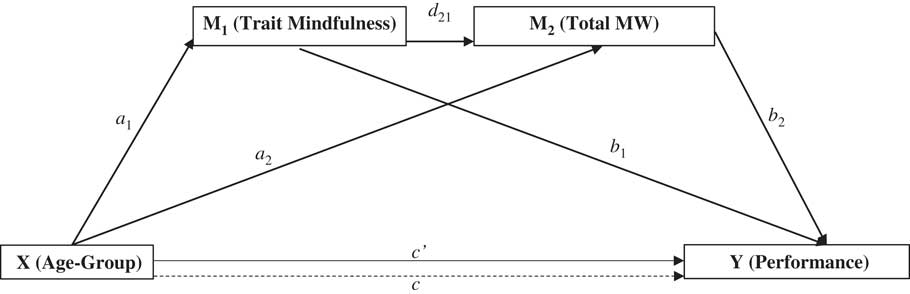
Lastly, we examined the roles of individual differences in MAAS and total MW in the relationship between age-group and global performance. Age-related differences in MAAS were examined using independent samples t-test. We then constructed serial multiple mediation models to assess the indirect effect of age-group (X) on global metrics of attentional control (Y) through MAAS (M 1) and MW (M 2) sequentially (Hayes, Reference Hayes2013; Figure 1). These models are considered appropriate given the significant partial correlation between the mediators when controlling for X (GNG: pr M1M2.X =−0.30, p=.001; CPT: pr M1M2.X =−0.26, p=.004).
A conceptual diagram of the serial multiple mediator model examining the effects of age-group on attentional control performance through mindfulness and MW.

Separate mediation models were run for each global dependent variable from the CPT and Go/No-Go task. There were three indirect effects of age-group on performance through: (1) MAAS, (2) MAAS and total MW, and (3) total MW. The total indirect effect is the sum of all specific indirect effects, an index of the effect of X on Y indirectly through one or more indirect mechanism. The direct effect (c’) is the estimated mean difference in Y between two cases that differ by one unit on X but who are equal on all mediators. The direct effect provides an adjusted mean difference in the effect of X on Y when controlling for M 1 and M 2. The total effect (c) is the sum of the direct and indirect effects, providing an estimate of the effect of X alone on Y. We used bias-corrected bootstrapping (5000 samples) that does not assume a normally distributed indirect effect (Preacher & Hayes, Reference Preacher and Hayes2004). Point estimates are unstandardized coefficients. Given the exploratory nature of these analyses, effects were considered significant if the 95% CI did not contain zero.
RESULTS
Descriptive statistics for all variables are presented in Table 1.
Age-Related Differences in Attentional Control
We examined age-related differences in dL and RT_CV on the Go/No-Go as well as d-proactive, d-reactive, and RT_CV in the CPT. There was no age-related difference in dL (U=1,702.00; p=.45) on the Go/No-Go task. Older adults exhibited greater RT_CV than young adults on the Go/No-Go (U=2,614.00; p<.001), but not the CPT (t(121)=.869; p=.39). Results from the CPT were contrary to our hypothesis, with no significant differences in performance by age-group (Wald χ2=2.62; p=.11; 99% CI=[−2.135, 0.366]) or strategy type (Wald χ2=0.61; p=.44; 99% CI=[−0.938, 1.051]). The age-group × strategy type interaction was not significant (Wald χ2=.35; p=.56; 99% CI=[−1.179, 1.874]), although older adults exhibited marginally greater d-reactive (M=7.90; SD=2.83) than young adults (M=7.01; SD=2.55; p=.07; 99% CI=[−0.366, 2.135]).
Age-Related Differences in MW
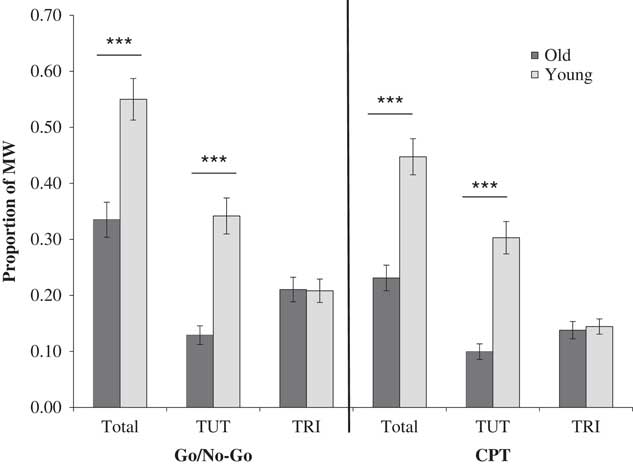
We examined age-related differences in total MW during each task as well as exploratory comparisons of TUT and TRI rates. As expected, a main effect of age-group revealed fewer total MW reports by older adults than young adults in both the Go/No-Go task (Wald χ2=19.22; p<.001; 99% CI=[0.120, 0.305]) and the CPT (Wald χ2=28.87; p<.001; 99% CI=[0.121, 0.285]), but there was no main effect of MW type. Furthermore, a significant age-group × MW Type interaction was observed for both the Go/No-Go task (Wald χ2=22.26; p<.001; 99% CI=[−0.332, −0.098]) and the CPT (Wald χ2=29.06; p<.001; 99% CI=[−0.291, −0.103]). Across tasks, older adults reported less TUT than young adults (Go/No-Go: p<.001; 99% CI=[0.120, 0.305]; CPT: p<.001; 99% CI=[−0.285, −0.121]), but equivalent TRI (Figure 2).
Age-related differences in MW type for the Go/No-Go and the CPT. Across tasks, age interacted with MW type, such that older adults (dark gray) reported less total MW and TUT compared with young adults (light gray); however, there was no age difference in TRI reports. *** p≤.001.

Impact of MW on Global Metrics of Attentional Control
The relation between total MW and metrics of attentional performance was investigated by merging across TUT and TRI. Due to mixed evidence of functional costs of MW across age groups, we believe this effect should be clarified before conducting further explorations of MW type. Merging is further justified by previous evidence suggesting that TRI and TUT are not differentially related to performance in young and older adults (McVay et al., Reference McVay, Meier, Touron and Kane2013). There were no significant main effects of MW or MW × age-group interactions for any global metrics, including: dL (Wald χ2=4.04; p=.04; 99% CI=[−3.997, 0.381]), RT_CV in the Go/No-Go (Wald χ2=3.10; p=.08; 99% CI=[−0.010, 0.081]), d-proactive (Wald χ2=0.16; p=.69; 99% CI=[−2.865, 5.139]), d-reactive (Wald χ2=0.01; p=.90; 99% CI=[−5.008, 2.384]), or RT_CV in the CPT (Wald χ2=0.75; p=.39; 99% CI=[−0.032, 0.054]).
Impact of MW on Local Metrics of Attentional Control
In an exploratory analysis, we examined differences in performance immediately preceding thought probes to investigate the effect of MW on performance. Average accuracy and RT were calculated for the four trials preceding reports of being On- or Off-task (collapsing across TUT and TRI).
Go/No-Go accuracy
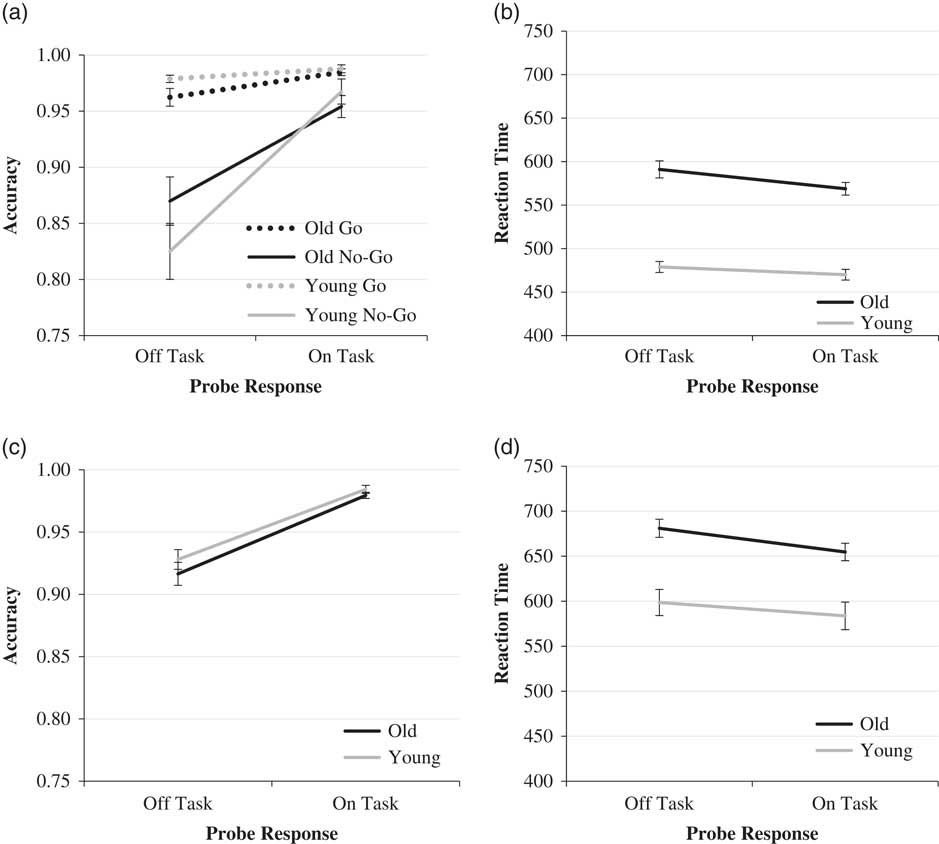
There was no main effect of age. There was a main effect of trial type (Wald χ2=54.11; p<.001; 99% CI=[0.048, 0.101]), with lower accuracy on No-Go trials than Go trials, and a main effect of probe type (Wald χ2=49.60; p<.001; 99% CI=[−0.088, −0.041]), with lower accuracy preceding MW than On-task reports. There was also a Probe Type × Trial Type interaction (Wald χ2=28.51; p<.001; 99% CI=[−0.160, −0.068]; Figure 3a), with lower accuracy preceding MW than On-task reports for both trial types, but a greater difference for No-Go trials. There were no significant age interactions.
Local effects of MW on attentional control. The top panel displays results for Go/No-Go (a) accuracy and (b) reaction time, the bottom panel displays results for CPT (c) accuracy and (d) reaction time. In all cases, performance was worse preceding MW (Off-task) than On Task reports. Older adults exhibited slower reaction times overall than young adults. Otherwise, age did not interact with probe type, suggesting equivalent impacts of MW on performance across age groups.

Go/No-Go reaction time
There was a main effect of age (Wald χ2=109.80; p<.001; 99% CI=[−131.342, −79.512]), reflecting slower RT in older adults (Figure 3b), and a main effect of probe type (Wald χ2=12.57; p<.001; 99% CI=[4.265, 26.913]) such that RT was longer preceding MW than On-task reports. There were no significant age interactions.
CPT accuracy
There was no main effect of age. There was a main effect of probe type (Wald χ2=108.48; p<.001; 99% CI=[−0.075, −0.045]) such that accuracy was lower preceding MW than On-task reports (Figure 3c). There were no significant age interactions.
CPT reaction time
There was a main effect of age (Wald χ2=19.90; p<.001; 99% CI=[−121.418, −32.531]), reflecting slower RT in older adults (Figure 3d), and a main effect of probe type (Wald χ2=22.10; p<.001; 99% CI=[9.514, 32.583]) such that RT was longer preceding MW than On-task reports. There were no significant age interactions.
Role of Dispositional Mindfulness
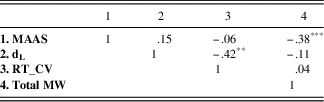
The older-adult data used in this study were previously published in an examination of the associations between mindfulness, MW, and attentional control in older adults (Fountain-Zaragoza et al., Reference Fountain-Zaragoza, Londerée, Whitmoyer and Prakash2016). We found that MW mediated the relation between trait mindfulness and proactive control, implicating mindfulness and MW as important contributors to differences in older adults’ attentional control. Considering the limited age differences in attentional control observed here, we were interested in investigating these two variables further. Corroborating previous findings, older adults reported higher trait mindfulness (MAAS; t(123)=−2.52; p=.01) and less MW than young adults, and the two were negatively related in both tasks (p’s<.001; Tables 2 and 3). Thus, serial multiple mediations were conducted to evaluate whether increased MAAS and reduced MW with age may be contributing to the limited age-related deficits in performance. Supplementary Tables S1–S3 present data for non-significant models.
Bivariate correlations between dispositional mindfulness, performance, and MW on the Go/No-Go Task

Note. N=124. Higher numbers reflect (1) higher dispositional mindfulness, (2) higher dL, (3) greater reaction time variability, (4) higher proportion total MW.
** p <.01, *** p <.001.
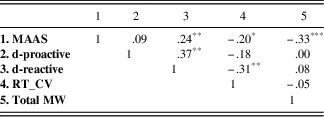
Bivariate correlations between dispositional mindfulness, performance, and MW on the CPT

Note. N=123. Higher numbers reflect (1) higher dispositional mindfulness, (2) higher d-proactive, (3) higher d-reactive, (4) greater reaction time variability, (5) higher proportion total MW.
* p <.05, ** p <.01, *** p <.001.
Go/No-Go performance
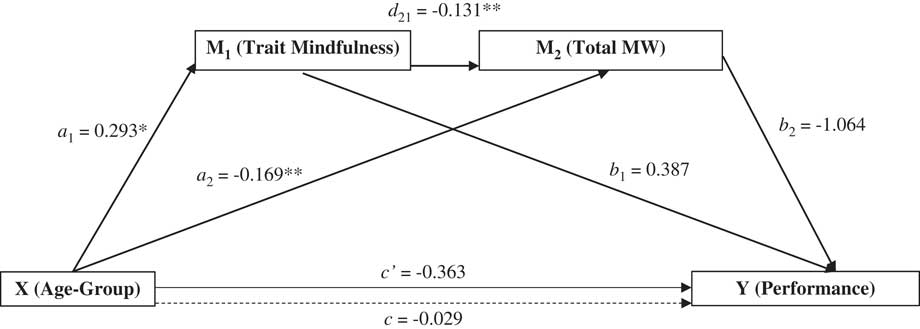
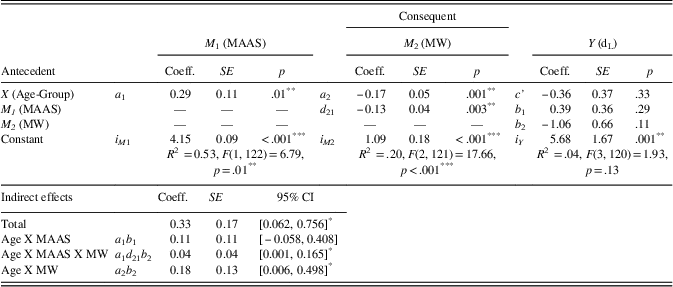
There was a total indirect effect of age-group on dL through MAAS and MW (point estimate=0.33, 95% CI=[0.062, 0.756]; Table 4, Figure 4). A significant path occurred through MAAS and MW (a 1 d 21 b 2=0.04, 95% CI=[0.001, 0.165]), with a positive effect of age on MAAS scores, a negative relation between MAAS and MW, and a negative effect of MW on dL. Another significant path occurred through MW alone (a 2 b 2=0.18; 95% CI=[0.006, 0.498]), with a negative effect of age on MW and a negative effect of MW on dL.
A statistical diagram of the serial multiple mediator model examining the effects of age-group on dL through mindfulness and MW. * p≤.05, ** p≤.01.

Model summary information for the serial multiple mediator model of age-group on Go/No-Go dL depicted in Figure 4

Note. Total effect (c)=−0.03, t(122)=−0.08, p=.94, 95% CI=[−0.763, 0.705].
*p <.05, **p <.01, ***p <.001.
Although the direct and total effects were not significant, the direction of effects represents a competitive mediation. The negative direct effect of age-group on dL (c’=−0.36) is counteracted by the net positive indirect effects (predicting a less negative effect of age-group on dL), resulting in a less negative total effect of age-group on dL (c=−0.03; 95% CI=[−0.763, 0.705]). The negative direct effect indicates that, controlling for MAAS and MW, there is estimated to be a mean difference in dL such that older adults perform worse than young adults, although this is not significant. However, inclusion of MAAS and MW scores in the model decreases the mean age difference in dL (c’=−0.36 vs. c=−0.03). Thus, these two variables partially account for observed equivalence in performance across groups. No specific indirect effects reached significance for RT_CV.
CPT performance
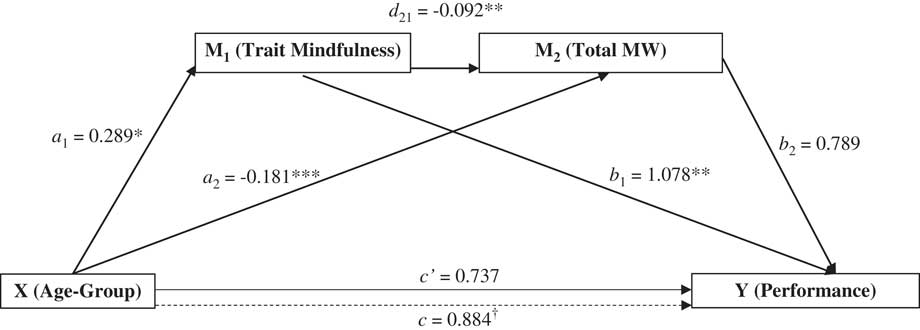
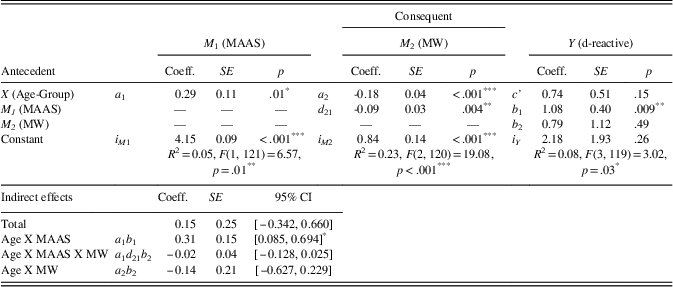
There was no significant total indirect effect of age-group on d-proactive through MAAS or total MW, and no specific indirect pathways reached significance. There was a marginally significant total effect of age-group on d-reactive (point estimate=0.88; 95% CI=[−0.093, 1.862]; Table 5, Figure 5) and a significant path through MAAS (a 1 b 1 =0.31; 95% CI=[0.085, 0.694]) such that there was a positive effect of age on MAAS which was related to increased reactive control. No specific indirect effects reached significance for RT_CV.
A statistical diagram of the serial multiple mediator model examining the effects of age-group on d-reactive through mindfulness and MW. † p≤.10, * p≤.05, ** p≤.01, *** p≤.001.

Model summary information for the serial multiple mediator model of age-group on CPT d-reactive depicted in Figure 5

Note. Total effect (c)=0.88, t(121)=1.79, p=.08, 95% CI=[-0.093, 1.862].
*p <.05, **p <.01, ***p <.001.
DISCUSSION
This study evaluated age-related differences in attentional control and MW, and assessed the relation between attentional control, MW, and dispositional mindfulness. Attentional control was evaluated using two tasks requiring sustained attention and inhibitory control: a Go/No-Go task and a CPT, which allows for a differentiation between proactive and reactive modes of attentional control. Contrary to our hypotheses, we found minimal age-related differences in performance on these two tasks. Across tasks, older adults reported less MW overall and less TUT, yet equivalent TRI compared to young adults. Although MW was not related to global metrics of performance, local performance measures captured the deleterious effects of MW across age groups. Critically, the lack of age-specific effects suggests that MW impacts older adults to a similar degree as young adults. Interestingly, the observed age equivalence in task performance appears to be at least partially explained by individual differences in trait mindfulness and MW.
We observed limited age differences in attentional control, with no differences in signal detection during the Go/No-Go task and no age-related reduction in proactive control, but a trending increase in reactive control for older adults. These findings may be partially attributed to the well-established tendency for older adults to use more conservative response strategies (Carriere et al., Reference Carriere, Cheyne, Solman and Smilek2010; Rabbitt, Reference Rabbitt1979; Salthouse, Reference Salthouse1979), as many studies report that older adults exhibit a speed-accuracy tradeoff such that they are able to achieve equivalent accuracy to young adults at the expense of slower responses (Brache et al., Reference Brache, Scialfa and Hudson2010; Carriere et al., Reference Carriere, Cheyne, Solman and Smilek2010; Grandjean & Collette, Reference Grandjean and Collette2011; Jackson & Balota, Reference Jackson and Balota2012; Staub et al., Reference Staub, Doignon-Camus, Bacon and Bonnefond2014b).
We did find evidence of greater RT_CV in older adults in one task, which is consistent with findings of greater intra-individual variability in older adults both within and between cognitive tasks (Christensen et al., Reference Christensen, Mackinnon, Korten, Jorm, Henderson and Jacomb1999; Jackson et al., Reference Jackson, Balota, Duchek and Head2012; Tse et al., Reference Tse, Balota, Yap, Duchek and McCabe2010), even when controlling for group differences in speed, accuracy, and practice effects (Hultsch, MacDonald, & Dixon, Reference Hultsch, MacDonald and Dixon2002). It is possible that the Go/No-Go and CPT may have had limited sensitivity to age-related differences in our sample of healthy older adults, as evidenced by high performance on both. The use of tasks designed to maximize sensitivity to age differences, such as cued-visual search (Greenwood & Parasuraman, Reference Greenwood and Parasuraman2004; Greenwood, Parasuraman, & Haxby, Reference Greenwood, Parasuraman and Haxby1993), sensory vigilance (Deaton & Parasuraman, Reference Deaton and Parasuraman1993), or irrelevant distractor processing under load (Lavie, Reference Lavie2010), may yield more nuanced information regarding the effects of age.
Additionally, given that sustained attention tasks formatted similarly to the Go/No-Go have been found to be particularly vulnerable to speed-accuracy tradeoffs (Peebles & Bothell, 2004), there is a clear need for clarifying the roles of speed-accuracy tradeoffs, performance variability, and attentional failures in overall task performance (Seli, Cheyne, & Smilek, Reference Seli, Cheyne and Smilek2012). Such effects might be best captured by computational approaches, such as diffusion modeling (e.g., Starns & Ratcliff, Reference Starns and Ratcliff2010), to estimate the relative contributions of these components (Ratcliff, Reference Ratcliff1978).
As hypothesized, we found a decrease in overall MW and TUT with age, yet equally prevalent evaluative thoughts about task performance (i.e., TRI). Previous studies demonstrate greater TRI in older adults (Frank et al., Reference Frank, Nara, Zavagnin, Touron and Kane2015; McVay et al., Reference McVay, Meier, Touron and Kane2013), but rates may have been lower in our study since participants performed at ceiling, presumably resulting in lower perceived task difficulty and fewer performance insecurities (McVay et al., Reference McVay, Meier, Touron and Kane2013). In contrast to the consistent link observed between MW and greater errors and RT_CV in young adults (Randall et al., Reference Randall, Oswald and Beier2014), we found no associations between MW and global metrics of performance.
However, investigation of the local effects of MW revealed that performance was worse on trials preceding MW than On-Task reports in both tasks. Previous investigations of age-related differences in the impact of MW are mixed; some have found that older adults experience greater MW-related impairment (Jackson & Balota, Reference Jackson and Balota2012; Zavagnin et al., Reference Zavagnin, Borella and De Beni2014), while others suggest that older and younger adults experience similar disruption from MW (Krawietz et al., Reference Krawietz, Tamplin and Radvansky2012; McVay et al., Reference McVay, Meier, Touron and Kane2013). The results of this study support the latter, as neither local nor global analyses yielded age differences in the magnitude of MW-associated performance impairment in either task.
Consistent with existing evidence, older adults reported higher levels of dispositional mindfulness than young adults (Frank et al., Reference Frank, Nara, Zavagnin, Touron and Kane2015; Prakash et al., Reference Prakash, Hussain and Schirda2015) and trait mindfulness was associated with less MW in both tasks across groups (Cheyne et al., Reference Cheyne, Carriere and Smilek2006; Frank et al., Reference Frank, Nara, Zavagnin, Touron and Kane2015; Mrazek et al., Reference Mrazek, Smallwood and Schooler2012). Expanding upon previous findings, mediation analyses revealed that mindfulness and MW help explain preserved attentional control with age. Specifically, age was associated with higher trait mindfulness, mindfulness was associated with less frequent MW, and reduced MW was related to enhanced sensitivity on the Go/No-Go task. Inclusion of these mediators in the model reduced estimated group differences such that older adults and young adults performed more similarly.
We also found that trait mindfulness, but not MW, helped account for the marginally greater reactive control in older compared to young adults. Although some of these effects were small, these preliminary findings suggest that individual differences in trait mindfulness and MW propensity explain some age-related variance in attentional control. Thus, these variables may be fruitful targets for interventions aimed at improving attentional control in older adults. In fact, existing randomized controlled trials of mindfulness training conducted in older adults have found preliminary evidence of attentional benefits (Alexander, Langer, Newman, Chandler, & Davies, Reference Alexander, Langer, Newman, Chandler and Davies1989; Lenze et al., Reference Lenze, Hickman, Hershey, Wendleton, Ly, Dixon and Wetherell2014; Moynihan et al., Reference Moynihan, Chapman, Klorman, Krasner, Duberstein, Brown and Talbot2013).
There are ongoing investigations into the mechanisms by which mindfulness is related to enhanced attentional control. Central to the aims of this study, one hypothesis is that individuals higher in dispositional mindfulness are less inclined to engage in MW, and thus experience fewer attentional disruptions. In support of this hypothesis, there is preliminary evidence of reduced MW following mindfulness training in both young adults (Mrazek et al., Reference Mrazek, Franklin, Phillips, Baird and Schooler2013) and older adults (Whitmoyer et al., under review).
Another proposed mechanism is that mindfulness is accompanied by increased acceptance, non-judgment, and non-reactivity, qualities that promote adaptive and effective emotion regulation. Emotion regulation is a cognitively demanding process, thus more efficient and successful regulation should free up cognitive resources to be relegated to a cognitive task. Existing evidence suggests that, compared to young adults, older adults place greater importance on emotional goals (e.g., Carstensen, Reference Carstensen1992) report higher trait mindfulness (Frank et al., Reference Frank, Nara, Zavagnin, Touron and Kane2015; Prakash et al., Reference Prakash, Hussain and Schirda2015), and engage in more acceptance-based emotion regulation strategies (Schirda, Valentine, Aldao, & Prakash, Reference Schirda, Valentine, Aldao and Prakash2016). Our results provide preliminary evidence that older adults who exhibit this profile might exhibit preserved attentional control.
The findings of this study should be considered in light of several limitations, which provide grounds for future research. First, the cross-sectional design precludes directional or causal inferences from the presented mediation models. Future studies are needed to establish improvement in attentional control as a function of manipulating MW, perhaps through mindfulness training. Second, our tasks were relatively longer than others in the literature (Jackson & Balota, Reference Jackson and Balota2012; McVay et al., Reference McVay, Meier, Touron and Kane2013; Smallwood, Nind, & O’Connor, Reference Smallwood, Nind and O’Connor2009), with more trials to aggregate for global performance measures and greater vulnerability to practice effects. This may have contributed to the ceiling accuracy observed in both groups, limiting sensitivity to age-related differences and MW-related performance costs (see McVay et al., Reference McVay, Meier, Touron and Kane2013). Future work might use briefer and more demanding tasks to elicit greater age differences or consider expanding age ranges given evidence for differences in attentional control and MW between young-old and old-old adults (Park et al., Reference Park, Lautenschlager, Hedden, Davidson, Smith and Smith2002; Zavagnin et al., Reference Zavagnin, Borella and De Beni2014). Lastly, self-report MW probes are inherently limited by relying on participants’ accounts. There is great promise in the future use of combined subjective and objective methods to study MW (Smallwood & Schooler, Reference Smallwood and Schooler2015), particularly in using computational models to derive estimate of MW from behavioral and neuroimaging data.
In summary, the present study found few age-related differences in inhibitory control, goal maintenance, or the consequences of MW for performance. Older adults were higher in dispositional mindfulness and engaged in less frequent MW than young adults. These variables helped account for the lack of observed age-related differences in attentional control. These findings may speak to the variable nature of healthy cognitive aging and the need for continued consideration of the contribution of individual difference variables to attentional control. Given the detriments of MW to performance on tasks requiring sustained attention, reduction of MW behavior is a promising target for interventions aimed at improving attentional control. These findings suggest that mindfulness meditation training might be particularly well-suited for older adults, as increased present-moment awareness may allow them to avoid attention lapses and allocate more resources to successful task completion.
ACKNOWLEDGMENTS
There are no conflicts of interest or financial support to disclose. All authors contributed substantially to this manuscript.
Supplementary materials
To view supplementary material for this article, please visit https://doi.org/10.1017/S1355617718000553