



Introduction
Most children do not consume alcohol routinely, but many sip small amounts (Donovan, Reference Donovan2004). Although sipping appears etiologically significant for later harmful alcohol use, most prevention and intervention efforts tend to target adolescence, perhaps because alcohol use in any form (including sipping) is far less normative in childhood. Rates of alcohol use typically hover around 20% among 9- to 10-year-olds and around 50% among 14-year-olds (Lisdahl et al., Reference Lisdahl, Tapert, Sher, Gonzalez, Nixon, Feldstein Ewing, Conway, Wallace, Sullivan, Hatcher, Kaiver, Thompson, Reuter, Bartsch, Wade, Jacobus, Albaugh, Allgaier, Anokhin and Heitzeg2021; Swendsen et al., Reference Swendsen, Burstein, Case, Conway, Dierker, He and Merikangas2012). Nevertheless, targeting alcohol consumption in childhood may provide an earlier window of opportunity to identify and establish the risk profiles of youth who are at long-term risk for harmful alcohol use. Early identification is especially critical given that age of initiation is strongly associated with later problems (DeWit, Reference DeWit2000; King & Chassin, Reference King and Chassin2007): sipping in childhood is prospectively associated with alcohol use and consequences in adolescence and diagnoses of alcohol use disorder in adulthood (Colder et al., Reference Colder, Shyhalla and Frndak2018; Donovan & Molina, Reference Donovan and Molina2007; Jackson et al., Reference Jackson, Barnett, Colby and Rogers2015). Further, because alcohol consumption is far less common in children than in adolescents, sipping may be especially reflective of tendencies toward psychosocial deviance.
Psychopathology and personality are tied to alcohol involvement across most major developmental periods, but it is unclear precisely when stable and robust associations among these constructs begin to emerge (Tully & Iacono, Reference Tully and Iacono2016). Drawing such an estimate requires careful tracing of alcohol use, psychopathology, and personality across sensitive developmental periods. In this study, we advance prior research on the psychopathology and personality risk profiles of alcohol sipping in childhood by examining the concurrent and prospective correlates of alcohol sipping. To do so, we used data from the Adolescent Brain and Cognitive Development Study (ABCD), which follows a large cohort of youth (N = 11,872) longitudinally.
To date, most research on alcohol sipping has focused on contextual variables, such as parental approval of alcohol use and peer influence (Donovan & Molina, Reference Donovan and Molina2011, Reference Donovan and Molina2014). Such findings lead others to conclude that sipping is more likely to reflect parental approval of alcohol consumption as opposed to psychosocial tendencies towards early alcohol experimentation (Donovan & Molina, Reference Donovan and Molina2014; Wadolowski et al., Reference Wadolowski, Hutchinson, Bruno, Aiken, Clare, Slade, Najman, Kypri, McBride and Mattick2015). But this conclusion is not well-supported by recent data, suggesting that sipping may be determined by contextual, dispositional, and psychopathology-relevant factors. Generally speaking, externalizing psychopathology (i.e., psychopathology characterized by poor behavioral and emotional control) and impulsivity (Colder et al., Reference Colder, Shyhalla and Frndak2018; Jackson et al., Reference Jackson, Barnett, Colby and Rogers2015; Wadolowski et al., Reference Wadolowski, Hutchinson, Bruno, Aiken, Clare, Slade, Najman, Kypri, McBride and Mattick2015; Watts et al., Reference Watts, Wood, Jackson, Lisdahl, Heitzeg, Gonzalez, Tapert, Barch and Sher2020) are reliable albeit weak cross-sectional and longitudinal correlates of alcohol use across the life span. Thus far, we have corroborated these general findings in the ABCD cohort. At baseline, when children were 9–10, 17 percent of children reported sipping alcohol outside of a religious context (Lisdahl et al., Reference Lisdahl, Tapert, Sher, Gonzalez, Nixon, Feldstein Ewing, Conway, Wallace, Sullivan, Hatcher, Kaiver, Thompson, Reuter, Bartsch, Wade, Jacobus, Albaugh, Allgaier, Anokhin and Heitzeg2021; Watts et al., Reference Watts, Wood, Jackson, Lisdahl, Heitzeg, Gonzalez, Tapert, Barch and Sher2020). In addition to finding that externalizing and other impulsivity-relevant personality features were associated with increased odds of having sipped alcohol before the age of 10 (Watts et al., Reference Watts, Wood, Jackson, Lisdahl, Heitzeg, Gonzalez, Tapert, Barch and Sher2020), Watts et al. (Reference Watts, Wood, Jackson, Lisdahl, Heitzeg, Gonzalez, Tapert, Barch and Sher2020) focused on a wider array of psychopathology features than is typical in the literature and found that fun seeking and prodromal schizophrenia symptoms were also associated with alcohol sipping.
Present study
In light of the existing literature, we sought to replicate and extend research on the psychopathology and personality correlates of alcohol sipping, with Watts et al. (Reference Watts, Wood, Jackson, Lisdahl, Heitzeg, Gonzalez, Tapert, Barch and Sher2020) examination of the cross-sectional correlates of sipping in the ABCD cohort being the primary target for our replication effort. We view Watts et al. (Reference Watts, Wood, Jackson, Lisdahl, Heitzeg, Gonzalez, Tapert, Barch and Sher2020) findings as preliminary for a number of reasons. First, we identified novel correlates of sipping, namely prodromal schizophrenia symptoms, that warrant replication. With the release of additional waves of the ABCD data, we can examine whether the concurrent associations between psychopathology/personality and sipping at baseline replicate in and across subsequent waves. Replication efforts in the ABCD cohort are especially appealing because they rule out sampling differences as an explanation for lack of replication.
Second, for the first time in the ABCD data, we can examine the prospective associations between psychopathology/personality at baseline and subsequent sipping. Should we replicate the concurrent associations we established earlier in prospective analyses, it would suggest that certain features of psychopathology (e.g., externalizing) reflect more chronic tendencies to engage in alcohol consumption across early childhood and into adolescence and adulthood. In contrast, if concurrent associations at baseline do not replicate prospectively, it may indicate that concurrent associations reflect state- or age-dependent effects that do not reflect a stable tendency to consume alcohol across development (Sher et al., Reference Sher, Gotham and Watson2004).
Third and finally, we have yet to detect associations between most forms of internalizing psychopathology and sipping in the ABCD cohort even though others have argued that there is an “internalizing pathway” to alcohol involvement whereby internalizing in early and middle childhood predicts alcohol involvement in adolescence and adulthood (Hussong et al., Reference Hussong, Jones, Stein, Baucom and Boeding2011). Our failure to detect such associations may be because we focused on too early a developmental period (ages 9 to 10), so they may arise when children are slightly older. Thus, the present study is well-equipped to examine these unresolved questions surrounding the associations between psychopathology and personality, on the one hand, and alcohol sipping, on the other.
Methods
Participants and procedure
Participants were drawn from the full baseline sample of the ABCD Study (Data Release 4.0), a prospective longitudinal cohort study of 11,872 9- and 10-year-olds (Mage = 120 months, SD = 7 months; 53% female) born in the United States between 2006 and 2008 (Garavan et al., Reference Garavan, Bartsch, Conway, Decastro, Goldstein, Heeringa, Jernigan, Potter, Thompson and Zahs2018). Consenting parents and assenting children were primarily recruited through a probability sample of public and private schools augmented to a smaller extent by special recruitment through summer camp programs and community volunteers. ABCD employed probability sampling of US elementary schools across 21 sites to yield a sample approximating the racial/ethnic and sociodemographic composition of the country. Enrollment required youth to be aged 9–10 and fluent in English; not have any history of substance use, severe mental illness, autism spectrum disorder (moderate/ severe), intellectual disability, major neurological disorder, or traumatic brain injury; have a birth weight >2 lbs; have at study inception no magnetic resonance imaging contraindications (e.g., braces, ferromagnetic metal implant); and have a biological or legal guardian willing to participate and able to speak English or Spanish. The ABCD data are open to the public upon receipt of a data use agreement (https://nda.nih.gov/abcd/). To facilitate reproducibility, we have provided all model scripts and outputs, as well as correlation matrices for all variables reported here (https://osf.io/4rypn/).
Youth in the ABCD study plan to be followed longitudinally for at least ten years, with assessments occurring semiannually, although the alcohol sipping data and most of the psychopathology variables presented here are only assessed annually. In Data Release 4.0, used here, alcohol sipping and psychopathology data are available for three waves: (1) baseline, (2) a year later, and (2) two years later. Complete year 1 data were not available for 5.5% of youth and complete year 2 data were not available for 12.3%. Missingness at years 1 and 2 was generally unassociated with the psychopathology and personality variables of focus in this manuscript, with two exceptions: baseline Child Behavior Checklist Rule-breaking scores and Kiddie General Behavior Inventory mania scores were associated with attrition at year 1 (ORs = 1.20, 1.21; see Table S1).
At baseline, 58% of youth participants identified as White, 20% as Hispanic, 10% as Black, 2% as Asian, and 10% as Other. Twenty-seven percent of youth’s parents reported being either nonreligious (atheist, agnostic) or not particularly religious, 33% reported practicing a religion where alcohol consumption is a component of religiously sanctioned rituals (i.e., Mainline Protestant, Catholicism, Judaism), and 21% reported practicing a religion where alcohol consumption is not a component of religiously sanctioned rituals (e.g., Evangelical Protestant, Historically Black Church, Mormon, Jehovah’s Witness, Muslim, Buddhist). Thirty percent of parents reported a combined household income of $0–50,000 (0–50,000), 28% of $50,001–100,000, and 42% of $100,001 or greater. Seven percent of parents reported a highest level of education as completing less than a high school diploma, 11% as completing high school or a GED, 29% as completing some college, 28% as completing a Bachelor’s degree, and 25% as completing a graduate degree (e.g., MA, JD, PhD). Sixty-eight percent of parents were married, 13% divorced or separated, 12% never married, 6% living with partner, and 1% widowed.
Measures
Alcohol sipping
Youth self-reported on an adapted version of the iSay Sip Inventory (Jackson et al., Reference Jackson, Barnett, Colby and Rogers2015), a 10-item measure of alcohol sipping. This assessment was only administered to participants who had heard of alcohol; it was assumed that they had not yet sipped alcohol if they have not heard of it (see Lisdahl et al., Reference Lisdahl, Sher, Conway, Gonzalez, Ewing, Nixon, Tapert, Bartsch, Goldstein and Heitzeg2018, for a thorough description of the substance use battery in ABCD). Participants report whether they have ever had a sip of alcohol, and if so whether they have sipped alcohol outside of a religious context. If participants reported sipping outside of a religious context, they then reported the number of occasions in which they have sipped alcohol overall and in a nonreligious context, the age at which they had their first sip of alcohol outside of a religious context, and whether they had ever finished a full alcoholic drink.Footnote 1 The number of occasions in which participants have sipped in a religious context was computed by subtracting the number of occasions in which they report sipping in a nonreligious context from the number of occasions in which they report any sipping. In waves following the baseline assessment, youth were asked about their alcohol sipping since the last assessment.
Here, we focus on the number of times youth have sipped alcohol, as opposed to other indicators of alcohol consumption (e.g., whether or not youth report having finished an entire alcoholic drink, whether or not youth have been drunk) because the base rates of more severe substance involvement are extremely low at baseline, year 1, and year 2. For instance, 1.6%, 2.3%, and 2.0% of youth report having consumed an entire alcoholic beverage at baseline, year 1, and year 2, respectively. In contrast with existing research (Donovan & Molina, Reference Donovan and Molina2011; Jackson, Colby, Barnett, & Abar, Reference Jackson, Colby, Barnett and Abar2015), the present study relies on the number of occasions sipped, as opposed to a dichotomous indicator reflecting whether a participant has ever sipped alcohol, to take into account frequency of drinking (see the Data Analysis section for more information). At each wave, we winsorized the continuous number of times sipped indicators to eliminate extreme values at the 97.5th percentile and reduce the potential for spurious but influential outliers (Watts et al., Reference Watts, Wood, Jackson, Lisdahl, Heitzeg, Gonzalez, Tapert, Barch and Sher2020). Nonreligious sipping could be described by four categories (0 occasions, 1, 2, 3+) at baseline and by three categories at years 1 and 2 (0, 1, 2+). Religious sipping could be described by three categories (0, 1, 2+) at baseline and 2 categories at years 1 and 2 (0, 1+).
Youth-reported psychopathology and personality
Youth completed several well-validated instruments assessing psychopathology and personality, each of which have been validated for use in youth samples. Assessments available varied by wave (Barch et al., Reference Barch, Albaugh, Avenevoli, Chang, Clark, Glantz, Hudziak, Jernigan, Tapert, Yurgelun-Todd, Alia-Klein, Potter, Paulus, Prouty, Zucker and Sher2018; see Table S2). Instruments included the Prodromal Questionnaire-Brief Version (PQ-B; Loewy et al., Reference Loewy, Pearson, Vinogradov, Bearden and Cannon2011; Karcher et al., Reference Karcher, Barch, Avenevoli, Savill, Huber, Simon, Leckliter, Sher and Loewy2018), an abbreviated youth version of the UPPS-P Impulsive Behavior scales (UPPS-P; Cyders et al., Reference Cyders, Smith, Spillane, Fischer, Annus and Peterson2007; Watts et al., Reference Watts, Wood, Jackson, Lisdahl, Heitzeg, Gonzalez, Tapert, Barch and Sher2020), and an abbreviated version of the Behavioral Inhibition and Activation scales (BIS/BAS; Pagliaccio et al., Reference Pagliaccio, Luking, Anokhin, Gotlib, Hayden, Olino, Peng, Hajcak and Barch2016; see Barch et al., Reference Barch, Albaugh, Avenevoli, Chang, Clark, Glantz, Hudziak, Jernigan, Tapert, Yurgelun-Todd, Alia-Klein, Potter, Paulus, Prouty, Zucker and Sher2018, for a thorough description of the mental health battery in ABCD). Example items are provided for non-copyrighted instruments.
PQ-B. The PQ-B comprises 21 items designed to assess symptoms associated with subclinical manifestations of psychosis (e.g., “Did you ever feel very certain that you have very special abilities or magical talents that other people do not have?”). Here, we used a sum score of the number of symptoms endorsed.
UPPS-P. The abbreviated youth version of the UPPS-P Impulsive Behavior scale comprises 20 items assessing five broad impulsivity dimensions: Lack of Perseverance, the inability to sustain attention or motivation to complete a task (e.g., “I finish what I start.”); Lack of Premeditation, the tendency to not plan ahead and behave without thinking (e.g., “I am very careful.”); Negative Urgency, the tendency to act hastily when in an extreme negative mood state (e.g., “When I am upset, I often act without thinking.”); Positive Urgency, the tendency to act hastily when in an extreme positive mood state (e.g., “I tend to lose control when I am in a great mood.”); and Sensation Seeking, the inclination towards seeking out novel, thrilling experiences (e.g., “I enjoy taking risks.”).
BIS/BAS. The abbreviated BIS/BAS scales comprise 20 items assessing two broad motivational systems, the behavioral inhibition (BIS) and behavioral activation (BAS) systems (Carver & White, Reference Carver and White1994). BIS is sensitive to signals of punishment and non-reward, novel stimuli, and innate fear stimuli, resulting in avoidance and negative emotionality, whereas BAS is sensitive to positive reinforcement and the absence of punishment, resulting in approach and positive emotionality. The BIS/BAS includes one subscale for BIS (e.g., “I worry about making mistakes.”) and three for BAS: Drive (e.g., “I go out of my way to get things I want.”), Fun Seeking (e.g., “I crave excitement and new sensations.”) and Reward Responsiveness (e.g., “When I'm doing well at something I love to keep at it.”).
Caregiver-reported psychopathology and personality. Caregivers rated their child on several additional well-validated instruments assessing psychopathology, including the Child Behavior Checklist (CBCL; Achenbach & Rescorla, Reference Achenbach and Rescorla2001), an abbreviated scale assessing dimensional mania symptoms termed the Kiddie General Behavior (K-GBI; Youngstrom et al., Reference Youngstrom, Fraizer, Demeter, Calabrese and Findling2008), and the Early Adolescent Temperament Questionnaire-Revised (Capaldi & Rothbart, Reference Capaldi and Rothbart1992).
CBCL. The Child Behavior Checklist (CBCL; Achenbach, Reference Achenbach2009) includes 118 items that coalesce into two broad scores for Externalizing (includes subscales for Rule-breaking Behavior and Aggressive Behavior) and Internalizing (includes subscales for Withdrawn Depression, Somatic Complaints, and Anxious Depression) that comprise 2 and 3 subscales, respectively. It also provides subscale scores for Thought Problems. Items are rated on a 0 (not true) to 2 (very true or often true) scale. We focused on the Externalizing and Internalizing composites, their subscales, and the Thought Problems subscale.
Dimensional mania. The dimensional mania scale comprises 10 items taken from the Parent General Behavior Inventory (Youngstrom et al., Reference Youngstrom, Fraizer, Demeter, Calabrese and Findling2008), a longer inventory that comprises 73 items pertaining to mood (e.g., “Has your child’s mood or energy shifted rapidly back and forth from happy to sad or high to low?”).
EATQ-R. The EATQ-R assesses eight primary dimensions of temperament (i.e., Affiliation, Attention, Fear, Frustration, Surgency, Inhibitory Control, Shyness) and two dimensions of behavior (i.e., Aggression, Depressive Mood; Capaldi & Rothbart, Reference Capaldi and Rothbart1992). Because there is not strong empirical support for the EATQ-R higher-order dimensions (i.e., Effortful Control, Surgency [which is distinct from the Surgency subscale], Negative Affectivity; Kozlowski et al., Reference Kozlowski, Antovich, Karalunas and Nigg2022), we focus on the subscales in the main text and report results from the higher-order dimensions’ scale scores in the Supplemental Tables.
Data analysis
We conducted all analyses using Mplus version 8.3 (Muthén & Muthén, Reference Muthén and Muthén1998-2017). Analyses accounted for the nesting of participants within data collection site (stratum) and a family identification variable (cluster) to account for nonindependence among participants collected at each site and among siblings within the same family. We conducted ordinal logistic regressions using the MLR estimator (maximum likelihood with robust standard errors) and specified the number of sipping occasions indicator as categorical. All continuous independent variables were standardized to facilitate interpretation of the odds ratios (i.e., to maintain a common metric to aid in comparisons).
Concurrent analyses examined the associations between psychopathology and personality at a given wave (e.g., year 1) and sipping at that same wave. Prospective analyses examined the associations between psychopathology and personality at baseline and sipping at either year 1 or year 2. Consistent with past research (Watts et al., Reference Watts, Wood, Jackson, Lisdahl, Heitzeg, Gonzalez, Tapert, Barch and Sher2020), all models included the following demographic covariates: age, sex assigned at birth, race/ethnicity, religion, parental education, and combined household income.Footnote 2 Prospective models (e.g., baseline psychopathology predicting year 2 sipping) treated age as a time-varying covariate, meaning that we included age at all relevant time points (i.e., age at baseline, year 1, and year 2) given that the timing between waves is not precisely 12 months. Models for later waves (i.e., years 1 and 2) also covaried sipping from prior waves to ensure that conclusions about prospective associations between psychopathology/personality and alcohol sipping were not due to concurrent ones (regardless, we report all models without sipping covariates in Tables S4–S7). For instance, baseline psychopathology’s associations with sipping from year 2 covaried sipping from both baseline and year 1.
Finally, given the sample size in ABCD, we do not focus on p value interpretation. Instead, we focus on effects whose 95% confidence intervals do not contain 0. Figures 1 and 2 report Odds Ratios and 95% confidence intervals, whereas p values and false discovery rate adjusted p values for primary analyses are reported in Tables S3–S6.
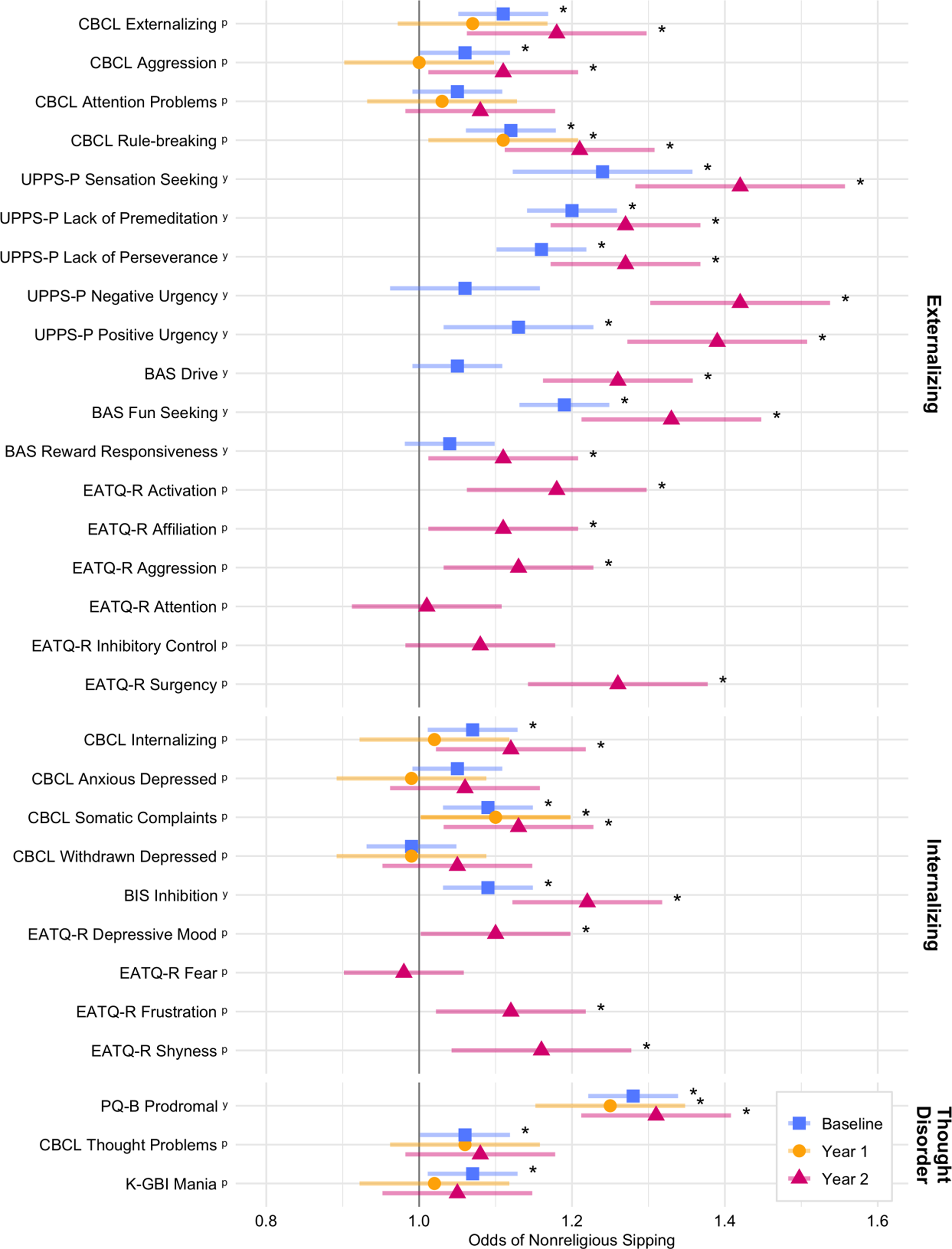
Concurrent associations between psychopathology/personality and sipping. Note. Baseline estimates are reported in Watts et al (Reference Watts, Wood, Jackson, Lisdahl, Heitzeg, Gonzalez, Tapert, Barch and Sher2020) and are presented here for comparison across waves of the ABCD study. Asterisks indicate that the 95% confidence interval around the estimate does not contain zero.
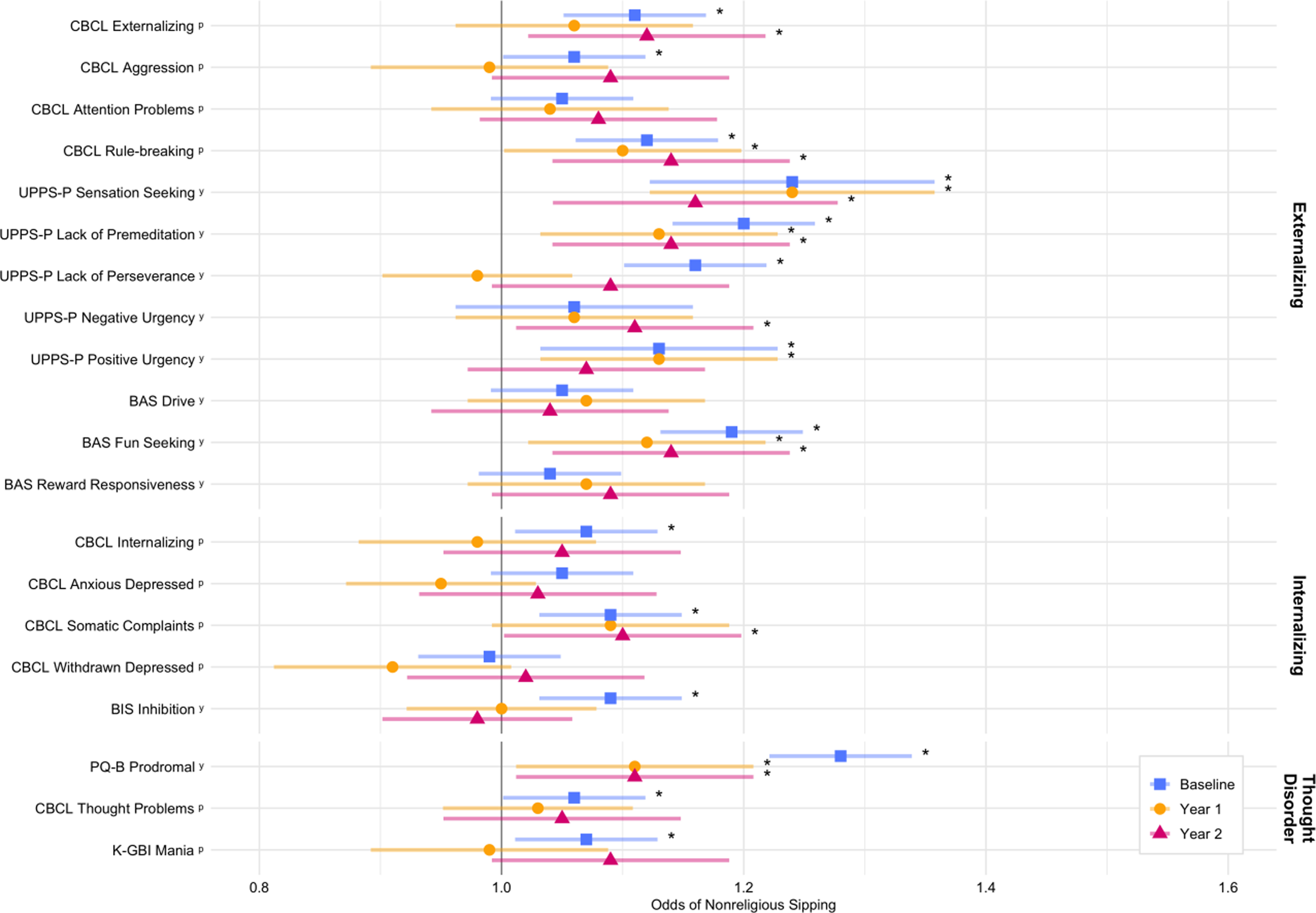
Prospective associations between baseline psychopathology/personality and sipping at subsequent waves. Note. Baseline concurrent estimates between psychopathology/personality and sipping are reported in Watts et al (Reference Watts, Wood, Jackson, Lisdahl, Heitzeg, Gonzalez, Tapert, Barch and Sher2020). We display the concurrent results here as comparison against the prospective analyses. Asterisks indicate that the 95% confidence interval around the estimate does not contain zero.
Results
Characteristics of alcohol sipping
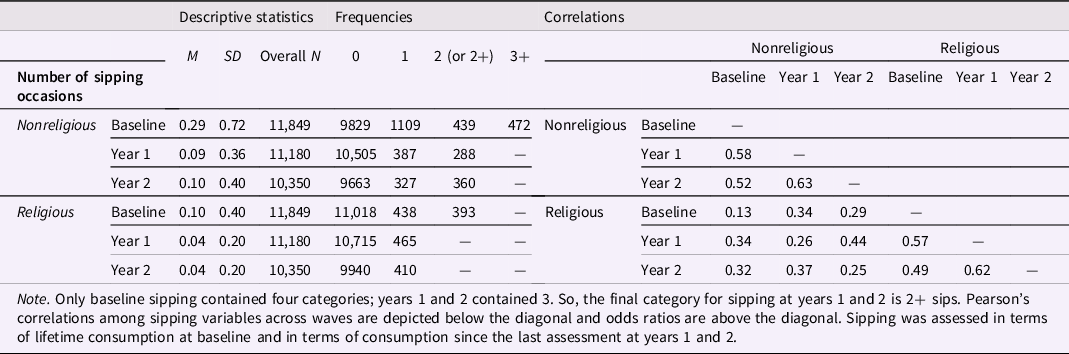
Rates of nonreligious sipping were 17.0% at baseline, 6.0% at year 1, and 6.6% between years 1 and 2 (recall that years 1 and 2 assess sipping since the last assessment; their lower base rates are probably attributable to a narrower assessment time frame). Rates of religious sipping were 7.0% at baseline, 4.2% between baseline and year 1, and 4.0% between years 1 and 2 (Lisdahl et al., Reference Lisdahl, Tapert, Sher, Gonzalez, Nixon, Feldstein Ewing, Conway, Wallace, Sullivan, Hatcher, Kaiver, Thompson, Reuter, Bartsch, Wade, Jacobus, Albaugh, Allgaier, Anokhin and Heitzeg2021; Watts et al., Reference Watts, Wood, Jackson, Lisdahl, Heitzeg, Gonzalez, Tapert, Barch and Sher2020). The number of nonreligious sipping occasions were moderately to strongly correlated across waves (polychoric rs ranged from .52 to .63; Table 1), and same with religious sipping (rs ranged from .49 to .62). Nonreligious sipping was also correlated with religious sipping within (rs ranged from .13 to .26) and across waves (rs ranged from .29 to .44), although these associations were generally less robust than the associations within sipping type (i.e., nonreligious, religious).
Descriptive statistics, frequencies of sipping, and intercorrelations among sipping indicators
Nonreligious sipping
Concurrent associations
Year 1. Scores on 3 of 11 scales (27%) were associated with increased odds of nonreligious sipping at year 1 (Figure 1, Table S3): PQ-B prodromal symptoms (OR = 1.25), CBCL Rule-Breaking (OR = 1.11), and CBCL Somatic Complaints (OR = 1.10).
Year 2. Scores on 22 of 30 scales (73%) were associated with increased odds of nonreligious sipping at year 2 (Figure 1, Table S4): CBCL Rule-breaking, Aggression, and Somatic Complaints; PQ-B prodromal symptoms; all UPPS-P subscales; all BAS subscales; EATQ-R Activation Control, Affiliation, Aggression, Depressive Mood, Frustration, Shyness, and Surgency; and BIS Inhibition (ORs ranged from 1.10 to 1.42).
Prospective associations
Sipping at Year 1. Baseline scores on 6 of 20 scales (30%) were prospectively associated with nonreligious sipping at year 1 (Figure 2, Table S5): UPPS-P Sensation Seeking, Positive Urgency, and Lack of Premeditation; BAS Fun Seeking, PQ-B prodromal symptoms; and CBCL Rule-breaking (ORs ranged from 1.10 to 1.24).
Sipping at Year 2. Baseline scores on 8 of 20 scales (40%) were prospectively associated with nonreligious sipping at year 2 (Figure 2, Table S6): UPPS-P Sensation Seeking and Lack of Premeditation; CBCL Rule-breaking; BAS Fun Seeking; UPPS-P Negative Urgency; PQ-B prodromal symptoms; and CBCL Somatic Complaints (ORs ranged from 1.10 to 1.16). CBCL Externalizing was also associated with increased odds of nonreligious sipping at year 2, but its association was largely driven by Rule-breaking given that Aggression’s confidence interval contained zero.
Religious sipping
Concurrent associations
Year 1. Scores on 5 of 11 scales (45%) were associated with increased odds of religious sipping at year 1 (Table S3): PQ-B prodromal symptoms (OR = 1.22); CBCL Aggression (OR = 1.16); and CBCL Rule-breaking and Attention Problems (ORs = 1.12).
Year 2. Scores on 20 of 30 scales (67%) were associated with increased odds of religious sipping at year 1 (Table S4): PQ-B prodromal symptoms; all UPPS-P subscales; CBCL Aggression and Rule-breaking; BAS Fun Seeking; EATQ-R Affiliation, Aggression, Frustration, Inhibitory Control, Shyness, and Surgency; CBCL Somatic Complaints; BIS Inhibition; CBCL Thought Problems; and K-GBI mania (ORs ranged from 1.16 to 1.38).
Prospective associations
Sipping at Year 1. Baseline scores on 11 of 20 scales (55%) were prospectively associated with religious sipping at year 1 (Table S5): UPPS-P Lack of Premeditation, Sensation Seeking, and Negative Urgency; CBCL Rule-breaking; BAS Fun Seeking; CBCL Attention Problems; PQ-B prodromal symptoms; UPPS-P Lack of Perseverance; and CBCL Aggression (ORs ranged from 1.11 to 1.22).
Sipping at Year 2. Baseline scores on 6 of 20 scales (30%) were prospectively associated with religious sipping at year 2 (Table S6): PQ-B prodromal symptoms (OR = 1.27); CBCL Externalizing, Anxious Depressed, and Somatic Complaints (ORs ranged from 1.17 to 1.18); BIS Inhibition (OR = 1.12); and CBCL Aggression (OR = 1.12).
Post hoc analyses
Novel alcohol use / Initiation. 42% (n = 283) and 48% (n = 328) of youth who sipped at years 1 (n = 675) and 2 (n = 687), respectively, did not sip at baseline. To examine novel alcohol initiation beyond baseline use, we subset the data to focus only on youth who did not report sipping at baseline. In so doing, the confidence intervals of the associations between baseline psychopathology/personality and subsequent sipping overlapped with those for the full sample, suggesting that associations for novel initiation mirrored those for alcohol sipping more generally (Tables S3–S6).
Parsing nonreligious and religious sipping. We expected that nonreligious sipping would be more strongly associated with psychopathology (c.f., Watts et al., Reference Watts, Wood, Jackson, Lisdahl, Heitzeg, Gonzalez, Tapert, Barch and Sher2020), but there were several instances in which nonreligious and religious sipping were equally associated with psychopathology and personality. Of the children who sipped alcohol, most reported nonreligious but not religious sipping (57–69%; baseline: 69%, year 1: 57%, year 2: 60%), fewer reported religious but not religious sipping (24–37%; baseline: 24%, year 1: 37%, year 2: 33%), and even fewer reported both nonreligious and religious sipping (7–8%; baseline: 8%, year 1: 6%, year 2: 7%). Thus, we wondered whether the associations between religious sipping and psychopathology were largely driven by the youth who reported sipping in religious and nonreligious contexts, so we dropped those participants from the analyses and re-estimated the associations between religious sipping and psychopathology. Most of the associations between religious sipping and psychopathology/personality did not change after dropping youth who sipped in both nonreligious and religious contexts (Tables S3–S6).
Discussion
In this study, we replicated and extended past research on the psychopathology and personality correlates of especially precocious alcohol use among children that participate in the ABCD Study (Watts et al., Reference Watts, Wood, Jackson, Lisdahl, Heitzeg, Gonzalez, Tapert, Barch and Sher2020). Most generally, we found that several psychopathology and personality features were associated with alcohol sipping early in the life span (Colder et al., Reference Colder, Shyhalla and Frndak2018; Jackson et al., Reference Jackson, Barnett, Colby and Rogers2015; Watts et al., Reference Watts, Wood, Jackson, Lisdahl, Heitzeg, Gonzalez, Tapert, Barch and Sher2020). At the same time, by comparing concurrent and prospective associations between alcohol sipping and psychopathology or personality, we identified stable vulnerability indicators of sipping, as well as potential developmentally specific indicators (Sher et al., Reference Sher, Gotham and Watson2004). Importantly, comparing concurrent and prospective correlates of alcohol sipping in the same cohort of youth ensures that differences across development are not due to sampling differences beyond those associated with attrition.
Aspects of reward sensitivity and externalizing – CBCL Externalizing, BAS Drive and Fun Seeking, all UPPS-P subscales, delinquency – as well as prodromal schizophrenia symptoms were consistently concurrently associated with sipping across the three waves we examined (Colder et al., Reference Colder, Shyhalla and Frndak2018; Jackson et al., Reference Jackson, Barnett, Colby and Rogers2015; Watts et al., Reference Watts, Wood, Jackson, Lisdahl, Heitzeg, Gonzalez, Tapert, Barch and Sher2020), suggesting strong replication within this cohort over time. That said, other psychosis-related variables – namely K-GBI Mania and CBCL Thought Problems – were not consistently associated with sipping, suggesting that the association between sipping and PQ-B prodromal symptoms is not more general to thought disorder per se.
Whether the most robust concurrent predictors of sipping were also prospectively associated with sipping depended on the indicator. UPPS-P Lack of Perseverance and prodromal schizophrenia symptoms were not prospectively associated with sipping, suggesting that they might reflect state-dependent, or short- but not long-term, risk for alcohol consumption. In contrast, BAS Fun Seeking and UPPS-P Lack of Premeditation, Positive Urgency, and Sensation Seeking scales were prospectively associated with sipping at years 1 and 2, and their associations were statistically comparable to the baseline associations. Thus, they might reflect stable vulnerability indicators of alcohol consumption in childhood and early adolescence (Sher et al., Reference Sher, Gotham and Watson2004).
Reward sensitivity is associated with externalizing (Michelini et al., Reference Michelini, Palumbo, DeYoung, Latzman and Kotov2021), but it is not sufficient to describe externalizing. Thus, that features of reward sensitivity (e.g., fun seeking, sensation seeking) were stable risk factors for sipping but more central aspects of externalizing (e.g., lack of perseverance) were not suggests that externalizing might be too broad a label in reference to psychosocial vulnerability toward precocious alcohol involvement. Our inclusion of temperament indicators in year 2 generally supports this conclusion. We found that surgency and affiliation were robustly positively associated with sipping, whereas inhibitory control was not. Based on these findings, we speculate that reward processing might reflect a stable vulnerability factor for alcohol consumption across youth development, and that other, more core or central features of externalizing (i.e., inhibitory control, lack of perseverance) might reflect state-dependent or moment-to-moment risk for drinking.
Interestingly, correlates of reward sensitivity – such as surgency, extraversion, and positive affect – are weak indicators of alcohol problems in adulthood, whereas impulsivity is among the foremost dispositional (or otherwise) correlates of alcohol consequences and alcohol use disorder later in adolescence and in adulthood (Sher et al., Reference Sher, Bartholow and Wood2000; Tully & Iacono, Reference Tully and Iacono2016). Park et al. (Reference Park, Sher, Wood and Krull2009) referred to extraversion and impulsivity as “dual mechanisms of risky drinking,” with extraversion reflecting a risk factor for selection into high-risk environments and impulsivity reflecting long-term risk for harmful alcohol use. In a prospective study of undergraduates, impulsivity but not extraversion was associated with pre-college drinking, but extraversion was associated with college drinking by way of selection into the Greek system. That is, extraversion appears indirectly associated with drinking through selection into high-risk environments (e.g., parties) that may facilitate social interaction and enhance positive affect. Within the context of youth alcohol consumption, specifically, surgency and affiliation (components of extraversion) may be associated with selection into high-risk environments, such as assorting with peers who have access to alcohol (e.g., Jackson et al., Reference Jackson, Barnett, Colby and Rogers2015; Martz et al., Reference Martz, Heitzeg, Lisdahl, Cloak, Ewing, Gonzalez, Haist, LeBlanc, Madden, Ross, Sher, Tapert, Thompson and Wade2022). In turn, highly extraverted youth may not be at long-term risk for alcohol use disorder and drinking consequences, but they may select into high-risk environments where alcohol is available, thereby increasing their risk of alcohol-related harms. In contrast, highly impulsive youth may be especially likely to experience alcohol-related consequences (e.g., unprotected sex, getting into fights, drinking and driving).
If extraversion merely predicts selection into high-risk environments and not long-term risk for harmful alcohol use, our findings raise questions about the nature of sipping. Wadolowski et al. (Reference Wadolowski, Hutchinson, Bruno, Aiken, Clare, Slade, Najman, Kypri, McBride and Mattick2015) argued that sipping is distinct from more severe forms of adolescent drinking, partly on the basis that it does not exhibit the same correlates as other indices of alcohol drinking (i.e., finishing a full drink). Still, we and others (Colder et al., Reference Colder, Shyhalla and Frndak2018; Jackson et al., Reference Jackson, Barnett, Colby and Rogers2015) have found that impulsigenic traits are associated with increased likelihood of having sipped alcohol in childhood, and impulsivity does appear among the most robust correlates of alcohol-related problems across the life span. Moreover, Jackson et al. (Reference Jackson, Barnett, Colby and Rogers2015) found that the odds of consuming a full drink, getting drunk, and engaging in heavy episodic drinking in ninth grade were five times greater for youth who had sipped alcohol by sixth grade. Thus, there is at least some evidence of developmental continuity between sipping and higher intensity drinking. Nevertheless, we are open to the possibility that the nature of sipping may change across development. A strength of the ABCD study design is that we can trace sipping well into adolescence, and our findings may change at later ages. We look forward to determining the extent to which sipping is predictive of more conventional indices of alcohol initiation, consequences, and alcohol use disorder.
Additionally, an important facet of psychopathology and personality we have yet to discuss is internalizing and negative emotionality. At baseline in the ABCD cohort (Watts et al., Reference Watts, Wood, Jackson, Lisdahl, Heitzeg, Gonzalez, Tapert, Barch and Sher2020), we found weak evidence for the so-called “internalizing pathway” to alcohol use (Hussong et al., Reference Hussong, Jones, Stein, Baucom and Boeding2011). In our concurrent analyses at year 2, we saw that some aspects of negative affect, including BIS Inhibition, CBCL Somatic Complaints, and EATQ-R Depressive Mood, were associated with sipping, albeit to a lesser extent than other features (e.g., reward sensitivity, impulsivity). If the associations between negative affect and sipping replicate in future waves of the ABCD study, they might suggest that internalizing becomes increasingly relevant to alcohol consumption across youth development, and is particularly relevant in early adolescence and beyond (Elkins et al., Reference Elkins, McGue, Malone and Iacono2004; Jackson & Sher, Reference Jackson and Sher2003). At the same time, it is unclear whether negative affect or internalizing per se are correlated with sipping, or if they are correlated by way of negative affect’s overlap with externalizing (Hussong et al., Reference Hussong, Ennett, Cox and Haroon2017).
Limitations and future directions
It is worth highlighting that we continued to observe that our associations for nonreligious sipping applied to religious sipping (Watts et al., Reference Watts, Wood, Jackson, Lisdahl, Heitzeg, Gonzalez, Tapert, Barch and Sher2020). As was the case at baseline in the ABCD cohort, we did not expect to observe similarities between nonreligious and religious sipping, mostly because we view the former and not the latter as indicating psychosocial deviance. One possibility is that religious ceremonies still provide youth with an environment to experiment with alcohol. It is unclear whether early exposure to alcohol within the context of religious practice increases risk for long-term alcohol-related harm; some data suggest that parental supply of sips of alcohol is associated with increased risk for binge drinking and alcohol consequences later in development, but not alcohol use disorder (Aiken et al., Reference Aiken, Clare, Boland, Degenhardt, Yuen, Hutchinson, Najman, McCambridge, Slade, McBride, De Torres, Wadolowski, Bruno, Kypri, Mattick and Peacock2020). One key limitation of the research we present here is that we were unable to distinguish further among contexts in which sipping takes place. Because the youth in the ABCD cohort are still young, most children report sipping alcohol at home under the supervision of their parents (see also Ennett et al., Reference Ennett, Jackson, Bowling and Dickinson2013). In future work, it will be important to determine whether sipping’s correlates with psychopathology and personality varies as a function of context (e.g., at home, with parental permission versus with friends, without parental permission).
Another important limitation of this study is that we were limited to data for three time points, which precluded our ability to explicitly model change using more elegant longitudinal methods, such as random intercept cross-lagged panel modeling or growth curve modeling. These methods illuminate meaningful developmental information that cannot be gleaned from the analyses we present here. Importantly, with additional waves of the ABCD study, we encourage the use of such methods to clarify whether there are bidirectional associations between sipping and psychopathology/ personality, whether there are important between- and within-person factors that determine sipping course, and whether there are correlated age-related changes in both sipping and psychopathology or personality. A related limitation of the ABCD sipping data is that the baseline assessment queries lifetime use, whereas all subsequent waves query use since the last assessment, which makes these variables more difficult to incorporate in random intercept cross-lagged panel modeling and the like.
A final limitation of this study is that our effects are small, and their clinical or real-world relevance is unclear. Our modest ability to predict substance use with psychopathology and personality variables suggests that we are focusing on an important piece of the precocious alcohol involvement puzzle, but psychopathology and personality are clearly only one piece (Donovan & Molina, 2008). As is clear from the existing literature, varied factors contribute to alcohol use across development, including but not limited to individual difference factors, sociodemographic characteristics (Lisdahl et al., Reference Lisdahl, Tapert, Sher, Gonzalez, Nixon, Feldstein Ewing, Conway, Wallace, Sullivan, Hatcher, Kaiver, Thompson, Reuter, Bartsch, Wade, Jacobus, Albaugh, Allgaier, Anokhin and Heitzeg2021), context (e.g., alcohol availability in the home), parenting factors (e.g., parental permissiveness surrounding drinking), and peer factors (e.g., peer use). In particular, we look forward to future research that examines the intersection of psychopathology and personality factors, on the one hand, and contextual factors, on the other, in predicting substance involvement across development. As youth in the ABCD cohort age and begin experimenting with substances more frequently, studies will be better suited to address finer-grained hypotheses regarding the intersection of varied influences on substance involvement across development.
Conclusion
We replicated and extended Watts et al. (Reference Watts, Wood, Jackson, Lisdahl, Heitzeg, Gonzalez, Tapert, Barch and Sher2020) examination of the concurrent associations between alcohol sipping, which is thought to reflect a precursor to more serious forms of alcohol consumption, and a wide array of psychopathology and personality variables in the baseline wave of the ABCD study. As with previous work, we found that aspects of externalizing, particularly reward sensitivity, and prodromal schizophrenia emerged as the strongest predictors of alcohol sipping. At the same time, our contrasting concurrent and prospective associations revealed that reward sensitivity appeared to reflect a stable risk factor for sipping across time, whereas more central impulsivity features and prodromal schizophrenia symptoms reflected concurrent but not necessarily prospective risk for sipping. In addition, for the first time in the ABCD cohort, we observed associations between negative affect and sipping, suggesting increased support for an internalizing pathway to alcohol use in youth. We look forward to further research that follows the longitudinal associations between sipping and more severe forms of alcohol use, as well as the associations between sipping and psychopathology over time. All told, sipping might not reflect long-term risk for harmful alcohol use, and the nature of sipping may change across development.
Supplementary material
The supplementary material for this article can be found at https://doi.org/10.1017/S0954579423000184
Data use statement
Data used in the preparation of this article were obtained from the Adolescent Brain Cognitive Development (ABCD) Study (https://abcdstudy.org), which is held in the NIMH Data Archive. The ABCD Study is a multisite, longitudinal study designed to recruit more than 10,000 children aged 9-10 and follow them over 10 years into early adulthood. The ABCD Study is supported by the National Institutes of Health and additional federal partners under award numbers U01DA041022, U01DA041028, U01DA041048, U01DA041089, U01DA041106, U01DA041117, U01DA041120, U01DA041134, U01DA041148, U01DA041156, U01DA041174, U24DA041123, U24DA041147, U01DA041093, and U01DA041025. A full list of supporters is available at https://abcdstudy.org/federal-partners.html. A listing of participating sites and a complete listing of the study investigators can be found at https://abcdstudy.org/Consortium_Members.pdf. ABCD consortium investigators designed and implemented the study and/or provided data but did not necessarily participate in analysis or writing of this report. This manuscript reflects the views of the authors and may not reflect the opinions or views of the NIH or ABCD consortium investigators. The ABCD data repository grows and changes over time. The ABCD data used in this report came from DOI 10.15154/1519007.
Author contributions
We define author contribution using the Contributor Roles Taxonomy (CRediT; http://credit.niso.org/). Watts was responsible for conceptualization, data curation, formal analysis, funding acquisition, methodology, project administration, software, supervision, visualization, and writing (original draft). Doss was responsible for formal analysis, software, and writing (original draft). Bernard was responsible for writing (review & editing). Sher was responsible for supervision and writing (review & editing).
Funding statement
ALW is funded through K99AA028306 (Principal Investigator: Watts). DLB is funded through K23MD016168 (Principal Investigator: Bernard).
Competing interests
None.



