INTRODUCTION
Although small-sized (2–120 mm), chaetognaths are often abundant and an important component in ocean biomass (up to 30% of the biomass of copepods in the global oceans (Reeve, Reference Reeve and Steele1970)). Chaetognaths often compose the second most abundant mesozooplanktonic group after copepods in the zooplankton of marine environments (Feigenbaum & Maris, Reference Feigenbaum and Maris1984; Shannon & Pillar, Reference Shannon and Pillar1986; Gibbons, Reference Gibbons1992). The exact position of chaetognaths remains uncertain for genomic data show affinities of chaetognaths to protostomes and yet chaetognaths show features of deuterostome-like embryology (Marlétaz et al., Reference Marlétaz, Martin, Perez, Papillon, Caubit, J. Lowe, Freeman, Fasano, Dossat, Wincker, Weissenbach and Le Parco2006). Classical taxonomy divides chaetognaths into nine genera and about 110 species (Tokioka, Reference Tokioka1965). After Tokioka, Bieri (Reference Bieri, Bone, Kapp and Pierrot-Bults1991) divided the genus Sagitta into 14 new genera and recognized 23 genera and 113 species. In this paper we are following Bieri's classification.
Chaetognaths can be found in all kinds of marine habitats and play important roles in the food webs (Bone et al., Reference Bone, Kapp, Pierrot-Bults, Bone, Kapp and Pierrot-Bults1991). In pelagic waters they are predators mainly of copepods, whereas in benthopelagic layers they are detritus feeders (Casanova, Reference Casanova1986). Their position in the pelagic food web makes them important controllers of energy flow to higher consumers, including several species of commercial fish (Kimmerer, Reference Kimmerer1984; Baier & Purcell, Reference Baier and Purcell1997), and they are thus considered a good indicator of potentially important fishery areas (Boltovskoy, Reference Boltovskoy1981).
Like other zooplankton organisms, chaetognaths are subjected to dispersion and changing physical–chemical conditions of the water (e.g. salinity, temperature and dissolved oxygen) (Ulloa et al., Reference Ulloa, Palma and Silva2000). Furthermore, several species of chaetognaths are strongly related to specific water masses (Ulloa et al., Reference Ulloa, Palma and Silva2000), and thus are very useful as indicators of water mass movements (Russell, Reference Russell1935, Reference Russell1936, Reference Russell1937; Mulkana & Mcllwain, Reference Mulkana and Mcilwain1973; Cheney, Reference Cheney1985; Pierrot-Bults, Reference Pierrot-Bults2008). Chaetognaths appear to be suitable for the study of the effects of physical processes acting at the mesoscale on the dynamics and variability of zooplankton populations (Duró & Saiz, Reference Duró and Saiz2000).
Composition, spatial and temporal variations of Chaetognatha have been carried out all around the world (e.g. Bieri, Reference Bieri1959; Terazaki, Reference Terazaki1989; Kruse et al, Reference Kruse, Bathmann and Brey2009; Bohata & Koppelmann, Reference Bohata and Koppelmann2013). Although several previous studies have dealt with the species distribution of chaetognaths in the South China Sea (SCS) (e.g. Zhang & Chen, Reference Zhang and Chen1991; Du et al., Reference Du, Li and Jia2003; Tse, Reference Tse, Hui and Wong2007; Lin et al., Reference Lin, Yin, Huang, Zhang and Li2010), there is little information on their distribution on the north-west continental shelf of the SCS, where mesoscale physical processes are determining factors. The present study is the first effort to determine how the monsoon affects the species composition, distribution and abundance, as well as the main assemblages of chaetognaths on the north-west continental shelf of the SCS during summer, winter and spring. Our hypothesis is that the density of chaetognaths is higher on the north-west continental shelf of the SCS than in the other regions of China as a result of greater food supply.
MATERIALS AND METHODS
Study area
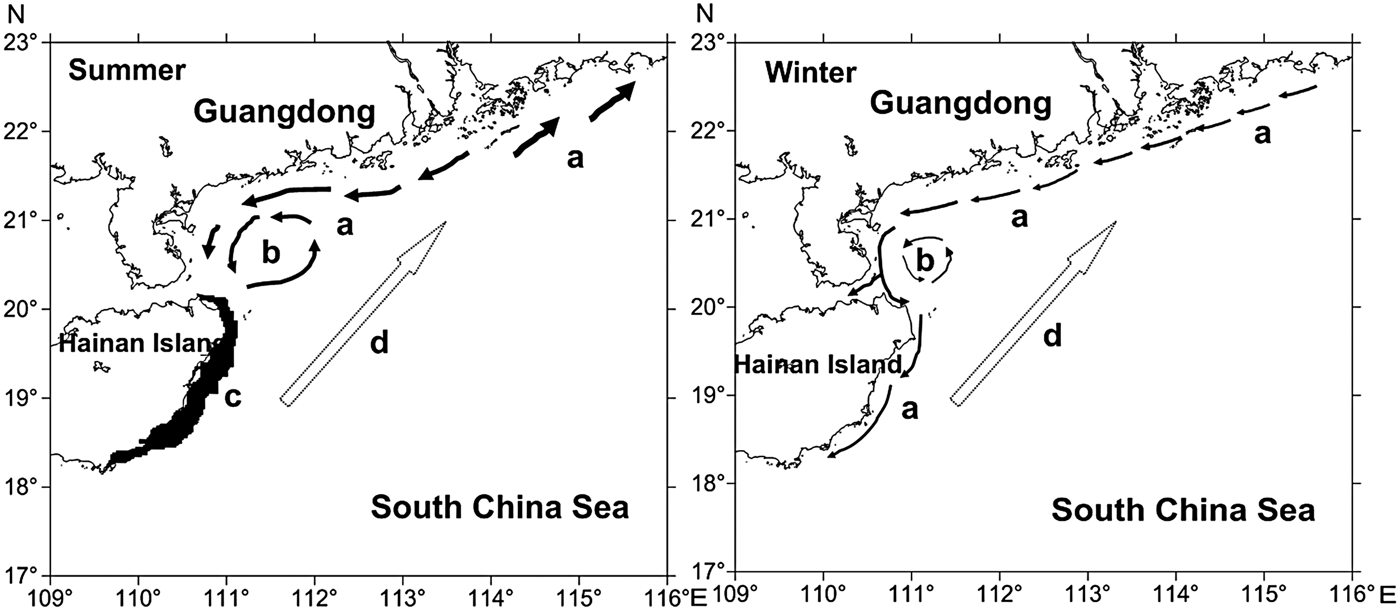
The SCS is a large semi-enclosed marginal sea in the north-west Pacific Ocean with a total area of 3.5 million km2. Liu found 41 species of chaetognaths belonging to 17 genera in oceanic waters around China (Reference Liu2008). Only Aidanosagitta crassa and A. umida could not be found in the SCS. The SCS is generally recognized as having the greatest diversity and density of chaetognaths in China's seas (Xiao, Reference Xiao2004). The surveyed region is located in the north-western SCS (17°17.10′–21°25.62′N 109°28.74′–113°13.26′E), which is affected by the Guangdong coastal current (GCC), the Qiongdong coastal upwelling, cyclonic circulation and the SCS warm current (Figure 1). Its main feature is a broad continental shelf with depths less than 200 m, while the east and south-east coasts of Hainan Island run parallel to the continental slope with a maximum depth of 1900 m. The climate in the SCS is dominated by the East Asian Monsoon system. In winter the north-east monsoon prevails in the SCS, whereas in summer the winds reverse direction to south-west (Su, Reference Su2004).
Ocean currents diagrams of the north-west continental shelf of the South China Sea (SCS): (A) the Guangdong coastal current; (B) cyclonic circulation; (C) the Qiongdong coastal upwelling; (D) the SCS warm current (from Li et al., Reference Li, Yin, Huang, Lian, Zhang and Liu2010).

The GCC is under the combined influence of the East Asia Monsoon and the Pearl River. Due to the large discharge of the Pearl River in summer, the GCC flows south-westerly around the east coast of the Leizhou Peninsula. The SCS surface current flows north-easterly, driven by the south-west monsoon. The current flows north-eastward, impacted by the south-west monsoon on the eastern side of Guangzhou Bay, whereas on the western side of Guangzhou Bay, it flows south-westward. Hence, a cold eddy is formed along the eastern waters of the Leizhou Peninsula (20°20′–21°10′N 110°50′–112°00′E) (Huang et al., Reference Huang, Wang, Li, Li and Mao1992). The cold eddy exists all year and varies seasonally, from strong in summer to weak in winter. Factors including the south-west monsoon and bottom topography can cause intense upwelling during the summer in the eastern waters of Hainan Island (Jing et al., Reference Jing, Qi, Hua and Zhang2009; Su & Pohlmmann, Reference Su and Pohlmann2009). The Qiongdong upwelling near the coast is concentrated between 18°30′–20°30′N and 110°–111°30′E, located within 30 m water depth. The upwelling lasts about 150 d, from April to October and peaks from June to August. There is a consistent north-eastward SCS warm current located in the east of the survey areas (Guan, Reference Guan1998).
We divided the surveyed region into three sub-regions based on the different topography and hydrological conditions (Figure 2): Region I (inshore waters of the western Guangdong); Region II (inshore waters to the east of Hainan Island); and Region III (offshore waters from the western Guangdong to Hainan Island). Region I (with water depth <50 m) is influenced by the Pearl River discharge and coastal mixing water. Region II is under the influence of the SCS surface water throughout the year, and is affected by upwelling in summer and by the GCC in spring and winter, with water depths greater than 100 m. Region III ranging in depth from 56 m to 1980 m is controlled by the SCS surface water all year (Li, Reference Li2002).
Map of the north-west continental shelf of the South China Sea showing the sampling locations. 1, the Leizhou Peninsula; 2, Guangzhou Bay; 3, the Qiongzhou Strait. Region I has 16 stations, shown as circles; Region II has 24 stations, shown as triangles; Region III has 42 stations, shown as squares (Li et al., Reference Li, Yin, Huang, Zhang, Lian and Liu2011).
Field sampling
The study was conducted during three different periods: July–August 2006 (summer); December 2006–January 2007 (winter); and April 2007 (spring). Zooplankton samples were taken at 82 stations along 13 transects (Figure 2). Zooplankton was sampled by vertical tows from 1 m above the bottom (depth <200 m) or from 200 m (depth >200 m) to the surface using plankton net of 169 μm mesh size (mouth diameter: 0.5 m) and plankton net of 505 μm mesh size (mouth diameter: 0.5 m). In this paper most data are based on the samples obtained with the 169 μm net (mouth diameter: 0.5 m). The net opening was fitted with a flow meter to determine the volume of water filtered during each tow (unit: m3). Trawl winch speed was about 1 m.s−1. Samples were fixed immediately after collection and preserved in 5% formaldehyde solution. All chaetognaths were sorted from the samples and identified to species level according to Xiao (Reference Xiao2004); copepods were also counted. Chaetognaths were classified into larvae, which contain no visible reproductive organs, and adults, which contain developing or mature reproductive organs. Most of the larvae could not be assigned to a species, so were counted as larvae. The counts of all species were converted to densities per m3 of water sampled (ind. m−3). Water temperature and salinity were measured by a CTD on-board.
Data analyses
The dominance indicator was estimated by use of Xu's equitability (Y) (Xu & Chen, Reference Xu and Chen1989):
 $$Y = \displaystyle{{n_i } \over N}f_i\comma \;$$
in which, n i is the abundance of the species i, f i is the occurrence frequency (the number of the stations with species i/the number of total stations) of species i, N is the total abundance. A species was defined as dominant when Y ≥ 0.02.
A one-way ANOVA on ranks test was used to test for significant differences between the three regions and between different seasons. Bivariate correlation was used to determine the relationship between chaetognath and environmental factors. All statistical analyses were performed using SPSS software.
RESULTS
Hydrography
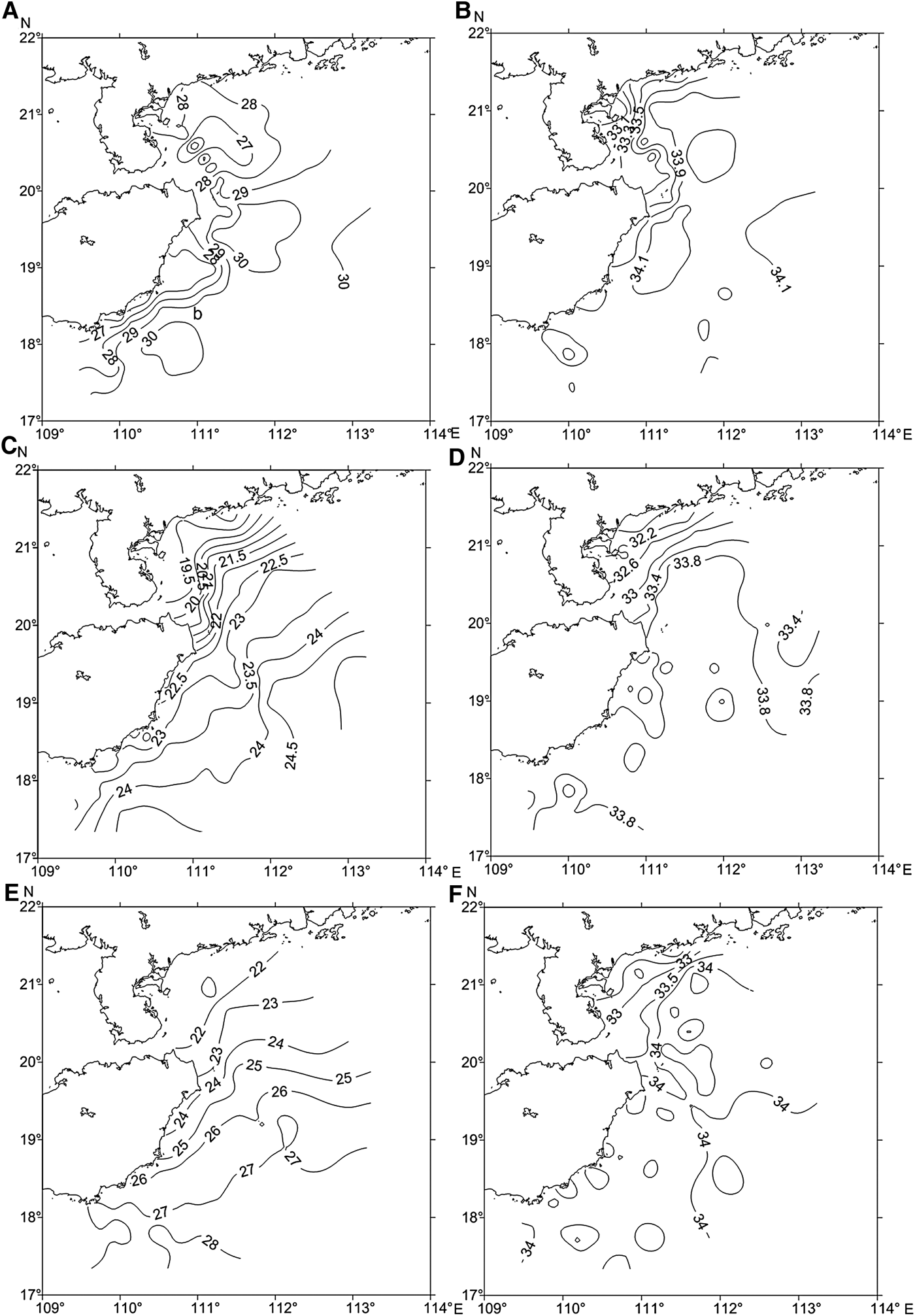
The average surface temperature was higher in summer (28.34 ±3.24°C) than winter (22.95 ±1.54°C) and spring (25.32 ±2.06°C). The surface temperatures differed significantly between seasons (F = 129.38, P < 0.001), ranging from 23.71 to 30.74°C, 18.77 to 25.27°C and 20.73 to 28.79°C in summer, winter and spring, respectively. The distribution of surface temperature was uneven, with lower values normally found in the intersection between Guangzhou Bay and the east mouth of the Qiongzhou Strait, where the cold ring was located (Figure 3A). During the summer, surface temperature of offshore waters was generally higher than inshore waters. The distribution of temperature in winter and spring showed a gradual increase corresponding to the latitude (Figure 3C, E).
Distribution of surface temperature (°C) and surface salinity in the north-western coastal waters of the South China Sea: left column = temperature; right column = salinity; row 1 = summer; row 2 = winter; row 3 = spring.
The average salinity in the surface layer was 33.95 (±0.26), 33.72 (±0.57) and 34.01 (±0.57) in summer, winter and spring, respectively. The maximum (34.78) and the minimum (31.51) of salinity were in spring. Salinity was higher in offshore waters than in inshore waters (Figure 3B, D, F). Differences in salinity between seasons was significant (F = 10.05, P < 0.001).
Copepods
Average density (means ±SD) of copepods in summer (1675.39 ±1904.43 ind. m−3) was significantly higher than winter (916 ±643.04 ind. m−3) and spring (815.68 ±994.13 ind. m−3) with significance P < 0.001. Difference of density of copepods among three regions was relatively more distinct in summer (P < 0.001) and spring (P < 0.001) than in winter (P < 0.05). During three seasons, the distribution of the density of copepods showed a same trend: highest in Region I and lowest in Region III (Figure 4A–C). All maximum density in three seasons was found in Region I.
Species composition
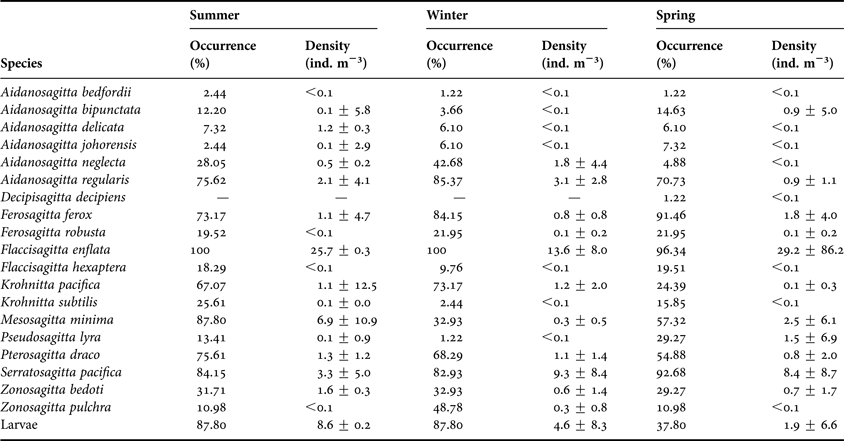
In total nineteen chaetognath species were identified in this study (Table 1), with 18 species occurring in summer, 16 species in winter, and 17 species in spring. Aidanosagitta delicata and A. johorensis were found exclusively in summer, while Mesosagitta decipiens was found only in spring. The specific composition displayed no clear seasonal changes. Flaccisagitta enflata was the most abundant and frequent species. This species was distributed throughout the study area and was the most abundant in all study areas. F. enflata, Mesosagitta Minima and Serratosagitta pacifica occurred with a frequency of more than 80% in summer and winter, respectively; as did F. enflata, A. regularis, Ferosagitta ferox and S. pacifica in spring. The frequency of occurrence of chaetognath larvae was higher in summer and winter than in spring (Table 1).
The occurrence and average density (ind. m−3) of chaetognaths on the north west continental shelf of the South China Sea during three seasons.
—, no occurrence. Occurrence = frequency of occurrence/82 (the station number).
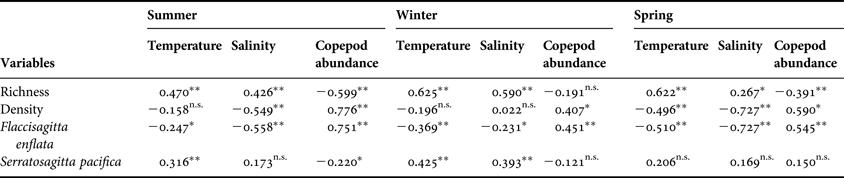
All species were divided into three groups according to their distribution and ecological characteristics: (1) warm water euryhaline species were the most widely distributed, with high densities, and found from high salinity offshore waters to low salinity coastal waters; (2) pelagic warm water species were typical tropical oceanic species found in high temperatures and at high salinity; and (3) warm water coastal species found in low densities in high temperatures and in low salinity waters (Du et al., Reference Du, Li and Jia2004). The ecological characteristics of chaetognaths were different among the regions. Warm water coastal species like Zonosagitta bedoti, Aidanosagitta neglecta and A. delicata were important species in terms of abundance throughout Region I. Low temperature and low salinity were the limiting factors for the oceanic warm-water species (Table 2). In addition, Serratosagitta pacifica, Mesosagitta minima, Pterosagitta draco, Flaccisagitta hexaptera, Pseudosagitta lyra and Krohnitta subtilis were oceanic warm water species that were recognized as offshore water indicator species. Warm water euryhaline species (F. enflata, A. regularis, Ferosagitta ferox) occurred in all three regions.
Correlations between biological indices of chaetognaths and environmental factors in the South China Sea.
n.s.P > 0.05; *P < 0.05; **P < 0.01.
Distribution of species richness
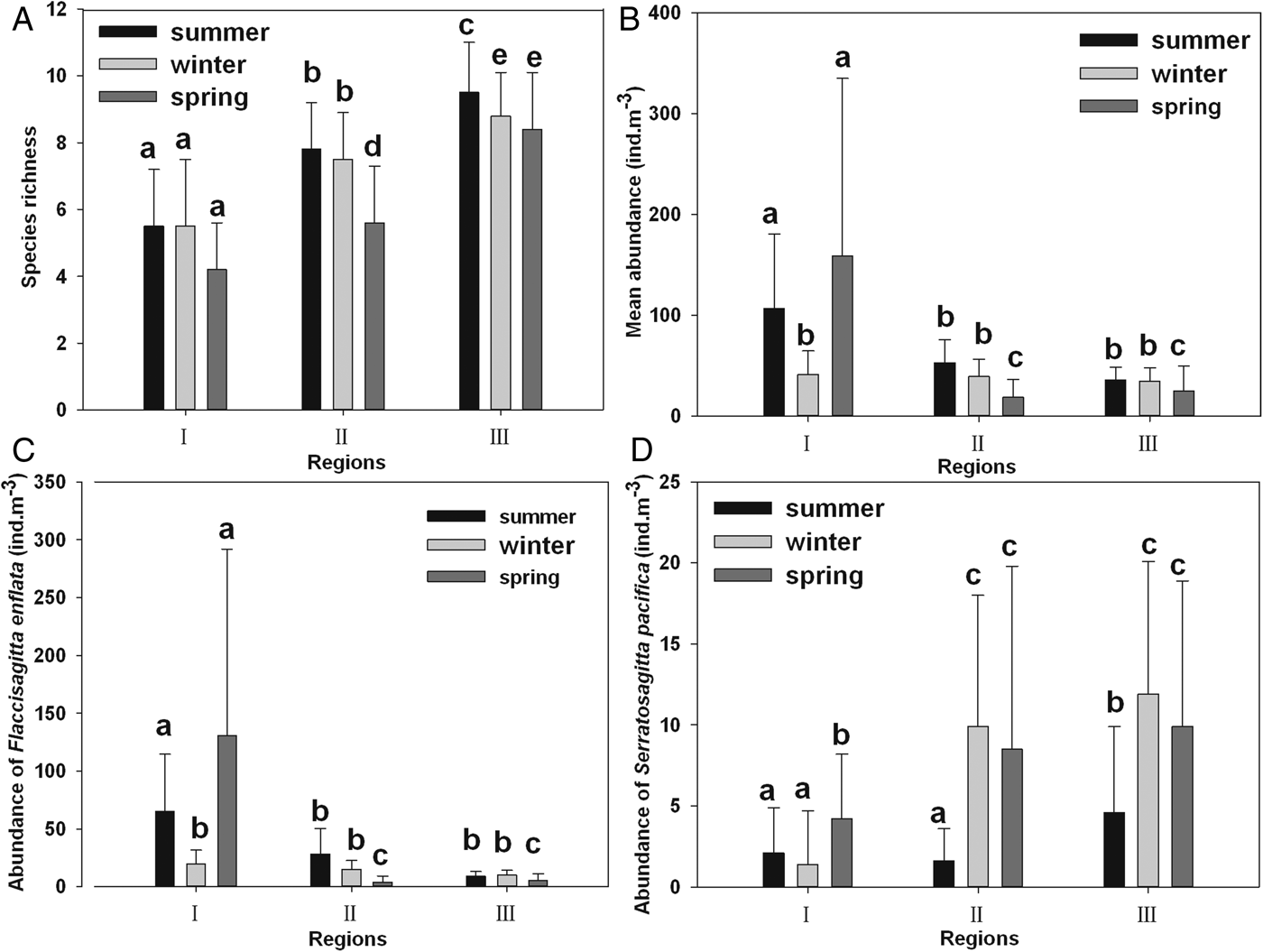
The number of species was higher in Region III than in Region II; Region I had the lowest in all three seasons (Figure 5A). Species richness was higher in summer than in winter; species richness was lowest in all three regions in spring. Region III in summer had the highest number of species (10) while Region I in spring had the lowest species richness (4). Noteworthy is the detection of Zonosagitta nagae when using plankton nets of 505 µm mesh size (mouth diameter: 0.5 m) in summer in Region I.
The seasonal variation of species richness was rather remarkable (F = 21.395, P < 0.001) (Figure 5A). There were clear differences in species richness among the three regions in summer (F = 34.912, P < 0.001), spring (F = 43.853, P < 0.001) and winter (F = 29.221, P < 0.001). There were significant differences between seasons in the distribution pattern of the species richness (F = 9.921, P < 0.001). Species richness was positively correlated with temperature and salinity (Table 2). Overall, Region III supported significantly more chaetognath species richness than Regions I and II (P < 0.01).
Distribution of species abundance
The average chaetognath abundances were 54.0 ±44.5, 36.8 ±16.7 and 48.9 ±95.5 ind. m−3 in summer, winter and spring, respectively. The abundance of chaetognaths was obviously higher in inshore waters than offshore waters during all three seasons (Figure 4D–F). During summer, there was an area of high abundance (>100 ind. m−3) in the eastern coastal water of the Leizhou Peninsula. At water depths of 0–50 m their abundance was higher than 50 ind. m−3, while fewer than 50 ind. m−3 were detected at depths greater than 50 m (Figure 4D). A high abundance area (>50 ind. m−3) in winter was located in the east mouth of Qiongzhou Strait and the eastern coastal waters of Leizhou Peninsula. The abundance during the spring peaked in the eastern coastal waters of Leizhou Peninsula (>100 ind. m−3; Figure 4F). The lowest abundance was found in the eastern offshore water of the Leizhou Peninsula and some patches south-east of Hainan Island in winter (Figure 4E). The differences in densities among the seasons were less marked and not statistically significant (F = 1.694, P = 0.186). Chaetognaths abundance was significantly correlated with copepod abundance at the level of 0.01 in all three seasons (Table 2).
Distribution of copepod abundance (upper row) (ind. m−3) and chaetognath abundance (lower row) (ind. m−3) on the north-west continental shelf of the South China Sea.
Dominant species
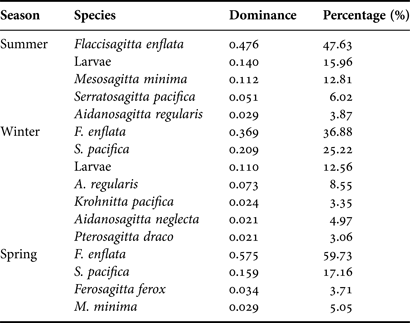
Flaccisagitta enflata had the highest dominance of the species overall during all cruises. Flaccisagitta enflata determined the horizontal distribution of chaetognaths (Table 3). Serratosagitta pacifica also was a dominant species in all three seasons. In addition, Mesosagitta minima and Ferosagitta ferox were present in fair numbers in spring and summer, while Aidanosagitta regularis and Pterosagitta draco were quite abundant in summer and winter, respectively (Table 3).
Dominance and percentage of total abundance of dominant species of chaetognaths during three seasons in the South China Sea.
Flaccisagitta enflata was the most dominant species, with mean densities of 25.7 (±0.3), 13.6 (±8.0) and 29.2 (±86.2) ind. m−3, which represented 47.63%, 36.88% and 59.73% of the total chaetognath abundances in summer, winter and spring, respectively. Flaccisagitta enflata displayed no clear seasonal pattern of occurrence, although populations were denser during summer and spring than in winter (Figure 5C). Similar patterns of distribution of F. enflata were found in summer and spring: (1) the abundance peaked (as high as 100 ind. m−3) in the east coastal waters of the Leizhou Peninsula; (2) their abundance was around 50 ind. m−3 where depths were less than 50 m; and (3) low densities ranged from 5 to 10 ind. m−3 in both Regions II and III. During spring, a low abundance was found in the eastern water of the Leizhou Peninsula where water depth is 50 m. The abundances were generally low (about 10 ind. m−3) in winter. The abundance of F. enflata was obviously higher in inshore waters than offshore waters in summer and spring (P < 0.001), while it showed no difference in winter between inshore waters and offshore waters (P > 0.05). Abundances of F. enflata were negatively correlated with temperature (P < 0.05) and salinity (P < 0.01) (Table 2).
Variations of species richness and abundance of chaetognaths at three sub-regions of the South China Sea in three seasons: (A) mean species richness; (B) mean total chaetognath abundance; (C) Flaccisagitta enflata abundance; (D) Serratosagitta pacifica abundance. Error bars represent SD. Columns denoted by different letters are significantly different from each other (ANOVA, P < 0.05).
Serratosagitta pacifica was second to F. enflata in terms of relative abundance with densities of 3.3 ±5.0, 9.3 ±8.4 and 8.4 ±8.7 ind. m−3 in summer, winter and spring, respectively. S. pacifica displayed obvious seasonal occurrence (P < 0.001). It showed different patterns from F. enflata in horizontal distribution: abundance in winter was higher offshore, but inshore during summer. During spring, the abundance increased with distance from the coast, from 5 ind. m−3 where the depth was 50 m, to 10 ind. m−3 where the depth was 200 m. Their abundance during summer was higher in Region III than in the other two regions (P < 0.01), but abundances did not differ significantly among the three regions in winter (P > 0.05) (Figure 5D). In the spring, Region II had the highest abundance of S. pacifica (P < 0.01) (Figure 5D). S. pacifica is a very close relative of F. enflata that more or less replaces it in winter. S. pacifica showed no clear relationships with environmental or biological factors (Table 2).
DISCUSSION
Influence of environmental factors on species distribution
Most species detected in the study prefer warm water (Dai, Reference Dai1995; Lin et al., Reference Lin, Yin, Huang, Zhang and Li2010). The species richness of chaetognaths was markedly higher in the tropical and sub-tropical waters of the SCS and the East China Sea than in the temperate waters of the Bohai Sea and the Yellow Sea. The numbers of species recorded in the Bohai Sea, the Yellow Sea and the East China Sea were 4, 14 and 31, respectively. The SCS, with 38 species, had the highest species richness (Xiao, Reference Xiao2004).
Environmental parameters play an important role in the dynamics of plankton communities. Different hydrographic conditions affected the distribution patterns of the various species of chaetognaths. Due to the combined effects of the Guangdong coastal current (GCC), inshore mixing water masses and the cold eddy, Region I has characteristics of low temperature and low salinity. The south-west monsoon and bottom topography can cause intense upwelling in Region II, which lasts from April to October. Therefore, a higher density of copepods was found in Region II in summer and spring (April). In contrast, the offshore waters are controlled by surface water of the SCS and affected by the SCS warm current, which is stronger in winter due to the north-east monsoon. So the offshore waters have characteristics of high temperature and high salinity (Wang et al., Reference Wang, Hong and Xu2010) and the number of dominant species was higher in winter than summer and spring (Table 3). Table 2 shows that species richness was positively correlated with temperature and salinity. The effect of the SCS warm current on the species richness of thaliaceans is in agreement with this result (Li et al., Reference Li, Yin, Huang, Zhang, Lian and Liu2011).
During the summer cruise we sampled Zonosagitta nagae when using plankton nets of 505 µm mesh size (mouth diameter: 0.5 m). Zonosagitta nagae was often found in temperate coastal waters throughout the Yellow Sea and the East China Sea (Lin, Reference Lin1982). In the East China Sea, it occurs in high abundances, second to that of F. enflata (Xu & Chen, Reference Xu and Chen2005). The occurrence of Z. nagae may indicate the presence of lasting intensification of the Pearl River dilute waters in summer, which enhanced the GCC in the west of Guangdong Province. Therefore, the chaetognaths probably were transported from higher latitude. Temperature was a major factor influencing the distribution range of Z. nagae, which was restricted to summer and is probably related to the existence of the cold vortex. Therefore it can be regarded as a cold eddy indicator in the sampled region.
Influence of environmental factors on abundance distribution
The density of chaetognaths of the north-west continental shelf of the SCS was not only higher than reported for other areas in China's seas (Dai, Reference Dai1989, Reference Dai1995; Zhang & Chen, Reference Zhang and Chen1991; Du et al., Reference Du, Li and Jia2003, Reference Du, Li and Jia2004; Xu et al., Reference Xu, Dai and Chen2004), but also greater than other regions in the world: 5.6–74.9 ind. m−3 from 0–25 m in the Sargasso Sea in the tropical Atlantic (Pierrot-Bults & Nair, Reference Pierrot-Bults and Nair2010), 6.9–9.8 ind. m−3 in the Algerian Basin of the western Mediterranean Sea (Riandey et al., Reference Riandey, Champalbert, Carlotti, Taupier-Letage and Thibault-Botha2005) and 2.6–17.3 ind. m−3 in the Australian sector of the Southern Ocean (Makoto, 1989). The marine mesozooplankton on the north-west continental shelf of the SCS is dominated by copepods. The abundance of copepods was about two to three times higher in inshore waters than in offshore waters. The high abundance of chaetognaths on the north-west continental shelf of the SCS may result from favourable food conditions for herbivorous copepods, which are preyed on by chaetognaths (Ramírez-Ávila & Álvarez-Cadena, Reference Ramírez-Ávila and Álvarez-Cadena1999).
The combined effects of the cold eddy, upwelling and the appropriate temperature and salinity in spring and summer produced a high food supply in Region I which was closely followed by high densities of chaetognaths (Figure 4). The abundances of chaetognaths and copepods were significantly correlated (Table 2). Differences of abundance among the three regions in winter were less clear due to the north-east monsoon. In addition, upwelling still occurred to the east of Hainan Island in summer. High primary production and secondary production supported high densities of chaetognaths, which were distributed in patches (Figure 4).
Influence of environmental factors on dominant species
Flaccisagitta enflata and Serratosagitta pacifica were the two most abundant species during summer, winter and spring, and showed no seasonal variation in the stable conditions. Flaccisagitta enflata is an epiplanktonic, temperate and warm water species (Alvariño, Reference Alvariño1965; Andréu, Reference Andréu1992) with a wide distribution in the Indian, Atlantic and Pacifica Oceans (Pierrot-Bults & Nair, Reference Pierrot-Bults, Nair, Bone, Kapp and Pierrot-Bults1991), and found over relatively broad temperature and salinity ranges (Xiao, Reference Xiao2004). Flaccisagitta enflata is also the most abundant species in this study and also one of the most abundant species in the Bohai Sea, the Yellow Sea and the East China Sea (Du et al., Reference Du, Li and Jia2003). Changes in the distribution and abundance of F. enflata have very important effects on distribution of total chaetognaths (Du et al., Reference Du, Li and Jia2003). A 505 µm mesh size plankton net (mouth diameter: 0.5 m) yielded higher abundances (14.1 ind. m−3) of F. enflata in the surveyed region than reports for other areas in China's seas. For example, the abundance of F. enflata was 3.58 ind. m−3 in the Beibu Gulf (Sun, Reference Sun1989), 11.67 ind. m−3 in the Taiwan Strait (Dai, Reference Dai1989), with seasonal average abundances of 3.98, 5.52, 4.46 ind. m−3 in the Nansha Islands (Lin et al., Reference Lin, Yin, Huang, Zhang and Li2010). In addition, the density is also higher than reported in other regions: 1–7 ind. m−3 recorded in the neritic region of the Agulhas Current (Stone, Reference Stone1969), 13–33 ind. m−3 recorded in the North Atlantic (Baier and Purcell, Reference Baier and Purcell1997) and 17–31 ind. m−3 recorded in the Indian Ocean (Øreslan, Reference Øresland2000).
In our study, chaetognath abundance in Region I (>50 ind. m−3) was higher than in the other two regions because of its lower temperature, low salinity and more abundant food. The abundance of F. enflata was negatively correlated with temperature and salinity, but positively correlated with copepod abundance. Flaccisagitta enflata occurred where the waters or currents meet (Hong et al., Reference Hong, Qiu, Ruan and Hong1991), indicating interactions between coastal and offshore waters. During the summer, Region I experiences the confluence of a large volume of Pearl River discharge, a strong GCC and offshore water—another reason why F. enflata abundance is higher in Region I than in other regions. In contrast, there were no clear differences between regions in winter because decreased Pearl River discharge rates result in SCS warm current dominance in all three regions.
Serratosagitta pacifica occurs in relatively wide temperature ranges and high salinity. Its high abundance is mainly limited by salinity (Sun, Reference Sun1989). Serratosagitta pacifica is generally regarded as a good indicator of offshore water in inshore regions. Intense coastal water plus upwelling caused low abundance of this species in inshore water in summer, except for a small patch on the east mouth of the Qiongzhou Strait. Its abundance was highest in winter and related to the weak coastal water and upwelling in winter. Serratosagitta pacifica abundance was higher in the other areas, except for a small part of Region I, where abundances ranged from 5 to 10 ind. m−3. At the same time, high abundances in winter also testified to the strengthening of the SCS warm current. Serratosagitta pacifica's distribution is closely related to the warm current and can be regarded as an indicator species of Kuroshio water offshore in the East China Sea and Taiwan Strait (Xiao, Reference Xiao2004).
Aidanosagitta neglecta is a neritic or distant neritic Indo-Pacific species and is usually associated with warm water masses (Tse et al., Reference Tse, Hui and Wong2007). In this study, higher abundances of A. neglecta were recorded during the winter. This contrasts with the view of Tse et al. (Reference Tse, Hui and Wong2007) that A. neglecta was positively correlated with temperature. On the other hand, it can be a good indicator of the enhanced influence of the SCS warm current in winter. In addition, oceanic warm water species, such as Mesosagitta minima, Pterosagitta draco, Flaccisagitta hexaptera, Pseudosagitta lyra and Krohnitta subtilis can also be indicators of the SCS warm current.
ACKNOWLEDGEMENTS
We appreciate suggestions given by two referees.
FINANCIAL SUPPORT
This study was supported by the Natural Science Foundation of China (Nos 31101619, 41276159 and 41130855), Chinese Offshore Investigation and Assessment (No. 908-01-ST08) and the Public Science and Technology Research Funds Projects of Ocean (No. 201305030).