Introduction
It is tolerably well known that Gérard Grisey's instrument was the accordion. Guy Lelong, in his edition of Grisey's writings published in 2008, featured a single photograph of Grisey as a child, one of a five-year-old Grisey playing a piano accordion.Footnote 1 But beyond this, the possible influence that Grisey's main instrument might have had on his later musical endeavours has rarely been explored. In order to assess this influence, the nature of Grisey's engagement with this instrument must first be ascertained. To do so, we are little aided by the first monograph on Grisey, Jérôme Baillet's Gérard Grisey, fondement d'une écriture from 2000, which begins its story as the twenty-six-year-old Grisey springs fully formed from the graduating class of the Paris Conservatoire in 1972, and with the composer's first avowed opus 1, D'eau et de pierre (1971–72).Footnote 2 But this account leaves obscure the composer's formative years in the 1960s; this period was dominated by the centrality of the accordion in his musical development and saw the completion of his first youthful compositional essays, most of which were scored for the accordion; his studies at a school in southern Germany specifically devoted to the accordion; and notably, the composition of a substantial work for accordion, Passacaille (1966). Even if Grisey ultimately expressed dissatisfaction with the work, it had sufficient merits to qualify Grisey for admission into Messiaen's legendary composition/analysis class at the Conservatoire that would have such decisive consequences for Grisey's evolution as a composer. After establishing the basic chronology of Grisey's relationship with the accordion, this article assesses the extent to which Grisey's musical training on the accordion left traces in his mature compositional language. By doing so, it gently unsettles the historiography of spectral music by first revealing significant strands of spectral genealogy that run through German rather than French compositional traditions, and by introducing the role of an unlikely and unsung instrument that was the primary musical interface of spectralism's most famous pioneer. Eager to avoid being identified with the humble instrument, a perennial object of scorn in certain art music circles, Grisey would go on to renounce his accordion past, and to ask his friends to destroy any of his accordion scores or recordings in their possession. As a result, the accordion, and Grisey's instrumental roots in general, were expunged from his own artistic narrative, an omission that then gets carried over as a historiographical blind spot in musicological writing on spectral music. In fact, in its most radical form, spectral music is perceived as completely divorced from any instrumental or performative considerations whatsoever, becoming couched in abstract, quasi-scientific terminology, the most characteristic documents of which remain Grisey's Darmstadtian essays ‘La musique, le devenir des sons’ and ‘Tempus ex machina’. Recovering the geographically and historically contingent aspects of Grisey's musical life – in particular, his accordion career in Alsace – contributes to a historical recontextualization of spectral music as a whole. The material characteristics of the accordion can be posited as one of the sources of Grisey's music and even, by extension, of spectral techniques generally.
Gérard Grisey is of course one of the major figures of the French spectral moment. ‘L’école spectrale’ emerged out of the Ensemble L'Itinéraire, the collective of composers and performers formed in Paris in 1973, mostly comprising graduates of the Paris Conservatoire, and specifically pupils in Messiaen's famous analysis class. L'Itinéraire was founded by composers Tristan Murail, Michaël Levinas, and Roger Tessier, who were soon joined by Gérard Grisey and Hugues Dufourt.Footnote 3 These composers had a penchant for microtonality and came to be grouped together as ‘spectral’ composers – a term coined by Dufourt.Footnote 4 Grisey famously declared: ‘We are musicians and our model is sound and not literature, sound and not mathematics, sound and not theatre, visual arts, quantum physics, geology, astrology, or acupuncture.’Footnote 5 In iconic works such as Partiels (1975), Grisey demonstrated how the micro-fluctuations of sound, coupled with the presence of overlapping and contrasting time-scales, could be used as the basis for musical works.Footnote 6 In Partiels, Grisey famously projected the overtones theoretically contained in sound produced by a low E intoned by the trombone at the beginning of the work onto instrumental space. Each of the instruments of the ensemble then sounds one of the frequencies of these overtones in a slow-motion simulation, before then gradually straying from this harmonic model in order to simulate inharmonic structures.Footnote 7 ‘Instrumental synthesis’ is but one of countless techniques Grisey and many of his peers employed, either by transcribing properties of natural sounds made visible through electronic tools captured at various microscopic time-scales, or else by imitating techniques of electronic sound manipulation such as ring modulation and tape-feedback loops on acoustic instruments.
And yet Grisey's musical concerns in his formative years did not presage in any obvious manner the spectral turn his compositions took in the early to mid-1970s. Grisey's first published composition predates D'eau et de pierre by some ten years: the Étude in F major for accordion, composed in 1963, when he was seventeen years old, a piece that was published a year later by the Swiss publisher Helbling. Grisey can also be heard playing the accordion on a commercial recording. And yet, around the time Grisey was studying at the Paris Conservatoire with Messiaen, Grisey decided to abandon the accordion. In a 1969 letter to his friend, the Canadian accordionist Joseph Macerollo, Grisey writes in serviceable English:
I could never tell to musicians of the Paris Conservatory that I am accordionist without hear them laughing. Messiaen knows something about electronic accordion but he doesn't like it at all . . . I am not playing accordion any more. My way is another one. I compose, which need a lot of time and I play a little piano . . . I didn't write any work for accordion during those past four years because I don't know anybody in France who would be able to do it. May be did you hear of the Passacaglia I wrote a few years ago. It's a youth's essay and I would like everybody forget it. My style have changed; I am now very close of people like Ligetti [sic] or Stockhausen.Footnote 8
The letter certainly suggests that part of the reason for Grisey's abandonment of the accordion was a fear of marginalization. In a country in which the accordion is a strong symbol of popular, working-class music-making (typified by the culture of the bal musette), Grisey would have trouble asserting his avant-garde bona fides in Messiaen's class were he to continue to identify as an accordionist. Moreover, as a piano accordionist in a country in which the button accordion reigned supreme, Grisey's musical practice would have been relegated to the margins of a margin. Nevertheless, this would not be the end of Grisey's interactions with the accordion, since he would later go on to include the accordion in the instrumentation of five of his mature works (four of these forming part of the Espaces acoustiques cycle), calling on his former classmate Hugo Noth, with whom he studied in the Accordion School in Trossingen, Germany, to perform the accordion part in these works.
Chronology of Grisey's accordion career and early compositions for accordion up to Passacaille
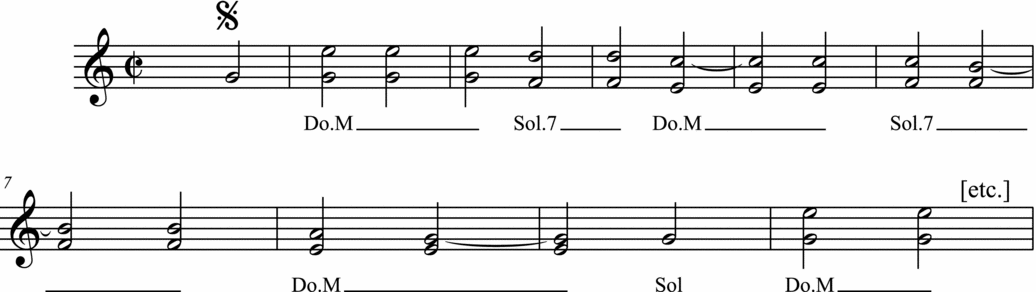
Grisey began his accordion studies in his hometown of Belfort, in the French province of Alsace, with Rudi Valli, a popular or ‘variété’ accordionist. Belfort is part of the only municipality of Alsace not to have been ceded to Germany after the Franco-Prussian war of 1871. The ‘Territoire de Belfort’ then acquired its own status as an administrative ‘département’ in its own right in the years following the First World War, detached from the Haut-Rhin (upper Rhine) département to which it previously formed a part. In 1960, the Territoire de Belfort was assigned to the Franche-Comté region rather than to Alsace as part of an administrative restructuring initiative. Although predominantly French-speaking, it shares many geographical and cultural ties with German-speaking neighbours in Germany and Switzerland, and stands adjacent to a swathe of French territory that was part of the German empire for several decades. This goes some way towards explaining Grisey's basic mastery of the German language that allowed him to pursue his accordion studies in Germany, in the south-west German town of Trossingen. The geographical location of Belfort also had a bearing on Grisey's early accordion career, which appears surprisingly cosmopolitan: although hailing from a modest family, through his talents as an accordionist, he was able to attend music school in Trossingen – about 180km away – and be published by a publisher in Zurich, some 160km from his hometown. Belfort is roughly the same distance to the Franco-German border along the Rhine as Trossingen is. Moreover, important German-speaking new music centres such as Freiburg im Breisgau, Donaueschingen, and Basel are all also within a 200km radius of Belfort. It is unsurprising then that Grisey's musical development was inflected by his Alsatian identity, an identity of which he was vividly conscious from an early age, as attests his first preserved musical composition, composed at age nine, and significantly entitled Fête en Alsace (Example 1).
Gérard Grisey, Fête en Alsace (1955), first ten bars. With kind permission of Paul Sacher Stiftung, Sammlung Gérard Grisey.

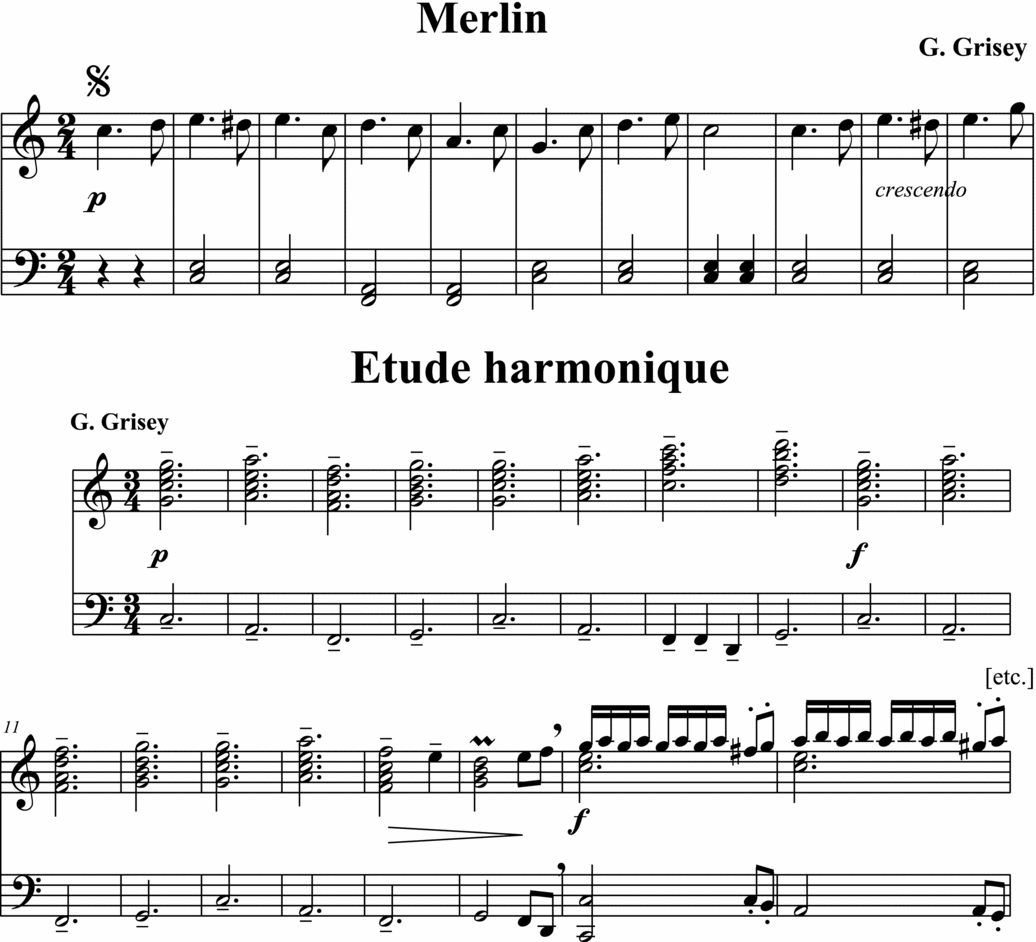
Besides Fête en Alsace, Grisey tried his hand at some youthful compositions for accordion, which, rather surprisingly, were preserved at the Paul Sacher Stiftung, including Merlin, composed at age eleven, Étude harmonique, from 1958, revised in 1961, and Samba-Capriccioso (undated). Excerpts of the Merlin and Étude harmonique appear in Example 2.
Gérard Grisey, Merlin (1957), first eleven bars and Étude harmonique (1958), first eighteen bars. With kind permission of Paul Sacher Stiftung, Sammlung Gérard Grisey.

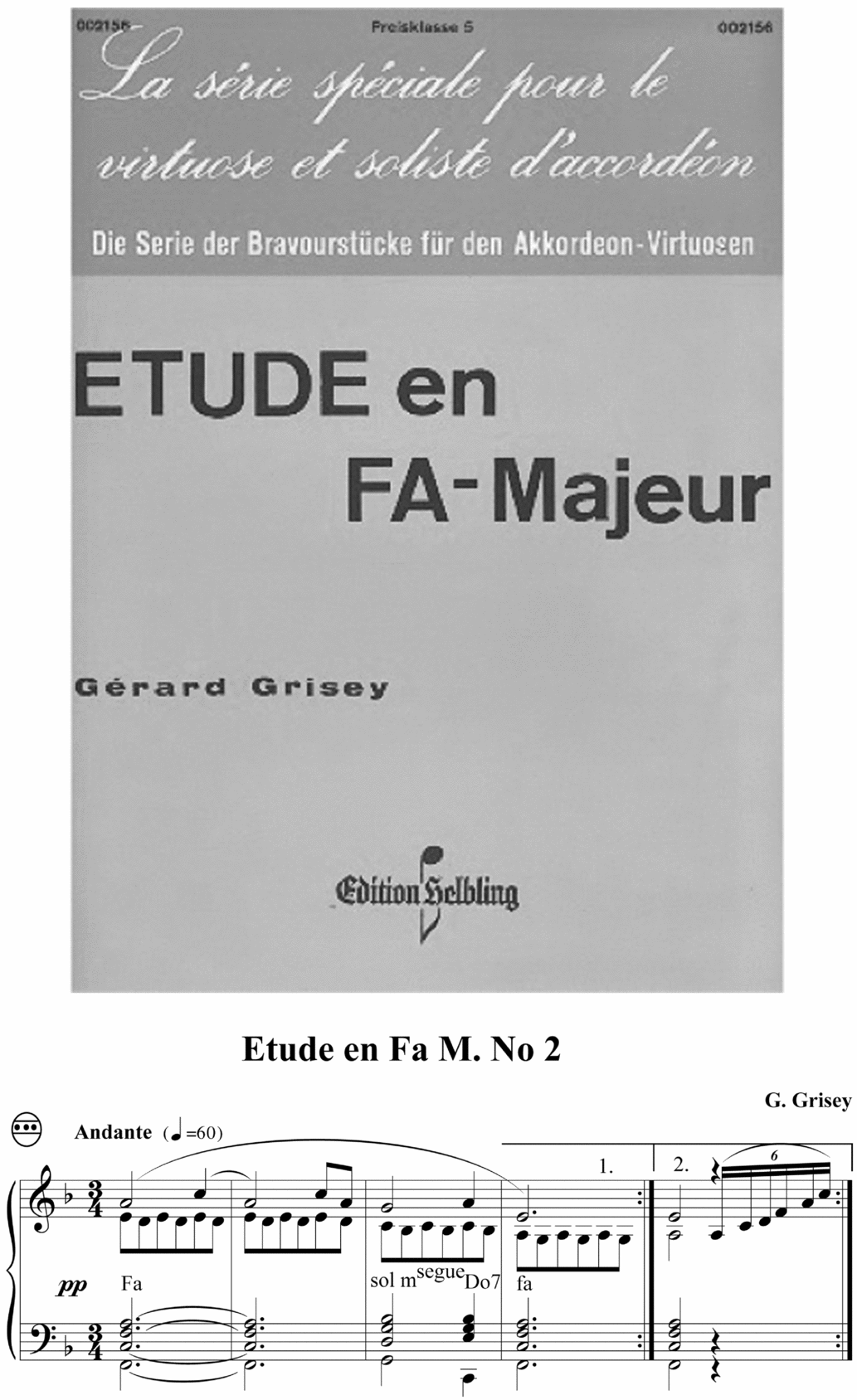
Then, in 1961, at the age of fourteen, Grisey purchased a professional quality accordion from his teacher for 2,300 francs. This is the Hohner Morino piano accordion that he would use for his entire decade-long performance career. In 1962–63, he composed three études for the accordion, the second of these, in F major, being the piece that was published by Helbling. The excerpt of this piece shown in Example 3 demonstrates the way Grisey made use of the Stradella bass – the system of left-hand buttons that allow the performer to sound pre-voiced major, minor, diminished, and dominant seventh chords by pressing single buttons.
Cover of Helbling Edition of Gérard Grisey's Étude en fa, and excerpt.

Sometime around 1963, Grisey also composed a Petit caprice en la majeur for two accordions. Then, in September 1963, the seventeen-year-old Grisey began to participate in the accordion competition circuit, the Coupe mondiale. The mondiale was held that year in Baden Baden, and it was there that Grisey met his Canadian colleague Joseph Macerollo. They were drawn to each other by their growing disillusionment with the world of accordion competitions and what they perceived as the empty virtuosity that they fostered. Grisey was nevertheless involved in displays of virtuosity at the Baden Baden mondiale, performing for the occasion an arrangement of Gershwin's Rhapsody in Blue. Grisey left the 1963 competition without a medal, but the following year he participated in the Coupe mondiale, held that year in Toronto, and took home a bronze.
From 1964 to 1965, Grisey studied accordion performance at the Städtischen Musikschule Trossingen, Germany. Trossingen was the headquarters of the Hohner company, the storied accordion manufacturers, that had established the school in the city in 1932 as a way of training accordion teachers, as well as to encourage accordion performance by commissioning and publishing new works for the instrument.Footnote 9 In Trossingen, besides the Hohner accordion school, Grisey also studied composition at the Hochschulinstitut für Musik, with neoclassical composer Helmut Degen (1911–95), who had authored a Handbuch der Formenlehre in 1957. Grisey also must have encountered the Munich-based composer Wolfgang Jacobi (1894–1972), since that composer subsequently wrote a letter of recommendation in support of Grisey's application to the Paris Conservatoire. Jacobi composed many works for solo accordion and accordion orchestra that were often performed by Trossingen students and faculty, and Jacobi would often attend the local music festival, the Trossinger Musiktäge.Footnote 10 It is unlikely, however, that Jacobi taught Grisey composition, since the German composer only refers to Grisey's accordion playing in the letter.Footnote 11 Grisey arrived too late in Trossingen to study with composer Hans Brehme (1904–57), who taught in Trossingen only until 1949, but Grisey did later record two works by this composer associated with late romanticism, neoclassicism and, towards the end of his life, twelve-tone technique.Footnote 12 It is difficult to say with any certainty what influence these three composers – Degen, Jacobi, and Brehme – might have had on Grisey's development as a composer, even if Grisey composed his youthful work for accordion Passacaille under Degen's tutelage.Footnote 13 Indeed, Degen's Handbuch does include a succinct description of the passacaglia form.Footnote 14 More generally, the MGG entry on Degen notes that his ‘compositions embody a principle of static form with a preference for sequential form such as the variation and the rondo’,Footnote 15 and the passacaglia is of course a static and sequential form if ever there was one. Indeed, Liam Cagney concludes in his dissertation on Grisey's early works that ‘it was at Trossingen, under the composer Helmut Degen, that Grisey acquired an early compositional grounding in the traditionally German preoccupations with large-scale musical form and harmonic function, the legacy of which is clear in his later music's concern for large scale formal coherence’.Footnote 16 Degen, Brehme, and Jacobi were also, broadly speaking, in the aesthetic orbit of Paul Hindemith, whose somewhat surprising influence in Grisey has already been noted by Julian Anderson, who observed that the prescient chapter of Hindemith's The Craft of Musical Composition (1937) devoted to combination-tone harmony was the source of inspiration for Grisey's use of ‘sum and difference tones as generators of harmonic fields’.Footnote 17
In Trossingen, Grisey immediately became friends with Hugo Noth, a Swiss classmate two years his junior, who would go on to become an accordion instructor for decades in Trossingen, as well as one of the most accomplished classical accordionists in Germany. Noth and Grisey were drawn to each other by the French language they shared (Noth describes Grisey's German at the time as weak, although Grisey's correspondence at the Sacher Stiftung reveals him to be comfortable corresponding in that language), as well as by their shared interest in contemporary music. At the time of their studies at Trossingen, Noth claims that Grisey was the finest accordionist at the school, and he did not hesitate to claim that Grisey considerably surpassed Noth's own mastery of the instrument at the time. Hugo Noth recalls that in Trossingen, Grisey already had his heart set on gaining admission to the Paris Conservatoire in order to study with Messiaen, and that he had planned his studies at the accordion school with this goal in mind. In 1967, the twenty-one-year old Grisey would return to Trossingen one last time in order to give a performance of the Passacaille that he had composed the previous year.
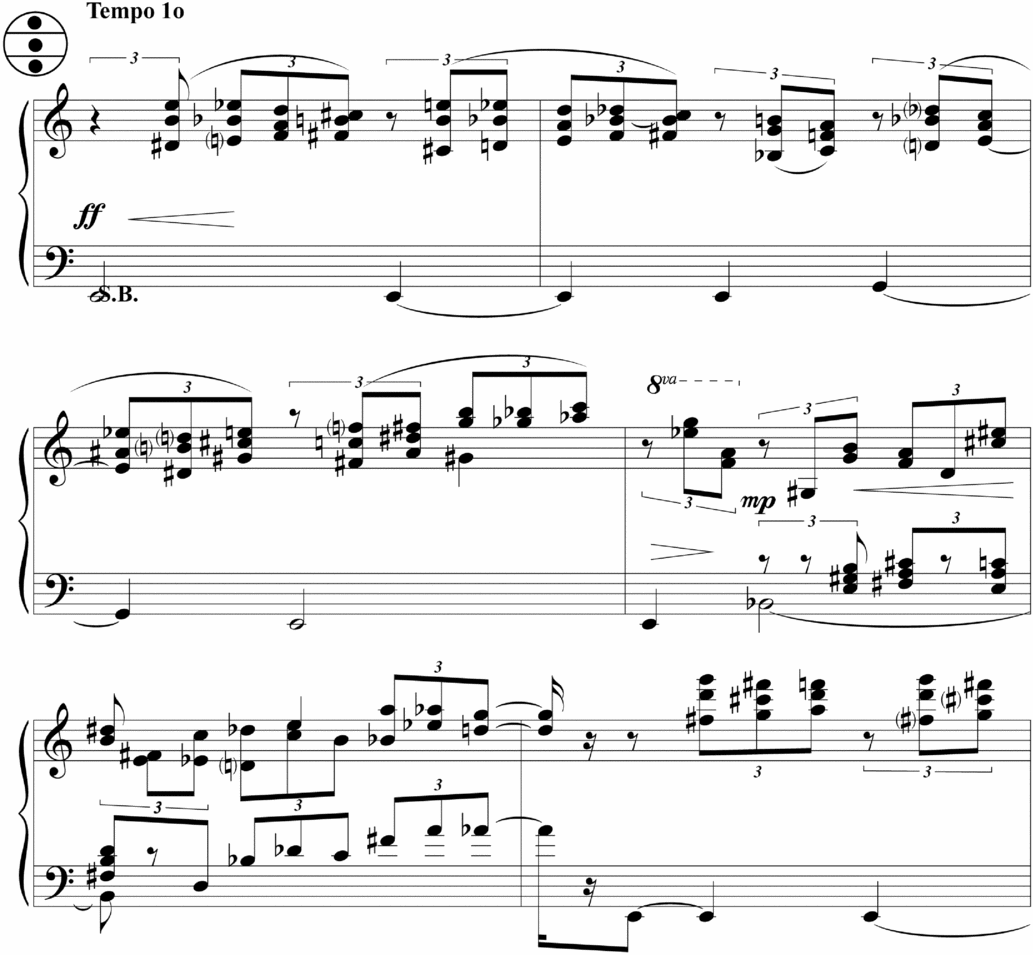
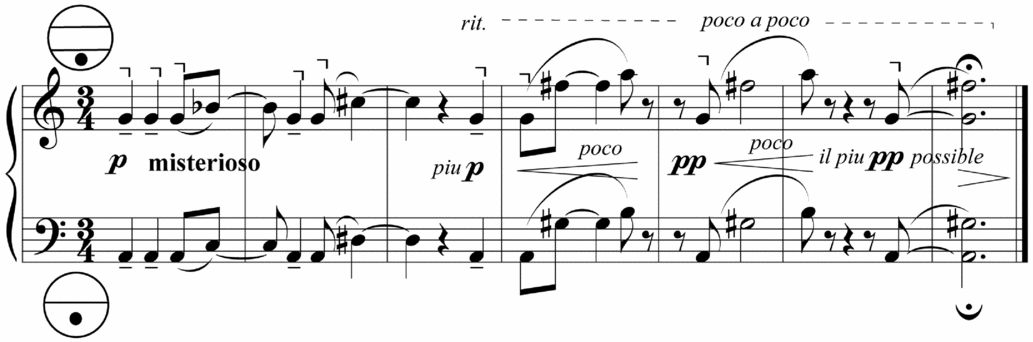
The withdrawn Passacaille, recorded for the first time only in 2006,Footnote 18 more readily recalls the work of a talented apprentice deeply indebted to Messiaen, despite the fact that he composed it before having set foot in the Paris Conservatoire, than the influence of his neoclassical composition teachers at the time. A passage with a bass pedal cantus firmus subtending a cascade of right-hand chords, for example, is reminiscent of one of Messiaen's Sainte Trinité organ improvisations (Example 4).
Excerpt from Gérard Grisey, Passacaille (1966), bars 47–52 with slight modifications. With kind permission of Paul Sacher Stiftung, Gérard Grisey Sammlung.

Elsewhere, a two-voiced passage in parallel motion foreshadows the kinds of fusion phenomena at the limit of harmony and timbre that would go on to be so central to his compositional style (Example 5). Liminal experiences between harmony and timbre are after all central to the accordion's sound, since it uses registral stops like an organ to build up a variety of timbres. An accordionist has an intuitive grasp of the way timbre can be constructed from superimposed voices, that is, harmony, and this infuses Grisey's early accordion piece as much as it does his later works.
Excerpt from Gérard Grisey, Passacaille (1966), last seven bars. With kind permission of Paul Sacher Stiftung, Gérard Grisey Sammlung.

In the same year as the premiere of Passacaille, Grisey's performances on the accordion were released on three LPs of new accordion music released by the Pennsylvanian label Kaibala, founded by the Latvian-born accordionist Victor Naruns. The recordings were made in 1964, as Liam Cagney has surmised, immediately following the Coupe mondiale in Toronto, while Grisey was staying in the United States with US accordionist Stanley Darrow, who was also featured on the Kaibala recordings. The records were released in 1967, and feature Grisey's performances of two works by Brehme: the Divertimento in F and the Elegy-Pastoral. In the performers’ biographies included on the record jacket, Grisey's move away from accordion performance is already announced: ‘Gerard Grisey is one of France's finest accordionists. At the present time, Mr. Grisey is not actively concertizing, but is studying composition at the Paris Conservatoire. He intends to return to the field of active concertizing upon graduation. Based on the excellent results of his first works, we can expect further compositions of high quality.’Footnote 19 The biography ends with the unfulfilled promise that ‘Mr. Grisey's Passacaglia for accordion will soon be recorded by Kaibala.’ Grisey's studies continued at the Paris Conservatoire beginning in 1966 until 1972, having joined Messiaen's composition class in 1968.Footnote 20 It must have been in his time in Messiaen's class that he decided not to return to accordion performance as the Kaibala bio suggested, and also to disown his Passacaille, as the 1969 letter to Macerollo quoted earlier demonstrates.
His reasons notwithstanding, Grisey's disavowal of the accordion would go one step further in a letter he wrote in 1991 in response to a request from accordionist Stefan Hussong, who had asked if he could commission an accordion piece from the composer. Grisey responded that ‘I have often thought again about the accordion, since I detest my Passacaille as a sin of youth.’Footnote 21 He expresses no special interest in the accordion at this point – but this indifference apparently quite recent, since Liam Cagney discovered sketches in the Grisey Collection at the Paul Sacher Foundation that ‘show that in the early 1980s Grisey researched contemporary techniques for the button accordion with the view to composing a work for the instrument’.Footnote 22 But his later aversion to the accordion also extended to the piano and the organ, owing to the fact that, as he goes on to state in his response to Hussong, he was no longer interested in composing music for any tempered instrument whatsoever.
Grisey's ‘native’ instrument in his later compositions and its possible contribution to his mature compositional style
Despite Grisey's disavowal of accordion performance in 1969, only three years would pass before Grisey incorporated the accordion into one of his own mature compositions: Dérives (1973–74) for double ensemble. In some ways, his writing for the accordion constitutes a microcosm of his compositional language as a whole. One can already see, for example, the way Grisey incorporates the accordion into his process writing in Dérives, that is, the way the music develops incrementally. Example 6 shows only the portion of Fig. 21 played by the ‘concertino’ ensemble that includes accordion.
Gérard Grisey – Dérives for two orchestral groups, Fig. 21, small ensemble only (excluding orchestra). Copyright 1974 by courtesy of Casa Ricordi Srl.

While arranging for the first performance of this work, in 1974, Grisey telephoned Noth in order to ask him to perform its Parisian premiere.Footnote 23 That Grisey was still in touch with his friend from his Trossingen days is not surprising, since throughout the 1970s Grisey still apparently had contact with his former accordion circles. According to Cagney, ‘in 1977 the Association of German Accordion Teachers (Der Deutsche Akkordeonlehrerverband, or DALV) commissioned from Grisey a student work for accordion and string trio’, although this work was never completed.Footnote 24 Grisey would call on Noth two years later for his next piece with accordion, Partiels, the third piece of the Espaces Acoustiques cycle, premiered on 4 March 1976 in Paris by L'Itinéraire.Footnote 25 Since the instrumentation of the Espaces acoustiques cycle is cumulative, that is, each of the six pieces contains the instruments of its predecessor as a subset of its instrumentation, the three works that follow Partiels in the cycle, Modulations, Transitoires, and Épilogue, also employ the accordion.
In Partiels and the subsequent Espaces acoustiques pieces, Grisey famously exploits combination tones to structure musical form.Footnote 26 A well-known example in Partiels (Figs. 12–21) exploits the acoustic principle of sum and difference tones:Footnote 27 a dyad with frequencies F1 and F2 is followed by its corresponding difference tone (F2-F1) or sum tone (F2+F1), or else by one of the partials of any of these four frequencies.Footnote 28 The wind instruments, and in particular the accordion, are used as the source, or carrier, frequencies. It may be because combination tones on the accordion are particularly prominent that Grisey made this one of the few passages of Partiels in which the sonority of the accordion detaches itself from the timbre of the ensemble and becomes clearly identifiable. In this way, the passage can almost be heard as an expansion of the natural beating effects that can be produced on the accordion,Footnote 29 an effect that Grisey had in fact already exploited in his previous work with the accordion: in Dérives, the accordion is tuned to 442Hz while the rest of the orchestra is set to the diapason of 440Hz.
It remains to be assessed to what extent properties of the accordion might have inspired Grisey's compositional language. Recent research in psychoacoustics suggests that musicians hear their own instruments in ways that are fundamentally different to the ways they hear any other instrumental sounds.Footnote 30 Consequently, even if Grisey abandoned accordion performance in favour of composition, it may be possible to ‘retrieve’ the accordion from Grisey's compositional thought, or to imagine ways the specific acoustic properties of the instrument may have spawned Grisey's musical imagination. Several aspects of the acoustics of the accordion that may have nourished Grisey's musical imagination are suggested below.
1 Acoustic envelopes
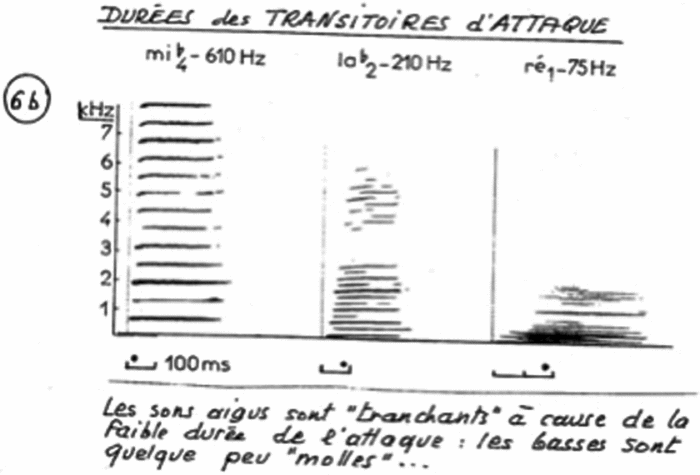
The accordion's tone can rarely achieve the solid, stable intensity of chords played, for example, on the organ; acoustic envelopes are in constant flux, like the envelope of an electrocardiogram reading. Indeed, unstable envelopes are one of the main musical ideas in the Espaces acoustiques, as they are employed as a kind of metaphor for inharmonicity. Related to this are the decay transients of the accordion sound. Emile Leipp, the renowned French acoustician who was Grisey's acoustics professor, devoted a journal-length study to the acoustics of the accordion in 1972.Footnote 31 Pierre Gervasoni, in his monograph on the accordion, gleans from these studies that ‘the accordion is of all the free reed instruments without doubt the one with the most prominent decay transients, which is a probable consequence of the valve mechanism’.Footnote 32 In fact, the hypothesis that the sonorities of the accordion were crucial to the development of spectralism becomes plausible when one considers that Emile Leipp, whose acoustic research had such a marked impact on French spectral composers, had himself played the accordion in his youth. As he recalls in the pages of the Groupe d'acoustique musicale's bulletin devoted to the instrument:
The truth is that the accordion was never unknown to me, and it is probably not futile to mention it here. It was actually the very first musical instrument that I heard and played in my childhood, immediately following the 1914–1918 War and it is well known how important the ‘first encounter with music’ is for the man! Later we danced to the sound of the accordion. Then the war came and I forgot the accordion.Footnote 33
Indeed, a page of Leipp's bulletin featuring spectrograms of accordion attack transients recalls parts of the score of Grisey's Transitoires (Figure 1).Footnote 34
Chart prepared by Emile Leipp of attack transients of the accordion, Bulletin du GAM 59 (February 1972), 18.

2 Sound fusion
A second, related, psychoacoustic property of the accordion that makes it a natural ally of spectral musical thinking is the propensity of its chords to fuse into timbres, the individual notes losing their distinctness. This fusion phenomenon can be a liability when performing traditional Classical or Baroque repertoire. Hugo Noth remarked in conversation that it is always problematic to play thirds and octaves on the accordion, because the upper note invariably sounds like a coloration of the lower note, rather than as a distinct tone in and of itself. This makes it hard to render the independence of voice required for contrapuntal repertoire such as Baroque fugues on the accordion.Footnote 35 But the tendency of harmony to dissolve into timbre in the accordion, far from being an impediment, may have nourished Grisey's spectral imagination, for whom such liminal phenomena played a quintessential role.
3 Dynamic swelling
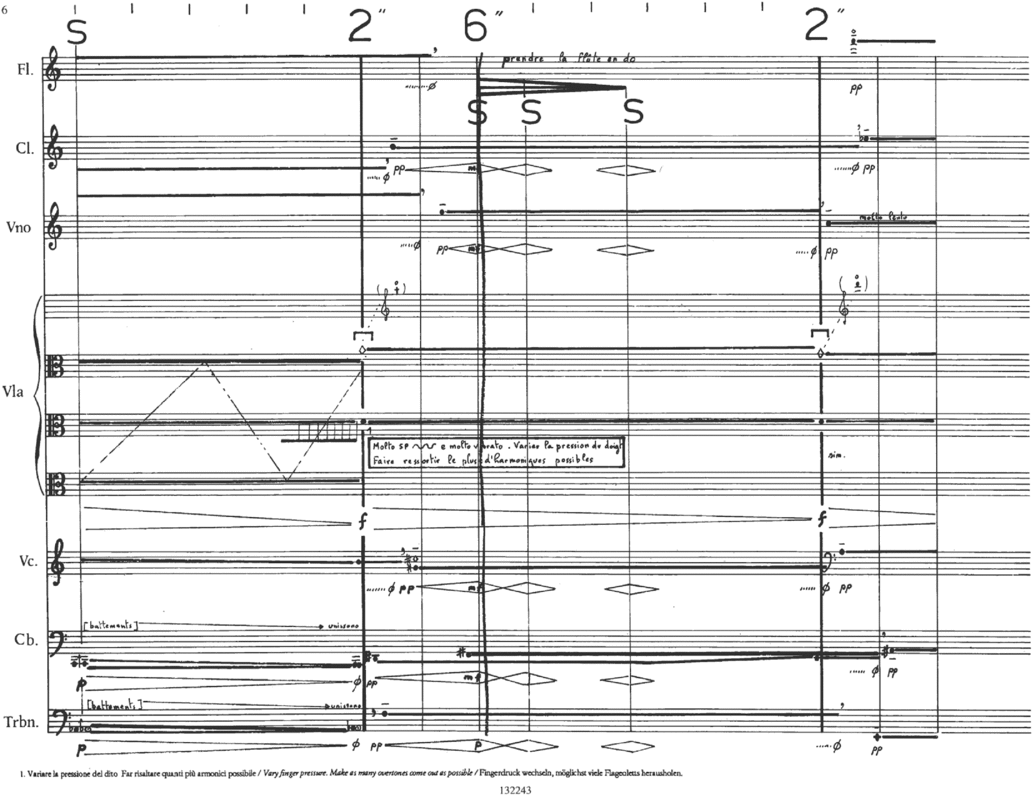
On an accordion, all notes played at the same time have the same amplitude; no dynamic control of individual notes is available to the performer in the way that is possible, for example, on the piano, since the same air pressure controlled by the bellows is transmitted to all of the sounding reeds. This property lends itself well to the production of dramatic swelling chord crescendi. These kinds of swells are often employed in Grisey's ensemble writing, as the matching dynamic envelopes in the passage of Périodes (1974) shown in Example 7 demonstrates.
Gérard Grisey – Periodes for seven instruments. Copyright 1974 by courtesy of Casa Ricordi Srl, p. 6.

Example 7 might suggest then that certain properties of the accordion may have influenced Grisey's musical imagination, even in compositions with no accordion part. Indeed, at other times, not only is the musical discourse apparently modelled on or inspired by the accordion, but also the absent accordion is replaced by another instrument. This is the case in Jour contre jour, in which there is only one electric instrument, an electric organ, whose sound is diffused in stereo through two loud speakers. This spatialized sonority is certainly evocative of the double sound source of the organ-like accordion, and indeed, the role of the organ in this piece is akin to that of the accordion in Partiels: to buttress the sonorities of the wind instruments.
4 Breathing cycles
Related to the frequent use of this swelling gesture is another dynamic quality of the accordion: the way the movement of air in its bellows recalls the rhythm of human breathing. While many twentieth-century composers have exploited the kinds of breathing-like noises that can be obtained on the accordion (e.g. Salvatore Sciarrino and Sofia Gubaidulina in their respective works for accordion), it is striking that the periodicity of breathing is employed as an important vector of musical form in Grisey's thought. Périodes (1974) was only the first work in which Grisey explicitly uses breathing rhythms (tension, relaxing of tension, rest),Footnote 36 while in his essay ‘Tempus ex machina’, Grisey writes that ‘acceleration and deceleration, just like periodicity, are parts of our daily experience: cardiac and respiratory rhythms that determine these phenomena’.Footnote 37 A well-known example occurs in one section of Partiels (Figs. 23–27) when seven overlapping breathing cycles are superimposed.Footnote 38 Each cycle consists of a build-up (inhalation) followed by a fade-out (exhalation) from the point of view of several different parameters: crescendo/diminuendo, an increasing/decreasing density of events, accelerando/ralentando, and so on. Grisey's intense musical preoccupation with the physiological rhythms of respiration could well be rooted in his first experience with an instrument equipped with breathing bellows.
5 Bi-instrumentality as metaphor
Finally, the two-sidedness of the accordion may well have been a decisive stimulus for Grisey's imagination. The accordion is after all essentially two spatially distinct instruments sharing a common air supply. The audience may hear the accordion as a single source, but from the vantage point of the performer that Grisey was, the instrument consists of two separate sounds located on the right and left sides. The significance of the bilateral nature of the instrument was well expressed by pianist and electronic music composer David Tudor when speaking of the bandoneon, a cousin of the accordion. According to Tudor, who had just composed a live-electronic work entitled Bandoneon! that features the instrument,
The bandoneon opens in two directions, but the reed assembly is available on two sides. So I modulated one side against the other side. And that was the beginning of the piece Bandoneon!.Footnote 39
If the technological basis of analogue electronic music is modulation, then the principle of modulating one sound against another is fundamental to the techniques available for the modification of sound spectra, a principle which relies on the existence of two distinct input sounds.Footnote 40 The bilateral character of the accordion is particularly suited to this separation of the two sound sources for use in sonic modulation. In the accordion, Grisey had found another way to express the metaphor of frequency modulation (akin to his work with combination tones-based harmony): the accordion's two distinct sound sources, produced by one musician, could be used to act on each other in a reciprocal modulatory relationship. The accordion as a metaphor for the double source of frequency modulation becomes plausible when one considers that four of Grisey's works are scored for two spatially distinct ensembles (Vagues, Chemins, le Souffle (1972), D'eau et de pierre (1972), Dérives (1974), and L'icône paradoxale (1994)), suggesting that doubled sound sources were fundamental to Grisey's compositional aesthetics.Footnote 41
Concluding remarks
Far from asserting that the accordion holds the key to understanding Grisey's subsequent spectral works, this article makes the less outlandish claim that Grisey's first instrument, and the culture of his native Territory of Belfort, had decisive consequences on his subsequent musical activity, even if his works that followed his entry into the Paris Conservatoire represent a quantam leap from Passacaille. Part of the proof of the centrality of the accordion is a matter of historical record, that is, that the instrument led him to further his studies at Trossingen, where he engaged with the music of composers such as Degen, Jacobi, and Brehme. Then, despite abandoning the accordion while at the Paris Conservatoire in favour of ‘another way’, the instrument contributed to the unique sound world of such works as Dérives and Partiels. But Grisey's spectral project, aiming as it did to draw musical consequences from the acoustic properties of sound, was nevertheless informed by his intense early experiences with the specific acoustics of the accordion, whose sonic characteristics may well have become encoded more or less consciously into the formalizations that Grisey proposed in his subsequent music. Indeed, recent literature in systematic musicology inspired by approaches founded in embodied cognition concerns the physical modalities of instrumental performance, and the ways in which an instrument's unique physical properties and a musician's physical actions on the instrument give rise to idiomatic musical material.Footnote 42 Grisey's compositional gestures can be seen in this light as partly flowing from his long embodied engagement with the accordion.
Moreover, if, as recent research suggests, music composition needs to be conceived as a craft, that is, as a particular case of long-term creative cognition in which psychological, anthropological, sociological, historical, and analytical approaches have the potential to illuminate each other, then a composer's ‘native interface,’ that is, their first musical instrument, needs to be examined as one important source of a composer's creative activity.Footnote 43 The accordion, in this light, can be viewed as forming a part of Grisey's compositional workshop, inasmuch as his early engagement with the accordion contributed to his understanding of the compositional affordances available to him.Footnote 44 Moreover, so-called ‘French Spectralism’ has geographical sources that are inseparable from the roots in the Upper Rhine region whence came one of its most illustrious exemplars, sources that run through southern Germany, Switzerland, and the accordion subculture of Trossingen.