Exposure to trauma, at rates of up to 50% to 70%, generates lifetime posttraumatic stress disorder (PTSD) in 6% to 14% of the general population.1,Reference Qureshi, Long and Bradshaw2 The effects of extreme stress on cognitive functioning, both immediately and over time, are not well understood. Research has begun to explore the resulting neurocognitive deficits and underlying changes associated with trauma exposure and with PTSD. Initial theories hypothesize that traumatic exposure triggers a cascade of biochemical changes leading to neuropsychiatric sequelaeReference Post, Stoddard, Benedek, Milad and Ursano3 and disruption of fronto-temporal brain function.Reference LaGarde, Doyon and Brunet4
It is well documented that trauma survivors with PTSD have decreased concentration and decreased ability to recall information.Reference Yehuda, Keefe, Harvey and Levengood5,Reference Vasterling, Brailey, Constans and Sutker6 Additionally, research has found long-term deficits in attention and overall task disruption in individuals exposed to a major earthquake, not related to a formal psychiatric diagnosis.Reference Helton and Head7 Sexually abused women had lower working memory than controls, independent of posttraumatic stress symptoms, suggesting that trauma exposure alone is associated with cognitive problems.Reference Blanchette and Caparos8 However, survival and success in our modern society require that we not only have intact memory and recall, but also that we are able to integrate these skills along with higher order processing.
Relatively few studies have focused on the effects of trauma on higher level cognitive functions, such as learning and mental flexibility. These deficits have been identified primarily in individuals with a PTSD diagnosis. For example, individuals who presented to an emergency room after exposure to diverse traumas had deficits in high-level attentional resources, executive function, and working memory in those with PTSD, whereas traumatized persons without PTSD lacked these problems.Reference LaGarde, Doyon and Brunet4 Furthermore, studies of combat veterans and others with PTSD have found deficits in both declarative and explicit memory, impairing conscious memory of facts and verbal recall.Reference Yehuda, Keefe, Harvey and Levengood5,Reference Gil, Calev and Greenberg9,Reference Bremner, Scott and Delaney10 Few studies assess higher level deficits related to posttraumatic symptoms. After a fire disaster, PTSD re-experiencing and arousal symptoms were associated with a relative decline in some verbal memory measures from pre- to post-trauma.Reference Parslow and Jorm11 None were identified finding higher level deficits in traumatized individuals independent of PTSD or posttraumatic stress symptoms, which would suggest that trauma exposure alone can be problematic.
Because such research related to disasters is limited, cognitive sequelae may go unrecognized and unaddressed. Additional research could enhance our understanding of the cognitive problems associated with disaster exposure and encourage the development of effective approaches to identify survivors with these complex problems, to assist them in negotiating disaster response systems, and to foster their recovery. This study explores higher level cognition related to Hurricane Katrina exposure and symptoms of PTSD and depression, a timely question as several massive hurricanes have had widespread adverse consequences on the health, mental health, and livelihood of survivors.
METHODS
Samples and Setting
The study population comprised Hurricane Katrina survivors who had relocated to Oklahoma after exposure to the hurricane or ensuing floods. Consent was obtained in accord with requirements of the University of Oklahoma Health Sciences Center Institutional Review Board, which approved the study. Relocated survivors were recruited via flyers posted at local relief agencies. Control participants who were not exposed to the disaster were recruited using similar techniques from the same agencies in the geographic areas where survivors were currently residing. Control participants were demographically matched to survivors by age, gender, and years of education. Exclusion criteria for all participants included the inability to consent or complete the assessment, active substance use, significant or unstable medical condition, and current use of certain medications such as psychotropic or cardiovascular drugs that could confound interpretation of results.
Measures and Procedures
All participants completed a series of neuropsychological assessments 1 year after Hurricane Katrina. Neuropsychological measures included the Trail Making Test, Part A (TMT-A) to assess processing speed, Trail Making Test, Part B (TMT-B) to evaluate mental flexibility, Conner’s Continuous Performance Test – 2 (CPT-II) for sustained attention, and the Rey Auditory-Verbal Learning Test (RAVLT) to ascertain learning and memory. These tests are widely used in a clinical setting and considered to have good reliability and validity.
The Trail Making Test, Part A requires that subjects quickly and accurately draw a line between randomly spaced numbers in ascending order as a simple test for gross processing speed.Reference Rey, Corwin and Bylsma12 The Trail Making Test, Part B is more complex, requiring subjects to draw a line between randomly spaced digits and numerals in ascending order, evaluating for processing speed but also higher executive functioning in the way of planning.Reference Rey, Corwin and Bylsma12
The CPT-II is a computer-based assessment requiring the participants to hit the space bar when a letter is shown on the screen that is not the letter “x.”Reference Spreen and Strauss13,Reference Halperin, Wolf, Greenblatt and Young14 The computer program records both errors of omission indicating inattention and errors of commission, indicating impulsivity and deficits in short-term memory.
Finally, the RAVLT is an evaluation based on the participant’s ability to recall a 15-word list via free recall, with prompts and distractors, and after a delay period allowing for further examination of short-term memory, learning efficiency, and response to interference.Reference Mungas15
All participants also completed a PTSD scale (Clinician-Administered PTSD Scale [CAPS]) and a depression scale (Beck Depression Inventory II [BDI-II]) to assess symptoms of PTSD and major depression, respectively. Both scales have been used extensively in disaster research.Reference Blake, Weathers and Nagy16,Reference Beck, Ward and Mendelson17
Statistical Analyses
T-tests were conducted, with significance at P < 0.05, to examine mean level differences on baseline demographic characteristics and on the cognitive and affective variables. For each cognitive measure with significant differences on t-tests, a univariate analysis of covariances (ANCOVAs) was conducted to compare the effect of trauma on neurocognitive outcomes while controlling for mood (ie, depression and PTSD symptoms).
RESULTS
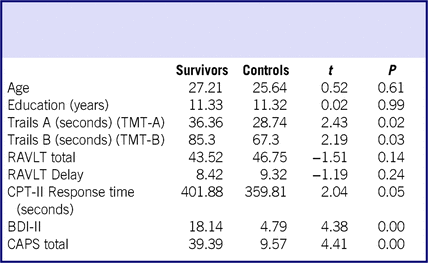
Participants included relocated Katrina survivors (N = 33; mean age = 27.2 +/- 12.6 years) and demographically matched controls (N = 28; mean age = 25.6 +/− 10.5). There were no statistically significant differences between survivors and controls in age, gender, and education, with 91% of survivors and 90% of controls of African American race (Table 1).
Demographics, Neuropsychological Test, and Affective Ratings

Relocated survivors scored significantly higher than controls on the CAPS (t [59] = 4.41, P = < 0.001), with survivors’ mean total of 39.39 falling above threshold severity level for PTSD (20–39 = subthreshold to threshold). Survivors also scored higher than controls on BDI-II assessments (t[59] = 4.40, P = < 0.001), with survivors’ mean total of 18.14 within the mild depression range of 14 to 19.
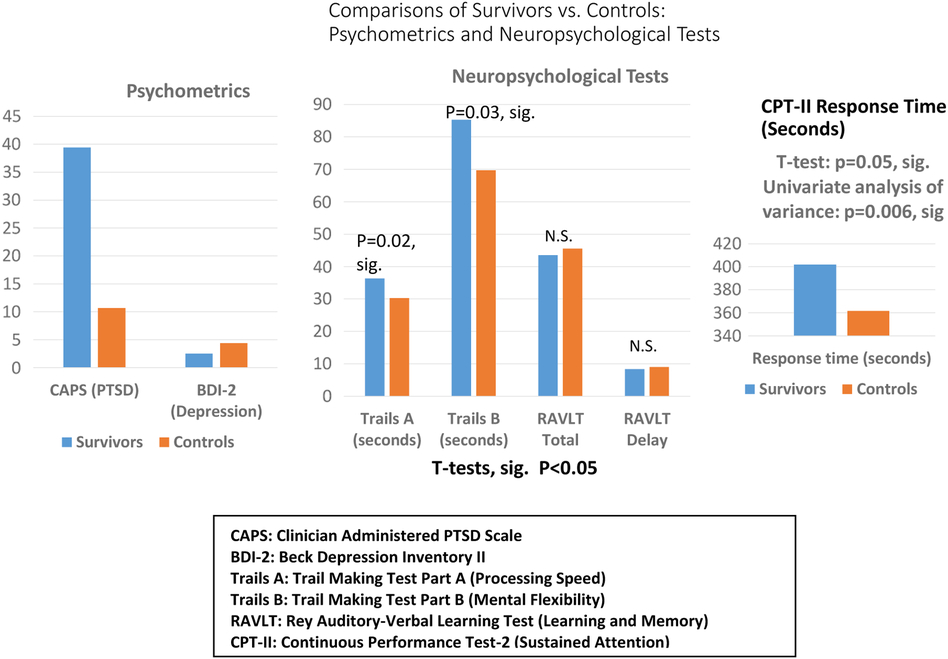
Relocated survivors scored statistically worse than controls on the TMT-A (t[58] = 2.43, P = 0.02), indicating disruption in cognitive processing speed. Survivors also performed worse on TMT-B (t[58] = 2.19, P = 0.03), indicating impaired mental flexibility (Figure 1).
Affective and Neuropsychological Tests: Survivors vs. Controls.

The CPT-II response time was significantly slower for relocated survivors than controls (t[58] = 2.04, P = 0.05), indicating decreased attention relative to the control group. Univariate ANCOVA of each neurocognitive assessment, while controlling for the effects of depression and PTSD symptoms, revealed significant differences only for the CPT-II response time in relocated survivors relative to controls, F = 4.871, P = 0.006 (Figure 1).
No statistically significant group differences were found for performance on RAVLT concerning learning and memory.
DISCUSSION
This study adds to the scant literature identifying neurocognition after disaster exposure. Relocated Katrina survivors had more neurocognitive dysfunctions and psychiatric symptoms than controls, with poorer performance in processing speed (TMT-A), sustained attention and overall mental flexibility (TMT-B), short-term memory and attention (CPT-II), and higher scores on measures of PTSD and depression.
These cognitive problems impair higher level processing and could indicate the presence of untreated or partially treated PTSD or depression. When controlling for depression and PTSD symptoms (ANCOVA), only CPT-II response time remained significantly different for survivors compared to controls, independent of emotional symptoms. Thus, survivors’ TMT-A and TMT-B deficits may be due to PTSD and depression symptoms. Survivors’ mean CAPS PTSD scores and BDI-II depression symptoms both were at mild illness levels.
Our study adds to previous investigations finding decreased concentration and recall related to both diagnosed PTSDReference Yehuda, Keefe, Harvey and Levengood5,Reference Vasterling, Brailey, Constans and Sutker6 and attention deficits related to depression and anxiety symptom levels.Reference Helton and Head7 Other studies have also documented deficits in declarative and explicit memory in PTSD from combat and other sources of trauma.Reference Yehuda, Keefe, Harvey and Levengood5,Reference Gil, Calev and Greenberg9,Reference Bremner, Scott and Delaney10 In addition, LaGarde’s investigation showed problems with high-level attention, executive function, and working memory in individuals with PTSD but no deficits in traumatized persons without PTSD.Reference LaGarde, Doyon and Brunet4 Blanchette’s study showed lower working memory in trauma survivors than controls, independent of posttraumatic stress symptoms, suggesting that trauma exposure alone is associated with cognitive problems.Reference Blanchette and Caparos8
Our study had mixed results in identifying cognitive deficits related to psychopathology. Exposure to the hurricane and relocation was sufficient to lead to cognitive functioning problems independent of emotional symptoms for CPT-II, indicating impulsivity and deficits in short-term memory. Two other higher level cognitive assessments showed deficits in survivors compared to controls, which may have been affected by PTSD symptoms and/or depression – TMT-A, assessing processing speed, and TMT-B, evaluating mental flexibility. Thus, our finding suggests that cognitive deficits should be assessed informally in a disaster community in both disaster survivors with clinically elevated symptoms of PTSD and depression, as well as in those exposed to disaster regardless of their emotional symptoms. Individuals identified as having problems could then be referred for a more formal assessment. It is not clear in the literature or in our study whether cognitive problems developed immediately after disaster exposure or whether they were transient or persistent. Our survivors had deficits present 1 year after Katrina, although onset and duration beyond that time were not determined. This is an area needing further exploration.
Among limitations of this study are the relatively small sample size, the fact that formal psychiatric diagnoses were not assessed, and the elimination of individuals with unstable medical conditions, active substance disorders, or medications affecting cognitive assessments. These could affect generalizability of the study. Also, because our participants were mostly African American, it is not known how this might have affected generalizability of our findings. Similar studies were not found comparing African American individuals from lower socioeconomic status (SES) groups with those of other racial/ethnic backgrounds or higher SES levels.
CONCLUSION
Although the results of this study are based on a small convenience sample of relocated Katrina survivors, the outcomes support existing studies and theories, as discussed earlier, regarding the impact of trauma and disaster exposure on simple, as well as complex cognitive functioning. These results might also have general implications for disaster recovery efforts. Survivors with cognitive deficits may have difficulty processing safety instructions and in accessing health and mental health care, housing, food, and needed supplies throughout recovery. Furthermore, relocation far from home after a community disaster adds an additional strain of removing survivors from familiar surroundings, social support, and formal disaster response agencies. Survivors may benefit from interventions specifically aimed at enhancing cognitive functions, as well as more traditional mental health and medical treatments, and these interventions should be available for extended periods of time for highly impacted survivors. The development of a brief assessment tool would be helpful to gauge general cognitive levels. Integrating this information into what is already known about trauma exposure and the resulting changes in autonomic, neuroendocrine, and immunological systems can also promote a more comprehensive and holistic approach to assisting disaster survivors in both the immediate aftermath and long after exposure.
Conflict of Interest Statement
The authors have no conflicts of interest.