

Introduction
Post-traumatic stress disorder (PTSD, Bremner & Marmar, Reference Bremner and Marmar1998) is an anxiety disorder following the experience of terrifying, life-threatening events (DSM-IV). A cognitive hallmark of PTSD is memory problems, manifesting both as reduced ability to recall learned material on explicit tests and as involuntary re-experiencing of the traumatic event(s) as intrusive thoughts, flashbacks and nightmares (for review, see McNally, Reference McNally2006). Essentially, PTSD patients have trouble remembering what they are supposed to remember and forgetting what they would rather not remember. They appear to have impaired memory control.
Memory control can be examined with paradigms testing automatic or intentional mechanisms. Examples of the former are part-list cueing (Roediger, Reference Roediger1973) or retrieval-induced forgetting (Anderson et al. Reference Anderson, Bjork and Bjork1994), whereas the think/no-think (Anderson & Green, Reference Anderson and Green2001) and the presently used directed forgetting (DF) paradigms (see Basden & Basden, Reference Basden, Basden, Golding and MacLeod1998) assess intentional processes. Two different variants of DF exist. In the list method, participants study two lists of stimuli and the instruction to forget or to remember follows after list 1. In the item method, each item is directly followed by a memory cue, either a ‘remember’ cue or a ‘forget’ cue. Later, memory is tested for all items, regardless of their initial instruction. In both paradigms a ‘DF effect’, better memory for ‘to-be-remembered’ than for ‘to-be-forgotten’ items, is typically found. In the list method, the effect occurs only in free recall, but in the item method it is apparent both in recall and recognition (Basden & Basden, Reference Basden and Basden1996). List method DF is traditionally attributed to retrieval inhibition occurring at recall and being released by re-exposure eliminating the effect on recognition tests. Item method DF was originally designed to study repression (Weiner & Reed, Reference Weiner and Reed1969), likewise suggesting a retrieval-based effect, but has been subsequently attributed primarily to selective rehearsal of ‘to-be-remembered’ items (Basden & Basden, Reference Basden, Basden, Golding and MacLeod1998). The paradigm requires items to be held in working memory until the cue appears, upon which they are segregated into ‘remember’ items that have to be further rehearsed and ‘forget’ items. By some accounts ‘forget’ items are not further processed at all, but recent evidence indicates that they are likewise subject to active processing (Fawcett & Taylor, Reference Fawcett and Taylor2008). Perhaps in line with the original ‘repression’ concept, neuroscientific studies suggest some of this active processing of ‘forget’ items to be inhibitory (Paz-Caballero et al. Reference Paz-Caballero, Menor and Jimenez2004; Wylie et al. Reference Wylie, Foxe and Taylor2008; Hauswald et al. Reference Hauswald, Schulz, Iordanov and Kissler2011). Thus, theoretically, item method DF provides a means to assess an individual's ability to segregate and selectively encode experimental material. Potentially, it also provides a measure of inhibitory capacities (e.g. Cottencin et al. Reference Cottencin, Vaiva, Huron, Devos, Ducrocq, Jouvent, Goudemand and Thomas2006). Because both learning and inhibitory functions are compromised in PTSD (for an overview, see Aupperle et al. Reference Aupperle, Melrose, Stein and Paulus2011), the paradigm is well suited to examine memory control following trauma (for review, see Geraerts & McNally, Reference Geraerts and McNally2008).
However, only three studies have investigated item method DF in clinical PTSD. McNally et al. (Reference McNally, Metzger, Lasko, Clancy and Pitman1998) examined DF of trauma-related, positive and neutral words in 14 women with PTSD due to childhood sexual abuse, 12 women with traumatic events but without PTSD and 12 women without traumatic experiences. The material was selected on the basis of the experimenters' experience with PTSD patients and the patients' medication status is not reported. DF was found across groups, reflected in overall superior recall of ‘remember’ compared with ‘forget’ words. However, in PTSD the effect was carried by trauma-related words, owing to recall rates close to floor for positive and neutral material, indicating normal recall of trauma-related words in PTSD and memory deficits for neutral or positive contents. PTSD participants benefited from ostensibly emotionally significant material, resulting in intact memory control in terms of selective rehearsal for trauma-related material, but not for other materials.
Zoellner et al. (Reference Zoellner, Sacks and Foa2003) studied item method DF of threat-related, positive and neutral words following induction of serenity or dissociative states in 28 women with PTSD and 28 controls. PTSD patients had worse memory performance than the control group and, in both groups, threat-related words were recalled better, but without emotional modulation of the DF effect itself. However, DF was modified by the dissociation induction, which eliminated the DF effect in both PTSD and the comparison group. Although showing an influence of psychological state, the data do not reveal the basic pattern of DF in PTSD.
Extant results suggest that material, psychological state and clinical diagnosis can influence DF in trauma victims. A more basic question, namely, whether traumatized individuals with or without PTSD are generally able to intentionally control their memory and whether they are able to differentially process neutral items at all, showing DF for this type of material, is somewhat obscured in the above studies. Zoellner et al.'s results indicate DF effects across different materials and groups, at least under serenity conditions, whereas McNally et al.'s data suggest DF for neutral material in controls, but not in PTSD. Cottencin et al. (Reference Cottencin, Vaiva, Huron, Devos, Ducrocq, Jouvent, Goudemand and Thomas2006) examined basic item-wise DF capacities for neutral words in 30 PTSD patients with various types of traumata and 30 sociodemographically matched unexposed healthy controls. PTSD patients were on various types of psychoactive medications, mostly antidepressants. Patients had generally reduced recall levels and, importantly, a reduced DF effect, that is, a smaller recall difference between ‘remember’ and ‘forget’ words. Following an inhibitory account of item method DF, results were attributed to compromised inhibitory functions in PTSD, but are equally compatible with impaired selective encoding, resulting from an inability to segregate forget and remember items and/or from an inability to selectively rehearse items. Results suggest basic deficiencies in intentional memory use in PTSD. These may be a consequence of exposure to traumatic stress in general or specific to PTSD diagnosis.
Extending these data, the present study investigates item method DF for neutral material in severely traumatized, unmedicated people with and without PTSD. Participants were identified in internally displaced persons (IDP) camps in Northern Uganda, where exposure to traumatic stress and PTSD prevalence is high (Karunakara et al. Reference Karunakara, Neuner, Schauer, Singh, Hill, Elbert and Burnham2004; Ertl et al. Reference Ertl, Pfeiffer, Saile, Schauer, Elbert and Neuner2010). Studies in populations where exposure to multiple traumatizing events is common afford investigation of unmedicated, never-treated people with PTSD allowing for comparison of DF between trauma-exposed individuals with PTSD and without PTSD in relatively large, demographically homogeneous groups, exposed to multiple, severe and similar types of traumata. We used a previously established, language-free DF design with pictorial stimuli and a recognition task (see also Hauswald & Kissler, Reference Hauswald and Kissler2008; Hauswald et al. Reference Hauswald, Schulz, Iordanov and Kissler2011; Nowicka et al. Reference Nowicka, Marchewka, Jednoróg, Tacikowski and Brechmann2010; Quinlan et al. Reference Quinlan, Taylor and Fawcett2010; Zwissler et al. Reference Zwissler, Koessler, Engler, Schedlowski and Kissler2011), in which old pictures are randomly mixed with thematically similar, individually paired new distracters for recognition testing. This accounts for very variable literacy levels in the studied population. Moreover, pictorial material is theoretically well suited to study memory disturbance in PTSD. An overactive and unintegrated, primarily visual, sensory memory is a hallmark of memory dysfunction in PTSD (Dalgleish et al. Reference Dalgleish, Hauer and Kuyken2008). Thus, pictorial material may tap into a core aspect of memory (dys-)function and memory control problems following psychological trauma. Moreover, pictures are generally better remembered than verbal material (‘picture superiority effect’, e.g. Shepard, Reference Shepard1967) preventing floor effects on memory performance in patient groups.
Finally, the presently used ‘old–new’ recognition test allows for comparison of false alarms (i.e. ‘old’ responses to lures) between people with and without PTSD and permits assessment of DF effects on false alarm patterns. PTSD patients are prone to ‘false memories’, intrusions of semantically similar, but never presented items on recall tests (Zoellner et al. Reference Zoellner, Foa, Brigidi and Przeworski2000) or ‘false alarms’ to distracters on recognition tests (Bremner et al. Reference Bremner, Krause, Shobe and Kihlstrom2000; Clancy et al. Reference Clancy, Schacter, McNally and Pitman2000). Therefore, people with PTSD may exhibit more false alarms in a DF task and the effect of the different instructions is of particular interest. Normally, more elaborate encoding following the ‘remember’ instruction should improve memory, reducing false alarms at test, whereas the ‘forget’ instruction should result in less detailed encoding, leading to more false alarms. Participants with PTSD may encode fewer details, resulting in more false alarms because of learning difficulties (Bremner, Reference Bremner2006; McNally, Reference McNally2006) or faulty source monitoring (Zoellner et al. Reference Zoellner, Foa, Brigidi and Przeworski2000). More false alarms should be primarily evident in the remember condition that should normally induce more elaborate encoding.
In line with Cottencin et al., we used relatively neutral pictures addressing the question of basic DF patterns following psychological trauma. Previous studies showed that DF of negative pictures requires more efforts than DF of neutral ones (Nowicka et al. Reference Nowicka, Marchewka, Jednoróg, Tacikowski and Brechmann2010) and that highly emotional pictures eliminate DF already in healthy individuals (Hauswald et al. Reference Hauswald, Schulz, Iordanov and Kissler2011; Zwissler et al. Reference Zwissler, Koessler, Engler, Schedlowski and Kissler2011), leaving little room for additional effects of PTSD. Because traumatization and PTSD can alter the emotional evaluation of stimuli (e.g. Adenauer et al. Reference Adenauer, Pinösch, Catani, Gola, Keil, Kissler and Neuner2010) and since emotional stimuli have been shown to affect DF in both healthy individuals (Hauswald et al. Reference Hauswald, Schulz, Iordanov and Kissler2011; Zwissler et al. Reference Zwissler, Koessler, Engler, Schedlowski and Kissler2011) and PTSD (McNally et al. Reference McNally, Metzger, Lasko, Clancy and Pitman1998), post-experimental content ratings are obtained to assess the relationship between stimulus perception and DF in the present population.
In sum, we aim to further specify the effects of traumatization on memory control in item method DF. Using a picture-recognition task, DF is examined in an unmedicated and never-treated sample of Ugandan civil war victims with and without PTSD. The effects of trauma versus PTSD on true and false recognition in item method DF are assessed and the influence of the material's emotional content on DF is tested.
Method
Participants and diagnostic screening
Altogether, 51 teenagers or young adults (age range: 16–30, mean age=20.78 years; 14 males) from two IDP camps near the town of Gulu in Northern Uganda took part in the experiment. Participants had been clinically diagnosed in a large epidemiological study on mental health and organized violence (for details, see Ertl et al. Reference Ertl, Pfeiffer, Saile, Schauer, Elbert and Neuner2010), which used a similar approach as a previous study of an IDP camp in Southern Uganda (Onyut et al. Reference Onyut, Neuner, Schauer, Ertl, Odenwald, Schauer and Elbert2004).
Ertl et al. (Reference Ertl, Pfeiffer, Saile, Schauer, Elbert and Neuner2010) assessed the mental health status of >1100 randomly selected youths and adults in Northern Ugandan with the help of trained local interviewers. Luo (the language in northern Uganda) versions of diagnostic instruments were created using a translation and blind back-translation procedure. Interviewer assessments were cross-validated with clinical expert diagnoses. In total, 82% of PTSD cases identified by clinical experts were recognized in the Luo Posttraumatic Diagnostic Scale (PDS; English version: Foa et al. Reference Foa, Cashman, Jaycox and Perry1997) screening by trained interviewers (sensitivity). Agreement on non-cases reached 76% (specificity). Overall efficiency of the PDS was 0.78, indicating that judgement according to the Luo PDS was in accordance with expert ratings, with a probability of 78%. The findings suggest that the Luo version of the PDS performed well in diagnosing PTSD and that judgements of local screeners trained in concepts of mental health were in accordance with the ratings of clinical psychologists familiar with the local culture.
Almost half (46.8%) of the young people interviewed had been abducted by the Lord's Resistance Army at least once in their lives, with abduction durations ranging from several hours up to >10 years (mean=5.32 months). From the diagnosed sample, we identified two groups that differed in their symptoms on the PDS but not in the kinds of traumatic experiences they had had. The PTSD group (n=26) had a mean score of 19.64 on the PDS (range 15–29, 15 being the cut-off for a PTSD diagnosis, see Foa et al. Reference Foa, Cashman, Jaycox and Perry1997; Rauch et al. Reference Rauch, Defever, Favorite, Duroe, Garrity, Martis and Liberzon2009) and the non-PTSD group (n=25) had no PTSD symptoms. The groups had experienced a similar number of traumatic events (meanPTSD=20.96 versus meannon-PTSD=16.96, difference n.s.). Participants had similar education levels with 2 years of formal schooling at some point in their lives; the groups did not differ in terms of age (meanPTSD=20.76 years versus meannon-PTSD=20.80 years, difference n.s.) and gender (both groups contained seven males). No participant was taking psycho-active medication. During the experiment, which took place in the participants' huts, a trained local interpreter translated instructions and responses. Participants provided informed consent and received a payment of 3000 Ugandan Shillings (~US$1.80).
Stimuli, design, and procedure
Because of theoretical considerations (see above) and since many of the patients were functionally illiterate, a previously established pictorial design was chosen (see also Hauswald & Kissler, Reference Hauswald and Kissler2008; Hauswald et al. Reference Hauswald, Schulz, Iordanov and Kissler2011; Nowicka et al. Reference Nowicka, Marchewka, Jednoróg, Tacikowski and Brechmann2010; Quinlan et al. Reference Quinlan, Taylor and Fawcett2010; Zwissler et al. Reference Zwissler, Koessler, Engler, Schedlowski and Kissler2011). Altogether, 56 complex colour photographs depicting scenes familiar to Ugandans were used as stimuli. The pictures showed social scenes, landscapes or food items (see Fig. 1 for examples). Two paired sets (set A and set B) of 28 pictures were created. Pictures from set A were presented in random order during learning. During recognition, pictures from both sets were presented in random order, pictures from set B serving as related lures. Picture-set assignment for the two members of each pair was counterbalanced. During learning, the photographs were shown for 3 s each. Each picture was followed by a symbol for the ‘forget’ (green circle) or the ‘remember’ (red triangle) instruction shown for 2 s. A new picture followed 2 s later. After learning, participants solved ‘Tangram’ puzzles for 3 min, arranging different geometric forms to fit a given outline. Finally, an old–new recognition test on a random sequence of the 28 old and 28 new pictures was administered. Each picture was presented individually for 3 s and participants had to indicate whether they had seen it before. Participants were explicitly reminded to base their decision on whether a picture had ever been presented before, not on the instruction it had been associated with. It was pointed out that the new pictures would be quite similar to old pictures and that they needed to pay careful attention to details. To further verify that instructions were understood, participants were asked to repeat the instructions in their own words. Moreover, for the first three pictures of the recognition test, participants were asked to explain how they had reached their decision.
Illustration of the picture sets showing three representative target-distractor pairs: (a) set A; (b) Set B. (Original photographs were shown in colour.)

Participants' emotional reactions to the pictures were assessed in a post-experimental rating. The experimenter re-presented each picture and asked the participant to rate it regarding arousal and valence using a 5-point scale. The concepts of arousal and valence were explained using examples from the immediate environment and then clarified by asking the participant to illustrate using a new example. Participants were asked to explain each individual rating such that the whole procedure took about 90 min. Post-experimental ratings could only be obtained from 27 participants (n PTSD=15, n non-PTSD=12).
Results
Picture arousal and valence
Overall, and as intended, the pictures were rated as relatively neutral (mean=3.20, s.e.=0.08) and unarousing (mean=2.92, s.e.=0.10), the two paired subsets (A and B) not differing in valence [t(27)=−0.057; p=0.96] or arousal [t(27)=1.184; p=0.25]. However, PTSD participants rated the entire picture set as more arousing [t(25)=2.23, p<0.05] than non-PTSD participants. There was no group difference in valence ratings [t(25)=−0.90, p=0.38].
Directed forgetting
Hits and false alarms
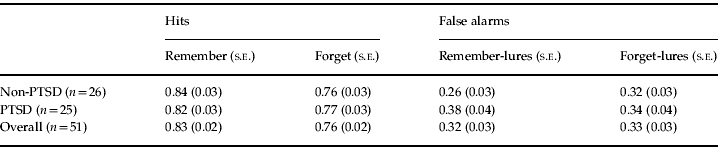
Table 1 presents mean hit and false alarm rates in the ‘remember’ and ‘forget’ conditions, separately for the two groups. Overall, an interaction of group×instruction×response type [F(1, 49)=6.17, p<0.05] was found.
Mean hit and false alarm rates in the ‘remember’ and ‘forget’ conditions, separately for the two groups as well as across the entire sample

PTSD, Post-traumatic stress disorder.
Further analyses showed that in the non-PTSD group, the instructions influenced hit and false alarm rate for ‘forget’ compared with ‘remember’ items [instruction×response type: F(1, 24)=15.68, p<0.001]. Hit rate was lower for ‘forget’ than for ‘remember’ items [t(24)=−3.75, p<0.001], whereas false alarms were lower for ‘remember’ than for ‘forget’ items [t(24)=− 2.25, p<0.05].
In the PTSD group, by contrast, the instruction influenced neither hits nor false alarms [instruction×response type: F(1, 25)=0.004, p=0.95]. DF reduced neither hits following the forget instruction [t(25)=−1.78, p=0.09] nor false alarms to ‘remember’ versus ‘forget’ lures [t(25)=−1.44, p=0.16]. A targeted between-group comparison revealed a higher false alarm rate in response to the ‘remember’ lures in the PTSD group [t(49)=2.12, p<0.05].
Discrimination accuracy and response bias
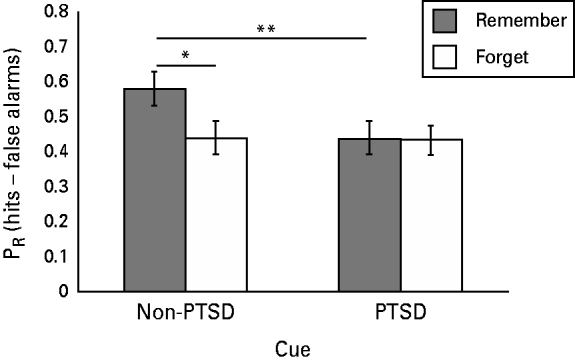
Following Snodgrass & Corwin's (Reference Snodgrass and Corwin1988) two-high-threshold model, discrimination accuracy (P r=hits−false alarms) and response bias [B r=false alarms/(1−P r)] were analysed from the data, simultaneously taking into account hits and false alarms and resulting in a bias-free measure of DF. The resulting response pattern is depicted in Fig. 2 and basically confirms the above results. A group (non-PTSD, PTSD)×cue (remember, forget) analysis of variance confirmed that, whereas the PTSD group showed no DF, the control group clearly did [F(1, 49)=6.17, p<0.05]. The control group was better at recognizing ‘remember items’ than ‘forget items’ [t(24)=−3.96, p<0.001], indicating a DF effect. By contrast, the PTSD group showed equal recognition accuracy for remember-pictures and forget-pictures [t(25)=0.07, p=0.95] and, moreover, significantly lower recognition accuracy for remember-pictures compared with the non-PTSD group [t(49)=2.07, p<0.05]. Groups did not differ in recognition bias B r [F(1, 48)=0.79; p=0.38].
A comparison of the effect of directed forgetting on discrimination accuracy in the two groups. PTSD, post-traumatic stress disorder. *Indicates significant differences.

Correlation analysis
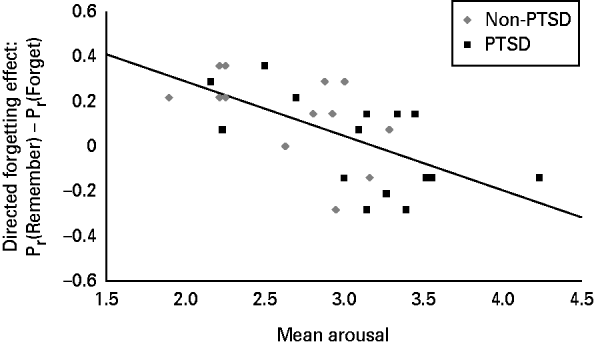
Fig. 3 shows the correlation between the DF effect, measured as the difference between recognition accuracy P r for ‘remember’ minus ‘forget’ items and mean arousal ratings across all participants from whom ratings were obtained [Spearman's r(25)=−0.62, p<0.01]. The effect was similar for the PTSD [r(13)=−0.63, p<0.05] and the non-PTSD group [r(10)=−0.60, p<0.05]. Entering the DF effect as the difference in hit rates into the analysis yielded almost identical results. No statistical relationship between valence and DF was found, neither in the whole group [r(25)=−0.12, n.s.] nor for PTSD [r(13)=−0.23, n.s.] or non-PTSD [r(10)=−0.07, n.s.] individually.
Scatterplot illustrating the relationship between mean arousal ratings for the entire picture set and directed forgetting performance for the post-traumatic stress disorder (PTSD) and the non-PTSD groups.

Discussion
Item method DF of complex pictures was investigated in an African crisis region, where exposure to traumatic events is sadly common and PTSD prevalence is high. DF patterns differed depending on diagnosis, with no DF in the PTSD group, but intact DF in the non-PTSD group, indicating a diagnosis-related dysfunction in trauma victims' ability to intentionally control their memories. Participants with PTSD rated the stimuli as more arousing; arousal ratings being, across the full sample, inversely correlated with DF, implying that perceived emotional content modulates DF, contributing to the dysfunction found in PTSD. Finally, in PTSD the ‘remember’ instruction did not reduce false alarms, whereas it did in the non-PTSD group.
An already established pictorial design (Hauswald & Kissler, Reference Hauswald and Kissler2008; Hauswald et al. Reference Hauswald, Schulz, Iordanov and Kissler2011; Nowicka et al. Reference Nowicka, Marchewka, Jednoróg, Tacikowski and Brechmann2010; Quinlan et al. Reference Quinlan, Taylor and Fawcett2010; Zwissler et al. Reference Zwissler, Koessler, Engler, Schedlowski and Kissler2011) was chosen because of the high number of illiterate people in the region. Also, due to the picture superiority effect, overall memory performance is better, reducing the problem of floor effects in potentially memory-impaired populations. Moreover, picture stimuli may tap more directly into the basic cognitive (dys-)functions in PTSD, which is characterized by hardly controllable sensory recollections (Ehlers et al. Reference Ehlers, Hackmann, Steil, Clohessy, Wenninger and Winter2002).
All participants in the present sample had experienced multiple traumatic events, with no significant difference between the non-PTSD and the PTSD groups. However, groups differed in DF. As expected, in the non-PTSD group the forget instruction reduced the number of correctly recognized items, both in terms of hit rate and recognition accuracy. By contrast, no DF was observed in the PTSD group. Although this was true for hit rates alone, it became even more evident on recognition accuracy, taking false alarms into account, because the ‘remember’ instruction reduced false alarms in the non-PTSD but not in the PTSD group. The present data indicate that severely and multiply traumatized unmedicated and never-treated people with a PTSD diagnosis are characterized by a lack of DF, which is in line with Cottencin et al.'s (Reference Cottencin, Vaiva, Huron, Devos, Ducrocq, Jouvent, Goudemand and Thomas2006) observation in a medicated sample using word stimuli and immediate and delayed free-recall testing. Going beyond Cottencin's findings, the data demonstrate that this problem is associated with PTSD itself rather than general to traumatization.
Our data also provide evidence for a role of emotional stimulus perception in the modulation of item method DF, with less DF in individuals who rated the stimuli as more arousing, PTSD participants giving, on average, higher arousal ratings. More intense evaluation of emotional pictures in PTSD has also been reported by Adenauer et al. (Reference Adenauer, Pinösch, Catani, Gola, Keil, Kissler and Neuner2010) and Hayes et al. (Reference Hayes, LaBar, McCarthy, Selgrade, Nasser, Dolcos and Morey2011) . The general finding that emotional significance modulates DF is in line with previous research, but the reported patterns vary. A reduction of DF for emotional stimuli corresponds with other findings using the present design in student participants (Hauswald et al. Reference Hauswald, Schulz, Iordanov and Kissler2011; Nowicka et al. Reference Nowicka, Marchewka, Jednoróg, Tacikowski and Brechmann2010; Zwissler et al. Reference Zwissler, Koessler, Engler, Schedlowski and Kissler2011). Combined evidence from the present and previous data suggests that incidental encoding of emotionally arousing stimuli during picture presentation, before the cue is shown, contributes to a lack of DF for more arousing stimuli in this paradigm (Hauswald et al. Reference Hauswald, Schulz, Iordanov and Kissler2011).
DF research using word stimuli and free recall testing found different patterns, differences in test difficulty between free recall and recognition tests, potentially accounting for some of the discrepancies. McNally et al. (Reference McNally, Metzger, Lasko, Clancy and Pitman1998) report DF in PTSD solely for emotionally negative words, whereas control groups showed DF across negative, positive and neutral words. PTSD patients also showed markedly reduced overall recall rates, indicative of considerable memory impairment (McNally et al. Reference McNally, Metzger, Lasko, Clancy and Pitman1998), resulting from a memory advantage for negative material in PTSD patients' free recall and impaired memory for other stimuli. Zoellner et al. (Reference Zoellner, Sacks and Foa2003) found no evidence for emotional modulation of the DF effect itself, but their dissociation induction eliminated DF in both PTSD and the comparison group. Regarding dissociation-proneness, the results are compatible with data from a picture-recognition design, where students with higher dissociation scores showed smaller DF effects (Hauswald & Kissler, Reference Hauswald and Kissler2008).
Much previous debate about trauma and DF surrounded the roles of ‘avoidant’ versus ‘intrusive’ encoding styles. Forgotten trauma memories are sometimes reported to be recovered during therapy, leading to the idea that at least a subgroup of trauma victims exhibits an ‘avoidant encoding style’, a reduction/defence in the processing of self-relevant, threatening information. The opposing view holds that trauma victims generally encode and remember negative emotional information all too well, exhibiting ‘intrusive encoding’. ‘Avoidant encoding’ was conceptualized as an adaptive reaction, especially to childhood sexual abuse, where the dependence on the abuser creates the necessity to dissociate oneself from particular events. It is assumed to occur more frequently in people with high dissociative symptoms. DF variants were used to test these concepts and studies examined mostly undergraduates, psychometrically defined as high and low dissociators (e.g. DePrince & Freyd, Reference DePrince and Freyd1999, Reference DePrince and Freyd2001). Due to differences in design and participant selection, the present data do not speak directly to these issues. However, assuming that ‘avoidant encoding’ is restricted to trauma-related stimuli, these would be expected to be more arousing than neutral stimuli. The present data indicate reduced DF with increasing stimulus arousal in traumatized individuals, ostensibly more compatible with ‘intrusive’ processing, perhaps due to intrusive encoding already in the pre-cue interval. However, mechanisms of avoidant encoding might be operational in selected subgroups (DePrince & Freyd, Reference DePrince and Freyd2001, Reference DePrince and Freyd2004), such as high dissociators with acute stress disorder (Moulds & Bryant, Reference Moulds and Bryant2002), under conditions of divided attention that may facilitate disengagement from emotional stimuli (DePrince & Freyd, Reference DePrince and Freyd1999, Reference DePrince and Freyd2004; but see McNally et al. Reference McNally, Ristuccia and Perlman2005) or in subgroups selected specifically for prominent avoidance symptoms.
In the present data, higher false alarm rates for ‘remember-related’ lures contribute to PTSD patients' lack of DF. In the non-PTSD group, false alarms were reduced by the ‘remember’ cue, presumably because pictures were then encoded in greater detail, which was not the case in the PTSD group. Recent neuroimaging results on the mechanisms of item method DF in word- or picture-recognition tasks (Wylie et al. Reference Wylie, Foxe and Taylor2008; Nowicka et al. Reference Nowicka, Marchewka, Jednoróg, Tacikowski and Brechmann2010) indicate that both medio-temporal lobe-based selective rehearsal of remember items and additional frontal control processes in response to the forget instruction contribute to the item method DF effect in healthy people. Based on the present data, it appears that the deviations seen in the PTSD group are largely due to more global encoding of ‘remember’ items, perhaps exacerbated by faulty source monitoring. Indeed, a recent functional magnetic resonance imaging study compared brain activity during picture encoding in US army veterans with and without PTSD (Hayes et al. Reference Hayes, LaBar, McCarthy, Selgrade, Nasser, Dolcos and Morey2011) and found a higher false alarm rate in the veterans with PTSD accompanied by reduced medial temporal lobe activity.
Faulty source monitoring (Zoellner et al. Reference Zoellner, Foa, Brigidi and Przeworski2000) and reduced inhibitory functioning (Gilboa et al. Reference Gilboa, Shalev, Laor, Lester, Louzoun, Chisin and Bonne2004) due to frontal lobe dysfunction may also contribute to higher false alarm rates in PTSD. Specifically, compromised frontal inhibition of memory traces similar to a specified cue may play a role (Schnyder et al. Reference Schnyder, Treyer and Buck2000). Because the problem is more evident for remember-related lures, less efficient learning appears to have a larger impact. Recent indication of more false alarms in recognition memory for arousing stimuli (Corson & Verrier, Reference Corson and Verrier2007) suggests that altered arousal in PTSD may exacerbate this pattern.
Since present data demonstrate that reduced DF is primarily a feature of full-blown PTSD and not a general consequence of exposure to extreme stress, pre-disposing factors may play an important role. For instance, recently a genetic variant of an adrenergic receptor was identified, which contributes to better emotional memory in healthy Europeans, but is also associated with more intrusions in Ugandans with PTSD (DeQuervain et al. Reference DeQuervain, Kolassa, Ertl, Onyut, Neuner, Elbert and Papassotiropoulos2007). Similarly, a pre-existing reduction in hippocampal volume has been shown to pre-dispose for the development of PTSD (Gilbertson et al. Reference Gilbertson, Shenton, Ciszewski, Kasai, Lasko, Orr and Pitman2002). Hippocampal volume reductions are also related to learning difficulties in PTSD, which are evident in the present and other studies.
In conclusion, the present results demonstrate intact item method DF in a population without PTSD that was exposed to severe traumata and a lack of item method DF in traumatized people with an additional PTSD diagnosis. In PTSD, more false alarms occurred, likely due to more global encoding strategies. DF was inversely related to arousal ratings, which were higher in the PTSD group. Thus, altered stimulus arousal contributes to the PTSD group's lack of DF. This, together with recent findings of a genetic association between intrusive symptoms following traumatic stress and adrenergic receptor sensitivity, suggests that some of the mnemonic dysfunctions in PTSD might be ameliorated if stimulus-related arousal levels were reduced, perhaps by means of arousal-dampening β-adrenergic blockade (Taylor & Cahill, Reference Taylor and Cahill2002) or appropriate psychotherapeutic intervention, which includes an ultimately arousal reducing exposition and habituation component (e.g. Neuner et al. Reference Neuner, Schauer, Klaschik, Karunakara and Elbert2004). Finally, data provide evidence for the successful cross-cultural applicability of experimental designs in PTSD research.
Acknowledgements
We thank Esther, Lawrence, Tony and Herbert Tumusiime for invaluable support in Gulu, Uganda. We also thank Gregory A. Miller and two anonymous reviewers for helpful comments on a previous version of this manuscript and Birke Lingenfelder for her help with data collection. Research was supported by the German Research Foundation (DFG KI1286–1).
Declaration of Interest
None.