

1. Introduction
The growth of foreign direct investment (FDI) constitutes one of the primary aspects of postwar economic globalization. While many consider FDI economically beneficial, governments in advanced industrial democracies maintain various policies and regulations that limit FDI flows into their economies. Broadly speaking, these FDI restrictions take two forms. First, governments set up barriers to the entrance of foreign capital at the border through capital account restrictions and mandatory screening and approval procedures of investment projects. Second, governments impose post-entry regulations and restrictions on foreign-invested firms, targeting these firms’ ownership structure, production and operations. The first form of restrictions is characterized as entry barriers, which concentrate effects in the pre-establishment stage of investment. The second form of restrictions is characterized as post-establishment restrictions, which constrain the operation of multinational corporations (MNCs) in the post-establishment phase.
While the existing literature has documented a series of mechanisms underlying evolving policies regulating FDI flows, the nuances in different forms of FDI restrictions have rarely been examined. In this article, we seek to provide an integrated political account for the two forms of FDI restrictions in advanced industrial democracies, focussing on the compound effect of left-leaning governments and labour unionization. We argue that while leftist governments are generally prone to liberalize entry barriers to FDI, they are also likely to tighten post-establishment restrictions on MNCs if labour unions’ membership coverage is high.
Our argument hinges on two main points. First, general labour and unionized labour hold different policy preferences regarding FDI regulation. Whereas generic interests of labour tend to be supportive of FDI liberalization, which is expected to broadly benefit the working class by increasing job opportunities and wages, unionized labour interests tend to prefer tightening FDI restrictions, fearing that the shocks that incoming MNCs can cause to the domestic labour market structure will erode union's wage-bargaining power. Second, left-leaning governments, facing the conflicting preferences for FDI policies from labour constituencies, are prompted to manipulate different types of FDI restrictions to strike a balance. Leftist governments tend to increase post-establishment restrictions on MNCs to cater to the protectionist demand from unionized interests, especially when these organizations make up a considerable proportion of the domestic labour force and exert significant political influence. Post-establishment restrictions on FDI are ideal instruments for protecting unionized interests, as they can be tailored to constrain the operation of MNCs and ameliorate the shocks of their global business model on the domestic labour market. At the same time, leftist governments seek to appeal to generic working-class voters more broadly by lowering entry barriers to FDI, as these restrictions occupy a more publicized position in the economic and ideological agenda of leftist governments.
To test our arguments, we conduct two sets of analysis. First, we conducted a time-series cross-national analysis of different forms of FDI restrictions at the country level, covering 25 Organisation of Economic Co-operation and Development (OECD) members from 2000 to 2014. We found post-establishment restrictions on FDI (that is, ownership and operational restrictions) became stricter when a leftist government was in power in countries where the level of labour unionization was relatively high. In contrast, entry barriers (that is, capital account restrictions and screening requirements) tended to decrease under leftist governments, and this association tended not to vary by the level of labour unionization. Second, we tested our argument at the sector level, making use of two types of sector-level data on FDI restrictions and labour unionization. The sector-level analysis better addressed methodological concerns stemming from unobserved heterogeneity and yields results consistent with the key finding in the country-level analysis.
Our article adds to the scholarship on the determinants of FDI policies in two respects. First, the existing studies on the political economic determinants of FDI restrictions tend to focus on one specific type of investment restriction at a time—for example, ownership restrictions (Pandya, Reference Pandya2014; Owen, Reference Owen2015), capital account measures (Pond, Reference Pond2018) or composite restrictions (Owen, Reference Owen2013). We refine the characterization of FDI restrictions by distinguishing entry barriers from post-establishment restrictions and by examining the heterogeneous mechanisms underlying them. Second, previous studies on the politics of FDI restrictions provide separate accounts that focus on either government partisanship (Pinto, Reference Pinto2013) or the political influence of unions (Owen, Reference Owen2013, Reference Owen2015). By focussing on different forms of FDI restrictions, we bring the two accounts into an integrated framework of FDI policies and unpack their compound impacts on the process of FDI policy formation.
The rest of this article is organized as follows: In sections 2 and 3, we discuss the logic underlying our theory about the conditional impact of government partisanship and labour unionization on FDI policies. In section 4, we discuss and present our research design and findings from country- and sector-level analyses. In section 5, we conclude by discussing broader implications of the research and extensions for future studies.
2. Capital Inflows, Labour Market Structure and Labour's FDI Preferences
While inflows of industrial capital are believed to bring economic and technological benefits, scholars of political economy have long noticed the distributional impact that inward FDI causes to the recipient country. The existing research largely characterizes the domestic distributional consequence of FDI inflows as a factoral divide. Domestic labour in advanced economies tends to benefit more from inward FDI than do domestic capital owners. From a factor-endowment point of view, inflows of capital as an abundant factor of production are expected to raise the marginal return to labour input in developed economies (Pinto, Reference Pinto2013; Pandya, Reference Pandya2014). Also, multinational corporations (MNCs) carrying out FDI activities pay, on average, higher wages to workers due to their higher productivity (Aitken et al., Reference Aitken, Harrison and Lipsey1996; Jensen and Rosas, Reference Jensen and Rosas2007; Martins, Reference Martins2011). These largely benign consequences of inward FDI for the general interests of labour underlie labour's support for FDI liberalization (Pandya, Reference Pandya2014; Pinto Reference Pinto2013). However, the impact of FDI on domestic capital owners is much less favourable, as it both lowers the marginal return to capital and exposes domestic firms to competition in domestic factor and commodity markets from more productive MNCs (Pandya, Reference Pandya2014; Pinto Reference Pinto2013).
It would be inaccurate, however, to characterize FDI as universally benefiting domestic labour in advanced economies. The structure of domestic labour markets varies among industrialized economies, and these variations shape the impact of inward FDI on labour's interests in nuanced ways. The most prominent aspect of labour market structure involves wage-setting and the role of organized labour. While inward FDI may be considered beneficial to individual workers in a decentralized wage-setting context, MNCs and the globalizing process of production have proven detrimental to the collective wage-setting interests of unionized labour. The differential impacts of inward FDI on the unionized and generic interests of labour underlie the nuanced structure of labour's preferences on FDI policy. Most importantly, the wage-bargaining power of labour unions vis-à-vis employers hinges on a coordinated and stable structure of a domestic labour market, which is vulnerable to shocks caused by production globalization. Cross-border flows of capital and goods have transformed domestic commodity and labour markets in ways that have weakened labour unions’ leverage in collective wage-bargaining. Various studies suggest that the deepening of the global production process since the 1970s, in the form of international trade and FDI, has led to steady decreases in unions’ influence and coverage in advanced economies (Dumont et al., Reference Dumont, Rayp and Willemé2006; Slaughter, Reference Slaughter2007; Vachon and Wallace, Reference Vachon and Wallace2013).
Inward FDI and the entrance of MNCs weaken labour unions’ power and compromise the unionized interests of labour in several ways. The entrance of MNCs into the domestic labour market increases the elasticity of labour demand, due to the MNCs’ highly flexible supply-chain arrangement and multi-sited production strategy (Scheve and Slaughter, Reference Scheve and Slaughter2004). A higher elasticity in labour demand enables MNCs to make more credible threats of relocating production, which greatly reduces labour unions’ wage-bargaining leverage (Choi, Reference Choi2001; Alvarez and Görg, Reference Alvarez and Görg2009). This globalized supply-and-production mode of MNCs shrinks the wage surplus that workers could obtain from unions’ bargaining leverage and has a negative impact on their membership cohesion (Dumont et al., Reference Dumont, Rayp and Willemé2006).
Labour unions’ influence is also reduced by changes in the mobility and wages of workers following the entrance of MNCs. The viability of labour unions relies on the concentration and low mobility of local workforces (Freeman, Reference Freeman1976). The growth of employment opportunities due to inward FDI renders workers more mobile. Also, when unions enjoy leverage in collective wage-bargaining, unionized workers can expect a sizable surplus in labour returns (Lee, Reference Lee1978; Svejnar, Reference Svejnar1986). As MNCs pay higher wages than their domestic counterparts (Brown et al., Reference Brown, Deardorff, Stern, Baldwin and Winters2004; Martins, Reference Martins2011), workers will find improvement of incomes through union membership less appealing. Moreover, since MNCs have different governance structures than domestic firms, and labour organizations find MNC governance structures more difficult to penetrate, unions have experienced substantial decreases in their wage-bargaining power and membership coverage (Vallas, Reference Vallas1999; Abraham et al., Reference Abraham, Konings and Vanormelingen2009). The influx of FDI and MNCs transforms the domestic labour market practices, curtailing unions’ influence and unionized labour's benefits.
Because of the pernicious consequences that inward FDI causes to labour unions and their members, unionized labour interests have expressed a protectionist preference on the issue of FDI restrictions and regulation (Owen, Reference Owen2013, Reference Owen2015). Identifying the globalized business model of MNCs as the key source of harm, labour unions, on behalf of their members, particularly oppose outright liberalization of regulatory restrictions on FDI (ITUC, 2008). This restrictive stance of unionized labour on FDI and MNCs stands in contrast to the more welcoming stance of the generic labour interests to FDI liberalization suggested by Pandya (Reference Pandya2014) and Pinto (Reference Pinto2013). This distinct composition of domestic labour's FDI preferences, which has been largely overlooked in the existing research, sets the foundation for our argument regarding the partisan dynamics of different types of FDI restrictions.
3. Government Partisanship, Political Influence of Unions and FDI Restrictions
3.1 Unionization and organized labour's influence on leftist governments
The distinct structure of domestic labour's preference over FDI policy shapes the political dynamics of FDI restrictions in important ways. Governments tend to adopt economic policies that are in line with their partisanship and ideological orientation (Bearce, Reference Bearce2003; Dutt and Mitra, Reference Dutt and Mitra2005). Existing studies on FDI policies suggest that leftist governments, with their pro-labour orientation, tend to take a more FDI-friendly stance than their rightist counterparts (Pinto, Reference Pinto2013). However, given domestic labour's non-monolithic preferences, as explicated above, leftist governments’ policy stance on FDI is, in fact, more variable and complex. On the one hand, the pro-working-class ideology of leftist governments prompts them to prioritize policies that encourage inflows of industrial capital and advance the general interests of their labour constituents; on the other hand, unionized labour demands tighter restrictions and regulations on inbound MNCs that compromise labour's collective and organizational interests.
These conflicting preferences within domestic labour cause the stance of leftist governments on FDI to be more variable than that of their ideological counterparts on the right. Leftist governments' stance on FDI policy is shaped jointly by labour unionization and the unionized interests' FDI preference. Although unions are formed to represent unionized labour in wage-bargaining, they also constitute a significant platform through which workers become politically active in order to influence social and economic policies (Bartolini, Reference Bartolini2007; Fisher, Reference Fisher2007). How encompassing unions are in the domestic labour market is a key indicator of their political influence over governments relative to other societal actors in policy-making processes (Owen, Reference Owen2013, Reference Owen2015). With a higher density of union membership in the labour force, unions can collect sufficient resources to exert political influence and thus have greater chances to advance their organizational interests.
The significance of unionization in shaping the processes and outcomes of policy making looms particularly large under leftist governments (Alvarez et al., Reference Alvarez, Garrett and Lange1991). While leftist political parties derive electoral support largely from the working class, the political mobilization of working-class voters requires more organizational efforts than that of voters from other social classes (Verba et al., Reference Verba, Nie and Kim1987). Unions and other labour organizations are important intermediaries that leftist parties utilize to politically mobilize working-class voters for electoral success (Fisher, Reference Fisher2007; Kerrissey and Schofer, Reference Kerrissey and Schofer2013). The extent to which leftist governments cater to unionized interests’ protectionist demands hinges on the electoral significance of labour unions, which is most directly reflected by their membership coverage. Existing research finds that the level of labour unionization is positively associated with turnout among working-class voters and with the electoral successes of left-leaning parties (Leighley and Nagler, Reference Leighley and Nagler2007; Flavin and Radcliff, Reference Flavin and Radcliff2011). Leftist governments are expected to assign weight to unions’ policy preferences under higher unionization levels that is commensurate with the electoral support that the unions can mobilize (Pontusson and Rueda, Reference Pontusson and Rueda2010).
Another significant dimension of unionization is the intensity of the unionized interests’ demand for regulating FDI and MNC activity; that intensity is likely to be greater in economies where a larger proportion of the domestic labour force is unionized and subject to the shocks that MNCs bring to the domestic practice of collective wage-setting (Milberg and Winkler, Reference Milberg and Winkler2010). Given the electoral significance of unions for leftist governments, more intense resistance to FDI liberalization from unionized interests will strengthen these governments’ protectionist stance. As unions are fundamentally vehicles for collective wage-bargaining, the coverage of union membership reflects the prevalence of centralized wage-setting in the domestic labour market. In this regard, the cross-national variation in industrial and labour relations identified by the Varieties of Capitalism (VoC) literature underlies the varying intensity of unionized labour's impact on FDI policy (Hall and Soskice, Reference Hall and David2001; Thelen, Reference Thelen, Hall and Soskice2001). Shaping both the influence and intensity of unionized interests’ FDI policy preference, labour unionization conditions the efforts of leftist governments to shield unionized interests from harms caused by inbound FDI and MNCs.
3.2 Partisanship, labour unionization and the structure of FDI restrictions
In regulating and restricting FDI inflows, governments generally resort to two broad categories of measures: entry barriers to FDI and post-establishment restrictions on foreign-invested enterprises. We argue that leftist governments generally liberalize entry barriers to FDI that broadly benefit domestic labour. As the level of unionization increases, leftist governments are likely to tighten post-establishment restrictions on FDI to cater to the growing protectionist demands from unionized interests.
The two types of FDI restrictions differ in the channels through which investment activities are regulated, mainly by the investment stages where their restrictive impact is exerted. Entry barriers to FDI generally enable host governments to prevent the entrance of foreign capital. These barriers can take several specific forms. First, at the beginning stage of investment when inbound foreign capital needs to be registered in the balance of payments to materialize investment projects, capital account restrictions could hinder the accompanying movements of capital (Asiedu and Lien, Reference Asiedu and Lien2004). Second, governments may require foreign investors to go through mandatory screening and approval processes before being granted the right of establishment. With such requirements, an investment project is subject to the risk of being vetoed. Examples of investment screening agencies mandated to oversee and approve the entrance of foreign industrial capital include the inter-agency Committee on Foreign Investment of the United States (CFIUS) and the Federal Ministry for Economic Affairs and Energy (Bundesministerium für Wirtschaft und Energi [BMWi]) of Germany. The entry barriers increase the transaction cost of establishment and incur a one-time suppression impact on FDI inflows, primarily through stalling investment moves in the pre-establishment phase. Once these barriers are passed and the investment is established, however, this type of restriction would have a limited influence on the operations of the subsidiaries established by foreign capital.
The second type of restrictions, post-establishment restrictions, apply more tailored regulatory guidelines to MNCs’ operations and exert more lasting impacts. For example, foreign equity restrictions on the ownership structure of foreign subsidiaries force MNCs to alter their entry mode and management strategy. Investors often form joint ventures with qualified domestic partners to cope with these foreign equity restrictions, which negatively impacts their flexibility and performance (Asiedu and Esfahani, Reference Asiedu and Hadi2001). Operational restrictions on MNCs may limit their access to local financing or their ability to acquire and use additional land and facilities, restricting their expansion and production flexibility. Host governments can also impose performance restrictions on MNCs that require localizing supply chains and that limit relocation of plants and production facilities. In general, these types of post-establishment restrictions impose constraints on the operation of MNCs and weaken their capability to fully take advantage of their globalized business model. Host governments tend to develop a post-establishment regulatory framework on FDI to ameliorate shocks that the influx of foreign capital can have on domestic markets (Mattoo et al., Reference Mattoo, Olarreaga and Saggi2004; Ghebrihiwet, Reference Ghebrihiwet2017).
Taking into consideration the differential impacts of FDI restrictions and the conflicting preferences of general and unionized labour, leftist governments seek a combination of restrictions that can strike a political balance. Given the ideological predisposition and electoral imperatives of leftist governments, an ideal combination of restrictions would address both the overall economic benefits that the liberalization of capital inflows brings to general labour and the parochial organizational interests of unions in regulating FDI and MNCs. In order to further the interests of general labour interests, leftist governments lift entry barriers to FDI to enlarge the domestic pool of industrial capital, broadly benefiting the domestic working class. Peer pressure coming from the worldwide trend of liberalization of capital flows also disincentivizes governments to shore up outright barriers to FDI (Elkins et al., Reference Elkins, Guzman and Simmons2006). Entry barriers are likely to be viewed as outright protectionism and are politically costly to lobby for and implement.
While unions want more regulations on FDI, they rarely advocate for outright barriers to foreign investment (Griswold, Reference Griswold2010; ITUC, 2008). Entry barriers suppress FDI inflows and reduce capital formation at home, from which unions have little to gain. In fact, recent European initiatives seeking to shore up entry barriers to FDI, such as a mandatory investment screening regime, encountered skepticism from labour unions (ETUC, 2016). Most importantly, the protection that unionized labour can obtain from outright barriers is limited, as they exert no direct effect on the operation and business model of MNCs that concerns the unions the most.
In contrast, post-establishment restrictions are more suitable instruments for addressing unions’ concerns. One of the key appeals of labour unions is on the national restrictions curbing MNCs’ “footloose” production and supply-chain arrangements that erode labour unions’ power (Alvarez and Görg, Reference Alvarez and Görg2009; Choi, Reference Choi2001) and cause the “re-commodification” of labour (Holdcroft and Lee, Reference Holdcroft and Lee2016). For example, instead of advocating outright barriers to FDI, unions oppose measures that “restrict government regulation, prevent governments from prioritising local firms or requiring use of local inputs, or impose any obligation … that requires countries to accept any foreign investment, regardless of its consequences” (ITUC, 2008: 9). A recent manifesto of organized labour's stance on post-establishment measures comes from their opposition to international economic agreements between advanced economies that weaken governments’ power of regulating foreign-invested firms after their entrance (ICTU, 2016).Footnote 1
Among post-establishment measures, performance restrictions requiring localization of suppliers and limiting the expansion of production facilities could significantly constrain MNCs’ capability to manipulate production and sourcing arrangements to undermine unions’ power. One of the typical union-weakening strategies employed by MNCs is “double-breasting,” which involves parallel productions at unionized and non-unionized sites (Gunnigle et al., Reference Gunnigle, Lavelle, McDonnell, Lewin and Kaufman2009). Because this strategy requires freedom of production expansion and flexibility in supply-chain arrangement (Lamare et al., Reference Lamare, Gunnigle, Marginson and Murray2013), any local restrictions on establishing additional plants and limits on supplier choices makes double-breasting less practical. Similarly, equity restrictions can prevent complete foreign control of local firms, thereby increasing the managerial cost of frequent production rearrangements and weakening the MNCs’ plant-level bargaining advantage that comes from the otherwise credible threat of production relocation (Brännlund et al., Reference Brännlund, Jonas and Dick2016). Post-establishment restrictions in these forms limit MNCs’ ability to weaken unionized labour by imposing constraints on MNCs’ globalized and flexible business model. These restrictions and regulations afford labour unions more effective protections than entry barriers do. Leftist governments can also tailor post-establishment restrictions to provide protection to unions without compromising their governments’ core economic agendas or the credibility of their commitment to the liberalization of FDI.
Because of the difference in the types of impact, the partisan divide in FDI policy assumes different patterns between entry barriers and post-establishment restrictions. Leftist governments tend to have a more liberalizing stance on entry barriers than rightist governments do. Leftist governments’ stance on post-establishment restrictions on FDI relative to that of rightist governments is affected by levels of unionization within a country. When the level of unionization is low, leftist governments tend to liberalize post-establishment restrictions. When the level of unionization is high, leftist governments tend to raise post-establishment restrictions on FDI in order to cater to the electorally influential trade unions. We thus obtain the following hypotheses for our empirical analysis:
Hypothesis 1
(Liberalizing Effect of Left-Leaning Governments on Entry Barriers): Left-leaning governments are negatively associated with entry barriers to FDI, regardless of the level of labour unionization.
Hypothesis 2
(Conditional Effect of Left-Leaning Governments on Post-establishment Restrictions): The association between left-leaning governments and post-establishment restrictions on FDI varies by the level of labour unionization. Specifically:
(a) Leftist governments are likely to be associated with lower post-establishment restrictions than other governments under low levels of unionization.
(b) As the level of unionization increases, leftist governments are more likely to be associated with higher post-establishment restrictions.
4. Partisanship, Labour Unionization and Types of FDI Restrictions: Country-Level Evidence from OECD Countries
We start our analysis using a sample consisting of 25 OECD member countries over eight years (2000, 2003, 2006, 2010–2014). Our model specification is provided in Equation (1) below. To test our hypotheses of FDI restrictions as a function of government partisanship and labour unionization, an interaction term of the two is specified in the equation. The expected sign of the coefficients of key variables are summarized in Table 1. Since we expect left-leaning governments to lower entry barriers regardless of the level of labour unionization, the coefficient of “Left-leaning Govt.” (b 1) should take on a negative and statistically significant sign. Furthermore, the coefficient on its interaction with labour unionization (b 3) is expected to be insignificant. As for post-establishment restrictions, unionization is expected to have a stronger conditioning effect. Left-leaning governments may be able to lower post-establishment restrictions at low levels of labour unionization, resulting in a negative coefficient (g 1). In the presence of higher levels of labour unionization, however, left-leaning governments will be more restrictive on post-establishment restrictions, resulting in a positive and significant coefficient of the interaction term (g 3). V in Equation (1) is the vector of control variables.
 $$ \eqalign{ \left( {\matrix{ {Entry\,Barrier_{it}} \cr {Post-establishment\,Restr._{it}} \cr}} \right) &= \Big( {_{\displaystyle{g_0}}^{\displaystyle{b_0}}} \Big) + \Big( {_{\displaystyle{g_1}}^{\displaystyle{b_1}}} \Big) Left-leaning\,Govt._{it} \cr&\quad+ \Big( {_{\displaystyle{g_2}}^{\displaystyle{b_2}}} \Big) Unionization_{it} + \Big( {_{\displaystyle{g_3}}^{\displaystyle{b_3}}} \Big) (Unionization \cr&\quad\times Left-leaning\,Govt.)_{it} + \Big( {_{\displaystyle{K_g}}^{\displaystyle{K_b}}} \Big) {\bi V} + \Big( {_{\displaystyle{e_g}}^{\displaystyle{e_b}}} \Big) } $$
Expected Sign of Coefficients

4.1 Operationalization of variables
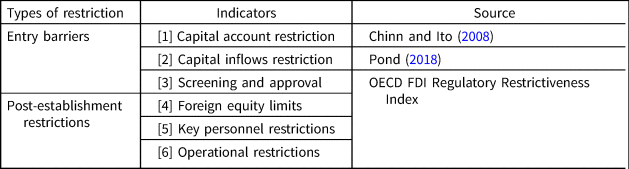
Our dependent variables are country-level FDI restrictions that are measured using six indicators summarized in Table 2. The first three indicators capture the level of entry barriers to FDI, while the rest assess the level of post-establishment restrictions on MNCs. We first use the inverse of the Capital Account Openness Index (Chinn and Ito, Reference Chinn and Ito2008) to measure the level of capital controls. This variable, [1] capital account restriction, estimates a country's degree of capital account restriction based on indicators that codify the tabulation of restrictions on financial transactions across borders using the International Monetary Fund's Annual Report on Exchange Arrangements and Exchange Restrictions. Given that Chinn and Ito's index captures restrictions on inflows as well as outflows of capital, we further use a more refined measurement that specifically captures capital account restrictions on capital inflows ([2] capital inflows restrictions) from Freeman and Quinn (Reference Freeman and Quinn2012) and Pond (Reference Pond2018) to corroborate our measurement.
Types and Indicators of Country-Level FDI Restrictions

The other indicators are from the OECD FDI Regulatory Restrictiveness Index, which includes [3] screening and approval requirements, [4] foreign equity limits, [5] rules for key personnel and [6] operational restrictions on foreign enterprises. In the presence of screening and approval requirements, foreign investors, prior to the establishment of their investment, have to go through evaluations and screenings by government agencies that use criteria of national economic needs, net economic benefits, or national security. Foreign equity limits record the maximum percentage of foreign ownership allowed in domestic enterprises. Restrictions on key foreign personnel regulate the nationality of senior executive personnel in MNCs. Finally, operational restrictions are implemented to regulate the operation of foreign investors by setting up performance requirements or controlling certain corporate activities, such as the establishment of branches, the purchase of land, hiring, reciprocity clauses and the repatriation of profits.
Our key independent variables are “Left-leaning government” and “Labour unionization.” We measure the ideological inclinations of incumbent governments with the party orientation of the chief executive regarding economic policies, using information from the Database of Political Institutions (DPI) (Keefer, Reference Keefer2005). In DPI, the chief executive's party orientation is considered left-leaning when the party's political position is described as “socialist,” “social democratic,” or “communist.” Conversely, right-leaning parties are those described as “conservative,” “Christian democratic,” or “right-wing” in their political economic positions. Using this information, we create an ordinal variable to reflect the strength of the pro-labour orientation of the government: leftist governments are coded “2” while centrist and rightist governments are coded “1” and “0” respectively. The other key independent variable, “Labour unionization,” is measured by the OECD's trade union density data, which records the density of labour union memberships in the domestic labour force at the country level.
We also include a set of control variables, including gross domestic product (GDP) per capita, GDP growth rate, net inflows of FDI, trade openness (the sum of export and import as a percentage of GDP), government consumption (government expenditure as a percentage of GDP), membership in the European Union,Footnote 2 electoral institution (proportional representation dummy), institutions of industrial relations (coordinated market economy dummy) and the number of bilateral investment treaties (BITs) signed.
4.2 Method selection
We apply a pooled ordinary least squares (OLS) regression design with panel corrected standard errors (PCSEs), considering our sample has more units than time periods (Beck and Katz, Reference Beck and Katz1995). All models in our analysis are specified with a panel-specific AR (1) error process and are estimated with year-fixed effect to account for the impact of time-varying systemic shocks on national FDI policies. While pooled OLS models with PCSEs deal with heteroscedastic and contemporaneous correlation in the error process that threatens valid inferences, country heterogeneity commonly found in time-series cross-sectional data remains a subject of concern. Country heterogeneity and its potential association with the independent and dependent variables violates the zero-conditional-mean-of-errors assumption, causing the OLS estimator to be biased and inconsistent in large samples. However, our concern regarding the interference of country heterogeneity with the regression results is moderate, given the data structure and our model specification. Most directly, government partisanship follows a data-generating process unlikely to be affected by time-invariant country-specific features. There is little existing evidence documenting a systematic association between time-invariant country characteristics and pro-labour parties’ probability of electoral victory. A strong association between government partisanship and the disturbance is thus unlikely to be present in the data.
However, a cross-national variation within left-leaning parties in their platforms could constitute another source of country heterogeneity. More specifically, European countries with certain social and economic institutions or traditions may produce leftist parties with policy platforms (particularly the part pertaining to FDI) that systematically deviate from their counterparts in other countries in our sample. This leftist-party heterogeneity that may relate to both FDI restriction and the error term could result in biased estimates of the partisan effect. Having acknowledged this issue, we believe such a leftist party heterogeneity can largely be accounted for by controlling for domestic institutional features that are likely to underlie this heterogeneity. These features include the electoral institution, in terms of whether a proportional representation system is adopted; EU membership; and the institution of domestic industrial relations (as reflected by whether the country is one of the coordinated market economies [CMEs] defined in Hall and Soskice [Reference Hall and David2001]). Controlling for these institutional variables in the model specification will tease out the part of the partisan effect correlated with country-specific errors in the residuals, thereby reducing the risk of bias caused by cross-country heterogeneity in leftist party platforms.
Lastly, one may be concerned that unit-specific error in our estimation is correlated with labour unionization, thus leading to biased estimates. One potential source of this correlation is the cross-national differences in institutions of industrial relations. For example, labour unionization is much higher in CMEs than in liberal market economies, due to the institutions in CMEs’ favouring the collective model of wage-setting. Biases may occur if these institutions in CMEs also shape the government's stance on FDI policies through alternative channels. We believe such a concern, however, is alleviated after controlling for whether a country is considered one of the CMEs. Due to this remedy, we choose not to resort to country fixed effect models mainly because the country-level unionization tends to be time-invariant in the relatively short time horizon of our sample. Applying two-way country and year fixed effect models in such a context would result in both inefficient and biased estimates (Beck, Reference Beck2001). Acknowledging that the unobserved country heterogeneity in labour unionization may still affect our findings, we complement the country-level analysis with a mixed-effect multilevel analysis using a sector-level dataset with which country fixed effect could be more suitably applied. The result of the sector-level analysis is presented in section 4.4.
4.3 Findings and discussion
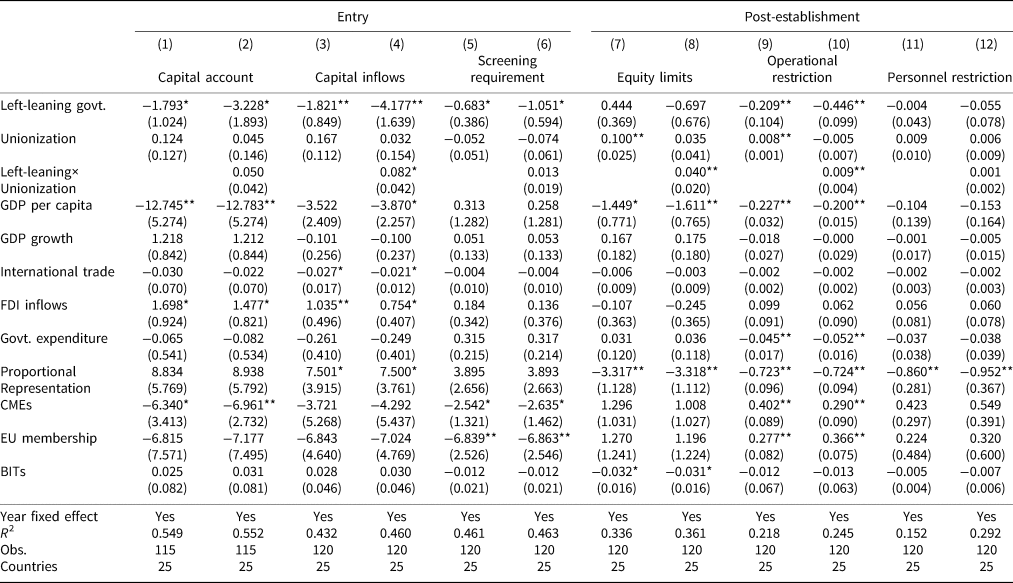
The regression results are presented in Table 3, starting with the three indicators of entry barriers: capital account restriction, capital inflows restriction, and screening and approval requirements. Across the three indicators, we found a generally negative association between left-leaning governments and entry barriers to FDI. In the models of capital account restriction (Models 1 and 2) and screening and approval requirements (Models 5 and 6), “Left-leaning govt.” acquires negative coefficients at the significance level of .10. In the models of capital inflows restriction (Models 3 and 4), “Left-leaning govt.” acquires negative coefficients at the significance level of .05. To calculate the substantive effect, the coefficient of “Left-leaning govt.” can be standardized using the standard deviation (s.d.) of the dependent and independent variable. In Model 3, the standardized coefficient is −0.213, indicating a 1 s.d. increase in “Left-leaning govt.” is associated with a 0.213 s.d. decrease in capital inflow restrictions. Similarly, the standard coefficient of “Left-leaning govt.” in Model 1 and Model 5 is −0.121 and −0.129. Also, Models 2, 4 and 6, which examine the conditioning effect of labour unionization, do not find a strong influence of unionization on the association between left-leaning governments and entry barriers to FDI. With the exception of Model 4, the interaction term “Left-leaning govt. × Unionization” fails to obtain significance at the .10 level. Overall, results in Models 1 through 6 suggest left-leaning governments tend to negatively affect entry barriers to FDI, and the intervening impact of unionization on such an effect is weak, lending preliminary support to Hypothesis 1.
Government Partisanship, Unionization and Dimensions of FDI Restrictions

Note: Panel corrected standard errors in parentheses. Significance levels: *p < .10; **p < .05
Turning to models of post-establishment restrictions, we find evidence from Models 7 through 12 indicative of a much stronger conditioning effect of labour unionization on the relationship between government partisanship and post-establishment regulations on MNCs. Per Models 7 and 8, while “Left-leaning govt.” displays no significant association on foreign equity regulations (Model 7), labour unionization significantly conditions the effect of partisanship on foreign equity restrictions, as indicated by a positive and significant interaction term in Model 8. Therefore, left-leaning governments are more likely to be associated with less liberal or more protective stances on equity restrictions under high levels of unionization. A similar pattern is also found for operational restrictions in Models 9 and 10. FDI restrictions in the form of operational measures decrease in the government's left-leaningness, as indicated by the negative and significant (at .05 level) coefficient of “Left-leaning govt.” in Model 9. Yet, higher levels of unionization would weaken this liberalizing effect of left-leaning governments on operational restrictions, as suggested by the positive and significant (at .05 level) interaction term in Model 10. However, a similar relationship is not sustained for personnel restrictions (Models 11 and 12). Neither government partisanship nor unionization influences the level of this type of restriction in significant ways. This may be due to the particular nature of this type of restriction, as personnel restrictions exert a limited influence on the competitiveness of MNCs compared to other post-establishment measures.
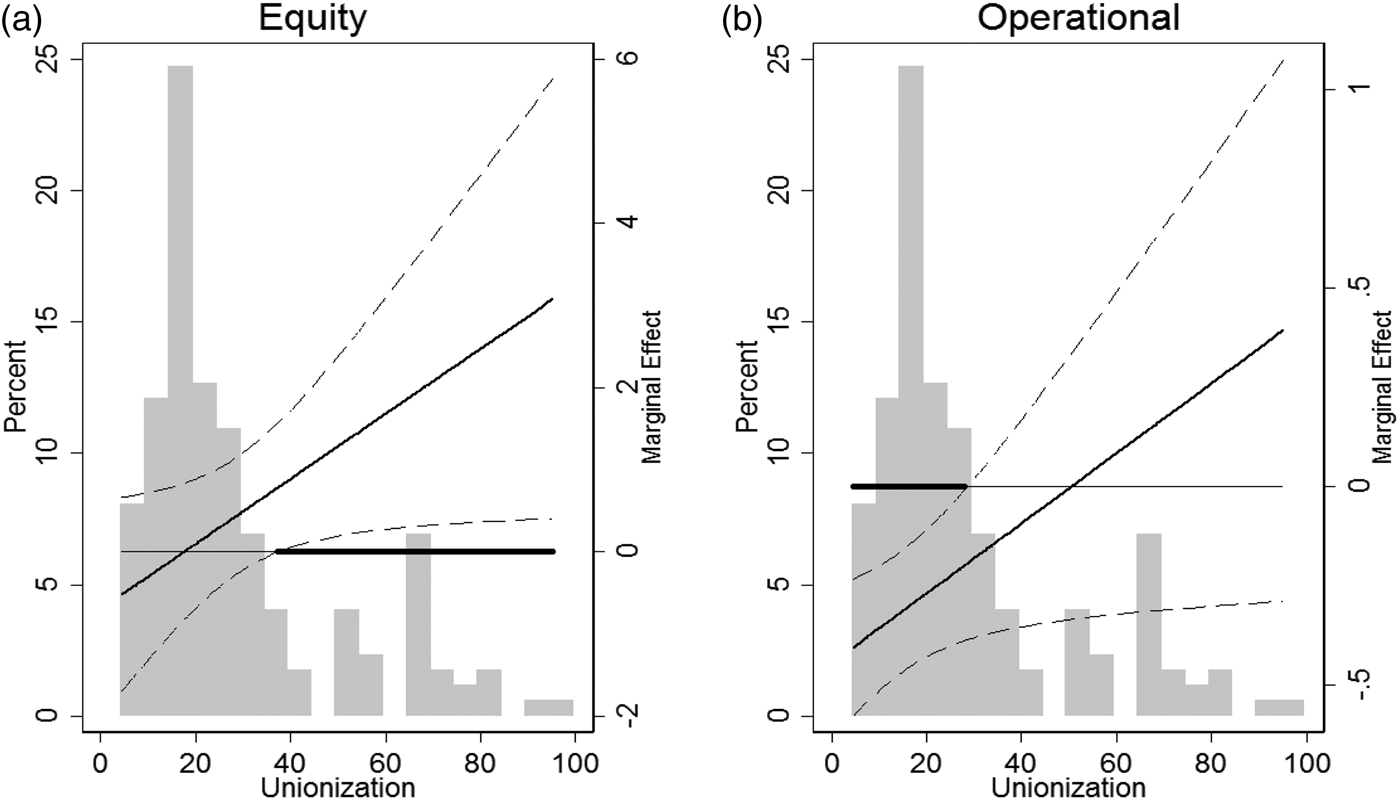
Mapping the marginal effect of left-leaning governments illustrates the aggregated effect of government left-leaningness at different unionization levels. Based on our specification, the marginal effect of left-leaning governments on FDI restrictions is provided by β + η · Unionization. Panel A of Figure 1 plots the marginal effect of left-leaning government on foreign equity limits against the level of labour unionization. As one can see in the figure, the marginal effect becomes positive and significantly different from zero when the unionization level rises above 38. Simply put, the left-leaningness of the government will make it more restrictive on foreign equity limits only when the domestic labour force is sufficiently unionized. Panel B of Figure 1 plots the marginal effect of left-leaning government on operational regulations against the degree of labour unionization. While the general pattern of the marginal effect function is similar, left-leaning governments are shown here to become less liberalizing on lifting operational restrictions on MNCs, which is seen from a negative and significant marginal effect under low unionization levels (that is, below 23).Footnote 3 Overall, results from the country-level analysis are largely consistent with our expectations: while left-leaning governments generally liberalize entry barriers to FDI, labour unionization is likely to undercut left-leaning governments’ stance on liberalization of post-establishment restrictions.
Unionization and the Marginal Effect of Left-Leaning Government

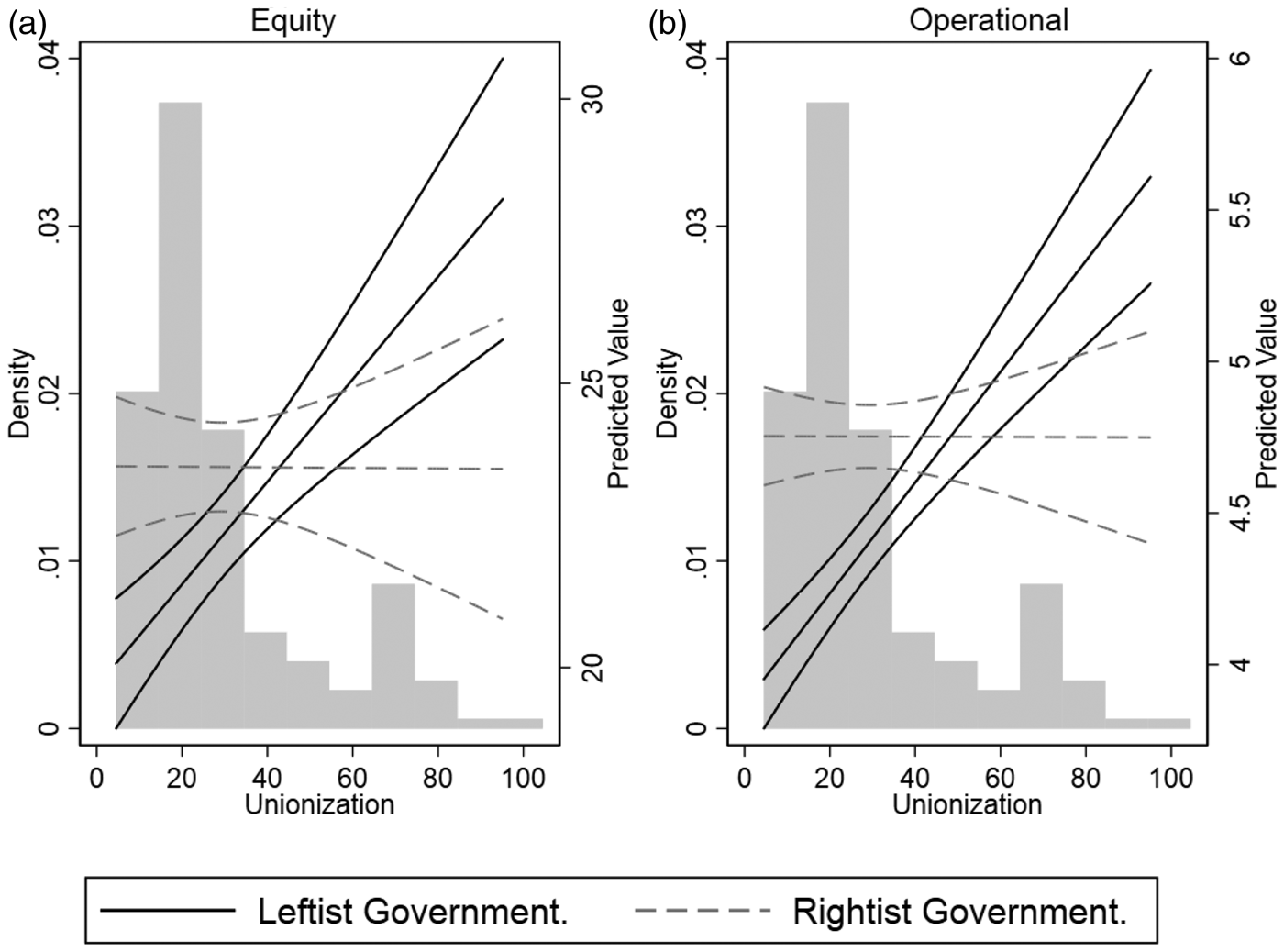
Besides illustrating the marginal effect, we also show how unionization shapes the difference between leftist and rightist governments in post-establishment restrictions by calculating the predicted value of the dependent variable. Figure 2 plots the predicted value of equity limits (Panel A) and operational restrictions (Panel B) under a rightist (that is, “Left-leaning govt. = 0) and leftist (that is, Left-leaning govt. = 2) government at different unionization levels.Footnote 4 Figure 2 suggests that leftist governments tend to be more liberalizing on both foreign equity limits and operational restrictions than rightist governments only when unionization is low. Also, leftist governments tend to be more restrictive on operational restriction than rightist governments when unionization level is sufficiently high. These observations suggest leftist parties are likely to deviate from the rightist parties on post-establishment restrictions only at sufficiently low or high unionization levels. When the unionization level is intermediate, leftist and rightist government tend not to display bifurcations of restriction levels.
Point Estimates and 95% Confidence Bands of Predicated Level of FDI Restrictions

4.4 Robustness of findings at the sector level
In this subsection, we use industry-level data of unionization and FDI restriction to test for the robustness of our finding at the sector level. The sector-level evidence is helpful for the following considerations: First, although the original hypotheses are generated at the country level for simplicity, the core rationale can be translated smoothly into a sector-level design. The effect of government partisanship on sector-specific FDI restrictions varies by unions’ differential influence across sectors, which provides a finer, yet consistent, empirical underpinning for our general argument. Second, disaggregating national FDI restrictions at the sector level unleashes greater within-country variation, which allows for a more suitable application of country-fixed effect specification that better tackles the unobserved country heterogeneity in estimation.
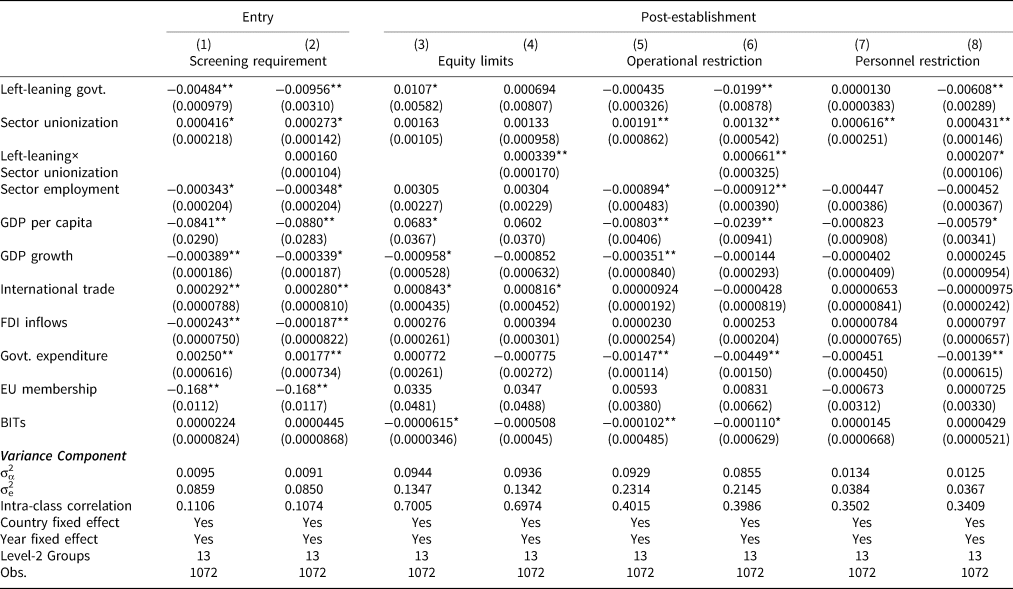
We prepare the sector-level data as follows. Like the country-level data on FDI restrictiveness, four types of sector-specific investment restrictions in 25 sectors are provided in the OECD FDI Regulatory Restrictiveness dataset: screening and approval, foreign equity, operational restrictions and key personnel. Data on sector unionization come from the ICTWSS Labour Organization Database covering 15 clusters of industrial sectors. For our analysis, these two different sector classifications are matched and merged into 13 sectors: banking, business services, communications, construction, fisheries, hotels and restaurants, manufacturing, metals, mining and quarrying, transport, and utility. Considering the multilevel structure in our data, we carry out the analysis with a series of random intercept mixed-effect multilevel models. The model specification is as follows:
 $$ \eqalign{ Restriction_{ijt} =& \; \alpha _j + \beta \cdot Left-leaning\; Govt._{it} + \gamma \cdot Unionization_{ijt} \cr & + \eta \cdot \lpar {Left-leaning\; Govt.\; \times \; Unionization} \rpar _{ijt}\; + \lambda \cdot {\bi V} \cr& + u_i + v_t + e_{ijt} with \; \alpha_j \sim N \lpar {\mu_\alpha, \sigma_\alpha^2} \rpar \; {\rm and} \; e_{ijt} \sim N \lpar {0,\sigma_e^2} \rpar } $$
In this equation, α j is the sector-level (j) random intercept and e ijt is the idiosyncratic error. The specification also incorporates both country and year fixed effect (u i and v t). The vector of control variables, V, includes one sector-level covariate (the share of sector employment in total employment) and seven time-variant country-level covariates (GDP per capita and growth, trade and FDI inflows, government expenditure, EU membership, BITs). According to our theoretical claims summarized in Table 1, the sign on η should be positive for post-establishment restrictions but insignificant for entry barriers, and β should be negative for both types of restrictions.
The estimation results are presented in Table 4. The intra-class correlation (ICC) varies across these four restrictions but is generally at levels suitable for multilevel modelling. Findings from Table 4 are largely consistent with those obtained at the country level. Per screening requirements, left-leaning governments are associated with lower levels of restrictions, given the negative and significant coefficient at the .05 level in Model 1. Also, the interaction term added to Model 2 gains no statistical significance at the .05 level or higher. Consistent with the country-level finding, this evidence suggests left-leaning governments are associated with lower sector-level entry barriers in the form of screening requirements, regardless of differential levels of unionization across sectors.
Sector-Level FDI Restrictions: Mixed Effect Models

Note: Sector-cluster standard errors in parentheses. Levels of significance: *p < .10; **p < .05
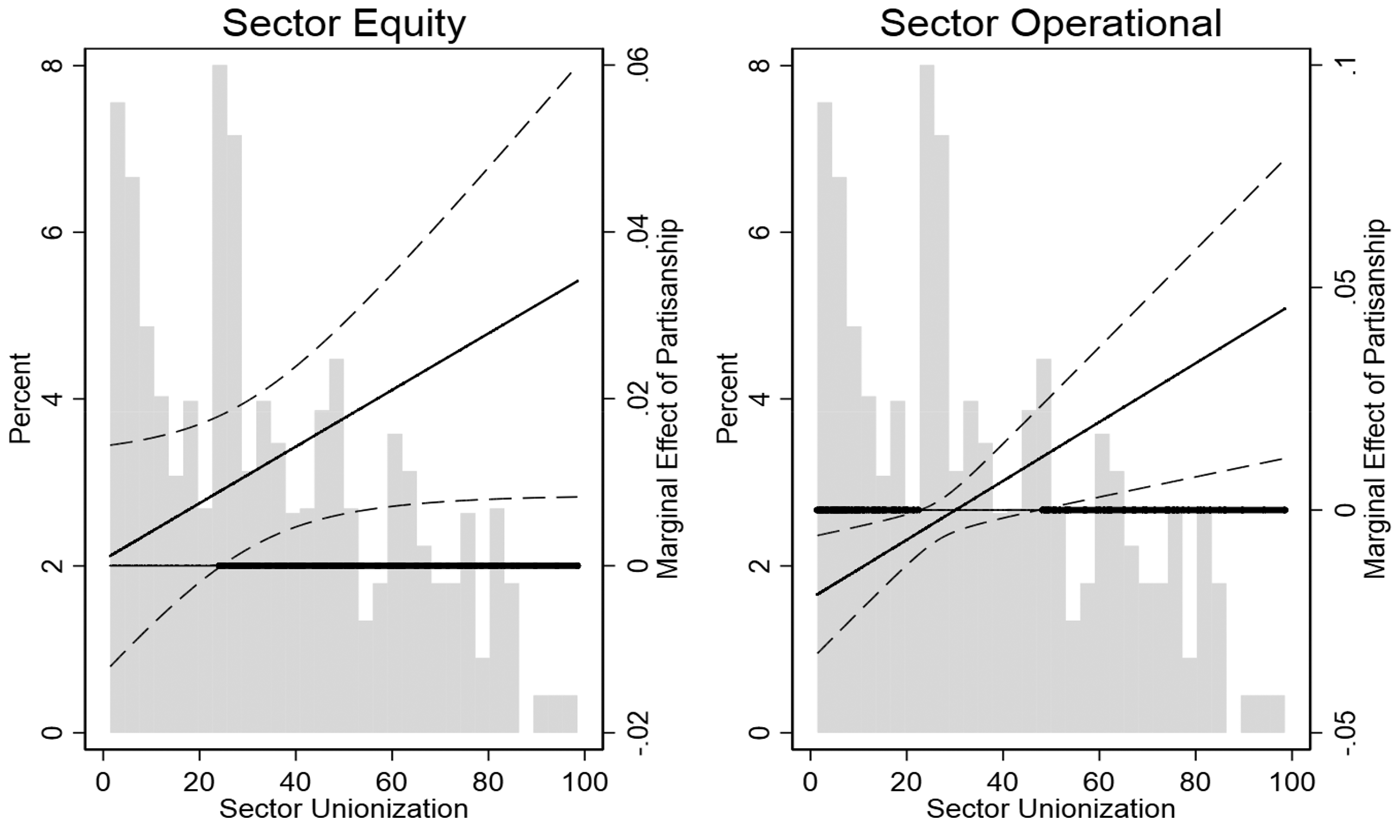
Sector-level unionization has a more pronounced conditioning effect in models of post-establishment restrictions (Models 3 and 8). Most importantly, the cross-level interaction term, “Left-leaning govt. × Sector unionization,” in Model 4 and Model 6 in Table 4 takes on a positive and significant sign (at the .05 level). This suggests left-leaning governments’ stance on post-establishment restrictions on FDI will be made significantly more protective by higher levels of sector unionization. The marginal effect of left-leaning governments as a function of sector unionization is plotted in Figure 3, using results from Models 4 and 6. The results from the models of personnel restrictions (Models 7 and 8) are weaker but largely consistent. For both foreign equity and operational restrictions, the sector-level unionization has a substantial conditioning effect on the relationship between government partisanship and the restrictions, although the conditioning effect of unionization results in a shift of the direction of the partisanship effect only for operational restrictions.Footnote 5
Sector Unionization and the Marginal Effect of Left-Leaning Government

5. Conclusion
Examinations of the political determinants of FDI policies are not new to scholars of political economy. This article takes the inquiry on FDI restrictions one step further by providing an integrated account for two different forms of FDI restrictions: entry barriers and post-establishment restrictions. Building on the existing research on FDI restrictions, we argue that neither labour unionization nor the partisan-ideological inclinations of governments alone can explain the variation in different forms of FDI restrictions in advanced industrial economies. The argument and evidence presented in this article highlight a compound effect of government partisanship and the political influence of unionized interests. While the policy stance of leftist governments on the liberalization of regulatory measures on FDI inflows is sensitive to the influence of labour unions, the removal of entry barriers to FDI by leftist governments is not likely to be offset by the protectionist appeal from labour unions. The country- and sector-level analyses of FDI restrictions we conducted provide preliminary support for our argument.
This study suggests various avenues for future studies. Labour unions’ labour market status and political influence vary by national economic institutions and traditions, as the Varieties of Capitalism literature suggests. Future studies need to be built on this article's framework and delve more deeply into examining the variations in market institutions and industrial relations between coordinated and liberal market economies, as well as their differential impacts on the interactions between unionized labour and the government in the context of globalization. Second, an extension study of this article may refine the examination of the changing policy influence of unionized labour, taking into account the steady decline of unions in developed economies since the 1980s. While this article implies that unionized labour's policy influence corresponds linearly with unions’ membership coverage, it is possible that a structural break in the political and market significance of unionized labour had occurred at some point during the decline of unions. Future studies could better characterize this non-linear process of unions’ fading influence, with special attention to differential impacts of national political and economic parameters on precipitating or delaying such a structural break in unions’ power. Finally, there are other forms of FDI policies that affect the movement of FDI, such as corporate governance and taxation, as well as other opaque informal practices that affect the competitiveness and profitability of MNCs. Follow-up studies may examine whether the suggested impact of government partisanship and unionization on FDI restrictions is applicable to other FDI policies and practices toward MNCs.
Supplementary material
To view supplementary material for this article, please visit https://doi.org/10.1017/S0008423919000295
Acknowledgments
Jia Chen acknowledges support from the National Social Science Fund of China (No. 17CGJ032) and the Program for Innovative Research Team of the Shanghai University of Finance and Economics (No. 2014110344).