In 2015, approximately 771 000 metric tons of Greek yogurt was produced in the U.S, representing nearly 40% of the total U.S. yogurt market (Erickson, Reference Erickson2017). The production of Greek yogurt is estimated to require about three times the amount of milk used to make regular yogurt, and as a result a higher amount of acid whey is generated as a by-product (Elliott, Reference Elliott2013; Erickson, Reference Erickson2017). The industrial methods for Greek yogurt production involve whey removal by mechanical procedures in order to achieve the desired level of solidity (Bong & Moraru, Reference Bong and Moraru2014). However, this straining procedure generates large quantities of acid whey that cannot be readily utilised nor disposed of easily due to both economic and environmental challenges (Smithers, Reference Smithers2015). Thus, a reduction of acid whey is greatly needed by the Greek yogurt industry in order to reduce the costs of storage and disposal of this hazardous waste product.
Greek or Greek-style yogurts (GSY) can be manufactured using a method that employs dried dairy ingredients to achieve a characteristically thick texture. These ingredients include dairy proteins (Desai et al. Reference Desai, Shepard and Drake2013; Gyawali & Ibrahim, Reference Gyawali and Ibrahim2016). However, the addition of dairy proteins alone does not enhance the textural characteristics (thickness and viscosity) of yogurt. Thus, it is a common industrial practice to incorporate other non-dairy ingredients such as different polysaccharide hydrocolloids (Boynton & Novakovic, Reference Boynton and Novakovic2013). These dairy proteins and hydrocolloids have a significant effect on the water holding capacity (WHC) of yogurt and have the potential to reduce the quantity of acid whey generated during the concentration step applied in yogurt production. As a result, hydrocolloids are increasingly being used in yogurts as thickeners, stabilisers, gelling agents, syneresis controlling agents, and as water holding agents (Saha & Bhattacharya, Reference Saha and Bhattacharya2010). Using these ingredients not only serves to hold the water but also modifies the yogurt texture, palate breakdown, and taste. Thus, the inclusion of hydrocolloids has an important impact on the manufacture of GSY (Gyawali & Ibrahim, Reference Gyawali and Ibrahim2016). The primary functions of hydrocolloids in this application are to form linkages between themselves and milk proteins and to stabilise the protein network, thereby preventing the free movement of water (Soukoulis et al. Reference Soukoulis, Panagiotidis, Koureli and Tzia2007; Tasneem et al. Reference Tasneem, Siddique, Ahmad and Farooq2014).
Currently, there is no U.S. legal standard or definition of identity for GSY. Different methods and processing steps are being used in the development of commercial GSY that generates acid whey. In our preliminary study (unpublished data), WHC of yogurts containing several hydrocolloids and dairy proteins were examined. Based on these results, pectin and WPC were selected as these ingredients showed higher WHC compared to others. Previous studies also showed that pectin and WPC have been widely adopted in dairy industry as these ingredients provide good gel structure of yogurt (Guzmán-González et al. Reference Guzmán-González, Morais, Ramos and Amigo1999; Soukoulis et al. Reference Soukoulis, Panagiotidis, Koureli and Tzia2007; Zhang et al. Reference Zhang, McCarthy, Wang, Liu and Guo2015). From a consumer standpoint, pectin also meets today's growing demand for clean ingredient labels. Similarly, whey protein concentrate (WPC) is a reasonably cost-effective alternative to other dairy ingredients such as skim milk powder and whey protein isolate. In addition, WPC can be used to improve physicochemical properties of non-fat yogurts (Kailasapathy et al. Reference Kailasapathy, Supriadi and Hourigan1996; Zhang et al. Reference Zhang, McCarthy, Wang, Liu and Guo2015). Therefore, the objective of this study was to investigate the effects of pectin and WPC as a practical method to reduce the quantity of acid whey generation during the manufacture of GSY.
Materials and methods
Ingredients
Two different types of pectin (Genu® pectin type LM-12 CG & Genu® Explorer 30 CS-YA pectin) were provided by CP Kelko (Lille Skensved, Denmark), and WPC-80 was provided by Agropur Ingredients (La Crosee, WI). Both types of pectin were a low ester pectin extracted from citrus peel. Fat free milk was purchased from a local grocery store in Greensboro, NC. Greek Yogurt starter culture, which is a blend of Lactobacillus bulgaricus and Streptococcus thermophilus, was obtained in freeze dried form from Cultures for Health (Sioux Falls, sd). The freeze dried culture was propagated by inoculation into the same milk used for yogurt preparation. Afterwards, 3·0% of the active yogurt culture was used to prepare experimental yogurt samples.
Yogurt manufacture
Pectins and WPC were added to a final concentration of 0·05%, w/v and 1·0%, w/v respectively. These concentrations were selected based on our preliminary study (data not shown) that demonstrated higher WHC with combination of pectin (0·05%) and WPC (1·0%) compared to other tested concentrations. These ingredients were gradually mixed under continuous agitation into milk samples. Milk samples that lacked these ingredients served as control. The mixtures were heated for 10 min at 90 °C and allowed to cool down to 40 °C. Each milk sample was then inoculated with 3·0% of active yogurt culture and subsequently incubated at 40 °C, until the pH reached ~4.6. Samples were then cooled and stored at 4 °C overnight, after which the yogurt characteristics were determined.
Water holding capacity (WHC)
The water-holding capacity of yogurt was determined using a procedure adapted from Guzmán-González et al. (Reference Guzmán-González, Morais, Ramos and Amigo1999). A sample of approximately 15 g of yogurt was centrifuged (Thermo scientific, Sorval ST 16R) at 4 °C for 10 min at 1300 × g. After centrifugation, the fraction containing the whey was carefully removed using 10 ml pipette tips, and the remaining yogurt was reweighed. The WHC (%, w/w) was calculated using the following equation:
 $${\rm WHC} = \displaystyle{{{\rm weight \ of \ drained \ pellet}} \over {{\rm weight \ of \ sample}}} \times {\rm 1}00$$
Susceptibility to yogurt syneresis
The method of Mohamed & Morris (Reference Mohamed and Morris1987) was used to measure the susceptibility of yogurt to syneresis. Briefly, a section of Whatman number 1 filter paper was used to cover a Buchner funnel with a diameter of 8 cm. Twenty grams of yogurt were spread over the surface in a thin layer. The sample was then vacuum filtered for 10 min. The liquid from the yogurt was collected and its volume was recorded. The syneresis (%, v/w) was calculated using the following equation:
 $${\rm Syneresis} = \displaystyle{{{\rm volume \ of \ liquid}} \over {{\rm weight \ of \ yogurt \ sample}}} \times {\rm 1}00$$
Protein analysis by native polyacrylamide gel electrophoresis (native-PAGE)
Using the native polyacrylamide gel electrophoresis (PAGE) system, the protein profiles of the liquid whey obtained by centrifuging the yogurt during WHC test were analysed. First, the protein concentration of the whey samples was determined using a BCA kit (Thermo Fisher Scientific) with Bovine Serum Albumin as the standard. Whey samples were then mixed with a loading buffer at the appropriate concentrations. A final sample of approximately 20 µl was loaded into each well of the gel. Pure WPC was also included as a reference protein marker. Electrophoresis was performed using a constant voltage of 80 V at 4 °C in a pre-chilled native page running buffer (30 g Tris base and 144·0 g glycine/l) for approximately 6 h. The gel was then stained with Coomassie brilliant blue R-250 and de-stained in an acetic acid/methanol solution.
Microbiological and chemical analysis
Each yogurt (10 g) sample prepared with Explorer 30 CS-YA pectin (P2) and WPC was suspended in 90 ml of 0·1% sterile peptone water and serially diluted. Then, 0·1 ml of appropriate dilutions was surface plated on specific agar to determine the counts of microorganisms. De Man Rogosa and Sharpe Agar medium (MRSA; Neogen) was used for enumeration of L. delbrueckii subsp. bulgaricus. The plates were incubated at 37 °C for 72 h anaerobically. Similarly, the counts of S. thermophilus were enumerated on M-17 agar (Difco, Detroit, MI) after incubating the plates at 37 °C for 48 h. Total solid, Protein, lactose, and water content of concentrated GSY samples were determined according to AOAC (2002).
Statistical analysis
The data obtained were analyzed with one-way ANOVA using the general linear model (GLM) procedure of SAS software v 9.4 (SAS Institute Inc., Cary, NC). The means were compared using Tukey's multi-comparison test at P < 0·05.
Results and discussion
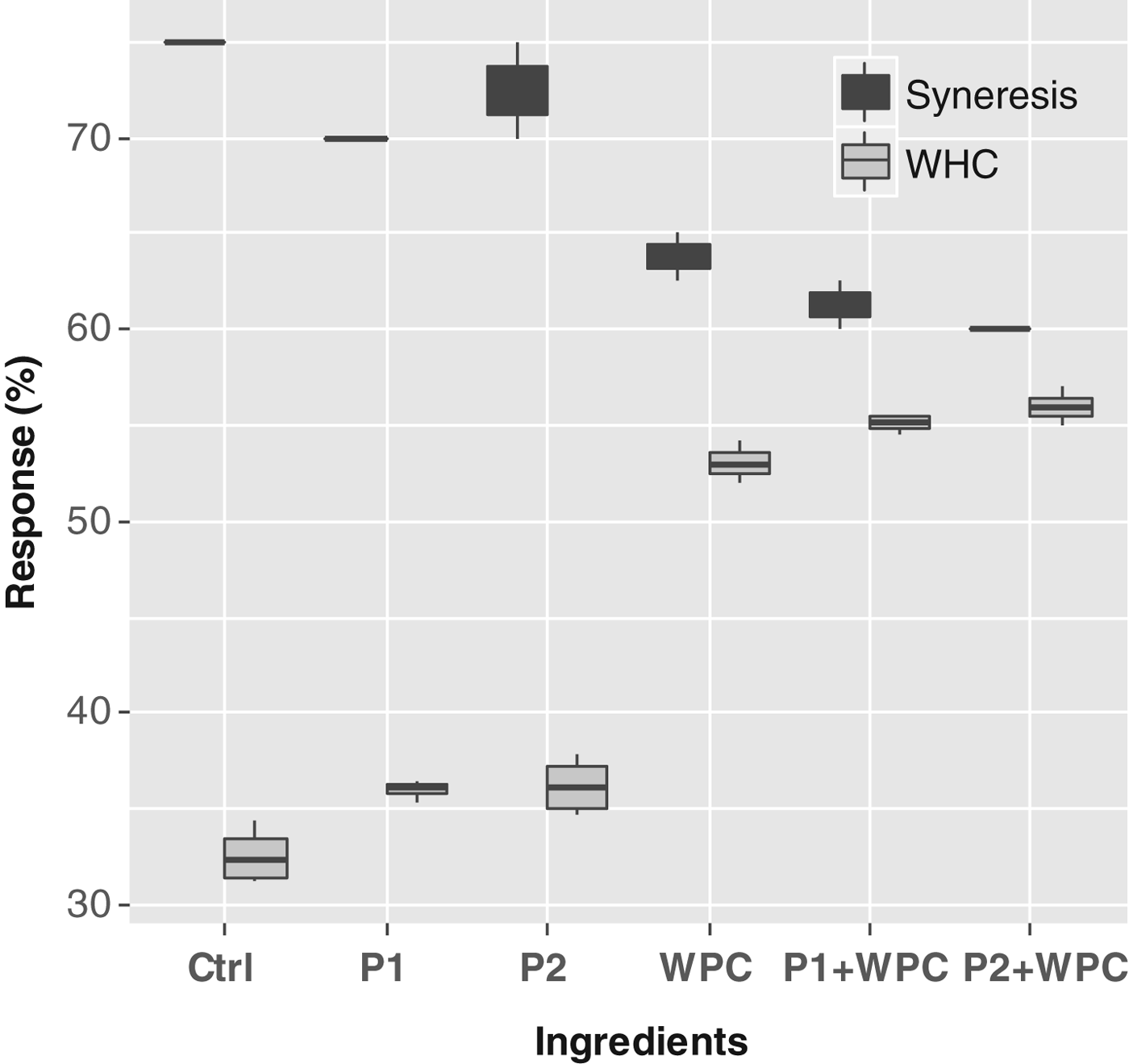
Figure 1 shows the WHC and syneresis of yogurt samples supplemented with pectin and WPC. In the control samples, WHC was 32·5%. When yogurt samples were supplemented with pectin-1 and pectin-2, WHC was significantly increased to 35·9 and 36·1% (P < 0·05) respectively, compared to the control. Similarly, with the addition of WPC, the WHC increased to 53·0% which was approximately 21% higher compared to the control. When yogurts were prepared with the combination of pectin and WPC, further improvement in WHC was observed. Both the pectins used in this study are less sensitive to acidity and have high calcium reactivity. According to the manufacturer's data sheet, pectin-1 is suggested as a gelling agent for fruit spreads applications, whereas pectin-2 is a thickening agent especially recommended for yogurt applications. As these two pectins differ in their degree of esterification, significant differences in WHC and syneresis values were expected. However, there was no statistically significant (P > 0·05) difference observed in WHC and synereis between the two individual treatments. Combination of both types of pectin with WPC showed comparatively higher WHC compared to all the individual treatments tested. We observed significantly (P < 0·05) higher WHC (56%) in yogurt sample prepared with pectin-2 plus WPC compared to individual treatments (32·5–53·0%). Similarly, syneresis in control yogurt was highest (75%) which is followed by yogurts supplemented with pectins ranging between 70 −72·50% (Fig. 1). Overall these results showed reduction of syneresis by 11·25% and 15% when yogurts were prepared with WPC and pectin plus WPC, respectively. These observations were in agreement with others, who demonstrated that the addition of WPC in yogurt reduced the separation of whey (Kailasapathy et al. Reference Kailasapathy, Supriadi and Hourigan1996; Puvanenthiran et al. Reference Puvanenthiran, Williams and Augustin2002; Remeuf et al. Reference Remeuf, Mohammed, Sodini and Tissier2003). The reduction in syneresis via the addition of WPC has been reported by Guzmán-González et al. (Reference Guzmán-González, Morais, Ramos and Amigo1999) and Puvanenthiran et al. (Reference Puvanenthiran, Williams and Augustin2002). This is a consequence of increase in the compactness of the yogurt microstructure which contains smaller pores. The level of compactness increases as the casein- to- whey protein ratio is reduced. Consequently, there is an increased binding of free water in the coagulum resulting in less whey separation. Since, pectin is anionic hydrocolloid capable of interacting with positive charge on the surface of the proteins, thereby strengthening the protein network resulting in increased water retention capacity (Soukoulis et al. Reference Soukoulis, Panagiotidis, Koureli and Tzia2007). Pectin also have the capacity to form complexes of protein and polysaccharide that are known to stabilise protein structure through carbohydrate-water interactions. These interactions lead to the formation of a three dimensional network that traps water within it to form a rigid structure that is resistant to flow resulting in a higher WHC (Saha & Bhattacharya, Reference Saha and Bhattacharya2010). Furthermore, to meet the health conscious consumer demand for nonfat yogurt, WPC as a fat replacer and pectin as a thickening agent could be used for improving the consistency of nonfat yogurt (Zhang et al. Reference Zhang, McCarthy, Wang, Liu and Guo2015).
Effect of pectin and WPC on WHC and syneresis of yogurt. P1, Genu® pectin type LM-12 CG; P2, Explorer 30 CS-YA pectin; WPC, whey protein concentrate.

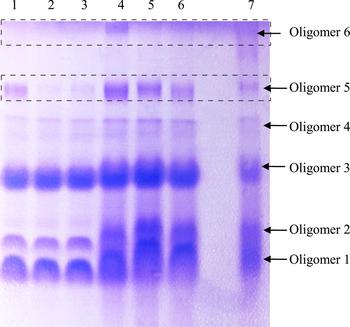
Native PAGE analysis of the liquid whey of yogurt samples was conducted in order to determine whether we could observe interactions between pectin and WPC and between these ingredients and the oligomeric state of whey proteins naturally found in milk. Figure 2 shows the changes in the pattern of WPC oligomers observed as a result of adding pectin. The oligomeric pattern of natural whey proteins that were present in milk (lane 7) corresponded well with the pattern displayed by WPC alone (lane 4), indicating that the oligomeric states of WPC were being observed in the native-PAGE. The addition of WPC to the yogurt samples appeared to lead to an increase in the concentration of higher-order oligomeric whey species (oligomer 5 and oligomer 6), which is logical because more whey protein was present. A decrease in the concentration of these higher-order oligomers was observed as a consequence of adding pectin-1(lanes 2, 5) or pectin-2 (lanes 3, 6). A reduced level of higher-order oligomers correlated well with an increase in WHC and a decrease in syneresis that was a result of adding pectin to yogurt. This increase in WHC and decrease in syneresis could be attributable to the protein-carbohydrate interaction between pectin and WPC. These results also suggested that the oligomeric state of WPC might play a role in WHC and syneresis. Pectin-2 had the greater effect on the oligomeric state of WPC as observed by the fainter oligomer 5 band in lane 6 than in lane 5. In addition, a slightly higher WHC and lower level of syneresis was observed with pectin-2 than with pectin-1. Therefore, pectin-2 plus WPC was selected for further microbial and chemical analysis.
Native page electrophoresis for 6 different yogurt types. Lane 1 = control, Lane 2 = yogurt with pectin-1, lane 3 = yogurt with pectin-2, lane 4 = yogurt with WPC, lane 5 = yogurt with pectin-1 + WPC, lane 6 = yogurt with pectin-2 + WPC, and lane 7 = WPC loaded by itself onto the gel. There was a decrease in the amount of higher order oligomers (oligomer 5 and oligomer 6) with the addition of pectin-1 (lanes 2 and 5) or pectin-2 (lanes 3 and 6) with respect to control (lane 1) and yogurt with WPC (lane 4, without pectin). The band pattern in lane 7 (WPC alone) corresponds to the pattern observed in lanes 1 through 6, confirming that it is the oligomeric state of whey protein that is being modulated by pectin.

Table 1 shows the microbiological properties of the yogurt samples supplemented with pectin-2 and WPC. This study was conducted to determine whether the addition of these ingredients could change the viable count of L. bulgaricus and S. thermophilus. In control sample, L. bulgaricus and S. thermophilus populations were 7·06 and 8·79 log CFU/g respectively. Similarly, with the addition of pectin and WPC, bacterial populations remained slightly higher but not significantly different (P > 0·05) than the control. The highest viability of L. bulgaricus (7·20 log CFU/g) and S. thermophilus (8·99 log CFU/g) was observed in yogurt fortified with combination of pectin and WPC. These results demonstrate that WPC could help improve the viability of yogurt culture as protein and phosphate contents in WPC acts as a buffering capacity. Thus, these ingredients could maintain high level of viable cells throughout the storage period. These added ingredients that contribute to the changes in physical and microbiological properties, could also have an impact on chemical composition of the final yogurt product. To demonstrate this, we determined the chemical analysis of the yogurt samples (Table 1). The protein content of our yogurt samples ranged from 5·83–8·89% (w/w). According to the codex standard for fermented milk, strained or concentrated yogurt should have a minimum of 5·6% protein of the total sample weight (Desai et al. Reference Desai, Shepard and Drake2013). Our results thus demonstrated that pectin plus WPC can be used as additives in GSY manufacturing to reduce acid whey generation.
Effects of ingredients on bacterial population (Log CFU/g) and chemical analysis (%) of yogurt samples

Means within a column not sharing a common superscript are significantly different (P < 0·05). Values are mean ± sd, n = 3, P2, Explorer 30 CS-YA pectin; WPC, whey protein concentrate.
Conclusion
In the present study, we demonstrated that supplementing yogurt with pectin and WPC increases WHC while decreasing syneresis. Adding pectin and WPC to nonfat GSY could thus be an effective way to reduce acid whey generation during the straining process. In addition, from the results of our PAGE study, we concluded that pectin interacts with WPC as well as natural whey proteins present in milk. The modulation of whey protein oligomers (both natural and additive) with pectin could thus be exploited as a method for increasing WHC in GSY. One possible strategy for increasing the WHC would be to optimise the ratio of pectin to WPC, thereby maximising the interaction between pectin and whey. However, it would then be important to ascertain which functional pectin group is actually changing the form of the whey protein, where the interaction is occurring, and where the oligomeric interface lies. An enhanced understanding of this interaction between pectin and whey would thus allow us to explore other ingredients, including different polysaccharides and milk proteins, in order to further modulate the oligomeric structure of the whey protein, modulate the WHC and thereby reduce acid whey production. Eventually, pectin, as well as other potential ingredients, could be used by GSY manufacturers to reduce acid whey waste during production of this popular yogurt product.
This work was supported by Agriculture research and the Department of Family and Consumer Sciences at North Carolina Agriculture and Technical State University through the USDA Evans-Allen Program, project number NC.X-291-5-15-170-1.